The effectiveness of herbicide spraying in agriculture can be significantly boosted by smart sprayers that deliver targeted, site-specific treatments rather than uniform broadcast applications. Researchers trained the YOLOv3-Tiny convolutional neural network (CNN) to identify two specific weeds—hair fescue and sheep sorrel—within photographs obtained from wild blueberry fields throughout Nova Scotia, Canada. A field evaluation was conducted across three commercial wild blueberry operations in Nova Scotia to investigate how camera type and target distance influenced detection performance. RGB images were acquired using a Canon T6 DSLR camera, an LG G6 smartphone, and a Logitech C920 webcam at varying distances from the weeds. Average F1-scores across each camera and image height pairing were assessed using a 3 × 3 factorial setup for hair fescue and a 3 × 2 factorial setup for sheep sorrel. Photographs taken at 0.98 m with the LG G6 and Canon T6 reached F1-scores of 0.97 when identifying at least one hair fescue tuft. At 0.57 m, the LG G6 and Canon T6 DSLR cameras attained F1-scores of 0.94 and 0.93, respectively, for spotting at least one sheep sorrel plant in each image. The Logitech C920 failed to detect sheep sorrel in 19 out of 27 tested combinations. Upcoming research will apply this CNN to direct real-time herbicide delivery via a smart sprayer. Furthermore, the model will power a web-based tool that can recognize these weeds and deliver location-specific guidance to support better decision-making. Detection of weeds via CNN technology promises enhanced management strategies, delivering notable cost reductions and improved environmental sustainability within the wild blueberry sector.
Wild blueberries (Vaccinium angustifolium Ait.) represent a perennial crop indigenous to northeastern North America. These plants propagate via rhizomes [1] and typically reach heights of 5-30 cm [2]. Commercial cultivation follows a two-year cycle in which fields are pruned by flail mowing or burning after harvesting concludes in August and September of the second (crop) year. In the first (sprout) year following pruning, new growth emerges, and berry buds develop starting in August [1]. The plants stay dormant over winter before resuming active development in the crop year [1]. Harvesting commences once roughly 90% of the berries have ripened [2]. Before the successful mechanical harvester designed by Doug Bragg in 1981 [3, 4], wild blueberries were gathered manually using hand rakes. Advancements in management techniques, particularly the mechanical harvester, drove substantial growth of the wild blueberry industry across Canada [2, 5, 6].
Weeds present in wild blueberry fields reduce overall yield [7-9], disrupt harvesting machinery [10], and lower berry quality [10, 11]. In conventional cropping systems, weeds are controlled through tillage, crop rotation, or manual removal [12]. However, tillage and rotation are impractical for wild blueberries due to the crop’s perennial and rhizomatous characteristics [1]. Manual weeding incurs excessive expenses due to high labour costs [13], leading most producers to rely on blanket applications of liquid herbicides for weed control in wild blueberry fields [7, 11]. Hair fescue (Festuca filiformis Pourr.) ranks as the fourth most prevalent weed in Nova Scotia wild blueberry fields, exhibiting an adjusted frequency of 74.55% and occurrence uniformity of 37.37% [14]. This species forms distinctive tufts with slender, green-to-tan blades (Figure 1). Its uniformity value of 37.37% indicates that hair fescue occurs in discrete patches rather than being evenly distributed across entire fields. Hexazinone was the primary control method for hairy fescue until repeated use led to resistance [7]. Currently, pronamide offers the most reliable management [15], though its application cost exceeds twice that of hexazinone on wild blueberry land [16]. Sheep sorrel (Rumex acetosella L.) is the dominant weed in these fields, with an adjusted frequency of 97.58% and an occurrence uniformity of 64.44% [14]. It features easily identifiable small, arrow-shaped leaves that appear green or red (Figure 1). The 64.44% uniformity measurement indicates that large portions of the field remain free of this weed. Pollen released by sheep sorrel can elevate the risk of botrytis blight (Botrytis cinerea) on wild blueberry foliage [17], potentially advancing to fruit buds without proper intervention [18]. Control of sheep sorrel has involved hexazinone [7, 19] and pronamide [17] with inconsistent outcomes. Early-season sulfentrazone treatments have demonstrated reduced seedling numbers, suggesting potential as a future strategy [20]. Given the patchy distribution of both hair fescue and sheep sorrel, targeted spot spraying with smart sprayers could substantially decrease total herbicide requirements.
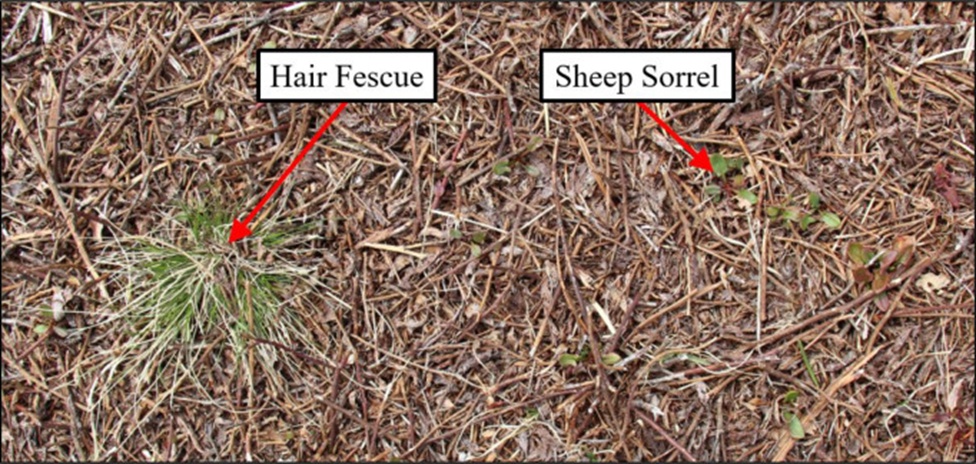
Figure 1. Hair fescue and sheep sorrel growing in a sprout-year wild blueberry field during spring 2019 in Nova Scotia. The hair fescue tuft is characterized by its thin, green blades, while the sheep sorrel plants are characterized by their green and red narrow-shaped leaves.
Smart sprayers reduce overall agrochemical volumes by restricting application to weed-infested areas [21-27]. Esau et al. [23] created a targeted system relying on green colour segmentation for weed identification in wild blueberry fields. When mounted on a smart sprayer with cameras positioned 1.2 m above ground, it achieved a 44.5% reduction in agrochemical use compared with broadcast methods [21]. Subsequent refinements produced herbicide reductions reaching 78.5% [22]. Nevertheless, the approach struggled to differentiate between weeds sharing similar colours. Commercially available systems such as GreenSeeker and WeedSeeker1 in other crops also depend on green colour sensing. Colour co-occurrence matrix techniques enabled real-time targeting of goldenrod (Solidago spp.) in wild blueberry fields [25, 26]. This delivered agrochemical savings of up to 60.58% [25], yet required custom development for goldenrod and lacked straightforward adaptation to additional weed species.
Convolutional neural networks (CNNs) constitute a sophisticated machine vision approach capable of accurately classifying entire images or individual objects inside them [28]. Training involves large collections of thousands of annotated images containing the intended objects. CNNs automatically extract relevant visual features and recognize associated patterns via error backpropagation [29] combined with repeated gradient-descent optimization [30]. Once the dataset is prepared, the process demands little ongoing user involvement, allowing straightforward adaptation to novel targets. Standard input resolutions range from 224 × 224 [31-33] up to 608 × 608 [34, 35], although higher resolutions can enhance detail visibility [33, 36]. Applications of CNNs in agriculture include weed identification [37-41], plant disease detection [42, 43], assessment of crop development and maturity [36, 44, 45], and livestock monitoring [46, 47].
Hennessy et al. [37] developed six CNN models with the Darknet framework [48] to recognize hair fescue and sheep sorrel in wild blueberry imagery. Training data were collected during April and May 2019 using eight different cameras. Results indicated that YOLOv3-Tiny [34] performed exceptionally well for these weeds and showed strong potential for guiding smart sprayer operations. The original 416 × 416 processing resolution was expanded to four higher resolutions, ranging from 864 × 480 to 1280 × 736 [37]. Model performance was evaluated at confidence thresholds of 0.15 and 0.25. F1-scores [49] for images containing at least one weed reached 0.94–0.97 for hair fescue and 0.87–0.90 for sheep sorrel. One notable drawback involved possible sampling bias in the training collection, as images were gathered without systematic location protocols, potentially favouring more obvious weed specimens while overlooking harder-to-detect cases.
The current research applied YOLOv3-Tiny for detecting hair fescue and sheep sorrel from images acquired at 0.57 m, 0.98 m, and 1.29 m distances using three different colour cameras in Nova Scotia wild blueberry fields, Canada. Data collection occurred across three commercial sites on three separate days in May 2020, coinciding with typical herbicide application windows. Sampling followed an inverted “W” pattern within each field [11, 14, 17, 50]. Detection performance, measured by F1-scores, was compared across all camera-distance pairings for both weed types. Outcomes provide practical guidance for selecting appropriate cameras and determining optimal spray boom heights for smart sprayers. Integration of CNN-based detection for directing herbicide application can markedly lower the quantity of agrochemicals required for effective field management.
Image acquisition was performed on May 6, May 14, and May 25, 2020, within sprout-year wild blueberry fields. These dates were chosen to span the typical spring herbicide application period used by growers. Collection took place in three locations—Debert (45.4265° N, 63.4826° W), Folly Mountain (45.4829° N, 63.5755° W), and Portapique (45.4054° N, 63.6706° W), Nova Scotia—between 9:00 am and 3:00 pm daily. Sampling points in each field followed an inverted “W” pattern [11, 14, 17, 50]. The process began by advancing 10 paces along the field boundary, then 10 paces inward, perpendicular to that line. Plots were flagged at randomly selected intervals between 5 and 10 paces using Minitab 19.2. At each plot, images were recorded at one of three heights—0.57 m, 0.98 m, or 1.29 m—to reflect possible sprayer boom variations. The 0.98 m and 1.29 m heights closely matched those in the prior training dataset by Hennessy et al. [37] (0.99 ± 0.09 m, 1.35 ± 0.07 m), whereas 0.57 m represented a clear departure (0.52 ± 0.04 m). Height assignment per plot was also randomized via Minitab 19. Sampling continued until each field contained a minimum of three target and three non-target plots per height for both hair fescue and sheep sorrel (Table 1). Overall, 83 plots were included: 29 in Debert, 23 in Folly Mountain, and 31 in Portapique.
Table 1. Number of target and non-target images collected for hair fescue and sheep sorrel. The images were captured three separate times on May 6, May 14, and May 25, 2020.
Field location | Target category | Overall total | 1.29 m height | 0.98 m height | 0.57 m height |
Debert | Hair Fescue | 15 | 5 | 5 | 5 |
Non–Hair Fescue | 14 | 6 | 4 | 4 | |
Sheep Sorrel | 9 | 3 | 3 | 3 | |
Non–Sheep Sorrel | 20 | 8 | 6 | 6 | |
Folly Mountain | Hair Fescue | 11 | 3 | 5 | 3 |
Non–Hair Fescue | 12 | 4 | 3 | 5 | |
Sheep Sorrel | 12 | 4 | 4 | 4 | |
Non–Sheep Sorrel | 11 | 3 | 4 | 4 | |
Portapique | Hair Fescue | 17 | 7 | 4 | 6 |
Non–Hair Fescue | 14 | 4 | 4 | 6 | |
Sheep Sorrel | 17 | 5 | 4 | 8 | |
Non–Sheep Sorrel | 14 | 6 | 4 | 4 |
Three cameras were used to capture images at each test plot. A Logitech C920 USB 2.0 webcam3 was fixed onto a tripod via an extension arm, directing the lens straight down toward the soil (Figure 2). Connection was made to the USB 3.1 port of an MSI Workstation laptop4 via a 2 m USB 3.0 extension cable, with all captures saved through Logitech Capture software at a resolution of 1920 × 1080. Every setting in Logitech Capture remained at factory defaults, except sharpness, which was reduced from 128 to 95 to eliminate tearing and unwanted visual artifacts (Figure 3). The C920’s autofocus would occasionally readjust on its own, leading to the adoption of a locked manual focus set at infinity. Selection of this camera stemmed from its status as an inexpensive consumer-grade device offering straightforward compatibility with Windows6 and documented earlier deployment in smart sprayer systems [51]. A total of eight individual Logitech C920 units were tested to verify that image-quality glitches and unpredictable autofocus shifts were not confined to a single defective unit. Every one of the eight units showed nearly identical issues. Images in matching orientation came from a Canon T6 DSLR camera7 and an LG G6 smartphone8, with lenses positioned right beside the Logitech lens (Figure 2). The choice of these two devices came down to their noticeably superior image clarity and expanded colour range relative to the Logitech c920. Resolutions reached 5184 × 3456 on the Canon T6 and 4160 × 3120 on the LG G6. Autofocus remained active with zero zoom on both, and the LG G6 used its regular lens rather than the ultrawide alternative.
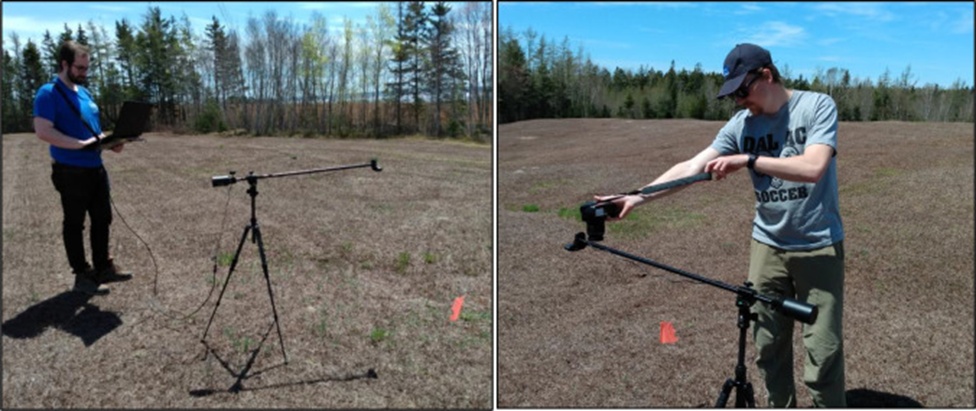
Figure 2. Field experimental setup showing image capture in the Portapique field on May 25, 2020. A tripod with an extension arm was used to hold the Logitech C920 camera at 0.98 m above the ground, with the lens facing the laptop (L). The Canon T6 camera was held with the lens directly beside the Logitech C920 at the same height for image capture (R).
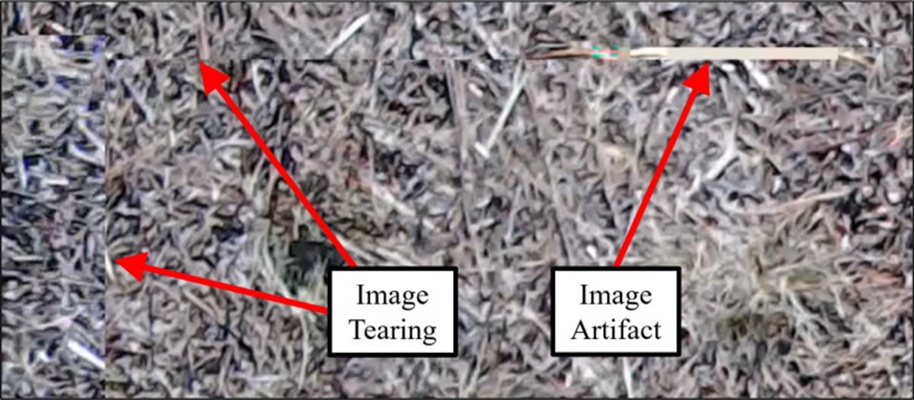
Figure 3. Examples of image tearing and artifacts seen in the Logitech C920 images when the default sharpness setting was used.
Dimensions of selected hair fescue and sheep sorrel specimens were taken directly in the Debert field on May 1, 2020, specifically at plots arranged along the “W” pattern. As many as three examples of each weed species were assessed per location, whenever possible, yielding 25 total measurements for hair fescue and 24 for sheep sorrel. Length and width determinations were made using a ruler from an overhead viewpoint. Length corresponded to the maximum horizontal extent of the weed. Width represented the broadest distance at right angles to that length (Figure 4). Field of view (FOV) assessment involved laying a measuring tape across the ground directly under the Logitech c920 camera to establish the actual ground coverage at each of the three heights. Such data supported a better understanding of the CNN’s detection findings.
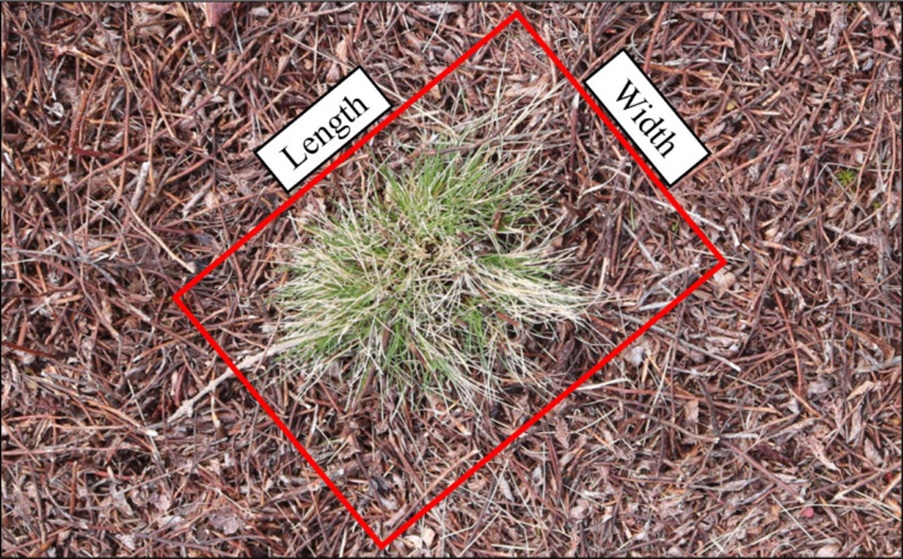
Figure 4. Example of the measurement method for a hair fescue tuft, with the red bounding box showing the length and width of the tuft. The base image was captured on April 26, 2019, with the Canon T6 camera at a sprout-year field in Debert, NS (45.4381°N, 63.4534°W). The image also shows branches and leaves from wild blueberry plants after mechanical flail mowing.
All collected field images were received and organized by date, field location, camera model, height, and target presence on the MSI Workstation Laptop featuring an Intel Core i9–9980H central processing unit (CPU)9 paired with an Nvidia RTX Quadro 5000 graphics processing unit (GPU)10. The YOLOv3-Tiny CNN was applied using the Darknet framework, employing the trained weights supplied by Hennessy et al. [37] to locate hair fescue and sheep sorrel in the images. Processing initially handled complete batches to determine the most suitable image resolution and detection threshold for effective identification of the two weeds. Network resolutions tested during trials included 1280 × 736 and 864 × 480, starting at a detection threshold of 0.15. Evaluation of each pairing relied on precision, recall, and F1-score calculations to assess success in spotting at least one target weed per image [49]. Derivation of these scores uses counts of true positives (tp), false positives (fp), and false negatives (fn). Precision consists of the ratio of true positives to total detections:
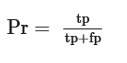 (1)
Recall consists of the ratio of true positives to total actual targets:
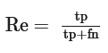 (2)
F1-score represents the harmonic mean of precision and recall:
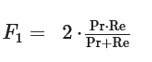 (3)
At the 0.15 threshold, precision consistently exceeded recall, prompting additional trials at lower thresholds of 0.10 and 0.05. Threshold reduction yields more true positives and false positives, thereby lowering precision while increasing recall. The highest overall F1-scores for both weeds emerged at 1280 × 736 resolution with a 0.05 threshold, and this pairing was used for all remaining evaluations.
Testing of field images for hair fescue and sheep sorrel detection utilized the YOLOv3-Tiny CNN running on the Darknet framework with trained weights from Hennessy et al. [37]. Calculation of F1-scores indicating detection of at least one target weed per image covered every possible mix of date, field, camera, and lens height. Variance analysis was conducted in Minitab 19 to identify meaningful main effects and interaction terms. Hair fescue showed notable main effects of camera selection, image height, and field, as well as a significant three-way interaction among them. Deeper review for hair fescue applied a 3 × 3 factorial layout combining lens height (0.57 m, 0.98 m, 1.29 m) with camera (Canon T6, LG G6, Logitech c920) inside a randomized complete block design for each separate field. Mean F1-scores for the interaction between camera and lens height per field were calculated, followed by group comparisons using Tukey’s pairwise approach in Minitab 19. Examination of sheep sorrel followed a 3 × 2 factorial layout using the identical three lens heights, but excluded Logitech C920 results due to limited usable data from that device.
Detection of at least one hair fescue plant per image yielded F1-scores spanning 0.80 to 0.81 across threshold and resolution shifts (Table 2). Peak precision reached 0.85 at 1280 × 736 resolution with the 0.15 threshold, contrasting with the bottom precision of 0.78 seen at both resolutions under the 0.05 threshold. Maximum recall reached 0.85 at 1280 × 736 resolution with a 0.05 threshold and fell by just 0.01 when switching to 864 × 480. Across both weed types, the prevailing pattern indicated that threshold reductions enhanced recall values while sacrificing some precision. Resolution maximization proved especially critical for sheep sorrel identification. Training of the networks at 1280 × 736 resolution probably contributed to this outcome. On average, sheep sorrel F1-scores rose by 0.07 when using 1280 × 736 rather than 864 × 480, attaining the best value of 0.67 at the 0.05 threshold. Consequently, the 1280 × 736 resolution with a 0.05 detection threshold was the ideal setting for both weeds. These top F1-scores remained beneath the levels achieved by Hennessy et al. [37], which were 0.97 for hair fescue and 0.90 for sheep sorrel. Camera impacts receive focus here, yet the composition of the training dataset might also be a contributing factor. Staff members gathered training images by traversing fields and actively searching for target weeds, possibly leaning toward larger, more obvious examples. By comparison, the “W” sampling strategy implemented in the present work minimizes such bias. It delivers a truer picture of the occurrence patterns of hair fescue and sheep sorrel within wild blueberry fields.
Table 2. Precision, recall, and F1-scores for detection of at least one hair fescue or sheep sorrel target per image at varying detection thresholds and resolutions.
Threshold | Sheep sorrel | Hair fescue | Resolution | ||||
Empty Cell | F1-Score | Recall | Precision | F1-Score | Recall | Precision | Empty Cell |
0.05 | 0.63 | 0.57 | 0.72 | 0.81 | 0.84 | 0.78 | 864×480 |
0.67 | 0.66 | 0.68 | 0.81 | 0.85 | 0.78 | 1280×736 | |
0.10 | 0.58 | 0.48 | 0.73 | 0.80 | 0.79 | 0.81 | 864×480 |
0.65 | 0.59 | 0.71 | 0.81 | 0.79 | 0.84 | 1280×736 | |
0.15 | 0.52 | 0.40 | 0.74 | 0.80 | 0.75 | 0.85 | 864×480 |
0.63 | 0.53 | 0.76 | 0.80 | 0.74 | 0.89 | 1280×736 | |
Mean length and width of hair fescue tufts recorded at the Debert site came to 54.6 ± 15.9 mm and 42.6 ± 13.3 mm, respectively (Table 3). Sheep sorrel proved far smaller on average, measuring 11.0 ± 1.7 mm long and 6.0 ± 0.9 mm wide. Confidence intervals at 95% for hair fescue measurements showed much greater spread than those for sheep sorrel, pointing to higher size inconsistency among hair fescue tufts. Ground distance per pixel extended from 0.60 mm up to 1.35 mm inside 1280 × 736 images and from 0.89 mm to 2.00 mm inside 864 × 480 images (Table 4). Under both resolutions, subtle sheep sorrel characteristics became less clear at higher image heights. Pixel sizes reaching 1.35 mm and 2.00 mm translated an average sheep sorrel leaf width into merely 4 and 3 pixels. Greater resolutions could therefore be essential to support dependable sheep sorrel recognition. Furthermore, dust or soil accumulation on lenses might impair performance, particularly on the LG G6 and Logitech c920 models, whose lenses are smaller than the Canon T6’s. Study images displayed no evident dust effects, although this issue might emerge as a constraint once deployed in real commercial settings.
Table 3. Mean measurements of hair fescue and sheep sorrel plants at the Debert Site on May 1, 2020.
Target weed | Dimension | Mean measurement (mm) |
Hair fescue | Length | 54.6 ± 15.9 |
Width | 42.6 ± 13.3 | |
Sheep sorrel | Length | 11.0 ± 1.7 |
Width | 6.0 ± 0.9 |
Table 4. FOV of the Logitech C920 camera at each tested image height. The size of the field represented by each pixel at 1280×736 and 864×480 resolution was calculated based on the FOV.
Height (m) | Pixel size (864 × 480 (mm)) | Pixel size (1280 × 736 (mm)) | FOV (m) | |
Empty Cell | Empty Cell | Empty Cell | Width | Length |
0.57 | 0.60 | 0.89 | 0.43 | 0.77 |
0.98 | 1.02 | 1.51 | 0.73 | 1.30 |
1.29 | 1.35 | 2.00 | 0.97 | 1.72 |
Detection of hair fescue revealed significant main effects (P < 0.05) for camera type, image height, and field. Interactions also mattered, specifically the combined effect of image height and field, and the full three-way interaction among camera type, image height, and field. Meanwhile, the primary impact from the day of capture and various paired interactions — such as day with camera, day with height, day with field, camera with height, or camera with field — along with the triple combination of day, camera, and height showed no meaningful influence. When Tukey’s method compared the pairings of image height and camera type, the strongest outcome in Debert came via the LG G6 positioned at 0.98 m (F1-score = 0.97) (Table 5). The Canon T6 at the same 0.98 m distance ranked next (F1-score = 0.82) but blended statistically with several lower results. Folly Mountain posted its top scores at 0.98 m, whether using the Canon T6 or LG G6 (F1-score = 0.97). In Portapique, the LG G6 at 1.29 m achieved the best performance (F1-score = 0.92), yet it remained comparable to most other tested arrangements in that area. Camera differences stood out clearly in just one situation — Debert at 0.98 m — where LG G6 scored highest (F1-score = 0.97), Canon T6 came after (F1-score = 0.82), and Logitech c920 lagged (F1-score = 0.63). Only the LG G6 and Logitech C920 differed sharply from each other, while the Canon T6 sat in between, with no clear separation. The fact that nearly 70% of the starting training pictures were shot at a distance of 0.99 ± 0.09 m probably helped explain the strong success at 0.98 m.
Table 5. Effect of lens height and camera selection on mean F1-score for detection of hair fescue plants using the YOLOv3-Tiny weights trained by Hennessy et al. [37]. Test images were captured in Nova Scotia on May 6, May 14, and May 25, 2020.
Height (m) | Camera | Field | |||||
Portapique |
| Folly Mountain |
| Debert |
| ||
0.57 | Canon T6 | ABCD | 0.84 | CD | 0.70 | CD^ | 0.74 |
0.57 | LG G6 | ABCD | 0.84 | CD | 0.72 | CD | 0.67 |
0.57 | Logitech c920 | ABCD | 0.77 | BCD | 0.75 | D | 0.61 |
0.98 | Canon T6 | ABCD | 0.83 | A | 0.97 | ABCD | 0.82 |
0.98 | LG G6 | ABCD | 0.77 | A | 0.97 | A | 0.97 |
0.98 | Logitech c920 | ABCD | 0.78 | AB | 0.96 | D | 0.63 |
1.29 | Canon T6 | ABCD | 0.86 | CD | 0.72 | ABCD | 0.80 |
1.29 | LG G6 | ABC | 0.92 | ABCD | 0.79 | ABCD | 0.81 |
1.29 | Logitech c920 | ABCD | 0.89 | ABCD | 0.76 | ABCD | 0.82 |
^Means followed by the same letter(s) are not significantly different based on Tukey’s means comparison at α = 0.05.
In the process of calculating F1-scores for sheep sorrel, 19 of the 27 possible height-date-field setups with the Logitech c920 yielded no usable detections. Those situations recorded absolutely no true positives, forcing precision and recall to zero and blocking any F1-score calculation due to division by zero. Even the best average F1-score possible with the Logitech C920 only reached 0.44 (Table 6). The camera’s lower sharpness setting produced fuzzier details and weaker separation between hues (Figure 5). Adjusting such images beforehand to emphasize green areas might lift performance on both sheep sorrel and hair fescue, but it would probably slow computation noticeably. Model training was based solely on Canon T6 and LG G6 images, bypassing the Logitech C920 entirely. This imbalance appears to be responsible for the network favoring detections in the higher-quality Canon T6 and LG G6 images.
Table 6. Sheep sorrel detection results from YOLOv3-Tiny on images captured with the Logitech C920 camera at three wild blueberry fields in Nova Scotia.
Date | Field | F1-score | Height (m) |
06-May | Portapique | 0.22 | 0.57 |
0.44 | 1.29 | ||
14-May | Debert | 0.29 | 0.57 |
0.33 | 1.29 | ||
Folly Mountain | 0.33 | 0.78 | |
Portapique | 0.22 | 0.57 | |
0.44 | 1.29 | ||
25-May | Debert | 0.33 | 0.57 |
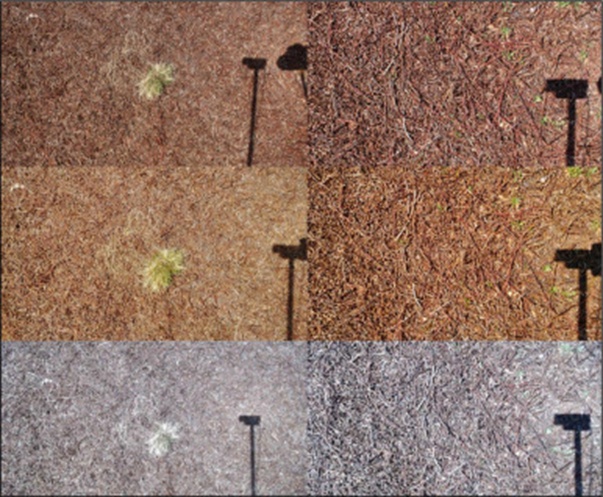
Figure 5. Sample of field images captured in the Folly Mountain field on May 6th, 2020. Pictures in the left column were captured at a height of 0.98 m and have a hair fescue tuft in the centre of the image. The pictures in the right column were captured at 0.57 m and show sheep sorrel leaves dispersed throughout the images. Images in the top row were captured with the Canon T6 camera, the middle row with the LG G6 smartphone, and the bottom row with the Logitech C920.
For sheep sorrel, clear statistical effects (P < 0.05) were observed for the main effects of image height and field, as well as their interaction. Camera itself showed no main impact, nor did any day-related pairs (day-camera, day-height, day-field), camera-related pairs (camera-height, camera-field), or any three-way combinations. Debert performed best at 0.98 m height, where both cameras achieved an F1-score of 0.83 (Table 7), with little distinction among the remaining height-camera mixes. Folly Mountain reached its peak at 0.57 m for both cameras (F1-score = 0.94, 0.93), and the rest proved statistically equivalent. Portapique followed suit, delivering its strongest scores at 0.57 m across both cameras (F1-Scores = 0.88, 0.83), while other heights remained on par. The compact nature of sheep sorrel foliage very likely accounts for weaker performance from taller shooting positions.
Table 7. Effect of lens height and camera selection on mean F1-score for detection of sheep sorrel plants using the YOLOv3-Tiny weights trained by Hennessy et al. [37]. Test images were captured in Nova Scotia on May 6, May 14, and May 25, 2020.
Height (m) | Camera | Field | |||||
Portapique |
| Folly Mountain |
| Debert | |||
0.57 | Canon T6 | AB | 0.88 | A | 0.93 | BC^ | 0.43 |
0.57 | LG G6 | ABC | 0.83 | A | 0.94 | BC | 0.43 |
0.98 | Canon T6 | ABC | 0.76 | ABC | 0.83 | ABC | 0.83 |
0.98 | LG G6 | ABC | 0.75 | ABC | 0.72 | ABC | 0.83 |
1.29 | Canon T6 | ABC | 0.65 | AB | 0.89 | C | 0.36 |
1.29 | LG G6 | ABC | 0.72 | ABC | 0.83 | BC | 0.41 |
^Means followed by the same letter(s) are not significantly different based on Tukey’s means comparison at α = 0.05.
Setting the resolution to the larger 1280 × 736 level and dropping the threshold all the way to 0.05 gave the most effective sheep sorrel spotting with the YOLOv3-Tiny CNN, hitting a top F1-score of 0.67 throughout the complete collection of pictures from three different Nova Scotia sites. Hair fescue spotting stayed mostly unaffected by these choices, consistently landing between 0.80 and 0.81. These figures trailed the validation numbers observed immediately after training, most likely because the original picture set contained some built-in bias. Given how tiny sheep sorrel leaves are, the bigger resolution probably helped preserve enough detail for proper recognition. Apart from one clear case in Debert at 0.98 m, switching cameras made little difference to hair fescue results. The Logitech C920 struggled with sheep sorrel, failing to detect any finds in 19 of the 27 tested setups. Possible reasons include its generally lower image standards compared with the Canon T6 and LG G6, or the complete lack of Logitech C920 examples during the original training phase. Capturing at 0.57 m was most successful for sheep sorrel across two of the three locations. Steps that boost green shading during image preparation could help make sheep sorrel stand out more clearly and raise success rates, even though the extra stage might cut into processing efficiency. The solid performance of the LG G6 shows that smartphone photos meet an acceptable standard for identifying both hair fescue and sheep sorrel in actual fieldwork. Moving forward, priority should be given to selecting a better camera for mounting on smart sprayers and to building a fresh, balanced image collection to update the CNN models. It will also be important to test various preparation methods for how they affect detection quality versus computation time.
On top of that, the CNNs need to be tested for smooth, real-time use in phone apps or online tools so growers can easily find hair fescue and sheep sorrel right in their own fields. Later projects should pay attention to how dust and grime on lenses could interfere. Applying CNN technology to zero in on hair fescue, sheep sorrel, and other weeds in wild blueberry areas with smart sprayers stands to lower overall herbicide use and deliver real economic gains to those who manage these crops.
Funding for this research was generously provided by the Natural Sciences and Engineering Research Council of Canada Discovery Grants Program (RGPIN-06295-2019), Doug Bragg Enterprises, Ltd, and New Brunswick Canadian Agricultural Partnership (CAP). The authors would like to thank Dr. Scott White for helping with field selection for the development of the image dataset and the wild blueberry growers in Nova Scotia for allowing the use of their fields during image collection. Also, the authors would like to acknowledge the efforts of the mechanized systems and precision agriculture research teams at Dalhousie’s Faculty of Agriculture.
None
None
None
Open Access The author(s) retain copyright. This article is licensed under the Creative Commons Attribution-NonCommercial-ShareAlike 4.0 International License. It may be shared and adapted for non-commercial purposes with appropriate attribution, an indication of changes, and distribution of adaptations under the same license. Third-party material may be subject to separate terms identified in its credit line. View the license at https://creativecommons.org/licenses/by-nc-sa/4.0/.
 Agro Intelligence Research Press