Autonomous farming is emerging as a precision agriculture frontier in which sensing, environmental awareness, reasoning, decision logic, robotic action, and adaptive feedback are linked within increasingly integrated technical systems. Yet autonomy in agriculture cannot be reduced to unattended machine operation because field environments are variable, data quality is uneven, physical actions are consequential, and farmers and operators retain essential contextual and supervisory roles. This article develops an original conceptual model for analysing autonomous farming systems as supervised socio-technical architectures rather than self-sufficient farm managers. The model is constructed through conceptual synthesis of agricultural robotics, computer vision, machine learning, navigation, control, human–robot interaction, and responsible innovation scholarship. It organizes autonomy into connected layers: use-case definition; sensing and environmental awareness; data quality and fusion; reasoning, planning, and uncertainty interpretation; acting, control, and robotic execution; learning, feedback, and drift monitoring; and human oversight, safety, accountability, and governance. The main contribution is a closed-loop account of how farm observations may become bounded robotic actions only when perception is validated, reasoning is contextually interpreted, plans remain within operating constraints, execution is monitored, and human intervention remains available. Learning is treated as governed model updating rather than automatic self-improvement. The model therefore clarifies both enabling relationships and non-guarantee boundaries: conceptual integration alone does not establish safe autonomous operation, productivity improvement, legal sufficiency, or deployment readiness. It offers a structured basis for future research, local validation planning, supervisory design, and responsible assessment of autonomous farming within precision agriculture.
Autonomous farming systems combine digital observation, computational interpretation, planning, control, and physical intervention within agricultural environments. Their significance lies not in a single robot or algorithm but in the coordination of sensing, task definition, mobility, manipulation, feedback, and human supervision. Agricultural robotics scholarship consequently treats autonomy as part of digital farming rather than as a credible route to completely unattended farm management [1]. This distinction is fundamental because a system may automate a bounded task while still depending on people for objectives, permissions, exception handling, maintenance, contextual judgment, and accountability.
Field operations also differ substantially in crop structure, terrain, weather exposure, biological variability, timing, and consequence. Robots developed for scouting, weeding, seeding, spraying, harvesting, or monitoring therefore require different combinations of perception, navigation, communication, implements, and control. Reviews of agricultural robots show that these functions cannot be understood through actuation alone; they depend on linked sensing, planning, execution, safety, and adaptability requirements [2]. A conceptual model is needed to explain those dependencies while avoiding the misleading assumption that technical integration automatically produces reliable autonomy.
A second difficulty is terminological. Agricultural robots, robotic platforms, autonomous vehicles, unmanned ground vehicles, unmanned aerial vehicles, decision-support systems, and supervisory-control systems can overlap without being equivalent. A platform may gather data without deciding, recommend an action without executing it, or execute a predefined route without learning from outcomes. The literature’s distinction among robots, perception systems, and agricultural tasks supports an architecture in which platform, awareness, reasoning, and execution are analysed separately before their interactions are assessed [3]. Such separation also makes failure attribution and validation needs more transparent.
This article proposes an original conceptual model of autonomous farming systems organized around sensing, environmental awareness, reasoning, decision logic, planning, acting, control, robotic execution, learning, feedback, safety, and human oversight. Core agricultural robot technologies already span mobile platforms, target detection, navigation, actuation, end-effectors, and operation planning [4]. The contribution here is to integrate these technical functions with data-quality gates, uncertainty interpretation, human-in-the-loop review, human-on-the-loop supervision, fail-safe boundaries, drift monitoring, accountability, and explicit limits on autonomous-operation, safety, productivity, and deployment claims.
Automation refers to predefined task execution under specified conditions, whereas autonomy adds the capacity to perceive, select among options, plan, and modify behaviour within a bounded operating domain. An autonomous farming system may therefore contain multiple automated subsystems, decision-support functions, robotic platforms, and supervisory interfaces. It need not be a single machine: coordinated fleets can distribute sensing, mobility, and treatment functions across heterogeneous robots [5]. This broader interpretation positions autonomy as a system property produced by interactions among components, tasks, people, and environmental constraints.
Precision agriculture provides a natural context for this development because it already links spatially and temporally differentiated information with targeted management. Autonomous vehicles, ground robots, aerial platforms, and robotic implements may extend that logic by collecting observations and performing local actions where conditions have been validated. However, technical possibility does not establish economic suitability, scalability, or farm-level value. Economic reviews of field robots identify unresolved questions concerning utilization, ownership, farm structure, labour substitution, and comparative cost [6]. Accordingly, the conceptual model includes a no-productivity-guarantee and no-deployment-readiness boundary.
Autonomous farming also remains a human-centred organizational change. Farmers may evaluate systems according to usefulness, compatibility, complexity, trust, control, perceived risk, and effects on work practices. Empirical research on intentions to use autonomous field robots shows that acceptance is a distinct condition rather than an automatic consequence of technical capability [7]. Farmer autonomy must therefore be preserved through transparent task definition, meaningful consent, understandable operating limits, accessible intervention mechanisms, and the ability to reject or modify machine-generated plans.
Aerial and ground systems illustrate why supervisory control is indispensable. Unmanned aerial vehicles may provide broad or rapid observations, while unmanned ground vehicles may offer closer sensing or physical execution; cooperative architectures can connect their missions, path planning, and control [8]. Yet cooperation increases interdependence and potential failure propagation. Human-in-the-loop arrangements are appropriate when authorization is required before action, while human-on-the-loop supervision applies when bounded actions proceed under active monitoring. Neither arrangement removes accountability, and both require explicit safety boundaries and a no-autonomous-operation guarantee.
Sensing is the acquisition of observations; perception is their computational interpretation; environmental awareness is the system-level representation used for reasoning and control. Sensor networks, IoT devices, remote sensing, cameras, positioning systems, and other field sensors may produce crop, soil, weather, spatial, and temporal data. Computer vision can transform imagery into detections, classifications, segmentations, or condition indicators across agricultural automation tasks [9]. These outputs are potential evidence, not verified facts, and their meaning depends on acquisition quality, calibration, coverage, timing, and task definition.
Environmental awareness requires more than adding sensors. Agricultural robots operate amid changing illumination, dust, vegetation, occlusion, uneven terrain, moving people, animals, machines, and biological structures with overlapping visual features. Reviews focused on agricultural robot perception emphasize the need to match sensor configurations and perception methods to such unstructured conditions [10]. Sensor fusion can combine complementary measurements, while data fusion can align imagery, sensor streams, weather information, field maps, and farm-management records. Poor synchronization, coordinate error, incompatible semantics, or missing provenance can nevertheless create a coherent-looking but incorrect state estimate.
Task-specific detection further illustrates the validation problem. Crop, weed, object, obstacle, pest, and disease categories depend on biological stage, viewpoint, local agronomic definitions, and consequences of error. Sequential visual information has been used to improve crop–weed segmentation and to examine robustness across unseen fields [11]. Even so, performance in selected datasets or locations cannot be assumed to generalize across crops, cultivars, seasons, soils, cameras, or management systems. High-consequence outputs should therefore carry uncertainty information and trigger human review when confidence or contextual fit is insufficient.
Remote sensing and drone imagery can complement proximal perception by revealing broader spatial patterns or providing multispectral information. Dense crop–weed classification from micro-aerial-vehicle imagery demonstrates how spectral and spatial inputs may enrich field awareness [12]. However, aerial observations can be affected by resolution, canopy structure, weather, flight conditions, mosaicking, and transfer from imagery to ground action. The proposed model therefore imposes a no-perception-guarantee boundary: sensing accuracy in one component does not establish complete environmental awareness, and no physical action should proceed when data quality, coverage, or hazard detection remains inadequate.
Reasoning converts an interpreted farm state into candidate judgments, plans, or actions. Machine learning can support classification, regression, prediction, and pattern recognition across crop, soil, water, weather, and other agricultural data [13]. Yet a predictive model is not a decision authority. Decision logic must additionally represent the farm objective, the action being considered, physical and agronomic constraints, uncertainty, potential consequences, and the conditions under which a human must approve, revise, defer, or reject the output.
Deep learning may extract complex representations from images and other high-dimensional data, but its usefulness remains dependent on representative training data, suitable evaluation, and transfer to the intended context. Agricultural deep-learning surveys show extensive analytical potential while also revealing differences in datasets, tasks, and validation practice [14]. Accordingly, the conceptual model separates model inference from context interpretation and risk classification. Reinforcement learning may be considered where supported, but reward design, simulated exploration, constraint handling, and transfer to physical environments require particularly cautious evaluation.
Planning translates candidate decisions into ordered and physically feasible tasks. Task planning defines what should occur and in what sequence; path planning determines how a platform may move; control later converts that plan into bounded commands. Reviews of autonomous agricultural mobility identify localization, mapping, positioning, navigation, and obstacle avoidance as interdependent requirements [15]. Failure in any one can invalidate the plan. Constraints should include platform capability, terrain, crop geometry, people and animals, geofences, task permissions, communication status, and an accessible route to safe interruption.
Reasoning validity is also sensitive to domain shift. Synthetic data and simulation can extend training coverage and support navigation development, but successful synthetic-to-real experimentation still requires local field evaluation [16]. The proposed model therefore places human-in-the-loop review before consequential or uncertain actions and human-on-the-loop supervision around bounded execution. Operator intervention must be possible when state estimates, plans, or controls diverge from expectations. A no-autonomous-decision-guarantee boundary prevents predictions, policies, or planned routes from being treated as valid authorizations without contextual validation and defined supervisory responsibility.
The acting layer converts an approved plan into physical behaviour through a robotic platform, control system, and task-specific actuators. Sensors and actuators must operate as coordinated subsystems because control commands depend on valid state estimates, while execution feedback must reveal whether movement or manipulation matches the command [17]. Autonomous vehicles, unmanned ground vehicles, and unmanned aerial vehicles may support different monitoring or intervention functions, but each requires a defined operating domain, mechanical suitability, communication status, and intervention pathway.
Navigation combines localization, mapping, obstacle awareness, route tracking, and motion control. Manipulation additionally requires target localization, reachability assessment, end-effector positioning, and force or motion limits. Field-tested harvesting research demonstrates that integrated detection, selection, cutting, grasping, and collection can be evaluated for a particular crop and task without proving general harvesting reliability [18]. Execution must consequently be validated at the level of the complete perception–planning–control chain rather than inferred from the success of an isolated component.
Platform design must also reflect crop geometry, terrain, soil conditions, and the physical consequences of error. Mobile agricultural robotics developed for cotton illustrates how harvesting requirements, platform dimensions, mobility, sensing, and collection mechanisms vary with the production environment [19]. Comparable constraints apply to spraying, seeding, mechanical weeding, scouting, and monitoring. A system suited to observation may not be appropriate for physical intervention, and successful navigation does not establish that an implement can act accurately or safely.
Robotic arms and end-effectors further show that execution depends on integrated hardware, perception, motion planning, and control rather than manipulator mechanics alone [20]. Fail-safe control should move the system toward a safer state when critical faults occur, while an emergency stop should remain accessible where supported. Safety boundaries must override task completion when localization, obstacle detection, actuation, communication, or human supervision becomes inadequate. Table 1 summarises sensing, reasoning, acting, control, robotic execution, oversight, and safety requirements in autonomous farming systems.
Table 1. Functional Requirements for Autonomous Farming Systems in Precision Agriculture: Sensing, Environmental Awareness, Data Fusion, Reasoning, Decision Logic, Planning, Control, Robotic Execution, Navigation, Actuation, Human Oversight, Safety Boundaries, Fail-Safe Control, and Execution Boundaries
Functional component | Core system question | Required input or condition | System function | Potential output or action | Failure or safety risk | Validation or safeguard need | Conceptual model role |
Sensing | What is being observed? | Calibrated sensors and valid coverage | Acquire measurements | Sensor stream | Missing or biased data | Calibration and quality checks | Evidence acquisition |
Environmental awareness | What operational state surrounds the system? | Validated perception | Represent crops, terrain and hazards | Situational model | Incomplete awareness | Scenario and local validation | Sensing-to-reasoning bridge |
Data fusion | Do sources provide a coherent state? | Time, spatial and semantic alignment | Combine heterogeneous data | Fused state estimate | Conflicting or stale data | Provenance and consistency checks | Context integration |
Reasoning | What does the evidence suggest? | Validated data and models | Classify, predict or interpret | Candidate judgment | Bias or domain shift | Independent validation | Analytical layer |
Decision logic | What response is permissible? | Objectives, constraints and uncertainty | Evaluate bounded options | Candidate decision | Invalid rule or objective | Human review | Decision gate |
Planning | How can the task be performed? | Map, resources and safety constraints | Generate task and path plan | Sequence or route | Unsafe or infeasible plan | Simulation and operator review | Decision-to-action bridge |
Navigation and control | Can movement remain stable and bounded? | Localization and validated trajectory | Convert plan into motion commands | Steering or trajectory tracking | Collision or loss of control | Runtime monitoring and limits | Mobility execution |
Actuation | Can the physical mechanism perform the task? | Functional actuator and target state | Apply controlled motion or force | Cut, grip, place or spray | Crop damage or unintended force | Position, speed and force limits | Physical intervention |
Robotic execution | Is the approved task being completed as intended? | Valid sensing, plan and control | Perform task sequence | Monitoring or intervention | Compounded subsystem error | Abort logic and outcome checks | Acting output |
Human oversight | Should action proceed, pause or stop? | Understandable system state | Approve, supervise or intervene | Authorization or handover | Automation bias or delayed response | Usable interface and authority | Supervisory control |
Safety boundary | Which conditions prohibit operation? | Explicit thresholds and hazard monitoring | Restrict or terminate action | Slow, stop or defer | Boundary omission | Independent safety checks | Cross-cutting protection |
Fail-safe control | What occurs after a critical fault? | Tested fault triggers | Move toward a safer state | Stop or isolate system | Fail-safe failure | Redundancy and periodic testing | Fault response |
Execution boundary | Does successful inference guarantee safe action? | Complete system evidence | Prevent unsupported execution | Human review or refusal | False confidence | Local field validation | No safe-execution guarantee |
Learning should be understood as the controlled use of accumulated evidence, not as an assumption that an autonomous system improves whenever it gathers more data. Repeated crop and soil monitoring can provide observations for evaluating task performance, environmental change, and sensing consistency [21]. However, observations become useful feedback only when their quality, provenance, timing, and relationship to a defined objective are known. Learning therefore begins with monitored evidence rather than unrestricted model modification.
A closed loop links sensing and environmental awareness to reasoning, planning, acting, outcome observation, and review. Human–robot interaction research indicates that adaptive agricultural systems require defined interfaces, operator roles, intervention opportunities, and evaluation of how people understand and influence system behaviour [22]. Performance monitoring, model-drift detection, data-drift detection, operator feedback, and safety-event review should inform whether the system continues, pauses, or returns for validation. Figure 1 illustrates the closed-loop autonomy cycle linking sensing, environmental awareness, reasoning, acting, robotic execution, learning, feedback, drift monitoring, and human supervisory control in autonomous farming systems.
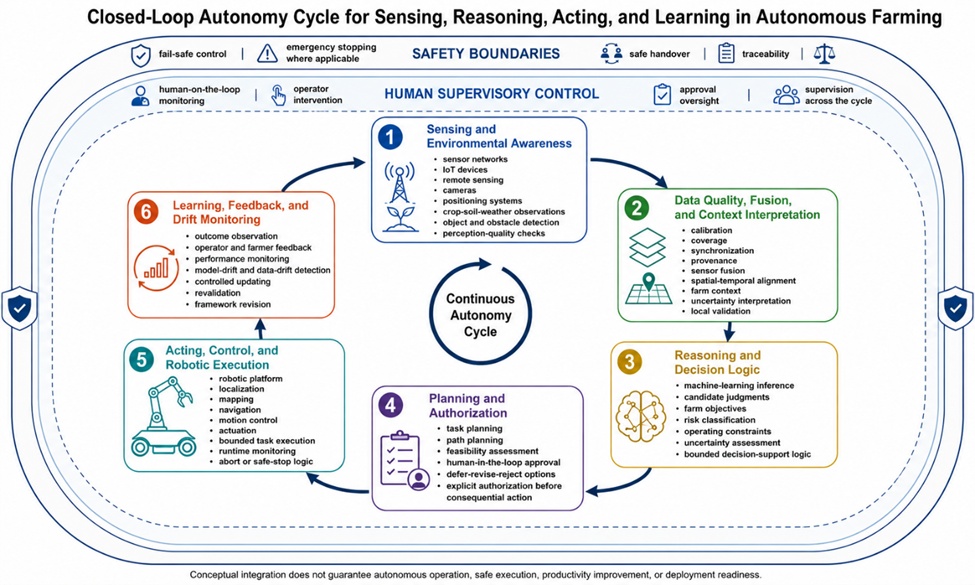
Figure 1. Closed-Loop Autonomy Cycle for Sensing, Reasoning, Acting, and Learning in Autonomous Farming
Alt-text description:
A conceptual closed-loop diagram showing sensing, environmental awareness, reasoning, planning, control, robotic execution, feedback, learning, drift monitoring, human supervision, safety boundaries, and framework updating in autonomous farming systems.
Human–robot collaboration can compensate for limitations in independent machine performance by allowing people to allocate tasks, correct interpretations, manage exceptions, and retain authority over consequential choices [23]. Operator, farmer, and advisor feedback should therefore be treated as structured evidence. It may reveal unsuitable objectives, impractical routes, misunderstood crop conditions, poor interfaces, or emerging risks that model-level metrics do not capture. Feedback channels require traceability so that later changes can be linked to their source and rationale.
Adaptive improvement may involve recalibration, revised thresholds, updated maps, retraining, changed task rules, or narrower operating limits. Reviews of agricultural human–robot collaboration emphasize that usability, interaction quality, and human factors remain important research needs alongside technical performance [24]. Every proposed update should undergo comparison with the previous version, local validation, regression testing, and approval before operational use. The model therefore contains a no-self-improvement guarantee and a no-deployment-readiness boundary: adaptation can degrade performance, and a successful update does not authorize broader autonomous operation.
The proposed model begins with farm autonomy use-case definition and stakeholder mapping. The task, crop, environment, intended benefit, foreseeable consequences, human roles, and operating limits should be explicit before sensing or model selection begins. Responsible development scholarship argues that autonomous agricultural robotics should be shaped by user-centred design, anticipation, and stakeholder engagement rather than technical capability alone [25]. Farmer autonomy and supervisory authority are therefore design requirements rather than external adoption considerations.
The next layers comprise sensing, environmental awareness, data quality, fusion, reasoning, planning, and risk interpretation. Raw observations are checked before being fused into a contextual state representation. Models generate candidate classifications or predictions, while decision logic evaluates them against farm objectives, constraints, uncertainty, and possible consequences. The architecture does not itself allocate legal responsibility or establish that an autonomous action is permissible; legal analysis of agricultural robots shows that responsibility and operational boundaries remain institutional and contextual questions [26].
Human oversight forms a mandatory gate between candidate plans and consequential execution. Human-in-the-loop review applies where approval is required before action, while human-on-the-loop supervision supports bounded activity with continuous intervention capability. This arrangement recognizes that autonomous technologies should not be assumed to reproduce the tacit, situated, and relational expertise embedded in agricultural work [27]. Operator intervention, safe handover, accessible stopping functions, and clear explanations of uncertainty are consequently integrated into the model.
The acting layer combines robotic platform suitability, navigation, localization, mapping, control, actuation, and task execution. A surrounding safety layer applies operating-domain limits, fail-safe behaviour, emergency stopping where supported, and incident monitoring. Accountability and traceability record data provenance, model versions, decisions, authorizations, interventions, and outcomes. Responsible precision-technology research further supports inclusion, reflexivity, and responsiveness when systems distribute benefits, burdens, knowledge, or control unevenly [28]. Privacy, cybersecurity, data governance, labour implications, and digital inclusion are therefore cross-cutting considerations.
The final layers include performance monitoring, environmental-change feedback, task-result assessment, model and data drift monitoring, controlled updating, and framework revision. Four boundaries constrain interpretation: the model does not guarantee autonomous operation, safety, productivity, or deployment readiness. It instead specifies questions, interfaces, safeguards, and feedback relationships that should be examined before bounded use is considered. Table 2 presents the proposed conceptual model of sensing, reasoning, acting, and learning in autonomous farming systems.
Table 2. Proposed Conceptual Model of Autonomous Farming Systems in Precision Agriculture: Use-Case Definition, Supervision Mapping, Sensing, Environmental Awareness, Data Fusion, Reasoning, Planning, Risk Interpretation, Human Oversight, Robotic Execution, Safety Boundaries, Learning, Feedback, Drift Monitoring, Accountability, Traceability, and Deployment Boundaries
Model layer or stage | Core purpose | Required input | System function | Potential output | Validation or oversight need | Failure risk | Feedback mechanism | Decision boundary |
Use-case definition | Bound the autonomy claim | Farm objective, task and context | Define intended function | Use-case statement | Farmer and expert review | Overbroad purpose | Requirement revision | No use outside defined task |
Supervision mapping | Assign authority and responsibility | Stakeholders and consequence analysis | Define approval and intervention roles | Responsibility map | Participatory review | Accountability gap | Stakeholder feedback | No unassigned critical decision |
Sensing | Acquire observations | Calibrated devices and valid coverage | Collect data | Raw observation stream | Calibration and quality control | Missing or inaccurate data | Sensor diagnostics | Reject invalid input |
Environmental awareness | Represent field state and hazards | Valid perception outputs | Build situational model | Contextual state estimate | Local scenario validation | False awareness | Perception-error review | No action with inadequate awareness |
Data quality and fusion | Produce coherent evidence | Multisource data and provenance | Align and combine sources | Fused state | Consistency checks | Corrupted or conflicting data | Quality alerts | Escalate inadequate evidence |
Reasoning and decision logic | Generate bounded options | Valid state, objectives and models | Predict, classify and evaluate | Candidate decision | Model and context validation | Invalid inference | Outcome comparison | Prediction is not authorization |
Planning | Create feasible task and route | Approved option, map and constraints | Sequence tasks and paths | Executable plan | Operator review | Unsafe plan | Plan-performance feedback | Remain within operating domain |
Risk interpretation | Evaluate uncertainty and consequences | Confidence and hazard evidence | Classify risk | Proceed, review, defer or stop | Competent reviewer | False reassurance | Calibration monitoring | High uncertainty requires escalation |
Human oversight | Preserve human authority | System state and intervention interface | Approve, monitor or stop | Human authorization | Training and interface testing | Automation bias | Intervention logs | Human authority cannot be bypassed |
Robotic execution | Perform approved physical task | Valid plan, control and platform | Navigate and actuate | Bounded field action | Runtime and local validation | Collision or unintended action | Task-result monitoring | Stop after critical mismatch |
Safety and fail-safe layer | Prevent or limit harm | Hazard thresholds and independent monitoring | Restrict, stop or hand over | Safer-state transition | Independent testing | Fail-safe failure | Incident review | Safety overrides task completion |
Learning and feedback | Evaluate results and propose change | Outcome and stakeholder evidence | Compare expected and observed performance | Candidate update | Controlled testing | Unsafe adaptation | Closed-loop review | No automatic production update |
Drift monitoring | Detect changing validity | Current data and baselines | Identify model or data shift | Drift alert | Silent degradation | Continuous or periodic monitoring | Revalidation request | Drift may suspend operation |
Accountability and traceability | Reconstruct decisions and actions | Logs, identities and versions | Preserve audit trail | Reviewable record | Access and integrity controls | Missing evidence | Audit findings | Untraceable action is not authorized |
Framework updating | Revise conceptual requirements | Validated evidence and feedback | Update model and boundaries | Revised conceptual version | Multidisciplinary review | Unsupported expansion | Version control | Revision does not establish readiness |
Deployment boundaries | Prevent unsupported claims | Complete technical and governance evidence | Restrict interpretation | Explicit non-guarantee statement | Independent readiness review | Premature deployment | Readiness reassessment | No operation, safety, productivity or readiness guarantee |
Figure 2 presents the proposed conceptual model of autonomous farming systems, integrating sensing, reasoning, acting, learning, human oversight, safety boundaries, accountability, and feedback updating.
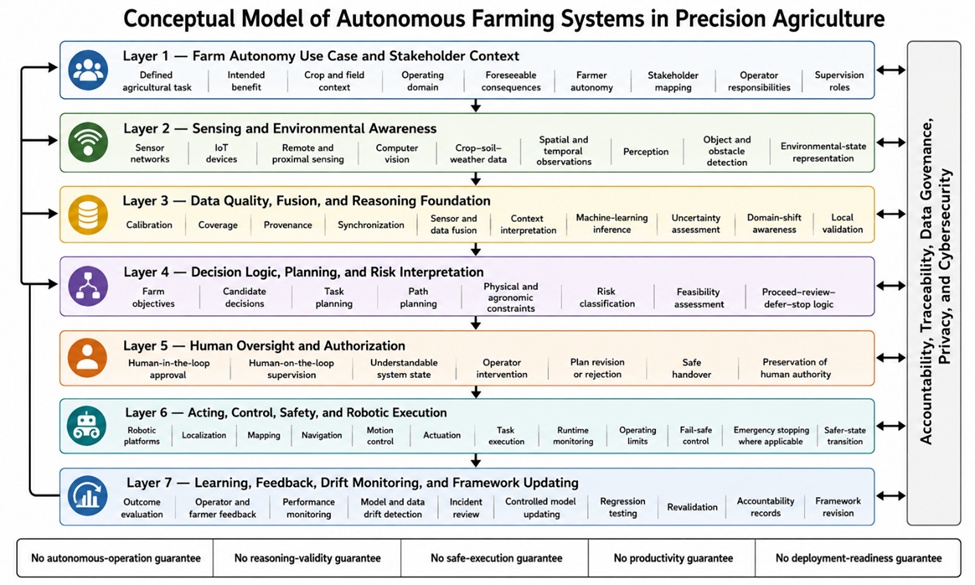
Figure 2. Conceptual Model of Autonomous Farming Systems in Precision Agriculture
Alt-text description:
A conceptual model showing autonomous farming system layers from use-case definition and sensing through reasoning, planning, control, robotic execution, safety oversight, learning, feedback, accountability, and deployment boundaries.
For farmers, operators, agronomists, advisors, extension services, and cooperatives, the model offers a vocabulary for asking where observations originate, how decisions are produced, who authorizes action, how control can be interrupted, and how failures are recorded. Local validation should examine crop, terrain, weather, connectivity, platform interaction, and supervisory practice rather than relying on generalized performance claims. These implications are conceptual and do not constitute agronomic, procurement, operational, or safety-certification guidance.
For robotics developers, AI developers, sensor providers, platform providers, and data stewards, future research should prioritize robust multimodal perception, uncertainty calibration, transparent decision logic, reliable handover, fail-safe design, cybersecurity, traceable model updating, and monitoring of data and model drift. Long-term field evaluation should assess complete sensing–reasoning–execution chains across changing conditions. Research should also report negative results, intervention frequency, operating-domain exclusions, and failure recovery instead of only model accuracy or task completion.
For researchers and policymakers, responsible evaluation should include accountability, labour implications, farmer autonomy, data governance, privacy, digital inclusion, and uneven access to infrastructure and expertise. Comparative work is needed on human-in-the-loop and human-on-the-loop arrangements, operator training, incident feedback, and stakeholder participation. These are proposed research directions rather than legal advice, policy prescriptions, commercial roadmaps, platform-selection recommendations, or deployment instructions. The conceptual model provides an analytical structure but cannot determine what system should be used in a particular jurisdiction or farm.
This article proposes a conceptual model of autonomous farming systems that links sensing, environmental awareness, data quality, reasoning, decision logic, planning, acting, control, robotic execution, learning, feedback, adaptive improvement, human oversight, safety, accountability, and governance. Its central proposition is that autonomy should be evaluated as a supervised closed-loop relationship rather than as independent machine operation. Validated perception must precede interpretation; reasoning must remain bounded by objectives, context, constraints, and uncertainty; physical execution requires reliable control and fail-safe interruption; and learning requires monitored evidence, approval, and renewed validation. The model also establishes explicit limits: conceptual integration alone does not guarantee autonomous operation, reasoning validity, safe execution, productivity, legal sufficiency, or deployment readiness. Autonomous farming should therefore be assessed through local context, transparent supervisory authority, traceable decisions, monitored feedback, and clearly defined boundaries rather than through autonomy claims alone.
None
None
None
None
Open Access The author(s) retain copyright. This article is licensed under the Creative Commons Attribution-NonCommercial-ShareAlike 4.0 International License. It may be shared and adapted for non-commercial purposes with appropriate attribution, an indication of changes, and distribution of adaptations under the same license. Third-party material may be subject to separate terms identified in its credit line. View the license at https://creativecommons.org/licenses/by-nc-sa/4.0/.
 Agro Intelligence Research Press