Generative artificial intelligence is creating new possibilities for conversational access to agricultural information, farm data, and decision-support resources. However, fluent interaction does not establish factual accuracy, agronomic validity, farmer trust, or operational safety. This article proposes an original conceptual architecture for generative AI-enabled farm advisory systems in precision agriculture. The architecture treats conversational decision support as a governed socio-technical process rather than a standalone chatbot function. It connects farm advisory use-case definition, farmer query interpretation, heterogeneous agricultural data inputs, curated knowledge retrieval, generative model layers, response grounding, advisory-output controls, uncertainty communication, human oversight, expert escalation, farmer feedback, monitoring, and controlled system updating. Sensor observations, remote-sensing products, weather information, soil and crop data, farm-management records, and textual agricultural knowledge are positioned behind data-quality, provenance, documentation, and access-control requirements. Foundation models, large language models, vision-language models, multimodal models, prompting, domain adaptation, and retrieval-augmented generation are treated as optional architectural components whose appropriateness depends on the bounded advisory task. The architecture further distinguishes factual checking from agronomic validity review and separates farmer-facing explanations from advisor-facing evidence assessment. Safety and trust requirements include risk classification, hallucination monitoring, privacy, cybersecurity, auditability, farmer autonomy, explicit advisory boundaries, and escalation pathways. The principal contribution is a structured framework for designing and evaluating conversational farm advisory systems without implying autonomous decision authority, validated agronomic advice, guaranteed trust, operational safety, or deployment readiness.
Precision agriculture increasingly depends on connected data environments in which field observations, sensor measurements, machinery records, remote-sensing products, weather information, farm-management data, and external knowledge are combined to support decisions. These environments are not merely technical pipelines: they involve data owners, service providers, advisors, researchers, platforms, and farmers whose roles influence how information is collected, interpreted, exchanged, and acted upon. Consequently, a generative AI-enabled farm advisory system must be understood as part of a wider smart-farming data ecosystem rather than as an isolated conversational model [1].
The growing interest in conversational artificial intelligence also raises questions about who defines agricultural problems, whose knowledge is represented, and which users can meaningfully access or challenge system outputs. Responsible innovation in Agriculture 4.0 requires anticipation of possible consequences, inclusion of affected stakeholders, reflexive examination of design assumptions, and responsiveness to emerging concerns. These principles are particularly relevant when conversational systems communicate in authoritative language, because interface fluency can conceal uncertainty, data exclusions, institutional interests, or uneven distributions of benefits and risks [2].
Digital agriculture changes more than the speed or volume of information processing. It can reshape advisory relationships, professional roles, farmer skills, labour arrangements, knowledge ownership, and the balance of influence among agricultural actors. A conversational advisory system may therefore alter how farmers obtain information and how advisors contribute contextual interpretation. Its evaluation should consider institutional and social effects alongside technical performance, including farmer autonomy, local knowledge, digital inclusion, accountability, and the possibility that technology-mediated advice could reinforce existing inequalities or dependencies [3].
Agricultural decision-support systems generally connect data acquisition, analytical or predictive models, user interfaces, and decision processes. Generative AI adds a flexible natural-language layer to this established structure, but it does not remove the underlying requirements for reliable inputs, appropriate models, usable interaction, and contextual validation [4]. This article therefore proposes a conceptual architecture for generative AI-enabled farm advisory systems. The contribution links conversational support with data governance, knowledge retrieval, model control, advisory-output validation, human oversight, farmer feedback, safety boundaries, monitoring, and explicit limits on agronomic, autonomous-decision, trust, and deployment-readiness claims.
Generative AI refers to computational models that produce new textual, visual, structured, or multimodal content in response to instructions and contextual inputs. Within crop production and broader farm advisory settings, large language models may help organize information, reformulate technical material, interpret questions, or support access to documented knowledge. Their value is nevertheless task dependent. A model that produces coherent agricultural language is not thereby qualified to determine whether a response is agronomically correct, locally appropriate, sufficiently current, or suitable for a consequential farm decision [5].
The possible use of large language models in food production must also be evaluated against risks of misinformation, inappropriate data collection, unequal access, changing labour roles, and unclear responsibility for generated outputs. A farmer-facing system may appear helpful because it responds rapidly and conversationally, yet its statements can remain incomplete, unsupported, or inconsistent with local conditions. Governance cannot therefore be reduced to a disclaimer placed beneath an interface. It requires defined use cases, restricted output categories, documented data practices, human review conditions, incident handling, and clear identification of accountable organizations and professionals [6].
Generative AI includes more than a single model family. Foundation models may provide broad pretrained capabilities, while large language models emphasize linguistic processing and vision-language or multimodal models combine text with images or other data forms. Generative methods may support synthetic content, information synthesis, question answering, or interactive explanation across agri-food activities. However, each application presents different evidence requirements and failure modes. Architectural design should therefore begin with the advisory task and risk level rather than assuming that a larger or more multimodal model automatically provides more useful or trustworthy support [7].
Prompting, fine-tuning, domain adaptation, knowledge retrieval, and retrieval-augmented generation represent distinct methods for shaping model behaviour. Prompting can specify response structure and boundaries, whereas fine-tuning or domain adaptation may align terminology and interaction patterns with a defined agricultural domain. Retrieval can supply external evidence at response time, allowing generated statements to be linked to curated sources. None of these methods independently establishes reliability. Agricultural language models continue to face limitations involving data representation, context specificity, hallucination, evaluation, infrastructure, and accessibility, requiring cautious integration within a controlled advisory workflow [8].
Conversational decision support begins with interpretation of the user’s question rather than immediate response generation. Farmer queries may contain local terminology, incomplete descriptions, uncertain timeframes, or implicit assumptions about a field, crop, disease symptom, management activity, or environmental condition. A retrieval component can transform the clarified question into a search across scientific or curated agricultural documents and return relevant passages for further review. Agricultural retrieval research shows that locating evidence for farmers’ questions is itself a separate technical problem whose quality must be evaluated before retrieved material is used to ground a generated response [9].
A conversational agent or chatbot can make information easier to request, refine, and revisit through natural-language dialogue. In extension contexts, this may assist with navigation of educational resources, reformulation of technical concepts, or preparation of questions for a specialist. Such systems should complement rather than replace the relational and interpretive functions of extension professionals. The interface should disclose its informational role, identify circumstances requiring human assistance, avoid presenting generated language as professional judgment, and provide an escalation route when the question exceeds available evidence or enters a potentially consequential advisory domain [10].
Generative AI may also function as an interface between farmers and analytical tools that would otherwise require technical expertise. It can potentially translate model outputs, summarize observations, ask for missing context, or present alternative interpretations in accessible language. Its usefulness nevertheless depends on language support, connectivity, device access, literacy, local terminology, and representation of diverse production conditions. Farmer-facing explanations should therefore be designed around the intended users and decision context. Advisor-facing explanations may require more detailed evidence provenance, assumptions, data-quality indicators, and unresolved uncertainties than the simplified account presented to a farmer [11].
Conversational decision support must maintain a boundary between organizing information and issuing agronomic recommendations. Domain-specific agricultural question-answering systems can be compared using defined evaluation procedures, but performance within an evaluation setting does not establish local advisory validity or field readiness [12]. Scenario explanations should use conditional language and make assumptions visible. Uncertainty communication should identify missing data, conflicting sources, retrieval gaps, and questions requiring expert interpretation. The system must also preserve farmer autonomy by allowing users to question, correct, reject, or escalate outputs, and it must not authorize or execute farm-management actions autonomously.
The proposed architecture accepts heterogeneous inputs only after determining their relevance and fitness for the defined advisory use case. Potential inputs include sensor measurements, weather observations, soil and crop records, satellite products, remote-sensing data, drone imagery where available, pest or disease observations, irrigation and nutrient records, machinery information, farm-management histories, and textual agricultural knowledge. Multimodal language models may combine textual and visual representations, but agricultural adaptation requires attention to modality alignment, dataset coverage, computational constraints, and task-specific evaluation. Multimodal capability should therefore be treated as an optional design choice rather than a universal requirement [13].
Vision-language models may support interaction with crop images, field observations, pest or disease symptoms, and other visual evidence. Nevertheless, image-conditioned responses remain dependent on acquisition quality, spatial and temporal relevance, resolution, labelling, and the model’s ability to generalize beyond its development context [14]. Satellite and drone imagery should carry acquisition dates, spatial boundaries, processing information, and quality indicators. Soil, weather, crop, and sensor data should retain units, timestamps, collection methods, calibration status, and missingness. Visual interpretation should remain descriptive or evidential unless qualified review establishes that stronger conclusions are appropriate.
The knowledge and model layers should remain functionally distinct. A curated agricultural knowledge base provides controlled textual evidence; retrieval ranks passages relevant to a clarified query; grounding links response claims to selected evidence; and a generative model converts structured context into a provisional conversational output. Knowledge-guided agricultural language-model research indicates that retrieval and domain adaptation can improve knowledge assimilation while remaining vulnerable to corpus gaps, weak retrieval, omitted detail, and domain-specific data scarcity [15]. Accordingly, retrieval-augmented generation should include source versioning, relevance thresholds, conflict handling, abstention rules, and claim-level traceability rather than being treated as a general solution to hallucination.
The advisory-output layer should produce bounded informational support such as evidence summaries, clarification questions, conditional interpretations, uncertainty statements, source trails, or expert referrals. Model documentation should identify intended uses, exclusions, versions, adaptation history, and known limitations. Output traceability should preserve the relationship among the query, input data, retrieved evidence, model version, response controls, human review, and final release state. Generative AI must be embedded within wider digital agri-food governance and monitoring processes rather than evaluated as a self-contained content generator [16]. Table 1 summarises the data inputs, model layers, conversational functions, advisory outputs, and validation needs for generative AI-enabled farm advisory systems.
Table 1. Data Inputs, Model Layers, and Advisory Outputs for Generative AI-Enabled Farm Advisory Systems: Sensor Data, Remote Sensing, Weather, Soil, Crop, Pest and Disease Data, Farm Records, Agricultural Knowledge Bases, Retrieval Quality, Response Grounding, Output Traceability, Farmer-Facing Explanations, and Advisory Boundaries
Architecture component | Core system question | Required input or condition | Model or data function | Potential advisory output | Failure risk | Validation or governance need | Architecture role |
Farmer and farm context | What farm, crop, location, production stage, and decision context are relevant? | Farmer-confirmed contextual information and defined advisory purpose | Constrains query interpretation and evidence selection | Restated question or request for missing context | Incorrect assumptions or inappropriate generalization | Farmer confirmation, data minimization, and context review | Use-case and interaction foundation |
Sensor data | Are measurements current, calibrated, complete, and relevant? | Device identity, units, timestamps, calibration records, and missingness indicators | Ingests and normalizes field observations | Descriptive measurement summary or data-quality warning | Sensor drift, unit errors, missing observations, or device mismatch | Calibration review, plausibility checking, and provenance tracking | Real-time or periodic farm-data input |
Remote-sensing and satellite data | Does the imagery represent the correct field, period, and spatial scale? | Geospatial boundaries, acquisition date, resolution, processing level, and quality metadata | Supplies spatial and temporal observations | Image-derived contextual description or trend summary | Cloud effects, outdated imagery, spatial mismatch, or unsuitable resolution | Geospatial verification, quality screening, and task-specific validation | Broad-area observational input |
Drone imagery | Is high-resolution imagery sufficiently complete and properly processed? | Flight metadata, image quality, coverage, calibration, and authorization | Provides detailed visual evidence where supported | Visual-condition summary or referral for review | Sampling bias, artefacts, incomplete coverage, or false visual inference | Image-quality checks and local expert interpretation | Optional high-resolution visual input |
Weather data | Are observed or forecast conditions sufficiently local and current? | Source identity, time horizon, geographic relevance, and uncertainty information | Contextualizes environmental conditions | Weather-context statement with limitations | Forecast uncertainty, location mismatch, or stale information | Source disclosure and uncertainty communication | Environmental-context input |
Soil and crop data | Are soil measurements and crop observations representative of the relevant management area? | Sampling method, depth, date, crop identity, variety, growth stage, and units | Provides agronomic context for retrieval and interpretation | Soil or crop condition summary and identified information gaps | Non-representative sampling, incorrect stage assumptions, or unit confusion | Sampling documentation, farmer confirmation, and agronomic review | Core farm-context input |
Pest and disease observations | Is available evidence sufficient for description, or is specialist diagnosis required? | Images, symptoms, timing, prevalence, crop context, and diagnostic evidence | Retrieves relevant knowledge and identifies uncertainty | Descriptive differential information or expert referral | Misidentification or inappropriate action based on incomplete evidence | High-risk classification, expert escalation, and no-treatment boundary | Consequential advisory-input category |
Irrigation, nutrient, and machinery records | Are operational records complete, interpretable, and authorized for use? | System type, application history, flow or machinery data, units, timestamps, and access rights | Supplies operational and historical context | Record summary, inconsistency notice, or missing-data request | Incorrect interpretation, proprietary-format errors, or security exposure | Access controls, record verification, and qualified review | Optional operational input |
Farm-management records | Are longitudinal records current, correctly linked, and used with consent? | Field histories, activities, inputs, observations, outcomes, and retention permissions | Provides temporal context across seasons or operations | Farm-history summary or contextual evidence packet | Incomplete records, cross-farm mixing, privacy breach, or outdated context | Consent, provenance, access control, and retention governance | Longitudinal contextual layer |
Textual agricultural knowledge | Which evidence sources are authoritative, current, and relevant to the bounded use case? | Curated peer-reviewed and validated agricultural materials with metadata | Populates the agricultural knowledge base | Source-linked evidence for retrieval | Outdated, conflicting, biased, or geographically unsuitable information | Editorial curation, domain review, version control, and conflict policy | Governed knowledge input |
Data quality, provenance, and documentation | Are inputs fit for purpose and fully traceable? | Completeness, accuracy, consistency, timeliness, source, transformations, and data dictionary | Scores input fitness and records lineage | Quality status, provenance record, abstention, or blocked processing | Invalid data transformed into persuasive language | Mandatory pre-generation quality gate and auditable documentation | Cross-cutting input-control layer |
Knowledge retrieval | Does the retrieval process return relevant, sufficient, and current evidence? | Clarified query, curated corpus, metadata, ranking method, and relevance criteria | Searches, ranks, filters, and assembles evidence | Ranked passages or evidence packet | Irrelevant retrieval, missing key evidence, or source conflict | Retrieval evaluation, thresholds, source display, and abstention | Evidence-access layer |
Retrieval-augmented grounding | Can material response claims be linked to retrieved evidence? | Selected passages, claim–source associations, response constraints, and source status | Conditions generation on evidence and preserves links | Grounded draft with source traceability | Unsupported synthesis despite apparently relevant retrieval | Claim-level checking, conflict handling, and human review | Pre-output grounding control |
Generative model layer | Is the selected model suitable for the defined language, modality, and task? | Model documentation, version, intended use, exclusions, adaptation history, and evaluation evidence | Produces a provisional response from controlled context | Draft explanation, summary, clarification, or referral language | Hallucination, bias, context drift, or false specificity | Domain evaluation, version control, risk-based restrictions, and monitoring | Provisional response-generation layer |
Prompt and response control | Are scope, format, uncertainty, prohibited claims, and escalation rules enforced? | Approved instructions, output schema, risk state, user role, and safety policies | Constrains response form and screens prohibited content | Structured response candidate with warnings or abstention | Prompt sensitivity, inconsistent compliance, or boundary bypass | Testing, change control, logging, and policy review | Behavioural control layer |
Farmer-facing explanation | Is the information understandable without overstating certainty or authority? | User language, literacy needs, local terminology, evidence state, and uncertainty level | Translates technical evidence into accessible language | Plain-language explanation, missing-data notice, or next-step referral | Oversimplification, persuasive fluency, or inappropriate reliance | Farmer-centred usability and comprehension evaluation | User-facing communication layer |
Advisor-facing evidence view | Can a qualified reviewer inspect evidence, assumptions, and unresolved uncertainties? | Retrieved sources, input provenance, model status, risk classification, and draft output | Presents a detailed review packet | Approved, revised, rejected, or escalated output | Automation bias or superficial review | Qualified reviewer authority, workload support, and audit trail | Professional oversight interface |
Output traceability | Can the final output and its development state be reconstructed? | Query, input versions, evidence identifiers, model and prompt versions, review actions, and timestamps | Records response lineage | Auditable output record | Unreconstructable error or unclear accountability | Secure logging, access governance, retention policy, and independent audit | Accountability and monitoring layer |
Advisory-validity boundary | Do technically valid inputs and grounded text establish agronomic correctness? | Explicit system limitation and independent domain-review requirement | Blocks unsupported inference from grounding to advisory validity | Caution, abstention, or expert referral | A well-sourced response treated as validated agronomic advice | Agronomic validity review and local validation planning | Hard interpretive and decision boundary |
Human oversight should be designed as an active architectural function rather than a symbolic assurance that a person is somewhere within the advisory process. Agricultural advisors contribute contextual sensemaking by interpreting digital information in relation to farm history, seasonal conditions, production constraints, farmer priorities, and locally established practices. A generative system may organize evidence or prepare a provisional explanation, but it cannot reproduce the relational knowledge, responsibility, and situated judgment through which advisors determine whether information is relevant to a particular farm. The architecture therefore assigns advisors a review and escalation role without assuming that every conversational exchange requires the same level of professional intervention [17].
Human-in-the-loop review should be triggered according to the risk, uncertainty, and intended use of an output. Evidence from combined digital and human advisory services indicates that digital information and interpersonal support can have different effects across farming populations and management contexts [18]. Consequently, human involvement should not be treated as a universal correction that automatically validates generated content. Reviewers require access to the original query, data provenance, retrieved evidence, model and prompt versions, identified uncertainties, and proposed response. The architecture should allow a reviewer to approve, revise, reject, or escalate the output while recording the basis of that decision for subsequent audit and learning.
Farmer participation is equally important because the farmer may identify misunderstood terminology, incorrect field context, missing records, inappropriate assumptions, or inaccessible explanations. User-centred agricultural decision-support research emphasizes early stakeholder involvement, assessment of the real decision context, and iterative evaluation of system usability and relevance [19]. Farmer feedback should therefore be separated into categories such as contextual correction, usability feedback, source challenge, outcome observation, and complaint. A farmer’s positive response cannot be treated as evidence of agronomic validity, while a correction should not flow directly into model training. Feedback must first be reviewed, documented, and routed to the relevant interface, data, retrieval, governance, or validation process.
Validation must distinguish factual accuracy, agronomic validity, local applicability, and operational reliability. Factual checking asks whether a statement is supported by evidence, whereas agronomic review asks whether the interpretation is meaningful under the relevant crop, soil, weather, management, and regional conditions. Agricultural knowledge and advice increasingly operate through networks involving farmers, advisors, researchers, firms, regulators, and digital intermediaries [20]. Validation should therefore include local evaluation planning, hallucination monitoring, advisory-output review, model-drift testing, knowledge-base maintenance, and controlled feedback updating. Neither a successful benchmark nor a carefully designed architecture is sufficient to establish field validity, operational safety, or deployment readiness.
Trust in a farm advisory system cannot be generated solely through a friendly interface, an explanation, or the display of source links. Farmers’ trust in smart-farming services is influenced by how data are collected, who benefits from their use, whether institutional practices are transparent, and whether users can challenge or withdraw from the arrangement [21]. The architecture therefore treats trust as a relational and institutional outcome rather than a technical feature. It requires clear use-case disclosure, understandable data practices, meaningful consent, farmer control, visible limitations, complaint mechanisms, and evidence that responsible actors respond appropriately when errors or conflicts occur.
Hallucination represents a central safety concern because a generated response may be grammatically fluent while containing unsupported, contradictory, or fabricated content. Hallucination research in natural-language generation shows that factual inconsistency takes multiple forms and requires explicit definitions, evaluation methods, mitigation strategies, and continuing monitoring [22]. The proposed architecture combines retrieval checks, claim-level evidence links, factual review, uncertainty communication, abstention rules, and incident logging. Retrieval-augmented generation is not treated as a guarantee because an output may still rely on irrelevant passages, omit conflicting evidence, misinterpret a source, or introduce unsupported conclusions during generation.
Safety also requires a clear allocation of control between computational assistance and human judgment. Human-centred AI supports the combination of substantial automation with substantial human control when interfaces, responsibilities, and intervention mechanisms are deliberately designed [23]. For conversational farm decision support, this means preserving the farmer’s authority to question, reject, or disregard outputs and providing qualified reviewers with real power to modify or block consequential responses. Risk classification should identify whether a query is informational, context-sensitive, potentially consequential, or beyond scope. High-risk or insufficiently grounded cases should trigger abstention or expert escalation rather than more confident generation.
Privacy and cybersecurity extend across the entire technical environment supporting conversational advice. Smart-farming systems may connect devices, gateways, communication networks, edge resources, cloud services, databases, analytical tools, and user applications, creating multiple points at which confidentiality, integrity, availability, or access control can fail [24]. The architecture therefore requires data minimization, authentication, authorization, protected transmission and storage, secure logging, incident response, and review of third-party access. Accountability must identify who is responsible for data quality, knowledge curation, model operation, advisory review, security, and remediation. These safeguards may support trustworthiness, but they cannot guarantee farmer trust or safe deployment.
The proposed architecture begins with farm advisory use-case definition and stakeholder mapping. The intended users, decision context, included functions, prohibited outputs, data requirements, affected stakeholders, and responsible organizations must be specified before a model is selected. Explanation requirements should also be defined at this stage because explainable AI includes different purposes, audiences, methods, and limitations [25]. A farmer may need a concise explanation of evidence and uncertainty, whereas an advisor may require source passages, data provenance, model documentation, assumptions, and a record of response controls. Explainability is therefore positioned as a separate architectural function and not as evidence that the underlying output is correct.
The second stage covers farmer query intake, clarification, and conversational interaction. The system should identify ambiguity, request essential context, confirm the intended task, and determine whether the query remains within its approved use case. Explanations should be selective, contrastive, and responsive to the user’s context rather than exhaustive technical descriptions [26]. Accessibility requirements include plain language, multilingual support where validated, compatibility with low-bandwidth channels, and alternatives for users with differing literacy or sensory needs. The interaction layer should disclose when it is generating information, communicate uncertainty, permit correction, and avoid interface patterns that pressure the farmer toward accepting a particular interpretation.
The third and fourth stages connect data assessment with knowledge retrieval and generative processing. Sensor, imagery, environmental, crop, operational, management, and textual inputs pass through quality, provenance, documentation, consent, privacy, and security checks. Curated knowledge is then searched and ranked, with retrieval quality evaluated independently from response generation. A generative model may produce a provisional synthesis using prompting, domain adaptation, fine-tuning, or multimodal processing where justified. Governance principles alone cannot make these processes responsible unless they are translated into assigned duties, professional practices, review procedures, auditing arrangements, and enforceable accountability [27]. The architecture therefore associates every technical layer with named oversight and change-control functions.
The fifth and sixth stages govern advisory-output generation, risk classification, validation, and human escalation. Draft responses are assessed for source grounding, factual consistency, agronomic-review requirements, uncertainty, prohibited claims, and potential consequences. Agricultural AI raises domain-specific concerns involving autonomy, labour, power, responsibility, data relations, environmental effects, and the treatment of different stakeholders [28]. These concerns cannot be reduced to generic model-performance measures. Farmer-facing outputs should remain informational and conditional, while advisor-facing views should expose assumptions and unresolved evidence gaps. Cases requiring diagnosis, prescriptions, consequential management choices, or unsupported local interpretation should be blocked or referred to appropriate human expertise.
The final stage establishes governed feedback, monitoring, and updating loops. Farmer corrections, advisor reviews, retrieval failures, security incidents, local validation findings, model-drift indicators, and knowledge-base changes are recorded and assessed before they alter any system component. Responsible smart-farming development requires socio-ethical considerations to be integrated throughout innovation rather than appended after technical construction [29]. Updating must therefore use version control, approval procedures, regression testing, and rollback capacity. The architecture retains explicit boundaries against agronomic-authority claims, autonomous farm decisions, guaranteed trust, certified safety, and deployment readiness. Table 2 presents the proposed conceptual architecture for generative AI-enabled farm advisory systems in precision agriculture.
Table 2. Proposed Conceptual Architecture for Generative AI-Enabled Farm Advisory Systems in Precision Agriculture: Use-Case Definition, Farmer Query Intake, Data Quality, Knowledge Retrieval, Generative Model Layer, Response Grounding, Advisory Output Review, Human Oversight, Farmer Feedback, Safety Boundaries, Trust Requirements, Accountability, Monitoring, and Claim Boundaries
Architecture stage | Core purpose | Required input | Architectural function | Potential output | Validation or oversight need | Failure risk | Feedback mechanism | Decision boundary |
Farm advisory use-case definition | Establish the bounded purpose of the system | Intended users, advisory context, included tasks, excluded tasks, and evidence requirements | Defines scope, output classes, and prohibited uses | Approved use-case statement | Farmer, advisor, domain, ethics, and governance review | Scope creep or use in unsupported decisions | Periodic use-case reassessment | No use outside the approved advisory purpose |
Stakeholder and user mapping | Identify affected actors, needs, rights, and responsibilities | Farmers, advisors, developers, data stewards, service owners, researchers, and indirect stakeholders | Assigns roles, authority, access, and accountability | Stakeholder and responsibility map | Participatory review and inclusion assessment | Exclusion of marginal users or responsibility gaps | Stakeholder consultation and complaint records | No assumption that users have uniform needs or capacities |
Farmer query intake | Capture the farmer’s actual question | Natural-language query, preferred language, consent, and available context | Records and classifies the request | Query record and initial task classification | Privacy and usability review | Misinterpreted intent or unnecessary data collection | Farmer correction and confirmation | No substantive response when essential intent is unclear |
Query clarification and context confirmation | Identify missing, ambiguous, or inconsistent information | Crop, field, timing, management context, local terminology, and intended decision | Asks targeted clarification questions | Confirmed query or request for additional evidence | Farmer confirmation | False assumptions propagated into retrieval and generation | Session correction log | No inference of undisclosed farm facts |
Data input assessment | Determine which data are relevant to the query | Sensor, weather, soil, crop, imagery, operational, farm-record, and textual inputs | Selects necessary inputs and rejects irrelevant data | Data inventory | Data steward and domain review | Excessive, irrelevant, or incomplete data use | Data-quality incident reporting | Data availability does not establish suitability |
Data quality and provenance review | Verify fitness, meaning, and traceability | Source, timestamps, units, collection methods, calibration, transformations, and documentation | Scores input quality and records lineage | Quality status, provenance record, or blocked input | Automated checks and qualified review | Invalid or untraceable data entering the model | Correction, replacement, or rejection workflow | Failed quality gates block consequential processing |
Privacy and cybersecurity review | Protect farm, personal, and operational data | Data-flow map, consent, threat model, access roles, storage and transmission controls | Applies minimization, authorization, security, and incident controls | Privacy and security status | Specialist review, testing, and monitoring | Leakage, unauthorized access, manipulation, or service disruption | Incident response and remediation | Inadequately protected data are not processed |
Knowledge-base curation | Maintain authoritative and relevant agricultural evidence | Candidate literature, validated advisory resources, metadata, update schedules, and editorial criteria | Selects, classifies, versions, supersedes, and archives sources | Curated agricultural knowledge base | Agronomic and editorial governance | Outdated, biased, conflicting, or geographically unsuitable sources | Curator, advisor, and user source challenges | Uncurated material is not treated as authoritative |
Knowledge retrieval | Locate evidence directly relevant to the clarified query | Curated corpus, query representation, metadata filters, and ranking procedure | Searches, ranks, and filters documents and passages | Evidence packet | Relevance evaluation and coverage checks | Irrelevant, incomplete, or stale retrieval | Retrieval-error registry and new relevance judgments | Retrieval failure triggers abstention or reformulation |
Retrieval and grounding layer | Bind material claims to selected evidence | Evidence packet, claim–source links, source status, and conflict indicators | Supplies controlled context to generation and preserves traceability | Grounded response context | Claim-level review and conflict handling | Grounded-sounding synthesis unsupported by the sources | Source-link corrections and retrieval updates | Retrieval augmentation does not guarantee factuality |
Generative model layer | Produce a provisional conversational synthesis | Model version, approved context, intended task, and documented limitations | Generates text or multimodal response candidates | Draft explanation, summary, clarification, or referral | Domain-specific evaluation and version control | Hallucination, bias, context drift, or false specificity | Model incident reporting and controlled testing | Model output is never final advisory authority |
Prompt and response-control layer | Enforce task, format, risk, uncertainty, and claim boundaries | Approved prompts, output schema, user role, risk state, and prohibited-content rules | Constrains generation and screens responses | Structured response candidate | Adversarial testing, logging, and change control | Prompt sensitivity, inconsistent compliance, or control bypass | Prompt revision under governance approval | Prompt controls do not establish safety alone |
Response grounding and factual checking | Determine whether claims match available evidence | Draft response, retrieved passages, farm inputs, and claim-support map | Detects unsupported or contradictory content | Verified, corrected, blocked, or uncertain response | Automated checks plus human review for consequential cases | Plausible but unsupported statements escape detection | Factual-error taxonomy and incident analysis | Factual consistency does not establish agronomic validity |
Agronomic validity review | Assess whether interpretation is meaningful in context | Farm context, evidence, uncertainties, and qualified agricultural expertise | Reviews domain relevance and local applicability | Reviewed interpretation, revision, or referral | Agricultural advisor or domain-expert review | Correct facts combined into inappropriate farm guidance | Advisor corrections and local evidence updates | The model does not independently validate agronomic advice |
Uncertainty and explanation layer | Communicate evidence, assumptions, unknowns, and limitations | Data-quality state, source agreement, retrieval coverage, model limitations, and user needs | Produces audience-specific explanation and uncertainty language | Farmer-facing explanation or advisor-facing evidence view | Comprehension and accuracy testing | False precision, vague warnings, or misleading explanation | Farmer and advisor feedback | Explanation does not prove correctness or guarantee trust |
Risk classification | Match safeguards to the consequence of error | Output type, intended use, uncertainty, reversibility, and affected parties | Assigns risk level and required controls | Risk status | Independent review of high-risk classification | Under-classification or inconsistent treatment | Reclassification from incidents and evaluation findings | Higher-risk cases require stronger review or refusal |
Advisory-output review | Confirm compliance before release | Draft output, evidence links, risk state, uncertainty, and policy checklist | Approves, revises, blocks, or escalates output | Release decision and review record | Qualified reviewer with meaningful authority | Rubber-stamping or excessive reliance on checklists | Reviewer override and correction analysis | Unreviewed high-risk output is not released |
Human oversight and expert escalation | Preserve human intervention and responsibility | Reviewer roles, evidence packet, escalation criteria, and contact pathway | Transfers unresolved or consequential cases | Human-reviewed output or expert referral | Review-capacity and accountability monitoring | Unavailable expert, delayed referral, or nominal oversight | Escalation outcome and service-quality feedback | Human presence alone is not sufficient oversight |
Farmer-facing conversational output | Present bounded, accessible decision-support information | Approved response, user preferences, uncertainty statement, and source information | Delivers explanation, options, questions, or referral | Informational conversational response | Fluent language interpreted as validated advice | Usability, accessibility, and comprehension evaluation | The output does not authorize a farm action | |
Farmer feedback and correction | Capture misunderstanding, contextual error, accessibility problems, and contestation | Voluntary feedback, correction controls, and consent | Routes feedback to the relevant governed process | Feedback or correction record | Satisfaction treated as validity or malicious feedback propagated | Feedback classification and human review | Feedback does not directly retrain or update the model | |
Validation and monitoring layer | Evaluate reliability before and during any future operational consideration | Test cases, local cases, incident logs, user research, drift indicators, and change history | Measures performance, detects failures, and restricts use | Validation, drift, or incident report | Independent technical, agronomic, and human-factors review | Narrow benchmarks conceal consequential failures | New failure cases added to controlled evaluation | No single test establishes validation sufficiency |
Knowledge-base updating | Maintain current, accurate, and context-relevant evidence | New studies, corrections, retractions, local evidence, and source challenges | Reviews and versions corpus changes | Updated knowledge-base version | Editorial and agronomic approval | Unreviewed update or retention of superseded evidence | Source review and correction history | Updates are not automatically accepted |
Model or system updating | Introduce controlled technical or policy changes | Change request, validation evidence, risk analysis, and rollback plan | Tests, approves, versions, releases, or rejects changes | New controlled system version | Change-control board and post-change monitoring | Regression, undocumented behaviour, or lost traceability | Incident and performance comparison across versions | Every material update requires renewed evaluation |
Accountability and auditability | Identify responsible actors and reconstruct system events | Role assignments, data lineage, model versions, prompts, outputs, reviews, and incidents | Maintains audit records and supports investigation | Audit trail, corrective action, and responsibility record | Independent audit and protected access | Missing logs, excessive surveillance, or responsibility shifted to users | Corrective-action tracking | The AI system is not an accountable moral or legal actor |
No agronomic-advice claim boundary | Prevent generated information from being represented as validated agronomic advice | Explicit use restrictions and expert-review criteria | Blocks unsupported prescriptions and diagnostic certainty | Caution, abstention, or expert referral | Informational content converted into a management prescription | Policy review and incident monitoring | No independent agronomic recommendation authority | |
No autonomous-decision claim boundary | Preserve farmer and authorized human control | Action permissions and separation from machinery or actuation systems | Prevents autonomous commitment or execution | Decision-support information only | Unintended action, automation bias, or loss of control | Authorization audits and technical separation | No autonomous farm-management decision or execution | |
No trust-guarantee boundary | Prevent trust from being claimed as an engineered outcome | Trust evidence, communication rules, and complaint mechanisms | Restricts promotional or deterministic trust claims | Calibrated trustworthiness statement | Interface fluency or explanation used to manufacture trust | Independent farmer-centred evaluation | Safeguards may support trustworthiness but cannot guarantee trust | |
No deployment-readiness boundary | Separate conceptual design from operational maturity | Implementation evidence, local validation, security tests, governance practice, and field evaluation | Restricts readiness and safety claims | Conceptual-status declaration | Architecture completeness mistaken for operational proof | Independent staged readiness assessment | The conceptual architecture alone is not deployment-ready |
Figure 1 presents the proposed conceptual architecture for generative AI-enabled farm advisory systems, linking farm advisory use cases, data inputs, retrieval and model layers, conversational outputs, human oversight, safety controls, farmer feedback, and system updating.
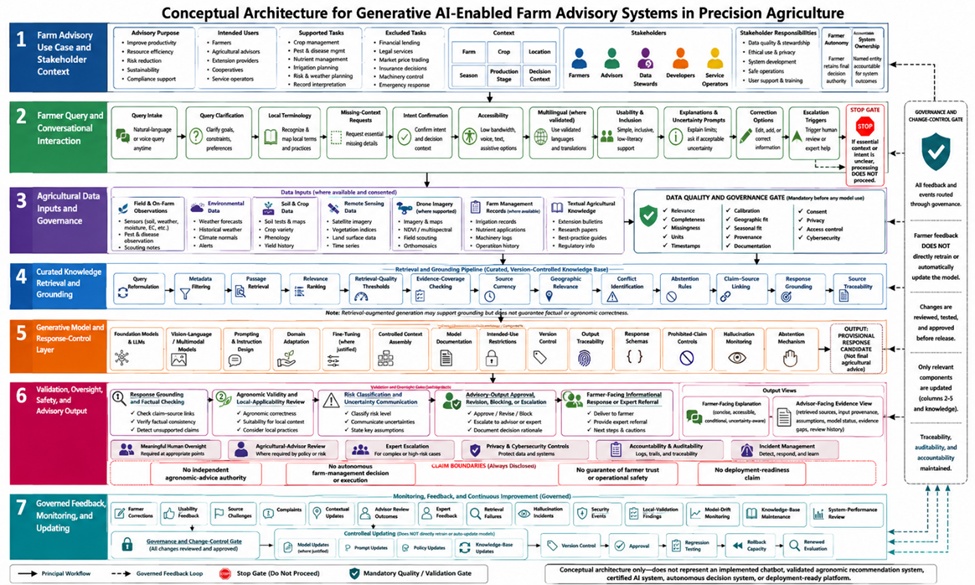
Figure 1. Conceptual Architecture for Generative AI-Enabled Farm Advisory Systems in Precision Agriculture
Alt-text description: A conceptual architecture showing farmer queries and farm data entering a generative AI advisory system with retrieval, grounding, model layers, advisory outputs, validation gates, human oversight, safety boundaries, farmer feedback, monitoring, and updating loops.
For farmers, advisors, extension services, cooperatives, and data stewards, the architecture provides a vocabulary for distinguishing conversational access from validated advice. Practical evaluation should ask whether data are current and interpretable, whether knowledge sources are curated, whether retrieval is relevant, whether uncertainty is understandable, and whether escalation pathways are reachable. Knowledge-guided model development may improve agricultural information processing, but its practical value remains dependent on corpus quality, retrieval performance, domain evaluation, and local context [15]. These implications describe areas for assessment and research; they are not instructions for selecting a platform, procuring a system, or making a farm-management decision.
Technology developers and platform providers should evaluate the complete advisory workflow rather than optimizing linguistic quality alone. Research is needed on multilingual farmer-query interpretation, low-bandwidth interaction, multimodal data quality, retrieval benchmarking, evidence-conflict handling, hallucination detection, advisor workload, farmer comprehension, and the effects of interface design on appropriate reliance. Advisory organizations should also investigate how professional roles, service relationships, and local knowledge change when conversational systems mediate access to agricultural information [17]. Such research should involve farmers and advisors before system requirements are fixed and should report failures, exclusions, and contextual limitations as carefully as technical performance.
Long-term research should connect local validation, security, governance, accessibility, and socio-ethical evaluation. Privacy and cybersecurity studies should examine threats across devices, communications, knowledge services, user accounts, audit records, and update mechanisms rather than treating the conversational interface as the only exposure point [24]. Institutional research should clarify accountability among developers, data custodians, advisory organizations, reviewers, and service operators. Responsible innovation should remain iterative, allowing use cases, safeguards, and system boundaries to be reconsidered as evidence and stakeholder concerns evolve [29]. These directions are conceptual research priorities, not legal, policy, procurement, engineering, or deployment prescriptions.
This article proposes a conceptual architecture for generative AI-enabled farm advisory systems that connects conversational decision support with farm and environmental data, curated agricultural knowledge, retrieval and grounding, generative model layers, advisory-output controls, uncertainty communication, validation, human oversight, expert escalation, farmer feedback, safety requirements, trust requirements, monitoring, and governed updating. Its central premise is that conversational fluency, model scale, multimodal capability, or source retrieval cannot independently establish factual reliability, agronomic validity, farmer trust, operational safety, or readiness for deployment. Responsible development requires bounded use cases, traceable evidence, contextual interpretation, farmer-centred interaction, meaningful human authority, privacy and cybersecurity protection, accountability, and explicit decision boundaries. The architecture is intended to structure future design, evaluation, and interdisciplinary research while preserving farmer autonomy and the indispensable role of agricultural expertise.
None
None
None
None
Open Access The author(s) retain copyright. This article is licensed under the Creative Commons Attribution-NonCommercial-ShareAlike 4.0 International License. It may be shared and adapted for non-commercial purposes with appropriate attribution, an indication of changes, and distribution of adaptations under the same license. Third-party material may be subject to separate terms identified in its credit line. View the license at https://creativecommons.org/licenses/by-nc-sa/4.0/.
 Agro Intelligence Research Press