Precision agriculture generates expanding volumes of sensor, machinery, remote-sensing, weather, soil, crop, livestock, operational, input-use, resource-use, and farm-management data. Although these data are commonly collected for immediate production purposes, they may also support sustainability reporting, environmental accountability, agricultural finance, insurance, and risk assessment. Such secondary use creates the possibility of a circular data economy in which curated farm data are responsibly reused across several applications and subsequently improved through feedback. This article proposes an original conceptual architecture for organizing these reuse pathways while preventing circularity from becoming uncontrolled extraction, opaque scoring, or unequal value capture. The architecture connects farm data generation and collection with quality and provenance review, metadata curation, consent and purpose limitation, data stewardship, interoperability, production analytics, sustainability reporting, finance and insurance applications, farmer protection, auditability, and feedback updating. It distinguishes analytical usefulness from implementation readiness and places governance gates before each consequential reuse pathway. Production reuse is treated as conditional decision support rather than a productivity guarantee; sustainability reuse is treated as bounded evidence rather than automatic reporting accuracy; and finance or insurance reuse is subject to data-quality, bias, fairness, transparency, and dispute requirements. The principal contribution is a structured circular data economy architecture that clarifies how agricultural data may circulate across domains while preserving farmer agency, contextual integrity, accountability, and explicit legal, financial, insurance, and deployment boundaries.
Precision agriculture increasingly depends on interconnected processes through which farm observations are generated, transferred, processed, analysed, and translated into decision-relevant information. These processes may involve sensors, agricultural machinery, remote-sensing platforms, weather services, farm-management systems, advisory tools, analytics providers, and other actors operating across an agricultural data chain. The value of farm data therefore does not arise solely from the act of collection. It depends on whether data retain sufficient quality, context, interoperability, and analytical relevance as they move between technical systems and organizational settings. Smart-farming research has shown that agricultural big-data applications are embedded in broader configurations of technologies, stakeholders, business relationships, and governance arrangements rather than functioning as isolated analytical tools [1].
A circular data economy extends this observation by asking how farm data generated for one legitimate purpose may be responsibly reused for another. Circularity in this context does not mean unrestricted replication or perpetual commercial exploitation. It refers to governed movement through a sequence of generation, validation, curation, authorized reuse, value creation, accountability, and feedback updating. The arrangement is socio-technical because its operation depends not only on databases and analytical models but also on institutions, professional roles, farmer capabilities, organizational incentives, and unequal distributions of knowledge and power. Research on digital agriculture has accordingly emphasized that technological change must be examined through social, institutional, ethical, and innovation-system perspectives alongside its technical performance [2].
The possibility of secondary reuse creates both opportunities and unresolved tensions. Farm data initially collected to support irrigation, nutrient management, disease monitoring, machinery operation, or crop forecasting may later be requested for sustainability indicators, supply-chain documentation, financial analysis, insurance design, or agricultural risk assessment. However, the existence of data does not establish that a proposed reuse is authorized, reliable, proportionate, or beneficial to the farmer. Agricultural big-data scholarship has identified continuing questions concerning ownership, privacy, security, access, control, aggregation, and the economic distribution of data-derived value [3]. These questions become especially consequential when farm data influence external assessments that may affect access to services, commercial relationships, environmental scrutiny, or perceived risk.
The conceptual problem is therefore not simply how to extract more value from agricultural data, but how to organize reuse without detaching data from their original context or transferring disproportionate risk to farmers. Digital agricultural development must be assessed in relation to people, production, and environmental consequences rather than through technological capability alone [4]. This article addresses that problem by proposing a circular data economy architecture for precision agriculture. The architecture connects farm data generation with production analytics, sustainability reporting, environmental accountability, finance, insurance, and risk assessment while embedding data-quality controls, provenance, consent, purpose limitation, interoperability, privacy, auditability, fairness review, farmer protection, and feedback mechanisms. It is presented as a conceptual contribution for structuring responsible reuse and future empirical investigation, not as an implemented marketplace, legal standard, financial decision system, insurance product, reporting framework, or deployment-ready technical design.
Farm data become a circular economic resource when their value can be renewed through carefully governed reuse rather than exhausted after a single production decision. This potential begins with diverse data-generating activities, including field sensing, machinery operation, satellite or drone observation, weather measurement, soil assessment, crop and livestock monitoring, input application, energy and water use, harvest recording, and farm-management documentation. Raw observations, however, are not automatically reusable assets. They must be transformed through cleaning, contextualization, validation, integration, analysis, and communication before they can support a legitimate secondary purpose. The agricultural data-value literature shows that value creation occurs through staged processes in which data are collected, transformed, combined, interpreted, and connected to decisions or services [5]. A circular architecture must therefore represent data value as conditional on quality, context, stewardship, and application fitness.
The economic value created from farm data must also be distinguished from the value captured by particular actors. A farmer may generate the underlying observations, while machinery manufacturers, platform providers, analytics firms, supply-chain organizations, financial actors, insurers, or public institutions possess greater capacity to aggregate and operationalize them. Digitalization can alter both how value is produced and who is positioned to appropriate it within an agricultural value chain [6]. Consequently, increased data reuse does not necessarily translate into greater farmer benefit. It may instead increase dependency on proprietary infrastructure, reduce bargaining power, create switching costs, or allow downstream actors to obtain recurring value from data for which farmers receive little control, transparency, or compensation. Fair value distribution must therefore be treated as a governance question rather than assumed to follow from technological participation.
Data-sharing platforms and intermediaries can make circular reuse technically and organizationally possible by coordinating transfers, formats, permissions, service relationships, and analytical functions. They may reduce fragmentation and connect farm information to production services, sustainability applications, public programs, financial analysis, insurance, or supply-chain systems. Research on agricultural data-sharing platforms demonstrates that intermediaries can create value by linking participants and enabling data combinations that would be difficult for isolated actors to assemble [7]. Nevertheless, platform-mediated coordination does not itself establish interoperability, fairness, accountability, or farmer control. The intermediary’s role must be bounded by transparent access conditions, purpose-specific authorization, portability, provenance obligations, security controls, and limits on onward disclosure or incompatible secondary use.
Farm participation is particularly sensitive to whether data use is understandable and whether farmers perceive that benefits and responsibilities are distributed credibly. Data stewardship should therefore include accessible explanations of what is collected, who receives it, why it is reused, how long it is retained, what analytical or institutional consequences may follow, and how errors or objections can be addressed. Farmer consent should not be reduced to a one-time acceptance of broad terms that permit indefinite function expansion. It should be specific enough to distinguish production support from sustainability, finance, insurance, and risk-scoring applications. Evidence from smart-farming research links farmer trust to transparency concerning downstream data use and to credible arrangements for benefit sharing [8]. A circular data economy must consequently preserve farmer agency through participation, control, review, withdrawal where feasible, dispute mechanisms, and explicit recognition that data circulation does not guarantee farmer benefit.
Production analytics represent the most immediate reuse pathway because many precision-agriculture data are generated to understand farm conditions and support operational decisions. Sensor observations may describe soil moisture, temperature, animal behaviour, machinery status, storage conditions, or environmental variables. Machine records can document field operations, fuel use, task timing, application rates, and equipment performance. Remote-sensing, weather, soil, crop, livestock, input-use, operational, and farm-management data can be combined to support classification, anomaly detection, forecasting, monitoring, and decision-support functions. Reviews of machine learning in agriculture demonstrate that such methods have been applied across crop production, water management, livestock systems, disease recognition, and farm-management tasks [9]. More advanced deep-learning techniques expand image- and sensor-based analytical capacity, but their validity remains dependent on dataset suitability, model design, and rigorous evaluation rather than architecture complexity alone [10].
Remote-sensing reuse illustrates both the scale of the opportunity and the importance of application-specific controls. Satellite, airborne, or drone-derived observations may contribute to crop-condition assessment, stress detection, field mapping, soil or water analysis, and spatial management. Yet imagery may be affected by atmospheric conditions, sensor resolution, cloud cover, temporal gaps, field size, mixed pixels, crop stage, and insufficient ground observations. Remote-sensing reviews in precision agriculture emphasize that spatial and temporal resolution, calibration, preprocessing, and field validation materially affect the reliability of analytical outputs [11]. Circular reuse may become more iterative when updated observations are connected to digital farm representations, simulation models, and management feedback. Digital-twin concepts illustrate how observations, models, scenarios, and operational responses may form a continuing update loop, although agricultural digital twins remain a developing concept rather than a universally validated production system [12].
Data reuse across production functions also requires preservation of meaning. A yield value without information on crop identity, field boundary, measurement method, harvest timing, moisture correction, or monitor calibration may be unsuitable for comparison or modeling. Similarly, input-use records require reliable product identities, units, rates, spatial locations, timing, and application context. Water-use estimates require distinctions between withdrawal, application, consumption, and modeled demand. Livestock observations may require animal identification, welfare context, sensor limitations, and restrictions on intrusive monitoring. Crop-data management research shows that increasingly connected agricultural systems depend on coordinated acquisition, storage, integration, interoperability, and contextual data management [13]. Metadata and provenance must therefore accompany reused information so that analysts can determine what each variable represents, how it was generated, and whether it remains fit for the new purpose.
Within the proposed architecture, production analytics form a governed application layer rather than an unrestricted destination for all available data. Data must first pass quality, provenance, authorization, and interoperability checks. Analytical outputs should be presented as bounded evidence, alerts, scenarios, classifications, or decision-support options with documented uncertainty and assumptions. Farm optimization may be included where an objective, constraints, trade-offs, and validation conditions are explicit, but optimization should not be represented as a guaranteed improvement in productivity, profitability, environmental performance, or farmer welfare. Human judgment remains necessary because analytical models may omit local knowledge, operational constraints, crop history, unusual weather, farmer priorities, or emerging conditions. Feedback updating should incorporate observed outcomes, farmer corrections, model errors, and contextual changes through controlled versioning rather than unmonitored automated learning. The production pathway therefore closes a circular loop only when new evidence improves data and models without converting uncertain predictions into compulsory or autonomous farm actions.
Farm data may also be reused to organize evidence concerning resource use, environmental pressures, and sustainability-related practices. Relevant inputs can include irrigation volumes, nutrient and pesticide applications, machinery fuel use, electricity consumption, soil observations, crop cover, field operations, emissions-related activity data, environmental measurements, and climate-risk information. Smart-farming technologies may support more precise observation and management of agricultural resources, but their sustainability implications depend on how they are implemented, interpreted, and evaluated [14]. The availability of fine-grained data should therefore be understood as an opportunity to strengthen evidence rather than as proof that a farm, technology, or reporting process is sustainable.
A sustainability-reporting reuse pathway must translate operational and environmental observations into indicators with explicit definitions, boundaries, units, methods, and uncertainty. Digital agriculture can support sustainable-system design by integrating field data, models, management information, and scenario analysis [15]. Nevertheless, sustainability evidence is rarely complete, and individual indicators may represent only selected dimensions of a complex farming system. Water-use data, for example, may not capture source scarcity or ecological effects. Nutrient-use indicators may not reveal nutrient availability, losses, soil conditions, or crop requirements. Pesticide-use records may document applications without establishing ecosystem or health outcomes. Soil-health and biodiversity claims require appropriate sampling, baselines, temporal coverage, and scientifically justified indicators rather than inference from general operational data.
Resource-use reporting must also recognize that precision-farming effects vary across technologies, farming systems, regions, and management conditions. Research examining the relationship between precision farming, agricultural production, and environmental performance shows that technology effects are heterogeneous and dependent on adoption, farm context, behavioral responses, and the specific resource being assessed [16]. Operational and input-use data may support calculations concerning fuel, energy, fertilizer, water, pesticide, or other resource use, but comparisons require harmonized units and consistent system boundaries. Evidence concerning precision-agriculture technologies and greenhouse-gas mitigation further indicates that emissions-related interpretation depends on technology-specific assumptions, management effects, and economic conditions [17]. Carbon or emissions reporting should therefore document activity data, emission factors, estimation methods, versions, exclusions, and uncertainty rather than presenting model-derived values as directly measured or independently verified outcomes.
Environmental accountability introduces additional governance concerns because data may be used not only for learning and reporting but also for monitoring, evaluation, or institutional scrutiny. Digitized agri-environmental governance can increase visibility and traceability while also creating new forms of oversight that affect farmer autonomy [18]. The proposed architecture therefore separates evidence organization from determinations of responsibility, compliance, or environmental causation. Metadata, provenance, auditability, and traceability should allow authorized reviewers to reconstruct how an indicator was produced, while farmer response and correction pathways should permit inaccurate records or contextual omissions to be challenged. Sustainability verifiers may be represented as conditional actors where supported, but their role must be limited to a defined evidence scope. The architecture does not guarantee sustainability accuracy, biodiversity benefit, emissions reduction, or reporting compliance, and it does not replace qualified scientific, reporting, or jurisdiction-specific review.
Farm data may support finance, insurance, and agricultural risk analysis when reuse is tied to a clearly defined question and when the evidence is sufficiently accurate, current, representative, and authorized. Potential inputs include remotely sensed vegetation conditions, weather observations, crop models, yield records, operational histories, climate-risk variables, and farm-management information. Integrative research on agricultural risk management shows that remote sensing, crop modeling, and economic analysis can be combined to improve the characterization of production risks, although each component introduces assumptions and uncertainty [19]. In agricultural finance, remotely sensed vegetation-health indicators have been examined as supplementary variables for explaining credit risk in a specific microfinance context [20]. Such evidence demonstrates a possible reuse pathway but does not justify treating satellite indicators as universal measures of borrower quality, repayment capacity, or creditworthiness.
Insurance applications similarly depend on whether the selected data and index design correspond to the losses experienced by an individual farm. Weather, vegetation, phenology, and production indicators may support index construction, exposure assessment, or claims-related evidence. However, index insurance remains vulnerable to basis risk when the calculated payment trigger does not correspond to actual farm-level loss. Reviews of grassland index insurance show that performance depends on data availability, index structure, geographic scale, farm heterogeneity, and regional conditions [21]. Temporal context is also material: incorporating crop phenology into weather-index design may reduce temporal basis risk by aligning weather exposure more closely with sensitive crop-development periods [22]. Reused data must therefore retain crop stage, location, season, measurement method, and uncertainty rather than being converted into decontextualized risk variables.
A quality gate is especially important when remote-sensing products are reused in financial or insurance settings. Different satellite products may represent vegetation or production conditions differently because of sensor characteristics, spatial resolution, processing methods, temporal frequency, cloud contamination, and calibration choices. Research evaluating remote-sensing products for agricultural index insurance demonstrates that product quality must be assessed specifically for the intended insurance function rather than inferred from general technical reputation [23]. Provenance records should identify the source product, processing history, spatial and temporal coverage, transformation steps, validation data, and known limitations. When quality is inadequate or provenance is incomplete, the data should be excluded, flagged for human review, or restricted to exploratory analysis.
Consequential reuse also requires procedural safeguards beyond predictive accuracy. Risk scores may compress heterogeneous farm conditions into a single classification that conceals missing data, regional disadvantage, unusual management practices, or the weaker digital records of smaller farms. Bias assessment should examine whether errors differ across crops, farm scales, regions, production systems, or levels of digital access. Fairness review should consider both model performance and the practical distribution of benefits, exclusions, and opportunities. Farmers should receive understandable information about what data were used, the purpose of the analysis, the limits of the result, and the responsible decision-maker. Correction, appeal, and dispute pathways should be available where outputs may affect access or treatment. The architecture therefore treats finance and insurance data reuse as bounded evidentiary support, not as proof of financial fairness, insurance fairness, creditworthiness, insurability, or underwriting readiness.
Table 1 summarises responsible farm data reuse pathways across production analytics, sustainability reporting, finance, insurance, and risk assessment.
Table 1. Responsible Farm Data Reuse Pathways in a Circular Data Economy for Precision Agriculture: Production Analytics, Decision Support, Sustainability Reporting, Environmental Accountability, Resource-Use Reporting, Finance Applications, Insurance Applications, Risk Assessment, Bias Review, Fairness Boundaries, and Farmer Protection
Reuse pathway | Core reuse question | Required data or condition | Reuse function | Potential output | Failure or fairness risk | Governance or validation need | Architecture role |
Production analytics | What farm condition or pattern is relevant to a defined production question? | Validated sensor, machine, crop, soil, weather, imagery, operational, and management data | Descriptive, diagnostic, predictive, or prescriptive analysis | Monitoring indicator, forecast, classification, or decision-support option | Overfitting, model drift, missing context, automation bias | External validation, uncertainty reporting, agronomic review, human oversight | Primary production-reuse pathway |
Decision support | How should analytical evidence be presented without displacing accountable judgment? | Interpretable outputs, alternatives, uncertainty, farmer objectives, and local context | Translate analysis into bounded options | Alert, scenario, ranked option, or explanation | Inappropriate reliance, information overload, false precision | Usability assessment, override mechanism, responsibility assignment | Human-facing application layer |
Sustainability reporting | What resource-use or sustainability evidence can be documented within a defined scope? | Validated environmental, operational, input-use, and contextual data | Calculate bounded indicators using documented methods | Sustainability evidence package or qualified indicator | Incomplete scope, false comparability, greenwashing | Metadata, method disclosure, auditability, uncertainty statement | Sustainability reuse pathway |
Environmental accountability | What environmental action, pressure, or condition is represented by the evidence? | Environmental observations, management records, baselines, and attribution limits | Organize traceable evidence for review | Environmental-accountability record | Unfair attribution, surveillance, proxy misuse | Provenance, farmer response, causal caution, proportional review | Accountability reuse pathway |
Resource-use reporting | How were water, nutrients, pesticides, energy, or other resources used? | Consistent units, boundaries, timing, source records, and allocation rules | Convert operational records into resource-use measures | Water-, nutrient-, pesticide-, fuel-, or energy-use indicator | Measurement error, inconsistent boundaries, unsupported comparison | Reconciliation, calculation audit, domain interpretation | Production–sustainability bridge |
Finance application | What authorized farm information is relevant to a defined financial analysis? | Current, purpose-specific, representative, and validated data | Assemble supplementary evidence for human analysis | Bounded financial evidence package | Exclusion of data-poor farms, proxy discrimination, opaque inference | Data minimization, bias review, explanation, human decision authority | Conditional finance reuse pathway |
Credit assessment where supported | Can selected indicators supplement a broader credit assessment? | Appropriate outcome definition, historical evidence, validation, and authorization | Generate a bounded supplementary indicator | Contextual credit-risk input | Misclassification, feedback loops, unsupported borrower ranking | External validation, fairness assessment, correction and appeal | Restricted finance subpath |
Insurance application | Can farm and environmental data support a defined insurance function? | Validated exposure, hazard, crop, weather, imagery, and production data | Support index design, monitoring, or evidence review | Candidate insurance index input or claims evidence | Basis risk, unequal coverage quality, inaccessible processes | Product-specific validation, farmer explanation, dispute pathway | Conditional insurance reuse pathway |
Risk assessment | Which hazards, exposures, and uncertainties are represented? | Explicit risk definition, time horizon, model assumptions, and contextual evidence | Construct a scenario-specific risk profile | Qualified risk indicator or scenario | Hidden assumptions, omitted vulnerability, deterministic interpretation | Sensitivity testing, uncertainty disclosure, accountable human review | Cross-domain analytical function |
Risk scoring boundary | Is compression into a score necessary, valid, and proportionate? | Representative data, justified outcome, calibration, and explainability | Produce a bounded score only where warranted | Interpretable indicator with confidence or uncertainty | Ranking bias, structural exclusion, concealment of uncertainty | Independent validation, monitoring, explanation, right to contest | Consequential-use governance gate |
Bias review | Do errors or outcomes differ across farm types or contexts? | Subgroup data, representative evaluation, and appropriate metrics | Detect systematic performance disparities | Bias and subgroup-performance report | Aggregate accuracy conceals unequal error | Independent technical and contextual assessment | Mandatory scoring safeguard |
Fairness review | Are the process and consequences substantively and procedurally fair? | Technical findings, stakeholder input, impact evidence, and decision context | Examine distributive and procedural effects | Approval conditions, redesign, restriction, or rejection | Metric-only fairness, exclusion of vulnerable farmers | Multidisciplinary and farmer-inclusive oversight | Consequential-use review layer |
Farmer transparency | Can the farmer understand the purpose, data, output, and responsible actor? | Accessible notice, data summary, explanation, and contact pathway | Communicate the reuse process and its limits | Individualized explanation and access record | Opaque scoring and inability to correct errors | Explanation standard, accessible records, response timelines | Farmer-protection mechanism |
Appeal or dispute pathway | Can incorrect data or an adverse use be challenged? | Evidence access, responsible reviewer, timelines, and remediation authority | Correct records and reconsider contested use | Correction, review, or documented resolution | Nominal appeal without authority or transparency | Independent escalation and auditable outcome | Redress mechanism |
No productivity-guarantee boundary | What cannot be concluded from production analysis? | Explicit limitations and uncertainty | Prevent overstatement of benefit | Qualified decision-support result | Productivity claims unsupported by field outcomes | Outcome evaluation and cautious communication | Production claim boundary |
No sustainability-accuracy guarantee boundary | What uncertainty remains in sustainability evidence? | Scope and uncertainty statement | Prevent automatic equation of data availability with accuracy | Qualified sustainability output | Unsupported or incomplete claims | Verification and correction process | Reporting claim boundary |
No financial-fairness guarantee boundary | What cannot be inferred from governed financial reuse? | Distributional and procedural review | Prevent inherent-fairness claims | Qualified finance application | Digitized exclusion presented as objective | Continuing fairness monitoring and appeal | Finance claim boundary |
No insurance-fairness guarantee boundary | What cannot be inferred from improved insurance data? | Basis-risk and distributional evidence | Prevent automatic fairness claims | Qualified insurance application | Improved average fit harms individual farms | Product-level evaluation and redress | Insurance claim boundary |
Farmer protection | What harms to autonomy, privacy, livelihood, or bargaining position may arise? | Impact assessment, farmer participation, safeguards, and exit conditions | Identify and reduce farmer-facing harm | Protection conditions or reuse rejection | Surveillance, dependency, value extraction, service exclusion | Independent representation and grievance process | Cross-cutting protective layer |
Responsible reuse begins with recognition that “ownership” does not provide a universally settled answer to every question concerning farm data. Agricultural data may involve overlapping interests associated with farmers, workers, equipment manufacturers, service providers, platforms, contractors, advisers, and public bodies. Contractual access may differ from practical control, and possession of a copy may not establish an unrestricted right to reuse it. Research examining farmer reluctance to share smart-farming data shows that uncertainty regarding rights, access, downstream use, and legal protection can inhibit participation [24]. The architecture therefore begins with a rights-and-interests assessment that documents relevant claims without asserting that all farm data are governed by a single ownership rule. Access permissions should be role-based and purpose-specific, while farmer control should include usable options concerning collection, transfer, correction, retention, and withdrawal where feasible.
Consent and participation must be connected to purpose limitation. A farmer who authorizes use of machinery records for maintenance should not be presumed to have authorized their use for credit analysis, insurance classification, environmental monitoring, or unrelated commercial profiling. Each reuse should have a clear purpose, compatible data scope, identified recipient, retention period, and statement of prohibited use. Ethical analysis of smart farming emphasizes privacy, autonomy, justice, responsibility, and power as core considerations for responsible innovation [25]. Consent should therefore be understandable, revisitable, and sufficiently granular to distinguish lower-consequence operational uses from potentially consequential reporting, financial, insurance, or scoring uses. Where consent is not the appropriate or only governance basis, the responsible basis and limits should still be made transparent and subject to oversight.
Data stewardship provides the organizational function needed to preserve quality, meaning, access discipline, and lifecycle accountability. A named steward should coordinate metadata, provenance, quality checks, corrections, retention, interoperability, portability, and incident handling. Privacy controls should limit unnecessary exposure of location, production, household, worker, or commercially sensitive information. Cybersecurity measures should protect confidentiality, integrity, and availability through authentication, encryption where appropriate, backups, access monitoring, vulnerability management, and response planning. Interoperability should allow authorized data exchange without semantic loss, while portability should permit farmers to obtain usable copies of relevant information and reduce dependence on a single proprietary provider. Political-economy research on digital agriculture warns that infrastructures and platforms may reinforce existing asymmetries of knowledge, access, and value capture [26]. Governance must consequently examine not only whether exchange is technically possible but also who controls standards, interfaces, permissions, and exit conditions.
A responsible circular data economy must also prevent the language of reuse from masking extraction. Precision-agriculture infrastructures can allow farm observations to become accumulated assets controlled by actors outside the farm, potentially increasing surveillance, dependency, and unequal appropriation [27]. Auditability and traceability should reveal who accessed data, how they were transformed, what model or rule was applied, and who was accountable for the resulting use. Bias assessment is mandatory where data contribute to ranking, scoring, eligibility, or differential treatment. Fair value review should identify who provides the data, who bears collection and decision risks, who receives economic or institutional benefits, and whether farmers retain meaningful alternatives. These controls can structure responsible practice, but they do not independently establish legal compliance, eliminate privacy or cybersecurity risk, guarantee fair value distribution, or ensure farmer benefit.
Table 2 maps responsible data reuse and governance requirements for circular farm data economies.
Table 2. Responsible Data Reuse and Governance Requirements for Circular Farm Data Economies: Ownership, Access, Control, Consent, Purpose Limitation, Data Stewardship, Privacy, Cybersecurity, Interoperability, Portability, Provenance, Auditability, Accountability, Fair Value Distribution, Bias Assessment, and Claim Boundaries
Governance requirement | Core responsible-reuse question | Required practice or condition | Governance function | Potential output | Failure risk | Oversight need | Architecture role |
Data ownership | What legal, contractual, technical, or practical interests exist in the data? | Document relevant rights and unresolved interests without assuming universal ownership | Clarify claims and constraints | Rights-and-interests record | False assertion of exclusive ownership | Qualified review where required | Entry-condition assessment |
Data access | Who may obtain which data for what purpose? | Least-privilege, role-based and time-bounded authorization | Limit availability | Access-control decision and log | Unauthorized or excessive use | Periodic access review | Cross-cutting control |
Data control | What meaningful choices can farmers exercise? | Usable collection, transfer, correction, retention and withdrawal controls | Preserve farmer agency | Control settings and decision history | Nominal control with no practical effect | Farmer representation and complaint review | Farmer-agency mechanism |
Consent and participation | Is participation informed, understandable and revisitable? | Specific notices, accessible choices, records and non-coercive participation | Authorize defined uses | Consent or participation record | Bundled or uninformed agreement | Consent audit and feedback | Authorization layer |
Purpose limitation | Is the reuse compatible with the communicated purpose? | Defined purpose, prohibited uses, expiry and compatibility assessment | Prevent function creep | Approved, conditional, or rejected reuse | Uncontrolled secondary use | Reuse review and accountable steward | Mandatory governance gate |
Data stewardship | Who maintains quality, context, access and lifecycle controls? | Named steward, duties, resources and escalation procedures | Coordinate responsible handling | Stewardship plan and issue register | Diffused responsibility | Periodic stewardship review | Operational governance layer |
Data governance | How are roles, rights, standards and accountability integrated? | Formal charter, decision authority, documentation and representation | Coordinate the data lifecycle | Governance charter and decisions | Fragmented controls | Multi-stakeholder oversight | Architecture-wide framework |
Privacy | What sensitive information may be exposed or inferred? | Necessity review, minimization, restricted access and suitable de-identification | Reduce unjustified exposure | Privacy assessment and controls | Re-identification, surveillance, commercial harm | Privacy review and breach response | Cross-cutting safeguard |
Cybersecurity | Can data or systems be accessed, manipulated or disrupted? | Authentication, encryption where appropriate, backups, monitoring and incident planning | Protect confidentiality, integrity and availability | Security plan and incident record | Theft, manipulation, ransomware, outage | Security testing and incident oversight | Technical safeguard |
Data interoperability | Can authorized systems exchange data without losing meaning? | Common formats, identifiers, vocabularies, APIs and semantic mappings | Enable controlled exchange | Interoperable data package | Semantic mismatch despite technical transfer | Conformance testing | Reuse-enablement layer |
Data portability | Can farmers obtain and transfer usable data copies? | Documented export formats, metadata and reasonable delivery | Reduce lock-in and support choice | Portable data package | Unusable export or contractual obstruction | Portability testing and complaint route | Farmer-agency safeguard |
Data quality assurance | Are data fit for the proposed reuse? | Quality criteria, thresholds, exception handling and correction | Prevent unsuitable use | Quality status and acceptance decision | Error propagation | Independent quality review | Mandatory application gate |
Data provenance | Can origin and transformation history be reconstructed? | Source identifiers, lineage metadata, versions and processing logs | Establish evidentiary lineage | Provenance record | Disputed or unverifiable origin | Lineage audit | Evidence layer |
Metadata documentation | Is meaning and context preserved? | Definitions, units, methods, dates, spatial scope and limitations | Prevent semantic drift | Data dictionary and metadata package | Misinterpretation after transfer | Steward review and version control | Context layer |
Auditability | Can an authorized reviewer reproduce data handling and calculations? | Accessible source records, logic, versions and permissions | Enable verification | Audit package and findings | Opaque or irreproducible use | Independent or separate audit | Assurance layer |
Traceability | Can transfers and transformations be followed across actors? | Access, transaction, transformation and custody logs | Allocate responsibility | End-to-end trace record | Accountability gaps | Cross-organizational review | Accountability infrastructure |
Accountability | Who must explain, correct and remedy failure? | Named owners, escalation, remediation and consequences | Connect authority with responsibility | Accountability map and remedy record | Responsibility shifted to systems or farmers | Senior oversight and independent challenge | Decision-responsibility layer |
Farmer protection | What harms to autonomy, privacy, livelihood or access may arise? | Impact assessment, safeguards, redress and farmer participation | Identify and reduce harm | Protection conditions or rejection | Surveillance, exclusion, dependency | Independent representation and grievance route | Protective layer |
Fair value distribution | How are benefits, costs and risks distributed? | Transparent value logic, negotiated terms, alternatives and review | Assess value creation and capture | Value-distribution statement | Farmers bear risk while others capture value | Farmer-inclusive governance | Value-governance layer |
Bias assessment | Do scoring errors differ across farm contexts or groups? | Representative evaluation, subgroup testing and monitoring | Detect systematic disparities | Bias report and mitigation plan | Hidden exclusion | Independent model review | Consequential-use gate |
No legal-compliance claim boundary | What legal conclusion is outside the architecture? | Explicit separation of conceptual controls from jurisdiction-specific legal review | Prevent false assurance | Qualified governance statement | Architecture presented as legally sufficient | External qualified assessment | Mandatory legal boundary |
No farmer-benefit guarantee boundary | What benefits remain uncertain or unevenly distributed? | Distributional evidence, farmer-defined outcomes and exit mechanisms | Prevent automatic benefit claims | Qualified value proposition | Participation without meaningful value | Continuing farmer-centred evaluation | Mandatory benefit boundary |
The proposed architecture organizes circular reuse as a sequence of controlled stages rather than a continuous flow in which any available data may be repurposed automatically. Its first stage is farm data generation, covering sensor, machine, remote-sensing, weather, soil, crop, livestock, operational, management, input-use, water-use, nutrient-use, pesticide-use, energy-use, yield, environmental, sustainability, and climate-risk data where appropriate. Collection and ingestion then authenticate transfers, register sources, preserve timestamps, and detect missing, duplicated, corrupted, or unauthorized records. The architecture is embedded within a multi-actor agricultural innovation system involving farmers, advisers, technology providers, platforms, intermediaries, public institutions, cooperatives where relevant, supply-chain actors, sustainability reviewers, finance actors, and insurance actors. Research on the digitalization of agricultural innovation systems supports treating these relationships as multi-level institutional arrangements rather than as isolated farm-to-platform transactions [28].
The second architectural stage is a combined quality, provenance, metadata, and curation layer. Each proposed reuse is assessed against application-specific requirements rather than a single generic quality score. Curation may harmonize units, resolve identifiers, document transformations, assign quality flags, and create versioned data objects, but it cannot replace absent observations or make unsuitable evidence reliable. Interoperability and portability functions operate only after meaning, permissions, and lineage have been preserved. The architecture assigns distinct responsibilities to technology suppliers, platform providers, service organizations, public actors, and other intermediaries because supply-side structures and incentives materially influence how agricultural digital systems develop and who controls their infrastructures [29]. These responsibilities include documentation, interface maintenance, error correction, security, portability, and support for independent review.
The third stage is a consent, purpose-limitation, stewardship, and governance core. Every proposed reuse is routed through a purpose gate identifying the requested data, intended application, recipient, duration, downstream-transfer limits, potential consequences, and responsible decision-maker. The core may approve, condition, restrict, or reject reuse. Production analytics, sustainability reporting, environmental accountability, finance, and insurance therefore operate as separate branches rather than as interchangeable uses of the same data asset. The architecture also includes a fair-value and farmer-protection review that examines dependency, bargaining power, benefit distribution, exit options, and the possibility that farmers bear data or decision risks while other actors capture value. Privacy, cybersecurity, accountability, and claim boundaries are applied across all branches rather than delegated to one final compliance check.
The fourth stage consists of application-specific reuse pathways. Production analytics generate bounded monitoring, prediction, or decision-support outputs. Sustainability and environmental branches organize traceable evidence under explicit calculation and attribution limits. Finance and insurance branches require additional bias, fairness, explanation, and dispute controls because their outputs may contribute to differential treatment. Auditability and traceability span all pathways, linking raw data, transformations, models, recipients, decisions, and corrections. A layered technical pattern involving continuous data integration, modeling, and feedback is consistent with the logic of digital twins in smart farming, although the present architecture extends that pattern by making governance and reuse boundaries explicit [30]. It does not imply a continuously autonomous system.
The final stage is feedback and architecture updating. Farmer corrections, model errors, audit findings, sustainability-review comments, dispute outcomes, security incidents, interoperability failures, and observed application limitations are returned to the relevant data, model, stewardship, or governance layer. Updates must be versioned, authorized, tested, and monitored so that corrective changes do not create new incompatibilities, biases, or unauthorized purposes. The architecture includes five explicit boundaries: no farmer-benefit guarantee, no legal-compliance claim, no financial-fairness guarantee, no insurance-fairness guarantee, and no implementation-readiness claim. These boundaries do not prevent research or carefully governed experimentation; they prevent conceptual completeness from being mistaken for empirical validation, institutional approval, or operational readiness.
Table 3 presents the proposed circular data economy architecture for precision agriculture.
Table 3. Proposed Circular Data Economy Architecture for Precision Agriculture: Farm Data Generation, Data Collection, Quality and Provenance Review, Metadata and Curation, Consent and Purpose Limitation, Data Stewardship, Interoperability, Production Analytics, Sustainability Reporting, Finance, Insurance, Fair Value Review, Auditability, Feedback, and Claim Boundaries
Architecture stage | Core purpose | Required input | Architectural function | Potential output | Validation or assessment need | Failure risk | Feedback mechanism | Decision boundary |
Farm data generation | Create observations at the farm or production-system source | Sensor, machine, imagery, weather, soil, crop, livestock, operational and management observations | Capture data with source, time, place, method and responsible actor | Raw data object with source metadata | Calibration, necessity, representativeness and authorization | Excess collection, faulty observations, surveillance | Farmer and operator error reporting | Collection does not authorize all reuse |
Data collection and ingestion | Transfer authorized data into controlled infrastructure | Raw data, transfer authorization, protocol and schema | Authenticate, ingest, time-stamp and register | Ingested data package | Integrity, completeness, duplication and security checks | Corruption, unauthorized transfer, context loss | Ingestion exception workflow | Rejected data do not proceed automatically |
Data quality and provenance review | Determine fitness and reconstruct origin | Ingested data, quality criteria, lineage and intended use | Assess quality, verify source and flag errors | Quality and provenance report | Application-specific thresholds and independent checks | Error propagation and disputed origin | Farmer correction and steward review | Fitness for one use does not establish fitness for another |
Metadata and curation layer | Preserve meaning and prepare controlled reuse | Accepted data, units, definitions, context and processing rules | Clean, harmonize, annotate and version | Curated data asset | Semantic consistency and transformation review | Semantic drift and undocumented changes | Metadata correction and version history | Curation cannot manufacture missing evidence |
Consent and purpose-limitation layer | Determine whether reuse is authorized and compatible | Purpose, permission basis, restrictions and notice | Match proposed use to permitted scope | Approval, conditions, restriction or rejection | Comprehension, voluntariness and compatibility review | Function creep and coercive participation | Consent revision and complaint process | Authorization is specific and revisitable |
Data stewardship and governance layer | Coordinate lifecycle decisions and responsibility | Governance charter, roles, policies and risk assessments | Oversee access, quality, retention, disputes and change | Governance decision and accountable owner | Independence, resources, representation and documentation | Diffused responsibility and dominant intermediaries | Governance review and incident learning | Stewardship does not replace farmer agency |
Interoperability and portability layer | Enable controlled exchange without semantic loss or lock-in | Curated data, standards, mappings, APIs and export rules | Transform and package authorized data | Interoperable or portable package | Conformance, semantic accuracy, security and usability | Broken mapping, lock-in, unauthorized replication | Compatibility reports and portability feedback | Technical exchange does not authorize a new purpose |
Production analytics reuse | Support defined monitoring or decision questions | Validated farm data, model, assumptions and user needs | Run bounded analytics with uncertainty | Insight, forecast, classification or support option | Model, agronomic, usability and drift validation | Overfitting, automation bias, unsuitable recommendation | Outcome monitoring and farmer feedback | No productivity or optimization guarantee |
Sustainability reporting reuse | Organize evidence for defined indicators | Validated environmental, input, operational and contextual data | Calculate indicators within explicit scope | Evidence package or qualified statement | Calculation audit, comparability, scope and uncertainty | Greenwashing and false precision | Verification and correction cycle | No automatic sustainability accuracy or compliance |
Environmental accountability reuse | Support review of environmental evidence | Observations, management records, baselines and responsibilities | Link evidence to bounded accountability questions | Traceable accountability record | Attribution, causal caution, proportionality and auditability | Unfair attribution and surveillance | Farmer response and institutional review | Data alone do not establish causation or responsibility |
Finance application reuse | Provide supplementary evidence for defined financial analysis | Authorized, validated and relevant data | Assemble contextual indicators | Bounded finance evidence package | Bias, relevance, explainability and human review | Proxy discrimination and exclusion of data-poor farms | Correction, appeal and outcome monitoring | No lending or creditworthiness decision |
Insurance and risk assessment reuse | Support defined insurance or risk functions | Hazard, exposure, weather, imagery, crop and operational data | Construct and evaluate bounded risk indicators | Candidate risk profile or insurance input | Basis risk, subgroup performance, uncertainty and product fit | Coverage gaps, false certainty and unfair treatment | Dispute feedback and recalibration | No underwriting readiness or insurance-fairness guarantee |
Fair value and farmer protection review | Assess distribution, autonomy and dependency | Proposed reuse, stakeholder roles, value flows and impact evidence | Evaluate benefit sharing, bargaining power, exit and harm | Conditions, redesign, restriction or rejection | Farmer participation and distributional assessment | Extractive reuse and uncompensated value capture | Farmer representation and periodic review | Value creation does not establish farmer benefit |
Auditability and traceability layer | Make handling and decisions reconstructable | Provenance, access, transfer, model and decision logs | Create end-to-end evidence trails | Reproducible audit package | Completeness, integrity and reviewer independence | Audit gaps and responsibility shifting | Findings and corrective action | Auditability does not certify substantive fairness |
Bias and fairness review | Detect systematic error and unfair impact where scoring occurs | Model, data, outcome, subgroup and impact context | Test disparities and practical consequences | Conditional approval, mitigation or rejection | Representative evaluation and multi-criteria review | Discriminatory proxies and hidden exclusion | Monitoring, complaints and revalidation | Technical fairness does not establish overall fairness |
Stakeholder feedback | Incorporate user knowledge, corrections and complaints | Explanations, errors, experience and impact observations | Record, assess and respond | Documented change or reasoned non-change | Accessibility, representation and responsiveness | Token participation and uncorrected harm | Formal escalation and response cycle | Feedback collection alone is not participation |
Architecture updating | Revise data, models, standards or governance controls | Monitoring, incidents, audits and stakeholder feedback | Version, test, approve and monitor changes | Updated component and change record | Regression testing, impact review and rollback | Uncontrolled change and reintroduced bias | Post-update monitoring | Updates require renewed validation and purpose review |
No farmer-benefit guarantee boundary | Prevent circulation from being equated with farmer benefit | Distributional evidence and farmer-defined outcomes | Require qualified value claims | Benefit limitation statement | Benefits captured outside the farm | Farmer-centred evaluation and exit options | Architecture does not guarantee farmer benefit | |
No legal-compliance claim boundary | Separate conceptual safeguards from legal determination | Jurisdiction-specific review outside the architecture | Label assumptions and unresolved questions | Legal-boundary statement | False assurance | Qualified external review | Architecture does not establish legal compliance | |
No financial-fairness guarantee boundary | Prevent governed reuse from being equated with fair finance | Procedural, distributional, bias and impact evidence | Require qualified financial claims | Fairness limitation statement | Digitized exclusion appears objective | Independent monitoring and appeal | Architecture does not guarantee financial fairness | |
No insurance-fairness guarantee boundary | Prevent better data from being equated with fair insurance | Basis-risk, access, pricing, claims and impact evidence | Require qualified insurance claims | Insurance-fairness limitation | Unequal coverage and ineffective disputes | Product-level evaluation and redress | Architecture does not guarantee insurance fairness | |
No implementation-readiness boundary | Separate conceptual design from operational approval | Technical, organizational, legal, security and impact validation | Define a research and assessment agenda | Validation roadmap | Premature deployment | Staged evaluation and redesign | Architecture is not deployment-ready |
Figure 1 presents the proposed circular data economy architecture for precision agriculture, linking farm data generation, governed reuse, production analytics, sustainability reporting, finance, insurance, farmer protection, accountability, and feedback updating.
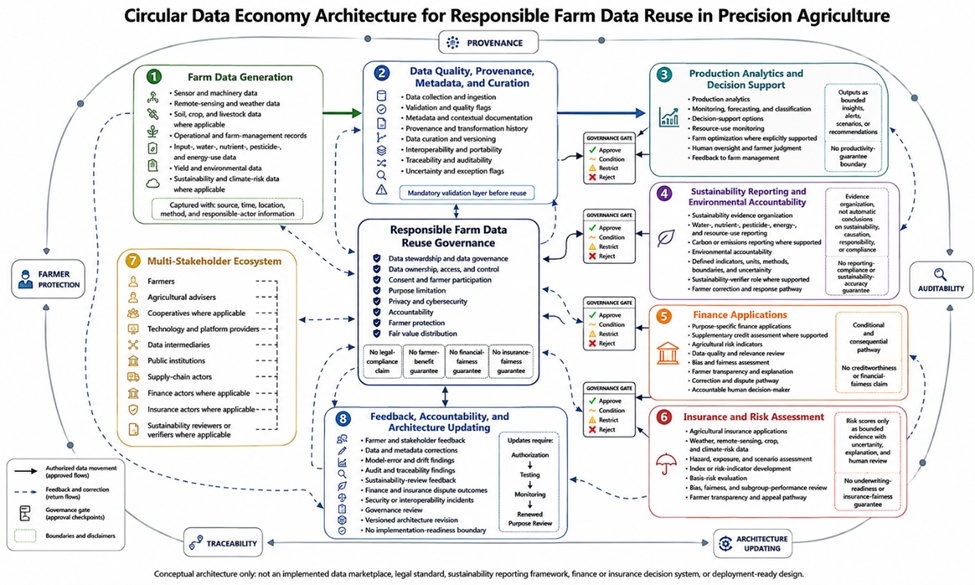
Figure 1. Circular Data Economy Architecture for Responsible Farm Data Reuse in Precision Agriculture
Alt-text description: A conceptual circular architecture showing farm data generated in precision agriculture moving through quality review, provenance, curation, consent, governance, interoperability, production analytics, sustainability reporting, finance, insurance, farmer protection, auditability, accountability, and feedback loops.
For farmers, advisers, cooperatives, technology providers, platform operators, and data intermediaries, the architecture clarifies that reuse readiness depends on more than technical access. Organizations would need to identify data stewards, document purposes, maintain metadata and provenance, support portability, communicate downstream uses, and establish mechanisms for correction and withdrawal where feasible. Advisers could serve as interpreters between analytical outputs and farm context, but their role should not be used to legitimize opaque systems or transfer responsibility away from data controllers and decision-makers. Cooperatives and farmer organizations may warrant study as possible governance and bargaining structures because they could aggregate technical capacity while representing farmer interests. These implications remain conceptual and require empirical investigation across different farming systems, infrastructure conditions, legal settings, and distributions of digital capability.
For sustainability verifiers, finance actors, insurers, supply-chain organizations, and public institutions, the architecture highlights the need to separate evidence collection from consequential judgment. Research should test whether purpose-specific quality thresholds, traceability records, uncertainty statements, bias reviews, explanations, and dispute pathways improve the legitimacy and reliability of reuse. Finance and insurance studies should examine error distribution across farm scales, regions, crops, production systems, and levels of digitalization rather than relying only on aggregate predictive performance. Sustainability research should evaluate whether data-based indicators remain comparable, auditable, and contextually meaningful and whether environmental accountability systems preserve farmer response and correction rights. Longitudinal assessment is needed because governance arrangements that appear acceptable at adoption may produce dependency, surveillance, or unequal value capture over time.
Future research should operationalize and test individual architectural stages without presuming that the whole design is validated. Priority areas include interoperable agricultural metadata, application-specific data-quality protocols, provenance and audit methods, consent interfaces, privacy-preserving analytics, cybersecurity testing, farmer-centred value assessment, bias and fairness evaluation, and governance of model and architecture updating. Comparative studies could investigate alternative stewardship arrangements, including platform-based, cooperative, public-interest, and distributed models. Participatory research should involve farmers in defining acceptable reuse purposes, benefit expectations, explanation needs, and dispute procedures. These are research directions and conceptual implications rather than legal, financial, insurance, investment, policy, procurement, agronomic, or operational advice.
This article proposes a circular data economy architecture for precision agriculture that connects farm data generation and curation with responsible reuse across production analytics, decision support, sustainability reporting, environmental accountability, finance, insurance, and risk assessment. Its central contribution is to place data quality, provenance, metadata, consent, purpose limitation, stewardship, interoperability, portability, privacy, accountability, fair value review, farmer protection, auditability, bias assessment, and feedback updating within one integrated conceptual structure. The architecture treats circularity as governed and revisable reuse rather than unrestricted data extraction or monetization. It also separates technical possibility from justified use by maintaining explicit boundaries concerning productivity, sustainability accuracy, legal compliance, creditworthiness, underwriting readiness, financial fairness, insurance fairness, farmer benefit, and implementation readiness. Responsible agricultural data reuse should therefore be assessed through farmer agency, contextual integrity, transparency, accountability, proportionality, and purpose-specific evidence rather than through data availability or analytical capability alone.
None
None
None
None
Open Access The author(s) retain copyright. This article is licensed under the Creative Commons Attribution-NonCommercial-ShareAlike 4.0 International License. It may be shared and adapted for non-commercial purposes with appropriate attribution, an indication of changes, and distribution of adaptations under the same license. Third-party material may be subject to separate terms identified in its credit line. View the license at https://creativecommons.org/licenses/by-nc-sa/4.0/.
 Agro Intelligence Research Press