Cold chains are essential food-system infrastructures because they preserve safety, quality, nutritional value, and marketability from production to consumption. Despite their importance, many cold-chain operations still depend on reactive checks, delayed audits, and fixed temperature protocols that are poorly aligned with the biological variability of food products. This reactive orientation allows quality deterioration to accumulate invisibly until products arrive at inspection points, retailers, or consumers. The central problem addressed in this article is the absence of an integrated architecture that connects continuous monitoring, predictive analytics, and automated decision support across the full cold-chain pathway. Sensors may detect temperature excursions, models may estimate shelf life, and logistics systems may manage routing, yet these capabilities often remain fragmented. Without architectural integration, cold chains cannot become truly intelligent, adaptive, or self-correcting. The objective of this article is to propose an Intelligent Cold Chain conceptual architecture for real-time quality preservation, spoilage prediction, and loss prevention. The architecture is designed to transform environmental and logistical data into predictive quality intelligence and operational decisions. It positions the cold chain as a cyber-physical system in which sensing, prediction, decision-making, and coordination interact continuously. The article develops its architecture through a conceptual synthesis of peer-reviewed research published between 2017 and 2025. The synthesis draws from cold-chain logistics, food quality engineering, IoT monitoring, machine learning, digital twins, and supply-chain systems design. It does not report new empirical data, but instead integrates existing technological and theoretical insights into an original systems framework. The proposed architecture defines four functional layers: sensing, prediction, decision, and coordination. These layers specify how sensor streams are acquired, how spoilage risk is inferred, how corrective actions are recommended, and how information is shared across actors. The architecture provides a blueprint for moving cold chains from passive refrigerated corridors toward proactive, data-driven systems that preserve quality and reduce food losses.
Cold chains are vital infrastructures within the global food system because they protect perishable products against the cumulative effects of temperature abuse, delays, and handling variability. Research on time-temperature management [1] shows that food quality is not determined by a single inspection event, but by the complete thermal history experienced across storage, transport, distribution, and retail. Reviews of cold-chain abuse [2] further demonstrate that deviations often occur between formal checkpoints, creating hidden quality losses before they become visible. This makes the cold chain both a logistics system and a quality-preservation system.
The weakness of many contemporary cold chains is that they remain organized around reactive control. Monitoring may occur through data loggers, manual inspections, or isolated alarms, yet corrective decisions are frequently taken after exposure has already affected product quality [3]. In this setting, static protocols treat all loads as if they have identical deterioration trajectories, even though product biology, packaging, route conditions, and handling events differ substantially. The result is a mismatch between the dynamic nature of food spoilage and the relatively fixed procedures used to manage it.
Digital technologies create the possibility of a different cold-chain logic. IoT-enabled monitoring can make temperature, humidity, location, and handling conditions continuously visible [4], while predictive analytics can convert these data into shelf-life forecasts and risk estimates [5]. Recent work on smart cold-chain logistics [6] suggests that these capabilities can shift cold-chain management from passive compliance toward active intelligence. The key architectural challenge is therefore not simply to install more sensors, but to connect sensing, prediction, decision, and coordination into one operational system.
This article proposes an Intelligent Cold Chain conceptual architecture that integrates real-time environmental monitoring, AI-driven spoilage prediction, and decision support for loss prevention. It first reconceptualises the cold chain as intelligent food infrastructure, then examines the sensing layer and its data streams. The later sections, to be developed in the complete manuscript, address prediction, decision support, actor coordination, and the proposed architecture. The contribution is conceptual and systems-oriented: it offers a structured design for transforming fragmented cold-chain technologies into a proactive quality-preservation system.
The cold chain has traditionally been understood as a sequence of refrigerated storage and transport activities that maintain prescribed temperature ranges. However, the review by Han et al. [6] indicates that fresh agricultural cold chains increasingly require integrated visibility, responsiveness, and information exchange. This expands the meaning of the cold chain from a physical logistics corridor to an intelligent food infrastructure. In such an infrastructure, refrigeration capacity, data streams, quality models, and stakeholder decisions function as interdependent components.
A systems view also reveals why static cold-chain control is insufficient. Food deterioration is cumulative, non-linear, and product-specific, so the same temperature deviation can have different consequences depending on prior exposure and remaining shelf life [1]. Studies of time-temperature abuse [2] show that losses arise not only from major equipment failures, but also from repeated small deviations, loading delays, and weak handovers. Intelligent infrastructure must therefore treat quality as a dynamic state variable rather than as a pass-or-fail condition checked at discrete points.
The move toward intelligence requires cold-chain systems to sense, interpret, and respond. Badia-Melis, Mc Carthy, Ruiz-Garcia, Garcia-Hierro, and Robla Villalba [3] describe a transition from conventional monitoring toward real-time applications capable of supporting operational visibility. Food informatics research [7] reinforces this shift by framing food-system data as a basis for modelling, optimisation, and cross-disciplinary decision-making. Together, these perspectives support a cold-chain architecture in which physical processes and digital representations co-evolve.
An intelligent cold chain should also be coordinated across organisational boundaries. Blockchain and traceability research [8] highlights the importance of trusted information exchange in food supply chains, especially when multiple actors handle the same product before it reaches consumers. IoT-based quality management studies [9] similarly suggest that value emerges when data are used across procurement, logistics, storage, and retail decisions rather than being confined to isolated devices. The architecture proposed in this article therefore treats the cold chain as a distributed cyber-physical system that requires both technical integration and governance alignment.
The sensing layer is the foundation of an intelligent cold chain because it captures the environmental and logistical conditions that shape product quality. Temperature remains the core data stream, but humidity, shock, vibration, gas composition, door openings, and light exposure can also provide signals of quality risk depending on the commodity and packaging system [3]. RFID and IoT implementations [4] show how product or pallet-level identifiers can link condition data to specific batches and logistics events. This linkage is essential because predictive models require not only measurements, but also contextualised histories.
Real-time monitoring differs from conventional logging because it enables intervention while quality can still be preserved. IoT-enabled cold-chain applications [10] demonstrate how sensor networks can transmit condition data from transport assets and logistics nodes, creating visibility beyond warehouse boundaries. When combined with GPS, wireless communication, and cloud data services, these systems can identify where and when temperature excursions occur. The architectural requirement is to make these data streams timely, interoperable, and interpretable for downstream prediction and decision layers.
Sensor integration also creates data-quality challenges. Measurements may differ by sampling frequency, calibration status, sensor placement, communication latency, and the physical distance between the sensor and the product core [5]. In multi-actor cold chains, data can be fragmented across transport providers, retailers, and technology platforms, which limits its usefulness for quality modelling [9]. An intelligent architecture must therefore include data validation, event harmonisation, and metadata management as part of the sensing layer rather than treating them as afterthoughts.
From a systems-engineering perspective, monitoring technologies should be selected according to the decisions they are expected to support. A simple temperature alarm may be sufficient for compliance reporting, but spoilage prediction requires continuous histories, product identity, and route context [11]. Table 1 summarises the key sensor technologies and data characteristics for intelligent cold-chain monitoring. These sensing functions provide the raw evidence from which the later prediction and decision layers infer quality risk.
Table 1. Sensor Technologies and Data Streams for Real-Time Cold Chain Monitoring
Sensor or data source | Primary measurement focus | Typical data characteristics | Architectural role in the intelligent cold chain |
Temperature sensors and data loggers | Air, package, pallet, container, or vehicle temperature | Continuous or interval-based thermal history; high relevance to shelf-life estimation | Establish the core time-temperature profile used by spoilage and quality-decay models |
Humidity sensors | Relative humidity around products or within storage spaces | Time-series environmental data; important for dehydration, condensation, and packaging performance | Adds quality context for products sensitive to moisture loss, mould growth, or condensation risk |
Gas sensors | Oxygen, carbon dioxide, ethylene, ammonia, or volatile spoilage compounds | Product- and packaging-specific signals; may require calibration and interpretation | Supports early detection of respiration, ripening, microbial activity, or package atmosphere failure |
Shock and vibration sensors | Mechanical impacts, vibration intensity, handling stress, and drop events | Event-based or continuous acceleration records; often linked to handling or transport episodes | Identifies physical damage risks that can accelerate deterioration or reduce marketability |
RFID tags and smart labels | Product identity, batch linkage, and sometimes embedded temperature or status data | Object-level identification combined with event or sensor data | Connects condition histories to specific products, lots, pallets, or shipments |
GPS and vehicle telematics | Location, route, speed, dwell time, and transport status | Spatial-temporal logistics data; often integrated with vehicle systems | Links quality risk to routes, nodes, delays, and handover events |
Wireless communication systems | Transmission of sensor and logistics data through cellular, LPWAN, Wi-Fi, Bluetooth, or 5G | Variable bandwidth, latency, power use, and coverage depending on route and infrastructure | Enables continuous visibility and supports timely alerts, prediction updates, and corrective actions |
Cloud, edge, and gateway devices | Local aggregation, preprocessing, filtering, and forwarding of sensor data | Multisource data streams requiring validation, timestamp alignment, and interoperability | Converts raw monitoring data into structured inputs for analytics, dashboards, and decision support |
The prediction layer converts cold-chain observations into estimates of remaining shelf life, quality decay, and spoilage risk. Neural-network approaches to perishable food temperature prediction [5] show that predictive models can learn dynamic thermal behaviour rather than treating exposure as a fixed compliance variable. Hybrid machine-learning models for cold-chain temperature prediction [12] extend this logic by linking logistics conditions with forecasted deviations. In the Intelligent Cold Chain, prediction is therefore not an isolated analytics function, but the interpretive layer that transforms sensor histories into quality intelligence.
Spoilage prediction must account for product-specific deterioration pathways. Blueberry freshness prediction using multi-source sensing and machine learning [13] demonstrates how environmental streams can be connected to freshness states, while egg freshness modelling under real-time storage conditions [14] illustrates the value of transfer learning for cold-chain quality assessment. Fish quality evaluation research [15] further shows that sensor-machine learning combinations can support quality inference for highly perishable products. These examples indicate that the architecture must support model diversity rather than assume a universal spoilage algorithm.
Kinetic models, machine learning models, and digital twins occupy complementary roles in quality risk detection. Non-destructive frozen-food quality determination using spectroscopy-based modelling [16] shows how quality signals can be inferred from indirect measurements, while machine-learning temperature management models [17] demonstrate the potential for safety and quality control in perishable supply chains. Artificial-intelligence shelf-life research [18] also highlights ongoing challenges related to data availability, model generalisability, and product heterogeneity. For this reason, the prediction layer should combine mechanistic knowledge with adaptive learning.
Digital twins strengthen spoilage prediction by representing both the physical product and the logistics environment in a continuously updated model [19]. Citrus supply-chain digital twins [20] show how trade-offs between quality and marketability can be quantified, while digital food twin research [21] frames food products as data-linked entities whose condition can be simulated and forecast. Table 2 classifies spoilage prediction models and their data requirements within the intelligent cold chain. This classification positions predictive analytics as a bridge between raw monitoring data and operational intervention.
Table 2. Spoilage Prediction and Quality Risk Detection Models: Approaches, Inputs, and Outputs
Model approach | Core analytical logic | Required inputs | Typical outputs | Role in the Intelligent Cold Chain |
Time-temperature kinetic models | Estimate quality decay using temperature-dependent reaction or microbial-growth functions | Product type, initial quality, temperature history, kinetic parameters, threshold values | Remaining shelf life, cumulative quality loss, safety-risk indicators | Provides interpretable deterioration estimates grounded in food science |
Machine-learning temperature prediction models | Learn patterns in thermal behaviour from historical and real-time logistics data | Sensor histories, route data, vehicle conditions, handling events, storage profiles | Forecasted temperature deviations, excursion probability, risk warnings | Anticipates future exposure before damage becomes irreversible |
Product-specific freshness models | Link environmental and product-quality measurements to freshness or acceptability states | Commodity identity, humidity, gas data, imaging or spectral data, quality labels | Freshness class, quality score, acceptability probability | Supports differentiated management of products with distinct spoilage pathways |
Microbial-growth and safety-risk models | Predict microbial proliferation under dynamic environmental conditions | Temperature history, product formulation, packaging, initial contamination assumptions | Microbial load estimate, safety margin, time-to-risk threshold | Connects cold-chain deviations to food-safety implications |
Digital twin simulation models | Maintain a virtual representation of product, package, route, and storage conditions | Multisource sensor streams, logistics events, product metadata, model parameters | Scenario forecasts, quality trajectory, intervention effects | Enables simulation of corrective actions before implementation |
Hybrid AI-mechanistic models | Combine domain equations with statistical or machine-learning components | Food-science parameters, sensor data, historical outcomes, operational context | Robust shelf-life prediction, uncertainty estimate, decision-ready risk score | Balances interpretability, adaptability, and predictive performance |
Alert and anomaly-detection models | Identify abnormal conditions or deviations from expected behaviour | Real-time sensor streams, baseline profiles, event rules, threshold limits | Alerts, anomaly labels, urgency levels, corrective-action triggers | Activates decision support when quality preservation is threatened |
The decision layer translates predicted quality risk into corrective action. Cold-chain break detection research [11] shows that machine learning can help identify abnormal thermal episodes, but the value of detection depends on whether the system can recommend timely responses. Over-temperature alarm systems [22] demonstrate the operational importance of immediate signalling when cold-chain conditions threaten quality. In the proposed architecture, alerts are not endpoints; they are triggers for structured decision logic.
Decision support should prioritise interventions according to product condition, route feasibility, and remaining market value. For meat cold chains, Ren et al. [23] emphasise that quality preservation depends on maintaining temperature integrity while considering handling, packaging, and distribution context. This implies that the same excursion should not always produce the same action. A pallet with high remaining shelf life may require monitoring, whereas a pallet nearing spoilage may require accelerated delivery, rerouting, or reprioritised sale.
Loss prevention also requires the integration of prediction models with logistics execution systems. Temperature prediction in food pallets [24] demonstrates that model training data and operational context influence the reliability of forecasts, so decisions must consider uncertainty. Predictive temperature management [17] further indicates that safety and quality control depend on aligning analytics with operational constraints. The Intelligent Cold Chain should therefore include confidence scores, decision thresholds, and escalation rules that help managers distinguish urgent risks from tolerable variability.
Figure 1 illustrates how cold-chain sensor events are converted into spoilage-risk interpretation, decision thresholds, corrective interventions, and feedback learning for future loss prevention.
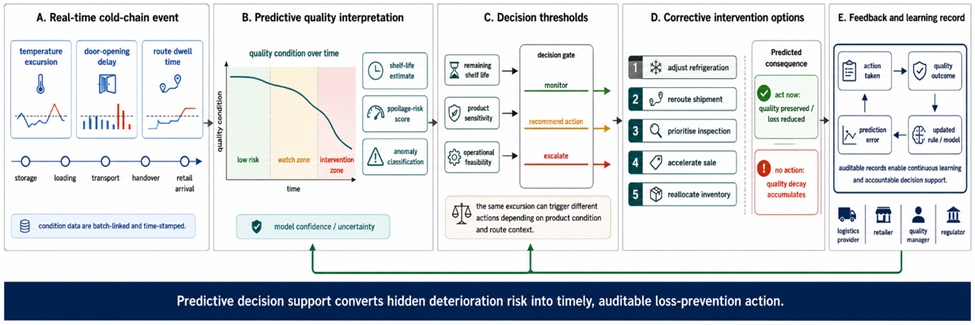
Figure 1. From temperature excursion to loss-prevention action: predictive decision logic in the Intelligent Cold Chain.
Automated decision support must remain auditable and explainable. Digital-twin planning and control in food supply chains [25] suggests that real-time models can support monitoring and control, yet managerial acceptance depends on whether recommendations can be understood and justified. AI-based shelf-life prediction studies [18] similarly identify generalisability and trust as continuing challenges. The architecture should therefore provide not only recommendations, but also the predicted quality consequence of acting or not acting.
The coordination layer addresses the fact that no single actor controls the entire cold chain. Growers, processors, logistics providers, port operators, distributors, retailers, and regulators each observe only part of the product journey, while quality deterioration accumulates across all parts. IoT-enabled quality management research [9] shows that food supply-chain value emerges when connected technologies support quality visibility across organisational boundaries. The Intelligent Cold Chain therefore requires shared data infrastructures rather than isolated monitoring systems.
Coordination depends on trusted product identity and traceability. Blockchain research in the food industry [8] highlights the potential of distributed records to support transparency, provenance, and trust among actors who may not share the same information systems. RFID-based traceability [4] provides the object-level identification needed to connect sensor histories with specific batches, pallets, or shipments. When these identity mechanisms are integrated with condition data, cold-chain actors can coordinate around the actual quality state of products rather than around documents alone.
Governance is as important as technology because shared data can create concerns about liability, commercial sensitivity, and accountability. Digital-twin implementation research in food supply chains [26] indicates that conceptual frameworks must account for organisational readiness, data ownership, and integration across business processes. Analyses of digital twins in agri-food supply chains [27] likewise show that adoption depends on aligning technical capability with supply-chain collaboration. The architecture must therefore define who can access which data, who can trigger interventions, and how responsibility is allocated when risk is detected.
Coordination also improves system learning. Cold-chain logistics research [6] frames future development around visibility, integration, and intelligent management, while real-time port monitoring [10] shows how logistics-node data can enrich operational awareness. If temperature excursions, delays, and corrective actions are recorded across actors, the system can learn which routes, carriers, packaging choices, and handover points repeatedly produce risk. In this way, coordination transforms isolated events into a cumulative knowledge base for loss prevention.
The proposed Intelligent Cold Chain architecture consists of four functional layers: sensing, prediction, decision, and coordination. The sensing layer captures temperature, humidity, gas, shock, location, identity, and logistics-event data through IoT, RFID, GPS, and related monitoring technologies [3]. The prediction layer converts these streams into shelf-life estimates, quality-risk scores, and anomaly signals using kinetic models, machine learning, and digital twins [5]. The decision layer then recommends or initiates corrective actions that preserve quality and prevent avoidable loss.
Information flows upward from physical products and logistics assets into digital representations, then downward from analytics to operations. Sensor data establish a live state description of each shipment, while prediction models estimate the likely future condition of the product under current and alternative scenarios [20]. Decision support uses these forecasts to propose actions such as temperature adjustment, inspection prioritisation, dynamic rerouting, accelerated sale, or inventory reallocation. Coordination mechanisms then distribute these decisions to the actors capable of executing them.
Figure 2 presents the proposed Intelligent Cold Chain architecture as an integrated cyber-physical system linking real-time sensing, spoilage prediction, decision support, cross-actor coordination, data governance, and continuous improvement.
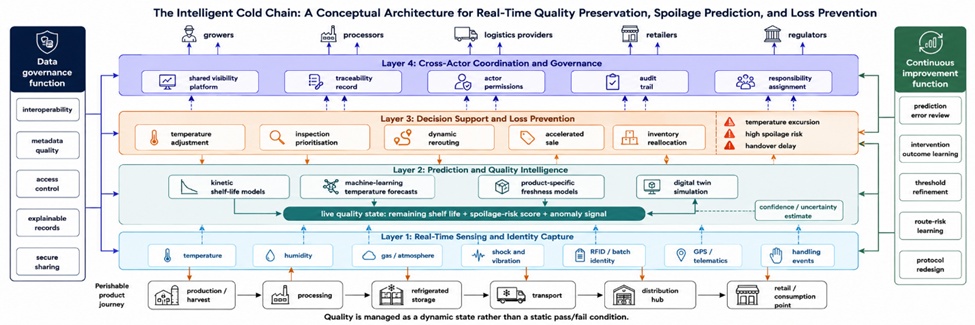
Figure 2. Intelligent Cold Chain conceptual architecture for real-time quality preservation and loss prevention.
The architecture also contains feedback loops that make the system self-correcting. When a corrective action is taken, its outcome becomes new evidence for evaluating the model and refining decision rules. Digital food twin research [28] and digital food-system modelling [21] support this feedback logic by showing how virtual representations can be updated as food products move through real environments. Over time, repeated feedback enables the architecture to learn which interventions preserve quality under specific product, route, and market conditions.
The architecture is conceptual rather than empirical, so it defines relationships, functions, and information flows rather than reporting measured performance. It is intended to guide system design, pilot implementation, and interdisciplinary research on intelligent cold-chain transformation. Table 3 presents the proposed Intelligent Cold Chain conceptual architecture with its layers, components, and information flows. The table specifies how each layer contributes to proactive quality preservation and loss prevention.
Table 3. Proposed Intelligent Cold Chain Conceptual Architecture: Layers, Components, and Data Flows
Architecture layer | Core components | Main data inputs | Main data outputs | Feedback and control function |
Sensing layer | Temperature sensors, humidity sensors, gas sensors, shock sensors, RFID, GPS, vehicle telematics, edge gateways | Environmental conditions, product identity, location, handling events, route status, timestamps | Validated sensor streams, event records, batch-linked condition histories | Detects real-time exposure and sends structured data to prediction models |
Prediction layer | Kinetic shelf-life models, microbial-growth models, machine-learning predictors, anomaly detectors, digital twins | Sensor histories, product metadata, route data, quality parameters, historical outcomes | Shelf-life estimates, quality-risk scores, spoilage forecasts, anomaly classifications | Updates predicted quality state as new measurements arrive |
Decision layer | Alert engines, decision rules, optimisation modules, dashboards, recommendation systems, escalation workflows | Risk scores, forecast uncertainty, operational constraints, inventory priorities, market requirements | Corrective-action recommendations, alarm priorities, rerouting options, inspection instructions | Converts predicted risk into actionable interventions |
Coordination layer | Shared platforms, traceability systems, actor permissions, governance rules, audit trails, collaboration interfaces | Product histories, action logs, stakeholder roles, compliance requirements, performance data | Shared visibility, responsibility assignment, cross-actor alerts, learning records | Aligns growers, processors, logistics providers, retailers, and regulators around product condition |
Data governance function | Interoperability standards, access controls, data-quality rules, metadata structures, accountability protocols | Raw and processed data from all layers, actor permissions, contractual and regulatory rules | Trusted datasets, auditable decisions, controlled information sharing | Ensures that intelligence is usable, secure, explainable, and legitimate |
Continuous improvement function | Model monitoring, performance evaluation, incident analysis, process redesign, learning repositories | Prediction errors, intervention outcomes, spoilage incidents, route performance, waste records | Updated models, revised thresholds, improved protocols, investment priorities | Enables the cold chain to learn from experience and reduce recurrent loss patterns |
For managers, the architecture implies that intelligent cold-chain adoption should begin with decision needs rather than technology procurement. Sensor investments should be tied to the quality risks that managers need to predict, the interventions they are willing to execute, and the data-sharing relationships required across partners [9]. Cold-chain operators can use the staged logic of sensing, prediction, decision, and coordination to prioritise implementation. This reduces the risk of creating sensor-rich but decision-poor systems.
Investment priorities should focus on interoperability, data quality, and predictive usefulness. The literature on cold-chain monitoring [3], RFID-enabled traceability [4], and digital twins in food supply chains [26] suggests that isolated devices create limited value unless they connect with enterprise systems and shared platforms. Managers should therefore evaluate vendors not only by measurement accuracy, but also by integration capability, model compatibility, and governance support. Partnership models with logistics providers, retailers, and analytics developers will be essential for scaling intelligent cold-chain functions.
Future research should empirically test the proposed architecture in real cold-chain settings and compare its performance against reactive monitoring regimes. Studies are needed to examine how predictive shelf-life estimates [18], digital-twin simulations [20], and alarm-based interventions [22] affect food loss, service performance, and economic viability. Researchers should also investigate standards for data exchange, model validation, uncertainty communication, and responsibility allocation across actors. Such work would move the Intelligent Cold Chain from conceptual design toward validated implementation.
This article has proposed an Intelligent Cold Chain conceptual architecture for real-time quality preservation, spoilage prediction, and loss prevention. The architecture responds to the limitations of reactive cold-chain management by integrating continuous monitoring, predictive analytics, decision support, and cross-actor coordination. Its central contribution is to organise these capabilities into a coherent systems framework that can guide design, implementation, and research.
The proposed architecture reframes the cold chain as an adaptive food-quality infrastructure rather than a passive refrigerated pathway. By linking sensor streams to spoilage forecasts and corrective actions, it enables quality to be managed as a dynamic state throughout the product journey. This creates the basis for proactive interventions before quality loss becomes irreversible.
The next step is to translate the architecture into pilot implementations across products, routes, and organisational settings. Such pilots should evaluate technical feasibility, managerial usability, economic value, and governance requirements. Cross-industry collaboration will be necessary to ensure that intelligent cold chains preserve food quality, reduce losses, and build trust across the entire food system.
None
None
None
None
Open Access The author(s) retain copyright. This article is licensed under the Creative Commons Attribution-NonCommercial-ShareAlike 4.0 International License. It may be shared and adapted for non-commercial purposes with appropriate attribution, an indication of changes, and distribution of adaptations under the same license. Third-party material may be subject to separate terms identified in its credit line. View the license at https://creativecommons.org/licenses/by-nc-sa/4.0/.
 Agro Intelligence Research Press