Food recalls remain essential instruments for protecting public health when unsafe, contaminated, mislabelled, or otherwise non-compliant products enter food supply chains. Yet many recall systems still operate primarily as downstream corrective mechanisms after hazards have already moved through production, distribution, retail, food service, or household channels. This reactive orientation can delay containment, increase exposure, and weaken public confidence in food safety governance. Conventional recall management is increasingly challenged by globalised sourcing, rapid distribution, e-commerce, multi-ingredient products, outsourced processing, fragmented traceability records, and uneven information sharing among actors. Weak risk signals may appear in laboratory data, consumer complaints, inspection findings, supplier records, online reports, or public health surveillance before they are recognised as recall-relevant evidence. When these signals remain disconnected, recall decisions may occur only after risk propagation has already widened. This article proposes a conceptual model for intelligent food recall systems that integrates early detection, risk signal fusion, network propagation mapping, coordinated response, accountability, and communication feedback. The model reframes recall management as a system intelligence problem rather than a narrow compliance, logistics, or product-removal task. It explains how anticipatory analytics and network-aware decision support can strengthen recall scope definition, actor alignment, and public communication. The contribution of the article is a structured conceptual framework for designing recall systems that are more anticipatory, traceable, coordinated, accountable, and adaptive. The model does not report new empirical data; rather, it synthesises food safety, artificial intelligence, supply-chain traceability, risk communication, and crisis-response perspectives into an integrated recall intelligence architecture. It offers a foundation for future empirical testing, digital system design, regulatory innovation, and food-industry implementation.
Food recalls are among the most visible and consequential interventions in food safety governance because they connect hazard control, consumer protection, regulatory accountability, and corporate responsibility. Their public health significance extends beyond the removal of unsafe products, since recalls often reveal deeper breakdowns in prevention, verification, supplier management, documentation, or communication. Global evidence on outbreaks and recalls shows that food safety incidents commonly arise from recurring contributory factors, supporting the need to frame recalls as system-level failures rather than isolated product defects [1].
The complexity of recall management has increased as food supply chains have become longer, faster, more distributed, and more data-intensive. Products may pass through farms, processors, brokers, storage facilities, distributors, retailers, food service operators, online platforms, and households before a hazard is confirmed. Recalls associated with foodborne disease outbreaks demonstrate that recall action is tightly linked to outbreak investigation, attribution, and timely identification of implicated products [2].
Reactive recall systems remain limited when they focus mainly on product withdrawal after contamination or non-compliance has already been confirmed. In many cases, weak signals exist before formal recall decisions, but they are dispersed across laboratory results, inspection records, complaint systems, supplier audits, surveillance alerts, and supply-chain documentation. Big-data approaches in food safety show that heterogeneous data streams can be used to support earlier recognition of food safety risks when they are organised into usable intelligence infrastructures [3].
This article argues that food recalls should be conceptualised as intelligent, anticipatory, network-aware, and coordination-intensive systems. Artificial intelligence and machine learning can support this shift by extracting risk signals from complex data types such as genomic records, images, text, sensor outputs, and supply-chain information when used within governed food safety decision processes [4]. The objective is to propose a conceptual model for intelligent food recall systems that integrates early detection, network propagation mapping, coordinated actor response, accountability, communication, and feedback learning. Figure 1 presents the proposed intelligent food recall architecture, showing how weak risk signals are transformed into network-aware recall decisions, coordinated response actions, accountable communication, and feedback-based system learning.
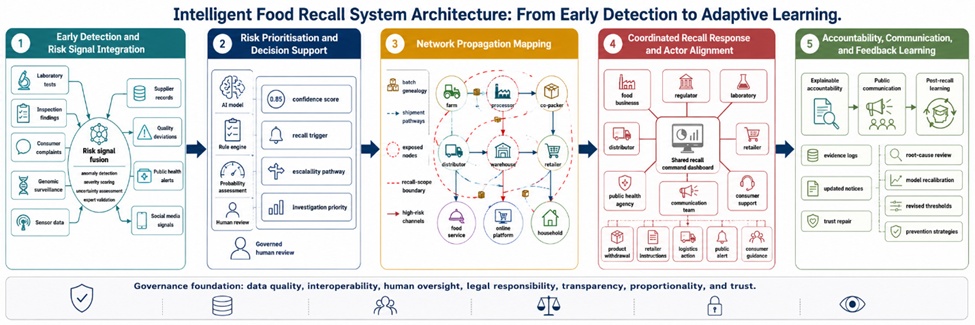
Figure 1. Intelligent Food Recall System Architecture: From Early Detection to Adaptive Learning
A food recall system becomes intelligent when it can sense emerging risk, integrate heterogeneous signals, interpret uncertainty, map product movement, coordinate intervention, and learn from previous events. This framing moves recall management beyond a compliance checklist and treats it as an information-processing capability distributed across firms, regulators, laboratories, logistics systems, retailers, health agencies, and consumers. Big-data research in food safety supports this view because recall intelligence depends on connecting internal operational records with external surveillance and contextual risk information [5].
The intelligence problem is not solved by data collection alone. Food businesses and regulators need decision-support mechanisms that can transform fragmented data into risk assessments, prioritised alerts, recall-scope recommendations, and actor-specific response tasks. Reviews of big-data and web-based decision-support systems in food safety show that analytical value emerges when data streams are converted into structured outputs for risk assessment and management action [6].
An intelligent recall system should therefore operate as an anticipatory infrastructure rather than a post-hoc administrative procedure. Such a system would continuously monitor signals, evaluate emerging hazards, identify affected product networks, notify responsible actors, guide proportional interventions, and update decisions as evidence changes. Research on AI, big data, internet of things, early warning, and emerging-risk identification shows that these technologies can contribute to more resilient food systems when they are integrated into structured food safety tools [7].
The central conceptual claim is that food recall management requires integration across detection, interpretation, propagation mapping, response coordination, accountability, and feedback. A recall that detects a signal but cannot map affected batches remains incomplete; a recall that maps exposure but cannot coordinate actors remains slow; and a recall that removes products but fails to communicate clearly may still damage trust. For this reason, intelligent recall systems should be designed as socio-technical infrastructures that combine analytics, governance, human judgement, and operational coordination [5-7].
Early detection is the first layer of an intelligent food recall system because recall speed depends on how quickly dispersed signals become decision-relevant evidence. Risk signals may arise from microbiological tests, chemical analyses, environmental monitoring, inspection findings, supplier non-conformance, consumer complaints, syndromic surveillance, social media posts, or epidemiological clusters. A machine-learning early-warning approach for Salmonella outbreaks illustrates how surveillance information can be analysed to detect emerging foodborne risks before escalation [8].
Risk signal integration requires more than automated alert generation. Predictive models must be connected to monitoring systems, validation routines, expert review, and decision thresholds so that recall teams can distinguish noise from actionable risk. Reviews of machine learning for food safety monitoring and prediction show that model performance, data quality, interpretability, and implementation context are essential when analytics are used to support food safety decisions [9].
Pathogen genomics adds a further layer of intelligence because it can strengthen linkage among human illness cases, food isolates, production environments, and possible sources. Whole-genome sequencing can support foodborne pathogen surveillance, source tracking, and risk assessment when integrated with epidemiological and supply-chain evidence. In intelligent recall systems, genomic signals should therefore be treated as part of risk-signal fusion rather than as isolated laboratory outputs [10].
Novel digital data streams can also supplement formal investigation workflows, especially when conventional reporting is incomplete or delayed. Recent analysis of novel data-stream use in foodborne illness cluster investigations by the United States Food and Drug Administration shows how nontraditional information can support investigation and decision-making when interpreted carefully [11]. Table 1 summarises the risk signals, data sources, and analytical methods that support early detection in intelligent food recall systems.
Table 1. Early Detection in Intelligent Food Recall Systems: Risk Signals, Data Sources, Analytical Methods, and Recall Triggers
Risk signal category | Typical data sources | Analytical methods | Recall intelligence function | Possible recall trigger |
Laboratory hazard detection | Microbiological tests, chemical residue tests, allergen tests, environmental swabs | Trend analysis, anomaly detection, threshold-based alerts, confirmatory testing | Identifies verified or suspected hazards in products, ingredients, or production environments | Positive pathogen result, undeclared allergen detection, chemical exceedance, repeated environmental positives |
Public health surveillance | Case reports, syndromic surveillance, outbreak databases, hospital and laboratory notifications | Cluster detection, time-series analysis, epidemiological linkage, geospatial analysis | Links illness patterns to possible food exposures and supports early outbreak recognition | Unusual illness cluster, epidemiological association with a product, increased reports in a region |
Genomic evidence | Whole-genome sequencing data, pathogen isolate databases, food-environment isolate matches | Genomic clustering, source tracking, phylogenetic comparison, risk attribution | Connects human, food, and environmental isolates to support source attribution | Genomic match between illness isolates and food or production-environment isolates |
Supply-chain and traceability records | Batch records, shipment logs, supplier records, enterprise resource planning systems, warehouse and retail records | Graph analytics, batch-linkage analysis, product-flow reconstruction, exposure mapping | Identifies where affected products moved and which nodes may require recall action | Affected batch distributed to multiple locations, shared ingredient across products, incomplete traceability records |
Consumer and market feedback | Complaints, returns, call-centre logs, online reviews, social media posts, retailer alerts | Natural language processing, sentiment analysis, complaint clustering, keyword detection | Detects weak market-facing signals before formal confirmation | Repeated complaints about illness, foreign material, odour, allergic reactions, or labelling inconsistency |
Process and quality deviations | HACCP records, temperature logs, sensor data, sanitation records, equipment alerts, production deviations | Statistical process control, real-time monitoring, predictive analytics, rule-based alerts | Identifies abnormal operating conditions that may increase product risk | Temperature abuse, sanitation failure, process deviation, equipment malfunction, repeated quality failure |
Regulatory and inspection signals | Inspection findings, non-compliance notices, import alerts, enforcement records, audit results | Risk scoring, rule-based prioritisation, cross-record linkage, decision-support dashboards | Prioritises facilities, products, or suppliers requiring investigation | Serious non-compliance, repeated audit failures, regulatory alert involving linked product or supplier |
External contextual signals | Weather events, supply disruptions, fraud alerts, geopolitical disruption, ingredient scarcity | Scenario analysis, risk modelling, emerging-risk screening, expert elicitation | Anticipates conditions that may increase contamination, substitution, or control failure risk | Emerging risk affecting a commodity, disruption linked to unsafe substitution, increased vulnerability of high-risk supply routes |
Food recalls unfold through networks because unsafe products rarely move along a single, transparent pathway. Contaminated, mislabelled, or otherwise risky products may pass through farms, processors, ingredient suppliers, co-packers, warehouses, wholesalers, retailers, food service channels, online platforms, and households before a recall decision is made. For this reason, propagation mapping should treat product-risk spread as a network cascade rather than a simple linear shipment problem, a view supported by modelling work on disruption propagation and recovery in agri-food supply-chain networks [12]. Figure 2 illustrates how an intelligent recall system can map risk propagation across interconnected supply-chain nodes while assigning coordinated, actor-specific response actions to contain exposure and refine recall boundaries.
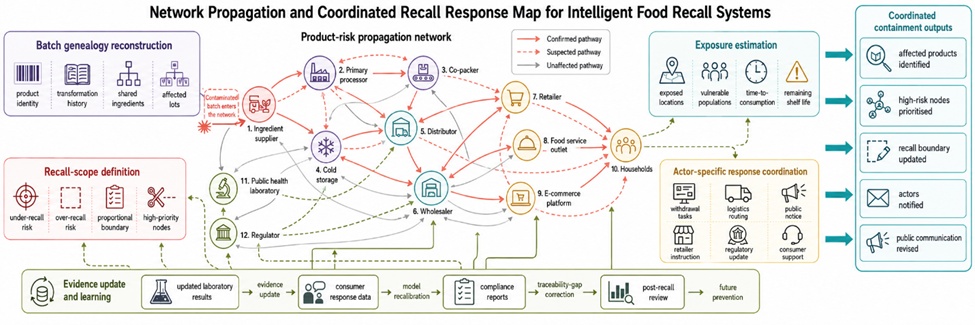
Figure 2. Network Propagation and Coordinated Recall Response Map for Intelligent Food Recall Systems
Network propagation mapping begins with the identification of nodes, edges, products, batches, processes, and decision points. Nodes may include facilities, distributors, retail locations, transport hubs, laboratories, regulatory agencies, or consumer-facing outlets, while edges represent product movement, data exchange, contractual dependence, or shared exposure pathways. Traceability systems can support this mapping only when their technical and organisational boundary conditions are understood, because blockchain or other digital ledgers do not automatically solve problems of data quality, actor participation, governance, or interoperability [13].
In intelligent recall systems, traceability should connect product identity, batch genealogy, transformation history, shipment pathways, and responsible actors. Blockchain-based traceability in food supply chains illustrates how distributed records can represent product movement and actor relationships in ways that may support more precise recall-scope definition [14]. This matters because under-recall may leave unsafe products in circulation, while over-recall may waste safe food, impose unnecessary economic costs, and erode confidence in proportional risk management.
Propagation mapping also improves recall prioritisation by distinguishing where risk has actually travelled from where it might be presumed to have travelled. A food-distribution blockchain use case shows the practical value of provenance visibility for answering where food has been and which partners may be linked to affected products [15]. In a conceptual intelligent recall system, this visibility would allow recall teams to identify high-risk nodes, prioritise consumer-facing channels, isolate affected batches, and update recall boundaries as new evidence arrives.
Coordinated response is the operational core of intelligent recall management because detection and propagation mapping do not protect consumers unless they trigger timely, aligned action. Recall categories, product types, hazard types, regulatory jurisdictions, and distribution channels shape the response burden and determine which actors must act first. Long-term analysis of food recalls in the United States shows that recall systems must account for changing recall patterns, triggers, and operational demands over time [16].
Actor alignment should also be risk-based rather than uniform across all recall events. Recall-associated outbreaks may differ by pathogen, food category, exposure setting, population vulnerability, and time to detection, meaning that response intensity should reflect the risk profile rather than only the administrative classification of the recall. Evidence on risk factors in recall-associated foodborne disease outbreaks supports the need for response systems that adapt to product, hazard, and context rather than applying the same workflow to every event [17].
Digital coordination can support alignment by creating shared dashboards, task lists, alert protocols, escalation rules, and decision-support outputs for firms, regulators, laboratories, distributors, retailers, and public health agencies. However, technology adoption must be matched with clear roles, staff capability, process redesign, performance expectations, and organisational trust. Research on Industry 4.0 and blockchain implementation in food supply chains highlights that digital transformation depends on people, process, performance, and technology dimensions rather than technology alone [18].
A coordinated recall response must balance speed, accuracy, proportionality, legal responsibility, and consumer protection. Acting too slowly may widen exposure, while acting on poorly interpreted evidence may create confusion, unnecessary waste, or reputational harm. Intelligent recall systems should therefore combine analytical outputs with human review, pre-agreed escalation pathways, documented responsibilities, and role-specific communication templates that reflect recall patterns, outbreak risk factors, and implementation realities [16-18].
Accountability in intelligent recall systems requires more than identifying the firm that issued the recall. It involves responsibility assignment, evidence documentation, auditability of decisions, explainability of analytical outputs, regulatory oversight, and post-recall learning. Public-facing communication is part of this accountability architecture because research on public attention shows that initial reports of foodborne illness may generate more attention than formal food recall announcements [19].
Recall communication should be timely, accurate, understandable, targeted, and updated as evidence changes. Consumers, retailers, food service operators, health professionals, and media channels may each need different versions of the same risk message, but those messages must remain consistent in substance. Research on food safety trust, risk perception, and company trust-repair actions in recall crises shows that recall management must address consumer interpretation and trust restoration, not only technical product removal [20].
Transparent traceability can strengthen accountability when it helps consumers and supply-chain actors understand what happened, which products are affected, and how risk is being controlled. Yet transparency is not only a data-access problem; it is also a communication problem involving clarity, relevance, and credibility. Evidence that blockchain-based food traceability can influence retailer choice through trust supports the argument that traceability information should be communicated in ways that are meaningful to stakeholders [21].
Intelligent recall systems should therefore integrate algorithmic decision support with transparent governance and human oversight. Delayed, vague, inconsistent, or overly technical messages can undermine compliance and generate confusion even when the technical recall decision is correct. A recall intelligence architecture should monitor public attention, support trust repair, and use traceability evidence responsibly so that accountability is both auditable within the system and understandable outside it [19-21].
The proposed conceptual model defines intelligent food recall systems as integrated socio-technical infrastructures with five interacting layers: early detection and risk signal integration, network propagation mapping, coordinated response and actor alignment, accountability and communication, and feedback learning. The analytic layer uses artificial intelligence to support detection, attribution, prediction, prioritisation, and decision support, while leaving final accountability within governed human and institutional processes. This design is consistent with food safety scholarship showing that AI can improve food safety across multiple functions when applied to clearly defined risk-management problems [22].
The first layer captures weak and strong signals from laboratories, inspections, consumer complaints, genomic surveillance, quality systems, supply-chain records, and connected devices. Internet of Things technologies can support this layer by enabling sensor-based monitoring and real-time data generation across food safety contexts [23]. In the model, these signals are not treated as separate warning channels but are fused into a risk-prioritisation process that evaluates credibility, severity, uncertainty, exposure potential, and need for escalation.
The second and third layers translate prioritised risk into network reasoning and coordinated action. Propagation mapping identifies affected products, batches, nodes, pathways, and potentially exposed actors, while coordinated response assigns tasks to firms, regulators, laboratories, logistics providers, retailers, public health agencies, and communication teams. Because digital food safety systems depend on data sharing across organisational boundaries, the model requires governed protocols for access, interoperability, confidentiality, liability, and responsible use [24].
The fourth and fifth layers ensure that recall decisions remain explainable, communicable, auditable, and adaptive. Risk-prioritisation tools may use alert databases such as RASFF to classify food safety risks and support decision-making, but these outputs should be embedded within governance, communication, and learning mechanisms [25]. Table 2 presents the proposed conceptual model for intelligent food recall systems, integrating early detection, network propagation mapping, coordinated response, accountability, and feedback learning.
Table 2. Conceptual Model for Intelligent Food Recall Systems: Detection, Propagation Mapping, Coordinated Response, Accountability, Communication, and Feedback Logic
Model layer | Core purpose | Main inputs | Analytical or organisational logic | Key actors | Main outputs | Feedback function |
Early detection and risk signal integration | Identify weak and strong indicators of unsafe, contaminated, mislabelled, or non-compliant food products | Laboratory results, inspection records, complaints, genomic data, quality deviations, sensor data, supplier records, public health alerts | Signal fusion, anomaly detection, predictive analytics, expert validation, severity scoring | Food businesses, laboratories, public health agencies, regulators, quality teams, technology providers | Risk alerts, confidence scores, escalation recommendations, investigation triggers | Improves signal thresholds, reduces false alarms, strengthens monitoring coverage |
Network propagation mapping | Identify how affected products, ingredients, or batches have moved through the supply chain | Traceability records, shipment data, batch records, supplier maps, retail distribution records, online sales records | Graph analytics, batch-linkage mapping, provenance reconstruction, exposure estimation | Manufacturers, suppliers, distributors, retailers, logistics providers, regulators | Affected-node maps, product-flow pathways, recall-scope boundaries, high-risk node lists | Refines supply-chain visibility and exposes traceability gaps |
Coordinated response and actor alignment | Convert risk intelligence into timely, role-specific intervention | Risk alerts, propagation maps, regulatory classifications, operational capacity, communication protocols | Shared dashboards, task allocation, workflow synchronisation, escalation rules, proportionality assessment | Recall managers, regulators, retailers, distributors, public health agencies, media teams, consumer support teams | Product withdrawal, public alerts, retailer instructions, logistics actions, consumer guidance | Tests response speed, clarifies responsibilities, improves future recall drills |
Accountability and communication | Ensure decisions are explainable, auditable, legally responsible, and publicly understandable | Decision logs, model outputs, evidence summaries, traceability records, communication updates, consumer questions | Human oversight, audit trails, explainability checks, risk communication, trust-repair logic | Firms, regulators, legal teams, communication teams, consumer organisations, media channels | Recall notices, evidence summaries, accountability records, updated public messages | Identifies communication failures, trust risks, documentation gaps, and governance weaknesses |
Feedback learning and prevention | Transform recall experience into prevention, system redesign, and future readiness | Post-recall reviews, performance indicators, consumer response data, compliance records, root-cause findings | Learning loops, root-cause analysis, model recalibration, policy revision, simulation exercises | Food businesses, regulators, researchers, technology providers, supply-chain partners | Updated controls, revised thresholds, improved models, training needs, prevention strategies | Converts recall events into organisational learning and system resilience |
For food businesses, the model implies that recall readiness should be embedded in routine food safety management rather than activated only after a crisis. Firms should invest in interoperable traceability records, integrated monitoring, recall simulation, digital dashboards, and machine-learning tools that can operate within HACCP-style control systems. Recent work on machine learning for food safety and HACCP monitoring in animal-source foods supports the practical need to test analytics within operational control programs rather than treating AI as a separate technological layer [26].
For regulators, public health agencies, laboratories, retailers, logistics actors, and technology providers, the model highlights the importance of shared standards, data governance, and cross-actor coordination. Future systems should connect food safety, quality management, traceability, and operational decision-making while preserving accountability for human judgement and regulatory oversight. Recent research on artificial intelligence applications in food safety and quality management supports a future agenda in which AI is integrated across detection, quality assurance, and management decisions [27].
Future research should empirically test the conceptual model in simulated and real recall settings. Studies should compare AI-assisted and conventional recall workflows in terms of detection speed, recall-scope accuracy, exposure reduction, communication effectiveness, trust outcomes, and post-event learning. Prototype research on blockchain-enabled traceability and certification for frozen food supply chains supports the need to evaluate auditable traceability architectures that combine distributed ledgers, IoT data, certification logic, and recall-relevant governance [28].
This article has proposed a conceptual model that reframes food recall as an intelligent, anticipatory, network-aware, and coordinated system. Rather than viewing recalls as downstream corrective actions, the model positions recall management as a continuous risk-intelligence process that begins with weak signal capture and extends through propagation mapping, actor coordination, accountability, communication, and learning. This perspective is especially important as food systems become faster, more global, more digitally mediated, and more vulnerable to complex propagation pathways.
The model shows that early detection alone is insufficient unless it is paired with the ability to identify where risk has travelled and who must act. A warning that cannot define affected products, map exposed nodes, coordinate responsible actors, or communicate clearly to the public may fail to protect consumers even if the analytical signal is accurate. Intelligent recall systems must therefore combine data science with traceability, governance, operational discipline, and human oversight.
The future of food recall management lies in systems that are not only faster but also more explainable, proportionate, inclusive, and trustworthy. Intelligent recall systems can provide a foundation for safer food supply chains by linking anticipation with accountability and technical precision with public communication. As food systems continue to evolve, recall intelligence should become a core capability of resilient, transparent, and consumer-centred food safety governance.
None
None
None
None
Open Access The author(s) retain copyright. This article is licensed under the Creative Commons Attribution-NonCommercial-ShareAlike 4.0 International License. It may be shared and adapted for non-commercial purposes with appropriate attribution, an indication of changes, and distribution of adaptations under the same license. Third-party material may be subject to separate terms identified in its credit line. View the license at https://creativecommons.org/licenses/by-nc-sa/4.0/.
 Agro Intelligence Research Press