Generative artificial intelligence is rapidly entering the food sector as a family of technologies capable of producing text, images, formulations, molecular structures, process scenarios, and synthetic training data. Its relevance to food manufacturing and product development lies in its capacity to accelerate experimentation, support creativity, and extend data-driven decision-making beyond conventional prediction. Yet the evidence base remains early, fragmented, and unevenly validated. This rapid evidence review maps the emerging literature on Generative AI in food manufacturing and product development from 2017 to 2025. The objective is to identify where applications are being explored, what opportunities are being claimed, and which risks and governance needs are becoming visible. The review focuses on Generative AI as a food system technology rather than as a general digital innovation. A rapid evidence review approach was used to synthesise 29 peer-reviewed articles relevant to Generative AI, food manufacturing, food quality control, product design, reformulation, digitalisation, food safety, and rapid review methodology. The review does not present new empirical data. Instead, it offers an accelerated mapping of a fast-moving field to inform research, practice, and policy. The evidence indicates that Generative AI is most visible in synthetic image generation, large language model support for food knowledge extraction, recipe and formulation assistance, hyperspectral data augmentation, and broader Industry 4.0 food manufacturing contexts. However, much of the literature remains conceptual, proof-of-concept, or adjacent to Generative AI rather than demonstrating mature industrial deployment. Risks are concentrated around validation, hallucinated outputs, safety claims, intellectual property, biological plausibility, and weak governance alignment. The review concludes that Generative AI has significant transformative potential in food manufacturing and product development, but this potential is conditional on rigorous validation and anticipatory governance. Without domain-specific standards, human oversight, transparent documentation, and regulatory engagement, Generative AI could amplify uncertainty rather than improve food system performance. A proactive research and practice agenda is therefore essential.
Generative AI has moved rapidly from a specialised computational approach to a general-purpose technology with implications for scientific discovery, industrial design, and knowledge work. In food systems, this shift is visible in recent work framing Generative AI as part of a broader transformation of the agri-food value chain and in studies evaluating food-oriented large language models for technical and professional tasks [1, 2]. The speed of this movement creates a central tension for food science: experimentation is accelerating faster than the development of validation protocols, safety standards, and sector-specific governance.
Food manufacturing is already being reshaped by digitalisation, computer vision, machine learning, Internet of Things infrastructure, and Industry 4.0 architectures. Reviews of artificial intelligence in the food industry and food processing 4.0 show that quality control, process optimisation, traceability, automation, and sustainability are becoming increasingly data-intensive domains [3-8]. Generative AI adds a new layer to this transformation because it does not merely classify, predict, or optimise existing data; it can generate candidate designs, synthetic data, explanations, recipes, and scenarios that may influence real food products and manufacturing decisions.
Product development is another area where the promise of Generative AI is especially visible. Food companies already use digital tools, big data, and integrated product development frameworks to accelerate innovation, while emerging AI applications suggest new possibilities for formulation, reformulation, flavour modelling, and alternative protein design [9-13]. However, food products are biological, sensory, cultural, and regulatory objects, so AI-generated ideas cannot be treated as valid simply because they are computationally plausible.
This rapid evidence review addresses the gap between technological possibility and validated food-sector adoption. It maps applications across manufacturing and product development, while also identifying validation gaps and governance needs that are specific to Generative AI in food contexts. The review draws on rapid review guidance and evidence mapping principles to provide a structured but accelerated synthesis suitable for a nascent and fast-moving field [14-16].
Generative AI refers to computational models capable of producing new outputs, including text, images, data, molecular representations, formulations, and design options. In this review, the term includes large language models, generative adversarial networks, transformer-based systems, and related architectures that can generate or augment food-relevant knowledge and data [1, 2, 17]. This distinguishes Generative AI from conventional predictive AI, which is primarily designed to estimate labels, risks, classes, or numerical outcomes from observed inputs.
The qualitative difference matters because food systems are safety-critical and materially grounded. A predictive model that classifies a defect or estimates contamination risk may be wrong, but a generative model may also fabricate a formulation, infer an unsupported safety claim, generate synthetic images that distort defect boundaries, or produce plausible but unverified technical guidance [18-20]. The same capability that makes Generative AI creative and scalable therefore creates new forms of uncertainty when outputs are translated into laboratory, factory, or consumer-facing decisions.
Adoption is being driven by pressures for faster innovation, lower development costs, reduced waste, and more flexible manufacturing. Evidence from food engineering, food manufacturing digitalisation, hyperspectral imaging, and AI-enabled quality control suggests that synthetic data, digital twins, and intelligent decision support may help overcome data scarcity and improve operational performance [6, 8, 10, 21-27]. Yet these drivers must be balanced against the challenge of validating generative outputs against food chemistry, microbiology, sensory performance, process feasibility, regulatory rules, and consumer acceptability.
This review used a rapid evidence review logic rather than a full systematic review because Generative AI in food manufacturing and product development is emerging quickly and remains conceptually dispersed. Rapid reviews are designed to streamline elements of evidence synthesis while preserving transparent search, selection, and mapping procedures, making them appropriate for time-sensitive technology fields [14, 15]. The review therefore prioritised breadth of mapping, domain relevance, and interpretive synthesis over exhaustive retrieval.
The evidence base was delimited to 29 peer-reviewed publications from 2017 to 2025 covering Generative AI, food-sector AI, manufacturing digitalisation, product development, food quality imaging, food safety knowledge extraction, reformulation, and rapid review methodology. Core Generative AI studies included food-oriented large language models, language-model extraction of food safety hazards, and generative adversarial network applications for food image and spectral data augmentation [2, 18-20, 22-28]. Broader contextual articles were retained where they explained the food manufacturing, product development, digital twin, Industry 4.0, or methodological setting in which Generative AI is likely to be adopted [3-17, 21, 29].
The evidence was mapped into three domains: manufacturing applications, product development and reformulation applications, and risks, validation gaps, and governance needs. Manufacturing evidence was strongest for synthetic image generation, hyperspectral augmentation, defect detection, and digitally enabled food processing, while product development evidence was more indirect and drew on reformulation, plant-based foods, sensory modelling, and digital product innovation [11-13, 21-27, 29]. Governance evidence was comparatively sparse, requiring synthesis across food safety extraction, large language model limitations, rapid review standards, and broader food AI guidance [3, 4, 14-16, 18-20].
The rapid approach has limitations because terminology is inconsistent, many food-sector AI studies do not explicitly use the term Generative AI, and some relevant developments may be embedded in adjacent fields such as computer vision, formulation science, or process engineering. Nevertheless, the selected evidence provides a sufficient basis for mapping the early opportunity-risk landscape and identifying where validation and governance must develop next. Table 1 outlines the review scope, search strategy, and the distribution of evidence across application domains.
Table 1. Rapid Evidence Review Scope and Evidence Mapping: Search Strategy, Inclusion Criteria, and Distribution of Studies by Domain
Evidence-mapping element | Scope used in this rapid review | Included evidence domains | Main contribution to the review |
Time window | Peer-reviewed literature published from 2017 to 2025 | Generative AI, food AI, digital food manufacturing, product development, reformulation, and rapid review methods | Captures the period in which food-sector digitalisation matured and Generative AI began entering applied food contexts |
Search orientation | Targeted search strings linking Generative AI, large language models, generative adversarial networks, food manufacturing, recipe generation, formulation, food safety, validation, governance, and rapid reviews | Food manufacturing, product development, safety and governance, and review methodology | Enables accelerated mapping of a nascent field without claiming exhaustive systematic coverage |
Inclusion criteria | Peer-reviewed journal articles relevant to Generative AI or its food-sector adoption context | Food-oriented LLMs, GAN-based data augmentation, food safety extraction, Industry 4.0 food manufacturing, reformulation, sensory modelling, plant-based food innovation, and rapid review guidance | Ensures that direct Generative AI evidence is interpreted alongside the food science and manufacturing settings where adoption occurs |
Exclusion criteria | Books, theses, reports, websites, non-peer-reviewed sources, and studies outside food, AI, manufacturing, product development, governance, or rapid evidence synthesis | Excluded sources not providing a food-sector, AI, or methodological contribution | Maintains relevance to an original rapid evidence review article rather than a broad technology commentary |
Manufacturing evidence | Studies on food processing 4.0, AI in food industry, IoT-enabled food manufacturing, hyperspectral augmentation, synthetic images, defect detection, and process efficiency | Quality control, data augmentation, defect recognition, digital manufacturing, process optimisation, and resource efficiency | Shows that manufacturing applications are the most technically developed part of the mapped evidence base |
Product development evidence | Studies on food extrusion datasets, food-oriented LLMs, digital product development, reformulation, plant-based analogues, and aroma or sensory intelligence | Recipe assistance, formulation support, ingredient design, sensory prediction, alternative proteins, and health or sustainability reformulation | Shows strong conceptual potential but limited direct validation of AI-generated formulations in real food systems |
Risk and governance evidence | Studies on LLM reliability, chemical food safety extraction, food named-entity recognition, AI guidelines, rapid review methods, and PRISMA-ScR evidence mapping | Hallucination risk, unsupported safety claims, biological validation, transparency, intellectual property, and regulatory readiness | Indicates that governance is less mature than technical experimentation and requires urgent development |
Evidence maturity | Mixed evidence base, ranging from conceptual reviews and methodological guidance to proof-of-concept Generative AI applications | Early-stage direct GenAI evidence and broader enabling literature | Supports a rapid, anticipatory synthesis rather than a definitive effectiveness assessment |
Generative AI applications in food manufacturing are most developed where they extend existing computer vision and spectral analysis pipelines. Synthetic data generation is especially relevant because food manufacturing inspection often suffers from limited examples of rare defects, contamination patterns, or abnormal product appearances. GAN-based augmentation in hyperspectral and image-based food studies has been used to strengthen detection models for maize kernels, unsound wheat kernels, pesticide residues, rawhide stick defects, and food recognition tasks [22-27].
The manufacturing opportunity is therefore not simply that Generative AI can create images, but that it can compensate for the imbalance and scarcity of industrial quality-control data. In food factories, defective products may be infrequent, variable, or difficult to capture under consistent imaging conditions, making synthetic defect generation attractive for model training. This aligns with broader reviews showing that computer vision and artificial intelligence are increasingly used for inspection, grading, monitoring, and quality assurance in the food industry [6, 7].
Generative AI may also support process optimisation by enriching simulation spaces and suggesting candidate operating conditions. Food processing 4.0 and Internet of Things-enabled manufacturing already emphasise connected sensors, process data, equipment monitoring, and adaptive control, creating a foundation for future generative process-design systems [5, 8, 21]. However, the evidence reviewed here shows stronger support for enabling digital infrastructure than for mature, validated Generative AI systems directly controlling food manufacturing lines.
Digital twin enrichment is another plausible manufacturing application because generative models can create scenarios, fill data gaps, and simulate alternative process states. Work on digital futures in food process engineering suggests that model-based, data-driven, and simulation-supported approaches are becoming increasingly important for food process design and control [10]. Yet the current evidence indicates that GenAI-enabled digital twins remain more of an emerging direction than a fully demonstrated industrial reality.
Product development is one of the most attractive domains for Generative AI because food innovation depends on exploring many combinations of ingredients, processing conditions, sensory attributes, nutrition goals, cost constraints, and sustainability targets. Large language models and food-oriented knowledge systems may support recipe ideation, technical documentation, literature extraction, and early formulation brainstorming [2, 18, 19, 28]. The FoodSky model, for example, demonstrates the emergence of food-oriented language models that can engage with chef and dietetic examination tasks, suggesting potential relevance to culinary and nutritional knowledge work [2].
Generative AI may also contribute to reformulation by proposing alternative ingredient combinations that reduce sugar, salt, fat, allergens, carbon intensity, or dependence on animal-derived ingredients. The reformulation literature shows that changes in processed foods such as yogurts and breakfast cereals are already a public health and product innovation concern [29]. In this context, GenAI could accelerate early-stage candidate generation, but each proposed formulation still requires laboratory validation, sensory testing, nutritional assessment, and regulatory review.
Alternative proteins illustrate both the opportunity and the validation deficit. The science of plant-based foods requires control over structure, flavour, texture, nutrition, processing behaviour, and consumer acceptability, all of which are difficult to infer from text-based or pattern-based outputs alone [12]. Generative AI may help search formulation spaces, but it cannot replace the physical, chemical, and sensory testing required to confirm whether a proposed meat, fish, milk, or egg analogue performs as intended.
Flavour and sensory design are similarly promising but scientifically demanding. The use of artificial intelligence in determining food odour codes shows how sensory intelligence can support interpretation of complex aroma systems, while digital product development studies show that data-driven innovation is becoming more important in food companies [11, 13]. Generative models may eventually support flavour pairing, aroma reconstruction, and texture prediction, but the reviewed evidence remains closer to enabling knowledge infrastructures than to validated autonomous product invention.
The main risk of Generative AI in food manufacturing and product development is that plausible outputs may be mistaken for validated outputs. Large language models can generate confident text, but food applications require evidence against chemical, microbiological, nutritional, sensory, processing, and regulatory criteria. Studies using LLMs for food safety hazard extraction and food named-entity recognition demonstrate useful capabilities, but they also imply the need for careful validation before such systems support safety-relevant decisions [18, 19].
A second risk is the production of hallucinated recipes, unsupported health claims, or technically infeasible formulations. Food-oriented LLMs may perform well on structured knowledge tasks, yet this does not prove that their generated recipes are safe, stable, scalable, or compliant with food law [2, 28]. In rapid product development settings, the temptation to treat generative suggestions as shortcuts could expose firms to safety, quality, consumer trust, and liability risks.
A third risk concerns synthetic data and model feedback loops. GAN-generated images or spectra can improve model training, but synthetic data may also introduce artefacts, exaggerate patterns, or hide failure modes if not tested against independent real-world samples [22-27]. In manufacturing contexts where inspection systems influence release decisions, validation must include not only accuracy metrics but also robustness, calibration, traceability, and performance under changing raw materials, lighting, equipment, and processing conditions.
Governance needs are therefore urgent and domain-specific. Food-sector GenAI governance should include documented human-in-the-loop workflows, pre-market validation requirements for AI-generated formulations, traceable records of generated outputs, disclosure of synthetic training data, and regulatory sandboxes for high-risk applications. Table 2 catalogues the identified risks, validation gaps, and governance needs for Generative AI in food manufacturing and product development.
Table 2. Risks, Validation Gaps, and Governance Needs for Generative AI in Food Manufacturing and Product Development
Risk area | How the risk appears in food manufacturing and product development | Main validation gap | Priority governance need |
Hallucinated safety claims | LLMs may generate confident but unsupported statements about allergens, microbial safety, shelf life, nutrition, or processing adequacy | Lack of systematic checking against food safety databases, laboratory evidence, and regulatory requirements | Mandatory human expert review for safety-relevant GenAI outputs and documented source grounding |
Untested formulations | AI-generated recipes or reformulations may be chemically unstable, sensorially unacceptable, unsafe, or impossible to scale | Insufficient laboratory, pilot-scale, and shelf-life validation of generated candidate products | Pre-market validation standards for AI-generated or AI-assisted formulations |
Synthetic image artefacts | GAN-generated defect or hyperspectral images may distort real defect distributions or produce unrealistic patterns | Limited external validation against independent factory samples and rare real defects | Documentation of synthetic data provenance, augmentation ratios, and independent test-set performance |
Biological plausibility | Generated ingredient combinations may ignore digestion, bioavailability, toxicity, allergenicity, or interactions during processing | Lack of biological and nutritional validation beyond computational plausibility | Required toxicological, nutritional, and allergenicity screening for novel AI-assisted ingredients |
Process infeasibility | GenAI may suggest process conditions, layouts, or control strategies that are incompatible with equipment, hygiene, or energy constraints | Weak integration between generated scenarios and engineering, sanitation, and equipment validation | Human-in-the-loop engineering review and factory-specific feasibility checks |
Intellectual property uncertainty | AI-generated formulations, recipes, sensory profiles, or process designs may raise questions of ownership and originality | Unclear allocation of rights between developers, food firms, model providers, and training-data owners | Contractual and regulatory clarification of ownership, attribution, and reuse rights |
Consumer transparency | Consumers may not know when products, claims, or labels were generated or substantially shaped by AI | Limited evidence on consumer expectations, trust, and disclosure preferences | Labelling or disclosure guidance for AI-assisted product development where material to consumer choice |
Regulatory misalignment | Existing food safety and product approval systems may not address generative model outputs directly | Lack of regulatory categories for GenAI-assisted formulations, claims, and manufacturing decisions | Regulatory sandboxes and sector-specific guidance for GenAI in food innovation |
Accountability gaps | Errors may be difficult to attribute across model vendors, food manufacturers, data providers, and human reviewers | Weak audit trails for prompts, generated outputs, modifications, and approval decisions | Full audit logging, responsibility assignment, and post-market monitoring for high-impact uses |
Over-reliance on automation | Staff may defer to plausible outputs even when model evidence is weak or incomplete | Limited training on GenAI limitations and uncertainty communication | Workforce training, escalation protocols, and mandatory expert sign-off for critical decisions |
The mapped evidence shows a field in a phase of rapid exploration rather than mature deployment. Direct Generative AI evidence in food is concentrated in food-oriented language models, LLM-supported food knowledge tasks, and GAN-based augmentation for quality-control data [1, 2, 18-20, 22-28]. Broader AI and food manufacturing reviews provide the infrastructure context, but they also show that much of the sector is still consolidating predictive AI, computer vision, and digitalisation before moving into fully generative systems [3-8].
The strongest near-term applications are those where generative models support existing expert workflows rather than replace them. Synthetic defect data can support inspection models, LLMs can assist with literature extraction or technical drafting, and generative systems can broaden early-stage formulation search [18, 19, 22-27]. However, the evidence does not yet support claims that Generative AI can autonomously validate food safety, invent commercially ready products, or operate manufacturing systems without expert oversight.
Figure 1 presents an integrated governance-oriented pathway showing how Generative AI can move from food-sector data and model generation to validated manufacturing and product-development decisions.
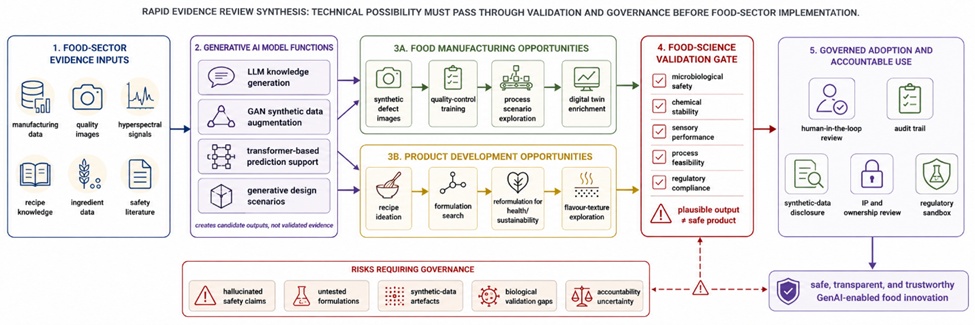
Figure 1. Integrated Evidence-to-Governance Pathway for Generative AI in Food Manufacturing and Product Development
The central imbalance is between technical push and governance pull. Food engineering, product development, and Industry 4.0 literatures show clear incentives for speed, automation, resource efficiency, and innovation, while rapid review guidance shows the value of transparent mapping when evidence is emerging [9-11, 14-16, 21]. Yet governance remains underdeveloped, especially for hallucination control, synthetic-data documentation, formulation validation, consumer transparency, and accountability across complex food innovation chains.
The first research priority is rigorous validation of GenAI outputs against food science standards. AI-generated recipes, process scenarios, ingredient combinations, safety summaries, and synthetic inspection data should be tested against laboratory results, pilot production, sensory panels, microbiological criteria, nutritional requirements, and independent real-world datasets [2, 12, 13, 18, 19, 22-29]. This validation should move beyond model accuracy and include feasibility, reproducibility, failure analysis, and uncertainty communication.
The second priority is explainability and documentation for generative food systems. Generative models should provide traceable links between inputs, generated outputs, training data, assumptions, and human modifications, especially when outputs affect food safety, product claims, or manufacturing release decisions [3, 4, 18-20]. Evidence mapping standards such as PRISMA-ScR and rapid review guidance can also inform transparent documentation of what is known, what is uncertain, and where evidence is still absent [14-16].
For practice, food firms should adopt voluntary safeguards before regulation fully catches up. These should include human-in-the-loop review, internal GenAI use policies, validation gates, synthetic-data disclosure, intellectual property review, and early engagement with regulators for high-impact applications [3-5, 8]. Firms should treat Generative AI as an innovation accelerator rather than a substitute for food science expertise, factory validation, and consumer responsibility.
Generative AI is becoming a powerful but still untamed force in food manufacturing and product development. It can accelerate ideation, enrich data, support quality-control systems, and expand the search space for new formulations. At the same time, it can also generate plausible but unsafe, unvalidated, or legally ambiguous outputs.
This rapid evidence review shows that the opportunity is real, but the evidence base remains early and uneven. The most credible near-term path is not autonomous GenAI-driven food innovation, but carefully governed collaboration between generative models, food scientists, engineers, regulators, and human decision-makers. The sector should therefore resist both uncritical enthusiasm and blanket rejection.
The future of Generative AI in food will depend on whether innovation is matched by safety, transparency, and public trust. Proactive governance should not be treated as a barrier to adoption, but as the condition that makes responsible adoption possible. If validation standards and accountability mechanisms are developed early, Generative AI can become a useful contributor to safer, smarter, and more sustainable food systems.
None
None
None
None
Open Access The author(s) retain copyright. This article is licensed under the Creative Commons Attribution-NonCommercial-ShareAlike 4.0 International License. It may be shared and adapted for non-commercial purposes with appropriate attribution, an indication of changes, and distribution of adaptations under the same license. Third-party material may be subject to separate terms identified in its credit line. View the license at https://creativecommons.org/licenses/by-nc-sa/4.0/.
 Agro Intelligence Research Press