The contemporary food system generates data at nearly every point where biological production, industrial processing, logistics, retail exchange, and consumer behaviour intersect. Farms produce sensor, satellite, machinery, weather, input, yield, and management data, while processing plants generate quality, safety, traceability, energy, water, and waste records. Downstream actors produce further streams of information through cold-chain monitoring, inventory systems, point-of-sale records, household consumption patterns, and nutrition-related choices. Despite this expanding data environment, the food system remains poor in system-wide intelligence because most data are captured, governed, and analysed within isolated organisational and technical domains. Production analytics, manufacturing intelligence, supply chain visibility, and consumer analytics have developed unevenly and are rarely connected into a coherent information architecture. As a result, decisions continue to be optimised locally rather than across the whole food system. This article proposes a conceptual framework for integrating production, processing, distribution, and consumption analytics into a unified food system intelligence capability. Food system intelligence is defined as the capacity to connect data across food system stages, convert them into actionable knowledge, and support decisions that improve productivity, sustainability, resilience, quality, and consumer value simultaneously. The article does not present new empirical data but synthesises existing literature to construct an integrative framework. The framework identifies four core data layers corresponding to production, processing, distribution, and consumption, joined through an integration layer based on standards, shared semantics, interoperable platforms, data-sharing agreements, and governance mechanisms. It also emphasises feedback flows, especially the use of downstream consumption, waste, and demand data to inform upstream production and processing decisions. Conversely, upstream sustainability, provenance, and production-practice data can enrich downstream retail, labelling, and consumer choice. The central argument is that food system intelligence is not primarily constrained by the absence of data but by the absence of integration and governance. Building this capability requires technical interoperability, institutional trust, reciprocal value creation, and a shift from stage-specific analytics to whole-system reasoning. The proposed framework offers a roadmap for connecting food system data to decisions from farm to fork and from fork back to farm.
The food system now produces unprecedented volumes of data, yet its capacity to understand itself as an integrated system remains limited. Digital agriculture has advanced through smart farming, big-data analytics, machine learning, and sensor-based decision support, making farm-level production increasingly measurable and modelled [1]. At the same time, food supply chains, processing systems, traceability platforms, and consumer-facing infrastructures generate their own data streams, but these streams often remain disconnected from the production data that precede them and the consumption data that follow them [2].
This article uses the term food system intelligence to describe the capability to integrate, analyse, and act on data across the full food system rather than within isolated stages. Such intelligence requires more than large datasets; it requires the ability to connect farm conditions, raw material attributes, processing performance, logistics constraints, retail demand, affordability, nutrition, and consumer preference into a shared analytical space. Existing work on food system dashboards demonstrates that integrated evidence can support better food policy, but dashboards alone do not yet create dynamic production-to-consumption intelligence [3].
The need for a conceptual framework emerges from the uneven development of digital capacity across the food system. Agricultural analytics has matured around yield prediction, input optimisation, environmental monitoring, and farm decision support [4], while supply chain transparency and blockchain-based traceability have developed around provenance, verification, and trust [5]. However, the analytical connection between these domains remains weak, producing a paradox in which individual stages become more data-rich while the system as a whole remains analytically fragmented.
The aim of this article is therefore to propose a conceptual framework for integrating production, processing, distribution, and consumption analytics into a coherent food system intelligence capability. The framework builds on literature in digital agriculture, food supply chain transparency, food system typologies, digital twins, data spaces, and semantic interoperability [6]. It argues that the next stage of food system digitalisation should move beyond local optimisation toward cross-system intelligence that can support sustainability, resilience, quality, affordability, and consumer choice together.
Food system intelligence is fundamentally an integration problem because the relevant data already exist but are distributed across different actors, technologies, standards, and decision contexts. Farm data are often held by producers, machinery providers, software platforms, input suppliers, or agronomic advisors, while processing, logistics, retail, and consumer data are held by other organisations with different incentives and formats [7]. This fragmentation prevents the food system from learning across stages, even when each individual stage is increasingly digitised.
The problem is not only technical. Data sharing in agri-food systems is shaped by ownership concerns, commercial sensitivity, trust deficits, power asymmetries, and uncertainty about who benefits from integration [8]. Data spaces and semantic infrastructures have been proposed as ways to enable trusted exchange, but their usefulness depends on governance arrangements that make participation valuable and safe for farmers, processors, retailers, technology providers, and consumers [9].
Figure 1 illustrates the transformation from fragmented stage-specific food system data into an integrated food system intelligence capability.
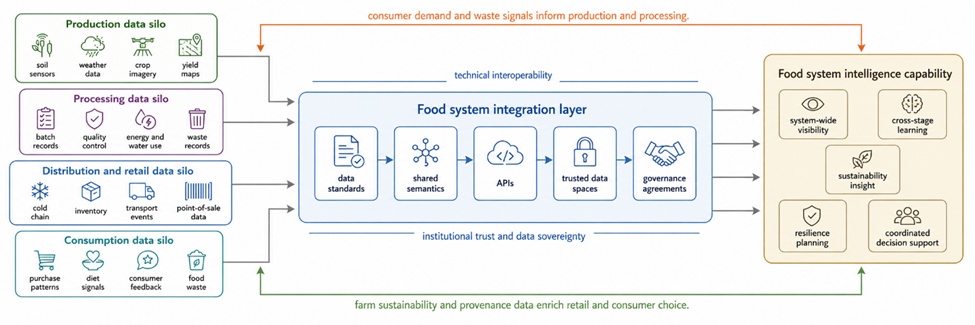
Figure 1. From Fragmented Food System Data to Integrated Food System Intelligence: A Production-to-Consumption Architecture for Connecting Farm, Processing, Distribution, Retail, and Consumption Analytics
A unifying framework is needed because food system intelligence cannot be achieved through isolated digital tools. Digital twins, food system dashboards, and integrated data platforms show the potential for modelling food systems as connected information environments, yet they remain partial unless they connect production realities, processing performance, supply chain movement, retail demand, and consumption outcomes [10]. The conceptual challenge is therefore to define how stage-specific analytics can be linked through shared data layers, integration mechanisms, and governance principles.
Farm-level data are among the most developed forms of food system data because production has been an early focus of digital agriculture. Sensors, drones, satellites, machinery telemetry, weather stations, farm management information systems, and yield monitors now generate data on soil conditions, crop status, input use, pest pressure, irrigation, field operations, and harvest outcomes [11]. These data make the farm more visible as an analytical unit, but they do not automatically make the wider food system more intelligent.
Production analytics has matured around yield prediction, input optimisation, variable-rate management, environmental monitoring, and decision support. Machine learning applications in agriculture show how diverse data sources can be used to model productivity, detect stress, forecast outcomes, and support more precise resource use [12]. Digital agriculture also offers a pathway for designing more sustainable agricultural systems when agronomic models are linked to environmental and economic decision criteria [13].
However, farm data often remain local, platform-bound, or actor-specific. The ownership and formatting of farm data may be distributed across equipment manufacturers, agritech firms, advisory services, public agencies, cooperatives, and individual farmers, making integration difficult even before data reach processors or downstream supply chain actors [14]. This creates a major bottleneck because downstream actors could benefit from structured information on production practices, expected quality, sustainability attributes, input histories, and harvest variability, while farmers could benefit from downstream demand and waste signals.
The production layer is therefore both a rich source of intelligence and an early site of fragmentation. To become useful for whole-system intelligence, farm data must be made interpretable beyond the farm through shared data definitions, trusted exchange arrangements, and governance models that protect farmer interests while enabling reciprocal value creation [15]. Table 1 summarises the current state of data and analytics at each food system stage and their integration deficits.
Table 1. Current State of Data and Analytics Across the Food System: Production, Processing, Distribution, and Consumption Stages — Capabilities, Data Types, and Integration Gaps
Food system stage | Dominant data types | Mature or emerging analytics capabilities | Main intelligence contribution | Integration deficits |
Production | Soil sensor data, weather data, satellite and drone imagery, machinery telemetry, input records, crop growth observations, yield maps, farm management records | Yield prediction, input optimisation, irrigation scheduling, pest and disease detection, environmental monitoring, field-level decision support | Makes biological production measurable and supports more precise agronomic decisions | Data are often platform-specific, locally held, inconsistently formatted, and weakly connected to processor, retailer, or consumer data |
Processing and manufacturing | Batch records, raw material quality data, food safety tests, sensor readings, quality-control images, traceability records, energy and water use, waste records | Quality control, process optimisation, defect detection, safety monitoring, resource-use tracking, batch traceability | Converts raw agricultural material into monitored product flows and measurable manufacturing performance | Processing data rarely include structured upstream production histories and often remain inside factory-level enterprise systems |
Distribution and retail | Cold-chain sensor data, inventory data, warehouse records, transport conditions, logistics events, point-of-sale data, demand forecasts, shelf-life records | Route optimisation, cold-chain monitoring, inventory forecasting, spoilage reduction, retail demand analytics, stock management | Reveals movement, availability, demand variation, and losses between processors, retailers, and consumers | Downstream demand and waste data rarely flow back to farmers or processors in actionable formats |
Consumption | Purchase data, household food behaviour data, nutrition data, consumer preference data, affordability indicators, waste data, digital platform interactions | Consumer segmentation, nutrition analytics, affordability assessment, demand sensing, product preference analysis, waste behaviour analysis | Captures how food is selected, used, valued, wasted, and linked to nutrition and health outcomes | Consumption data are fragmented across retailers, platforms, surveys, households, and public health datasets, with limited feedback into upstream planning |
Cross-system intelligence layer | Linked production, processing, logistics, retail, consumption, sustainability, and provenance data | Integrated modelling, digital twins, dashboards, traceability analytics, scenario analysis, federated analytics, shared decision support | Enables whole-system learning across farm-to-fork and fork-to-farm feedback flows | Requires standards, ontologies, APIs, governance agreements, trust mechanisms, incentives, and data sovereignty protections |
Processing and manufacturing intelligence represents the point at which biological variability is converted into controlled industrial performance. Food factories generate data through quality-control sensors, batch records, safety tests, temperature monitoring, ingredient tracking, production scheduling, energy use, water use, and waste measurement. The rise of Food Processing 4.0 has expanded the use of automation, digital monitoring, artificial intelligence, and connected production systems in food manufacturing [16].
This stage is analytically important because it translates raw agricultural inputs into products with defined safety, quality, shelf-life, nutritional, and sensory properties. Industry 4.0 approaches in food processing show how manufacturing data can support process control, defect detection, predictive maintenance, resource efficiency, and operational responsiveness [17]. Yet these systems often optimise factory performance without systematic access to upstream farm-level data on production conditions, input histories, harvest timing, or environmental attributes.
The disconnect between farm production and processing intelligence limits the ability of processors to anticipate variability in raw material quality. Traceability research shows that food supply chains increasingly seek transparency across actors, but much traceability remains event-based rather than analytically integrated across production, transformation, and consumption [18]. A processor may know where a batch came from and how it moved, but not always have machine-readable agronomic context that can be used to optimise processing parameters or sustainability claims.
Food manufacturing therefore needs to be treated as a middle intelligence layer rather than a closed operational domain. Digital food twins illustrate how food science and data science can be combined to model product behaviour, process performance, and system conditions, but their value increases when they are connected to both upstream production data and downstream demand or consumption data [19]. In the proposed framework, processing intelligence becomes the translation layer that links raw material variability, factory performance, product quality, and consumer-relevant attributes.
Distribution and retail analytics reveal how food moves, deteriorates, is priced, is purchased, and is wasted after processing. Cold-chain sensors, warehouse management systems, transport records, inventory platforms, shelf-life monitoring, and point-of-sale data can provide detailed information on the temporal and spatial performance of food flows. Digital transformation frameworks for food supply chains emphasise that these data can support visibility, responsiveness, coordination, and risk reduction across supply chain actors [20].
Retail and logistics data are especially important because they capture demand and loss closer to the point of consumption. If point-of-sale trends, stockouts, spoilage, household waste patterns, and consumer preference signals could be fed back into production and processing, they could improve crop planning, product reformulation, packaging decisions, and distribution scheduling. Digital twin frameworks for food supply chains suggest that such feedback is technically imaginable, but it requires integrated data models rather than isolated operational dashboards [21].
Consumption analytics adds another layer of system intelligence because food systems ultimately exist to provide accessible, affordable, nutritious, and acceptable diets. Work on the cost and affordability of healthy diets demonstrates that consumption cannot be understood only as market demand; it is also shaped by affordability, availability, income, nutrition, and social conditions [22]. For this reason, consumption data should not be treated merely as commercial retail information but as part of a broader food system intelligence layer linking consumer choice, dietary quality, and system performance.
The current food system still tends to organise information as a one-way flow from farm to fork rather than a learning loop from fork back to farm. Food system typologies show that different food systems vary in structure, complexity, market orientation, and development pathways, which means that downstream signals must be interpreted in context rather than imposed as universal demand indicators [23]. A mature intelligence system would allow consumption, retail, and waste data to inform upstream production while also allowing farm sustainability and provenance data to enrich downstream choice.
Cross-system integration requires technical mechanisms that allow heterogeneous data to be discovered, interpreted, exchanged, and reused across organisational boundaries. Shared ontologies, semantic standards, APIs, data harmonisation protocols, blockchain infrastructures, and data spaces can all contribute to this integration challenge. Semantic interoperability is particularly important because data cannot become intelligence if different actors use incompatible meanings for products, batches, production practices, quality attributes, or sustainability indicators [14].
Blockchain and traceability technologies address one part of the problem by supporting provenance, verification, and tamper-resistant records. However, blockchain alone does not create food system intelligence unless traceability records are connected to analytics, decision rights, governance models, and reciprocal value creation [5]. Similarly, federated learning offers a promising mechanism for cross-silo analytics because it can allow models to learn across distributed datasets without requiring all raw data to be centrally pooled [24].
The organisational challenge is therefore as important as the technical challenge. Data spaces can support trusted exchange, but participation depends on clear rules for ownership, access, consent, benefit sharing, liability, and sovereignty [9]. A food system intelligence framework must therefore combine interoperability infrastructure with governance innovation so that farmers, processors, distributors, retailers, consumers, public agencies, and technology providers can contribute data without losing control over their interests.
The proposed conceptual framework defines food system intelligence as a layered and governed capability linking production, processing, distribution, and consumption analytics. The production layer captures biological, environmental, operational, and input-use data; the processing layer captures transformation, quality, safety, resource-use, and batch data; the distribution layer captures movement, storage, inventory, cold-chain, and retail data; and the consumption layer captures purchasing, affordability, preference, nutrition, and waste data. These four layers are connected by an integration layer that enables data standards, APIs, shared semantics, data harmonisation, secure exchange, and cross-system analytics [15].
The integration layer is not simply a technical connector but the core architecture through which food system data become food system intelligence. It must translate stage-specific data into comparable, machine-readable, and decision-relevant information while preserving contextual meaning. Agricultural data spaces provide one model for this task because they emphasise governed exchange rather than uncontrolled data extraction [25].
The framework also depends on feedback loops that reverse the conventional direction of food system information. Consumer waste data can inform production planning, retail demand signals can inform processing schedules, and affordability or nutrition data can guide product development and distribution decisions. Conversely, farm sustainability data, provenance records, and production-practice information can move downstream to support product differentiation, labelling, consumer trust, and policy accountability [3].
Figure 2 presents the proposed food system intelligence framework as a layered architecture connecting data layers, integration mechanisms, governance principles, and decision feedback.
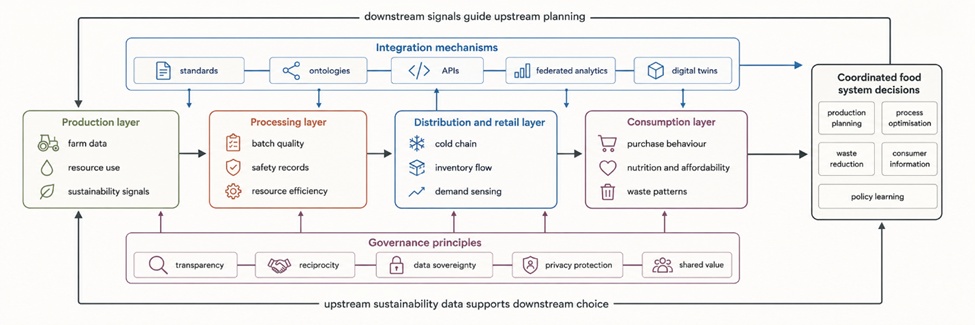
Figure 2. Layered Conceptual Framework for Food System Intelligence: Data Layers, Integration Mechanisms, Governance Principles, and Bidirectional Decision Feedback Across the Farm-to-Fork System
Governance principles are therefore built into the framework rather than added after technical design. Transparency is needed so actors understand how data are used; reciprocity is needed so value flows back to those who provide data; and data sovereignty is needed so farmers, firms, and consumers retain meaningful control over participation. Table 2 presents the proposed conceptual framework for integrating food system analytics into a unified intelligence capability.
Table 2. Proposed Conceptual Framework for Food System Intelligence: Data Layers, Integration Mechanisms, and Governance Principles
Framework component | Core function | Key data or mechanisms | Intelligence contribution | Governance requirement |
Production data layer | Captures farm-level biological, environmental, operational, and management conditions | Soil data, weather data, input records, machinery telemetry, crop imagery, yield maps, sustainability indicators | Enables understanding of production capacity, variability, resource use, and sustainability performance | Farmer data rights, platform transparency, benefit sharing, consent-based exchange |
Processing data layer | Captures transformation of agricultural inputs into food products | Batch records, quality-control data, food safety tests, processing parameters, energy and water use, waste records | Links raw material variability to product quality, safety, efficiency, and resource performance | Commercial confidentiality, auditable traceability, responsible data access |
Distribution and retail data layer | Captures movement, storage, availability, demand, and losses | Cold-chain records, logistics events, warehouse data, inventory records, point-of-sale data, shelf-life indicators | Supports demand sensing, spoilage reduction, inventory coordination, and supply chain responsiveness | Fair data-sharing contracts, risk-sharing rules, interoperability between supply chain actors |
Consumption data layer | Captures consumer choice, affordability, nutrition, preference, and waste outcomes | Purchase data, dietary indicators, affordability data, household waste signals, consumer feedback, product interaction data | Provides downstream feedback for production, processing, product design, and policy decisions | Privacy protection, consumer consent, ethical use of behavioural and nutrition data |
Integration layer | Connects stage-specific data into shared analytical infrastructure | Data standards, APIs, ontologies, semantic models, data spaces, blockchain records, federated analytics | Converts disconnected datasets into cross-system intelligence and feedback loops | Data sovereignty, trust frameworks, access rules, accountability mechanisms |
Decision and feedback layer | Converts integrated intelligence into coordinated action | Dashboards, decision-support tools, digital twins, scenario models, alerts, sustainability labels | Enables system-wide optimisation across productivity, resilience, sustainability, quality, affordability, and consumer value | Transparent decision logic, human oversight, equity-aware implementation, measurable public and private benefits |
For practice, the framework suggests that food system actors should invest less in isolated dashboards and more in shared infrastructure for data exchange. Processors, retailers, farmer organisations, logistics providers, and public agencies could pilot integrated data platforms that connect production conditions, processing outcomes, supply chain events, and demand signals. Digital twins of agri-food supply chains provide a practical direction for such pilots because they can model interactions among physical flows, data flows, and decision points [26].
The framework also implies that data-sharing cooperatives, sectoral data spaces, and federated analytics may be more realistic than fully centralised data repositories. Cross-silo federated learning is relevant because it can support shared model development while reducing the need to expose commercially sensitive or personally sensitive raw data [24]. Similarly, semantic data-sharing approaches can help food system actors move from document exchange to reusable machine-readable intelligence [8].
For research, the central agenda is to evaluate how integrated food system intelligence changes decisions and outcomes. Future studies should examine the economics of data sharing, the governance of food system data spaces, the design of interoperable ontologies, and the measurable impacts of integration on waste, sustainability, resilience, quality, affordability, and nutrition. Emerging work on artificial intelligence in the food industry points to expanding technical possibilities, but conceptual and empirical research must ensure that these technologies support system-wide intelligence rather than deepen fragmentation [27].
Food systems are increasingly data-rich, but they are not yet intelligence-rich. The main barrier is not the absence of information but the fragmentation of information across production, processing, distribution, retail, and consumption. A system that cannot connect these data cannot fully understand its own performance, vulnerabilities, trade-offs, or opportunities.
This article has proposed a conceptual framework for food system intelligence based on four data layers, one integration layer, and governance principles that enable trusted and reciprocal data exchange. The framework positions intelligence as a whole-system capability that allows downstream consumption and waste signals to inform upstream production, while upstream sustainability and provenance data enrich downstream choices. Its contribution is to shift the discussion from digital tools within food system stages to integration across the food system as a whole.
Building food system intelligence will require collective action across farmers, processors, distributors, retailers, consumers, policymakers, researchers, and technology providers. It will require standards, shared semantics, interoperable platforms, governance agreements, and institutional trust. The reward is a food system capable of learning from itself and acting more coherently for productivity, resilience, sustainability, quality, affordability, and public value.
None
None
None
None
Open Access The author(s) retain copyright. This article is licensed under the Creative Commons Attribution-NonCommercial-ShareAlike 4.0 International License. It may be shared and adapted for non-commercial purposes with appropriate attribution, an indication of changes, and distribution of adaptations under the same license. Third-party material may be subject to separate terms identified in its credit line. View the license at https://creativecommons.org/licenses/by-nc-sa/4.0/.
 Agro Intelligence Research Press