Intelligent agricultural systems increasingly combine sensors, artificial intelligence, automation, robotics, remote sensing, decision support, digital platforms, and data infrastructures to support farm management. These systems promise more precise monitoring, faster decisions, and improved resource use. Yet their practical value depends on how they enter the social and ecological realities of farming. A persistent problem in intelligent agriculture is that systems are often evaluated through technical performance, productivity, efficiency, or predictive capability. Such evaluations can understate whether technologies fit farmer judgement, local work routines, ecological variability, and institutional conditions. When these dimensions are treated as secondary, intelligent systems may intensify rather than resolve farm-system tensions. This article develops a theory of the socio-technical farm based on human–technology–ecology alignment. The central argument is that intelligent agricultural systems become effective, responsible, and sustainable only when human actors, technological functions, and ecological processes are mutually coordinated. Alignment is therefore theorised as an active, situated, and adaptive relationship rather than as a static design feature. The theory-building synthesis integrates scholarship on intelligent agriculture, digital farming, socio-technical systems, human-centred design, ecological feedback, farm decision-making, and responsible innovation. It defines core constructs, explains alignment mechanisms, identifies misalignment risks, and specifies boundary conditions. The article positions farms as dynamic systems in which judgement, data, machinery, organisms, soil, weather, markets, and governance interact. The proposed theory contributes a farmer-centred and ecology-aware account of intelligent agriculture. It explains how adaptive feedback, contextual design, interpretability, advisory support, accountable governance, and ecological embeddedness shape whether intelligent systems strengthen or weaken farm performance. The theory redirects evaluation from automation alone toward aligned socio-technical design that supports human agency, technological responsibility, and ecological care.
Intelligent agricultural systems have become central to contemporary debates about the future of farming because they combine data, algorithms, platforms, automation, sensing, and decision-support functions within everyday farm management. The social-science literature on digital agriculture shows that these developments cannot be understood only as technical upgrades because they reorganise relations among farmers, advisers, firms, institutions, and knowledge systems [1]. This article therefore begins from the premise that intelligent agriculture is a socio-technical transformation rather than a simple collection of devices.
Smart farming also depends on linked data infrastructures that connect fields, machines, sensors, analytics, platforms, and management choices. Big-data systems in farming create new forms of coordination by transforming heterogeneous observations into decision-relevant information, yet this coordination remains dependent on actors, standards, ownership arrangements, and organisational capacity [2]. The socio-technical farm emerges where data infrastructures become embedded in the practical routines through which agricultural work is planned, monitored, and adjusted.
Agricultural analytics expand the range of decisions that can be supported, but they also introduce challenges of interpretation, integration, and contextual fit. Big-data analysis in agriculture can help identify patterns across production, climate, soil, and management data, while still requiring careful translation into meaningful farm action [3]. The theoretical gap addressed here is that human, technological, and ecological dimensions are often discussed separately, even though farm outcomes depend on their alignment.
This article develops a theory of the socio-technical farm as an intelligent agricultural system shaped by human–technology–ecology alignment. The need for such a theory is reinforced by responsible-innovation scholarship, which shows that smart farming redistributes inclusion, agency, accountability, and the capacity to shape technological futures [4]. The following sections define the theoretical foundations of the socio-technical farm, explain its core constructs, and prepare the alignment pathways developed in the later parts of the article.
The socio-technical farm is grounded in the idea that agricultural technologies operate within wider innovation systems rather than within isolated production units. Digitalisation of agricultural innovation systems connects technologies, policy, markets, knowledge networks, advisory services, and users across multiple levels [5]. This means that the intelligent farm should be theorised as a node within a broader ecology of actors, institutions, infrastructures, and expectations.
A second foundation is transition thinking, because Agriculture 4.0 does not move along a single pathway or produce uniform benefits. Game-changing agricultural technologies can support multiple transition trajectories, and those trajectories raise questions about diversity, responsibility, inclusion, exclusion, and governance [6]. In the proposed theory, these transition pathways form boundary conditions that shape whether intelligent systems become aligned with farmers and ecosystems or reinforce narrow technological agendas.
A third foundation concerns agricultural knowledge, because farming is not only a site of production but also a situated practice of observing, interpreting, experimenting, and adapting. Digitalisation changes agricultural knowledge by reshaping how farmers know their fields, assess risk, engage with advice, and translate information into action [7]. Human judgement is therefore not replaced by intelligent technology; it becomes a central alignment construct that determines how technological outputs are interpreted and used.
A fourth foundation is the role of advice networks as mediating infrastructures between digital systems and farm practice. Digitalisation of agricultural knowledge and advice networks shows that advisers, platforms, data tools, and institutional norms increasingly interact in the production of farm decisions [8]. The socio-technical farm therefore requires a theory of adaptive coordination in which farmers, advisers, technologies, and governance arrangements jointly shape how intelligence becomes actionable.
The farm as a socio-technical system is composed of human actors, intelligent technologies, ecological processes, data infrastructures, governance arrangements, labour routines, and management goals. Data-driven coordination depends on trust, transparency, and perceived benefit-sharing because farmers are unlikely to rely on systems whose data practices or value distributions remain unclear [9]. Trust is not an optional social variable in this theory; it is a mechanism through which technological capability becomes legitimate and usable.
Intelligent agriculture also changes the farm by altering labour, community relations, and the distribution of power. Agricultural automation can reshape rural livelihoods and deepen digital divides when new technologies privilege particular skills, scales, or forms of capital [10]. The socio-technical farm therefore includes labour capacity and community embeddedness as core conditions of alignment, not as external consequences of technological change.
Technological adoption is likewise ordered by material conditions, knowledge practices, and farmer engagement rather than by technical availability alone. Precision-agriculture technologies become meaningful only when they fit the material realities of equipment, land, data flows, skills, and decision routines [11]. Misalignment occurs when a technically sophisticated system fails to connect with the practical ways farmers diagnose problems, compare options, and act under uncertainty.
Digital platforms add a further layer to the socio-technical farm because they can shape the trajectory of decisions, dependencies, and forms of agency. Platform-based farming may lock farms into algorithmic pathways when farmers lose interpretive control over how data are classified, valued, and translated into recommendations [12]. Table 1 summarises the core theoretical constructs of the socio-technical farm.
Table 1. Core Theoretical Constructs of the Socio-Technical Farm: Human Actors, Intelligent Technologies, Ecological Conditions, Alignment Mechanisms, Misalignment Risks, and Boundary Conditions
Core theoretical construct | Definition in the socio-technical farm theory | Alignment mechanism | Misalignment risk | Boundary condition |
Human actors | Farmers, advisers, workers, service providers, technology developers, platform firms, and governance actors who shape farm decisions. | Interpret data, negotiate goals, maintain practical control, and translate technological outputs into situated action. | Farmer judgement becomes marginalised, labour capacity is underestimated, or decision authority shifts away from farm-level actors. | Skills, trust, advisory support, ownership structures, labour availability, and institutional legitimacy. |
Intelligent technologies | Sensors, AI systems, robotics, automation, remote sensing, decision-support tools, platforms, and data infrastructures. | Extend observation, prediction, coordination, and feedback when designed around contextual farm practice. | Opaque recommendations, platform dependency, automation bias, poor usability, and algorithmic lock-in. | Data quality, interoperability, explainability, accessibility, affordability, and maintenance capacity. |
Ecological conditions | Soil, water, biodiversity, weather, pests, crops, livestock, landscape processes, and seasonal variability. | Provide feedback signals that guide adaptive management and test the ecological consequences of technological decisions. | Ecological complexity is reduced to narrow indicators, delayed feedback is ignored, or optimisation harms biodiversity and resilience. | Climate variability, landscape heterogeneity, species interactions, resource constraints, and temporal feedback delays. |
Alignment mechanisms | Processes that coordinate human judgement, technological capability, and ecological feedback. | Enable adaptive coordination through participatory design, interpretability, advisory mediation, monitoring, and governance. | Alignment becomes superficial when tools optimise isolated variables without supporting situated judgement or ecological learning. | Institutional support, governance accountability, local knowledge, and capacity for iterative learning. |
Misalignment risks | Failures that arise when human, technological, and ecological elements do not fit one another. | Risks are reduced when design, governance, and use practices remain responsive to farm realities. | Weak adoption, loss of trust, ecological harm, deskilling, exclusion, unsustainable intensification, or brittle decision routines. | Power asymmetries, market pressure, data ownership, farm scale, regulatory context, and environmental uncertainty. |
Boundary conditions | Contextual factors that determine whether intelligent agriculture produces aligned or misaligned outcomes. | Clarify where the theory applies differently across farm types, regions, capabilities, and ecological settings. | A system that works in one context is transferred uncritically to another, producing poor contextual fit. | Farm size, commodity type, advisory infrastructure, ecological sensitivity, digital connectivity, and governance maturity. |
Human–technology alignment refers to the degree to which intelligent agricultural technologies support farmer judgement rather than displace it. Agricultural decision-support systems align with practice when farmers and other stakeholders shape system design, because user-centred development improves the fit between recommendations, interfaces, decision contexts, and real management needs [13]. In the socio-technical farm, a decision-support tool is therefore not aligned simply because it is accurate; it is aligned when its outputs are interpretable, actionable, and compatible with situated farm reasoning.
This alignment is conditioned by farm scale, regional context, institutional support, cost, perceived usefulness, and farmer capability. Precision-technology adoption varies across farmers and regions because adoption depends on economic, organisational, social, and infrastructural conditions rather than on technical availability alone [14]. The theory therefore treats adoption as evidence of relational fit among people, tools, institutions, and work routines, not as a simple indicator of technological superiority.
Advisers play a mediating role in human–technology alignment because they translate digital outputs into decisions that farmers can evaluate and adapt. Smart-farming advisers can support digital innovation by connecting data systems, equipment, agronomic interpretation, and farm-specific practice [15]. This means that alignment is often distributed across a network of human actors rather than located solely in the interface between one farmer and one device.
Misalignment occurs when big-data systems increase dependency, reduce interpretive control, or distribute benefits unevenly across farm actors. Perceptions in the grains industry show that big data can be viewed either as a tool for broader farm capability or as a system that primarily advantages larger, better-resourced actors [16]. Human–technology alignment therefore requires explainability, override capacity, digital skills, advisory support, fair access, and governance arrangements that preserve meaningful farmer agency.
Technology–ecology alignment refers to the degree to which intelligent technologies represent, monitor, and respond to ecological complexity without reducing it to narrow optimisation variables. Agricultural IoT systems can translate soil, climate, crop, livestock, and environmental conditions into data streams, but their value depends on reliable sensing, integration, maintenance, connectivity, and interpretation [17]. In the socio-technical farm, sensors are not neutral windows onto ecology; they are selective instruments that make some ecological signals visible while leaving others outside the model.
Digital agriculture can support sustainability when it is used to redesign agricultural systems across spatial and temporal variability. System design matters because data-driven tools can strengthen ecological management only when they connect field-level decisions with broader sustainability goals and long-term resource consequences [18]. Technology–ecology alignment therefore requires that intelligent tools be evaluated not only by immediate productivity but also by how they support adaptive ecological learning.
Precision farming sits at the nexus of production and environmental outcomes because the same technologies that improve input efficiency may also influence nutrient flows, emissions, biodiversity, and resource pressures. Environmental benefits are not automatic; they depend on how precision tools are deployed, what objectives they optimise, and whether management decisions account for ecological trade-offs [19]. The theory therefore treats ecological performance as an alignment outcome rather than an assumed result of technical precision.
A central risk is that models may simplify ecological processes into indicators that are easy to measure but insufficient for sustainable management. Technology–ecology misalignment arises when soil health, water dynamics, pest interactions, animal welfare, biodiversity, and landscape processes are represented too narrowly for the decisions being made. Building on the sustainability logic of digital system design, aligned technologies must incorporate uncertainty awareness, biodiversity-sensitive metrics, adaptive models, and feedback loops that can challenge rather than merely confirm optimisation routines [18].
Human–ecology alignment refers to the relationship between farmer judgement and the living, variable, and place-specific conditions of agricultural ecosystems. Agroecological principles emphasise diversity, synergies, recycling, resilience, efficiency, co-creation of knowledge, and local adaptation as foundations for sustainable food-system transitions [20]. In the socio-technical farm, these principles indicate that farmer judgement must remain ecologically embedded rather than being reduced to compliance with algorithmic outputs.
Farms also operate within working landscapes where production, biodiversity, livelihoods, and human well-being interact. Landscape scholarship shows that agricultural systems can be managed for both biodiversity and people when ecological processes are considered alongside social goals [21]. Human–ecology alignment therefore extends beyond the field boundary to include habitat connectivity, water flows, pollination, pest regulation, community needs, and long-term landscape resilience.
Conservation practice adoption demonstrates that ecological alignment depends on farmer decision factors, institutional context, and practice-specific constraints. Decisions to adopt conservation practices are shaped by attitudes, knowledge, social norms, economic considerations, policy incentives, and the perceived fit of practices with farm conditions [22]. The theory therefore treats human–ecology alignment as a practical accomplishment in which ecological care must be compatible with livelihoods, risk judgement, and management feasibility.
Intelligent technologies may strengthen human–ecology alignment when they expand observation and make delayed ecological feedback more visible. They may also weaken it when local knowledge, seasonal memory, and experiential judgement are treated as inferior to digital outputs. Table 2 compares the three alignment pathways linking humans, technologies, and ecological processes in intelligent agricultural systems.
Table 2. Human–Technology–Ecology Alignment Pathways in Intelligent Agricultural Systems: Alignment Mechanisms, Failure Modes, Governance Needs, and Sustainability Implications
Alignment pathway | Core relationship | Alignment mechanisms | Common failure modes | Governance needs | Sustainability implications |
Human–technology alignment | Relationship between farmers, advisers, workers, platforms, machines, algorithms, and decision-support systems. | Participatory design, interpretability, advisory mediation, override capacity, digital skills, contextual interfaces, and fair access. | Opaque recommendations, automation bias, platform dependency, deskilling, weak trust, poor usability, and exclusion of less-resourced farms. | Data transparency, accountability, benefit-sharing, training, inclusive innovation, and protection of farmer agency. | Supports adoption, adaptive decision-making, responsible automation, and equitable access to intelligent agriculture. |
Technology–ecology alignment | Relationship between sensors, models, AI systems, robotics, decision-support tools, and ecological processes. | Ecological feedback, biodiversity-sensitive metrics, uncertainty-aware modelling, adaptive monitoring, and system-level sustainability goals. | Narrow optimisation, incomplete ecological representation, weak biodiversity accounting, poor model transferability, and delayed recognition of harm. | Standards for ecological data quality, environmental accountability, monitoring protocols, and safeguards against unsustainable intensification. | Improves resource management, ecological responsiveness, climate adaptation, and resilience when tools reflect ecological complexity. |
Human–ecology alignment | Relationship between farmer judgement, local knowledge, seasonal experience, risk assessment, and ecological conditions. | Experiential learning, local adaptation, conservation knowledge, landscape awareness, agroecological reasoning, and iterative management. | Displacement of local knowledge, reduced ecological judgement, short-term productivity bias, weak conservation uptake, and mismatch with livelihood constraints. | Supportive policy, advisory networks, conservation incentives, participatory learning, and recognition of situated ecological knowledge. | Strengthens biodiversity care, soil and water stewardship, adaptive capacity, and long-term sustainability. |
Triadic alignment | Integrated relationship among human actors, intelligent technologies, and ecological processes. | Adaptive coordination, feedback loops, reflexive governance, shared interpretation, data stewardship, and continuous recalibration. | Fragmented optimisation, conflicting goals, unjust benefit distribution, ecological blind spots, and brittle decision systems. | Cross-actor governance, ethical data arrangements, responsible innovation, interoperability, and institutional learning. | Enables intelligent agriculture to support productivity, responsibility, resilience, and ecological care together. |
The proposed theory defines the socio-technical farm as an intelligent agricultural system in which human judgement, technological capability, and ecological feedback must be aligned through adaptive coordination. Digital agriculture faces hurdles related to data quality, interoperability, skills, decision support, adoption, infrastructure, and institutional readiness, all of which affect whether intelligent systems can fulfil their promise [23]. These hurdles are not implementation details outside the theory; they are boundary conditions that determine whether alignment can be achieved.
The model consists of three alignment relationships: human–technology alignment, technology–ecology alignment, and human–ecology alignment. Digital innovation can contribute to sustainable and resilient agricultural systems when it moves beyond narrow efficiency gains toward deeper redesign of management, risk response, resource use, and learning capacity [24]. The theory therefore distinguishes shallow optimisation from systemic alignment: the former improves isolated outputs, while the latter coordinates human agency, technological intelligence, and ecological resilience.
The model also includes governance as a cross-cutting mediator because alignment is shaped by who is included, whose knowledge counts, who benefits from data, and who can challenge technological trajectories. Uneven engagement in digital farming creates legitimacy risks when system design privileges some actors, farm types, datasets, or commercial interests over others [25]. Table 3 presents the proposed theory of the socio-technical farm.
Table 3. Proposed Theory of the Socio-Technical Farm: Constructs, Alignment Relationships, Feedback Mechanisms, Boundary Conditions, and Research Propositions
Theory component | Definition | Main mechanism | Boundary conditions | Misalignment outcome | Related research proposition |
Human judgement | Situated capacity of farmers and advisers to interpret uncertainty, compare options, and act responsibly under changing farm conditions. | Interpretability, advisory mediation, override capacity, and experiential learning. | Skills, trust, labour capacity, advisory access, data literacy, and decision autonomy. | Deskilling, automation bias, weak adoption, and loss of situated control. | Intelligent systems support performance when they augment rather than replace farmer judgement. |
Technological capability | Capacity of sensors, AI, robotics, platforms, and decision-support tools to collect, process, model, and communicate farm-relevant information. | Data integration, predictive modelling, interoperability, automation, and usable interfaces. | Data quality, connectivity, cost, maintenance, model validity, and platform governance. | Opaque recommendations, platform lock-in, poor contextual fit, and brittle decision routines. | Technological capability improves outcomes only when embedded in accountable and context-sensitive use. |
Ecological feedback | Signals from soil, water, biodiversity, weather, organisms, animals, and landscape processes that reveal the consequences of management action. | Monitoring, adaptive modelling, biodiversity-sensitive indicators, and iterative recalibration. | Climate variability, landscape heterogeneity, delayed feedback, ecological thresholds, and measurement limits. | Narrow optimisation, environmental harm, weak resilience, and misrepresentation of ecological complexity. | Ecological feedback strengthens alignment when it is visible, interpretable, and linked to adaptive decisions. |
Human–technology alignment | Fit between farmer judgement and intelligent technological systems. | Participatory design, explainability, control, trust, and advisory support. | Farm scale, skills, institutional support, affordability, and perceived usefulness. | Rejection, dependency, exclusion, or erosion of farmer agency. | Adoption and responsible use increase when intelligent systems preserve meaningful human control. |
Technology–ecology alignment | Fit between technological representation and ecological complexity. | Sensing, modelling, uncertainty awareness, ecological metrics, and system-level goals. | Data coverage, model transferability, environmental variability, and monitoring capacity. | Ecological blind spots, unsustainable intensification, and false confidence in simplified indicators. | Sustainability gains depend on whether technologies represent ecological complexity sufficiently for the decision context. |
Human–ecology alignment | Fit between farmer knowledge, management practice, and ecological conditions. | Local knowledge, seasonal memory, conservation practice, landscape awareness, and adaptive learning. | Livelihood pressures, policy incentives, risk exposure, social norms, and ecological sensitivity. | Weak conservation uptake, degraded resilience, and disconnection from ecological signals. | Local ecological knowledge improves intelligent agriculture when it is integrated into digital decision processes. |
Governance | Rules, norms, institutional arrangements, and accountability structures that shape data use, participation, responsibility, and value distribution. | Transparency, benefit-sharing, ethical review, inclusive innovation, and reflexive learning. | Power asymmetries, ownership arrangements, regulation, market structure, and institutional trust. | Legitimacy loss, inequitable benefits, data extraction, and irresponsible automation. | Accountable governance reduces misalignment by making intelligent systems contestable and inclusive. |
Data rights, power distribution, privacy, ownership, and social impacts must be treated as core theoretical components rather than as secondary ethical concerns. Smart-farming ethics shows that responsible innovation must address how digital systems redistribute control, accountability, and value across farm actors and technology providers [26]. The proposed model therefore defines alignment as a governed relationship: intelligent agriculture is aligned only when it is technically functional, socially legitimate, and ecologically responsive. Figure 1 illustrates the proposed socio-technical farm model, showing how human judgement, intelligent technological capability, ecological feedback, and governance interact to produce either aligned or misaligned intelligent agriculture.
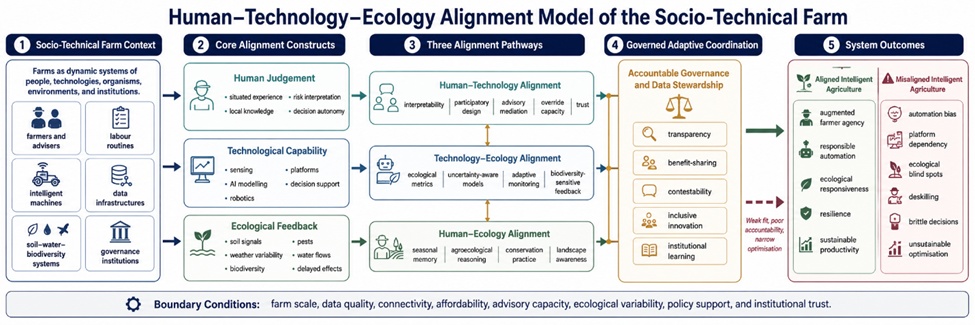
Figure 1. Human–Technology–Ecology Alignment Model of the Socio-Technical Farm
The first proposition is that intelligent agricultural systems improve farm decision quality when they augment farmer judgement through interpretability, participation, advisory mediation, and meaningful control. Responsible innovation in smart farming suggests that anticipation, inclusion, reflexivity, and responsiveness can reduce socio-technical misalignment by making development processes more attentive to farmers, values, and consequences [27]. Future research can test this proposition by examining whether participatory and explainable systems produce stronger trust, adoption, and decision confidence than systems designed around automation alone.
The second proposition is that AI decision-support systems become aligned aids only when farmers can understand, evaluate, contest, and adapt their recommendations. Trust in agricultural AI is a central condition for responsible use because opaque or poorly contextualised systems may be rejected, misused, or treated as substitutes for judgement [28]. Empirical work can operationalise this proposition by comparing how different levels of explainability, uncertainty communication, and override capacity affect farmer reliance across farm types and decision domains.
The third proposition is that sustainability and resilience depend on the timing, visibility, and interpretation of feedback between human decisions and ecological responses. Social-ecological feedbacks can generate tipping dynamics in farming-system diversification, indicating that delayed or poorly interpreted feedback may shift systems toward stable but undesirable regimes [29]. Future studies can refine the socio-technical farm theory by identifying which feedback loops, governance arrangements, and local-knowledge practices help intelligent agriculture move toward aligned rather than misaligned system states.
This article has developed a theory of the socio-technical farm based on human–technology–ecology alignment. The theory positions intelligent agricultural systems as relational arrangements among farmers, advisers, workers, digital infrastructures, machines, ecological processes, and governance institutions. Its central contribution is to explain why intelligent agriculture cannot be judged only by technical sophistication or predictive performance.
The theory argues that responsible and sustainable intelligent agriculture depends on three alignment pathways. Human–technology alignment preserves farmer judgement and meaningful control; technology–ecology alignment ensures that digital systems remain responsive to ecological complexity; and human–ecology alignment keeps agricultural decision-making grounded in local knowledge, experience, and environmental care. Misalignment in any pathway can produce weak adoption, loss of trust, ecological harm, platform dependency, or unsustainable optimisation.
The socio-technical farm offers a forward-looking basis for designing, governing, and evaluating intelligent agricultural systems. It invites researchers and practitioners to examine whether technologies strengthen adaptive coordination rather than simply automate existing routines. Intelligent agriculture will be most valuable when it enhances human agency, technological responsibility, and ecological care through aligned socio-technical design.
None
None
None
None
Open Access The author(s) retain copyright. This article is licensed under the Creative Commons Attribution-NonCommercial-ShareAlike 4.0 International License. It may be shared and adapted for non-commercial purposes with appropriate attribution, an indication of changes, and distribution of adaptations under the same license. Third-party material may be subject to separate terms identified in its credit line. View the license at https://creativecommons.org/licenses/by-nc-sa/4.0/.
 Agro Intelligence Research Press