The digitalisation of agri-food networks is increasingly presented as a pathway toward more intelligent, efficient, transparent, and resilient food systems. In this narrative, artificial intelligence functions as the analytical brain of the food system, converting dispersed data from farms, supply chains, markets, and consumers into actionable intelligence. This promise has become central to contemporary visions of smart farming, precision logistics, demand forecasting, and waste reduction. Yet the language of food system intelligence often conceals a more troubling political-economic transformation. The infrastructures that collect, process, and monetise agri-food data are frequently controlled by proprietary platforms, agribusiness firms, technology corporations, and data intermediaries. As a result, digitalisation may expand not only analytical capacity but also platform dependency, data concentration, and asymmetrical control over decision-making. This critical review interrogates the tension between food system intelligence and platform dependency in digital agri-food networks. It examines how AI, data infrastructures, and platform governance reshape farmer autonomy, market structure, and public authority. The review draws on critical data studies, political economy, agri-food governance, and platform studies to question the assumption that more data automatically produces more democratic or sustainable food systems. The review concludes that the central policy question is not whether AI should be used in agri-food systems, but who governs it, who benefits from it, and whose knowledge counts within it. Without deliberate governance intervention, digital agri-food networks risk becoming extractive data monopolies rather than intelligent public goods. A more democratic digital food future requires data sovereignty, farmer-centred infrastructures, public-interest governance, and stronger collective control over agri-food data systems.
Digitalisation has become one of the dominant imaginaries through which the future of food systems is now being organised. Early reviews of big data and smart farming describe a rapid expansion of sensors, platforms, analytics, and decision-support systems across agricultural production and supply chains [1]. This transformation promises more precise decisions, better coordination, and improved responsiveness, yet it also reconfigures food systems around infrastructures that are unevenly owned, accessed, and governed.
The promise of artificial intelligence in agri-food systems is usually framed through the language of optimisation. Big data analytics are expected to improve productivity, resource allocation, logistics, market matching, and environmental monitoring [2]. However, this framing often treats data as a neutral input and AI as a technical instrument, rather than recognising that data infrastructures are embedded in ownership relations, commercial incentives, and political choices [3].
The central tension examined in this review is therefore between food system intelligence and platform dependency. Precision agriculture and digital farming are frequently promoted as technologies that make food systems more transparent and efficient, but critical scholarship shows that they may also extend new forms of corporate control over land, data, labour, and decision-making [4]. The intelligence of the system may increase, but the authority to define, access, and monetise that intelligence may become concentrated in fewer hands.
This article contributes a critical synthesis of digital agri-food governance by drawing together political economy, critical data studies, and agri-food platform research. Rather than asking only whether AI improves food system performance, it asks how AI-mediated infrastructures redistribute power across farmers, platforms, retailers, consumers, and public institutions. In doing so, it challenges techno-optimistic narratives and argues that food system intelligence must be evaluated as a governance problem, not merely as a technical achievement [5, 6].
Digital agri-food networks are not confined to the farm gate. They connect input suppliers, machinery firms, crop advisors, farm management platforms, logistics providers, retailers, financiers, insurers, and consumers through continuous data flows. The result is a multi-actor digital architecture in which agricultural production becomes linked to predictive analytics, platform services, market intelligence, and automated coordination across the food chain [7].
This networked architecture changes the meaning of governance in agriculture. Traditional agricultural policy was designed around land, production, subsidies, food safety, and trade, but digital agri-food systems also require rules for data ownership, algorithmic accountability, interoperability, platform access, and benefit-sharing [8]. When farm data move through proprietary infrastructures, governance is no longer only about regulating agricultural activity; it is also about regulating information power.
The digitalisation of agricultural innovation systems creates new interdependencies between farmers and technology providers. Farmers may depend on digital platforms for agronomic advice, machinery diagnostics, input recommendations, compliance documentation, and market access, while platforms depend on farmers as continuous sources of data [7]. This reciprocal relationship is unequal because platforms typically control the technical architecture, data standards, analytics, and contractual terms through which participation occurs.
Figure 1 maps the digital agri-food network architecture through which farm-level data are transformed into platform-controlled food system intelligence.
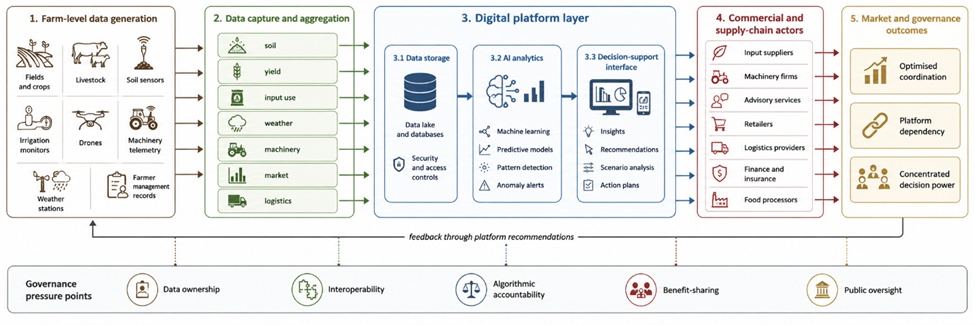
Figure 1. Digital Agri-Food Network Architecture: Data Flows, Platform Intermediation, and Governance Pressure Points from Farm Production to Food Markets
Governance has not kept pace with this transformation. Research on smart farming trust shows that farmers are often uncertain about how their data are used, who benefits from them, and whether data-sharing arrangements are transparent or fair [9]. This uncertainty indicates that digital agri-food networks are not merely technical systems requiring better adoption strategies, but contested governance spaces in which authority, accountability, and value distribution remain unresolved.
The discourse of food system intelligence presents AI as a means of making agri-food systems more visible, anticipatory, and adaptive. Through predictive analytics, machine learning, and integrated data platforms, AI is expected to convert dispersed signals into actionable knowledge for production, logistics, retail, and consumption [1]. This framing is powerful because it links digital agriculture to widely accepted goals such as efficiency, transparency, waste reduction, sustainability, and resilience.
Yet the intelligence narrative depends on a set of epistemological assumptions that require critical scrutiny. It assumes that more data generate better knowledge, that algorithmic analysis is more objective than situated human judgement, and that optimisation benefits the food system as a whole rather than particular actors within it. Critical studies of automated agrifood futures warn that such assumptions can obscure the labour, politics, and distributive consequences embedded in digital infrastructures [10].
The claim that AI produces system-wide intelligence also risks overlooking what kinds of intelligence are excluded. Farmer knowledge, local agronomic judgement, informal adaptation, and community-based decision-making may be displaced when platform analytics become the privileged basis for action [11]. As digital farming systems become more automated, the question is not simply whether they produce accurate recommendations, but whether they narrow the forms of knowledge considered legitimate in food governance.
The contrast between intelligence claims and dependency realities is therefore central to evaluating AI in agri-food networks. Digital farming platforms may promise transparency while operating through opaque algorithms, promise autonomy while deepening platform lock-in, and promise resilience while concentrating infrastructural control [12]. Table 1 contrasts the promise of food system intelligence with the documented realities of platform dependency.
Table 1. Food System Intelligence Promise vs. Platform Dependency Reality: A Critical Comparison of Claims and Evidence
Intelligence promise | Underlying assumption | Platform dependency reality | Governance implication |
Real-time transparency across agri-food networks | More data automatically make the system more visible and accountable | Data visibility is often asymmetric because platforms can see across users, while farmers see only platform-filtered outputs | Transparency must include rights to access, audit, contest, and collectively govern platform-held data |
Efficiency through AI optimisation | Algorithms optimise for system-wide benefit | Optimisation may prioritise platform revenue, input sales, logistics efficiency, or retailer advantage rather than farmer welfare | Public-interest criteria are needed to define what counts as efficient and for whom |
Better farm decision-making | Platform analytics improve farmer autonomy | Farmers may become dependent on proprietary recommendations, bundled services, and closed data ecosystems | Governance must protect farmer agency, interoperability, and the right to use alternative advisory systems |
Reduced waste and improved resilience | Integrated data systems coordinate food flows for collective benefit | Resilience may be privatised through infrastructures owned by dominant firms, while risks remain distributed across farmers and communities | Food system resilience requires public and cooperative data infrastructures, not only private optimisation platforms |
Neutral and objective intelligence | AI produces technically superior knowledge | Algorithmic outputs reflect data access, model design, commercial incentives, and unequal power relations | AI governance must address bias, accountability, explainability, and political-economic context |
Inclusive digital transformation | Adoption expands benefits across the sector | Smaller farmers and less powerful actors may face exclusion, surveillance, or unfavourable dependency | Digital inclusion must address bargaining power, affordability, data rights, and collective representation |
Platform dependency emerges when farmers and agri-food actors cannot practically participate in digital markets, advisory systems, or production networks without relying on proprietary infrastructures. Digital agriculture platforms often integrate data capture, analytics, machinery interfaces, input recommendations, and service delivery into bundled ecosystems that are difficult to leave once adopted [13]. This dependency is not simply a matter of user preference; it is produced through technical standards, contractual control, data portability limits, and the cumulative value of historical farm data.
Data concentration gives platforms an informational advantage that individual farmers cannot easily match. Studies of precision agriculture and algorithmic rationality show that platform firms can aggregate data across farms, regions, and markets, enabling them to identify patterns that remain invisible to individual producers [14]. This asymmetry allows platforms to position themselves as indispensable interpreters of agricultural reality, even when the data originally come from farmers’ fields, machinery, labour, and decisions.
The concentration of digital power is reinforced by network effects. As more users join a platform, the platform gains more data, improves its analytics, attracts more commercial partners, and becomes increasingly difficult to challenge [15]. In this process, agricultural data become an infrastructural asset, and the firms that control the data stack gain strategic influence over production practices, input markets, financial services, and downstream food-chain coordination.
Figure 2 shows the mechanism through which the promise of AI-enabled food system intelligence can become a pathway toward platform dependency and farmer vulnerability.
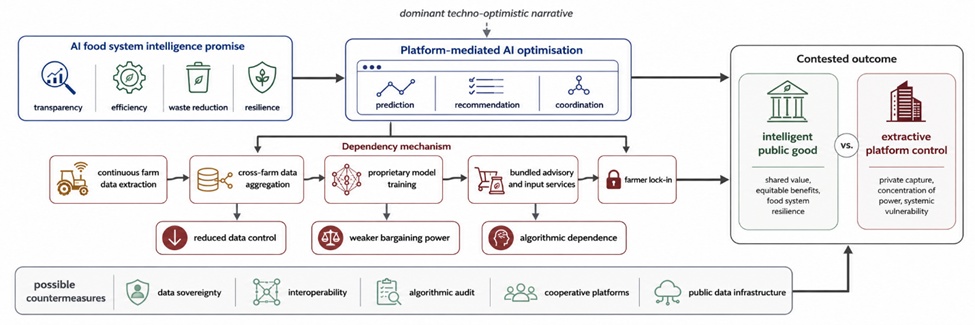
Figure 2. From Food System Intelligence to Platform Dependency: Mechanisms Linking AI Optimisation, Data Concentration, Farmer Lock-In, and Market Asymmetry
Platform dependency also shifts decision-making power from farmers to algorithmic systems whose assumptions are not always visible or contestable. The issue is not that digital advice is inherently harmful, but that advice embedded in proprietary ecosystems may lock farmers into particular products, practices, or market relations [12]. When the platform becomes the gatekeeper of agronomic knowledge, farm management risks being reorganised around commercial analytics rather than farmer autonomy or public-interest agricultural goals.
Data power in digital agri-food networks operates through the capacity to collect, aggregate, analyse, and monetise information generated by others. Farmers are frequently positioned as data providers, while platforms, agribusinesses, retailers, and technology companies become the primary actors capable of transforming that data into commercial intelligence [4]. This creates a structural imbalance in which those who generate data do not necessarily control its meaning, circulation, or economic value.
Farmer vulnerability is intensified when platform services become tied to input markets, machinery systems, finance, and advisory infrastructures. Research on data-sharing reluctance shows that farmers’ concerns are not merely cultural resistance to innovation, but grounded anxieties about transparency, benefit-sharing, and future misuse of data [9]. If data from farms can inform pricing, risk scoring, land valuation, or input recommendations, then participation in digital systems may expose farmers to new forms of surveillance and market discipline.
Market asymmetry is also evident in food retail and consumer-facing data systems. Big data in food retail can create dependent consumers and strengthen the capacity of retailers and platforms to shape demand, segment markets, and influence purchasing behaviour [16]. When these downstream data systems are linked to upstream production and logistics, food-chain intelligence may become a mechanism for coordinating markets in ways that benefit dominant intermediaries more than farmers or consumers.
The erosion of farmer agency is therefore not only technological but political. Automated agriculture can reorganise labour, skill, and decision-making in ways that reduce the visibility of farmers’ experiential knowledge while increasing dependence on platform metrics and machine-readable indicators [17, 18]. In this context, farmer sovereignty requires more than access to digital tools; it requires enforceable rights over data, meaningful participation in governance, and the ability to refuse extractive digital arrangements without losing market access.
Existing governance frameworks remain poorly equipped to address the specific power relations created by digital agri-food platforms. Data protection law often focuses on personal data, while much agricultural data concerns land, production, machinery, animals, soil, climate, and business activity that may fall outside conventional privacy protections [8]. This creates a regulatory gap in which economically sensitive farm data can be extracted and reused without governance mechanisms that match its strategic value.
Competition law also faces difficulties in digital food systems because platform power is not always expressed through conventional price effects. Dominance may arise through control over data infrastructures, interoperability standards, analytics ecosystems, and access to markets, rather than through direct monopoly pricing [19]. Agricultural policy has similarly struggled to treat digital platforms as core governance actors, even though they increasingly mediate production decisions, advisory services, and market relations.
Voluntary data codes and contractual commitments can provide partial protections, but they often depend on the goodwill of powerful firms and the capacity of individual farmers to understand and negotiate complex terms. Research on trust, transparency, and benefit-sharing in smart farming suggests that farmers need clearer institutional guarantees, not merely better communication from technology providers [9, 20]. Without enforceable rights, voluntary governance risks becoming a legitimacy tool that reassures users while leaving structural asymmetries intact.
More transformative governance responses include data cooperatives, public data trusts, open data infrastructures, and farmer-led data sovereignty initiatives. Open data politics in food and agriculture, however, are themselves contested because “setting data free” can benefit powerful actors if openness is not linked to justice, reciprocity, and collective control [21]. Governance must therefore move beyond a simple binary between open and closed data and ask who can use data, under what conditions, for whose benefit, and with what accountability.
The critical synthesis advanced here is that food system intelligence is increasingly privatised while its risks and dependencies are socialised. Digital platforms promise integrated knowledge, but they often depend on the extraction of dispersed farm, market, logistics, and consumer data into proprietary infrastructures [22]. This creates a contradiction: the system becomes more analytically connected, yet the capacity to govern that intelligence becomes more concentrated and less democratically accountable.
The politics of digital agri-food networks cannot be understood through adoption studies alone. Political economy research shows that agri-food technology is shaped by incumbent advantage, investment logics, and the ability of dominant firms to frame technological disruption in ways that preserve existing power relations [23-25]. The result is not necessarily a radical democratisation of food systems, but a form of non-disruptive disruption in which digital innovation reorganises markets without fundamentally challenging corporate concentration.
Critical data studies further reveal that platform power works through imaginaries as well as infrastructures. Data productivism frames food insecurity, sustainability, and productivity as problems that can be solved through more data, more analytics, and more technological integration [26]. This imaginary can depoliticise food-system problems by shifting attention away from land inequality, labour precarity, market concentration, and public disinvestment, and toward technical optimisation.
A critical governance approach must therefore connect data infrastructures to questions of power, justice, and democratic control. Agricultural data governance from the ground up requires attention to social movements, food sovereignty, data justice, and the collective institutions through which communities can contest extractive digitalisation [27]. Table 2 synthesises the power dynamics, governance gaps, and potential responses across the digital agri-food network.
Table 2. Critical Synthesis of Power Dynamics, Governance Gaps, and Responses in Digital Agri-Food Networks
Network domain | Dominant power dynamic | Governance gap | Risk for farmers and publics | Potential governance response |
Farm-level data capture | Platforms collect continuous data from machinery, sensors, fields, and management records | Weak rights over non-personal agricultural data | Farmers generate valuable data without controlling downstream use | Statutory farm data rights, portability, and collective bargaining mechanisms |
Platform analytics | Proprietary models interpret agronomic, market, and operational data | Limited algorithmic transparency and auditability | Farmers receive recommendations without knowing embedded assumptions or commercial incentives | Independent audits, explainability duties, and contestability rights |
Input and advisory systems | Digital recommendations can be bundled with seeds, chemicals, machinery, or finance | Competition law often misses data-driven tying and ecosystem lock-in | Farmers may be steered toward proprietary input packages | Interoperability rules, anti-lock-in regulation, and separation of advisory and sales functions |
Supply-chain coordination | Retailers and logistics platforms use data to optimise flows and manage risk | Public governance has limited visibility into private coordination systems | Efficiency gains may accrue downstream while risks remain upstream | Public-interest reporting, fair trading rules, and supply-chain data accountability |
Market access platforms | Platforms mediate access to buyers, credit, insurance, and certification | Unequal bargaining power in data-sharing contracts | Smaller producers may face exclusion, surveillance, or unfavourable scoring | Cooperative platforms, data trusts, and inclusive digital market governance |
Public food-system governance | States rely on private digital infrastructures for insight and coordination | Public institutions lack independent data capacity | Food system intelligence becomes dependent on corporate infrastructures | Public data infrastructures, democratic oversight, and mission-oriented digital policy |
Future research should examine agricultural AI as a political-economic infrastructure rather than a neutral technical layer. Comparative studies are needed to identify how different platform models, ownership structures, and regulatory regimes shape farmer dependency, market concentration, and public governance capacity [28]. Such work should move beyond adoption barriers and ask how digital systems redistribute authority within agri-food networks.
A second research priority concerns farmer-centric and justice-oriented data governance. Studies of digital transformation in agriculture and rural areas show the need for socio-cyber-physical frameworks that connect technical design with responsibility, social relations, and institutional context [29]. Future scholarship should examine how data cooperatives, public data trusts, Indigenous and community data sovereignty models, and farmer-led infrastructures can create alternatives to extractive platform dependency.
A third priority is action-oriented research that tests democratic digital infrastructures in practice. Critical studies of digital agriculture warn that farmers cannot “eat data” if data-driven systems fail to address material livelihoods, ecological sustainability, and local control [30]. Research should therefore evaluate not only whether AI systems improve prediction or efficiency, but whether they expand farmer agency, strengthen public governance, reduce dependency, and support more just food-system transitions.
This critical review has argued that the key issue in digital agri-food networks is not whether AI produces intelligence, but how that intelligence is organised, owned, and governed. The dominant narrative promises transparency, efficiency, resilience, and optimisation, yet the infrastructures through which these promises are delivered often deepen platform dependency and data concentration. Food system intelligence can therefore become a euphemism for platform control when it is detached from democratic governance.
The choice is not between AI and no AI. The real choice is between AI embedded in extractive proprietary platforms and AI governed as a public good. A just digital food future requires data rights, interoperability, farmer participation, public-interest infrastructures, and institutional mechanisms that prevent the conversion of farm-level data into monopolistic power.
Re-politicising food system digitalisation is therefore essential. Digital agri-food networks must be governed not only for innovation, but also for accountability, sovereignty, equity, and democratic control. Without collective intervention, the intelligence of the food system will continue to grow in private hands while farmers and publics bear the risks of dependency.
None
None
None
None
Open Access The author(s) retain copyright. This article is licensed under the Creative Commons Attribution-NonCommercial-ShareAlike 4.0 International License. It may be shared and adapted for non-commercial purposes with appropriate attribution, an indication of changes, and distribution of adaptations under the same license. Third-party material may be subject to separate terms identified in its credit line. View the license at https://creativecommons.org/licenses/by-nc-sa/4.0/.
 Agro Intelligence Research Press