Agri-food systems increasingly operate under compound crises in which climate shocks, supply disruptions, market instability, ecological stress, and social vulnerability interact. These crises do not affect production, distribution, livelihoods, and food access in isolation. They move through connected risk pathways that can destabilise farms, supply chains, public institutions, and households at the same time. Artificial intelligence can support prediction, monitoring, early warning, and decision support in these contexts. However, technical forecasting alone does not constitute resilience when risks cascade across multiple domains. Agri-food resilience requires that predictive information be translated into adaptive decisions, coordinated response, and food security protection. This article develops a conceptual model of AI-supported agri-food resilience under compound crises. The model links climate shocks, supply disruptions, farmer adaptation, and food security governance as interacting domains. It treats AI as a decision-support function embedded within social, institutional, ecological, and market systems rather than as a stand-alone technological solution. The model identifies resilience mechanisms that connect risk detection, signal integration, uncertainty communication, adaptive decision support, institutional coordination, feedback learning, and accountability. It also clarifies boundary conditions that determine whether AI strengthens or weakens resilience. These include data quality, interpretability, local relevance, farmer participation, institutional response capacity, equity, and governance accountability. The article contributes a structured conceptual model for understanding how AI can support agri-food resilience when analytics are aligned with adaptation needs and food security objectives. It argues that resilient agri-food AI systems must connect prediction with human judgement, local knowledge, public action, and accountable coordination. The proposed model offers a basis for future empirical testing, policy design, and responsible innovation in crisis-sensitive food systems.
Agri-food systems are increasingly exposed to compound crises in which climate shocks, supply disruptions, market volatility, public-health emergencies, conflict, and livelihood insecurity interact across scales. In this article, agri-food resilience is understood as the capacity of food systems to sustain essential functions while absorbing disturbance, adapting to changing conditions, and recovering from disruption. This framing is important because food-system failure rarely begins or ends at one point in the system; it emerges through linked vulnerabilities in production, distribution, access, governance, and social protection [1].
At farm level, resilience requires more than short-term survival after a shock. Farming systems must combine robustness, adaptability, and transformability so that producers can maintain livelihoods, adjust practices, and reorganise when existing arrangements become untenable. These capacities are shaped by farm resources, advisory systems, institutional support, market relations, ecological conditions, and the ability to learn from repeated disruption [2].
Food security adds a further conceptual layer because resilient production does not automatically guarantee stable access, utilisation, or equitable outcomes. Local food-system resilience depends on how communities, markets, and institutions absorb shocks while protecting vulnerable households and maintaining access to nutritious food. A conceptual model of AI-supported resilience must therefore link technical risk detection with food-security outcomes and crisis-response arrangements [2, 3].
The need for an integrated model is intensified by the possibility of simultaneous production shocks across major agricultural regions. When breadbasket regions experience overlapping climatic stress, the resulting risk can move through trade, prices, input systems, humanitarian demand, and public institutions. This article develops a conceptual model that connects four domains—climate shocks, supply disruptions, farmer adaptation, and food security governance—to explain how AI can support resilience only when predictive analytics are aligned with adaptive capacity and coordinated response [4].
AI-supported agri-food resilience depends first on the integration of data across farms, landscapes, supply chains, markets, institutions, and food-security monitoring systems. Big data in smart farming can improve situational awareness by combining sensor streams, weather data, machinery data, remote observations, farm records, and platform-based information. Yet these data streams become resilience-enhancing only when they are interoperable, interpretable, and connected to decisions that matter under crisis conditions [5].
Machine learning can contribute to resilience through prediction, classification, anomaly detection, yield estimation, pest and disease identification, resource optimisation, and operational decision support. These functions can help identify emerging risks before they become acute, especially when climate stress, input scarcity, and market uncertainty converge. However, the conceptual role of machine learning is not to replace agricultural judgement but to extend the range of observable signals available for timely adaptation [6].
Deep learning expands the capacity of agricultural systems to interpret complex visual, spatial, temporal, and sensor-based data. It can support crop monitoring, disease detection, stress diagnosis, and other analytical functions relevant to crisis preparedness. In a resilience model, these capabilities must be connected to uncertainty communication and explainable decisions, because opaque signals are difficult to act on when farmers, supply-chain actors, and public agencies must make high-stakes choices under pressure [7].
Smart farming should therefore be understood through responsible innovation rather than technological determinism. AI can strengthen agri-food resilience when it supports anticipation, inclusion, reflexivity, and responsive governance, but it can also deepen vulnerability if tools are inaccessible, misaligned with farmer needs, or governed through narrow efficiency goals. The conceptual model developed here treats responsibility as a boundary condition that determines whether digital agriculture contributes to system-level resilience [6-8].
Climate shocks are a central driver of agri-food vulnerability because they affect crop growth, water availability, livestock systems, pest pressure, labour conditions, and infrastructure reliability. Long-term climate change can slow agricultural productivity growth, which makes production systems more exposed to repeated disturbance and less able to recover between shocks. In conceptual terms, climate shocks represent an upstream risk pathway that can trigger downstream supply disruptions, adaptation demands, and governance responses [9].
Climate effects on food production are not uniform across crops, regions, seasons, or farming systems. This unevenness means that AI-supported climate-risk analytics must be spatially sensitive and crop specific rather than based on aggregate warning signals alone. Remote sensing, climate analytics, crop modelling, and machine learning can help identify where production risks are emerging, but their resilience value depends on whether they inform decisions that can still be changed in time [9, 10].
Drought and heat stress illustrate why climate shocks should be modelled as interacting hazards rather than isolated events. When heatwaves intensify water deficits, shorten crop-development windows, or coincide with sensitive growth stages, the resulting crop losses may exceed what single-hazard assessments anticipate. AI-supported risk systems should therefore detect compound climatic stress, communicate uncertainty, and connect alerts to adaptation options such as planting adjustment, irrigation prioritisation, crop switching, input planning, and emergency support [11].
Climate-shock detection must also be linked to farmer decision-making, local validation, and institutional response. A risk signal that cannot be interpreted by farmers, trusted by advisors, or acted upon by agencies may improve prediction without improving resilience. Table 1 summarises AI-supported climate-shock detection and agricultural-risk interpretation functions for agri-food resilience. These functions clarify how analytical signals become useful only when they are connected to adaptation timing, uncertainty communication, and response capacity [9].
Table 1. AI-Supported Climate-Shock Detection and Agricultural-Risk Interpretation for Agri-Food Resilience: Risk Signals, Data Sources, Analytical Functions, Decision Uses, Adaptation Needs, and Failure Risks
Climate-shock or agricultural-risk signal | Potential data sources | AI-supported analytical function | Decision-support use | Farmer adaptation need | Food-security or governance relevance | Failure risk if poorly governed |
Drought onset and soil-moisture deficit | Satellite imagery, soil sensors, rainfall records, evapotranspiration estimates, hydrological data | Detect spatial water stress and forecast likely production impacts | Irrigation prioritisation, drought advisories, water allocation, emergency planning | Adjust planting dates, select tolerant varieties, prioritise water use, reduce input exposure | Supports drought early warning, procurement planning, and anticipatory assistance | False confidence, late warnings, exclusion of rainfed farmers, weak local validation |
Heat stress during sensitive crop stages | Weather stations, climate forecasts, crop phenology data, remote sensing, farm observations | Identify periods of yield vulnerability and likely heat-related crop stress | Heat advisories, harvest timing, crop-stage risk alerts, labour safety planning | Change planting windows, protect livestock, adjust field operations, manage shade and water | Helps anticipate crop losses, labour risks, and local food supply pressure | Overgeneralised alerts, insufficient uncertainty communication, poor fit to local crop calendars |
Flooding and excess rainfall | Rainfall forecasts, river-level data, topography, drainage maps, satellite flood detection | Map inundation risk and identify exposed production and transport zones | Drainage action, field access planning, road-routing decisions, emergency logistics | Protect stored inputs, delay field operations, shift transport routes, manage crop damage | Supports food distribution planning and infrastructure response | Missed informal roads, poor coverage of small farms, delayed institutional action |
Pest and disease pressure after climate anomalies | Field images, extension reports, weather anomalies, pest surveillance, farmer reports | Detect outbreak probability and classify visible symptoms | Targeted scouting, pesticide planning, extension alerts, regional surveillance | Apply timely control measures, coordinate local monitoring, adjust crop management | Helps prevent production losses and reduce unnecessary input use | Algorithmic misclassification, chemical overuse, inequitable access to diagnostics |
Crop-yield anomaly and production shortfall | Remote sensing, crop models, historical yields, farm records, market arrivals | Estimate likely production deviations before harvest | Procurement planning, insurance triggers, food-balance assessment, market monitoring | Prepare storage, negotiate sales, diversify income, adjust household food planning | Supports early food-security assessment and supply planning | Poor calibration, hidden uncertainty, mis-targeted assistance, market panic |
Rainfall variability and seasonal uncertainty | Seasonal forecasts, climate indices, local rainfall records, indigenous knowledge, advisory data | Translate probabilistic forecasts into locally meaningful risk scenarios | Planting advisories, input-purchase timing, credit and insurance decisions | Match crop choice and input intensity to expected conditions | Supports anticipatory planning across farming and public programmes | Probabilistic information misunderstood, weak trust, one-size-fits-all advice |
Infrastructure exposure to climate hazards | Road networks, storage locations, flood maps, market nodes, transport data | Identify climate-sensitive bottlenecks linking production and distribution | Route planning, storage protection, emergency transport coordination | Protect harvest access, coordinate with buyers, shift delivery timing | Links climate shocks to supply-disruption governance | Focus on formal infrastructure only, neglect of remote communities |
Supply disruptions reveal that food security depends on more than agricultural production. Transport failures, processing constraints, labour shortages, storage bottlenecks, border delays, and retail interruptions can prevent food from reaching households even when aggregate supply appears adequate. Food supply chains during crisis conditions show how logistics, labour, market access, and institutional coordination become resilience mechanisms rather than merely operational concerns [12].
Food-system fragility emerges when multiple nodes in production-to-consumption systems are disrupted at the same time. Input shortages can reduce farm capacity, transport barriers can delay distribution, and price instability can reduce household access even before physical scarcity becomes visible. AI-enabled supply-chain analytics can help detect these pressures, but disruption signals must be interpreted through food access, farmer livelihoods, and public-response needs [13].
Crisis conditions also show that resilience requires adaptive reconfiguration rather than simple restoration of pre-crisis flows. Food systems may need alternative procurement routes, decentralised storage, local processing capacity, flexible retail arrangements, and mechanisms to reduce waste when normal channels fail. In this sense, AI-supported supply monitoring should help actors identify feasible substitutions, not only predict where disruption may occur [14].
The conceptual model treats supply disruptions as mediating pathways between climate shocks, farmer adaptation, and food security governance. A drought may reduce production, but its food-security consequences depend on storage capacity, transport reliability, market concentration, import dependence, purchasing power, and emergency distribution. Supply-chain analytics can support resilience when they connect disruption detection to coordinated decisions about routing, procurement, market regulation, farmer support, and protection of vulnerable consumers [12].
Farmer adaptation is a central resilience mechanism because farms are where climate information, input constraints, market signals, labour realities, and livelihood risks become practical decisions. Adaptive capacity depends on assets, knowledge, institutions, social networks, credit, land access, extension support, and the ability to act before losses become irreversible. Smallholder adaptation studies show that vulnerability cannot be reduced through information alone when farmers lack the material and institutional conditions required to respond [15].
Digital climate services can support adaptation by translating climate and production-risk information into locally relevant advisories. These services may guide planting dates, crop choice, irrigation scheduling, pest surveillance, input use, and risk management when they are accessible, trusted, and understandable. However, digital advice becomes resilience-enhancing only when farmers can evaluate recommendations against local knowledge, resource constraints, and livelihood priorities [16].
Climate-smart agriculture illustrates the importance of enabling conditions in adaptation support. Adoption depends not only on the technical promise of a practice but also on information access, financial capacity, institutional incentives, labour availability, land tenure, market opportunities, and perceived risk. AI-enabled advisory systems should therefore avoid one-size-fits-all recommendations and instead support context-sensitive decision pathways that reflect diverse farm realities [17].
In the proposed conceptual model, farmer adaptation links upstream risk detection with downstream food-security outcomes. Climate-shock analytics may identify water stress, and supply-chain analytics may detect input scarcity, but resilience depends on whether farmers can adjust practices in time. AI can support adaptive capacity when it strengthens farmer agency, communicates uncertainty clearly, incorporates local feedback, and connects farm decisions to advisory, financial, market, and governance support [15].
Food security governance is the institutional domain through which warnings, analytics, and adaptation needs become collective response. Early warning in agri-food systems is valuable only when alerts are actionable, trusted, timely, and connected to agencies capable of mobilising support. Drought early warning, for example, must move beyond risk detection toward anticipatory action, resource allocation, and protection of food availability and access [18].
Governance also determines whether crisis recovery reproduces vulnerability or reduces it. Food systems can become more resilient and just when policy responses address unequal exposure, household access, labour precarity, and the needs of marginalised producers and consumers. AI-supported governance dashboards should therefore be designed to identify vulnerability and response gaps, not merely to optimise flows or predict aggregate supply [19].
Coordinated response requires links among public agencies, market actors, community organisations, humanitarian providers, farmer groups, and emergency food systems. Governance during food-security crises shows that institutional coordination is often improvised under pressure, especially when shocks affect supply, income, access, and community support at the same time. AI can support coordination by organising risk signals, targeting assistance, modelling scenarios, and monitoring response, but it cannot substitute for accountable institutions and trusted relationships [20].
The governance function in the conceptual model is therefore both analytical and political. It interprets climate and supply signals, identifies who is at risk, determines which response mechanisms are activated, and evaluates whether interventions protect food security. Table 2 maps supply disruptions, farmer adaptation needs, and food security governance functions in compound agri-food crises. The table emphasises that coordinated response must connect disruption pathways with farmer realities, institutional triggers, and risks of exclusion [18].
Table 2. Supply Disruptions, Farmer Adaptation, and Food Security Governance Under Compound Crises: Disruption Pathways, Adaptation Needs, Governance Functions, Response Triggers, and Coordination Risks
Disruption pathway | Farmer adaptation need | AI-supported monitoring or decision function | Governance response function | Possible response trigger | Food-security objective | Coordination risk |
Input shortage affecting seed, fertiliser, fuel, or veterinary supplies | Substitute inputs, adjust planting plans, reduce exposure to costly inputs, coordinate purchasing | Input availability tracking, price anomaly detection, supplier-risk mapping | Temporary procurement support, input distribution, credit adjustment, market oversight | Rapid price increase, stockout reports, delayed import or transport data | Protect production capacity and farmer livelihoods | Support may favour larger or better-connected farms |
Transport or logistics breakdown | Shift delivery timing, use alternative routes, coordinate with buyers, protect perishable goods | Route-risk modelling, transport delay detection, network bottleneck identification | Emergency logistics coordination, road access support, local storage activation | Road closure, fuel scarcity, severe weather, port congestion | Maintain food flows and reduce post-harvest losses | Informal routes and remote communities may be invisible |
Labour constraint during crisis | Adjust crop operations, mechanise selectively, cooperate locally, prioritise critical tasks | Labour availability monitoring, harvest-risk forecasting, scheduling support | Labour mobility rules, worker protection, emergency staffing, advisory support | Harvest delay, public-health restriction, migration disruption | Prevent production and harvest losses | Labour rights may be subordinated to supply continuity |
Market closure or demand collapse | Diversify channels, store produce, process locally, shift sales strategy | Market-access mapping, demand forecasting, price volatility detection | Public procurement, local market reopening protocols, buyer coordination | Sharp farm-gate price decline, unsold produce accumulation | Protect farmer income and food availability | Procurement may be slow or poorly targeted |
Food price spike affecting consumers | Adjust household consumption, seek support, rely on social networks or safety nets | Price monitoring, vulnerability targeting, food-access risk dashboards | Cash transfers, food assistance, price regulation, safety-net expansion | Rapid staple-price increase, household food insecurity indicators | Protect access to affordable and nutritious food | Targeting systems may miss informal or undocumented households |
Storage or cold-chain failure | Reallocate produce, change harvest timing, use local processing, reduce spoilage | Storage-capacity monitoring, cold-chain risk detection, spoilage prediction | Infrastructure support, emergency storage, public-private coordination | Power outage, storage saturation, temperature excursions | Reduce waste and stabilise supply | Data may privilege formal supply chains |
Compound climate and market shock | Combine agronomic adaptation with income and risk-management strategies | Multi-hazard scenario modelling, farm-risk profiling, livelihood-risk dashboards | Integrated agricultural, market, and social-protection response | Concurrent yield loss, price volatility, and household vulnerability | Protect production, livelihoods, and access together | Agencies may respond in silos rather than as a system |
The proposed conceptual model begins by asking what resilience is for, who benefits, which shocks are considered, and through which mechanisms system functions are protected. Food-system resilience concepts emphasise that resilience must specify the object of resilience, the disturbance, the affected groups, the temporal horizon, and the desired outcomes. In this article, the object is the agri-food system, the disturbances are compound crises, the affected groups include farmers and food-insecure households, and the desired outcome is sustained food security with adaptive capacity [21].
The model includes four core domains: climate shocks, supply disruptions, farmer adaptation, and food security governance. AI connects these domains through decision-support functions such as risk detection, signal integration, scenario analysis, targeting, uncertainty communication, and feedback learning. Yet AI can also create new vulnerabilities when optimisation is narrow, data gaps are ignored, externalities are displaced, or accountability is weak [22]. Figure 1 presents the proposed conceptual model showing how AI-supported risk detection, signal integration, adaptive decision support, governance coordination, feedback learning, and accountability connect climate shocks, supply disruptions, farmer adaptation, and food security protection under compound crises.
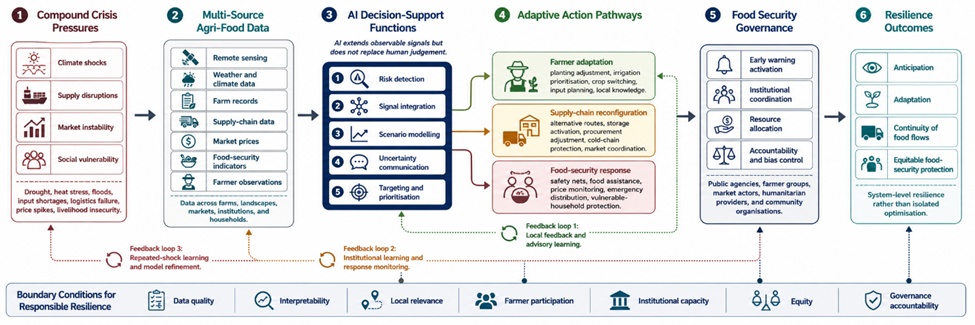
Figure 1. AI-Supported Agri-Food Resilience Under Compound Crises: Linking Climate Shocks, Supply Disruptions, Farmer Adaptation, and Food Security Governance
The model therefore includes boundary conditions that determine whether AI strengthens or weakens resilience. Precision-agriculture and digital decision-support tools must account for unequal access, labour implications, knowledge politics, power relations, and uneven distribution of benefits. These conditions matter because a tool that improves aggregate efficiency may still reduce resilience for farmers or communities excluded from data systems, advisory services, or institutional response [23].
The first feedback loop in the model connects climate-shock detection with farmer adaptation. Agricultural knowledge and advice networks translate climate, crop, and market signals into usable recommendations, making them essential intermediaries between AI systems and farm-level decisions [24]. A second feedback loop connects farmer data, institutional learning, and system improvement, but this loop depends on trust, transparency, and benefit-sharing in smart farming data relations [25].
The third feedback loop connects supply-disruption monitoring with food security governance. When analytics identify logistics bottlenecks, market instability, or food-access risk, governance actors must decide whether to activate procurement, safety nets, transport support, market regulation, or emergency assistance. Table 3 presents the proposed conceptual model of AI-supported agri-food resilience under compound crises. The model treats Agriculture 4.0 technologies as part of governed transition pathways rather than universal solutions, because responsibility and diversity are central to resilient food-system transformation [26].
Table 3. Proposed Conceptual Model of AI-Supported Agri-Food Resilience Under Compound Crises: Climate Shocks, Supply Disruptions, Farmer Adaptation, Food Security Governance, Resilience Mechanisms, Feedback Loops, and Boundary Conditions
Conceptual model component | Core construct | AI-supported decision function | Resilience mechanism | Feedback loop | Boundary condition | System-level outcome |
Climate-shock domain | Drought, flood, heat stress, rainfall anomaly, crop stress, water scarcity | Remote sensing, early warning, crop-risk modelling, anomaly detection | Anticipation of production risk before irreversible loss | Climate signal to farmer advisory and public response | Local calibration, uncertainty communication, timeliness | Earlier adaptation and reduced crop-loss exposure |
Supply-disruption domain | Logistics breakdown, input shortage, labour constraint, market instability, price spike | Supply-chain monitoring, bottleneck detection, price prediction, network analysis | Continuity of food flows and identification of vulnerable nodes | Supply signal to procurement, routing, and safety-net response | Inclusion of informal markets and remote communities | More stable availability and improved access protection |
Farmer-adaptation domain | Adaptive capacity, livelihood decisions, technology use, local knowledge, resource constraints | Localised recommendations, digital extension, risk profiling, decision support | Translation of risk information into feasible farm action | Farmer feedback to advisory systems and model improvement | Accessibility, trust, affordability, farmer participation | Strengthened agency and context-sensitive adaptation |
Food-security governance domain | Early warning, coordination, safety nets, procurement, accountability, crisis response | Dashboards, scenario planning, targeting tools, resource allocation, monitoring | Coordinated institutional response to protect food security | Governance feedback to data systems and response protocols | Accountability, bias control, institutional capacity | More equitable and timely food-security response |
Cross-domain integration | Compound-crisis linkage across climate, supply, farms, and institutions | Multi-source data integration, scenario modelling, decision prioritisation | Alignment of prediction, adaptation, and governance | System learning across repeated shocks | Interoperability, explainability, data quality | System-level resilience rather than isolated optimisation |
Risk pathway | Shock transmission from production stress to access insecurity | Cascading-risk detection and vulnerability mapping | Identification of where risk becomes food insecurity | Household and community indicators inform response refinement | Protection of vulnerable groups and avoidance of exclusion | Reduced likelihood that shocks become food-security crises |
Accountability layer | Governance of AI design, deployment, and evaluation | Audit trails, participatory evaluation, performance monitoring, bias assessment | Correction of harmful or ineffective decision-support systems | Evaluation results reshape models and institutions | Transparency, contestability, benefit-sharing | Responsible AI aligned with food security and resilience |
For policymakers, food-security agencies, farm advisors, humanitarian organisations, and agricultural technology firms, the model implies that AI tools should be designed around crisis decisions rather than around prediction alone. Practical implementation should include safeguards for fairness, transparency, accountability, privacy, robustness, and environmental sustainability. Ethical and responsible AI in digital agriculture is therefore not an optional add-on but a condition for using analytics in high-stakes resilience decisions [27].
For farmer organisations and public institutions, the model highlights the need for smallholder-centred digital ecosystems. Infrastructure, connectivity, digital literacy, advisory capacity, and locally relevant data systems are necessary for AI-supported adaptation to reach farmers who face the greatest exposure to climate and market shocks. Sustainable digital agriculture for smallholder farmers requires inclusion, capacity building, and governance arrangements that prevent digital tools from widening existing inequalities [28].
Future research should empirically test the proposed model across different crops, regions, crisis types, supply-chain structures, and governance systems. Studies should evaluate whether AI-supported risk detection actually improves adaptation timing, institutional response, food access, and livelihood outcomes under compound crises. Research on AI and global food security in developing agricultural contexts should also examine implementation barriers, data limitations, local participation, institutional uptake, and the conditions under which digital tools support rather than undermine resilience [29].
This article has developed a conceptual model of AI-supported agri-food resilience under compound crises. The model links climate shocks, supply disruptions, farmer adaptation, and food security governance as connected domains rather than separate technical problems. Its central contribution is to show how resilience depends on the movement from risk detection to adaptive action, coordinated response, and food-security protection.
The model argues that AI can support resilience only when predictive analytics are connected to human judgement, farmer agency, institutional capacity, and accountable governance. Climate-risk detection, supply-chain monitoring, adaptation advice, and governance dashboards may all be useful, but none is sufficient by itself. Their value depends on whether they help actors understand uncertainty, respond in time, protect vulnerable groups, and learn from repeated shocks.
Agri-food AI systems should therefore be designed as crisis-sensitive, farmer-centred, food-security-oriented, and governance-aware decision-support systems. The future of AI for agri-food resilience lies not in automation alone but in building systems that help societies anticipate shocks, adapt under uncertainty, coordinate response, and protect food security during compound crises.
None
None
None
None
Open Access The author(s) retain copyright. This article is licensed under the Creative Commons Attribution-NonCommercial-ShareAlike 4.0 International License. It may be shared and adapted for non-commercial purposes with appropriate attribution, an indication of changes, and distribution of adaptations under the same license. Third-party material may be subject to separate terms identified in its credit line. View the license at https://creativecommons.org/licenses/by-nc-sa/4.0/.
 Agro Intelligence Research Press