Smart farming technologies are often presented as innovations whose adoption depends mainly on technical availability, economic advantage, or farmer willingness. Such interpretations do not adequately explain why similar technologies are adopted and sustained in some settings but resisted, selectively used, discontinued, or abandoned in others. This realist review develops an explanatory synthesis of smart farming adoption through context–mechanism–outcome reasoning. It examines how farm structure, farmer capability, financial resources, infrastructure, connectivity, advisory support, institutional conditions, social legitimacy, platform relations, and data governance influence farmers’ interpretations of technological opportunities and risks. Adoption is distinguished from technology acceptance, partial adoption, sustained use, discontinuance, abandonment, and implementation failure. Enabling mechanisms include perceived usefulness, compatibility, trust, decision confidence, credible value, and experiential learning. Constraining mechanisms include affordability concern, return uncertainty, complexity, privacy concern, autonomy concern, platform dependency, and maintenance burden. The synthesis indicates that no contextual factor or mechanism independently guarantees adoption or implementation success. Similar technologies may generate different outcomes because farmers encounter different resources, constraints, relationships, and implementation experiences. The review proposes a recursive programme theory in which appraisal, trial, implementation experience, feedback, and changing farm conditions continually reshape perceived value, trust, capability, and willingness to continue. Responsible implementation therefore requires context-sensitive evaluation, farmer-centered usability assessment, reliable infrastructure, credible advisory and technical support, interoperability, transparent data governance, and attention to exclusion. The proposed configurations support explanatory synthesis and empirical testing rather than universal prediction or implementation prescription.
Digital technologies are changing agricultural monitoring, machinery management, information exchange, decision support, and advisory systems. However, agricultural digitalisation cannot be understood solely as the diffusion of technically superior tools. It is a socio-technical process involving heterogeneous farms, users, institutions, infrastructures, commercial actors, knowledge systems, and power relations [1]. A technology may therefore function technically while remaining financially inaccessible, operationally incompatible, institutionally unsupported, or difficult to incorporate into routine farm decisions.
Responsible-innovation scholarship has argued that Agriculture 4.0 should be assessed through inclusion, anticipation, reflection, and responsiveness rather than productivity expectations alone [2]. Farmers encounter technologies through specific devices, platforms, contracts, data requirements, service arrangements, and claims about future value. Their willingness to adopt may depend on whether these arrangements appear legitimate, understandable, reversible, governable, and compatible with farming responsibilities.
Digital farming can also redistribute control over data, labour, knowledge, and markets [3]. Adoption may coexist with dependency, intensified monitoring, restricted decision autonomy, or greater reliance on proprietary systems. Conversely, non-adoption may reflect a reasoned response to uncertainty, unsuitable design, unclear data rights, weak support, or insufficient value. Treating farmer resistance as a deficit can conceal the conditions that make caution rational.
Agriculture 4.0 includes diverse technologies and transition pathways rather than a single modernization process [4]. Remote sensing, sensors, robotics, variable-rate equipment, mobile applications, digital advisory systems, artificial intelligence, and data platforms impose different financial, technical, and organisational requirements. Adoption must therefore be differentiated by technology, farm type, implementation stage, function, and duration of use.
Many studies identify factors associated with adoption, such as farm size, education, perceived usefulness, cost, or access to advice. These associations remain valuable, but they often do not explain how particular circumstances alter farmers’ reasoning. A realist review addresses this explanatory problem by examining how contexts activate mechanisms that contribute to adoption, non-adoption, partial adoption, sustained use, discontinuance, abandonment, or implementation failure.
This review asks six questions:
What contexts shape differentiated smart farming outcomes?
What mechanisms appear to explain adoption, resistance, discontinuance, or failure?
What outcomes are reported across the literature?
Which context–mechanism–outcome configurations explain variation?
What implementation conditions appear necessary for responsible and sustained use?
What research agenda follows from the evidence gaps?
The review does not calculate a pooled adoption rate or present a universal barrier checklist. Its contribution is an explanatory programme theory that separates initial acceptance from acquisition, implementation, routine use, and sustained value. The configurations developed here may support empirical testing, but they do not prove universal causality or predict individual farmer behavior.
Cross-regional evidence shows that precision agriculture adoption varies with regional conditions, farm structure, technology characteristics, and institutional environments [5]. A system that appears financially credible on one farm may appear disproportionately risky on another. Farms differ in production intensity, capital availability, labour organisation, equipment age, connectivity, technical support, and succession expectations.
Adoption is also technology specific. German crop-farming evidence indicates that farmers may adopt some precision technologies while rejecting or postponing others [6]. A farmer may use navigation systems but avoid variable-rate applications, adopt digital recordkeeping without integrating sensors, or use smartphone services without investing in automated machinery. Adoption is therefore frequently selective, sequential, or modular.
Farmers’ evaluations may change after direct experience. Comparisons between expectations and practical experience show that usefulness, complexity, compatibility, and support requirements may be reassessed after technologies enter real production environments [7]. A tool that appears attractive during demonstration may become burdensome when calibration, data entry, connectivity, maintenance, or interpretation requirements become visible.
Evidence from a European small-scale farming region similarly shows that access to digital tools does not result in uniform or integrated use [8]. Farmers may employ only selected functions because of limited interoperability, uncertain returns, inadequate support, or deliberate prioritisation. Partial use may represent rational adaptation rather than incomplete acceptance.
Adoption should therefore be treated as a process involving awareness, appraisal, intention, trial, acquisition, initial implementation, workflow integration, adaptation, continued use, and possible exit. Movement through these stages is not necessarily linear. Farmers may return to earlier stages when costs change, support deteriorates, new evidence emerges, or farm circumstances shift.
Technology readiness must also be distinguished from implementation readiness. Technology readiness concerns whether a system performs its intended technical functions. Implementation readiness concerns whether users, farms, providers, infrastructures, advisory organisations, and governance arrangements can incorporate the technology safely and usefully. A technically mature tool may fail when connectivity is unreliable, outputs do not fit decisions, maintenance is excessive, or responsibilities are unclear.
Adoption is not inherently beneficial. A technology may increase workload, create dependency, produce unreliable outputs, or transfer disproportionate value to platform operators. Non-adoption or discontinuance may prevent unsuitable costs or risks. The relevant question is therefore not whether adoption should always occur, but how particular configurations produce different outcomes.
Realist synthesis explains outcomes by examining how contextual conditions interact with mechanisms. A context–mechanism–outcome configuration should specify how resources, opportunities, constraints, or relationships influence actors’ reasoning and responses [9]. Technologies, subsidies, advisory services, contracts, infrastructure, demonstrations, and information are treated as resources or constraints. Mechanisms include perceived usefulness, value, trust, risk, compatibility, feasibility, autonomy, and burden.
Context is relational and dynamic rather than a static list of demographic variables [10]. Farm size may matter because it alters the capacity to spread fixed costs, employ specialists, conduct trials, or absorb failed investments. Connectivity may matter because it shapes reliability and the practical credibility of cloud services. Farmer age may interact with experience, succession, investment horizons, and support rather than operating as an independent cause.
The analytical question is therefore what works, for whom, under which circumstances, and through which mechanisms [11]. The same condition may activate different responses. A subsidy may reduce financial exposure for one farmer, appear administratively inaccessible to another, or encourage acquisition without sustained use for a third. Similarly, non-adoption can arise from affordability concern, weak usefulness, distrust, poor connectivity, limited skills, or autonomy protection.
The review focused on peer-reviewed journal literature concerning smart farming, precision agriculture, digital agriculture, farmer adoption, implementation barriers, advisory systems, technology acceptance, trust, data governance, platform relations, and responsible innovation. Eligible articles had to contain sufficient contextual, mechanistic, outcome, or implementation evidence to support realist interpretation. Studies reporting only adoption percentages or purely technical performance were excluded from programme-theory development.
Evidence appraisal emphasized relevance and rigor for the inference being made. Quantitative associations were treated as possible contextual signals rather than automatic causal explanations. Qualitative studies were used to examine reasoning, experience, trust, compatibility, identity, and practical integration. Reviews and conceptual studies supported broader programme-theory construction.
Table 1. Operational distinctions and analytical boundaries for examining smart farming adoption and failure
Concept | Operational meaning | Main analytical boundary |
Technology acceptance | Favorable attitude or willingness to consider use | Does not establish acquisition or implementation |
Adoption | Acquisition, access, activation, or initial use | Does not equal successful implementation |
Non-adoption | Voluntary or constrained absence of uptake | May represent a rational decision |
Partial adoption | Selective use of functions, fields, or periods | May be adaptive rather than deficient |
Sustained use | Meaningful continued use over time | Persistence does not prove benefit |
Discontinuance | Cessation of a previously used system | Is not always implementation failure |
Abandonment | Exit after an implementation becomes unworkable | Requires post-adoption evidence |
Implementation failure | Failure to embed a technology sustainably in routine practice | May arise across the socio-technical system |
Context | Conditions that shape mechanism activation | Is relational and dynamic |
Mechanism | Reasoning or response activated by resources or constraints | A barrier itself is not always a mechanism |
Outcome | Intended or unintended result | Includes resistance, dependency, and exclusion |
CMO configuration | Context-sensitive explanatory proposition | Is not a universal causal law |
Programme theory | Integrated explanation linking several configurations | Does not predict individual behavior |
Programme theory was developed iteratively. Initial propositions were constructed from recurring relationships among contexts, reasoning, and outcomes. These propositions were compared across technologies, farm types, institutional settings, and governance arrangements. Contradictory findings were used to refine contextual conditions rather than force uniform conclusions.
Precision agriculture adoption cannot be interpreted without specifying the technology, function, farm segment, and stage of use [12]. Aggregate adoption categories may combine guidance systems, sensors, digital maps, decision-support applications, and data platforms despite major differences in cost, skills, connectivity, and expected value.
Farm size is frequently associated with adoption, but it should be interpreted through underlying resources. Larger operations may spread fixed costs, employ technical staff, conduct limited trials, and negotiate service arrangements. Smaller farms may face higher proportional costs, although low-cost, modular, cooperative, or mobile technologies may remain relevant. Farm size is therefore not an independent cause.
Farmer characteristics may also shape digital use. Evidence on agricultural smartphone adoption indicates that age, education, farm scale, experience, attitudes, and existing digital practices interact with use [13]. These characteristics should not be converted into fixed adopter profiles. An older farmer with extensive digital experience and reliable assistance may have stronger implementation capacity than a younger farmer facing poor connectivity or inadequate capital.
Digital skills matter when they support interpretation, configuration, troubleshooting, and control. However, skills cannot compensate for an unreliable or irrelevant technology. Highly capable farmers may reject systems that are unaffordable, incompatible, opaque, or burdensome.
Qualitative research with small commercial family farms shows that adoption reasoning combines cost, knowledge, perceived usefulness, risk, local relevance, and institutional support [14]. Resource constraints increase the consequences of failed investment, but affordability is only one part of the decision. Farmers may question whether a tool was designed for their production scale, whether local agronomic conditions are represented, or whether repair services are available.
Brazilian evidence connects digital participation with connectivity, training, technical assistance, and farm conditions [15]. Connectivity influences whether data synchronize, updates are installed, remote support is available, and recommendations arrive at useful times. Nominal network coverage does not necessarily represent operational readiness when connections are unstable or expensive.
Training interacts with infrastructure and usability. Practical, repeated, and locally relevant training may increase confidence. One-time demonstrations are unlikely to address problems that emerge later during calibration, seasonal configuration, software updates, or data transfer.
Farmers also experience digital transformation through different trajectories [16]. Some gradually integrate technologies as confidence and value become visible. Others use systems selectively, delegate digital tasks, combine digital and conventional practices, or withdraw after burdens emerge. These pathways change as production systems, labour, markets, provider relationships, and family circumstances evolve.
Six contextual layers shape adoption:
Farm and production context.
Farmer capability and experience.
Technology complexity, reliability, and compatibility.
Infrastructure and connectivity.
Advisory, institutional, and social conditions.
Data governance, platform structure, and market power.
These contexts interact. Affordable technology may remain unusable without connectivity. Strong skills may not overcome poor local relevance. Trusted advice may encourage trial but cannot guarantee economic value. Context matters because it changes how farmers interpret technological resources and risks.
Research on Italian farmers indicates that information sources can influence adoption intention through perceived usefulness and perceived ease of use [17]. Usefulness is not an inherent property perceived equally by all users. It reflects whether a technology addresses a credible farm problem. Ease of use includes cognitive demand, data preparation, workflow disruption, and confidence, not only interface simplicity.
Perceived value extends beyond purchase price. Farmers may consider subscriptions, training, downtime, data management, maintenance, switching costs, and uncertainty about future benefits. A technology may be useful but still appear insufficiently valuable relative to its full burden.
Trust becomes important when farmers share data, rely on automated recommendations, or depend on continuing provider support. Smart-farming research shows that transparency and credible benefit sharing influence trust in data relationships [18]. Farmers may ask what data are collected, who accesses them, whether they are commercialized, and whether data can be retrieved or deleted.
Trust is not a substitute for governance. It is more likely to develop where providers act competently, fairly, transparently, and predictably. It can decline after unclear data use, contract changes, unreliable service, or unfulfilled promises.
Risk perceptions surrounding smart farming include technical, economic, social, and regulatory concerns [19]. Farmers may consider equipment failure, inaccurate recommendations, cyber incidents, subscription changes, data misuse, or dependence on providers. The significance of these risks depends on production context. Failure during a low-stakes trial differs from failure during irrigation, harvesting, or livestock monitoring.
Farmers’ reluctance to share data can reflect unclear rights, contractual asymmetry, and limited practical control [20]. A contract may state that farmers own their data while granting providers broad rights to analyse or commercialize them. Practical autonomy depends on whether farmers can understand terms, restrict secondary use, correct errors, export data, and leave a service without disproportionate loss.
Autonomy concerns also apply to algorithmic recommendations. Farmers may welcome decision support while resisting opaque systems that narrow professional judgment or make automated actions difficult to override.
Adoption is produced through alignment among technologies, equipment, farm routines, knowledge, and relationships [21]. Incompatible systems can require duplicate data entry, parallel records, repeated workarounds, or reliance on outside specialists. Such conditions may lead to partial adoption rather than complete rejection.
Reliability and maintenance are also important. Recurrent calibration, software faults, connectivity problems, or repair delays can generate frustration and reduce perceived value. Acquisition is therefore not equivalent to implementation.
Advisers may translate technical information, connect tools with local decisions, facilitate trials, and support interpretation [22]. These functions can activate learning, trust, and decision confidence. However, support depends on adviser competence, accessibility, independence, workload, and institutional resources.
Advisers may themselves lack access to platform data or sufficient training. Support available only at the point of purchase may encourage acquisition without sustaining use.
The principal enabling mechanisms are perceived usefulness, credible value, compatibility, trust, decision confidence, learning, observability, social legitimacy, and perceived control. Constraining mechanisms include affordability concern, uncertainty, complexity, frustration, privacy concern, autonomy concern, platform dependency, and maintenance burden.
The principal pathways connecting these contexts, mechanisms, and outcomes are shown in Figure 1.
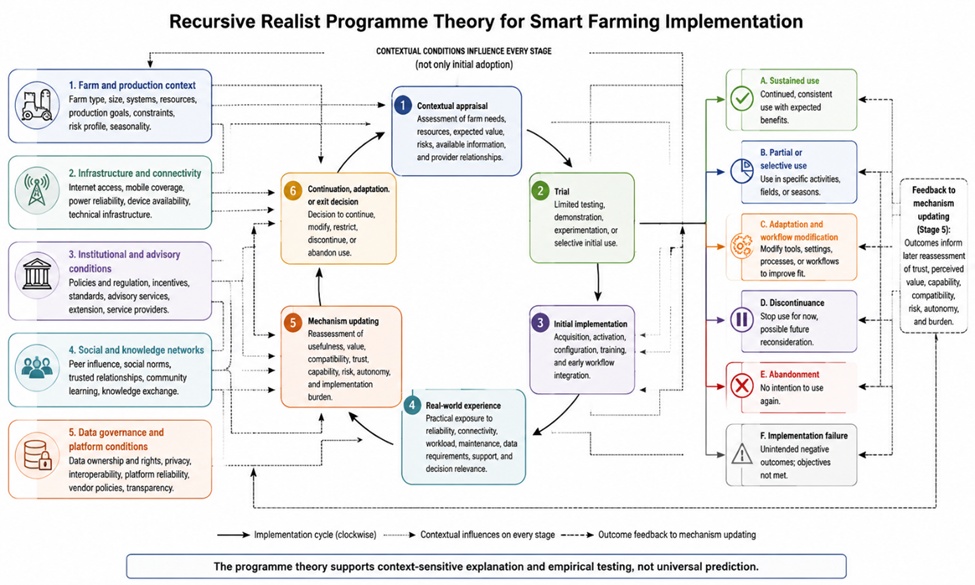
Figure 1. Context-conditioned mechanisms leading to smart farming adoption and failure
Alt-text. A three-part diagram showing contexts on the left, enabling and constraining mechanisms in the centre, and differentiated outcomes on the right. Feedback arrows connect outcomes with later farmer assessments.
Innovation uncertainty can delay, constrain, or redirect adoption [23]. Uncertainty may concern technical performance, integration costs, provider stability, compatibility, and benefit timing. Farmers may recognize potential usefulness while postponing investment until evidence improves.
Adoption refers to initial access or use. Partial adoption refers to selected functions or limited areas. Sustained use requires continuing value, acceptable workload, reliability, and support. Discontinuance refers to cessation after prior use, while abandonment refers to exit after implementation becomes unworkable. Implementation failure occurs when a technology does not become meaningfully embedded in routine practice.
Digitalisation is also reorganizing agricultural knowledge and advice networks [24]. These networks influence which technologies become visible, how claims are interpreted, and who supports troubleshooting. Strong networks can provide translation and validation. Fragmented systems may leave farmers dependent on vendors or informal assistance.
Digital extension requires user-centered design, institutional integration, local relevance, and attention to exclusion [25]. Device access alone does not establish meaningful participation. Farmers also require the ability to interpret information, question recommendations, obtain support, protect data, and influence system design.
Agricultural digital transformation can be understood as a socio-cyber-physical process linking people, institutions, digital infrastructures, data, equipment, and biological production systems [26]. Failure can arise when any of these elements is poorly aligned. A technically accurate model may have little value if required data are unavailable. Reliable sensors may be underused when outputs do not fit decisions.
Agriculture 4.0 should therefore be assessed in relation to people, production, and environmental consequences [27]. Adoption alone does not demonstrate agronomic, economic, social, or environmental benefit. Evaluation should examine reliability, workload, usability, autonomy, data rights, distribution of benefits, and capacity to exit.
Implementation capacity is distributed among farmers, advisers, providers, machinery dealers, telecommunications companies, public institutions, researchers, and platform operators. Failure should not automatically be attributed to farmers.
Uneven resources, infrastructure, and representation can produce unequal engagement with digital farming [28]. Farms with stronger capital and support may capture early benefits, while less-resourced farms face higher proportional costs or technologies poorly adapted to their needs.
Ethical questions involving privacy, accountability, fairness, and autonomy are integral to implementation [29]. Transparent and credible governance may strengthen trust and perceived control. Opaque arrangements may produce restricted data sharing, conditional adoption, or resistance.
Digital farming platforms can create path dependency by structuring data flows, services, and future choices [30]. Integrated platforms may offer convenience while increasing switching costs or dependence on proprietary formats. Farmers may therefore balance usefulness against possible loss of control.
Supply-side structures also shape implementation. Providers, machinery companies, telecommunications firms, public institutions, and data businesses influence which technologies are developed, priced, supported, and maintained [31]. Farmer-level training cannot solve provider instability, absent broadband, weak interoperability, or concentrated platform power.
The main configurations are summarized in Table 2.
Table 2. Context–mechanism–outcome configurations explaining differentiated smart farming outcomes
Configuration | Context | Mechanism | Possible outcome | Boundary |
Resource-enabled implementation | Suitable resources, infrastructure, support, and workflow fit | Usefulness and implementation confidence | Adoption or sustained use | Resources do not guarantee benefit |
Financial vulnerability | Limited capital and uncertain returns | Affordability concern and loss avoidance | Delay, non-adoption, or restricted trial | Non-adoption may be rational |
Advisory mediation | Credible and accessible support | Trust, learning, and decision confidence | Trial, adaptation, or continued use | Advice cannot correct unsuitable technology |
Weak technical support | Unresolved faults and repair delays | Frustration and maintenance burden | Underuse, abandonment, or failure | Support presence does not prove quality |
Connectivity constraint | Unstable or expensive connectivity | Low usability confidence | Partial use or discontinuance | Connectivity alone does not ensure adoption |
Opaque data governance | Unclear rights or secondary data uses | Privacy and autonomy concern | Resistance or conditional adoption | Formal consent may not provide meaningful control |
Interoperable workflow | Compatible equipment, data, and routines | Lower integration burden | Easier or broader use | Interoperability is not sufficient alone |
Platform dependency | Proprietary systems and high switching costs | Loss-of-control concern | Conditional use, resistance, or trust erosion | Dependency varies by setting |
Peer-visible benefit | Credible experience among comparable farmers | Social learning and legitimacy | Trial or adoption interest | Peer evidence may also discourage adoption |
Recursive feedback | Real-world use reveals value, burden, or risk | Updated trust and perceived value | Continued use, adaptation, or exit | Mechanisms change over time |
The programme theory generated by the review is recursive rather than linear. Farmers initially appraise technologies through existing resources, expectations, information, risks, and relationships. Trial and implementation then generate new evidence. Farmers learn whether technologies work under actual connectivity, labour, weather, equipment, and time constraints.
Experience updates perceived usefulness, trust, capability, compatibility, and risk. Positive experience may reinforce continued use. Recurrent problems may produce partial use, discontinuance, or abandonment. Outcomes also change the surrounding context because advisers gain experience, providers modify services, and institutions revise support arrangements.
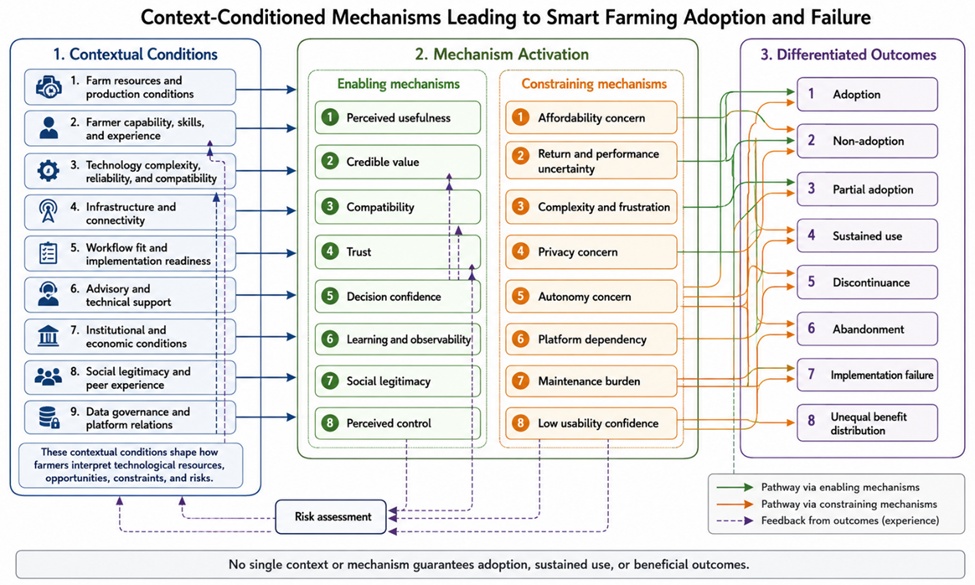
Figure 2. Recursive realist programme theory for smart farming implementation
Alt-text. A circular model showing contextual appraisal, trial, implementation, experience, mechanism updating, and continuation or exit. Feedback loops connect outcomes with later implementation cycles.
Future research should move beyond cross-sectional adoption intentions and examine how mechanisms change during implementation. Prospective realist evaluation could test whether particular resources activate the expected reasoning in contrasting contexts.
Longitudinal studies are needed because initial enthusiasm may decline when maintenance becomes visible, while skepticism may decrease after reliable performance. Usage data should be combined with interviews, observations, support records, and cost evidence because login frequency does not establish meaningful use or benefit.
Failure and abandonment require direct study. Research should document faults, workarounds, unmet expectations, support breakdowns, data problems, and exit decisions. Partial adoption should also be examined at the function level rather than treated as incomplete uptake.
Usability studies should occur under actual farm conditions, including weather, dust, gloves, time pressure, intermittent connectivity, and seasonal workload. Farmer participation should influence problem definition, not only interface testing.
Data-governance research should examine what happens when farmers attempt to retrieve, correct, transfer, restrict, or delete data. Interoperability should be tested through practical switching and data-migration exercises rather than vendor claims.
Equity monitoring should identify who participates, who benefits, who bears implementation costs, and who remains absent from design and evaluation.
Table 3. Future research and implementation agenda
Priority | Required advance | Main evidence need | Boundary |
Realist adoption evaluation | Prospective testing of CMO propositions | Context, reasoning, process, and outcome evidence | Does not prove universal causality |
Longitudinal use studies | Follow technologies from trial to exit | Changing value, support, cost, and reliability | Continued use is not proof of benefit |
Failure documentation | Study abandoned and stalled implementations | Faults, burdens, workarounds, and exit decisions | Failure remains context specific |
Partial-adoption research | Measure use by component and function | Selected, ignored, or replaced functions | Partial use may be adaptive |
Farmer-centered usability | Evaluate systems in real farm conditions | Workload, errors, accessibility, and learning | Usability does not guarantee value |
Advisory-support evaluation | Assess adviser competence and independence | Advice processes and farmer decisions | Adviser presence is not enough |
Data governance and trust | Compare contracts with actual practice | Data use, portability, remedies, and incidents | Trust scores are insufficient |
Platform autonomy | Study switching and dependency | Exit costs, migration, and override behavior | Platform use does not prove loss of autonomy |
Interoperability | Test real cross-system integration | Data transfer, duplication, and workflow burden | Standards do not ensure seamless use |
Equity monitoring | Disaggregate access, costs, benefits, and control | Distributional and participation evidence | Access alone is not inclusion |
Smart farming adoption is not determined by technology availability, farmer attitude, affordability, trust, or skills alone. It is a context-dependent implementation process involving farms, users, technologies, infrastructures, advisers, institutions, markets, and governance arrangements.
Adoption, partial adoption, sustained use, discontinuance, abandonment, and implementation failure are distinct outcomes. Adoption may result from usefulness, compatibility, confidence, and support but remain superficial or unsustainable. Non-adoption may reflect financial constraint, unsuitable design, weak infrastructure, distrust, or legitimate autonomy concerns. Partial adoption may represent practical adaptation rather than incomplete acceptance.
Mechanisms operate through context. Trust matters when transparency and accountability make vulnerability acceptable. Training matters when the system is relevant and learnable. Advisory support matters when advisers are capable and independent. Affordability matters in relation to total cost, uncertainty, and financial exposure. No single mechanism guarantees adoption or beneficial outcomes.
The proposed programme theory treats implementation as recursive. Experience changes value judgments, trust, capability, risk perception, and willingness to continue. Responsible implementation therefore requires reliable infrastructure, farmer-centered design, credible support, interoperability, transparent data governance, meaningful autonomy, and practical options for feedback and exit.
The configurations developed in this review are explanatory propositions requiring empirical testing. They do not predict individual farmer behavior, establish universal causality, or provide a guaranteed implementation formula.
None
None
None
None
Open Access The author(s) retain copyright. This article is licensed under the Creative Commons Attribution-NonCommercial-ShareAlike 4.0 International License. It may be shared and adapted for non-commercial purposes with appropriate attribution, an indication of changes, and distribution of adaptations under the same license. Third-party material may be subject to separate terms identified in its credit line. View the license at https://creativecommons.org/licenses/by-nc-sa/4.0/.
 Agro Intelligence Research Press