Climate-smart precision agriculture is increasingly discussed as a means of connecting farm data, environmental observation, and analytical modeling with climate adaptation, mitigation-relevant assessment, and resilience planning. However, data availability and predictive capability alone do not establish climate benefit, decision reliability, or farm readiness. This article proposes a conceptual data-science framework that organizes climate-smart use-case definition, farm-context mapping, multi-source data integration, adaptation analytics, mitigation-relevant analysis, climate-risk modeling, uncertainty assessment, resilience-oriented decision support, sustainability feedback, monitoring, and governance safeguards. The framework distinguishes climate hazards, exposure, vulnerability, adaptive capacity, forecasting, scenario analysis, and operational decision support while preserving boundaries between analytical indicators and verified outcomes. Remote sensing, sensors, weather and climate records, soil and crop observations, water and resource-use data, machine learning, geospatial analysis, time-series modeling, and data fusion are positioned as conditional inputs and methods rather than automatic sources of climate benefit. The framework also requires local validation, uncertainty communication, farmer participation, human oversight, data-quality assessment, provenance, interoperability, and feedback updating. Its main contribution is an integrated architecture for interpreting how data-science functions may support climate-smart precision agriculture without presenting modeled outputs as guaranteed adaptation, verified mitigation, proven resilience, carbon accounting, or deployment readiness. The article therefore frames climate-smart precision agriculture as a governed learning system whose value depends on evidence quality, contextual interpretation, transparent limitations, and iterative assessment.
Climate-smart precision agriculture combines farm data, digital observation, and analytical methods to examine how agricultural systems may respond to climate pressures. Its data environment extends beyond isolated sensors or prediction models to connected infrastructures that collect, exchange, interpret, and return information to decision contexts. Smart-farming literature therefore supports viewing agricultural data science as an ecosystem of technologies, actors, analytics, and governance arrangements rather than as a single technical intervention [1].
This ecosystem is also socio-technical. Digital agriculture changes knowledge relationships, advisory practices, institutional roles, and control over information, so its consequences cannot be understood through model accuracy alone. Research on agricultural digitalization shows that adoption, legitimacy, inclusion, and responsibility shape whether analytical systems become useful or burdensome in practice [2]. A climate-smart framework must consequently incorporate farmers, advisors, data stewards, and public institutions alongside data pipelines and algorithms.
Precision technologies may support mitigation-relevant analysis by revealing patterns in input use, machinery operations, nutrient application, irrigation, productivity, and other activity data. Nevertheless, estimated efficiencies or modeled emissions-related differences are not equivalent to verified emissions reductions. Evidence on precision technologies and greenhouse-gas mitigation indicates potential contribution pathways, but outcomes remain dependent on technology type, farm context, management response, system boundaries, and assessment method [3].
This article therefore proposes a conceptual data-science framework for climate-smart precision agriculture. The framework links adaptation, mitigation-relevant analysis, climate-risk interpretation, uncertainty communication, resilience-oriented decision support, data integration, sustainability feedback, and governance boundaries. This system-level orientation follows the argument that digital agriculture can help structure more sustainable agricultural-system design when production, environmental, and socioeconomic information is interpreted jointly [4]. The contribution is architectural and analytical, not an implemented or field-validated platform.
Climate-smart precision agriculture can be understood as the context-sensitive use of precision, smart-farming, and digital-agriculture capabilities to support climate-related observation, analysis, and decision processes. It does not arise automatically from technology adoption. Evidence from smallholder climate-smart agriculture shows that access, affordability, literacy, training, institutional support, and power relations influence whether digital tools are usable or exclusionary [5]. Farmer participation and local capacity are therefore framework requirements rather than optional adoption considerations.
Precision agriculture contributes fine-grained information about variability in crops, soils, water, inputs, and operations. Its relevance to climate-smart objectives lies in how this information is connected to adaptation needs, resource-use trade-offs, and environmental interpretation. Research at the production–environment nexus indicates that outcomes differ across technologies, farming systems, incentives, and implementation conditions [6]. Resource-use efficiency should therefore be assessed with absolute use, productivity, externalities, and possible rebound effects rather than treated as a universal sustainability proxy.
Smart farming and Agriculture 4.0 also introduce choices about transition pathways. Farms differ in scale, assets, connectivity, labor, risk exposure, and access to expertise; a uniform architecture may consequently reinforce existing inequalities or create inappropriate dependencies. Responsible transition research argues that diversity and responsibility must be actively managed when agricultural technologies reshape food-system practices [7]. Climate-smart precision agriculture should therefore permit differentiated use cases, proportional safeguards, and explicit limits on automated authority.
Farm-system resilience further requires balancing people, production, and environmental objectives. A system may improve one indicator while worsening affordability, autonomy, ecological pressure, or operational vulnerability. Human-centered Agriculture 4.0 scholarship emphasizes that technical capability should be evaluated against social acceptability, production needs, and planetary consequences [8]. Accordingly, adaptation, mitigation-relevant analysis, and sustainability feedback must remain conditional on farm context, farmer priorities, uncertainty, and long-term monitoring.
Remote sensing can provide repeated spatial observations of vegetation condition, canopy development, soil properties, moisture-related signals, and environmental stress. Satellite and, where appropriate, drone imagery may support geospatial screening of heterogeneous fields and changing conditions. However, spectral indicators are proxies whose interpretation depends on resolution, atmospheric correction, timing, crop stage, calibration, and ground observations. Precision-agriculture remote-sensing evidence therefore supports monitoring and prioritization rather than unqualified diagnosis or climate-benefit claims [9].
Machine learning can analyze non-linear relationships among weather, soil, crop, management, imagery, and sensor variables. Classification, forecasting, clustering, and anomaly detection may assist adaptation planning or resource-use analysis when targets are well defined and data are representative. Agricultural machine-learning research also demonstrates that preprocessing, feature selection, sample size, evaluation design, and validation strongly affect reported performance [10]. Model accuracy should thus be interpreted as task- and dataset-specific evidence, not proof of causal benefit or local transferability.
Sensor networks and Internet of Things architectures can connect field observations with near-real-time analytics. Weather stations, soil sensors, crop measurements, water records, and equipment data may improve temporal detail, but connectivity, energy requirements, maintenance, security, compatibility, and missing data can interrupt the analytical chain. Internet of Things research in precision agriculture identifies interoperability and reliable communication as persistent conditions for meaningful integration [11]. Data fusion should therefore preserve timestamps, units, spatial references, provenance, and uncertainty across sources.
Deep learning may expand image-based crop, stress, pest, and disease analytics, yet complex models remain dependent on representative datasets and external validation [12]. Smart-sensor research similarly emphasizes data quality, calibration, communications, integration, and usable information delivery across the sensing pipeline [13]. Within the proposed framework, adaptation analytics compare conditional options across hazards and constraints, whereas mitigation-relevant analytics examine resource, energy, nutrient, water, or emissions-related indicators. Neither function guarantees adaptation, verifies mitigation, or constitutes carbon accounting.
Climate-risk modeling should distinguish hazard, exposure, vulnerability, and adaptive capacity. A drought, heat event, or disease-conducive period becomes farm risk only through its interaction with crops, timing, water access, soils, infrastructure, management flexibility, and response capacity. Yield-prediction research shows that weather, soil, crop, remote-sensing, and management variables can be combined analytically, but inconsistent evaluation and limited transfer testing constrain farm-level interpretation [14]. Yield estimates should therefore be presented as conditional distributions or anomalies rather than certain outcomes.
Climate-sensitive pest and disease risks add further complexity because biological processes, host condition, surveillance quality, and weather interact across scales. Integrated Internet of Things and machine-learning approaches may support forecasting or early warning where concurrent data and prospective evaluation are available. Reviews of climate-linked disease forecasting nevertheless identify data scarcity, transparency, validation, and model-comparison weaknesses [15]. Alerts should prompt inspection and review, not automatic treatment or operational recommendations.
Climate information becomes decision-relevant only when its form, timing, scale, and uncertainty correspond to user needs. A global meta-analysis of agricultural climate services found that information use depends on accessibility, salience, credibility, and connection to actual decisions [16]. Uncertainty communication should consequently show ranges, probabilities, scenario assumptions, missing data, and sensitivity to model choice. Local comprehension testing is necessary because technically correct intervals can still be misunderstood or treated as guarantees.
Scenario analysis and robust planning can compare options across alternative climatic and socioeconomic conditions without assuming that one future will occur. Risk-informed land-use and irrigation planning illustrates the value of evaluating alternatives under uncertainty rather than optimizing against a single forecast [17]. Structured decision analysis can also make assumptions, stakeholder preferences, and uncertain consequences visible when climate services or adaptation options are compared [18]. Internal, external, local, and prospective field-validation plans should remain distinct; none supports a certainty claim before relevant evidence exists.
Table 1 summarises data-science components for adaptation, mitigation-relevant analysis, climate risk modeling, and farm-level uncertainty in climate-smart precision agriculture.
Table 1. Data-Science Components for Climate-Smart Precision Agriculture: Remote Sensing, Sensor Data, Weather and Climate Data, Soil and Crop Data, Resource-Use Data, Adaptation Analytics, Mitigation-Relevant Analysis, Climate Risk Modeling, Scenario Analysis, Forecasting, Uncertainty Quantification, Validation, and Claim Boundaries
Data-science component | Core climate-smart question | Required data or condition | Analytical or modeling function | Potential output | Uncertainty or overclaiming risk | Validation or governance need | Framework role |
Remote sensing | Where are crop, soil, water, or stress patterns changing? | Calibrated imagery and ground observations | Classification and change detection | Spatial indicators | Proxies treated as direct outcomes | Ground and local validation | Spatial observation |
Sensors and Internet of Things | What is occurring at field level over time? | Calibrated devices, maintenance, and connectivity | Continuous measurement and event detection | Time-series indicators | Drift, failure, or missing data | Quality control and provenance | In-situ observation |
Weather and climate data | Which short- and long-horizon conditions matter? | Observations, forecasts, scenarios, and scale metadata | Hazard, trend, and feature analysis | Exposure context | Forecasts and scenarios conflated | Skill, scale, and assumption review | Climate context |
Soil and crop data | How do site and biological conditions shape response? | Representative soil, crop, phenology, and management records | Interaction and vulnerability analysis | Context profile | Sparse samples generalized broadly | Sampling and crop-stage validation | Vulnerability input |
Water and irrigation data | When may demand exceed accessible supply? | Moisture, supply, flow, demand, and system capacity | Water-balance and scenario analysis | Conditional stress information | Incomplete accounting | Field and agronomic review | Adaptation input |
Nutrient, energy, and resource-use data | Where are input patterns and dependencies located? | Consistent activity and output records | Balance, efficiency, and hotspot analysis | Resource indicators | Efficiency labeled sustainability | Boundary and trade-off review | Mitigation-relevant input |
Machine and deep learning | Which patterns or predictions are supportable? | Representative data and defined targets | Classification, prediction, and anomaly detection | Risk or monitoring estimates | Accuracy treated as causal or transferable | External and local validation | Analytical engine |
Geospatial and time-series modeling | How do conditions vary across space and time? | Aligned georeferenced and longitudinal data | Overlay, trend, lag, and forecast analysis | Maps and trajectories | Scale mismatch or non-stationarity | Spatial and temporal back-testing | Analytical structure |
Data fusion | Can complementary observations form a coherent farm state? | Compatible schemas, units, timestamps, and identifiers | Feature-, model-, or decision-level fusion | Integrated dataset | Error propagation and hidden incompatibility | Interoperability and provenance checks | Integration function |
Adaptation analytics | Which options remain plausible across scenarios? | Hazard, vulnerability, feasibility, and preference data | Robust and multi-criteria comparison | Conditional option set | Ranking presented as prescription | Farmer and advisor review | Adaptation support |
Mitigation-relevant analytics | How may activities alter resource or emissions-related indicators? | Activity data, factors, baselines, and boundaries | Indicator and scenario comparison | Mitigation-relevant estimates | Estimate presented as verified reduction | Specialist review and explicit scope limits | Mitigation analysis |
Risk modeling and forecasting | What conditional risks are indicated at a stated horizon? | Hazard, exposure, vulnerability, and response data | Probabilistic or ensemble modeling | Risk distribution or alert | False precision and domain shift | Calibration, external, and local testing | Risk interpretation |
Uncertainty quantification and communication | What is known, variable, or decision-sensitive? | Error ranges, ensembles, sensitivities, and user needs | Probability, interval, and explanation methods | Uncertainty statement | Ranges misunderstood or omitted | Calibration and comprehension testing | Decision boundary |
Validation and claim controls | What level of use is supported by evidence? | Held-out, external, local, and prospective evidence | Performance and readiness assessment | Qualified use statement | Validation levels conflated | Independent review and audit trail | No-certainty, no-guarantee, and no-accounting boundary |
Resilience-oriented decision support should translate climate information into understandable options without transferring final authority to an algorithm. Co-produced forecast visualizations and repeated interaction can improve farmers’ interpretation of climate information when communication reflects local language, timing, and decision needs [19]. Outputs should present alternatives, assumptions, and uncertainty rather than categorical instructions.
Tool availability alone does not ensure meaningful use. Perceived usefulness, compatibility with established practice, accessibility, and user confidence influence engagement with agricultural weather and climate decision tools [20]. Farmer-facing interfaces therefore require usability assessment, while advisor-facing systems should expose input provenance, model limitations, scenarios, and uncertainty so outputs can be independently reviewed.
Drought, irrigation, crop-monitoring, and resource-use tools may structure risk assessment, highlight conditions requiring attention, and compare plausible responses. A drought-risk webtool illustrates how water, crop, and climate information can be organized for decision support without guaranteeing outcomes [21]. Alerts and rankings should trigger inspection and contextual interpretation, not autonomous irrigation, treatment, or farm-management actions.
Participation must shape use-case definition, assumptions, outputs, and revision rather than operate as nominal consultation [22]. Trustworthy agricultural artificial intelligence also requires identifiable responsibility, accountability, oversight, and mechanisms for challenge or correction [23]. The framework consequently applies no-resilience-guarantee, no-autonomous-decision, and no-operational-recommendation boundaries to every decision-support output.
Climate-smart analysis requires heterogeneous data to be aligned across sources, scales, timestamps, identifiers, and units. Agricultural big-data architectures show that ingestion, storage, processing, visualization, and external validity are interconnected design problems [24]. Integration should preserve missingness, transformation history, spatial resolution, uncertainty, and provenance rather than conceal incompatibilities through automated preprocessing.
Data access is also a governance relationship. Farmers may resist sharing data when control, ownership, benefit, liability, or future use is unclear [25]. Integration therefore requires transparent agreements, proportional access controls, legitimate purposes, and mechanisms through which farmers can understand, contest, or withdraw participation where applicable.
Privacy safeguards should extend across collection, communication, storage, analysis, linkage, and service delivery. Smart-farming privacy research demonstrates that risk can arise throughout the data lifecycle, not only at the point of collection [26]. Data minimization, role-based access, traceability, security review, and accountability should therefore accompany interoperability and analytical convenience.
Sustainability feedback should compare explicitly defined indicators with stated goals, baselines, boundaries, and time horizons. Monitoring scholarship cautions that selected metrics or dashboards do not independently prove agricultural sustainability [27]. Water, nutrient, energy, resource-use, and emissions-relevant feedback must remain traceable and qualified; modeled indicators are not verified environmental performance or certified emissions reductions.
Table 2 maps decision-support, resilience, data-integration, and sustainability-feedback requirements for climate-smart precision agriculture.
Table 2. Decision Support, Farm-System Resilience, Data Integration, and Sustainability Feedback Requirements for Climate-Smart Precision Agriculture: Adaptation Support, Climate-Risk Decision Support, Resource-Use Feedback, Water and Nutrient Feedback, Environmental Accountability, Farmer Participation, Human Oversight, Monitoring, Feedback Updating, and Resilience Boundaries
Decision-support or feedback component | Core resilience or sustainability question | Required context or data | Decision-support or feedback function | Potential output | Failure or misinterpretation risk | Oversight or monitoring need | Claim boundary |
Adaptation and climate-risk support | Which options remain plausible? | Hazards, vulnerability, constraints, preferences | Scenario comparison | Conditional options | Ranking treated as prescription | Farmer and advisor review | No adaptation guarantee |
Irrigation and drought support | How do water conditions affect choices? | Weather, soil moisture, supply, crop stage | Water-balance analysis | Risk information | Generic thresholds transferred locally | Field review | No operational recommendation |
Crop monitoring | Where is investigation needed? | Imagery, sensors, phenology | Anomaly detection | Inspection priority | Alert treated as diagnosis | Field verification | No autonomous action |
Farmer- and advisor-facing support | Is information understandable and reviewable? | User needs, provenance, uncertainty | Explanation and visualization | Qualified decision support | Automation bias or exclusion | Usability testing and override | Human authority retained |
Data integration and interoperability | Can data be exchanged without losing meaning? | Schemas, identifiers, units, timestamps | Harmonization and semantic mapping | Integrated dataset | Hidden incompatibility | Conformance audit | Integration is not validation |
Data quality and provenance | Are inputs reliable and traceable? | Metadata, lineage, quality criteria | Profiling and lineage tracking | Quality report | Corrected data presented as raw evidence | Version control | Poor data may block analysis |
Resource, water, and nutrient feedback | Are use patterns changing? | Consistent activity and output records | Balance and trend analysis | Resource indicators | Efficiency equated with sustainability | Boundary and trade-off review | No performance guarantee |
Energy and emissions-relevant feedback | Where are energy or activity hotspots? | Energy, machinery, input, and factor data | Scenario estimation | Mitigation-relevant indicator | Estimate treated as verified reduction | Method and factor review | No emissions-verification claim |
Sustainability and accountability | Can claims be traced to evidence? | Goals, baselines, indicators, provenance | Monitoring and claim–evidence linkage | Feedback statement | Selective metrics | Periodic independent review | No sustainability guarantee |
Monitoring and updating | Are conditions, models, or outcomes changing? | New data, logs, complaints, observations | Drift detection and controlled revision | Update record | Silent degradation | Revalidation after change | Updating is not readiness |
The framework begins with climate-smart use-case definition and farm-context mapping. Farmers, advisors, researchers, cooperatives, data stewards, and public institutions should clarify the decision, time horizon, intended user, available authority, and unacceptable claims. Digital agricultural knowledge networks support connecting technical systems with human advisory and institutional relationships [28].
The second stage inventories climate, weather, remote-sensing, sensor, soil, crop, water, resource-use, and management data. Quality, provenance, privacy, temporal synchronization, spatial alignment, and semantic interoperability are reviewed before analysis. Spatio-temporal semantic data architectures demonstrate how agricultural data can be integrated while retaining contextual meaning across heterogeneous systems [29].
The analytical core contains adaptation analytics, mitigation-relevant analysis, hazard–exposure–vulnerability modeling, scenario analysis, forecasting, and uncertainty assessment. Because agricultural artificial intelligence can create systemic risks and externalities, model relevance, safety, accountability, affected stakeholders, and possible unintended effects must be reviewed before operational claims are considered [30].
The next stage translates validated evidence into resilience-oriented decision support. Outputs include conditional scenarios, risk explanations, monitoring priorities, and sustainability feedback. Human reviewers retain authority, while farmer feedback can identify inaccessible interfaces, missing variables, impractical assumptions, or locally inconsistent outputs. Material corrections or model updates require documented revalidation.
The final stage monitors data quality, model drift, user experience, environmental indicators, governance incidents, and contextual change. Feedback may return to data collection, assumptions, models, interfaces, or use-case definition. This cyclical architecture is proposed for framework development only and does not establish field validation, climate benefit, carbon-accounting compliance, operational safety, or deployment readiness.
Table 3 presents the proposed data-science framework for climate-smart precision agriculture.
Table 3. Proposed Data-Science Framework for Climate-Smart Precision Agriculture: Use-Case Definition, Farm Context Mapping, Climate Hazard and Exposure Assessment, Farm Vulnerability, Data Inventory, Data Quality, Data Integration, Adaptation Analytics, Mitigation-Relevant Analytics, Risk Modeling, Uncertainty Communication, Resilience Decision Support, Sustainability Feedback, Monitoring, Governance, and Claim Boundaries
Framework stage | Core purpose | Required input | Data-science function | Potential output | Validation or assessment need | Failure risk | Feedback mechanism | Decision boundary |
Use-case and stakeholder definition | Bound the problem and authority | Decision, users, context | Requirements analysis | Use-case statement | Stakeholder review | Technology-first framing | Scope revision | No deployment claim |
Hazard, exposure, and vulnerability | Structure climate risk | Climate, spatial, farm, capacity data | Risk decomposition | Risk profile | Local and scale checks | Composite-score misuse | Context correction | No loss guarantee |
Data inventory and quality | Establish fitness and traceability | Data catalogue and metadata | Profiling and provenance review | Data-quality record | Independent checks | Hidden bias or missingness | Correction log | Unsuitable data may halt analysis |
Integration and interoperability | Combine data coherently | Schemas, identifiers, mappings | Alignment and fusion | Integrated data layer | Semantic testing | Information loss | Mapping update | Integration is not validation |
Adaptation analytics | Compare conditional options | Risk, feasibility, preferences | Scenario and robust analysis | Option set | Sensitivity and local review | Prescription from ranking | Outcome feedback | No adaptation guarantee |
Mitigation-relevant analytics | Examine resource and activity indicators | Inputs, energy, factors, boundaries | Indicator comparison | Mitigation-relevant estimate | Method and boundary review | Verified-reduction overclaim | Data and factor update | No mitigation or accounting claim |
Risk and uncertainty modeling | Estimate conditional patterns | Hazard and farm data | Probabilistic, ML, or ensemble modeling | Risk distribution | Calibration and external validation | False precision | Drift monitoring | No prediction certainty |
Resilience decision support | Explain risks and alternatives | Validated evidence and user context | Visualization and option comparison | Human-reviewed output | Usability and equity assessment | Automation bias | Farmer and advisor feedback | No autonomous decision |
Sustainability feedback | Monitor selected indicators | Goals, baselines, observations | Trend and benchmark analysis | Feedback dashboard | Indicator and attribution review | Dashboard treated as proof | Periodic review | No sustainability guarantee |
Monitoring and governance | Detect change, failure, or misuse | Logs, outcomes, incidents, new evidence | Monitoring, audit, controlled updating | Revision record | Revalidation and accountability review | Silent degradation | Framework updating | No readiness inference |
Figure 1 presents the proposed data-science framework for climate-smart precision agriculture, linking climate-smart use-case definition, data integration, adaptation and mitigation-relevant analytics, climate risk modeling, uncertainty communication, resilience decision support, sustainability feedback, monitoring, and framework updating.
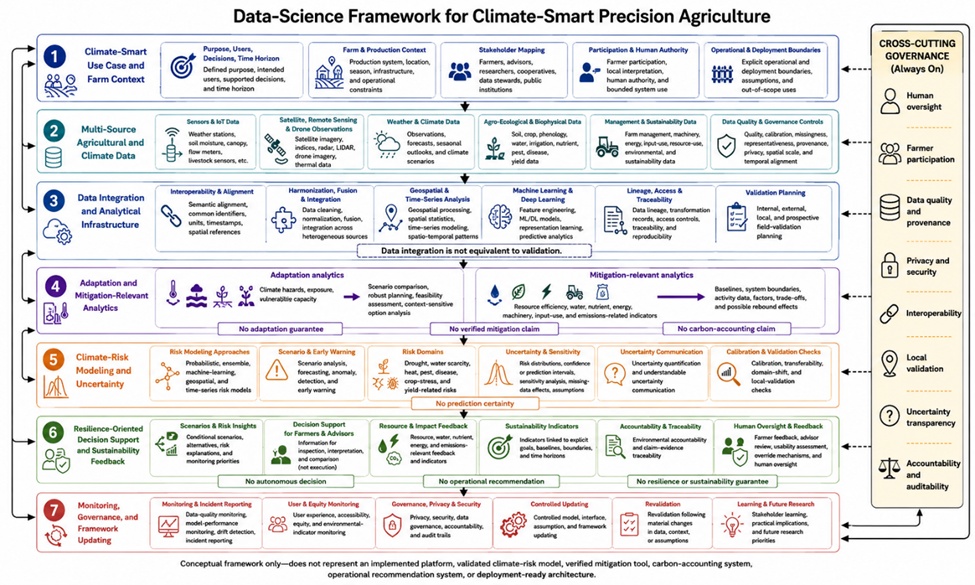
Figure 1. Data-Science Framework for Climate-Smart Precision Agriculture
Alt-text description:
A conceptual data-science framework showing climate-smart precision agriculture data flowing through farm-context mapping, climate hazard and exposure assessment, data-quality review, data integration, adaptation analytics, mitigation-relevant analytics, climate-risk modeling, uncertainty communication, resilience decision support, sustainability feedback, monitoring, governance, and feedback updating.
For farmers and advisors, the framework implies that climate information should be accompanied by local assumptions, uncertainty, data-quality limitations, and opportunities for correction. Extension services and cooperatives may support interpretation, digital inclusion, and feedback collection. These implications concern analytical governance and communication, not agronomic, financial, insurance, procurement, or platform-selection advice.
Technology developers and data stewards should prioritize interoperable schemas, provenance, privacy, calibration, external validation, accessible explanations, override mechanisms, and monitored updating. Researchers should examine cross-farm transferability, compound climate hazards, uncertainty comprehension, participatory validation, distributional effects, and the relationship between monitored indicators and longer-term resilience outcomes.
Public institutions and policymakers may use the framework to identify evidence gaps, governance responsibilities, and minimum questions for responsible evaluation. Future work should develop context-sensitive validation protocols, sustainability-feedback methods, and accountability processes without treating the framework as policy guidance, certified carbon accounting, regulatory approval, or a deployment instruction.
This article proposes a data-science framework that links climate-smart use-case definition, farm context, integrated data, adaptation analytics, mitigation-relevant analysis, climate-risk modeling, uncertainty communication, resilience-oriented decision support, sustainability feedback, monitoring, governance, and framework updating. Its central premise is that climate-smart precision agriculture should be judged through data fitness, local validation, farmer context, transparent uncertainty, feedback, and safeguards rather than technological capability or climate-benefit claims alone. The framework organizes evidence and decision boundaries but does not guarantee adaptation, mitigation, resilience, verified environmental performance, operational safety, or deployment readiness.
None
None
None
None
Open Access The author(s) retain copyright. This article is licensed under the Creative Commons Attribution-NonCommercial-ShareAlike 4.0 International License. It may be shared and adapted for non-commercial purposes with appropriate attribution, an indication of changes, and distribution of adaptations under the same license. Third-party material may be subject to separate terms identified in its credit line. View the license at https://creativecommons.org/licenses/by-nc-sa/4.0/.
 Agro Intelligence Research Press