Edge Artificial Intelligence and Tiny Machine Learning are increasingly discussed as approaches for moving selected analytical functions from remote cloud infrastructure to low-power devices located closer to agricultural data sources. Their potential relevance to precision agriculture lies in supporting local sensing, classification, monitoring, and decision-assistance functions where continuous connectivity, high-performance computing, or extensive data transmission may be impractical. This framework-oriented review examines Edge AI and TinyML through four connected dimensions: low-power intelligence, embedded farm systems, agricultural deployment constraints, and farm-scale applications and implementation barriers. The review distinguishes on-device inference and near-sensor intelligence from conventional agricultural Internet of Things sensing, generic wireless sensor networks, cloud-based artificial intelligence, and non-embedded machine-learning applications. It organizes the reviewed evidence around embedded hardware, model compression, memory, latency, energy use, sensor quality, connectivity, environmental exposure, calibration, maintenance, usability, affordability, local validation, cybersecurity, privacy, and human oversight. The synthesis indicates that compact inference can reduce reliance on continuous cloud access in appropriately designed systems, but miniaturized models alone do not establish accuracy, robustness, affordability, usability, sustainability, or deployment readiness. Farm-scale usefulness remains conditional on the quality of sensing systems, hardware-aware model design, environmental testing, lifecycle maintenance, locally relevant validation, and clear responsibility for system oversight. The main contribution is a framework that connects technical design choices with deployment conditions, implementation boundaries, and a research and practice agenda for evaluating low-power agricultural intelligence without converting prototype feasibility into unsupported operational claims.
Precision agriculture increasingly depends on connected systems that generate, transmit, process, and interpret data from crops, soils, machinery, weather conditions, water systems, and farm operations. Within these systems, analytical value is created not by isolated algorithms but through relationships among sensing devices, communication infrastructure, data-management processes, decision interfaces, service providers, and farm users. Edge AI and TinyML therefore need to be understood as components within a broader agricultural data ecosystem rather than as independent substitutes for cloud computing, agronomic knowledge, or human decision-making [1].
Machine learning has been applied to agricultural classification, prediction, monitoring, and decision-support tasks using image, environmental, soil, livestock, crop, and water-related data. This breadth demonstrates the potential relevance of computational intelligence to farming, but it also creates substantial variation in data requirements, outcome definitions, validation practices, and practical risk. Reported predictive performance in an agricultural machine-learning study does not by itself show that the model can operate within constrained memory, energy, processing, sensor, or connectivity conditions, nor does it establish that embedded implementation will remain reliable under changing farm environments [2].
The affordability argument for Edge AI and TinyML is similarly more complex than reducing processor size or cloud usage. Digital agriculture operates within social and organizational settings shaped by skills, access to technical support, farm scale, market relationships, infrastructure, institutional capacity, and unequal control over data and digital services. A low-cost embedded device may remain inaccessible or unsustainable when installation, calibration, connectivity, maintenance, training, replacement, and interpretation requirements are included. Affordable precision agriculture must consequently be evaluated as a socio-technical proposition rather than a hardware-price category [3].
Edge AI and TinyML may assist selected agricultural functions, including monitoring and analytical support for irrigation, crop health, pest or disease conditions, and resource management. However, the agricultural significance of these functions depends on whether input data are sufficiently representative, outputs are interpretable, models remain valid under local conditions, and users can recognize uncertainty and system failure. This review therefore develops a framework-oriented synthesis that connects low-power intelligence and embedded farm systems with deployment constraints, farm-scale application conditions, implementation barriers, responsible-use boundaries, and research priorities rather than treating compact inference as evidence of operational effectiveness [4].
Edge AI refers broadly to the placement of artificial-intelligence processing nearer to the location where data are generated or used, including sensor nodes, embedded processors, local gateways, single-board computers, mobile platforms, or other edge devices. TinyML represents a more constrained subset of embedded machine learning in which models are designed to operate within limited processing, memory, storage, and energy resources, commonly at microcontroller scale. Its defining issue is therefore not simply small model size, but the combined feasibility of model execution, data preprocessing, runtime support, memory allocation, response time, and energy consumption within a constrained device environment [5].
TinyML also differs from conventional agricultural Internet of Things sensing. A sensor node that measures and transmits soil, weather, crop, water, or environmental variables is not necessarily an intelligent edge system. Near-sensor intelligence requires some local transformation, filtering, classification, anomaly detection, prediction, or decision logic before data are transferred to another computational layer. Frugal embedded intelligence consequently depends on coordinated design across sensors, processors, communication modules, power supplies, firmware, model architectures, and data pathways. Miniaturizing a model without evaluating these surrounding components may shift rather than resolve system constraints [6].
On-device inference can reduce the need to send every raw observation to a remote platform and may allow selected functions to continue during intermittent connectivity. It can also support lower communication latency and some forms of data minimization when only processed outputs are transmitted. These potential benefits are conditional, however, on device capability, model freshness, secure updating, failure detection, buffering, synchronization, and the continuing validity of locally executed models. On-device processing does not remove privacy, cybersecurity, governance, or human-oversight requirements, and it does not establish that an automated output is agriculturally appropriate [7].
Edge AI in farming is best interpreted through a cloud-edge continuum rather than a strict choice between local and remote processing. Sensor nodes may perform basic preprocessing or event detection; gateways may aggregate information, coordinate communications, or execute larger models; and cloud services may support storage, model development, cross-site analysis, or controlled updating. The appropriate distribution of functions depends on data volume, response-time requirements, energy availability, connectivity conditions, privacy expectations, hardware resources, and the consequences of failure. Agricultural IoT architecture therefore provides the infrastructural context within which embedded intelligence must be evaluated [8].
The review covers Edge AI, TinyML, embedded machine learning, on-device inference, near-sensor intelligence, edge and fog computing where relevant, and their placement within agricultural IoT and cloud-edge systems. It includes literature concerning sensor nodes, gateways, constrained processors, low-power sensing, model optimization, farm-monitoring applications, environmental exposure, communications, maintenance, affordability, usability, validation, and responsible implementation. The agricultural scope includes field and controlled-environment applications while recognizing that sensing-to-decision systems consist of interconnected physical, computational, communication, and human-facing layers [9].
The framework does not treat every agricultural IoT system as Edge AI and does not classify every agricultural machine-learning model as TinyML. Conventional sensing without local analytical processing, cloud-only models without meaningful edge relevance, and wireless sensor networks used solely for data transport fall outside the central technical category, although they may provide important architectural or deployment evidence. The synthesis also distinguishes technical feasibility from implementation readiness by examining device, network, application, and support layers separately before considering how they interact within farm systems [10].
The evidence base includes reviews, surveys, conceptual analyses, methodological contributions, and relevant experimental or prototype studies that illuminate at least one framework dimension. It excludes non-peer-reviewed technical promotion, product documentation, vendor claims, and unsupported operational prescriptions. The approach is framework-oriented rather than meta-analytic: its purpose is to organize design requirements, deployment constraints, application conditions, implementation barriers, and research priorities across heterogeneous evidence. The resulting framework is an analytical structure for interpreting low-power agricultural intelligence, not an operational guide or a claim that reviewed systems are validated for generalized farm use [11].
Agricultural TinyML studies illustrate how task requirements interact with embedded resource limits. Image-based crop-disease classification, for example, requires coordination among image acquisition, preprocessing, model architecture, compression, memory use, runtime compatibility, and inference latency. A model that fits within constrained hardware may support local screening where appropriately validated, but device compatibility does not establish diagnostic reliability across crops, disease stages, lighting conditions, backgrounds, locations, or seasons. Local datasets and hardware execution evidence therefore need to be interpreted as bounded feasibility evidence rather than universal field validation [12].
Embedded intelligence also extends beyond image classification. Multivariate greenhouse applications may use compact models to interpret environmental measurements or support bounded control-related classifications on constrained devices. Such systems link sensor quality, temporal sampling, preprocessing, model complexity, and output logic within a single embedded pipeline. Their usefulness depends on whether environmental variables are measured reliably, whether the training conditions represent the intended greenhouse context, and whether failure states are separated from ordinary predictions. Compact model design can support microcontroller compatibility, but it cannot independently establish safe or effective environmental control [13].
Edge architectures may distribute computation across several hardware levels. Sensor nodes can perform low-level filtering or inference, mobile or fixed gateways can aggregate observations and execute more demanding functions, and cloud resources can support model development, storage, or controlled synchronization. UAV-assisted or gateway-mediated designs demonstrate how agricultural data and inference may move between sensing, edge, and remote layers according to energy, bandwidth, timing, and task requirements. This distribution can reduce selected communication burdens, although it also introduces dependencies involving coverage, synchronization, gateway availability, model consistency, and maintenance [14].
Hardware-aware design requires the model and runtime to be evaluated on the intended embedded platform rather than considered only as abstract software. Microcontrollers and other embedded processors differ in available memory, numerical support, peripheral interfaces, scheduling behavior, and compatible operations. Quantization, pruning, compact architectures, and other compression methods may reduce storage or processing demand, but theoretical reductions do not always produce equivalent device-level gains. Agricultural-object classification on constrained processors therefore illustrates the need to measure the complete inference pipeline and preserve sufficient operational headroom for firmware, sensor buffers, logging, communication, and future updates [15].
Low-power intelligence also depends on how often sensing, computation, and communication occur. Adaptive sampling may reduce unnecessary acquisition or radio activity when environmental conditions are stable, but it can also miss short-duration or spatially variable events when its assumptions are poorly matched to farm conditions. Energy assessment should consequently include sensing, preprocessing, inference, communication, idle operation, battery behavior, and solar input where relevant rather than reporting model computation alone [16]. Evaluation methodologies for TinyML should likewise combine predictive performance with memory, latency, energy, hardware compatibility, data representativeness, and failure analysis so that compact execution is not misinterpreted as reliable agricultural performance [17]. Table 1 summarises low-power intelligence and embedded farm system requirements for Edge AI and TinyML in precision agriculture.
Table 1. Low-Power Intelligence and Embedded Farm System Requirements for Edge AI and TinyML in Precision Agriculture: On-Device Inference, Near-Sensor Intelligence, Microcontrollers, Sensor Nodes, Gateways, Model Compression, Quantization, Pruning, Energy Use, Memory Footprint, Latency, Offline Inference, and Performance Boundaries
Technical component | Core design question | Required evidence or input | Low-power function | Agricultural use context | Failure risk | Evaluation need | Framework role |
Edge AI | Which analytical functions should occur locally, at a gateway, or remotely? | Data urgency, bandwidth, privacy, computational load, connectivity pattern, and consequences of delay | Moves selected processing nearer to data generation | Monitoring, event detection, local alerts, and bounded decision assistance | Poor task allocation may increase energy use, latency, or system fragility | Compare local, gateway, and cloud pathways under equivalent task conditions | Organizes processing across the cloud-edge continuum |
TinyML | Can the complete inference task operate within highly constrained resources? | Model, runtime, memory, operator support, preprocessing, latency, and energy requirements | Enables embedded inference on constrained processors | Sensor classification, disease screening, adaptive sampling, and local anomaly detection | A fitted model may remain inaccurate, outdated, or environmentally fragile | Joint predictive, memory, timing, and energy assessment on intended hardware | Defines the most resource-constrained intelligence layer |
Embedded machine learning | Is the learned function safely integrated with sensing, firmware, communications, and possible actuation? | Sensor pipeline, preprocessing logic, firmware architecture, output handling, and fallback states | Executes learned functions within embedded systems | Greenhouse monitoring, irrigation observation, environmental nodes, and compact classifiers | Pipeline mismatch or firmware failure may invalidate outputs | End-to-end and hardware-in-the-loop testing | Connects the model with the physical farm system |
On-device inference | Which functions should remain available without continuous remote access? | Connectivity profile, model freshness, storage capacity, response-time need, and update pathway | Processes data locally and can reduce raw-data transfer | Remote or intermittently connected agricultural settings | Stale models, silent errors, or unsynchronised records may persist offline | Test disconnection, continued operation, reconnection, and synchronization | Supports connectivity-resilient but bounded local operation |
Near-sensor intelligence | What processing should occur directly beside the sensor? | Signal characteristics, event frequency, noise, calibration state, and transmission cost | Filters, compresses, or interprets observations before communication | Soil, weather, crop, water, image, and environmental sensing | Sensor noise or drift may be converted into confident local outputs | Compare raw signals, processed signals, and downstream decisions | Reduces communication while exposing dependence on sensor quality |
Microcontrollers | Does the workload fit the processor’s actual memory, arithmetic, timing, and peripheral limits? | RAM, flash, clock behavior, supported numerical precision, firmware size, and sensor interfaces | Provides low-power sensing, control, and inference | Distributed sensor nodes and compact detection systems | Memory overflow, unsupported operations, or missed timing deadlines | Physical-device profiling with full firmware and runtime | Principal hardware class for TinyML |
Single-board computers | Is additional processing capacity justified by increased power and system complexity? | Processor demand, operating-system overhead, thermal behavior, storage, and power supply | Supports larger edge workloads and gateway functions | Local aggregation, machine vision, and multi-node coordination | Higher energy use, software complexity, and thermal instability | Compare lifecycle burden and performance with smaller alternatives | Intermediate edge layer between constrained nodes and cloud resources |
Sensor nodes | Can sensing, inference, storage, and communication share one energy budget? | Sensor duty cycle, sampling schedule, radio use, inference frequency, and power source | Combines acquisition and local processing in a distributed unit | Soil, environmental, crop, water, and livestock-related monitoring where supported | Radio or sensing demand may dominate inference savings | Component-level and whole-node energy accounting | Basic unit of distributed agricultural intelligence |
Gateway devices | Which functions require aggregation, protocol translation, buffering, or larger local models? | Node density, communication protocols, storage needs, model-management requirements, and coverage | Concentrates processing away from highly constrained nodes | Farm-level coordination, local dashboards, buffering, and edge-cloud synchronization | Gateway failure may interrupt multiple downstream services | Availability, fault-recovery, coverage, and synchronization testing | Bridges sensor nodes, users, and remote services |
Model compression | Which reductions preserve agriculturally relevant model behavior? | Baseline performance, target-device limits, representative data, model size, and operator compatibility | Reduces storage and computational requirements | Embedded vision, sensor classification, and local prediction | Compression may reduce performance for rare classes or local conditions | Compare compressed and uncompressed models across contexts and subgroups | Central model-size and performance trade-off |
Quantization | What numerical precision can be reduced without unacceptable degradation? | Calibration data, runtime support, supported operators, and task sensitivity | Lowers memory use and arithmetic cost | Microcontroller-based image and sensor inference | Quantization error or unsupported operations may change outputs | Device-level predictive, timing, memory, and energy testing | Specific hardware-aware compression method |
Pruning | Can parameters or operations be removed in a form usable by the target runtime? | Sparsity structure, runtime support, model redundancy, and target workload | May reduce storage or computation | Efficient embedded neural inference | Theoretical sparsity may not create actual acceleration or energy savings | Measure realized rather than nominal device benefits | Conditional optimization mechanism |
Knowledge distillation where supported | Can task-relevant behavior be transferred to a smaller model? | Suitable teacher model, representative data, student capacity, and independent evaluation | Produces a compact model from a larger reference model | Image or multimodal agricultural applications where evidence exists | The smaller model may inherit bias or local failure patterns | Independent validation of the compact model under intended conditions | Optional model-reduction pathway |
Efficient neural networks | Is efficiency incorporated into model architecture from the outset? | Device-aware architecture, operation count, memory traffic, runtime compatibility, and task data | Reduces computation and storage demand | Crop, disease, pest, weed, or object recognition where supported | Efficiency on one processor may not transfer to another | Cross-device and cross-context benchmarking | Hardware-aware model-design principle |
Low-power sensing | Can sensing frequency or resolution be reduced without losing important agricultural variation? | Temporal dynamics, spatial variability, event duration, and agronomic relevance | Reduces sensing and communication energy | Soil and environmental monitoring | Under-sampling may miss transient or local events | Compare adaptive and fixed sensing against reference observations | Extends low-power analysis beyond model inference |
Battery operation | Can the complete node remain available under realistic duty cycles and environmental conditions? | Battery characteristics, current profile, temperature, communication bursts, and servicing interval | Enables untethered operation | Remote and distributed farm nodes | Capacity loss or unexpected workload may cause premature shutdown | Long-duration monitoring of complete-node power demand | Operational-autonomy dimension |
Solar energy where supported | Can harvested energy cover variable sensing, inference, and communication loads? | Irradiance, shading, storage, panel orientation, seasonal variation, and load profile | Supports recharging of autonomous nodes | Remote environmental and field monitoring | Weather variability, dust, shading, or battery ageing may create energy deficits | Seasonal energy-balance and degradation evaluation | Conditional energy-supply strategy |
Latency | Is end-to-end response time suitable for the intended agricultural function? | Sensor acquisition time, preprocessing, inference, communication, interface delay, and task tolerance | Supports timely local processing | Alerts, monitoring, event detection, and bounded control assistance | Fast model inference may conceal slow sensing or communication | Measure complete sensor-to-output timing | Core responsiveness dimension |
Memory footprint | Does the full system fit with sufficient operational and update headroom? | Model, runtime, firmware, buffers, logs, communication stack, and update requirements | Limits storage and dynamic-memory demand | All constrained embedded applications | Model-only reporting may conceal system-level memory failure | Measure peak RAM and complete flash use on the target device | Core embedded-feasibility dimension |
Offline inference | Which functions remain useful and safe during connectivity loss? | Local inputs, model version, buffering, failure logic, audit records, and synchronization rules | Maintains selected analytical functions without remote access | Intermittently connected agricultural environments | Local outputs may become stale, unreviewed, or inconsistent with remote records | Outage, recovery, resynchronization, and model-currency testing | Connectivity-resilience mechanism |
No performance-guarantee boundary | What evidence is required before reliability or effectiveness can be claimed? | Multi-context validation, uncertainty analysis, failure-mode evidence, and relevant farm outcomes | Does not create a technical function; constrains interpretation | All Edge AI and TinyML applications | Prototype feasibility may be presented as operational performance | Prespecified local, temporal, external, and system-level evaluation | Separates compact execution from validated agricultural usefulness |
Agricultural edge systems are exposed to deployment conditions that differ substantially from controlled laboratory environments. Outdoor or semi-outdoor platforms may need to coordinate low-power sensing, embedded processing, battery operation, solar energy harvesting where applicable, data storage, and communication through variable networks. Power autonomy cannot be inferred from processor efficiency alone because sensing frequency, radio transmission, gateway interaction, environmental conditions, and battery behaviour contribute to the total energy demand. Field-oriented environmental collectors demonstrate the importance of assessing the complete platform, including power supply, connectivity, sensor stability, calibration, enclosure, and maintenance requirements [18].
Energy efficiency must also be considered alongside communication reliability and cybersecurity. Agricultural wireless sensor networks can involve distributed, unattended nodes that communicate through constrained links and may be difficult to inspect physically. Energy-aware routing or reduced transmission may extend node operation, but security procedures, authentication, message integrity, and recovery mechanisms also require computational and communication resources. Treating security as a later software addition may therefore undermine both energy planning and system dependability, particularly when compromised or malfunctioning nodes influence downstream monitoring or control functions [19].
Local processing changes the flow of agricultural data but does not remove privacy or cybersecurity obligations. Edge devices may reduce the transmission of raw observations, yet they can still retain sensitive farm records, geolocated production information, imagery, operational patterns, user credentials, model parameters, and derived inferences. Devices, gateways, update channels, communication links, and user interfaces can each create attack or disclosure pathways. Secure updating, access controls, authentication, data minimization, logging, and clearly defined retention practices remain relevant even when most inference occurs on the farm [20].
Safeguards must extend across the complete architecture because threats and failures can move between sensing, communications, processing, and application layers. Device heterogeneity, unattended installations, variable network quality, and inconsistent update practices complicate cross-layer protection [21]. Physical exposure adds further uncertainty: dust can foul sensors or ventilation openings; humidity and rain can affect electronics and measurements; heat can alter batteries, processors, and sensor responses; and equipment movement or vibration can damage connections. Protective enclosures and robust installation may reduce these risks, but their effectiveness requires testing under the intended environmental conditions rather than assumption from indoor operation [18].
Sensor drift, model drift, calibration changes, device failure, and maintenance gaps can gradually reduce system validity without producing an obvious technical fault. Embedded drift-compensation methods demonstrate that changes in sensor response can sometimes be detected or corrected locally, but evidence from one sensor domain cannot be transferred automatically to agricultural conditions without local evaluation [22]. Responsible deployment must also reflect the availability of local infrastructure, replacement components, technical skills, training, repair services, and human oversight, especially where digital interventions are introduced into resource-constrained settings [23]. These interactions mean that low-power intelligence, farm sensors, intermittent connectivity, environmental exposure, maintenance capacity, and validation boundaries must be evaluated as one deployment pathway rather than as isolated engineering variables.
Figure 1 illustrates the deployment architecture and constraint pathway for Edge AI and TinyML in agricultural environments, linking sensors, embedded inference, gateways, connectivity, power, environmental stressors, validation, and human oversight.
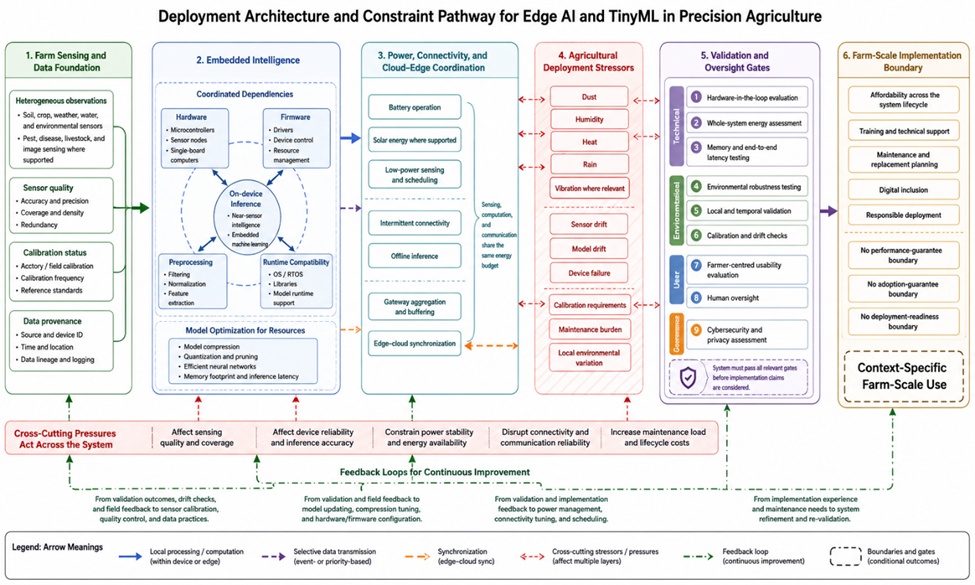
Figure 1. Deployment Architecture and Constraint Pathway for Edge AI and TinyML in Precision Agriculture
Alt-text description:
A conceptual architecture showing farm sensors feeding embedded Edge AI and TinyML devices, gateways, intermittent connectivity, power constraints, environmental stressors, calibration, validation, maintenance, human oversight, and deployment boundaries.
Farm-scale Edge AI applications can range from environmental monitoring to embedded decision assistance, but each application requires its own evidentiary boundary. A constrained crop-recommendation model may demonstrate that selected calculations can be executed locally without continuous cloud access, yet standalone inference does not establish that the recommendation is agronomically valid, economically beneficial, understandable to farmers, or appropriate under changing soils, climates, cultivars, and management practices [24]. Soil-moisture inference and related decision-support functions likewise depend on representative sensor placement, calibration, temporal sampling, and locally relevant outcome evidence rather than computational feasibility alone [14].
Crop monitoring, disease detection, pest recognition, and weed detection often depend on image or sensor data that vary with lighting, growth stage, background, species, symptom expression, occlusion, and field management. Reviews of weed-detection research show that dataset diversity, computational requirements, environmental variation, and cross-field generalization remain material barriers before embedded deployment can be inferred [25]. TinyML disease-classification studies provide useful evidence about model compression and constrained execution, but they do not establish autonomous diagnosis across farms or seasons [12]. Greenhouse models and UAV-assisted systems extend the application space to multivariate environmental monitoring and mobile edge architectures, although their outputs remain bounded by the conditions and tasks under which they were evaluated [13].
Irrigation monitoring illustrates the importance of combining edge processing with communication infrastructure and farmer-facing interfaces. Low-cost devices may collect or aggregate observations near irrigation equipment, while local or remote interfaces communicate system status to users. However, component affordability is only one part of the implementation problem. Coverage, installation, compatibility, data interpretation, interface design, troubleshooting, and continued technical support determine whether a monitoring architecture can remain usable after initial setup [26].
Livestock sensing, greenhouse management, mobile robotics, crop scouting, and farm decision support may also benefit from local processing where latency or connectivity constraints make continuous cloud access impractical. Nevertheless, tasks involving animals, moving equipment, environmental control, or treatment decisions introduce additional welfare, safety, and oversight concerns. Arable-farming evidence shows that IoT implementation is shaped by interoperability, connectivity, business models, maintenance, service availability, and the fit between technology and established work practices [27]. Edge intelligence cannot overcome these barriers merely by reducing model size.
Affordability should therefore include acquisition, installation, power supply, connectivity, calibration, training, software or model maintenance, repair, replacement, and access to competent support. Supply-side structures and service ecosystems can determine which farms obtain digital tools, who controls the associated data, and whether users remain dependent on external providers [28]. Farmer usability, digital inclusion, and local validation must be treated as evaluation requirements rather than assumed outcomes. A technically functional system may remain unused, misunderstood, or unsustainable, and neither short-term prototype operation nor local inference establishes adoption or farm-scale effectiveness. Table 2 maps deployment constraints, farm-scale applications, and implementation barriers for Edge AI and TinyML in agricultural environments.
Table 2. Deployment Constraints, Farm-Scale Applications, and Implementation Barriers for Edge AI and TinyML in Agricultural Environments: Connectivity, Power, Battery Life, Memory, Processing, Sensor Quality, Calibration, Dust, Humidity, Heat, Rain, Device Failure, Maintenance, Affordability, Usability, Local Validation, and Deployment Boundaries
Application, constraint, or barrier | Core farm-scale question | Required data or system condition | Edge or TinyML function | Potential use | Implementation or failure risk | Evaluation or support need | Claim boundary |
Connectivity limitation | Can essential functions continue when remote communication is weak or unavailable? | Characterized coverage, outage duration, buffering capacity, and recovery logic | Local inference, buffering, and selective synchronization | Continued bounded monitoring or alerts | Missing, delayed, duplicated, or stale data | Disconnection, reconnection, and synchronization testing | Edge processing may reduce dependence on continuous connectivity but cannot guarantee network availability. |
Intermittent networks | Does the system recover correctly after repeated network interruption? | Reliable timestamps, local storage, conflict handling, and data-integrity checks | Store-and-forward operation | Remote field monitoring | Inconsistent records or delayed updates | Controlled outage and recovery evaluation | Offline operation does not eliminate synchronization requirements. |
Power limitation | Which sensing, inference, communication, or idle processes dominate energy use? | Whole-node current profiles and realistic duty cycles | Adaptive sensing and low-power local processing | Untethered environmental monitoring | Premature shutdown or reduced sampling | Complete-system energy measurement | Low-power inference does not prove low-power system operation. |
Battery life | Can the system remain available across temperature, ageing, and communication variation? | Battery characteristics, environmental conditions, and service interval | Supports autonomous operation | Distributed farm nodes | Capacity loss and unexpected maintenance | Long-duration field-oriented power assessment | Estimated capacity is not demonstrated field autonomy. |
Solar variability where supported | Can harvested energy cover seasonal and event-driven loads? | Irradiance, shading, storage, orientation, and load profile | Recharging and adaptive scheduling | Remote sensing installations | Weather, dust, shading, or ageing may create energy deficits | Seasonal energy-balance evaluation | Solar integration does not guarantee uninterrupted operation. |
Memory limitation | Does the complete software stack fit with sufficient operating headroom? | Model, firmware, runtime, buffers, logs, and update requirements | Compact model execution | Microcontroller-based applications | Overflow, crashes, or inability to update | Peak-RAM and full-flash assessment | Model size alone does not establish device fit. |
Processing limitation | Can all required tasks complete within timing and thermal limits? | Worst-case workload and concurrent task profile | Hardware-aware inference | Local classification and detection | Missed deadlines or reduced sensing frequency | End-to-end worst-case timing tests | Average inference time does not guarantee real-time performance. |
Sensor quality | Are measurements sufficiently accurate and representative for the intended function? | Installation guidance, reference comparison, quality flags, and data provenance | Local filtering or inference | Soil, climate, crop, water, and livestock sensing where supported | Systematic input error may create misleading outputs | Comparison with accepted reference measurements | Model performance cannot automatically compensate for poor sensing. |
Sensor drift | How will gradual changes in sensor response be detected? | Longitudinal reference observations and calibration history | Drift detection or compensation | Environmental monitoring | Biased inputs and deteriorating predictions | Periodic reference checks and drift analysis | Initial calibration does not establish long-term stability. |
Model drift | Does the relationship between inputs and outcomes change across seasons or practices? | Temporal labels, monitoring criteria, and controlled updating | Local monitoring or adaptation where validated | Long-term decision assistance | Declining relevance without obvious hardware failure | Multi-season performance monitoring | Offline inference does not guarantee model currency. |
Calibration | Who performs calibration, how often, and against which reference? | Documented procedures, tools, records, and responsible personnel | Corrects or contextualizes sensor inputs | All measurement-dependent applications | Inconsistent data across sites or replacement sensors | Predeployment and periodic calibration checks | Manufacturer or laboratory specifications do not prove site-level validity. |
Dust | Can exposed components continue to operate under particulate loading? | Appropriate enclosure, placement, and cleaning access | No direct intelligence function; protects system continuity | Outdoor and machinery-adjacent nodes | Fouling, blocked vents, and distorted measurements | Dust-exposure and maintenance evaluation | Indoor operation does not establish outdoor robustness. |
Humidity | Are sensors and electronics protected from moisture and condensation? | Moisture control, enclosure design, ventilation, and inspection | No direct intelligence function | Greenhouse and irrigated environments | Corrosion, shorts, and measurement bias | Cyclic humidity and condensation testing | Nominal protection does not establish long-term resistance. |
Heat | Can devices operate under direct sun and enclosure heating? | Thermal design and environmental monitoring | Temperature-aware scheduling where appropriate | Outdoor nodes and gateways | Thermal throttling, battery degradation, and sensor error | Worst-case temperature evaluation | Room-temperature performance is insufficient for field claims. |
Rain | Can installations resist precipitation, splash, and water ingress? | Enclosure integrity, cable protection, drainage, and mounting | No direct intelligence function | Outdoor monitoring | Service interruption or permanent damage | Rain and ingress testing | Weather resistance must be demonstrated under relevant exposure. |
Device failure | Can failure be detected and handled without misleading downstream users? | Health monitoring, watchdogs, diagnostics, and safe fallback states | Fault detection where supported | Distributed sensor and gateway systems | Silent data loss or erroneous outputs | Fault-injection and recovery evaluation | Monitoring reduces but does not eliminate failure risk. |
Soil-moisture monitoring | Are measurements representative of local soil variability? | Calibrated sensors, appropriate placement, and temporal sampling | Local filtering, prediction, or anomaly detection | Irrigation-status awareness | Spatial bias, drift, and poor calibration | Site-specific validation | Inference does not establish irrigation effectiveness. |
Irrigation monitoring | Can equipment and water status be observed across the intended area? | Reliable sensors, communication, and interpretable interfaces | Edge aggregation and local alerts | Pivot or distributed irrigation observation | Coverage gaps, interface burden, and maintenance | Operational and usability evaluation | Monitoring evidence does not prove water savings. |
Crop monitoring | Does the sensing method capture meaningful crop variation? | Representative local data across growth stages and environments | Embedded classification or event detection | Crop-status screening | Lighting, occlusion, and seasonal shift | Multi-site and temporal validation | Detection capability does not establish management benefit. |
Disease detection | Can symptoms be distinguished from visually similar conditions? | Locally relevant images and independent reference diagnosis | Embedded image classification | Preliminary screening | Misclassification, class imbalance, and transfer failure | Expert-confirmed local validation | A classifier should not be presented as autonomous diagnosis. |
Pest detection where supported | Are targets observable at the required scale and frequency? | Representative labels and reliable sensing conditions | Local event detection | Scouting support | Small targets, false alarms, and changing backgrounds | Field testing with confirmed labels | Detection does not establish control effectiveness. |
Weed detection where supported | Can weeds be separated from crops, residue, and soil across fields? | Diverse imagery and species labels | Efficient visual detection | Scouting or robotic perception support | Domain shift, occlusion, and computational demand | Cross-field and device-level testing | Model accuracy does not establish safe autonomous treatment. |
Livestock monitoring where supported | Are behavioural or environmental signals valid for the target animals and setting? | Reliable wearable, image, acoustic, or environmental data | Local classification and anomaly alerts | Behavioural or environmental screening | False alerts, device burden, and welfare concerns | Longitudinal and welfare-sensitive validation | Edge alerts do not establish health or husbandry outcomes. |
Greenhouse monitoring where supported | Can compact models interpret multivariate climate data reliably? | Calibrated sensors, representative conditions, and safe output logic | Local multi-label inference | Microclimate monitoring or bounded control support | Sensor faults and narrow training conditions | Hardware-in-the-loop and fail-safe evaluation | Prototype performance does not prove safe autonomous control. |
Robotics where supported | Is edge perception timely and dependable for a bounded robotic function? | Synchronized sensing, localization, and independent safety controls | Low-latency local perception | Navigation, scouting, or target recognition | Dust, vibration, computational load, and human–machine hazards | System-level safety and field testing | TinyML feasibility does not authorize autonomous action. |
Farm decision support | Are outputs understandable, relevant, reviewable, and accompanied by uncertainty? | Contextual data, validated models, and human-readable interfaces | Local recommendations or alerts | Timely assistance | Missing context, automation bias, and stale models | Agronomic and farmer-centred evaluation | Embedded outputs do not replace professional or farmer judgment. |
Affordability | Is the complete lifecycle affordable for the intended farm context? | Acquisition, installation, energy, communication, maintenance, and support costs | May reduce selected computing or communication requirements | Wider access to distributed sensing | Hidden recurring costs and unequal service access | Context-specific total-cost assessment | TinyML does not automatically make precision agriculture affordable. |
Farmer usability | Can users interpret normal outputs, uncertainty, and failure states? | Appropriate interface, language, workflow fit, and support | Local alerts and simplified interaction | Faster access to information | Alert fatigue, confusion, and low trust | Participatory and longitudinal usability testing | Technical operability does not establish farmer acceptance. |
Training and support | Who installs, updates, troubleshoots, and explains the system? | Training resources, service channels, and role allocation | Sustains embedded-system use | Routine operation | Skills gaps and provider dependence | Training and support evaluation | A self-contained device is not necessarily self-supporting. |
Maintenance | Can devices be cleaned, recalibrated, powered, and repaired locally? | Replaceable components, diagnostics, documentation, and supply access | Preserves sensing and inference quality | Long-term operation | Downtime, abandonment, or escalating lifecycle cost | Maintainability trials and service records | Minimal computing demand does not imply minimal maintenance. |
Digital inclusion | Are benefits and burdens distributed fairly across farm types and users? | Accessibility, language fit, infrastructure, and institutional support | Offline functions may broaden access in some contexts | Use under constrained connectivity | Exclusion through cost, skills, ownership, or service design | Distributional and accessibility assessment | Offline inference alone does not resolve digital inequality. |
Local validation | Does the system perform with local crops, soils, climates, and practices? | Representative local data and independent outcomes | Calibration or controlled adaptation | Context-sensitive inference | Failure of transfer from external datasets | External, temporal, and local validation | Performance elsewhere cannot be assumed locally. |
No adoption-guarantee boundary | Has sustained use and organizational fit been demonstrated? | Longitudinal user evidence | No technical function; constrains interpretation | All applications | Pilot use may be mistaken for acceptance | Continued-use and discontinuation studies | Availability does not guarantee adoption. |
No farm-scale effectiveness guarantee boundary | Have agronomic, economic, or operational outcomes been evaluated appropriately? | Comparative field evidence and relevant outcome measures | No technical function; constrains interpretation | All applications | Technical metrics may be substituted for farm outcomes | Appropriately designed field evaluation | Device or model performance does not establish farm-scale effectiveness. |
No deployment-readiness boundary | Has the complete system been assessed across sites, seasons, users, and failures? | Integrated technical, environmental, user, and governance evidence | No technical function; constrains interpretation | All systems | Prototype evidence may be generalized prematurely | Stage-gated multi-context assessment | Prototype or single-context evidence does not establish deployment readiness. |
The reviewed evidence indicates that Edge AI and TinyML should be assessed as interacting technical and socio-technical arrangements rather than as isolated compact models. Agriculture 4.0 research documents potential benefits from connected sensing, automation, and analytics while also identifying financial, technical, organizational, interoperability, and skills barriers [29]. A framework for affordable precision agriculture must therefore connect model efficiency with hardware capacity, sensor quality, network conditions, service infrastructure, user capabilities, and the intended agricultural task.
No single cloud-edge configuration is universally appropriate. Local inference may reduce selected communication and latency requirements, gateways may support aggregation and coordination, and cloud resources may remain useful for storage, training, updating, and cross-site analysis. The distribution of these functions should follow local constraints and responsibility arrangements rather than an assumed linear transition from cloud systems to autonomous edge devices. Agriculture 4.0 pathways are diverse and context-dependent, and responsible implementation requires attention to who benefits, who bears risk, and which alternatives are excluded by a particular technical design [30].
The meaning of affordability also extends beyond computational efficiency. A system that uses low-cost or low-power hardware may still require substantial installation, calibration, connectivity, training, maintenance, replacement, and support. Its interface may not align with farm workflows, and its outputs may not be trusted or actionable. Digital agriculture must work for people and production while remaining attentive to wider environmental and social implications; technical capability alone cannot establish those outcomes [31].
Responsibility is distributed across model developers, device designers, data providers, system integrators, service organizations, advisers, farm managers, and users. Human oversight must therefore include clear authority to question, suspend, recalibrate, update, or reject system outputs. Trust should be grounded in demonstrated trustworthiness, transparent limitations, traceable data and model histories, understandable failure communication, and meaningful routes for contesting decisions rather than in generalized claims about artificial intelligence [32].
The synthesis consequently treats compact inference as one enabling layer within a larger evidence chain. TinyML evaluation requires multidimensional testing of prediction, hardware, energy, and latency limits [17]. Outdoor agricultural use adds power, connectivity, sensor, environmental, and maintenance dependencies [18]. Farm-scale implementation further requires usable interfaces, support capacity, local fit, and attention to unequal access [31]. Governance and responsibility remain necessary across the complete lifecycle [32]. Table 3 presents a framework-oriented synthesis for Edge AI and TinyML in affordable precision agriculture.
Table 3. Framework-Oriented Synthesis for Edge AI and TinyML in Affordable Precision Agriculture: Low-Power Intelligence, Embedded Farm Systems, Cloud-Edge Trade-Offs, Model Compression, Energy Constraints, Connectivity, Environmental Robustness, Sensor Drift, Farm-Scale Applications, Affordability, Usability, Privacy, Cybersecurity, Local Validation, Responsible Deployment, and Research Priorities
Synthesis theme | Evidence pattern | Technical interpretation | Deployment interpretation | Implementation risk | Research or practice gap | Framework boundary | Agenda implication |
Low-power intelligence | Selected ML functions can be executed on constrained devices | Model architecture, runtime, memory, latency, and energy must be co-designed | Local processing is valuable only where task and context justify it | Compact execution may be mistaken for reliable intelligence | Comparable task–device evaluations | Low-power execution does not establish decision quality | Develop hardware-aware agricultural model-design protocols |
Embedded farm systems | Sensing, processing, communications, interfaces, and power are interdependent | The complete pipeline determines feasibility | Failure in one component can undermine the service | Model-only testing conceals system dependencies | End-to-end and fault-oriented evaluation | The model is only one system component | Evaluate full embedded pipelines |
Cloud-edge trade-off | Local, gateway, and cloud resources offer different advantages | Processing location should follow data, timing, privacy, and compute needs | Hybrid systems require synchronization and fallback logic | Over-centralization or over-localization may create fragility | Comparative cloud, gateway, and device studies | Edge and cloud are complementary | Develop context-sensitive workload-partitioning methods |
Model compression and accuracy | Compression can enable device fit while altering model behaviour | Quantization, pruning, distillation, and efficient architectures need device testing | Smaller models may remain locally invalid | Aggregate accuracy may hide loss for rare or local conditions | Compression studies using representative agricultural data | Compression does not preserve accuracy automatically | Report subgroup, device, and post-compression performance |
Energy constraints | Sensing, communication, inference, and idle operation share the energy budget | Whole-node profiling is required | Workload, temperature, battery age, and network state affect autonomy | Inference-only energy figures may exaggerate savings | Standard whole-system energy protocols | Low-power models do not prove long battery life | Establish energy-aware agricultural evaluation standards |
Latency constraints | Local processing may reduce some response delays | End-to-end timing includes sensing, preprocessing, inference, and communication | Required response time varies by application | Fast model execution may conceal slow system response | Application-specific end-to-end timing evidence | Low inference latency does not guarantee timely operation | Standardize complete sensor-to-output latency reporting |
Connectivity and offline inference | Local functions can continue during some network interruptions | Buffering, model freshness, and recovery logic are required | Intermittent operation needs graceful degradation | Offline outputs may become stale or unsynchronized | Outage and recovery evaluations | Offline inference does not remove network dependence | Develop connectivity-resilient hybrid architectures |
Environmental robustness | Agricultural devices face dust, moisture, heat, rain, and physical exposure | Enclosures, thermal design, and sensor protection affect performance | Long-term exposure can degrade availability and measurement quality | Indoor results may be generalized to field conditions | Repeatable environmental stress and ageing protocols | Robustness is limited to tested conditions | Conduct farm-relevant robustness testing |
Sensor drift | Sensor response may change with ageing and exposure | Monitoring, recalibration, or compensation may be required | Drift increases maintenance and reference-measurement needs | Silent input bias can degrade predictions | Agricultural longitudinal drift datasets | Initial calibration does not prove stability | Integrate drift monitoring into device lifecycles |
Model drift | Seasonal, environmental, and management changes may alter relationships | Model monitoring and controlled updating are needed | Labels may not be available for rapid drift detection | Outdated models may continue producing confident outputs | Multi-season and temporal validation | Offline models are not necessarily current | Develop safe monitoring and update procedures |
Farm-scale application diversity | Tasks range from scalar sensing to image analysis and decision support | Hardware and model requirements are task-specific | Risk and maintenance differ by application | Results from one task may be generalized to others | Application-specific benchmarks and field protocols | No universal TinyML configuration exists | Build task-specific evidence frameworks |
Affordability | Lower computation or transmission may reduce selected expenses | Total architecture and lifecycle costs determine affordability | Installation, replacement, support, and connectivity remain material | Component price may conceal recurring costs | Total-cost evidence across farm contexts | TinyML does not guarantee affordability | Evaluate lifecycle and distributional costs |
Accessibility and digital inclusion | Local processing may help in constrained-connectivity settings | Accessible interfaces and support remain necessary | Benefits depend on skills, language, ownership, and service access | Technology may deepen existing inequalities | Inclusion studies across farm types and users | Offline operation does not resolve the digital divide | Include distributional and accessibility assessment |
Maintenance and usability | Sustained value depends on understandable and serviceable systems | Diagnostics and interface design are core requirements | Local repair and calibration capacity affect availability | Functional systems may be abandoned or misused | Participatory usability and maintainability studies | Deployability is not sustained use | Test systems with intended users and service providers |
Privacy | Edge processing may reduce raw-data transmission | Data minimization, storage, access, and inference sensitivity still matter | Local devices may contain valuable or sensitive data | “Local data” claims may create false confidence | Data-flow and re-identification assessments | Edge processing does not guarantee privacy | Develop privacy-preserving edge-data practices |
Cybersecurity | Distributed devices and gateways create multiple attack surfaces | Secure boot, authentication, updates, and logging are required | Unattended devices may be difficult to inspect or patch | Compromise can affect data and downstream decisions | Agricultural edge threat models and recovery tests | Security cannot be permanently guaranteed | Integrate cybersecurity into design and maintenance |
Local validation | Agricultural heterogeneity limits transferability | Models require locally representative and temporal evidence | Crop, soil, climate, and management variation affect usefulness | Benchmark performance may be mistaken for generalization | Multi-site, multi-season, and external validation | Performance elsewhere cannot be assumed locally | Require context-specific validation plans |
Responsible deployment | Technical choices distribute authority, benefit, and risk | Oversight and traceability must be built into system design | Responsibility spans developers, deployers, advisers, and users | Accountability can become fragmented | Operational responsibility mapping and participatory assessment | Framework use does not certify responsibility | Establish lifecycle responsibility and contestability |
Research priorities | Evidence is fragmented across model, hardware, network, farm, and user studies | Integrated evaluation methods are needed | Field evidence should accompany efficiency claims | Selective reporting prevents comparison | Common multidimensional protocols | Proposed priorities are not validated solutions | Coordinate technical, deployment, user, and governance research |
Figure 2 presents the framework-oriented synthesis for Edge AI and TinyML in affordable precision agriculture, integrating low-power intelligence, embedded farm systems, deployment constraints, farm-scale applications, implementation barriers, responsible deployment, and research priorities.
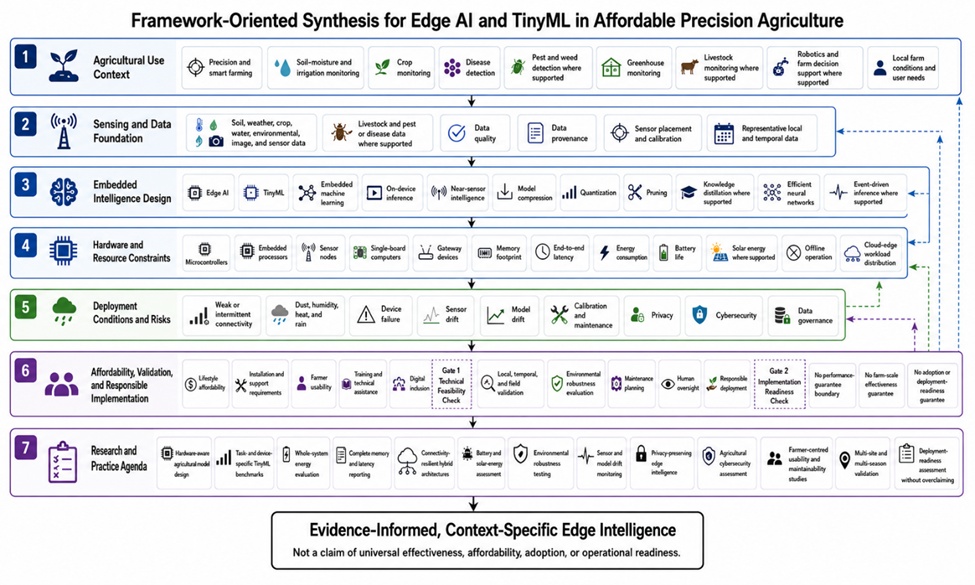
Figure 2. Framework-Oriented Synthesis for Edge AI and TinyML in Affordable Precision Agriculture
Alt-text description:
A conceptual synthesis framework linking Edge AI and TinyML design choices to embedded hardware, farm sensors, energy and connectivity constraints, environmental robustness, applications, affordability, usability, responsible deployment, validation, and research priorities.
A first priority is hardware-aware agricultural model design. Models should be developed with the intended processor, runtime, sensor pipeline, preprocessing method, memory headroom, and update pathway in view rather than compressed only after training [15]. Agricultural TinyML benchmarks should report task definitions, dataset provenance, local relevance, operator compatibility, memory, latency, energy, and failure conditions. Multidimensional methodologies are needed because predictive accuracy alone cannot expose practical device and deployment limitations [17]. Energy protocols should measure sensing, inference, communication, and idle behaviour across realistic duty cycles [16], while memory and latency reporting should cover the complete firmware and sensor-to-output pathway rather than the model file alone [12].
A second priority concerns connectivity and environmental resilience. Hybrid architectures should be evaluated under weak, intermittent, and unavailable network conditions, including buffering, continued local operation, reconnection, synchronization, and model-version control [14]. Solar-powered and battery-operated sensing requires seasonal energy-balance evidence, degradation monitoring, and explicit maintenance assumptions [18]. Environmental testing should examine dust, humidity, heat, rain, contamination, enclosure ageing, and device failure under conditions relevant to the intended agricultural setting. Sensor and model drift monitoring should be incorporated into lifecycle design, but compensation methods must be validated with agricultural sensors and local reference data rather than transferred uncritically from other sensing domains [22].
A third priority is realistic evaluation of affordability, usability, inclusion, and maintenance. Low-cost deployment research should account for installation, communication, calibration, interfaces, support, replacement, and downtime rather than component price alone [26]. Farmer-centred usability studies should examine whether users understand outputs, uncertainty, alerts, connectivity loss, calibration needs, and failure states [31]. Maintenance planning should identify who cleans, repairs, recalibrates, powers, updates, and replaces devices and whether the required parts and skills are locally available [27]. Inclusion assessment should examine whether service models, language, ownership arrangements, infrastructure, or technical dependence exclude particular farms or users [23].
A fourth priority is integrated cybersecurity, privacy, responsibility, and farm-scale validation. Agricultural edge systems require threat modelling, authenticated updating, access control, incident recovery, and clear responsibility for compromised or malfunctioning devices [20]. Privacy-preserving edge intelligence should examine retained data, transmitted outputs, inference sensitivity, access rights, and the possibility that processed information remains commercially or personally revealing [21]. Responsible-deployment assessment should allocate oversight and accountability across developers, integrators, advisers, service providers, and farm users [32]. Farm-scale validation should combine technical, environmental, usability, maintenance, and relevant agricultural outcomes across appropriate sites and periods, while remaining explicit that even strong contextual evidence does not prove universal effectiveness or deployment readiness [29].
This framework-oriented review positions Edge AI and TinyML as potentially useful components of affordable precision agriculture when they are assessed within complete embedded farm systems rather than through miniaturized inference alone. The synthesis connects low-power intelligence, embedded hardware, sensor nodes, gateways, model compression, memory, latency, energy, connectivity, environmental exposure, calibration, maintenance, applications, usability, affordability, inclusion, cybersecurity, privacy, human oversight, and local validation. Edge AI and TinyML may reduce reliance on continuous cloud connectivity and support selected local analytical functions, but they do not independently guarantee accuracy, robustness, sustainability, farmer adoption, operational safety, or affordability. Their farm-scale relevance depends on hardware-aware design, whole-system energy and timing evaluation, representative sensor data, environmental robustness testing, maintainability, understandable interfaces, context-specific validation, and clearly allocated responsibility. The proposed framework therefore supports cautious comparison, evidence planning, and research prioritization while preserving firm boundaries between embedded feasibility, deployment readiness, and demonstrated agricultural effectiveness.
None
None
None
None
Open Access The author(s) retain copyright. This article is licensed under the Creative Commons Attribution-NonCommercial-ShareAlike 4.0 International License. It may be shared and adapted for non-commercial purposes with appropriate attribution, an indication of changes, and distribution of adaptations under the same license. Third-party material may be subject to separate terms identified in its credit line. View the license at https://creativecommons.org/licenses/by-nc-sa/4.0/.
 Agro Intelligence Research Press