Precision agriculture is increasingly organized around farm-generated data, connected machinery, remote sensing, digital advisory tools, analytics platforms, and data-sharing arrangements that reshape how decisions are made, value is created, and responsibility is distributed across agricultural systems. This article develops an original policy framework for farm data sovereignty in precision agriculture, treating sovereignty not as a simple ownership claim but as a governance condition shaped by farmer rights, access, control, consent, portability, transparency, interoperability, benefit-sharing, accountability, and institutional oversight. The framework approach is conceptual and literature-grounded, focusing on how farm data move through platform-controlled infrastructures, service contracts, advisory networks, cooperatives, research systems, and commercial analytics environments. The central policy problem is that farmers may generate data essential to precision agriculture while lacking practical ability to understand, access, transfer, audit, contest, or benefit from data and data-derived services. The article identifies key governance dimensions for fair, transparent, and interoperable farm data ecosystems, including contract fairness, platform accountability, data stewardship, privacy, cybersecurity, algorithmic transparency, dispute resolution, and collective governance. Its contribution is to provide a structured policy framework that helps policymakers, farm organizations, cooperatives, technology providers, advisory services, researchers, and platform developers diagnose governance gaps and design data policies that protect farmer agency while enabling responsible data sharing and innovation in precision agriculture.
Precision agriculture has become a data-intensive transformation of farming in which field operations, machinery use, sensor measurements, remote observations, agronomic recommendations, and farm management decisions are increasingly mediated by digital infrastructures. Smart farming systems generate and process data across farms, platforms, advisory networks, input suppliers, research organizations, and service providers, creating data value chains that extend well beyond the farm boundary [1–3]. As a result, the policy significance of farm-generated data cannot be understood only through the lens of improved productivity or technical optimization. It must also be understood through questions of who can access data, who can interpret it, who can reuse it, who can commercialize it, who is accountable for decisions derived from it, and how farmers remain active participants in data-driven agricultural systems.
The rise of Agriculture 4.0 has also intensified the need for responsible innovation in digital agriculture because data-driven farming systems affect production, sustainability, rural livelihoods, expertise, institutional relationships, and farmer agency [4]. Precision agriculture tools may support better decision-making, but their governance implications depend on the contractual, technical, ethical, and institutional arrangements through which data are collected, stored, linked, analysed, and shared. A policy framework for farm data sovereignty is therefore needed not to oppose innovation, but to ensure that data-intensive innovation remains fair, transparent, accountable, and usable for farmers and farm organizations.
Farm-generated data have economic value because they can support agronomic decision support, benchmarking, input optimization, equipment services, insurance products, supply-chain coordination, sustainability claims, and research. They also have technical value because they feed machine learning systems, farm management information systems, predictive models, and cross-platform analytics. However, these same data raise governance concerns when farmers do not know how data are reused, when platform terms are difficult to understand, when interoperability is limited, or when data-derived recommendations cannot be meaningfully checked or contested. These concerns align with wider scholarship on smart farming data value chains, digital agriculture institutions, advisory networks, and responsible innovation [1-4].
This article develops a policy framework for fair, transparent, and interoperable farm data ecosystems in precision agriculture. Its core argument is that farm data sovereignty should not be reduced to the question of whether farmers “own” data in a formal legal sense. Instead, sovereignty should be treated as a practical governance capacity: the ability of farmers and legitimate farm organizations to understand, access, control, transfer, audit, contest, and benefit from farm-generated data and data-derived services. This framing allows policy design to move beyond abstract ownership language toward enforceable rights, transparent responsibilities, interoperable infrastructures, accountable platforms, and institutional safeguards for responsible digital agriculture [4].
Farm data sovereignty is a policy and governance concept concerned with farmer agency over data generated through farm operations, machinery, sensors, digital platforms, advisory services, and analytics systems. It involves ethical questions about autonomy and responsibility, power questions about who controls agricultural big data, and collective questions about how precision agriculture data serve private, public, and shared interests [5–7]. In this article, farm data sovereignty refers to the practical ability of farmers to understand, access, control, transfer, contest, and benefit from farm data and data-derived services within specific contractual, technical, institutional, and legal contexts.
The concept should not be treated as a universal legal declaration that farmers automatically own all data generated on farms. Such a claim would be too broad because data rights may depend on the type of data, the technology used to generate it, the contract governing the service, the platform architecture, the jurisdiction, the role of third-party analytics, and the institutional setting in which data are shared. A more careful policy position is that farm data sovereignty may strengthen farmer agency when it combines rights to access, use, control, consent, portability, explanation, privacy, benefit-sharing, and redress with practical technical mechanisms and accountable institutions [5, 6].
Precision agriculture creates new dependencies because data generation is often distributed across farmers, machinery manufacturers, sensor providers, satellite or drone-based service providers, farm management platforms, cloud analytics companies, advisors, researchers, cooperatives, and commercial service providers. These dependencies are not only technical. They also shape bargaining power, knowledge asymmetry, contract interpretation, data-use expectations, and the capacity of farmers to compare services or leave a platform. Agricultural big data can therefore concentrate influence in actors that control analytics infrastructure, data aggregation, and decision-support systems, even where farmers remain the original source of much operational data [6].
Farm data sovereignty must also account for the public-interest and collective dimensions of agricultural data. Some farm-generated data may support sustainability monitoring, pest and disease surveillance, climate adaptation, food-system planning, or research that benefits wider agricultural communities. Yet public-interest use does not remove the need for consent, transparency, benefit-sharing, stewardship, and accountability. The policy challenge is to enable responsible data sharing while avoiding extractive arrangements in which farmers provide valuable data but receive limited explanation, limited control, limited access to derived value, or limited ability to challenge harmful uses [7].
Ownership language is common in farm data debates, but it can obscure the more practical rights that determine whether farmers have meaningful control over data-intensive precision agriculture systems. Farmers may hesitate to share data when the legal, contractual, or practical consequences of sharing are unclear, especially where platform terms do not explain who can access data, how long data are retained, how data may be aggregated, whether third parties can reuse data, and what remedies exist if expectations are breached [8]. For this reason, farmer rights should be specified as a bundle of governance claims rather than reduced to a single ownership assertion.
A policy framework for farm data sovereignty should distinguish ownership claims from access rights, usage rights, control rights, portability rights, consent rights, privacy protections, benefit-sharing expectations, and governance rights. Moving beyond the ownership debate is important because ownership alone may not give farmers practical ability to retrieve usable data, prevent unwanted reuse, understand analytics, move between platforms, negotiate fair terms, or participate in decisions about collective data infrastructures [9]. In policy terms, the key issue is not only who can claim a proprietary interest in data, but who can exercise effective power over data flows, data-derived value, and data-related risks.
Farmer rights also require benefit-sharing mechanisms because data exchange is unlikely to be perceived as fair when farmers provide data without clear value, explanation, or reciprocal advantage. Farmers’ willingness to share data is shaped by expectations about who benefits, how shared data will be used, whether data will improve services, and whether the farmer will retain some influence over downstream use [10]. Benefit-sharing does not necessarily require a single payment model. It may include improved advisory feedback, lower transaction costs, cooperative bargaining, access to aggregated insights, transparent commercial terms, or participation in data governance decisions.
These rights must be translated into practical governance mechanisms and technical requirements. Access rights require usable export formats, clear request procedures, and reasonable response timelines. Consent requires farmer-readable explanations, granular options where feasible, and mechanisms for withdrawal or revision. Portability requires interoperable formats and avoidance of unnecessary platform lock-in. Privacy and confidentiality require safeguards for identifiable, commercially sensitive, or strategically valuable farm information. Dispute resolution requires accessible procedures for correcting data errors, challenging misuse, and clarifying responsibility when data-derived recommendations create harm or uncertainty [8-10].
Table 1 summarises the key farmer rights and governance claims involved in farm data sovereignty for precision agriculture.
Table 1. Farmer Rights and Governance Claims in Farm Data Sovereignty for Precision Agriculture: Ownership, Access, Control, Consent, Portability, Privacy, Benefit-Sharing, Transparency, Accountability, and Dispute Resolution
Governance claim | Core policy meaning | Farmer-facing question | Platform or service-provider responsibility | Policy risk if unclear | Technical requirement | Governance safeguard | Precision agriculture relevance |
Ownership claim | Clarifies whether and how parties assert interests in farm-generated data without assuming universal legal ownership. | What data are considered mine, shared, derived, aggregated, or controlled by the service provider? | Explain contractual data categories and avoid misleading ownership language. | Farmers may believe they control data while contracts permit broad reuse. | Data classification, provenance tagging, and clear separation of raw, processed, and derived data. | Plain-language contract clauses and independent review of data terms. | Machinery, sensor, platform, and analytics data may be treated differently across services. |
Access right | Ensures farmers can view and obtain relevant farm data held by platforms or service providers. | Can I access my operational, sensor, machinery, and management data in a usable form? | Provide accessible dashboards, export tools, and documented request procedures. | Data become functionally unavailable despite being generated through farm activity. | User authentication, export interfaces, data dictionaries, and usable file formats. | Minimum access standards and response-time obligations. | Precision decisions often require historical field, equipment, input, and yield data. |
Control right | Gives farmers practical influence over data collection, retention, sharing, and reuse. | Can I decide what is collected, retained, shared, or reused? | Provide configurable permissions and explain consequences of each option. | Data use may expand beyond farmer expectations. | Permission management, retention settings, and auditable access logs. | Default limits on secondary use and clear change-notice procedures. | Control is essential when platforms aggregate field operations and agronomic performance data. |
Consent mechanism | Requires informed, meaningful, and revisable permission for defined data uses. | What exactly am I agreeing to, and can I change my decision later? | Present consent in clear, specific, and farmer-readable terms. | Consent becomes formalistic rather than meaningful. | Granular consent tools, version tracking, and withdrawal mechanisms. | Consent renewal for materially changed data uses. | Precision agriculture services often combine data across devices, seasons, and third parties. |
Usage right | Defines permitted uses, secondary uses, analytics uses, and third-party uses. | Who can use my data, for what purpose, and under what limits? | State permitted and prohibited uses, including aggregation and analytics. | Data may be repurposed for commercial or strategic uses without farmer understanding. | Use-purpose metadata, access controls, and data-use logs. | Purpose limitation clauses and audit rights. | Data may support input recommendations, benchmarking, insurance, finance, or market services. |
Portability right | Enables farmers to move data between systems or service providers. | Can I transfer my data to another platform, advisor, or cooperative? | Provide exportable, machine-readable, and documented data formats. | Farmers may face lock-in and reduced bargaining power. | APIs, standardized formats, semantic mappings, and export documentation. | Portability requirements in service contracts and procurement rules. | Multi-platform decision support depends on moving field, sensor, machinery, and management data. |
Privacy and confidentiality | Protects identifiable, commercially sensitive, and strategically valuable farm information. | Could my data reveal sensitive production, financial, land-use, or operational information? | Apply privacy, confidentiality, security, and aggregation safeguards. | Farm data may expose competitive position, land-management practices, or business strategy. | Encryption, access controls, aggregation thresholds, and de-identification where appropriate. | Confidentiality clauses, privacy impact review, and breach notification procedures. | Farm data can reveal yields, input strategies, machinery routes, soil conditions, and management decisions. |
Benefit-sharing | Ensures farmers receive fair value or reciprocal benefit from data sharing. | What do I gain when my data improve a service, model, benchmark, or commercial product? | Explain benefit models and return useful insights where feasible. | Data extraction may occur without visible farmer benefit. | Feedback dashboards, aggregated insight reports, and benefit-tracking mechanisms. | Cooperative bargaining, revenue-sharing options, or service-value commitments. | Aggregated farm data can improve analytics, benchmarking, and advisory recommendations. |
Transparency | Requires understandable explanation of data collection, processing, sharing, and analytics. | What happens to my data after it leaves my farm system? | Provide clear data-flow explanations and farmer-facing notices. | Farmers may be unable to assess risks, benefits, or responsibilities. | Data-flow maps, metadata records, model-use explanations, and notification systems. | Transparency standards and independent accountability review. | Farmers need understandable explanations of how data support recommendations and services. |
Platform accountability | Assigns responsibility for data handling, service claims, errors, misuse, and unclear practices. | Who is responsible if data are misused, lost, misinterpreted, or used in harmful recommendations? | Define responsibilities, escalation routes, and correction procedures. | Responsibility may be diffused across platforms, vendors, and advisors. | Audit logs, incident reporting systems, and traceability mechanisms. | Accountability clauses, auditability, and external oversight. | Precision agriculture decisions often depend on linked platforms, advisors, and analytics providers. |
Dispute resolution | Provides accessible ways to correct data, challenge misuse, or resolve contractual uncertainty. | How can I contest an error, unfair use, or unclear data practice? | Offer clear complaint, correction, appeal, and mediation pathways. | Farmers may lack remedies when data practices cause harm or confusion. | Error correction tools, ticketing systems, and record-retention mechanisms. | Independent mediation, cooperative support, or sector-level ombuds mechanisms. | Errors in field boundaries, prescriptions, or records may affect management decisions and service outcomes. |
Transparency is central to farm data sovereignty because farmers cannot exercise meaningful control over data practices they cannot understand. Smart farming research has shown that trust, transparency, and benefit-sharing are closely connected, while data-sharing codes and stakeholder policy discussions highlight the need for clearer responsibilities, more credible commitments, and stronger alignment between data-use rules and farmer expectations [11–13]. Transparency therefore should not be treated as a formal disclosure exercise alone. It must be understandable, actionable, and farmer-facing.
Platform accountability requires precision agriculture service providers to explain what data are collected, how data are processed, whether data are aggregated, which third parties may receive data, how long data are retained, and how data-derived recommendations are produced or supported. Where data-sharing arrangements rely on voluntary codes or standard contracts, accountability depends on whether commitments can be understood, monitored, and enforced in practice [12]. A platform may disclose terms in a legal document, but that does not necessarily mean farmers can evaluate data-use consequences, compare services, or make informed choices.
Transparency also matters for advisory and decision-support systems because farm data are increasingly converted into recommendations, risk alerts, benchmarks, sustainability metrics, and management prescriptions. Farmers need accessible explanations of data inputs, model assumptions, confidence limits, update frequency, and the responsibilities of platforms, advisors, and service providers. This does not require revealing every proprietary technical detail, but it does require enough explanation for farmers to understand the basis, limitations, and appropriate use of data-derived recommendations. Without such explanation, analytics can reinforce power asymmetries and reduce farmer capacity to contest or contextualize automated outputs [6, 11].
A farmer-facing accountability model should combine transparent terms, traceable data flows, audit logs, correction procedures, benefit-sharing explanations, and accessible dispute-resolution pathways. Stakeholder-oriented agricultural data-sharing policy shows that codes, contracts, institutions, and platform practices must be aligned if trust is to move beyond aspirational language [13]. For precision agriculture, this means accountability should be embedded at multiple points: before data are collected, when consent is obtained, when data are shared, when analytics are generated, when recommendations are delivered, and when farmers seek clarification, correction, portability, or redress [11-13].
Interoperability is a central governance condition for farm data sovereignty because farmers cannot meaningfully exercise portability, comparison, or multi-service choice when farm data remain locked inside incompatible platforms. Precision agriculture data move through sensors, machinery systems, remote sensing providers, farm management platforms, cloud analytics services, advisors, cooperatives, public agencies, researchers, and commercial service providers. Interoperable smart agriculture data spaces can support more coordinated data exchange by making it technically possible for data to move across actors, systems, and services under defined governance conditions [14].
Fair data exchange also depends on metadata, semantic compatibility, provenance, data quality, and reuse conditions. FAIR-oriented agri-food data governance can improve findability, accessibility, interoperability, and reusability, but FAIR implementation should not be confused with fairness in the social or policy sense [15]. A dataset may be technically reusable while still being governed by unclear consent, weak benefit-sharing, or limited farmer control. For this reason, farm data sovereignty requires technical interoperability to be linked with farmer rights, transparent data-use rules, platform accountability, and fair exchange arrangements.
Implementation capacity is another bottleneck. Agri-food data projects may formally endorse FAIR principles while still facing practical barriers related to metadata quality, governance coordination, institutional capacity, and inconsistent implementation across projects and actors [16]. In precision agriculture, these barriers are intensified by heterogeneous farm machinery, proprietary platform architectures, different data formats, variable advisory systems, and uneven farmer access to technical expertise. Interoperability policy should therefore address not only data standards but also procurement rules, platform obligations, advisor responsibilities, and cooperative or institutional support for farmers.
Interoperability strengthens farmer agency when it reduces lock-in, enables data portability, allows farmers to compare platforms, supports multi-platform decision support, and permits trusted advisors or cooperatives to work with data generated by different technologies. It also supports innovation by allowing new services to build on authorized data flows without requiring farmers to surrender control to a single platform. However, interoperable exchange must be governed carefully: open technical pathways without consent, privacy safeguards, cybersecurity controls, provenance records, and accountability mechanisms can increase risk rather than fairness [14-16].
Figure 1 maps the precision agriculture data ecosystem by showing how farm-generated data move among farmers, machines, sensors, platforms, advisors, researchers, cooperatives, and service providers.
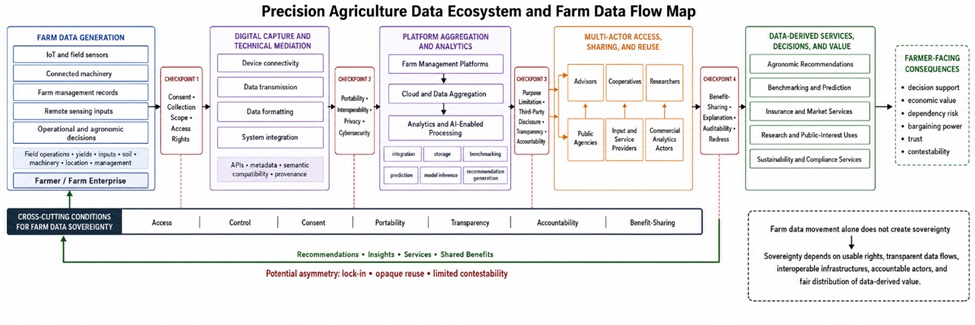
Figure 1. Precision Agriculture Data Ecosystem and Farm Data Flow Map. The figure conceptualizes farm-generated data flows among farmers, IoT sensors, machinery systems, remote sensing providers, farm management platforms, advisors, cooperatives, researchers, public agencies, and commercial service providers. It highlights governance points where access rights, consent, interoperability, transparency, platform accountability, and farmer benefit-sharing must be addressed.
Alt-text description: A conceptual data-flow map showing farmers at the center of a precision agriculture data ecosystem. Data flows connect farmers to sensors, machinery, remote sensing systems, farm management platforms, advisors, cooperatives, researchers, public agencies, and commercial service providers. Governance checkpoints mark consent, access rights, portability, interoperability, transparency, accountability, and benefit-sharing.
A first policy gap concerns unequal capacity to participate in and benefit from precision agriculture data ecosystems. Digital farming technologies may reshape labour, rural communities, skill demands, and access to agricultural innovation in ways that do not affect all farmers equally [17]. Farm data sovereignty policy must therefore recognize that rights on paper may have limited value if farmers lack broadband access, digital skills, advisory support, bargaining capacity, or affordable tools for exercising access, portability, consent, and dispute-resolution rights.
A second gap concerns the governance of risk. Smart farming is associated with perceived risks among governance actors, including uncertainty about data control, responsibility, surveillance, dependency, and unintended consequences [18]. These risks are not solved by technical efficiency alone. They require institutional arrangements that clarify responsibilities among platforms, machinery firms, advisors, cooperatives, public agencies, and farmers, especially where data-derived decisions influence production choices, sustainability claims, compliance reporting, or commercial relationships.
A third gap concerns contradictions among the actors, tools, rules, and market expectations that shape agricultural big data use. Data-intensive farming may involve tensions between farmer goals, platform business models, advisory practices, institutional requirements, and technical infrastructures [19]. These tensions can produce unclear accountability when data pass through multiple systems, when analytics are presented as recommendations rather than decisions, or when farmers are expected to trust outputs without sufficient explanation of data quality, model limitations, or responsibility for errors.
A fourth gap concerns inequality and structural power in digital agriculture. Patterns of inequality can emerge when large farms, well-resourced actors, or dominant platforms are better positioned to capture value from data-driven tools, while smaller or less digitally equipped farms face higher transaction costs and weaker bargaining power [20]. Farm data sovereignty policy must therefore be distribution-sensitive. It should ask not only whether data sharing is permitted, but whether data arrangements reinforce or reduce unequal access, unequal benefit, unequal control, and unequal capacity to contest data practices.
The proposed policy framework begins from the principle that farm data sovereignty should be evaluated by whether data arrangements strengthen farmer agency across diverse farm types and production contexts. Agricultural big data should not be designed only for large-scale or highly resourced actors; policy should assess whether data systems are usable, beneficial, and negotiable for farmers with different capacities, advisory relationships, and market positions [21]. The framework also aligns with responsible Agriculture 4.0 by treating data governance as a matter of people, production, and the planet rather than as a narrow technical compliance exercise [22].
The first pillar is farmer rights. This pillar includes practical rights to access, control, consent, portability, privacy, confidentiality, benefit-sharing, explanation, correction, and dispute resolution. Privacy and confidentiality are particularly important because farm data can reveal commercially sensitive information about production strategies, land use, input decisions, yields, machinery movements, soil conditions, and business relationships [23]. A farmer-rights pillar should therefore require plain-language data terms, granular consent where feasible, defined limits on secondary use, accessible data export, and procedures for correcting or contesting data practices.
The second pillar is secure data stewardship. Farm data sovereignty cannot be operationalized if farm data infrastructures are vulnerable to unauthorized access, manipulation, ransomware, device compromise, or insecure data exchange. Smart farming and precision agriculture systems face cybersecurity threats across sensors, machinery, communication networks, cloud platforms, and analytics services, making security a governance requirement rather than a purely technical add-on [24]. Data stewardship should include security-by-design, access controls, incident reporting, provenance records, retention rules, and accountability for data handling across service chains.
The third pillar is algorithmic accountability. Precision agriculture data increasingly feed AI-enabled advisory systems, predictive analytics, automated recommendations, and decision-support tools, which means data governance must address risks and externalities associated with agricultural AI [25]. Algorithmic accountability should include transparency about data inputs, model purposes, limitations, uncertainty, update cycles, and appropriate use conditions. It should also include farmer-facing explanations and contestability pathways because agricultural AI can affect agronomic decisions, risk perceptions, advisory relationships, and farmer trust [26].
The fourth pillar is collective and institutional governance. Individual consent and bilateral contracts may be insufficient where data ecosystems are complex, platform-dependent, or characterized by unequal bargaining power. Bottom-up data-trust-like models can offer one governance pathway for collective agency when adapted carefully to agricultural settings, especially where farmers need shared representation, trusted intermediaries, or collective negotiation capacity [27]. In contexts involving community or collective data relations, governance principles emphasizing collective benefit, authority to control, responsibility, and ethics can also inform more accountable data stewardship [28].
Table 2 presents the proposed policy framework for fair, transparent, and interoperable farm data ecosystems in precision agriculture.
Table 2. Proposed Policy Framework for Farm Data Sovereignty in Precision Agriculture: Farmer Rights, Platform Accountability, Interoperability, Fair Data Exchange, Data Stewardship, Algorithmic Transparency, Institutional Oversight, and Implementation Safeguards
Policy pillar | Core objective | Key governance mechanism | Technical enabler | Responsible actors | Farmer protection function | Innovation-enabling function | Implementation risk | Recommended policy response |
Farmer rights | Ensure farmers can understand, access, control, transfer, contest, and benefit from farm data. | Rights bundle covering access, consent, control, portability, privacy, benefit-sharing, correction, and dispute resolution. | Dashboards, export tools, consent records, permission settings, and correction workflows. | Policymakers, platforms, farmer organizations, cooperatives, advisors. | Prevents purely symbolic sovereignty by making rights usable. | Builds trust needed for responsible data sharing and service adoption. | Rights may remain abstract or buried in contracts. | Require plain-language terms, minimum access standards, and usable farmer-facing interfaces. |
Transparent data-use rules | Make data collection, processing, sharing, retention, and reuse understandable. | Data-use notices, data-flow explanations, retention rules, third-party disclosure, and change notifications. | Data-flow maps, metadata records, notification systems, and versioned terms. | Platforms, machinery firms, cloud providers, advisors, cooperatives. | Helps farmers evaluate risks, benefits, and responsibilities. | Supports informed participation in data-driven services. | Transparency may become legalistic and unreadable. | Develop farmer-readable disclosure formats and sector-level transparency templates. |
Platform accountability | Assign responsibility for data practices, unclear terms, misuse, service errors, and data-derived outputs. | Auditability, complaint pathways, accountability clauses, incident reporting, and service responsibility rules. | Audit logs, incident registers, data-use logs, and traceability systems. | Platforms, service providers, advisors, regulators, certification bodies. | Reduces responsibility gaps across data-service chains. | Creates predictable rules for trusted platform innovation. | Accountability may be diffused across multiple providers. | Require responsibility mapping for multi-actor precision agriculture services. |
Interoperability and portability | Reduce lock-in and enable authorized data movement across systems. | Portability rights, standard data formats, APIs, semantic compatibility, and procurement conditions. | APIs, machine-readable exports, data dictionaries, metadata schemas, and semantic mappings. | Standards bodies, platforms, machinery firms, public agencies, cooperatives. | Allows farmers to switch services and use independent advisors. | Enables cross-platform decision support and new service development. | Proprietary systems may resist meaningful portability. | Link procurement, certification, and public funding to interoperability obligations. |
Fair data exchange | Ensure reciprocal value, clear boundaries, and legitimate conditions for sharing farm data. | Benefit-sharing rules, purpose limitation, aggregation safeguards, and data-sharing agreements. | Permissioned exchange systems, benefit dashboards, and provenance records. | Farmers, platforms, cooperatives, researchers, public agencies, commercial partners. | Protects farmers from extractive or unclear data reuse. | Enables responsible research, benchmarking, analytics, and sustainability services. | Benefit may be unclear or captured mainly by data aggregators. | Require explicit benefit statements and review of high-value secondary uses. |
Data stewardship | Govern data quality, provenance, retention, confidentiality, security, and lifecycle management. | Stewardship duties, quality assurance, provenance documentation, retention limits, and confidentiality rules. | Provenance metadata, quality flags, encryption, retention controls, and access permissions. | Data stewards, platforms, cooperatives, advisors, research organizations. | Protects farmers from inaccurate, insecure, or miscontextualized data use. | Improves reliability of analytics, advice, and data reuse. | Stewardship responsibilities may be unclear. | Assign named stewardship responsibilities in contracts and cooperative data arrangements. |
Algorithmic transparency | Make data-derived recommendations understandable, contestable, and appropriately limited. | Explanation duties, model-use notices, uncertainty communication, and contestability procedures. | Explainability tools, model documentation, input summaries, and feedback mechanisms. | AI developers, platforms, advisors, researchers, certification bodies. | Helps farmers understand and challenge automated or semi-automated advice. | Supports trustworthy AI-enabled precision agriculture. | Proprietary models may limit explanation. | Require farmer-facing explanations without demanding unnecessary disclosure of trade secrets. |
Institutional oversight | Provide governance beyond bilateral platform contracts. | Codes with accountability mechanisms, certification, mediation, audits, cooperative representation, and public-interest review. | Compliance registers, audit templates, reporting tools, and governance platforms. | Public agencies, farmer organizations, cooperatives, standards bodies, independent auditors. | Reduces asymmetry between individual farmers and powerful data intermediaries. | Provides stable rules for responsible market development. | Voluntary principles may lack enforcement. | Combine voluntary guidance with enforceable obligations where appropriate. |
Implementation safeguards | Address capacity, cost, cybersecurity, fragmentation, and unequal bargaining power. | Training, advisory support, phased compliance, funding support, cyber-risk management, and dispute-resolution access. | Farmer training tools, cybersecurity controls, help desks, and low-cost compliance templates. | Policymakers, extension services, cooperatives, platforms, insurers, farmer groups. | Makes rights practically usable for diverse farms. | Supports adoption by lowering governance and compliance barriers. | Small farms and small providers may face cost and complexity burdens. | Use proportional requirements, cooperative support, and publicly supported advisory capacity. |
Figure 2 illustrates the proposed farm data sovereignty policy framework linking farmer rights, platform accountability, interoperability, fair data exchange, institutional oversight, and responsible innovation.
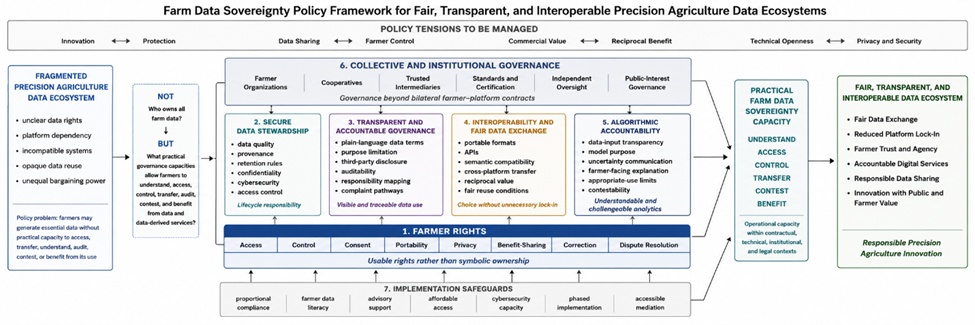
Figure 2. Farm Data Sovereignty Policy Framework for Fair, Transparent, and Interoperable Precision Agriculture Data Ecosystems. The figure presents a layered policy framework in which farmer rights, transparent data-use rules, platform accountability, interoperability, data stewardship, algorithmic transparency, institutional oversight, and implementation safeguards support fair data exchange and responsible innovation in precision agriculture.
Alt-text description: A layered policy framework diagram showing farmer rights as the foundation, connected to transparency, platform accountability, interoperability, data stewardship, algorithmic transparency, institutional oversight, implementation safeguards, fair data exchange, and responsible precision agriculture innovation.
Implementation risks arise when farm data sovereignty policy is fragmented across contracts, platform practices, technical standards, advisory norms, and public policy instruments. Ownership language may create expectations that are not matched by practical access, control, portability, or redress mechanisms, while weak interoperability can make farmer choice difficult even where rights are formally recognized [8, 9, 14]. Policymakers should therefore avoid relying only on broad statements of ownership or voluntary principles. They should define minimum governance functions: farmer-readable transparency, usable access, meaningful consent, data export, purpose limitation, auditability, and dispute-resolution pathways.
Technology providers and platforms may resist requirements that reduce lock-in, require clearer data-use terms, or expose data flows to greater scrutiny. At the same time, excessive or poorly designed compliance burdens may limit innovation, especially for smaller service providers, cooperatives, advisory organizations, and research initiatives. A proportional policy approach should combine baseline farmer protections with flexible implementation pathways, including interoperable APIs, common data dictionaries, model documentation, cybersecurity safeguards, privacy protections, and certification or assurance mechanisms scaled to risk [15, 23-25]. Public procurement and innovation funding can encourage compliance by favoring services that demonstrate portability, accountability, and farmer-facing transparency.
Farmer organizations, cooperatives, advisors, and trusted intermediaries should play a stronger role in implementation because individual farmers may lack time, expertise, or bargaining power to evaluate complex data terms. Cooperative or data-trust-like arrangements may help farmers negotiate data-sharing conditions, pool expertise, manage collective permissions, and secure reciprocal benefits where such models are contextually appropriate [27]. Advisory services and researchers should also support farmer-centered data literacy, explainability, and responsible data-sharing practices, ensuring that precision agriculture innovation strengthens farmer agency rather than shifting control toward opaque platform infrastructures [3, 13, 26, 28].
This article has developed a farm data sovereignty policy framework for fair, transparent, and interoperable precision agriculture data ecosystems. Its central contribution is to move beyond a narrow ownership framing and define farm data sovereignty as a practical governance capacity shaped by farmer rights, access, control, consent, portability, privacy, benefit-sharing, transparency, platform accountability, interoperability, data stewardship, algorithmic accountability, institutional oversight, and implementation safeguards. Fair data governance in precision agriculture requires more than data availability or digital efficiency. It requires farmer-facing transparency, usable rights, accountable platforms, interoperable infrastructures, trusted intermediaries, cybersecurity, dispute resolution, and responsible innovation arrangements that protect farmer agency while enabling data sharing for agronomic, commercial, research, and public-interest purposes. The proposed framework offers a structured policy tool for researchers, policymakers, cooperatives, farm organizations, advisory services, platform developers, and technology providers seeking to design agricultural data ecosystems that are not only technically advanced but also fair, trustworthy, and governable.
None
None
None
None
Open Access The author(s) retain copyright. This article is licensed under the Creative Commons Attribution-NonCommercial-ShareAlike 4.0 International License. It may be shared and adapted for non-commercial purposes with appropriate attribution, an indication of changes, and distribution of adaptations under the same license. Third-party material may be subject to separate terms identified in its credit line. View the license at https://creativecommons.org/licenses/by-nc-sa/4.0/.
 Agro Intelligence Research Press