Foundation models are increasingly investigated as reusable architecture-level systems for agricultural sensing, remote-sensing interpretation, multimodal learning, knowledge access, phenotyping, monitoring, and decision-support assistance. However, the evidence remains dispersed across model families, data modalities, agricultural applications, and validation settings. This systematic review synthesises the technical architectures, data requirements, opportunities, risks, deployment challenges, evidence gaps, and research priorities associated with foundation models in smart farming and precision agriculture. Peer-reviewed journal literature was identified through structured database and publisher-platform searches, supplementary reference checking, predefined eligibility criteria, sequential screening, claim-specific evidence extraction, and thematic synthesis. Evidence was organised across language, vision, vision-language, multimodal, geospatial, remote-sensing, time-series, self-supervised, transfer-learning, and domain-adaptation approaches. The reviewed literature indicates that foundation-model approaches may support transferable representation learning, reduced annotation dependence, multimodal data integration, crop and livestock monitoring, remote-sensing analysis, plant phenotyping, agricultural knowledge services, and bounded decision-support workflows. Nevertheless, reported results are commonly task-, dataset-, region-, sensor-, or application-specific. Important limitations include agricultural data scarcity and heterogeneity, geographic and temporal domain shift, uncertain generalisation, bias, weak explainability, inadequate uncertainty communication, privacy and cybersecurity risks, unclear accountability, computing demands, and limited farmer-centred or operational evaluation. Priorities include agricultural benchmark suites, domain-specific pretraining resources, multimodal and spatiotemporal adaptation, low-resource representation, robustness testing, calibrated uncertainty, human-in-the-loop evaluation, privacy-preserving development, sustainable-computing assessment, and lifecycle governance. Foundation models represent a promising research direction, but benchmark performance or pretraining scale alone does not establish agronomic validity, operational safety, farmer trust, or deployment readiness.
Foundation models are large-scale pretrained artificial intelligence systems designed to learn reusable representations that can be adapted to multiple downstream tasks through fine-tuning, prompting, transfer learning, or other forms of domain adaptation. Within smart farming and precision agriculture, these systems are being investigated for image interpretation, agricultural language processing, multimodal data integration, remote-sensing analysis, plant phenotyping, crop monitoring, knowledge discovery, livestock observation, and decision-support assistance. Their significance lies not merely in model size, but in an architecture-level shift from independently trained task-specific systems toward broadly pretrained models intended to support multiple agricultural applications. Nevertheless, agricultural usefulness depends on the quality and representativeness of pretraining data, the suitability of adaptation procedures, and the strength of task- and domain-specific validation [1].
The emergence of agricultural foundation models builds on two intersecting developments. First, task-specific deep-learning systems demonstrated that learned representations could support classification, detection, segmentation, prediction, and other analytical functions across agricultural imagery and sensor data. Second, smart farming developed as a data-intensive ecosystem involving farm machinery, sensors, platforms, service providers, public institutions, supply-chain actors, and farmers. Foundation models therefore enter agriculture not as isolated algorithms, but as components of heterogeneous technical and institutional systems in which data access, interoperability, ownership, control, and accountability influence how model outputs are produced and used [2, 3].
A persistent constraint across agricultural artificial intelligence is the limited availability of high-quality labels for diverse crops, animal conditions, soils, environments, seasons, and management systems. Agricultural annotation often requires specialist knowledge, repeated field observation, or laboratory confirmation, while collected datasets may remain geographically narrow or operationally inconsistent. These constraints have increased interest in self-supervised learning, weakly supervised learning, transfer learning, and other label-efficient approaches that use large volumes of unlabelled data before adaptation to narrower agricultural tasks. Such approaches may reduce part of the annotation burden, but they do not eliminate the need for reliable reference data, external evaluation, and careful analysis of domain shift [4].
A systematic review is needed because the evidence spans multiple model families and research traditions, including large language models, vision foundation models, vision-language systems, multimodal models, geospatial and remote-sensing foundation models, self-supervised pretraining, transfer learning, and emerging time-series architectures. The literature also differs substantially in agricultural context, data modality, evaluation design, and interpretation of readiness. This review therefore examines foundation models as a heterogeneous class of architecture-level approaches, maps their agricultural data and validation requirements, distinguishes demonstrated research capabilities from proposed opportunities, and integrates technical findings with evidence concerning governance, farmer-centred evaluation, privacy, cybersecurity, uncertainty, sustainability, and deployment risk.
In this review, a foundation model is understood as a model pretrained at substantial scale on broad or heterogeneous data and intended to provide reusable representations or generative capabilities across multiple downstream tasks. Agricultural foundation models may originate from general-purpose language, vision, multimodal, or geospatial systems, or they may be pretrained specifically on crop, livestock, environmental, satellite, sensor, or agricultural knowledge data. This definition distinguishes foundation models from conventional machine-learning systems trained for one predefined outcome, single-task deep-learning networks developed on a bounded dataset, generic decision-support software without reusable pretrained representations, and traditional remote-sensing classifiers that do not employ large-scale transferable pretraining [5].
Large language models represent one foundation-model family relevant to agricultural AI. Their potential functions include information retrieval interfaces, summarisation, question answering, document preparation, knowledge navigation, and conversational assistance. In crop-production contexts, however, their usefulness varies by task and by the extent to which generated outputs depend on current, local, and specialised agronomic information. Linguistic coherence does not demonstrate factual correctness, and general-purpose pretraining may omit local cultivars, production conditions, regulatory contexts, or recent scientific findings. Agricultural language-model outputs therefore require bounded use, source verification, domain grounding, and expert review where errors could affect consequential decisions [6].
Vision-language and multimodal foundation models extend pretrained representation learning across images, text, labels, sensor streams, or other data sources. Their architectures may combine a visual encoder, a language component, cross-modal projection or fusion layers, and task-specific adaptation mechanisms. In agriculture, these systems may connect crop images with disease descriptions, phenotypic traits, management records, environmental observations, or user questions. Their potential advantage is the ability to integrate visual and semantic evidence, but successful adaptation requires appropriately paired data, domain-relevant terminology, computational resources, and evaluation of whether generated textual interpretations are actually grounded in the supplied agricultural evidence [7].
Agricultural foundation-model development can consequently be viewed as a multistage process involving data collection and preprocessing, large-scale or inherited pretraining, domain adaptation, fine-tuning or prompting, application integration, and task-specific evaluation. Different stages may rely on satellite imagery, close-range images, farm sensors, weather observations, soil information, crop records, livestock data, or textual knowledge. Multimodal systems may create broader analytical possibilities, yet their complexity also increases exposure to data misalignment, missing modalities, inherited bias, high computing requirements, weak interpretability, and uncertain transfer across farms or regions. Foundation models should therefore be treated as adaptable research infrastructures rather than self-validating agricultural intelligence [8].
The review focuses on peer-reviewed evidence concerning foundation models and closely related architecture-level approaches in smart farming, precision agriculture, digital agriculture, agricultural remote sensing, crop science, livestock systems, phenotyping, and farm decision support. Included technologies comprise large language models, vision foundation models, vision-language models, multimodal foundation models, geospatial and remote-sensing foundation models, time-series models where directly supported, self-supervised pretraining, transfer learning, fine-tuning, prompting, retrieval-augmented generation where reported, and domain adaptation. For language-model evidence, the synthesis considers model architecture, agricultural knowledge integration, adaptation strategy, application type, validation design, and documented limitations rather than treating all generative systems as a uniform category [9].
Six review questions guide the analysis. RQ1 examines the model and architecture types studied in agricultural contexts. RQ2 addresses agricultural tasks, data modalities, and system settings. RQ3 evaluates technical architectures, pretraining strategies, adaptation methods, and data requirements. RQ4 synthesises opportunities for monitoring, prediction, knowledge discovery, decision support, automation, and sustainability-oriented applications. RQ5 examines bias, robustness, generalisation, explainability, uncertainty, privacy, cybersecurity, farmer trust, human oversight, governance, and field-validation limitations. RQ6 identifies research directions for responsible development and evaluation. The scope includes digital agri-food evidence when it informs farm-level data, knowledge, decision, or governance questions, but it does not assume that generative capability establishes operational maturity [10].
The conceptual boundary excludes conventional machine-learning studies lacking meaningful pretraining, transfer, self-supervised, multimodal, language-model, geospatial-foundation, or architecture-level relevance. It also excludes conference-only publications, preprints without journal publication, non-peer-reviewed reports, software documentation, websites, repositories, commercial materials, policy documents, and sources without verifiable DOI information. Remote-sensing evidence is included when it addresses large-scale pretraining, transferable geospatial representations, spatial or temporal adaptation, agricultural downstream tasks, or benchmark and validation concerns. This dedicated treatment is necessary because remote-sensing foundation models differ from ordinary image classifiers in their sensor diversity, geographic scale, spatial structure, temporal characteristics, and adaptation requirements [11]. Table 1 summarises the systematic review scope, research questions, eligibility criteria, and evidence extraction domains.
Table 1. Systematic Review Scope for Foundation Models in Smart Farming and Precision Agriculture: Research Questions, Eligibility Criteria, Databases, Search Concepts, Screening Logic, Evidence Extraction Domains, and Review Boundaries
Review component | Operational definition | Included evidence | Excluded evidence | Purpose in the review | Boundary or limitation |
Review domain | Foundation models and architecture-level AI approaches relevant to agricultural systems | Smart farming, precision agriculture, digital agriculture, agricultural remote sensing, crop science, livestock systems, phenotyping and farm decision support | Generic AI without substantive agricultural relevance | Establish the population and application domain | Agricultural relevance must be explicit rather than inferred from generic technical capability |
RQ1: model types | Identification of foundation-model and related architecture families | Language, vision, vision-language, multimodal, geospatial, remote-sensing and supported time-series models | Single-purpose conventional models without transferable pretraining | Develop an agricultural foundation-model taxonomy | Terminology varies across studies and may not be used consistently |
RQ2: tasks and contexts | Mapping of model use to agricultural tasks, modalities and operational settings | Monitoring, mapping, phenotyping, disease recognition, knowledge services, livestock observation and decision-support assistance | Applications lacking agricultural data or use context | Determine where evidence is concentrated | Presence of an application does not establish field effectiveness |
RQ3: architectures and data | Examination of pretraining, adaptation, fusion and data requirements | Self-supervision, transfer learning, fine-tuning, prompting, domain adaptation, multimodal fusion and labelled-data requirements | Performance-only reports without sufficient technical description | Explain how reported systems are constructed and evaluated | Technical details are unevenly reported |
RQ4: opportunities | Synthesis of capabilities proposed or demonstrated in reviewed research | Representation reuse, reduced annotation dependence, scalable monitoring, multimodal integration and knowledge access | Speculative commercial or operational claims without peer-reviewed evidence | Identify research and decision-support potential | Opportunities are interpreted as conditional rather than guaranteed outcomes |
RQ5: risks and deployment challenges | Analysis of technical and sociotechnical failure conditions | Bias, fairness, robustness, generalisation, explainability, uncertainty, privacy, cybersecurity, farmer trust and governance | Unsupported assumptions that technical performance resolves deployment risk | Define responsible-use constraints | Direct agricultural evidence is limited for several governance dimensions |
RQ6: research directions | Identification of evidence gaps requiring further investigation | Benchmarks, domain data, external validation, user evaluation, sustainable computing and lifecycle governance | Universal model, vendor or deployment prescriptions | Develop a research agenda grounded in identified gaps | Directions are proposed priorities, not operational recommendations |
Eligible publication type | Peer-reviewed journal article with verifiable DOI | Reviews, technical studies, application studies, methods articles and relevant social-science research | Books, chapters, theses, conferences, preprints, websites, reports and policy documents | Maintain evidence quality and traceability | Journal publication does not by itself establish methodological quality |
Eligibility period | Publication within the predefined review interval | Articles published from 1 January 2017 to the search date | Articles outside the interval | Capture contemporary developments underlying agricultural foundation models | Earlier foundational concepts may be underrepresented |
Search sources | Academic databases and publisher-platform interfaces | ScienceDirect, SpringerLink, IEEE Xplore, PubMed, MDPI, Wiley and DOI-linked publisher records | Google Scholar as a sole evidence source | Increase disciplinary and publisher coverage | Direct subscription-database export coverage was not identical across platforms |
Search concepts | Combined technology, agricultural-domain and evidence-theme terms | Foundation models, LLMs, multimodal learning, remote sensing, self-supervision, agriculture, validation and governance | Narrow searches based only on individual model names | Improve retrieval across inconsistent terminology | Rapidly changing terminology may reduce retrieval completeness |
Evidence extraction | Structured extraction of technical, agricultural, evaluation and risk information | Study aim, context, architecture, modality, task, data need, validation, opportunity, risk and deployment challenge | Unreported information inferred by the reviewers | Support transparent thematic synthesis | “Not clearly reported” is required where evidence is absent |
Review boundary | Separation of research capability from readiness | Benchmark findings, architecture descriptions and documented limitations | Claims of autonomous, safe or deployment-ready operation without direct evidence | Prevent overinterpretation | The review does not certify models, recommend vendors or prescribe farm actions |
The review process was structured around transparent identification, screening, eligibility assessment, extraction, and synthesis. Reporting design was informed by systematic-review guidance concerning explicit documentation of study identification and selection and by search-reporting guidance concerning databases, interfaces, search strings, dates, limits, and supplementary retrieval methods [12, 13]. These frameworks were used to organise the review process and reporting record; they were not interpreted as evidence of prospective registration, meta-analysis, formal risk-of-bias scoring, or complete compliance with every optional reporting element.
Searches covered ScienceDirect and Elsevier journal collections, SpringerLink, IEEE Xplore, PubMed, the MDPI journal platform, Wiley Online Library, DOI-linked publisher records, and backward and forward reference checking from eligible articles. Search concepts combined terms for foundation models, large language models, vision and vision-language models, multimodal systems, geospatial and remote-sensing foundation models, time-series models, self-supervised learning, transfer learning, fine-tuning, prompting, retrieval-augmented generation, and domain adaptation with terms for agriculture, smart farming, precision agriculture, crops, plants, livestock, phenotyping, soil, irrigation, weeds, pests, disease, robotics, and decision support. Multiple retrieval systems were used because academic search platforms differ in coverage, query functionality, indexing practices, and reproducibility characteristics [14].
The search covered publications from 1 January 2017 to 13 July 2026. The documented candidate log contained 51 records identified through database and publisher-platform searching and five additional records identified through reference checking. Six duplicate or repeated-version records were removed, leaving 50 records for title and abstract screening. Eight records were excluded at that stage because they lacked agricultural relevance, addressed generic artificial intelligence only, or did not demonstrate sufficient foundation-model, pretraining, transfer-learning, self-supervised, multimodal, or architecture-level relevance. Forty-two articles underwent full-text or detailed publisher-metadata assessment. Eight were subsequently excluded because they were conference or preprint-only publications, lacked an eligible journal or verifiable DOI record, focused on conventional task models without adequate architecture-level relevance, had only indirect agricultural relevance, or could not support a planned systematic-review claim. The resulting evidence set contained 34 journal articles.
For each included article, evidence was extracted concerning study aim, agricultural context, model or architecture type, data modality, agricultural task, technical architecture feature, data requirement, validation or evaluation approach, reported opportunity, reported risk or limitation, deployment challenge, and contribution to the review synthesis. Evidence was recorded as “not clearly reported” when the source did not provide sufficient detail. Claim-specific citation mapping was completed before manuscript drafting, and references were fixed in order of first appearance. The search has limitations: direct institution-level Scopus and Web of Science exports were not available in the evidence-building interface, terminology evolved rapidly during the eligibility period, and some emerging model families may be indexed under task-specific rather than foundation-model terminology. Consequently, the review emphasises reproducible scope, cautious interpretation, and transparent evidence boundaries rather than claiming exhaustive retrieval of every agricultural foundation-model publication. Table 2 summarises the study selection and evidence extraction structure used for the systematic review.
Table 2. Study Selection and Evidence Extraction Structure for the Systematic Review: Database Search, Duplicate Removal, Title and Abstract Screening, Full-Text Eligibility, Inclusion Logic, Exclusion Reasons, Evidence Extraction Fields, and Transparency Notes
Review stage | Screening or extraction action | Eligibility or extraction criterion | Output | Transparency note | Potential limitation |
Database and publisher-platform search | Execute combined technology, agriculture and evidence-theme searches | Potential relevance to foundation models or related architecture-level agricultural AI | 51 candidate records | Search concepts and interfaces were documented | Platform-specific indexing and query syntax may differ |
Supplementary reference checking | Examine references and citations of eligible reviews and technical studies | Journal article with DOI and direct relevance to an uncovered review domain | 5 additional candidate records | Added before deduplication | Citation checking may favour well-connected publications |
Duplicate removal | Compare titles, authors, DOI records and publication versions | Retain one eligible journal version of each article | 50 unique records after six removals | Journal versions were preferred over preprints or repeated index records | Metadata differences can complicate duplicate identification |
Title and abstract screening | Assess agricultural and architecture-level relevance | Explicit agricultural context and meaningful foundation-model, transfer, self-supervised, multimodal or pretraining relevance | 42 articles advanced after eight exclusions | Predefined exclusion categories were used | Abstracts may omit relevant technical or validation details |
Full-text eligibility assessment | Evaluate publication type, DOI, technical content, agricultural fit and claim relevance | Peer-reviewed journal article able to support at least one planned review claim | 34 included articles after eight exclusions | Exclusion reasons were recorded by category | Full-text access and reporting completeness varied |
Inclusion logic | Map each article to review questions and synthesis domains | Direct or carefully bounded support for architecture, data, opportunity, risk, validation or research-gap claims | Final evidence set | No article was retained solely to reach a numerical target | The evidence set remains heterogeneous in design and maturity |
Exclusion reasons | Remove ineligible publication types or weakly aligned evidence | Conference or preprint only; no eligible journal or DOI; conventional task model; indirect agriculture; insufficient claim fit | Documented exclusion categories | Categories correspond to predefined criteria | Some borderline studies could reasonably be classified differently |
Evidence extraction: study characteristics | Record aim, context, architecture, modality and task | Information explicitly reported by the article | Structured study profile | Missing information was not inferred | Reporting standards differ across technical and review articles |
Evidence extraction: technical features | Record pretraining, adaptation, fusion and data requirements | Sufficient description of architecture or learning strategy | Architecture and data map | Technical terminology was normalised cautiously | Articles may use inconsistent definitions of foundation models |
Evidence extraction: evaluation | Record benchmark, transfer, validation and generalisation information | Evaluation procedure explicitly described | Validation evidence profile | Internal results were separated from external validation | Many studies used narrow or application-specific datasets |
Evidence extraction: opportunities and limitations | Record reported capabilities, risks and implementation constraints | Claim supported directly by study results or discussion | Opportunity–risk synthesis | Proposed opportunities were distinguished from demonstrated outcomes | Reviews and conceptual articles may provide indirect rather than empirical evidence |
Evidence extraction: governance and users | Record privacy, security, accountability, trust and oversight information | Directly reported or systematically reviewed evidence | Sociotechnical evidence profile | Governance evidence was integrated without assuming legal sufficiency | Direct farmer-centred evidence remains limited |
Citation planning | Assign every included article a specific first-use claim | Citation must match the supported sentence and sequential order | Locked Vancouver citation blueprint | Grouped citations were limited to the preapproved audit | Later manuscript changes could disrupt citation order |
Synthesis preparation | Organise findings across architectures, data, applications, risks and research directions | Evidence patterns supported by multiple or directly relevant articles | Narrative and tabular synthesis | No meta-analysis or universal model ranking was attempted | Heterogeneity prevents quantitative pooling |
Vision foundation models represent one of the most developed architecture classes in the reviewed agricultural literature. Rather than learning all visual features from a task-specific agricultural dataset, these models begin with broadly pretrained representations and are subsequently adapted to agricultural classification, detection, or segmentation tasks. Agricultural adaptation may modify feature aggregation, intermediate layers, task heads, or fine-tuning procedures to retain transferable visual information while responding to crop-specific structures. Reported application results demonstrate the feasibility of this approach within selected datasets, but they do not establish that visual representations will transfer uniformly across crops, cultivars, imaging systems, growth stages, weather conditions, or field environments [15].
Geospatial and remote-sensing foundation models require additional architectural treatment because agricultural observations are structured across space, time, spectral bands, sensors, and geographic regions. Cropland classification systems may separate spatial and temporal attention so that land-pattern characteristics and seasonal crop development are learned through distinct but coordinated components. This approach is relevant to agricultural landscapes in which crops can have similar appearances at one observation date but diverge across their phenological trajectories. Time-series foundation-model research remains less mature than vision-oriented agricultural work, and temporal architectures require careful evaluation of seasonality, missing observations, changing management practices, sensor differences, and future-period transfer [16].
Self-supervised pretraining provides a complementary route for learning from large agricultural datasets that lack complete labels. Satellite time-series models, for example, can be pretrained on unlabelled observations and then adapted to crop-mapping tasks using smaller labelled datasets. Such designs may learn spectral and temporal relationships before task-specific supervision, potentially reducing dependence on expensive crop labels. Their validity nevertheless depends on the representativeness of the unlabelled pretraining data, the quality of downstream reference labels, and whether evaluation is conducted across genuinely independent regions, seasons, and sensor conditions rather than through random partitions of closely related observations [17].
Vision-language architectures extend these principles by aligning visual evidence with textual descriptions, class labels, prompts, or agricultural knowledge. In small-sample crop-disease recognition, image–text–label integration may provide semantic information that is unavailable to image-only systems and may assist learning when labelled examples are limited. However, the quality of multimodal learning depends on whether visual observations and textual descriptions are accurately paired, whether disease labels reflect reliable diagnoses, and whether generated interpretations remain grounded in the input evidence. Performance within a single crop or disease dataset cannot be assumed to transfer to other crops, disorders, cameras, field backgrounds, or production environments [18].
Prompted vision systems and general-purpose segmentation models provide another adaptation pathway. Crop-field boundary research indicates that a general vision foundation model can be incorporated into an agricultural remote-sensing pipeline through super-resolution preprocessing and task-specific edge correction, although pipeline complexity and geographic transfer remain important limitations [19]. Transferability evidence further shows that agricultural classification performance can change under phenological, temporal, and spatial shifts, making external-domain testing essential [20]. Contrastive self-supervised learning may reduce reliance on exhaustive agricultural annotation by learning representations from unlabelled images, but outcomes remain dependent on data composition, augmentation design, and downstream evaluation [21]. Integrating language and vision models into plant-stress phenotyping may expand systems from trait recognition toward interpretive or decision-support functions, yet hallucination, explainability, uncertainty, and human-oversight requirements remain unresolved [22]. Table 3 maps technical architectures and data requirements for foundation models in smart farming and precision agriculture.
Table 3. Technical Architectures and Data Requirements for Foundation Models in Smart Farming and Precision Agriculture: Large Language Models, Vision Foundation Models, Vision-Language Models, Multimodal Models, Geospatial Models, Remote Sensing Models, Time-Series Models, Transfer Learning, Fine-Tuning, Domain Adaptation, Multimodal Data Fusion, Benchmarking, Validation, and Deployment Boundaries
Architecture or data component | Core technical question | Required evidence or input | Model function | Agricultural use context | Validation need | Risk of overinterpretation | Review synthesis role |
Large language model | Can a pretrained language model process agricultural terminology, context, and user questions reliably? | Curated agricultural corpora, current knowledge, local terminology, provenance, and expert-reviewed outputs | Text generation, summarisation, question answering, retrieval interface, and reasoning assistance | Advisory support, documentation, knowledge access, and research navigation | Factuality testing, source verification, local-context evaluation, and expert review | Fluency may be mistaken for agronomic correctness | Distinguishes language capability from decision quality |
Vision foundation model | Do broadly pretrained visual representations transfer to agricultural imagery? | Diverse crop, livestock, field, lighting, background, sensor, and growth-stage data | Classification, detection, segmentation, and feature extraction | Crop monitoring, disease recognition, weed detection, phenotyping, and robotic perception | Multicrop, multiseason, multisensor, and external-farm validation | Strong internal results may be interpreted as universal transfer | Defines visual adaptation opportunities and domain-shift limits |
Vision-language model | Does image–text alignment improve agricultural interpretation? | Paired images, descriptions, labels, prompts, and agricultural knowledge | Visual question answering, semantic recognition, explanation generation, and open-vocabulary analysis | Plant disease, phenotyping, livestock observation, and advisory interfaces | Grounding tests, hallucination checks, expert validation, and explanation-fidelity assessment | Generated explanations may appear evidentially grounded when they are not | Evaluates multimodal interpretation and explanation risks |
Multimodal foundation model | Can heterogeneous agricultural modalities be aligned without losing temporal or contextual meaning? | S synchronised imagery, sensors, weather, soil, management records, livestock data, and text | Joint representation, multimodal fusion, and cross-modal inference | Integrated crop, livestock, and farm decision-support research | Missing-modality testing, alignment checks, ablation analysis, and external validation | Additional modalities may increase complexity without improving reliability | Provides the central integration architecture for smart farming |
Geospatial foundation model | Do large-scale spatial representations transfer to agricultural landscapes? | Multi-region, multi-resolution, multi-sensor, and georeferenced data | Mapping, segmentation, spatial inference, and land-pattern representation | Cropland classification, land-use analysis, and field-boundary mapping | Cross-region, cross-resolution, and cross-sensor evaluation | Broad geospatial performance may conceal crop-specific limitations | Connects general Earth-observation pretraining to farm-scale applications |
Remote-sensing foundation model | Can pretrained Earth-observation models represent agricultural spectral, spatial, and seasonal characteristics? | Multispectral, hyperspectral, synthetic-aperture-radar, aerial, and satellite data with metadata | Crop classification, detection, segmentation, and change analysis | Crop mapping, field monitoring, land management, and stress observation | Seasonal, geographic, atmospheric, sensor, and resolution validation | Remote-sensing benchmark performance may be treated as agronomic usefulness | Forms a distinct evidence stream within agricultural foundation models |
Time-series foundation model | Can the model learn seasonal, longitudinal, and event-dependent agricultural dynamics? | Repeated satellite, sensor, weather, crop, soil, management, or livestock observations | Temporal representation, forecasting, sequence modelling, and anomaly detection | Crop development, yield-support research, irrigation monitoring, and animal behaviour | Future-season testing, missing-data evaluation, and temporal-shift analysis | Historical fit may be misinterpreted as future reliability or causality | Identifies an emerging but underdeveloped architecture class |
Self-supervised learning | Can useful agricultural representations be learned without exhaustive labels? | Large unlabelled datasets and smaller labelled evaluation subsets | Pretraining, contrastive learning, masked prediction, and representation learning | Crop images, satellite time series, sensors, and livestock streams | Label-fraction comparison, independent transfer testing, and data-quality assessment | Reduced annotation needs may be described incorrectly as elimination of labels | Connects label-efficient learning with foundation-model development |
Transfer learning | How effectively do pretrained features move between tasks, farms, regions, and seasons? | Well-described source and target datasets with documented distribution differences | Reuse and adaptation of pretrained parameters or representations | Crop classification, disease detection, phenotyping, and remote-sensing analysis | Spatial, temporal, phenological, sensor, and management-transfer tests | Successful fine-tuning on one target can conceal poor wider transfer | Provides a central test of agricultural generalisation |
Fine-tuning | How much agricultural task-specific adaptation is required? | Curated downstream data, labels, task definitions, and validation sets | Full, partial, or parameter-efficient model adaptation | Specialised crop, livestock, remote-sensing, and advisory tasks | Overfitting assessment, calibration, and independent-domain evaluation | Fine-tuned performance may remain narrowly dataset-specific | Separates reusable pretraining from task-specific specialisation |
Prompting | Can desired task behaviour be elicited without changing model parameters? | Instructions, examples, task constraints, visual prompts, and agricultural context | In-context task specification, conversational interaction, and prompted segmentation | Language interfaces, information assistance, and vision segmentation | Prompt-sensitivity, reproducibility, and failure-case testing | Selected successful prompts may be treated as stable model capability | Maps low-cost adaptation alongside instability and context dependence |
Retrieval-augmented generation | Can external agricultural evidence reduce unsupported language-model outputs? | Curated, current, authoritative, and citable agricultural knowledge resources | Retrieval followed by constrained or evidence-linked generation | Agricultural knowledge services, extension support, and literature navigation | Retrieval recall, source authority, citation faithfulness, and answer-safety evaluation | Retrieval may be assumed to eliminate reasoning or source-selection errors | Represents a conditional grounding mechanism rather than a reliability guarantee |
Domain adaptation | Can models adjust to differences among crops, regions, languages, sensors, and farm systems? | Source and target distributions, target-domain examples, and shift indicators | Distribution alignment and specialised representation learning | Regional crop mapping, local-language systems, and farm-specific analytics | Explicit target-domain and unseen-domain evaluation | Adaptation to one domain may degrade another or conceal residual bias | Cross-cutting requirement for agricultural model transfer |
Pretraining data | Which capabilities and biases are embedded before agricultural adaptation? | Data provenance, licensing, geographic distribution, modality, quality, and representativeness | Base representation and generative-capability learning | All foundation-model categories | Dataset audits, contamination checks, and downstream bias analysis | Dataset scale may be conflated with agricultural representativeness | Identifies the primary source of reusable capability and inherited risk |
Agricultural labelled data | What expert annotations remain necessary after pretraining? | Reliable disease, crop, soil, animal, field, and management labels | Supervised adaptation and reference evaluation | Classification, detection, segmentation, diagnosis, and monitoring | Label-validity testing, inter-annotator agreement, and external reference checks | Noisy or weak labels may create misleading apparent improvements | Defines the continuing evidence burden after large-scale pretraining |
Multimodal data fusion | At what stage and under what conditions should agricultural modalities be combined? | Aligned timestamps, locations, identifiers, units, metadata, and quality indicators | Early, intermediate, late, or hybrid fusion | Whole-farm monitoring, phenotyping, and integrated decision support | Modality ablation, missing-data tests, and temporal-alignment evaluation | Correlated inputs may create apparent gains without independent information value | Explains the technical basis and fragility of multimodal systems |
Spatial data | How does geographic structure affect learning and validation? | Coordinates, field boundaries, spatial resolution, landscape context, and sampling design | Spatial representation and mapping | Remote sensing, soil analysis, crop mapping, and field analytics | Spatially independent holdouts and leakage controls | Random splitting may leak neighbouring observations between train and test sets | Establishes spatial independence as a validation requirement |
Temporal data | Can models account for seasonality, phenology, management timing, and long-term change? | Timestamps, repeated observations, growth stages, interventions, and multiple seasons | Temporal representation, forecasting, and sequence analysis | Crop growth, yield-related research, weather effects, and animal monitoring | Future-period and cross-season validation | Temporal leakage may inflate performance | Establishes time as a primary source of agricultural domain shift |
Sensor data | Can heterogeneous agricultural devices be harmonised and trusted? | Calibration, sampling frequency, units, maintenance records, drift, and missingness | Environmental, equipment, soil, and physiological-state representation | Irrigation, soil monitoring, machinery, greenhouses, and livestock | Cross-device, degradation, missingness, and real-time evaluation | Laboratory-quality measurements may not represent operational sensor streams | Links model architecture to IoT data quality and infrastructure |
Satellite data | Which spatial, temporal, and spectral characteristics are appropriate for the task? | Multispectral or radar imagery, atmospheric correction, metadata, and reference labels | Large-area observation and geospatial pretraining | Crop classification, land monitoring, field boundaries, and stress assessment | Cross-sensor, cloudy-condition, region, season, and resolution testing | Coarse resolution or processing artefacts may be overlooked | Represents the dominant current modality for geospatial agricultural models |
Drone imagery | Can high-resolution aerial data improve fine-scale agricultural analysis? | Flight plans, camera calibration, georeferencing, altitude, weather, and field diversity | Fine-scale detection, segmentation, and phenotyping | Weed mapping, plant counts, crop stress, and structural phenotyping | Cross-flight, field, altitude, season, and camera validation | Curated flights may not represent routine operating conditions | Provides a complementary modality where peer-reviewed evidence supports its use |
Weather data | Does weather context improve agricultural prediction or interpretation? | Local observations, forecasts, historical records, uncertainty, and spatial resolution | Contextual conditioning and temporal prediction | Disease-risk research, irrigation support, crop monitoring, and yield-related analysis | Forecast-error propagation and climate-regime evaluation | Correlation may be interpreted incorrectly as causal agricultural reasoning | Defines a critical contextual input for time-dependent applications |
Soil data | Can models represent highly heterogeneous soil characteristics at useful scales? | Physical, chemical, moisture, biological, and spatial soil measurements | Soil-state representation, mapping, and contextual conditioning | Soil monitoring, irrigation, nutrient research, and crop suitability analysis | Ground sampling, cross-field testing, and spatial-uncertainty assessment | Sparse samples may create false spatial precision | Identifies an important but underrepresented agricultural modality |
Crop data | Are crop species, cultivar, development stage, treatment, and management adequately documented? | Crop identity, phenology, management operations, environmental context, and outcomes | Crop-specific representation, adaptation, and prediction | Monitoring, disease recognition, phenotyping, and yield support | Multicultivar, multistage, and management-system evaluation | Crop labels alone may conceal important production-context differences | Establishes essential domain metadata for agricultural validity |
Textual agricultural knowledge | Is embedded or retrieved knowledge current, local, traceable, and authoritative? | Peer-reviewed evidence, expert-curated resources, extension material, terminology, and provenance | Language adaptation, retrieval, explanation, and knowledge navigation | Advisory support, question answering, and knowledge discovery | Source-quality, temporal-validity, citation-faithfulness, and local-relevance audits | General web text may contain outdated or contextually unsuitable information | Defines the grounding requirement for agricultural language systems |
Benchmarking | Do evaluations permit meaningful and reproducible comparison? | Shared datasets, predefined splits, suitable baselines, metrics, compute reporting, and uncertainty measures | Comparative assessment | All model families and agricultural tasks | Hidden external tests, subgroup reporting, and replication | Leaderboard ranking may reward narrow optimisation | Identifies a major cross-cutting evidence gap |
External validation | Does model performance persist beyond development conditions? | Independent farms, regions, seasons, devices, sensors, and user groups | Generalisation assessment | All applications with potential operational relevance | Prespecified independent evaluation and prospective testing | Internal testing may be misrepresented as field readiness | Defines the boundary between experimental performance and deployment evidence |
No deployment-readiness boundary | What technical, human, organisational, and governance evidence is still missing? | Robustness, safety, field, integration, monitoring, accountability, and user evidence | Interpretation constraint rather than a model function | All proposed agricultural uses | Staged field evaluation, fallback testing, monitoring, and responsibility assessment | Technical feasibility may be labelled prematurely as readiness | Prevents unsupported operational or autonomous-deployment claims |
The reviewed evidence identifies potential opportunities not only for replacing narrow analytical components, but also for connecting information across tasks and modalities. Large language models may assist with documentation, communication, information synthesis, and task-level knowledge access, while their impact on agricultural work may include both complementary support and changes in occupational responsibilities. Such effects cannot be evaluated only through model accuracy because they also concern skill requirements, role redesign, unequal access, and the distribution of responsibility between workers and automated systems [23].
Conversational and generative interfaces may make agricultural analytical tools more accessible to users who cannot interact directly with programming languages, complex dashboards, or specialist modelling systems. They may support natural-language questioning, explanation, translation, or navigation of analytical outputs. At the same time, farmer-facing interfaces can reproduce hallucinations, weak local knowledge, digital-literacy barriers, unreliable connectivity, language exclusions, and misplaced confidence in plausible answers. Their usefulness therefore depends on local context, understandable uncertainty, source transparency, escalation to qualified expertise, and evaluation with intended users rather than assumptions about user needs [24].
Farmer trust and technology acceptance are also deployment conditions rather than automatic consequences of technical capability. Agricultural AI adoption can be influenced by perceived usefulness, behavioural intention, compatibility with established work, confidence in the technology, social expectations, available support, and perceptions of control. These factors may differ among farm types, regions, production systems, and levels of digital experience. A model that performs adequately in a technical study may still be rejected, misunderstood, overtrusted, or used in unintended ways if its purpose, limitations, required actions, and accountability arrangements are unclear [25].
Remote-sensing and geospatial foundation models create opportunities for scalable agricultural observation, but responsible use requires attention to dataset provenance, geographic representation, bias, uncertainty, explainability, human rights, environmental implications, and the downstream consequences of spatial decisions. These concerns are particularly important when maps or classifications influence resource allocation, monitoring, credit, insurance, compliance, or access to services. Responsible Earth-observation AI therefore requires lifecycle evaluation that extends from data collection and model design to interpretation, communication, institutional use, and mechanisms for contesting or correcting outputs [26].
Privacy and cybersecurity become increasingly important as foundation-model pipelines combine farm-management data, machinery records, sensor streams, imagery, communications, livestock information, and external platforms. Federated learning may support collaborative model development without centralising every raw record, but it does not by itself prevent parameter leakage, poisoning, re-identification, non-independent data effects, or unequal control over the resulting models [27]. Connected smart-farming systems also remain vulnerable to attacks affecting devices, communications, identities, data integrity, service availability, and automated control functions [28]. These risks reinforce two claim boundaries: the reviewed evidence does not establish field readiness, and it does not support autonomous agricultural decisions without meaningful human review, override, monitoring, and accountable fallback procedures.
The integrated evidence shows that agricultural foundation-model research develops through an interdependent chain rather than a simple progression from larger models to better farming outcomes. Architecture types determine what representations can be learned; agricultural data quality and modality determine what information those representations contain; adaptation and validation determine whether capabilities transfer to a crop, animal, region, season, sensor, or user group; and governance conditions determine whether outputs can be used responsibly within real agricultural institutions. Opportunities in monitoring, mapping, phenotyping, knowledge access, and decision-support assistance therefore coexist with risks involving domain shift, data scarcity, bias, uncertainty, privacy, cybersecurity, accountability, and environmental cost. A systemic interpretation is necessary because narrow performance metrics can omit externalities occurring beyond the model-development setting [29]. Figure 1 synthesises how foundation-model architectures, agricultural data requirements, application opportunities, risks, deployment challenges, and research directions are connected in smart farming and precision agriculture.
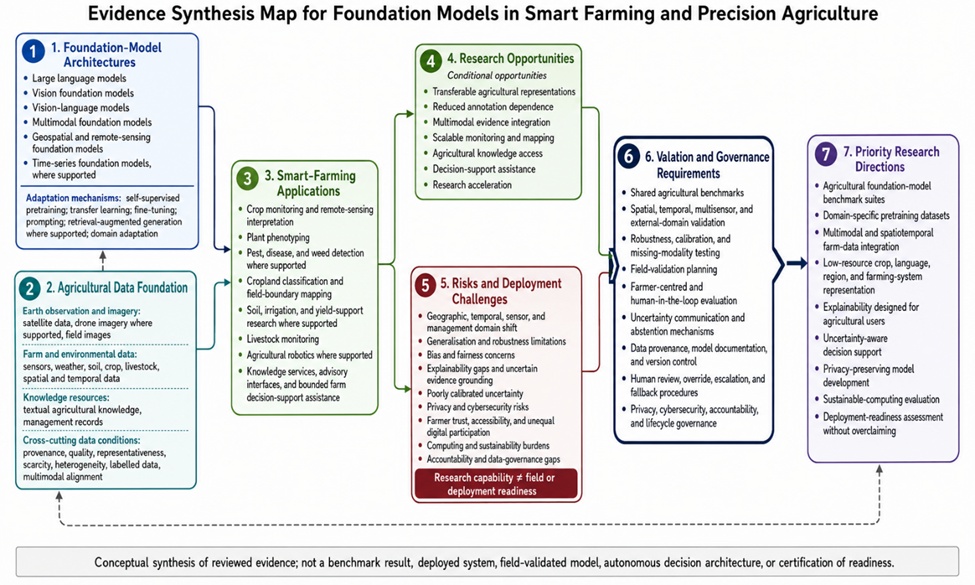
Figure 1. Evidence Synthesis Map for Foundation Models in Smart Farming and Precision Agriculture. The figure connects foundation-model architecture types, agricultural data requirements, application opportunities, risks, deployment challenges, validation needs, governance requirements, and future research directions identified in the systematic review. The figure is conceptual and does not represent a benchmark result, deployed system, field-validated model, or autonomous agricultural decision-support architecture.
Alt-text description
A conceptual evidence synthesis map showing foundation-model types connected to agricultural data modalities, smart farming applications, technical opportunities, risks, deployment challenges, validation needs, governance requirements, and research directions.
Responsibility within this evidence chain is distributed. Model developers influence pretraining data, architectures, optimisation, documentation, and known limitations; data providers influence coverage, consent, quality, and provenance; agricultural organisations influence integration, training, monitoring, and escalation; and users influence interpretation and contextual judgment. Trustworthy practice therefore cannot be assigned to a single “responsible user” at the final stage. Responsibility gaps can emerge when developers assume deployers will validate models, deployers assume vendors have addressed bias and safety, and users receive outputs without sufficient information or authority to question them [30].
Cybersecurity evidence forms a related cluster that is sometimes separated from model evaluation but is directly relevant to foundation-model deployment. Agricultural AI systems may depend on sensors, edge devices, gateways, cloud services, APIs, farm-management platforms, mobile interfaces, and automated equipment. A technically accurate model can still become unreliable if the data stream is spoofed, corrupted, interrupted, or manipulated. The reviewed cybersecurity literature covers threat detection, prevention frameworks, technical countermeasures, organisational safeguards, and training, but evidence from long-term real-farm evaluation remains limited [31].
The social-science evidence introduces a further corrective to technology-centred interpretation. Digital agriculture changes relations among farmers, platforms, advisers, technology providers, supply-chain organisations, and public institutions. Access to infrastructure, data ownership, digital skill, labour effects, platform power, service dependency, and inclusion can influence who benefits from foundation-model systems and who bears their errors or costs. These dimensions are not secondary implementation issues; they shape which problems are defined, which data are collected, whose knowledge is represented, and how model outputs enter agricultural decisions [32].
Across the evidence base, the strongest clusters concern visual representation learning, remote-sensing analysis, crop classification, multimodal recognition, language-based knowledge access, and label-efficient pretraining. Evidence is thinner for independent field validation, causal decision impact, uncertainty calibration, farmer-centred longitudinal evaluation, low-resource regions, autonomous robotics, soil and irrigation applications, sustainable-computing assessment, and governance effectiveness. The literature therefore contains an important tension: foundation models are designed for broad transfer and reuse, but agricultural evidence remains predominantly narrow, context-dependent, and experimentally bounded. This contradiction does not invalidate the research direction; it defines the validation and governance agenda required before wider claims can be made.
Agricultural foundation-model benchmarks should move beyond single-dataset accuracy and include annotation efficiency, external-domain transfer, calibration, robustness, subgroup performance, computational demand, and reproducibility. Controlled evidence from crop classification indicates that self-supervised pretraining can retain useful performance with substantially smaller labelled subsets, making label-efficiency evaluation a meaningful benchmark dimension [33]. Future benchmark suites should nevertheless include independent crops, farms, seasons, regions, sensors, and management conditions so that reduced annotation dependence is not confused with general agricultural validity.
Precision livestock farming requires a parallel research programme because livestock systems generate different combinations of video, imagery, audio, physiological sensors, environmental measurements, movement records, feeding data, production records, and textual information. Foundation models may support animal identification, health observation, behaviour interpretation, feeding analysis, and decision-support research, but progress depends on synchronised longitudinal datasets, animal-level ground truth, robust multimodal fusion, welfare-sensitive validation, and safe integration with human and automated workflows [34]. Livestock benchmarks should therefore distinguish perception, interpretation, prediction, and intervention rather than treating them as one capability.
Domain-specific pretraining resources should be developed with documented provenance, geographic and production-system coverage, licensing, crop or animal representation, sensor metadata, and known limitations. Multimodal datasets should align satellite, drone, field-image, sensor, soil, weather, management, livestock, and textual data through consistent identifiers and timestamps. Research should give particular attention to low-resource crops, languages, farming systems, and regions that are poorly represented in general-purpose or high-income-country datasets. Geospatial and temporal adaptation methods should be evaluated under future seasons, climate variability, sensor changes, and management shifts, while bias and fairness assessments should report disaggregated performance rather than only aggregate averages.
Responsible evaluation also requires explanation methods designed for agricultural users, calibrated uncertainty, abstention when evidence is insufficient, robustness testing under field variability, and realistic human-in-the-loop studies. Farmer-centred validation should examine comprehension, workload, reliance, contestability, accessibility, and decision consequences rather than measuring acceptance alone. Privacy-preserving methods should be tested against leakage, poisoning, and non-independent farm data; sustainable-computing studies should report energy, hardware, and lifecycle effects; and governance standards should document datasets, model versions, limitations, intended uses, monitoring, incidents, and accountable parties. Table 4 presents research directions for responsible foundation-model development and evaluation in smart farming and precision agriculture.
Table 4. Research Directions for Responsible Foundation Models in Smart Farming and Precision Agriculture: Agricultural Benchmarks, Domain-Specific Pretraining, Multimodal Farm Data, Geospatial and Temporal Adaptation, Low-Resource Representation, Explainability, Uncertainty, Robustness, Bias, Human-in-the-Loop Evaluation, Privacy, Sustainable Computing, Governance, and Deployment-Readiness Assessment
Research direction | Problem addressed | Required methodological advance | Required data or infrastructure | Validation need | Governance or user need | Expected contribution | Boundary statement |
Agricultural foundation-model benchmarks | Fragmented tasks, metrics, datasets, and evaluation procedures | Multitask protocols incorporating transfer, calibration, robustness, annotation efficiency, uncertainty, and computing requirements | Curated crop, livestock, sensor, text, geospatial, and multimodal benchmark resources | Hidden external test sets and independent replication | Transparent benchmark governance and version control | More comparable and reproducible evidence | Benchmark leadership does not establish field or deployment readiness |
Domain-specific pretraining datasets | General-purpose corpora may not represent agricultural knowledge or environments adequately | Documented sampling, curation, quality control, and balanced domain coverage | Large, licensed, geographically diverse agricultural image, text, sensor, and remote-sensing corpora | Downstream transfer, contamination, bias, and subgroup evaluation | Data rights, provenance, consent, and benefit-sharing arrangements | Better representation of agricultural concepts and variation | Greater data scale does not automatically guarantee reliability |
Multimodal farm-data integration | Agricultural data are heterogeneous, asynchronous, incomplete, and institutionally fragmented | Fusion methods robust to missing, delayed, noisy, and conflicting modalities | Interoperable farm-data infrastructure, metadata, identifiers, time alignment, and quality indicators | Modality ablation, missing-data simulation, and external farm testing | Data-access, ownership, and sharing agreements | More context-aware agricultural representations | Integration alone does not demonstrate causal or decision value |
Geospatial and temporal model adaptation | Models may fail across regions, seasons, sensors, and climate conditions | Spatial–temporal adaptation, shift detection, continual evaluation, and uncertainty-aware transfer | Multiyear, multiregion, multi-resolution, and multi-sensor datasets | Future-season, unseen-region, and cross-sensor evaluation | Regional stakeholder participation and transparent limits | More defensible transfer across agricultural contexts | Adaptation findings remain conditional on evaluated target domains |
Low-resource crop and region representation | Dominant crops, languages, and regions receive disproportionate research attention | Few-shot, self-supervised, active-learning, and transfer methods combined with representation audits | Data partnerships for neglected crops, smallholder systems, local languages, and underrepresented environments | Disaggregated evaluation under low-resource conditions | Local governance, compensation, participation, and benefit sharing | Broader scientific and geographic relevance | Dataset inclusion alone does not establish equitable benefit |
Explainability for agricultural users | Technical explanations may be unfaithful, incomprehensible, or irrelevant | Task-specific faithful explanation methods and explanation-quality evaluation | User-interface prototypes, expert rationales, evidence links, and counterfactual cases | Fidelity testing plus farmer and agronomist comprehension studies | Participatory design, correction mechanisms, and contestability | Better capacity to review, challenge, and contextualise outputs | User preference does not prove explanation faithfulness |
Uncertainty-aware decision support | Foundation models can be confidently wrong or fail under distribution shift | Calibration, abstention, out-of-distribution detection, prediction intervals, and evidence-linked confidence | Representative validation streams and continuous monitoring infrastructure | Prospective calibration, error-severity, and decision-impact evaluation | Clear escalation, fallback, and override procedures | Safer bounded decision-support assistance | Uncertainty estimates do not eliminate the need for human judgment |
Robustness under field variability | Environmental noise, missing data, equipment differences, and biological variation reduce reliability | Agricultural stress tests, corruption suites, adversarial evaluation, and shift monitoring | Diverse real-field datasets, controlled test environments, and simulation resources | Cross-farm, cross-device, extreme-weather, and degraded-input testing | Defined safe failure states and incident response | Better characterisation of failure conditions | Robustness on predefined tests is not universal robustness |
Bias and fairness assessment | Errors and benefits may be distributed unevenly across farms, crops, regions, and user groups | Agricultural subgroup definitions, distributional metrics, causal audits, and impact assessment | Geographic, crop, farm-structure, language, and access metadata | Disaggregated evaluation and repeated monitoring | Stakeholder-defined fairness objectives and redress | Visibility of unequal performance and benefit | No single metric establishes comprehensive fairness |
Human-in-the-loop evaluation | Human oversight is frequently assumed without empirical workflow evidence | Controlled and field-based studies of review, correction, escalation, and override | Decision-support prototypes, realistic tasks, audit trails, and qualified participants | Prospective evaluation of reliance, correction quality, workload, and outcomes | Clear authority, responsibility, and access to supporting evidence | Evidence about when human oversight improves or fails to improve decisions | Human presence alone is not meaningful oversight |
Farmer-centred validation | Technical benchmarks omit usability, local relevance, autonomy, and long-term effects | Participatory, mixed-method, and longitudinal evaluation | Diverse farmer panels, local-language interfaces, and representative farm settings | Comprehension, accessibility, trust, reliance, contestability, and decision-impact assessment | Compensation, inclusion, autonomy, recourse, and transparent purpose | Better alignment between systems and farmer needs | Positive user feedback does not prove agronomic effectiveness or safety |
Privacy-preserving model development | Farm-data collaboration can expose commercially, personally, or operationally sensitive information | Federated learning, secure aggregation, differential privacy, access controls, and privacy accounting | Distributed infrastructure, secure identity management, and governance agreements | Leakage, poisoning, re-identification, and non-independent-data testing | Enforceable data rights, withdrawal, auditability, and responsibility allocation | Safer collaborative agricultural learning | Federated architecture does not by itself guarantee privacy |
Sustainable-computing evaluation | Training and operating large models may create energy, water, hardware, and rebound costs | Lifecycle, marginal-impact, and task-normalised efficiency assessment | Compute, energy, carbon, water, equipment, and utilisation records | Reproducible comparisons across architectures, scales, and deployment modes | Reporting standards and net-benefit criteria | More credible environmental interpretation | Computational efficiency does not automatically produce net sustainability benefit |
Governance and documentation standards | Data histories, model limitations, roles, and incidents are inconsistently documented | Agriculture-specific dataset, model, evaluation, and deployment documentation frameworks | Versioned registries, provenance records, audit logs, monitoring systems, and incident databases | Documentation-quality and governance-process audits | Accountability, contestability, stakeholder access, and clear ownership of decisions | More traceable model lifecycles and responsibilities | Documentation supports governance but does not itself guarantee safety or compliance |
Deployment-readiness assessment without overclaiming | Prototype or benchmark performance is often conflated with operational readiness | Staged assessment covering technical validity, human factors, infrastructure, safety, governance, and monitoring | Independent field-test facilities, fallback systems, monitoring tools, and incident-response processes | Prospective, external, multiseason, and workflow-level evaluation | Named accountable parties, escalation routes, recourse, and post-deployment review | Clearer evidence thresholds for future research and evaluation | A readiness framework would guide assessment and would not certify a model as deployment-ready |
This systematic review integrates evidence on foundation models in smart farming and precision agriculture across model architectures, agricultural data requirements, application opportunities, technical risks, deployment challenges, governance concerns, and research gaps. The literature indicates that pretrained language, vision, multimodal, geospatial, remote-sensing, and self-supervised systems may support agricultural representation learning, monitoring, mapping, phenotyping, knowledge access, and bounded decision-support research. However, the evidence remains uneven across crops, regions, sensors, production systems, user groups, and real operating conditions. Responsible progress requires representative domain-specific data, transparent pretraining and adaptation procedures, multimodal alignment, external spatial and temporal validation, robustness testing, calibrated uncertainty, faithful explanations, farmer-centred evaluation, meaningful human oversight, privacy and cybersecurity safeguards, sustainable-computing assessment, and accountable lifecycle governance. Foundation-model scale, generative fluency, or benchmark performance should therefore be interpreted as evidence of research capability rather than proof of agronomic validity, autonomous intelligence, operational safety, farmer trust, or deployment readiness.
None
None
None
None
Open Access The author(s) retain copyright. This article is licensed under the Creative Commons Attribution-NonCommercial-ShareAlike 4.0 International License. It may be shared and adapted for non-commercial purposes with appropriate attribution, an indication of changes, and distribution of adaptations under the same license. Third-party material may be subject to separate terms identified in its credit line. View the license at https://creativecommons.org/licenses/by-nc-sa/4.0/.
 Agro Intelligence Research Press