Precision agriculture depends on distributed data from sensors, remote sensing, machinery, crop and livestock monitoring, weather services, and farm-management systems. Collaborative model development can use these resources, yet central collection may intensify privacy, ownership, access, control, cybersecurity, participation, and secondary-use concerns. This article proposes a conceptual federated learning architecture in which farms retain raw data locally while contributing model updates to coordinated cross-farm learning. The architecture integrates use-case definition, stakeholder and governance mapping, farm-data sensitivity assessment, provenance and quality review, local node configuration, local model training, protected update exchange, secure aggregation, global and local evaluation, cross-farm validation, heterogeneity assessment, privacy safeguards, security controls, drift monitoring, auditability, and farmer feedback. It distinguishes horizontal federated learning from conditional vertical and transfer configurations and connects these principles to bounded agricultural use cases, including crop monitoring, disease detection, yield prediction, remote-sensing interpretation, livestock monitoring, and human-reviewed decision support. Secure aggregation, differential privacy, homomorphic encryption, and trusted execution environments are treated as context-dependent safeguards rather than guarantees. The contribution links decentralized model development with governance, accountability, communication constraints, non-identically distributed data, validation, monitoring, and claim boundaries. It supports research and design but does not establish certification, legal compliance, superiority, farmer approval, operational safety, or deployment readiness.
Precision agriculture combines sensing, imaging, machinery telemetry, management records, and computational models distributed across farms, devices, cooperatives, researchers, providers, and platforms. Federated learning enables local training and shared model development without routinely pooling raw datasets [1]. Decentralized computation nevertheless retains heterogeneity, communication, optimization, privacy, and coordination problems [2].
Federated learning separates local data and training from update exchange and aggregation. Unlike generic distributed computing, participating data are not necessarily centrally controlled. Farm nodes receive a model, train locally, generate parameters, gradients, or deltas, and send approved updates to a coordinator that aggregates and redistributes a revised model [3].
Agricultural data may reveal production conditions, management choices, crop performance, resource use, machinery activity, land characteristics, and commercial patterns. Farms also vary in scale, climate, soil, equipment, connectivity, data quality, and capacity. Federated learning may reduce centralized pooling while leaving privacy, governance, communication, heterogeneity, and validation unresolved [4]
This article proposes a conceptual cross-farm architecture connecting use-case definition, stakeholder mapping, data sensitivity, local retention and training, update sharing, secure communication, aggregation, safeguards, validation, monitoring, traceability, accountability, and farmer participation. It rejects claims that federation automatically guarantees privacy, security, fairness, accuracy, trust, compliance, or readiness.
Privacy-preserving precision agriculture seeks useful intelligence while limiting unnecessary disclosure, concentration, transfer, or reuse. It spans agricultural AI, smart farming, sensor networks, remote sensing, decision support, and connected equipment. Federated learning can coordinate distributed holders while raw records remain local, but agricultural applications, clients, privacy assumptions, and evaluations vary [5].
Privacy depends on collected data and possible inferences. Sensors may reveal environmental, crop, livestock, and operational conditions; imagery exposes spatial patterns; management records describe yields, inputs, and practices. Federated crop classification supports decentralized collaboration, but one bounded experiment cannot establish universal suitability across crops, regions, devices, or objectives [6].
Data governance defines who authorizes processing, accesses artefacts, restricts use, and challenges decisions. A farm may retain raw data yet lose control over updates, metadata, or global models. Federated yield modelling supports shared prediction without conventional pooling, but usefulness still depends on quality, representativeness, validation, and site relationships [7]. Decentralization does not resolve authority or responsibility.
Confidentiality and cybersecurity differ from privacy. Local processing may reduce central-repository exposure, but compromised endpoints, insecure channels, malicious updates, and inference attacks remain possible. Computation, memory, connectivity, and energy also constrain safeguards [8]. The architecture makes no privacy or compliance guarantee and requires independent security, governance, and validation assessment.
Farm-data sensitivity is contextual. Sensors may reveal schedules; imagery, field conditions; soil and yield records, productive capacity; machinery data, routes; and management records, commercial decisions. Cross-farm learning requires an inventory of data, purposes, harms, and restrictions. Trust also depends on transparency, benefit-sharing, accountability, and influence [9].
Ownership, access, and control are distinct. Storage does not confer unrestricted reuse authority, and technical access does not justify every purpose. Uncertainty about rights, uses, access, and control can discourage participation [10]. The architecture should record authorization, artefacts, retention, secondary-use limits, and change procedures.
Provenance, documentation, and quality matter because farms differ in collection, labels, calibration, missingness, timing, and context. Errors, biased samples, outdated observations, or incompatible definitions can distort updates and aggregation. Ethical and stakeholder concerns should remain integral to design [11], making provenance and quality review continuing gates.
Consent may be relevant but is neither universal nor sufficient. Where used, it should be understandable, specific, documented, and linked to realistic choices. Farmer participation should include feedback on relevance, limits, governance, and risk. Digital agriculture can reproduce unequal control and benefit [12]. Table 1 summarises farm data sensitivity, cross-farm learning needs, privacy risks, governance concerns, and architecture roles in privacy-preserving precision agriculture.
Table 1. Farm Data Sensitivity and Cross-Farm Learning Requirements in Privacy-Preserving Precision Agriculture: Sensor Data, Remote Sensing, Soil Data, Crop Data, Weather Data, Machinery Data, Yield Data, Farm-Management Records, Data Ownership, Access, Control, Provenance, Farmer Trust, Consent, and Raw Data Sharing Boundaries
Farm data or learning component | Core privacy question | Required context or condition | Cross-farm learning function | Potential output | Privacy or governance risk | Safeguard or evaluation need | Architecture role |
Sensor, weather, soil, crop, imagery, machinery, yield, management, and livestock data | What can records reveal about identity, operations, land, performance, or welfare? | Valid source, calibration, labels, time, location, granularity, and purpose | Environmental, image, forecasting, operational, or livestock learning | Local update | Re-identification, surveillance, bias, competitive or welfare harm | Minimisation, access control, provenance, domain review, local validation | Governed local input |
Ownership, access, and control | Who may authorize processing and future use? | Documented roles, rights, permissions, and withdrawal rules | Determines participation and permitted actions | Governance decision | Conflicting authority or loss of control | Governance review and escalation | Governance gate |
Provenance, documentation, quality, trust, and consent where supported | Are data traceable, reliable, and participation conditions understandable? | Versioned sources, limitations, practical choices, feedback channels | Supports reliable training and legitimate participation | Quality and participation record | Contamination, token consent, or trust-washing | Screening, audit logging, periodic review | Assurance and social-governance layer |
Cross-farm development and raw-data boundary | What purpose justifies collaboration, and do raw records remain local? | Compatible task, governance agreement, threat model, data-flow map | Coordinates local training and aggregation | Candidate shared model | Hidden replicas, inference leakage, unequal benefit | Cross-farm validation, privacy testing, data-flow audit | Central function and mandatory boundary |
Federated learning divides responsibilities between local nodes and coordinators. Farm or edge nodes retain approved data, train locally, and generate updates; a coordinator distributes models, schedules participants, aggregates updates, and returns revisions. Agricultural IoT environments include heterogeneous sensors, gateways, machinery, and devices with differing security and processing capabilities [13].
Edge federation may reduce high-volume data transfer, but it depends on processing, memory, power, bandwidth, latency, connectivity, and round reliability. Mobile-edge research identifies communication efficiency, client selection, resource allocation, and device heterogeneity as central [14]. Remote agriculture may amplify these constraints, so participation requires local resource and security assessment.
Horizontal federation fits farms with similar variables and different observations. Vertical federation may combine different features for aligned entities but adds linkage and governance risks. Transfer federation may assist related tasks with limited overlap. Non-IID conditions require explicit treatment because farms differ in crops, climate, labels, practices, hardware, and sampling [15].
Secure aggregation can hide individual plaintext updates but cannot prove accuracy, integrity, representativeness, or safety. The architecture must separate confidentiality from authentication, anomaly detection, robust aggregation, privacy protection, and validation. Different heterogeneity forms may require personalization, clustering, alternative aggregation, or redesigned evaluation [16].
Potential uses include crop monitoring, disease classification, yield prediction, remote-sensing interpretation, livestock monitoring, and human-reviewed decision support. Each requires assessment of sensitivity, labels, local relevance, uncertainty, and error consequences. Federated transfer learning illustrates bounded potential, but outcomes depend on data and assumptions [17]; no universal use or performance claim follows.
Cross-farm development separates raw data from permitted outbound artefacts. Each node retains approved records, trains a model, and generates parameters, deltas, or gradient-derived updates. A coordinator schedules nodes, distributes versions, screens updates, and aggregates accepted contributions. Clients, topology, aggregation assumptions, privacy mechanisms, and boundaries must be explicit [18]. Figure 1 illustrates the workflow.
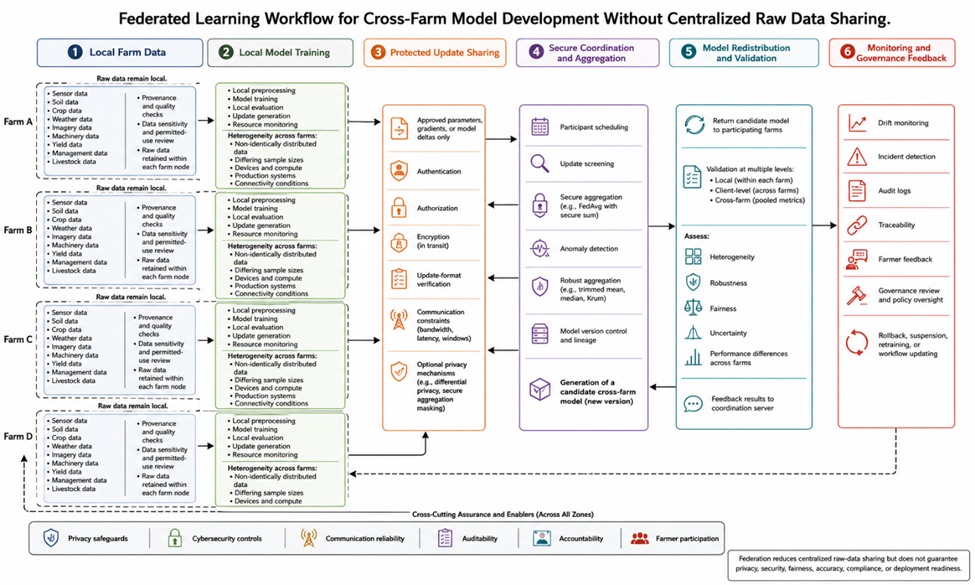
Figure 1. Federated Learning Workflow for Cross-Farm Model Development Without Centralized Raw Data Sharing
Alt-text description: Multiple farm nodes keep raw data local, train models, send protected updates to a coordinator, receive an aggregated model, validate locally, monitor drift, and return feedback.
The no-centralized-raw-data-sharing boundary requires end-to-end data-flow verification. Raw records may still appear in caches, backups, logs, diagnostics, or centralized preprocessing. Cross-silo agricultural learning permits shared modelling without raw-data exchange, but compatible objectives, controlled coordination, and validation remain necessary [19].
Agricultural heterogeneity affects training and aggregation. Differences in sample size, production, climate, machinery, sensors, resolution, labels, and practices create imbalance and conflicting local optima. Adaptation and pruning may help under site-specific and communication constraints, but remain task dependent [20]. Local, client-level, and cross-farm evaluation are required.
Bandwidth, connectivity, computation, memory, and energy determine participation. On-device smart-irrigation research makes resource measurement central [21]. Unequal connectivity can exclude farms and bias learning. Model and data drift should be monitored as seasons, sensors, management, and biological conditions change. Aggregation alone does not establish quality.
Federated learning changes training location but not attack surfaces. Compromised participants may alter data, code, or updates; adversaries may intercept communications, steal credentials, exploit coordinators, or infer information. Model poisoning, data poisoning, inference attacks, malicious aggregation, and disruption remain concerns [22]. The architecture should define threat assumptions, rejection criteria, response, and recovery.
Privacy assessment should examine updates, gradients, metadata, participation records, outputs, and logs. Confidentiality requires authentication, authorization, encryption, protected storage, and secure communication. Secure aggregation, differential privacy, homomorphic encryption, or trusted execution provide conditional protection with different assumptions, costs, and privacy-utility trade-offs [23]. No safeguard is universal.
Differential privacy requires a specified protection objective, privacy unit, accounting method, and utility assessment. Noise may reduce selected inference risks, but repeated participation accumulates loss and stronger perturbation may weaken convergence or utility. Privacy interacts with participation, communication rounds, and performance [24], requiring documented parameters and local and global evaluation.
Homomorphic encryption supports computation over protected values, while trusted execution may isolate operations. Suitability depends on keys, hardware trust, computation, latency, dropout, attestation, and side-channel risk. Additive homomorphic encryption demonstrates protected computation with implementation and performance costs [25]. Neither mechanism establishes correctness, integrity, complete privacy, or certification.
Governance determines who authorizes participation, operates coordination, defines aggregation, inspects logs, modifies models, suspends nodes, and changes purpose. Auditability preserves records; traceability links outputs to data, code, models, and decisions; accountability assigns responsibility. Defence performance depends on assumptions and implementation [26]. Table 2 maps these requirements.
Table 2. Federated Learning Principles, Decentralized Model Development, Privacy Safeguards, Security Risks, and Governance Requirements for Cross-Farm Agricultural AI: Local Data Retention, Local Training, Model Updates, Global Aggregation, Secure Aggregation, Differential Privacy, Data Heterogeneity, Non-IID Farm Data, Model Poisoning, Inference Attacks, Auditability, Traceability, and Claim Boundaries
Principle, component, requirement, or risk | Core architecture question | Required input or procedure | Federated or safeguard function | Potential output | Residual or failure risk | Validation, monitoring, or governance need | Boundary statement |
Local retention, training, update sharing, and aggregation | What remains local, what leaves, and how is it combined? | Data-flow map, valid data, update format, aggregation rule | Produces local and candidate global models | Model states | Leakage, poisoning, dominance, instability | Local, client-level, and convergence analysis | Locality and aggregation do not prove privacy or quality |
Secure communication, secure aggregation, differential privacy, homomorphic encryption, or TEE | Which safeguards fit the threat, utility, and resources? | Authentication, authorization, encryption, accounting, keys, or attestation | Protects channels, updates, or selected computation | Protected contribution | Endpoint compromise, collusion, utility loss, overhead | Privacy-utility and security assessment | Conditional safeguards, not guarantees |
Horizontal, vertical, or transfer federation under heterogeneous farm conditions | Which relationship applies, and how do clients differ? | Feature alignment, task relation, distributions, devices, connectivity | Organises collaboration and participation | Shared or adapted model | Linkage exposure, negative transfer, imbalance, exclusion | Configuration-specific and per-client validation | No universal configuration or performance claim |
Poisoning, inference, auditability, traceability, accountability, and claim boundaries | Can learning be corrupted or information inferred, and can decisions be reconstructed? | Provenance, anomaly detection, attack modelling, versioned logs, role map | Flags risk and supports review | Alert, risk report, audit trail | Adaptive attacks, incomplete testing, missing lineage | Incident response, rollback, independent review | No privacy, security, compliance, or readiness guarantee |
The architecture begins with use-case and stakeholder definition: the problem, intended users, output, contexts, and need for collaboration. Relevant actors include farmers, operators, advisors, stewards, developers, providers, validators, and governance decision-makers. Sensitivity, quality, provenance, documentation, and control are assessed before training. Smart-agriculture research supports separating local modelling, privacy processing, communication, and aggregation [27].
The local layer contains approved data, preprocessing, training, evaluation, update generation, and resource monitoring. Updates pass through authentication, authorization, encryption, format checks, anomaly screening, and justified privacy mechanisms. Cybersecurity remains distinct from privacy because confidential systems may still contain compromised devices or malicious updates. Agricultural federated intrusion detection supports separate security monitoring [28].
The coordination layer manages eligibility, model distribution, scheduling, update receipt, aggregation, version control, and candidate generation. Participation policies should consider availability, connectivity, staleness, capability, and exclusion of poorly connected farms. Changing agricultural networks may require adaptive coordination [29], which should remain transparent, monitored, and fairness-reviewed.
The assurance layer evaluates global and local performance, cross-farm generalization, heterogeneity, bias, fairness, robustness, uncertainty, and drift. Candidate models should return to farms rather than be judged only by averages. Auditability links documentation, versions, updates, tests, incidents, and approvals. Blockchain-assisted federation may support integrity and provenance [30] but does not prove accuracy, trustworthiness, or legitimate governance.
The final layer links monitoring, farmer participation, governance review, and updating. Drift, failures, anomalous updates, incidents, local degradation, or farmer concerns can trigger reassessment, suspension, rollback, renewed validation, or termination. Remote settings may require hierarchical or satellite-assisted coordination with added infrastructure dependencies [31]. Table 3 presents the architecture.
Table 3. Proposed Federated Learning Architecture for Privacy-Preserving Cross-Farm Model Development in Precision Agriculture: Use-Case Definition, Governance Mapping, Data Sensitivity, Local Farm Nodes, Edge Training, Model Updates, Secure Communication, Privacy Safeguards, Security Safeguards, Federated Aggregation, Validation, Heterogeneity Assessment, Drift Monitoring, Auditability, Farmer Feedback, and Deployment Boundaries
Architecture stage | Core purpose | Required input | Architectural function | Potential output | Validation or assessment need | Failure risk | Feedback mechanism | Decision boundary |
Use-case, stakeholders, governance, and data review | Define purpose, authority, sensitivity, quality, and provenance | Agricultural problem, stakeholder map, data inventory and documentation | Sets scope and screens inputs | Approved use case and data reports | Necessity, representation, privacy, quality | Function creep, responsibility gaps, contaminated data | Stakeholder and steward revision | No undefined federation or unsuitable data |
Farm-node configuration, local training, and update generation | Prepare controlled nodes and produce minimum necessary updates | Hardware, software, credentials, valid data, training rules | Hosts data, training, local evaluation, and update creation | Eligible node and local update | Misconfiguration, overfitting, leakage | Node testing, local validation, update screening | Unverified nodes excluded; raw gradients require justification | |
Secure communication, safeguards, coordination, and aggregation | Protect transfer and combine eligible contributions | Threat model, channels, participation and aggregation rules | Transmits protected updates and produces a candidate model | Protected aggregate and global model | Compromise, false assurance, poisoning, dominance, staleness | Privacy-utility, security, convergence, rollback monitoring | No universal safeguard; aggregation is not validation | |
Validation, heterogeneity, fairness, drift, auditability, and traceability | Test context-specific behaviour and preserve evidence | Structured holdouts, client metrics, longitudinal signals, logs | Assesses generalization, distributional effects, change, and lineage | Validation report, alert, audit trail | Hidden local failure, exclusion, missed drift, sensitive logging | Redesign, suspension, rollback, remediation | No readiness claim; traceability does not prove validity | |
Farmer feedback, governance updating, and claim boundaries | Maintain participation and reassess purpose, risk, and evidence | Feedback, incidents, validation, residual-risk registers | Revises, restricts, or ends the federation | Updated decision | Token consultation or premature use | Formal change control and independent review | No privacy, security, performance, compliance, or deployment guarantee |
Figure 2 presents the proposed federated learning architecture for privacy-preserving precision agriculture, integrating farm data sensitivity, local training, secure communication, aggregation, privacy safeguards, security safeguards, validation, governance, farmer feedback, and architecture updating.
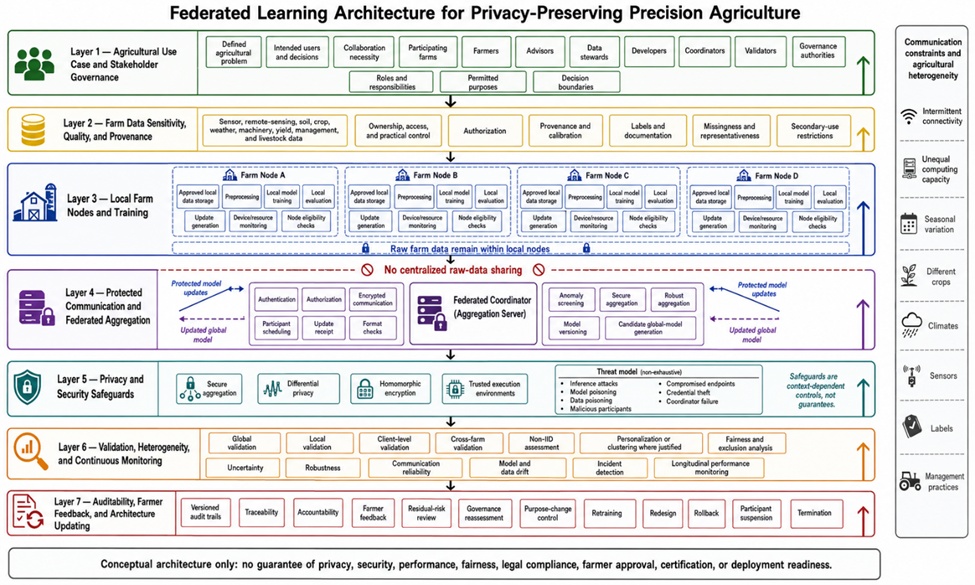
Figure 2. Federated Learning Architecture for Privacy-Preserving Precision Agriculture
Alt-text description: A layered architecture shows governance, local farm data, local training, protected update exchange, aggregation, privacy and security controls, validation, monitoring, auditability, farmer feedback, and explicit decision boundaries.
For farmers, operators, advisors, cooperatives, stewards, and public-interest organisations, the architecture clarifies whether collaboration is necessary, what remains local, what is exchanged, who controls development, and how concerns are handled. Participation requires understandable information about purpose, risk, access, benefit, limits, and escalation. These implications are conceptual, not professional advice.
For providers, developers, model teams, and cybersecurity specialists, future research should examine agricultural non-IID data, sparse participation, unequal resources, intermittent connectivity, seasonal change, personalization, cross-farm validation, drift, update leakage, poisoning resistance, and privacy-mechanism trade-offs. Client-level outcomes should be reported because global averages may conceal local failure, exclusion, or unequal benefit.
For researchers, policymakers, public institutions, and governance bodies, longitudinal evaluation should test whether privacy risks re-emerge through metadata, repeated updates, model access, or linkage; whether auditability remains accurate; whether drift affects farms unequally; and whether responsibility remains clear when shared models fail. The architecture can identify questions for qualified review but does not establish compliance, prescribe regulation, endorse vendors, or authorize deployment.
This article proposes an architecture linking farm-data sensitivity, cross-farm learning, local retention, local training, update sharing, secure communication, aggregation, privacy safeguards, cybersecurity controls, governance, validation, monitoring, auditability, farmer participation, and architecture updating. Reducing centralized raw-data sharing may support collaboration but cannot establish privacy, security, fairness, accuracy, trust, compliance, reliability, or deployment readiness. Responsible development requires bounded use cases, stakeholder mapping, quality review, heterogeneity assessment, cross-farm validation, privacy and threat assessment, drift monitoring, traceability, and governance feedback.
None
None
None
None
Open Access The author(s) retain copyright. This article is licensed under the Creative Commons Attribution-NonCommercial-ShareAlike 4.0 International License. It may be shared and adapted for non-commercial purposes with appropriate attribution, an indication of changes, and distribution of adaptations under the same license. Third-party material may be subject to separate terms identified in its credit line. View the license at https://creativecommons.org/licenses/by-nc-sa/4.0/.
 Agro Intelligence Research Press