The increasing incorporation and pervasive use of digital tools in agriculture have created dependencies and limitations that have slowed adoption and reduced the performance of novel technologies due to inadequate interoperability and resilience. Growing recognition of these difficulties has spurred the development of approaches designed to tackle them through decentralized IT architectures. Through the concept outlined here, the authors seek to enhance these existing frameworks by providing detailed proposals for server configurations. Commodity hardware combined with freely available, community-driven software enables low-cost entry to digital capabilities while still furnishing dependable support, provided that selected open-source instruments benefit from sizable or engaged user bases. Incorporating machinery rings magnifies financial gains by enabling the pooled, cross-farm deployment of costly technology. Farm servers stationed at individual holdings operate as edge nodes inside a regional grid. The area-based machinery ring serves as the next node, providing remote services to agricultural operators, who see machinery rings as a reliable ally. The framework is shaped by reassessed criteria, supplemented by insights from an author-led survey, and now places greater weight on inter-farm cooperative models. It directly addresses the chief hurdles farmers face in shifting to digital methods: control over proprietary data, operational robustness, system compatibility, steep investment requirements, and confidence.
Digital farming is increasingly vital in agriculture, offering a host of benefits and higher productivity. Concurrently, every digitized procedure must remain fully operational, down to the outermost boundaries of the network, both in the holding and in the field, safeguarding robust agriculture within the essential domain of food supply [1].
Within industrial contexts, digitized operations are woven into methodologies and penetrate sensitive segments of organizational management and governance frameworks [2-4]. For agriculture, this observation applies to pioneering farms, regardless of scale, that employ digital solutions. As digital integration deepens across business workflows, sensitive digital administrative tiers are implicated as well, thereby demanding heightened vigilance in safeguarding and resilience. This realization has driven, at least in part, a reassessment of corporate structures, sparking a shift toward decentralized digital ecosystems that offer fundamental capabilities via identity and access governance, operating independently of cloud infrastructure [5-7] through locally installed and blended cloud arrangements. This reasoning also extends to the deepening digital transformation on farms and within agrarian businesses [8, 9]: matters of continuity, informational integrity, and proprietorship over data have attracted sharper scrutiny and are entering farmers’ strategic considerations, accompanied by a measure of doubt and reluctance toward capital outlay. Even so, weaving digital processes into agricultural practice is rational for farmers, as the sector’s digital innovations explored in the following segment make clear. To accelerate deep-rooted, on-farm digital adoption, a customized pathway is required that bridges farmers’ actual operational circumstances, their informational safeguards, the resilience of digitized production processes amid disruptive events, alongside public and political expectations for an accountable, digitally enabled agriculture, and, above all, a secure, robust critical food production framework. Preconditions for a distributed infrastructure have been revised, and software modules for on-farm geographical data processing have been proposed [10].
This digitally-oriented agricultural model may strain end users’ technical proficiency. However, the intention rests, first, on giving concrete shape to an infrastructure that merges the demand for multi-layered resilience [8] through dispersion, a step necessitated by agriculture’s classification as vital infrastructure. Second, it strives to lower the barrier to entry for farmers by adopting community-driven software components and budget-conscious configurations that remain functional without relying solely on cloud platforms or stable internet access. The primary goal is to ensure that every farmer can participate in this evolutionary trajectory and incorporate digital tools into their individual management approaches; persuasive reasons to pursue this course are presented in the next section. The secondary target is to reflect the requirements and reservations voiced by farmers, extracted from scholarly work and (Section 1.2) the questionnaire, emphasizing joint, cross-farm utilization of DAT (digital agricultural technology). To offer perspective on a concrete illustration, section 3 presents how spatial datasets might be administered within a comparable system paired with a community-driven FMIS.
The transformational possibilities inherent in the shift from site-specific crop management to connected, intelligent farming, and ultimately to comprehensive digital agriculture have been underscored in academic works [11-16].
Such forward strides encompass the crafting of supporting software platforms that structure and interpret information gathered at the farm level. This represents a very foundational pillar of agricultural digitization. The majority of these capabilities are delivered by Farm Management Information Systems (FMIS), which, for example, enable producers to compute nutrient budgets, organize and sequence field activities, compile application charts, prepare instructions for compatible machinery, oversee water delivery networks, and much more. Furthermore, these platforms can supply administrative features for enterprise oversight, supplier coordination, evidentiary outputs linked to grant claims, and filings destined for regulatory entities. In mature operational settings, forecasting and advisory mechanisms guide cultivators toward optimal sowing times, crop protection interventions, watering schedules, and harvesting windows [17-20].
Above and beyond these enhancements to the everyday labor of farmers, the electronically captured records—covering, for example, ground characteristics, output levels, planting sequences, cultivation techniques, and ultimately a farm’s entire operational footprint—carry a deep reservoir of insight and revealing linkages for agriculturalists across subsequent periods and multiple cycles of growth.
Harnessing the sheer scale of compiled agricultural information delivers a substantial edge for deploying artificial intelligence, such as through simulation-based modelling employing virtual replicas. Whereas a discrepancy between anticipated gains and actual execution previously existed [21, 22], techniques, frameworks, and practical cases have since been developed [23-25] and advanced within research initiatives [26]. Virtual replicas can provide a foundation for tools that help farmers advance, map out novel business directions, and detect and sidestep threats early, whether through real-time data feeds or by running prospective scenarios on the virtual counterpart and intervening before negative outcomes [27]. Such capabilities, which hold clear practical value for agricultural operators, must be embedded inside a robust infrastructure to render their functioning as trustworthy as possible and to draw on them precisely when circumstances are most demanding—amid crises.
A further benefit lies in greater visibility surrounding food manufacturing across the entire value network. Producers stand to gain by emphasizing extraordinary product quality or alternative benefits, equipping consumers with the means to engage in informed purchasing behaviour.
A mounting preoccupation with stewarding and retaining control over data in agricultural settings is now evident [8, 9, 28], driven by concerns about informational self-determination and the potential erosion of control over day-to-day operational records. This situation ultimately dampens enthusiasm for digitization efforts.
Simultaneously, a shortfall exists in confidence, transparency, and influence regarding external platforms, particularly where the physical locations of servers underpinning remote computing environments, online portals, and browser-reliant products remain undisclosed. Cultivators seek assurance that they alone control their informational assets to uphold their competitive position and safeguard the value they generate. There is marked hesitancy among farmers to consign expansive troves of holding-level data to consolidated remote servers out of fear that dominance over those records could slip away [9, 29]. For this reason, those digitalized elements of an enterprise’s vital infrastructure require sufficient hardiness to stay operational amidst common or anticipated ruptures in linkages—ranging from ordinary upkeep, coding flaws, and physical device breakdowns, through online offences, mishaps, and electrical grid collapses, to government actions, environmental calamities, armed hostilities, and beyond. Recognized scenarios and their corresponding mitigations are documented in the research corpus [30-33].
A further substantial impetus toward dispersal arises from legal ambiguities over who truly owns data. The bulk of empirical datasets is not subject to any formal intellectual property rights under the law, even though the database’s structure may qualify for such protection. Personal-level records fall within the ambit of protective frameworks such as the GDPR, which is operative across EU territories [34]. Those running agricultural businesses dread unauthorized dissemination of both private particulars and commercially sensitive intelligence, alongside harmful knock-on effects such as market rigging via collusive pricing or unsolicited onward passage to oversight institutions [35].
Parallel to the issue of properly shielding farm-generated records, matters rooted in private law likewise surface where data is conceived as a tradeable commodity and where data handling is offered as a contractual service to growers. The core predicament revolves around assigning rightful claim to the value extracted from said data and establishing who bears accountability when either the records themselves or their manipulation proves defective [29, 35].
Growers regularly face a bind whereby refusal to permit the harvesting, warehousing, and exploitation of their data renders a service inaccessible, thereby either shutting them out altogether or coercing them into arrangements they would rather avoid.
Lastly, cultivators frequently lack clarity on whether capital deployed toward digital implements will yield fiscal dividends. The learning curve attached to unfamiliar hardware and software can be steep, intensifying hesitancy around adoption and rendering the calculus of return on investment (ROI) uncertain. This obstacle becomes especially acute as cultivated areas shrink [36]. Where investments are nonetheless made, operators commonly encounter convoluted data-handover procedures, a consequence of missing uniform connective gateways (APIs) that enable frictionless reuse of records originating on one platform within another’s operational setting. For discrete activities, practitioners must frequently contend with repeated format disconnects and piecemeal software usage. Farmers encounter snags with cross-manufacturer, cross-device, and cross-application compatibility, along with the typically closed-off nature of data schemas, all of which curtail agility and, in the final analysis, stymie the onward march of digitalization—especially within regions like Europe where mixed machinery inventories are the norm.
The current paper sets out to advance a farm-level architectural proposal for server infrastructure that weaves together existing components into a fresh configuration, squarely addressing the foremost stumbling blocks cultivators encounter upon initiating digitization.
The opening objective is economic accessibility. To this end, openly licensed, shelf-ready elements have been selected. Where more costly solutions are called for, the design folds in either a machinery ring (MR) or, in contexts where no MR operates, an agricultural service provider. To address the altered dynamics that arise when DAT is deployed collaboratively across multiple farms, the earlier requirements catalog [10] has been updated based on questionnaire responses. In this manner, the proposal orients itself directly around grower expectations, giving particular weight to inter-farm dimensions. The collaborative link with the MR might also counterbalance the scarcity of backstopping and skill-building [37] tied to DAT, positioning the MR as the first dependable port of call for farmers.
The second objective is to safeguard the robustness already attained through preceding conceptual work [8, 38]. The constituent parts are laid out in a configuration that takes those earlier models as a structural template. Every component is selected and integrated based on the preconditions that have been scrutinized.
To facilitate the greatest possible system interconnectivity [39] alongside informational safeguarding as the third objective, the architectures of software arrangements already organized along distributed lines serve as guiding references by virtue of their use of open APIs. The informational self-governance of farmers [40] stands to be buttressed here by weaving in an obligation to secure explicit agreement to user stipulations formulated either by the growers themselves or by the machinery ring acting on their behalf whenever records change hands.
An internet-distributed questionnaire was administered within the EIP-AGRI project MR-digital to explore the deployment of cross-holding digital agricultural technology (DAT). The questions spanned matters of data protection and data integrity through to possible deterrent factors concerning the shared application of DAT across farm boundaries. During the period from the middle of December 2020 to the closing days of January 2021, invitations to contribute were sent by e-mail to 5529 holdings across Germany. The proportion of fully returned, usable questionnaires reached 4.4% (n = 244). Of these, farm proprietors or farm directors (hereafter, simply farmers) accounted for 96.7% of completions, while hired staff or employees accounted for 3.3%. A share of 59.5% of the electronic addresses was sourced from publicly accessible state-level rosters of officially recognized vocational training farms. The balance of 40.5% comprised individuals drawn from earlier research cohorts. Accordingly, the questionnaire primarily captured vocational training establishments accredited under Germany’s “Berufsbildungsgesetz” (BBiG, the Vocational Training Act; see §§ 27–30 BBiG).
Table 1 presents the structural indicators of the farms that provided responses and juxtaposes them with the statistical series published by the Federal Statistical Office. Marked departures in scale between the surveyed cohort and the nationwide benchmark stand out: the sample possesses substantially greater land endowment (∅ 372.7 hectares, x˜ 125 hectares) set beside the pan-German mean (∅ 64.1 hectares). This variance is coherent and readily accounted for by the purposive inclusion of vocational instruction operations (≥ 59.5%) together with full-time cultivators (93%). As for legal form, ‘sole proprietorship’ dominates both in the sample (55.7%) and in the national reference picture (86.8%; Statistisches Bundesamt 2023). Owing to the specific profile of the responding units (farm businesses larger than the norm) and the chosen medium of inquiry (web-based questionnaire), the findings are unsuited to stand as statistically representative of the totality of German agricultural holdings (n = 258, 740) [41]. Nevertheless, the input supplied by these businesses holds unique value precisely because they harbour an inherent stake in advancing toward durable growth that benefits the next cohort, rather than merely pursuing margin. By comparison, those running diminutive enterprises frequently maintain primary occupations outside the agricultural sector, lessening their reliance on farming revenues and their dedication to pressing structural adaptations. On the other end of the spectrum, expansive operations may harbour commercial orientations that prioritize profit maximization ahead of motives rooted in generational transfer and customary ethos. While the panel of respondents cannot claim to mirror the entire population of German farmers, the questionnaire can nonetheless render insightful glimpses into the anticipated developmental trajectories of such establishments.
Table 1. Sample comparison with data from the German Federal Statistical Office (Statistisches Bundesamt, 2023).
Feature | Sample survey | German average |
Farm size (in ha UAA) | ∅ 372.7; x˜ 125 (n = 243; n = 1 N/A) |
|
Legal form |
|
|
Form of farming |
|
|
Age (years) Sole proprietor | ≥ 50: 49.7% | ≥ 55: 41.7% (2020) |
Farm succession secured for sole proprietors | ≥ 50-year-old: 39.0% yes | ≥ 55-year-old: 36.7% yes (2020) |
GbR = Gesellschaft bürgerlichen Rechts (translated as: Company under civil law); GmbH = Gesellschaft mit beschränkter Haftung (limited liability company); ha = hectare; N/A = not specified; conv. = conventional; UAA = area used for agriculture; ecol. = organic; e.g. = for example; ∅ = average; x˜ = median; % = percent; n = sample size; ≥ = greater-than-or-equal-to sign. Source: Own representation according to (Statistisches Bundesamt 2023).
The design of the survey instrument rested on findings from a thorough review of the published literature and three expert dialogues with farmers (see, for instance, [1, 29, 40, 42-44]).
To facilitate segmented analysis of the gathered responses, a mix of univariate methods (encompassing frequency distributions, arithmetic means, and standard deviations), bivariate techniques (the U test and Chi2 cross-tabulation), and multivariate procedures (the H-test) was deployed, thus combining descriptive and inferential statistical frameworks [45, 46].
Based on the questionnaire replies, 37.7% (n = 92) of those surveyed apply DAT in collaborative, cross-holding arrangements; the largest share (54.3%) functions as a hired contractor or service supplier, or participates in a grower-run machinery pool (22.8%). A clear preponderance (62.3%; n = 152) do not engage in cross-farm DAT employment, naming prohibitive acquisition expenses (x̅ = 2.46; SD: 1.50), an unfavourable balance between outlay and returns (x̅ = 2.75; SD: 1.44), patchy web and broadband availability (x̅ = 3.22; SD: 1.62), the peril of total operational collapse (x̅ = 3.45; SD: 1.48), and weak informational safeguards (x̅ = 3.66; SD: 1.50).
When examining the hurdles collated in Table 2, notably pronounced contrasts materialize for “prohibitive acquisition expenses” (U test: P = 0.000066) and “unfavourable balance between outlay and returns” (U test: P = 0.0039) across the southwestern and northeastern federal territories of Germany. In the Southwest (SW), prohibitive acquisition expenses (1 = full endorsement to 3 = leaning toward endorsement, SW = 85.0%; NO = 58.6%) alongside the unfavourable balance between outlay and returns (1=full endorsement to 3=leaning toward endorsement, SW=81.2%; NO=58.7%) surface as the foremost stumbling blocks. The landscape in the Northeast, by contrast, is less sharply delineated. The null proposition reading: “The hurdles, prohibitive acquisition expenses (H-test, P = 0.000066) and unfavourable balance between outlay and returns (H-test, P = 0.004) hold equal salience across the two federal territories, Southwest and Northeast” may be set aside upon scrutiny of the grouped medians.
Table 2. Grouped mean values: Reasons that inhibit the inter-farm use of DAT by federal region, 1-Totally agree, 6-Not at all agree.
Obstacle reasons | North East | South West | ||
Empty Cell | SD | x̅ | SD | x̅ |
High investment costs | 1.53 | 3.15 | 1.40 | 2.16 |
Unfavorable cost-benefit ratio | 1.44 | 3.26 | 1.40 | 2.53 |
Poor network and broadband infrastructure | 1.73 | 3.39 | 1.57 | 3.14 |
Risk of system failure | 1.51 | 3.63 | 1.47 | 3.37 |
Insufficient data protection | 1.54 | 4.0 | 1.47 | 3.51 |
The questionnaire data signal an absence of statistically meaningful separation for the hurdles “patchy web and broadband availability” (1 = full endorsement to 3 = leaning toward endorsement, SW = 60.4%; NO = 54.3%), “peril of total operational collapse” (1 = full endorsement to 3 = leaning toward endorsement, SW = 55.7%; NO = 50.0%), and “weak informational safeguards” (1 = full endorsement to 3 = leaning toward endorsement, SW = 46.2%; NO = 32.6%) between the two federal territories (U test: P > 0.05).
Significant distinctions (χ²-test, P < 0.05) emerged among varied brackets of the acreage possession composition (Table 3) linked to cultivators’ openness to distribute, handle, and retain records for defined aims via the machinery ring. Of particular note, the readiness to distribute records stands out as somewhat stronger within the 51—100 and 101—200 hectares brackets, suggesting that enterprises of these scales may have a specific need for external support in stewarding and managing their operational data.
Table 3. Willingness to share farm data with the machinery ring by class of land ownership (willingness to share data within the individual classes in %).
Purpose of the data transfer | 1001 | 501 | 201 | 101 | 51 | 0 |
Farm-specific advice | 40.7% | 12.5% | 36.4% | 60.8% P = 0.056 | 51.4% | 24.0% |
Digital job planning and execution | 48.1% | 50.0% | 39.4% | 45.6% | 44.4% | 24.0% |
Farm-specific data evaluation | 37.0% | 12.5% | 39.4% | 45.6% | 31.9% | 20.0% |
Transmission of individual process data for documentation purposes | 29.6% | 12.5% | 27.3% | 38.0% P = 0.033 | 45.8% | 28.0% |
Source: Own survey.
A marginally sharper reluctance manifests among cultivators in the southwest compared with those in the northeast regarding the retention and handling of business records (U test: P = 0.0223). No more than roughly half of participating growers across both territories rate the retention and handling of records as extremely (level 1) or quite (level 3) crucial (64.2%, n = 107, southwest; 52%, n = 40, northeast).
Two out of three (66.4%; n = 162) indicate readiness to supply farm records stemming from collaborative DAT employment to the machinery ring through electronic mail, while 20.5% (n = 50) lean toward confined entry to their own farm server for subsequent manipulation. A centralised remote data repository functioning as an interface with external service vendors appeals to 31.1% (n = 76), and 43.0% (n = 105) embrace the same setup with their machinery ring cast in the vendor role. Decisive fluctuations tied to either operational acreage or federal territory cannot be substantiated (χ²-test, P > 0.05).
At this juncture, the bulk of growers house their farm documentation in on-premises domestic settings, be it as physical paper records (55.3%), inside the integral hard disk of a desktop machine (63.5%), and/or on detachable storage hardware (65.2%) (Figure 1).
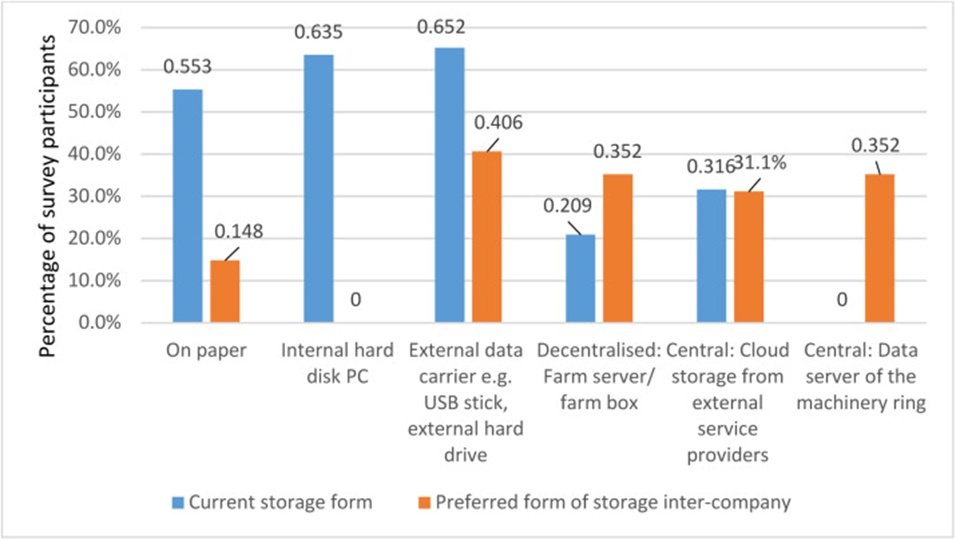
Figure 1. Form of storage of company data currently and in the inter-company context, n = 244 (in %) (Source: Own survey).
Extending earlier scholarly work [10] and the questionnaire outputs, a suite of stipulations was formulated for a dispersed, failure-resistant IT backbone that aligns with cultivator concerns and addresses indispensable facets of operational dependability and structural distribution. These stipulations span:
1. Monetary stipulations: Adopting affordably priced, generic, shelf-ready (COTS) apparatus as hardware together with lean-cost infrastructure building blocks anchored in openly licensed programming to elude proprietary entrapment and facilitate customisation and ongoing enhancement.
2. Connectivity and permission stipulations: Instituting a hardened network fabric operated by trusted stewards (MR), embracing distributed, tailor-configured rollout alternatives alongside elastic authorisation governance resting in farmers’ hands. Furthermore, deploying operational modules as infrastructure-as-code (IaC) released under unrestrictive, community-sourced software terms, thereby enabling MR to administer off-site services.
3. Seamless exchange and informational protection: Guaranteeing mutual operability through uniform communication conduits and application programming gateways (APIs), making room for expansion, unimpeded informational circulation, and module substitution. In parallel, enshrining informational self-rule through mandatory acceptance of the grower’s terms of engagement before layered record dissemination, and by means of infrastructural provisioning and oversight channelled through the MR entity.
4. Continuity of operations: Fashioning both tethered and autonomous functional capacity across all critical instruments and remedies. Additionally, enacting informational robustness through a pliable blend of aggregated and distributed safekeeping choices. Finally, engineering bespoke redundancy solutions for mirrored records and linkage (IoT) delivery, placing the MR as the foremost point of liaison to outside suppliers.
To embed the vision of a resilient, digitally-enabled agricultural arrangement within both ongoing and forthcoming trajectories of farm development, we sketch a concise portrait of a fully digitalised holding model. Under this scheme, information stands as the operational linchpin, with each discrete dataset filed a solitary time to establish an unchallenged reference source (SPOT) [47]. The holding’s foundational resources furnish the starting blocks for the digitisation undertaking. This spans core descriptors of fields and herds, which supply the substructure onto which further layers of intelligence are affixed—terrain make-up, elevation readings, vegetative indices extracted from remote sensing captures, and sensor-supplied measurements. Such intelligence may be channelled into analytical evaluations and administrative judgments, all the while, as fresh data streams continually materialise, documenting the standing and condition of resources, cultivation activities, tonnages reaped, and production substances applied. The corpus of this intelligence is harvested and stored on the farm server in accordance with a database blueprint that adheres to the ACID tenets (atomicity, consistency, isolation, durability). Each sensing unit maintains a doubled tether to the farm server via both the World Wide Web and the holding’s internal network. The farm server hosts software calibrated to the distinctive requirements of each cultivator, incorporating an FMIS that affords the farmer a wide-angle lens on all monetary inflows and outflows, as well as a geographic information system (GIS) software bundle for curating locational data. The farmer is empowered to strategize, assign, chronicle, and dissect all holdings and activities carried out on the property. Information sourced externally—weather streams, remotely captured visuals, pricing indices, cost figures, bulletins, and pedagogical reference materials—remains accessible via routine internet uplinks. Yet, to ensure operational dependability, every dataset pivotal to the holding’s workflows is kept and accessible offline, disconnected from any external network or power feed.
Over and above its role as a self-contained holding-level server, the farm server (Hofbox) slots into a sprawling lattice of affiliated holdings and the machinery rings partnered with them. The farm server serves as a peripheral terminal within this lattice, with the principal communication pathway favouring exchange between the farm server and the area machinery ring server. To underwrite both secure and efficient stewardship of the composite architecture, growers grant access to the IT-trained personnel of the local MR, who perform off-site software maintenance and deploy protective measures on the farm server housed within the MR farm server networking sphere. Given that many cultivators possess scant IT proficiency, this external support is vital. The farm server comes equipped with an approachable operator dashboard that grants control over record availability by specifying which individuals or utilities may access designated datasets. Broadly, the design envisages that internet-based utilities have sanctioned access to records on the farm server via standardised APIs, removing the need for growers to port records to any utility for alignment or updates [10].
The machinery ring operates within geographically bounded limits. It interconnects all farm servers of its enrolled members to a centralised bureau, which serves as a regional hub within the dispersed architecture. From this hub server locale, the machinery ring reaches decisions regarding auxiliary server warehousing sites and underwrites the security and integrity of farmer-held records and their duplicates. Consequently, for holdings enrolled in the network, duplicated off-location data copies reside in a reliable business-to-business (B2B) environment.
This construct draws life from both live and concluded undertakings [8, 48]. OpenHorizon, an edge orchestration framework crafted by IBM, serves as a guiding template. Once an edge unit—in our context, the farm server—receives power and connects to the network, the on-device OpenHorizon agent steps in to install and supervise containerized applications on the unit, ensuring continued operation even when internet connectivity is interrupted. Containers, along with their tailoring parameters, are sourced from an orchestration hub, which is a node in the software provisioning pipeline.
For record circulation, the paradigm advanced by Inrupt/Solid supplies a guiding model [49]. Its core premise is that information resides in a user-controlled enclave, and external services must petition the data owner for permission to access it. This grower-operated data vault, in our illustrative case, assumes the form of a personal data store (PODS) [50], stewarded by the farmer and accessible via the cloud, thereby forging a direct link to either the farm server or a synchronised cloud-hosted mirror, affording elevated uptime. Informational self-rule is implemented through entry governance, together with a usage covenant with legal enforceability, assented to by every cooperating party at the point where records are drawn upon via a pod’s API [51]. The stewardship and safekeeping of information adhere to semantic and ontological benchmarks, ensuring the enduring legibility and locatability of data (the FAIR benchmarks: Findable, accessible, interoperable, and readable [52]) for both algorithmic consumers and human readers.
The system’s arrangement will be walked through with an illustration of the administration of location-referenced information on a working holding. In the domain of field cropping, a considerable portion of datasets possesses a geographic attribute and falls under the heading of geodata when that geographic linkage is formally encoded. The value and practical utility have been borne out across numerous spheres [53-56], with cartographically anchored precision-cropping methodologies depending particularly on such inputs. It follows that the agricultural operator requires the facility to manipulate geodata file structures, such as bridging files encountered during platform-to-platform migration (e.g., Shapefiles, GeoTIFFs, ISOXML). Contemporary FMIS products, however, provide only limited geodata capabilities within their tool sets: ordinarily, the supported geodata classes are limited to field outlines, and a browser-based mapping component is used to render and select tabulated entries keyed to those outlines. Richer decision-making support should integrate multiple geographic information feeds to capture disparities in site-level biophysical settings and address them through modulated treatments involving zone separation and zone-specific orchestration of crop husbandry and input placement. Worthwhile source material spans from distantly collected vegetation reflectance data and pedological charts to digital topographic representations and ecological datasets. It may also include locally instrumented intelligence on harvest tonnages, atmospheric readings, machinery telemetry logs, and more.
An adaptable bare-bones personal computer foundation was selected (an Intel NUC 10) and kitted out with 32GB of RAM and a pair of storage devices: a 500GB Kingston SSD for the operating system and application software, plus a 2TB HDD. This configuration proves sufficiently performant and capable of running services within the on-premises farm networking environment and outwardly, while remaining modifiable and expandable at any juncture. For the bulk of holdings captured in the questionnaire, the present-day cost of below 700 EUR answers the call for budget-conscious, readily available hardware.
The illustrative application focuses on geodata stewardship for a medium-scale European enterprise, harnessing conventional, freely licensed spatial data infrastructure (SDI) modules to manage and process geodata. The PostgreSQL database engine is made spatially capable via the PostGIS plug-in and serves as the server-side foundation for supplementary services. Geodata may be kept either within a database or on a network-attached file store, with vector data generally stored in the database and raster data retained as standalone files. Geoserver provides connectivity to geodata and cartographic visualisations through standardised OGC (Open Geospatial Consortium) protocols, including WFS (Web Feature Service) and WMS (Web Map Service), as well as the OGC API, which is currently under development as a newer benchmark. The freely licensed FMIS FarmOS delivers an on-site solution for farm management records.
An entirely virtualised operating platform, bundled with an open-source software collection and GIS features, enables remote access to a desktop workspace: QGIS is a multi-capability GIS tool that provides sophisticated means for geodata retrieval, handling, and rendering. It opens up pathways for pulling in and blending intelligence from distant or local database instances, web-exposed services, or stored files. The operator may call up and work with varied geodata origins inside QGIS: parcel boundary definitions from the FMIS become available by way of a WFS extension to FarmOS and can be merged with third-party suppliers such as orbital imagery vendors or state-operated open data gateways; furthermore, locally held information pools like application charts, harvest mapping files, or orthorectified imagery captured by UAS (unmanned aerial systems) may be introduced from the local SDI. QGIS can convert selected geometric objects into export-ready configurations for systems that cannot interface with data via an API, including those outside cloud platforms or tractor-mounted terminals. Elaborate data amalgamation procedures for prescription chart generation are backed by the specialist tool GeoFIS.
Gains for the end operator materialise via a pre-set workspace where particular services already feature pre-established links and stand primed for data interchange, affording adaptable permutations. At the present stage, access to services and data collection relies on locally managed credentials and parameter settings; approaches for identity verification and entitlement granting to operators through unified sign-on mechanisms such as OpenID are slated for appraisal and deployment. Worked examples highlight the necessity of semantically enriched scaffolding around data, including conventions for metadata characterisation, as well as utilities that mechanise access and lighten the handling load for the end user. A great many datasets carry salient details in a tacit rather than overt manner: sections of a filename or column headers may bear significance, demanding human decoding and habitually shifting with each information provider. Instruments that assist in producing data endowed with deepened semantic tagging remain needed.
The software arrangement characterised above is entirely free and open-source, meeting the requirements of thriftiness and malleability, which chime with the attitudes reported by growers in the questionnaire. Moreover, this software collection remains operable for the farmer, both tethered and disconnected from the web, ensuring a workflow that does not hinge on internet availability and satisfying the call for operational robustness.
Agricultural operators assign weight to the safeguarding, integrity, and self-governance of their informational assets, a theme that is highlighted by our questionnaire and published studies [49]. A scheme for structuring and securely accessing information can be located within the data utilisation governance paradigm of agricultural data spaces (ADS) [51, 57]. Evolutionary strides and normalisation activity around data spaces may produce deployable building blocks for nimble, distributed data curation and cross-system federated arrangements. Still more stringent stipulations prevail in the medical care arena, as set out by Storey [58]. Figures 2 and 3 juxtapose the prevailing status quo of a digitally augmented farm with the aspired future condition, applying a POD formulation drawn from the Web 3.0 model [50]. The orange arrows represent the relocation of information: in a conventional scenario (Figure 2), growers are obliged to juggle data and disseminate it to external actors. Information must be produced and brought up to date on several separate platforms by hand. It may, as a result, become discordant and gradually drift further apart, above all if reciprocal exchange via export and import is not feasible. Several incompatible renditions of datasets can stem from import/export cycles, particularly where movement runs in both directions. Stipulations governing the employment of information remain subject to externally set service terms. In Figure 3, the grower preserves information in personally governed systems, where required data can be accessed locally and finely graduated permissions are extended to outside actors. The relocation of information to external systems is built on an access tier, alongside prior identity proofing and entitlement conferral.
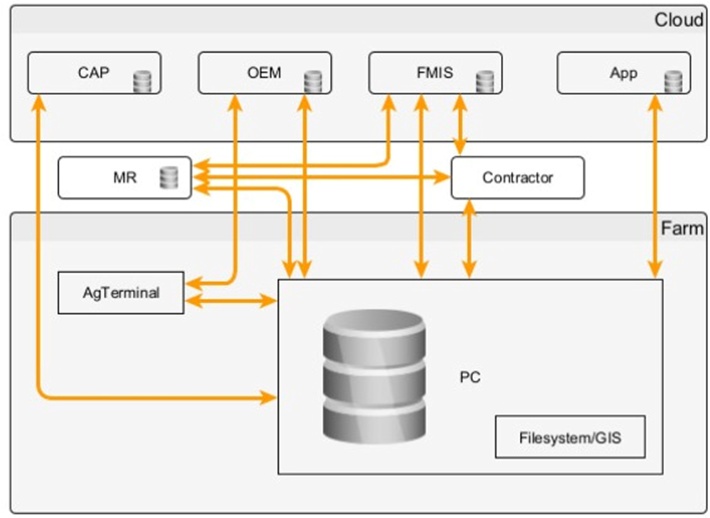
Figure 2. Classical connections between farmers’ infrastructure and cloud-based services: data is stored and needs to be updated in different places. The orange arrows show the data flow in all directions.
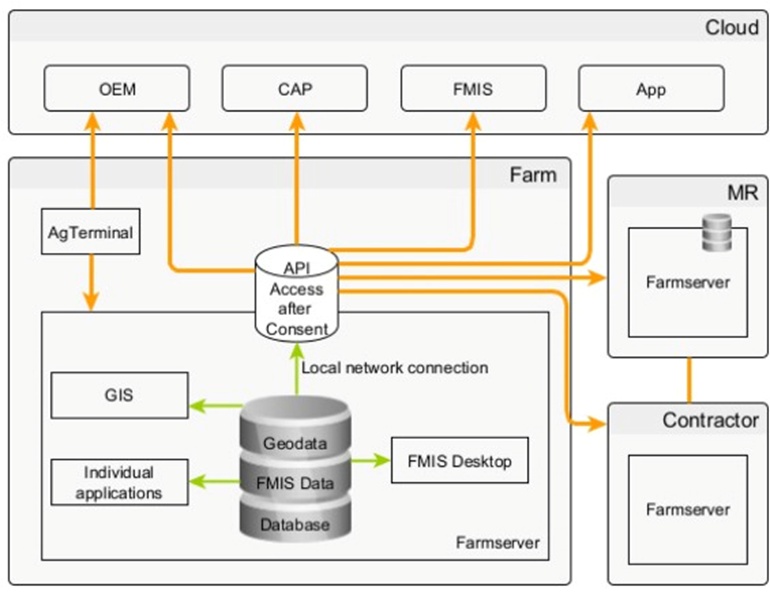
Figure 3. Data is stored only on the farm server and on backup locations. Third parties gain access after obtaining farmers’ consent to the data agreement, terms, and conditions. Dataflow (orange arrows) flows in only one direction.
Through this mechanism, the farmer maintains authority over which entities may touch which datasets and supplies services with up-to-date data editions. Consistent with Table 3 of the questionnaire, growers exhibit varying degrees of willingness to circulate information, shaped by the intended application, operational acreage, or other factors.
The nodes standing in direct interchange within this distributed construct are made up of a Hofbox placed on the holding, a Hofbox situated at the area MR bureau, and a cloud element, where server placements inside Germany or across the European area may be opted for to buttress informational self-rule via legislative guardrails (data protection statutes, GDPR). With a duplicated networking pathway—a holding-owned radio linkage tethering the farm to the area MR—the complete set of stipulations set down in Section 2.3 can be satisfied. The diverse personal leanings of growers regarding storage venues (Figure 1) are accommodated within the distributed blueprint.
The questionnaire and the outline of an archetypal digitized holding provide a solid foundation for aligning the suggested remedy with grower requirements. The catalogued prerequisites, along with most societal expectations, are met by the recommended architecture, which draws on Web 3.0 tenets. A solution that remains within financial reach lowers the threshold for later adopters and modest-scale enterprises to embark upon digitization. The community-driven model unlocks abundant avenues for collaborative input and tailoring. The requisite instruction to become acquainted with the capabilities and methods for operating and merging the tools still needs to be devised; area-based assistance furnished by MR is the ideal arrangement. Fresh digital workflows can be cultivated and sustained by the infrastructure. For bespoke modifications inside a freely licensed program, either the associated software community may lend a hand, supplementary functions can be realised through commissioned coders expanding the source code, or instructional walkthroughs can be supplied by practitioners or support vendors. The infrastructure-as-code (IaC) paradigm facilitates pluggable add-ons. The institutional structure of the MR occupies a pivotal position in cultivating and backing dependable commercial collaborators who command growers’ confidence, creating the opportunity to bring on board a qualified IT practitioner to address matters cultivators cannot resolve unaided, while spreading the expenditure jointly with other MRs and their member holdings. Continuity of operations and informational self-rule can be orchestrated to meet region-specific expectations and attune the architecture to the surrounding setting. System compatibility is addressed through the rollout of uniform, already-established APIs at every feasible juncture.
One possible shortcoming of the pathway is the considerable self-starting drive and intrinsic motivation required of growers to learn new software through walkthroughs and other channels. Dependent on the current level of IT provision within MR, supplementary personnel and resources may prove indispensable. This chimes with the questionnaire outcomes, which show that the segment of cultivators operating holdings in the 51–200 ha bracket shows particular interest in expanded digital offerings but grapples with knowledge gaps and limited available time. Younger agriculturalists could be pivotal participants, given that they already possess, or are cultivating, digital fluency to a threshold of heightened receptivity to information circulation, with self-imposed guardrails.
In line with Vogel [35] and Hilgendorf and Vogel [59], juridical and contractual encumbrances may arise on the growers’ side of bespoke agreements with original equipment manufacturers and digital solution vendors. To bolster the grower’s stance vis-à-vis corporate entities, Vogel advocates the use of template agreements, stewarded by farming cooperatives, that commit signatories to a behavioural charter. He also flags their constraints, a point at which the authors regard MRs as the ideal counterparts for drafting, embedding, and overseeing such agreements. As a weighty actor within the agricultural economy, the MRs could capably steward these contractual dimensions.
Over the course of the undertaking, the authors identified technical hurdles tied to execution specifics that require expert development support: most notably, the crafting, integration, and automated rollout of containerized services under a consolidated access governance framework represent pivotal building blocks with security ramifications. Growers need aid and servicing on this front. A further technical stumbling block is the fallback (radio) networking link that connects the area MR office, farm servers, and on-farm sensors and equipment, making the arrangement web-independent in the event of disruptions. Proposals have been tabled [8, 60] that need to be tailored to each MR.
Extending the conceptual, more broadly pitched formulation put forward by the authors in [8], the current remedy is expressly designed to respond to grower imperatives and fulfil demands for operational continuity and informational self-determination. By including the MRs, the execution is undertaken on an expert footing, buttressed by durable, long-term backing. The ultimate on-the-ground deployment calls for the pooled endeavour of every stakeholder and body engaged with this subject matter, channelling concentrated energies and pooled insight toward a wide-scale implementation initiative that puts the vision of the archetypal holding to the test and hones its practical realisation in the field.
The present study was carried out as part of the MR digital project, funded by the European Innovation Partnership ‘Agricultural Productivity and Sustainability’ (EIP-AGRI) program of the European Union, which is now part of the EU Common Agricultural Policy (CAP) Network. We would like to thank the European Innovation Partnership and the federal state of Baden-Württemberg for funding. Furthermore, we want to express great gratitude to our project farmers and partners for their collaboration and extraordinary contributions to the project.
None
None
None
Open Access The author(s) retain copyright. This article is licensed under the Creative Commons Attribution-NonCommercial-ShareAlike 4.0 International License. It may be shared and adapted for non-commercial purposes with appropriate attribution, an indication of changes, and distribution of adaptations under the same license. Third-party material may be subject to separate terms identified in its credit line. View the license at https://creativecommons.org/licenses/by-nc-sa/4.0/.
 Agro Intelligence Research Press