Smart farming technologies are frequently associated with improved efficiency, environmental performance, and adaptive agricultural management, yet digital capability alone does not establish sustainability. This article proposes a sustainability-by-design framework that embeds environmental, economic, social, resilience, and governance considerations into the design and evaluation of smart farming technologies. The framework connects digital agriculture capabilities with resource-use baselines, water- and nutrient-use assessment, conditional pesticide and energy considerations, soil and biodiversity relevance, waste and emissions evaluation, and human oversight. It further integrates climate-risk assessment, scenario planning, adaptive farm-system design, operational resilience, learning feedback, and explicit boundaries against treating monitoring or prediction as proof of climate resilience. Social value is addressed through farmer participation, autonomy, digital inclusion, accessibility, usability, affordability, local relevance, knowledge integration, trust, transparency, data governance, and accountability. Cross-cutting sustainability design principles include context sensitivity, life-cycle thinking, interoperability, trade-off assessment, uncertainty communication, evaluation planning, controlled updating, and clearly defined decision boundaries. The proposed framework is intended to organize design choices, evidence requirements, governance safeguards, and future evaluation rather than prescribe farm-management actions or certify sustainable outcomes. Its main contribution is a structured socio-technical model for examining when, how, for whom, and under what conditions smart farming technologies may support sustainability-oriented agricultural transformation.
Smart farming refers broadly to agricultural systems in which sensors, connected devices, digital platforms, analytical models, and decision-support functions are used to observe, interpret, or influence production processes. These systems may connect field conditions, machinery, weather information, farm records, remote observations, and management decisions through data-intensive infrastructures involving farmers, advisors, technology developers, service providers, and data intermediaries. This interconnected architecture means that smart farming is not merely a collection of digital tools but a socio-technical arrangement in which data quality, interoperability, platform relationships, ownership, responsibilities, and decision authority shape how technological functions are used. Smart farming should therefore not be treated as sustainable by definition simply because it increases the visibility, speed, or precision of agricultural information [1].
Sustainability-by-design extends sustainability considerations into the formulation of the problem, the definition of system objectives, the selection of digital functions, and the planning of evaluation before implementation claims are made. Digital agriculture may help structure more sustainable agricultural systems when data, models, indicators, farm objectives, ecological constraints, economic conditions, and trade-offs are considered together. Its potential contribution depends not only on whether a system can generate predictions or recommendations but also on whether its performance is measured against defensible resource-use baselines and interpreted across environmental, economic, and social dimensions. Digital capability can consequently support sustainability-oriented system design, but it cannot independently demonstrate environmental improvement, economic viability, or responsible implementation [2].
A sustainability-by-design approach must also account for the institutional and social transformations associated with agricultural digitalization. Digital systems can alter farm work, knowledge relationships, professional roles, advisory practices, access to information, data control, and the distribution of decision-making power. They may produce different consequences for farmers depending on farm scale, infrastructure, skills, location, financial capacity, market position, and access to support. These conditions require analysis of labor, identity, autonomy, expertise, institutions, and social inequality alongside technical performance. Evaluating smart farming exclusively through productivity, accuracy, automation, or input-use indicators would therefore omit important dimensions of social sustainability and socio-technical change [3].
The objective of this article is to propose an original sustainability-by-design framework for smart farming technologies that integrates digital agriculture, resource efficiency, climate resilience, adaptive farm systems, social value, inclusive technology design, governance safeguards, and evaluation planning. The framework is informed by responsible-innovation principles that emphasize anticipation of potential effects, inclusion of affected actors, reflexive examination of design assumptions, and responsiveness to evidence and stakeholder concerns. It is intended to guide the organization of sustainability questions and design requirements rather than function as a certification system, implementation protocol, policy instrument, or operational farm-management prescription. The central contribution is a structured model for distinguishing sustainability-oriented design intentions from empirically validated sustainability outcomes [4].
Sustainability-by-design in smart farming can be defined as the deliberate integration of sustainability objectives, evidence requirements, stakeholder considerations, governance safeguards, and evaluation boundaries throughout the development of a digital agricultural system. It differs from post hoc sustainability assessment because environmental and social questions are considered before technology functions, data flows, system boundaries, and decision roles become fixed. It also differs from broad claims that a technology is sustainable because it is precise, automated, data-driven, or capable of reducing a particular input under selected conditions. Design-stage sustainability thinking requires developers and users to identify possible benefits, burdens, unintended consequences, affected groups, and responsibility gaps across the technology lifecycle. Socio-ethical issues should therefore be addressed as interconnected design requirements rather than fragmented concerns added after technical development [5].
This interpretation also distinguishes sustainability-by-design from technology adoption. Adoption indicates that a technology has been acquired, trialed, accessed, or used, but it does not establish that the technology produces environmental benefit, equitable value, climate resilience, affordability, or long-term usefulness. Digital farming systems may be more accessible to organizations with greater capital, connectivity, technical support, data infrastructure, and capacity to absorb risk. Such uneven conditions can affect who influences system objectives, whose knowledge is represented, who controls data, and who receives economic or informational benefits. Sustainability-by-design must consequently ask who can participate in technological development, who may be excluded, who bears costs or dependencies, and whether existing inequalities are reinforced or reduced [6].
Smart farming must further be interpreted across physical, digital, social, and institutional layers. The physical layer includes soils, water, crops, livestock, machinery, ecological processes, and production infrastructure. The digital layer includes devices, data, networks, algorithms, models, and interfaces. The social layer includes farmers, workers, advisors, researchers, service providers, rural communities, and other affected groups. The institutional layer includes contracts, organizational arrangements, standards, markets, public services, data rules, and responsibility structures. Sustainability-by-design links these layers so that technical functions are evaluated within the farm and rural systems in which they operate. This integrated socio-cyber-physical perspective prevents environmental or operational performance from being assessed independently of institutional capacity and social consequences [7].
A sustainability-oriented design process should therefore include resource-use evidence, climate-risk reasoning, social-value assessment, inclusive participation, governance safeguards, trade-off analysis, and explicit evaluation plans. Decision-support functions may change how knowledge is generated, interpreted, and acted upon, while also redistributing labor, authority, benefits, and burdens among farmers, advisors, developers, and service providers. Human oversight must be substantive rather than symbolic, with clearly defined competence, access to relevant information, ability to question recommendations, and authority to override or escalate decisions. The framework proposed in this article treats these requirements as interconnected design conditions while maintaining that their inclusion does not prove sustainability, farmer acceptance, or implementation readiness [8].
Digital agriculture can support resource-efficiency assessment by improving the observation, spatial differentiation, timing, and documentation of agricultural inputs and production conditions. Sensor data, remote sensing, connected devices, machinery records, and farm-management information may help characterize water status, soil variation, crop condition, nutrient demand, pest pressure, energy use, operational losses, or other relevant variables. Precision functions may then support targeted monitoring, scenario comparison, or site-specific application. However, the environmental implications of these functions vary according to the technology, production context, baseline, measurement boundary, and response of the wider farming system. Potential effects on water, fertilizer, pesticides, fuel use, and emissions should therefore be evaluated separately rather than combined into a general claim that precision agriculture is environmentally beneficial [9].
Resource efficiency is also multidimensional. A reduction in one input does not necessarily indicate improved overall sustainability if productivity, soil condition, ecological effects, economic feasibility, rebound effects, or burdens elsewhere in the system are ignored. Water-use efficiency may be reported as output per unit of water, absolute water use, timing efficiency, or reduced losses, each of which reflects a different sustainability question. Nutrient-use efficiency similarly requires attention to crop uptake, soil reserves, application timing, runoff, leaching, and long-term soil fertility. Economic and agronomic outcomes are relevant because a technology that reduces a resource under modeled conditions may remain inaccessible, unreliable, or financially unsuitable in practice. Resource-efficiency assessment must therefore combine environmental, agronomic, and economic evidence without assuming that improvement in one dimension compensates for deterioration in another [10].
The same caution applies to pesticide reduction, energy efficiency, soil health, biodiversity, waste, and emissions. Digital detection and targeted application may support more selective pest management where biological diagnosis, treatment thresholds, resistance risks, non-target effects, and human review are adequately addressed. Energy assessment should include not only machinery operation but also devices, connectivity, data transmission, computing infrastructure, maintenance, and replacement. Soil-health relevance requires multiple physical, chemical, and biological indicators rather than dependence on a single digital proxy. Biodiversity effects require ecological evidence at appropriate spatial and temporal scales, while waste and emissions claims require clearly defined material-flow and system boundaries. Precision technologies can support monitoring and evaluation across these domains, but heterogeneous evidence does not justify universal claims of reduced resource use or environmental impact [11].
Resource-efficiency design must begin with a defensible baseline and specify which input, output, ecological condition, time horizon, and system boundary are being evaluated. Digital functions should be linked to explicit sustainability questions, with documented data provenance, uncertainty, model assumptions, interoperability requirements, and human decision authority. Relative efficiency indicators should be considered alongside absolute use because improved efficiency may coincide with expanded production or greater total consumption. Economic assumptions must also be disclosed, particularly where projected input reductions or profitability depend on farm structure, scale, financing, or modeled scenarios rather than observed outcomes. Digital agriculture may structure resource monitoring and comparison, but it does not establish resource efficiency or sustainability without contextual evaluation [12]. Table 1 summarises digital agriculture and resource-efficiency requirements for sustainability-by-design in smart farming technologies.
Table 1. Digital Agriculture and Resource-Efficiency Requirements for Sustainability-by-Design in Smart Farming: Water Use, Nutrient Use, Pesticide Reduction, Energy Efficiency, Soil Health, Biodiversity Relevance, Waste Reduction, Emissions Relevance, Sensor Data, Remote Sensing, IoT, Decision Support, Human Oversight, and Sustainability Boundaries
Resource-efficiency component | Core sustainability question | Required evidence or input | Digital agriculture function | Potential output | Risk of overinterpretation | Evaluation or governance need | Framework role |
Water-use efficiency | Does the system reduce water demand or losses without shifting environmental burdens or undermining relevant production objectives? | Water-source context, baseline withdrawals, soil moisture, weather, crop demand, application timing, output, and quality information | Sensing, irrigation monitoring, forecasting, anomaly detection, and decision support | Water-use indicators, temporal patterns, and context-specific decision options | Lower application in a selected period may be treated as proof of watershed-level sustainability | Baseline comparison, hydrological context, rebound analysis, uncertainty disclosure, and human approval | Environmental resource-efficiency pathway |
Nutrient-use efficiency | Does nutrient management improve input–output performance while limiting losses and preserving longer-term soil function? | Soil tests, nutrient balances, crop demand, application records, weather, yield context, runoff, and leaching evidence | Spatial diagnosis, variable-rate planning, application monitoring, and decision support | Nutrient-balance information, efficiency estimates, and management options | Lower application may be interpreted as improved soil or water outcomes without supporting evidence | Agronomic validation, loss monitoring, local calibration, and longitudinal soil assessment | Nutrient-management pathway |
Pesticide-use reduction where supported | Can application or exposure be reduced while maintaining appropriate crop-protection performance and managing ecological risks? | Pest or disease evidence, treatment thresholds, application records, resistance conditions, toxicity, and non-target indicators | Detection, risk alerts, targeted application, and treatment documentation | Application-intensity records, treated-area information, and conditional recommendations | Fewer applications may be equated with lower ecological risk without toxicity or exposure assessment | Diagnostic confirmation, expert oversight, resistance stewardship, and non-target evaluation | Conditional crop-protection pathway |
Energy efficiency | Does the system reduce total energy demand when equipment, connectivity, computing, and maintenance are included? | Fuel, electricity, machinery activity, communications, data processing, maintenance, replacement, and embodied-energy information | Route optimization, equipment monitoring, scheduling, automation, and fault detection | Operational and life-cycle energy profiles | Operational fuel savings may obscure energy use associated with digital infrastructure | Life-cycle boundaries, infrastructure accounting, rebound assessment, and periodic review | Energy and life-cycle pathway |
Soil health relevance | Do digital functions support meaningful assessment of soil condition rather than a narrow or unvalidated proxy? | Soil physical, chemical, and biological indicators, management history, spatial sampling, and temporal baselines | Soil sensing, mapping, trend analysis, anomaly detection, and decision support | Soil-condition maps and monitored trends | Sensor outputs may be presented as validated soil-health outcomes | Ground-truthing, multi-indicator assessment, agronomic interpretation, and longitudinal validation | Soil-condition pathway |
Biodiversity relevance where supported | Are potential effects on habitats, organisms, ecological interactions, and landscape diversity identified? | Habitat context, species or proxy indicators, land-use pattern, chemical exposure, and temporal observations | Spatial mapping, environmental monitoring, targeted management, and change detection | Biodiversity-relevant condition or risk information | Input reduction may be assumed to produce biodiversity benefits automatically | Ecological expertise, appropriate scales, counterfactual analysis, and indirect-effect assessment | Ecosystem-sustainability pathway |
Waste reduction | Does digitalization prevent material, food, nutrient, or operational waste rather than merely measure or relocate it? | Material flows, losses, rejected output, storage conditions, spoilage, maintenance, and disposal information | Traceability, forecasting, storage monitoring, process coordination, and anomaly detection | Waste-flow visibility and prevention opportunities | Improved monitoring may be mistaken for demonstrated waste prevention | Material-flow accounting, outcome verification, and clear responsibility allocation | Circularity and loss-prevention pathway |
Emissions relevance where supported | Do measured changes reduce net emissions within a defensible and transparent system boundary? | Fuel, fertilizer, soil emissions, energy source, equipment, digital infrastructure, output, and land-use information | Activity monitoring, emissions estimation, optimization, and scenario comparison | Operational or life-cycle emissions estimates | Modeled reductions may be reported as measured mitigation | Transparent assumptions, accounting methods, sensitivity analysis, and independent evaluation | Climate-mitigation pathway |
Sensor data | Are measurements accurate, representative, maintained, and suitable for the intended sustainability decision? | Calibration records, sampling design, placement, maintenance, missing-data patterns, and reference observations | Continuous or periodic measurement of field and operational conditions | Time-stamped resource, environmental, and production data | High data volume may be confused with high evidentiary quality | Calibration, quality assurance, drift detection, documentation, and data lineage | Evidence-input layer |
Remote sensing | Can remotely observed signals validly represent the targeted environmental or resource condition? | Spatial resolution, temporal frequency, atmospheric effects, ground observations, preprocessing, and model assumptions | Spatial monitoring, change detection, anomaly identification, and mapping | Maps, indices, and alerts | Remote indices may be treated as direct measurements of sustainability outcomes | Ground validation, uncertainty reporting, scale matching, and model documentation | Spatial evidence layer |
IoT data | Can connected devices deliver reliable, secure, interoperable, and contextually meaningful information? | Device specifications, connectivity, timestamps, data formats, security controls, maintenance, and failure records | Data integration, near-real-time monitoring, alerts, and coordination | Combined operational data streams and event records | Device connectivity may be equated with effective or sustainable management | Cybersecurity, interoperability, fallback procedures, maintenance responsibility, and data-quality controls | Infrastructure layer |
Decision support | Do recommendations reflect local objectives, constraints, uncertainty, and farmer knowledge? | Validated data, models, decision rules, user objectives, farm constraints, and local knowledge | Converts evidence into options, alerts, scenarios, or ranked recommendations | Contextual decision options with rationale and uncertainty | Recommendations may be interpreted as prescriptions or optimized sustainability outcomes | Explainability, human review, contestability, outcome monitoring, and escalation | Decision layer |
Precision application | Does site-specific execution improve system-level performance rather than spatial precision alone? | Baseline application, prescription maps, equipment accuracy, weather, crop response, and environmental indicators | Variable-rate or targeted execution | Spatial application records and treatment patterns | Greater precision may be labeled sustainable without outcome verification | Equipment validation, off-target monitoring, comparative baselines, and environmental assessment | Action-execution layer |
Resource-use monitoring | Are changes measured against stable, relevant, and transparent baselines? | Historical and current resource data, system boundaries, production output, and contextual variables | Dashboards, benchmarking, anomaly detection, and trend analysis | Absolute-use and resource-intensity indicators | Relative efficiency gains may conceal rising total consumption | Absolute and intensity measures, baseline governance, auditability, and periodic reassessment | Evaluation layer |
Human oversight | Who reviews recommendations, exceptions, uncertainty, and unintended resource consequences? | Defined roles, relevant expertise, escalation rules, user feedback, and override records | Interpretation, approval, correction, and contextual judgment | Accountable and revisable resource-related decisions | Nominal human involvement may be treated as meaningful control | Competence, authority, information access, workload assessment, and override capability | Governance safeguard |
No resource-efficiency guarantee boundary | What evidence is required before an efficiency claim is accepted? | Comparative observations, output measures, indirect effects, uncertainty, and transparent system boundaries | Organizes evidence without certifying improved efficiency | Provisional and qualified efficiency interpretation | Assumed, modeled, or short-term savings may be presented as validated performance | Claim thresholds, outcome verification, uncertainty disclosure, and repeated assessment | Resource-claim boundary |
No sustainability-guarantee boundary | Do resource-efficiency findings correspond to multidimensional sustainability performance? | Environmental, social, economic, life-cycle, resilience, and distributional evidence | Integrates multiple domains without certifying sustainability | Bounded sustainability interpretation | A favorable resource indicator may conceal trade-offs, inequities, or life-cycle burdens | Multicriteria evaluation, stakeholder review, trade-off disclosure, and independent validation | Overarching interpretive boundary |
Climate resilience concerns the capacity of an agricultural system to anticipate, absorb, respond to, recover from, and learn from climate-related disturbances while maintaining functions judged important within a defined context. Digital technologies may support this capacity by improving climate-risk observation, weather and environmental monitoring, scenario analysis, communication, and decision support. Relevant functions can include monitoring climate variability, identifying water stress, examining extreme-weather exposure, supporting heat-risk analysis where evidence is appropriate, and prioritizing surveillance for climate-sensitive pest or disease pressure. These capabilities may strengthen adaptation planning, but their effectiveness depends on data quality, local calibration, institutional integration, user capacity, and the availability of feasible responses. Digital monitoring or forecasting should therefore be interpreted as a potential resilience input rather than a validated resilience outcome [13].
Adaptive farm systems connect information with revisable decisions, human judgment, operational capacity, and learning feedback. Their design should begin with locally relevant hazards, production-system sensitivities, infrastructure, farm resources, market conditions, and the knowledge of affected farmers and advisors. The same technology may have different resilience implications in settings with different connectivity, financial capacity, literacy, extension support, water access, service availability, and exposure to climate risks. Smallholder contexts require particular care because affordability, infrastructure, institutional support, and the consequences of decision error may differ substantially from those of highly capitalized agricultural enterprises. Climate-resilience-by-design must therefore be locally bounded and cannot be transferred across farming contexts without reassessment [14].
Scenario planning, risk monitoring, and early warning can help users explore how decisions might perform under plausible climate conditions, but they should not be represented as predictions of a single future. Scenario assumptions, uncertainty, model limitations, event thresholds, response times, and available adaptation options should be clearly communicated. Regional evidence indicates that digital climate action is influenced by broader ecosystems involving institutions, markets, connectivity, advisory services, technology providers, and user capacity. Adaptive value may be limited when a warning cannot be received, understood, trusted, financed, or translated into an appropriate response. Operational resilience must also address dependence on networks, devices, electricity, providers, maintenance, and data services so that digitalization does not create unrecognized points of system failure [15].
Resilience assessment requires longitudinal and context-specific evidence concerning exposure, continuity, response, recovery, adaptation, and the distribution of effects among affected groups. Empirical relationships identified within one national or institutional setting may inform hypotheses about digital agriculture and resilience, but they do not establish universal causal effects. Human oversight, post-event learning, documented decision records, controlled updating, and review of false alerts or failed responses are necessary to determine whether adaptive functions remain appropriate as conditions change. The proposed approach therefore maintains a no-resilience-guarantee boundary: climate data, alerts, scenarios, or decision-support functions may assist resilience planning, but they cannot independently prove that an agricultural system is resilient [16]. Figure 1 illustrates how digital agriculture capabilities can be connected to resource efficiency, climate-risk monitoring, adaptive farm systems, human oversight, and resilience boundaries.
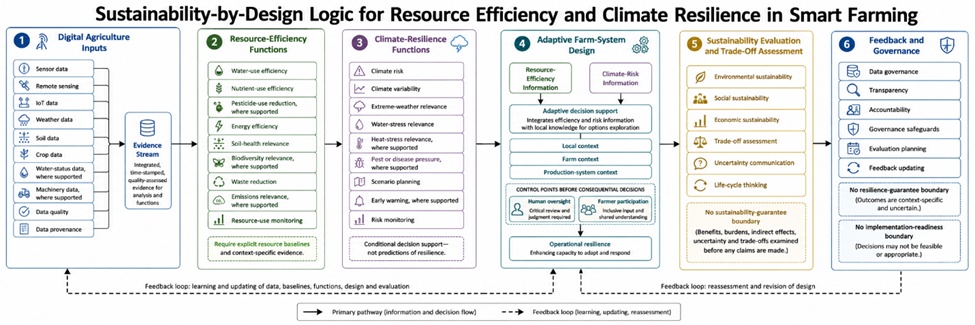
Figure 1. Sustainability-by-Design Logic for Resource Efficiency and Climate Resilience in Smart Farming
Alt-text description: A conceptual workflow showing digital agriculture data flowing into resource-efficiency assessment, climate-risk monitoring, adaptive farm-system design, scenario planning, decision support, human oversight, sustainability evaluation, and feedback loops.
Social value in smart farming concerns the ways a technology may affect farmer autonomy, livelihoods, work, knowledge, relationships, capabilities, and access to agricultural opportunities. It cannot be inferred from technical availability or productivity-oriented functionality alone. Digital inclusion requires attention to connectivity, device access, digital literacy, language, disability, technical support, data infrastructure, and the capacity to interpret and act on system outputs. These conditions are unevenly distributed within and between agricultural regions, with smallholders and less-resourced users often facing greater barriers to participation in data-driven farming. Inclusive technology design must therefore identify not only intended users but also people who may be excluded, indirectly affected, or unable to benefit under existing infrastructural and institutional conditions [17].
Farmer participation should begin during problem definition and continue through requirement setting, testing, evaluation, and controlled updating. Participation is meaningful only when farmers can influence consequential decisions rather than merely comment on systems whose central objectives and operating assumptions have already been fixed. Farmer autonomy also requires comprehensible choices, the ability to question or override recommendations, access to relevant data, and protection against dependency on a provider or platform. Broader political-economic analysis is necessary because digital agricultural systems can reshape labor, expertise, ownership, market relationships, data control, and bargaining power. Social-value assessment must consequently examine how benefits, burdens, authority, and risks are distributed rather than assuming that adoption represents empowerment [18].
Accessibility, usability, affordability, and local relevance are related but distinct requirements. A system may be technically accessible yet difficult to understand, poorly aligned with agricultural workflows, unaffordable to maintain, or dependent on unreliable connectivity. Local relevance requires compatibility with the production system, climate, language, institutions, advisory environment, and forms of farmer knowledge operating in a particular setting. Smallholder relevance should be assessed where appropriate through farm scale, mixed livelihood strategies, labor conditions, market access, risk-bearing capacity, and service availability. Gender and equity relevance should similarly be examined where supported through disaggregated participation, access, workloads, decision authority, safety, and benefit distribution. A people–production–planet perspective helps maintain social and environmental objectives alongside technical and productive ambitions [19].
Trust should be treated as an outcome of credible performance, transparent limitations, fair data practices, accountable actors, and effective avenues for correction rather than as a communication problem to be solved through promotion. Transparency should explain system purpose, data sources, ownership arrangements, significant assumptions, responsible actors, and material limitations. Explainability is particularly relevant when recommendations have consequential resource, financial, livelihood, or environmental implications, although an explanation cannot transform an uncertain model output into established fact. Data governance should clarify collection, access, reuse, transfer, retention, deletion, portability, and responsibility, while accountability should identify who must respond when errors or harms occur. Evidence from digital agricultural services shows that availability, access, or initial use does not by itself establish sustained adoption, livelihood improvement, environmental benefit, resilience, or social value [20]. Table 2 maps climate resilience, adaptive farm systems, social value, and inclusive technology design requirements for sustainable smart farming.
Table 2. Climate Resilience, Adaptive Farm Systems, Social Value, and Inclusive Technology Design Requirements for Sustainable Smart Farming: Climate Risk, Extreme Weather, Scenario Planning, Early Warning, Farmer Participation, Digital Inclusion, Accessibility, Affordability, Local Relevance, Trust, Data Governance, Accountability, and Claim Boundaries
Sustainability or inclusion component | Core design question | Required evidence or practice | Sustainability-by-design function | Potential output | Failure or exclusion risk | Evaluation or governance need | Framework role |
Climate risk | Which hazards, exposures, vulnerabilities, and response capacities are material to the defined farm system? | Local observations, credible projections, production sensitivities, assets, infrastructure, and livelihood context | Establishes a bounded climate-risk baseline | Context-specific risk profile | Generic indicators may omit locally decisive vulnerabilities | Participatory risk definition, credible data sources, and periodic review | Resilience baseline |
Climate variability | Does the design address seasonal and interannual variability rather than average conditions alone? | Longitudinal weather, soil, water, production, pest, and management information | Supports analysis of changing ranges and patterns | Variability scenarios and confidence ranges | Short records may underrepresent variability or changing conditions | Temporal validation, uncertainty analysis, and nonstationarity review | Climate-variability pathway |
Extreme weather relevance | Can relevant extreme events be recognized with sufficient lead time for feasible responses? | Locally appropriate event definitions, thresholds, exposure, response capacity, and historical impacts | Supports detection, warning, and response coordination | Event-specific alerts and response options | False alarms, missed events, inappropriate thresholds, or warning fatigue | Local calibration, redundant communication, and post-event review | Hazard-response pathway |
Water stress relevance | Can water-related vulnerability be assessed within local water availability and production constraints? | Soil moisture, rainfall, evapotranspiration, water access, crop sensitivity, and irrigation capacity | Supports water-risk monitoring and scenario analysis | Conditional water-risk information | Sensor or forecast error may encourage inappropriate responses | Ground validation, source-sustainability assessment, and human review | Water-resilience pathway |
Heat stress relevance where supported | Are heat thresholds appropriate to the crop, livestock, microclimate, and decision context? | Temperature, humidity, duration, local thresholds, production-system sensitivity, and recovery information | Supports heat-risk detection and timing analysis | Heat-risk periods and alerts | General thresholds may not transfer to local systems | Local calibration, expert interpretation, and uncertainty disclosure | Conditional heat-risk pathway |
Pest or disease pressure where supported | Does climate-linked risk information distinguish predicted pressure from confirmed biological presence? | Surveillance, host status, weather, biological knowledge, historical outbreaks, and diagnostic evidence | Supports risk prioritization and targeted surveillance | Risk probabilities or surveillance priorities | Predictive risk may be mistaken for confirmed infestation or infection | Diagnostic confirmation, expert oversight, and false-positive review | Biological-risk pathway |
Scenario planning | How might alternative decisions perform under plausible climate conditions? | Multiple scenarios, system constraints, assumptions, sensitivities, and stakeholder objectives | Tests options across plausible futures | Comparative scenarios and robustness insights | Scenarios may be presented as forecasts or omit disruptive conditions | Assumption disclosure, sensitivity analysis, and stakeholder review | Anticipatory planning layer |
Early warning where supported | Is warning performance adequate for the intended decision and available response time? | Forecast skill, thresholds, communication channels, user capacity, and feasible response options | Converts climate information into time-bounded warnings | Warning with rationale and uncertainty | Inequitable access, false confidence, missed events, or warning fatigue | Validation, accessible communication, user testing, and escalation rules | Conditional anticipatory function |
Adaptive farm system | Can information, people, resources, and practices respond to changing conditions? | Farm-system map, decision authority, constraints, response options, and feedback records | Connects monitoring with revisable action and learning | Adaptive decision architecture | Automation, lock-in, or rigid assumptions may create maladaptation | Human oversight, modularity, fallback procedures, and periodic review | Core adaptive architecture |
Operational resilience | Can essential functions continue during device, network, energy, or provider disruption? | Dependency map, power, connectivity, maintenance, skills, backups, and manual alternatives | Builds redundancy and fault response into digital design | Continuity and fallback plan | Digital dependency may create new points of system failure | Offline capability, maintenance responsibility, redundancy, and incident review | Technology-resilience safeguard |
Learning feedback | Are outcomes, errors, events, and user experiences used to revise the system? | Decision records, observed outcomes, model errors, farmer feedback, and changed conditions | Enables controlled adaptation and learning | Updated parameters, requirements, or safeguards | Uncontrolled updating may cause drift or reduce local relevance | Version control, validation gates, and stakeholder review | Learning and revision layer |
Farmer participation | Can affected farmers shape objectives, requirements, testing, and revision? | Early, representative, accessible, and documented engagement | Integrates farmer priorities and experiential knowledge | Co-defined requirements and feedback records | Participation may become symbolic or unrepresentative | Representation review, response obligations, and decision transparency | Co-design foundation |
Farmer autonomy | Does the system preserve meaningful choice, contestability, and control? | Override mechanisms, clear options, data rights, portability, and non-digital alternatives | Supports informed and voluntary use | User-controlled decisions and documented overrides | Lock-in, automation bias, surveillance, or dependency | Consent, contestability, portability, and authority definitions | Rights and agency safeguard |
Digital inclusion | Who lacks infrastructure, devices, skills, language access, or support? | Connectivity, literacy, device availability, service access, and disaggregated user analysis | Identifies and reduces barriers to participation | Inclusion requirements and support plan | Benefits may concentrate among already advantaged users | Distributional monitoring and accessibility targets | Equity pathway |
Accessibility | Can people with differing abilities, literacy levels, languages, devices, and connectivity use the system? | Inclusive user testing, language analysis, disability access, offline needs, and device constraints | Adapts interfaces and communication channels | Accessible interaction modes | Formal availability may conceal practical inaccessibility | Accessibility review, multiple channels, and grievance mechanisms | Access safeguard |
Usability | Can intended users understand and operate the system in actual working conditions? | Task analysis, field-based testing, workflow observation, cognitive load, and error records | Aligns system behavior with agricultural practices | Usability findings and revised requirements | Laboratory testing may fail to represent farm conditions | Iterative field testing and error monitoring | Human-centered design pathway |
Affordability | Are acquisition, connectivity, training, maintenance, replacement, and switching costs transparent and proportionate? | Total-cost information, user resources, financing conditions, and lifecycle costs | Incorporates financial constraints into design | Affordability profile and cost boundary | Initial pricing may conceal recurring costs or lock-in | Transparent total cost, contract review, and alternative pathways | Economic-inclusion pathway |
Local relevance | Does the system reflect local agriculture, climate, institutions, language, infrastructure, and knowledge? | Local data, farmer knowledge, ecological context, markets, advisory systems, and institutional conditions | Contextualizes functions and outputs | Locally bounded requirements | Generic models may marginalize local knowledge or generate irrelevant recommendations | Local validation and transferability statements | Context safeguard |
Smallholder relevance where supported | Are farm scale, risk capacity, livelihood diversity, labor, and service constraints represented? | Smallholder participation, farm-size diversity, market access, labor patterns, and risk tolerance | Adjusts requirements for constrained and heterogeneous settings | Smallholder-relevant criteria | Capital-intensive design may exclude less-resourced farmers | Targeted accessibility and distributional evaluation | Equity and livelihood pathway |
Gender or equity relevance where supported | Are differences in access, labor, authority, safety, and benefits assessed across groups? | Disaggregated information, representative participation, workload analysis, and local social context | Identifies differentiated needs and potential harms | Equity-impact questions and safeguards | Aggregate user categories may conceal intersecting inequalities | Disaggregated evaluation and benefit–burden review | Equity pathway |
Rural livelihood relevance | How might the system affect income stability, work, knowledge, markets, and vulnerability? | Livelihood mapping, labor effects, costs, risks, market relations, and longitudinal evidence | Links technology functions with livelihood priorities | Livelihood-impact hypotheses and indicators | Productivity may be mistaken for livelihood improvement | Longitudinal and distributional outcome assessment | Social-value pathway |
Knowledge integration | Can scientific, technical, farmer, and local knowledge be compared and combined transparently? | Participatory elicitation, provenance, disagreement records, attribution, and expert review | Supports plural and contextual decision evidence | Documented knowledge sources and unresolved differences | Local knowledge may be extracted, simplified, or overridden | Consent, attribution, epistemic transparency, and contestability | Knowledge pathway |
Trust | Are claims, data practices, responsibilities, limitations, and remedies worthy of justified reliance? | Performance evidence, governance records, incident history, user experience, and recourse | Supports calibrated rather than unconditional trust | Trust-relevant evidence and identified concerns | Trust may be treated as persuasion rather than earned reliability | Honesty, reliability, accountability, and effective remedy | Relational outcome |
Transparency | Can users understand system purpose, data sources, responsible actors, ownership, and material limitations? | Documentation, data lineage, contracts, model purpose, limitations, and change records | Makes relevant system properties visible | Layered disclosures and audit records | Excessive or superficial disclosure may not support understanding | Comprehension testing and independent auditability | Information safeguard |
Explainability where relevant | Can consequential recommendations be explained at the level needed for review and action? | Model behavior, contributing factors, decision stakes, uncertainty, and user needs | Supports comprehension, challenge, and correction | Decision rationale and uncertainty explanation | Plausible explanations may lack fidelity or encourage false confidence | Fidelity testing, user evaluation, and expert escalation | Decision safeguard |
Data governance | Who may collect, access, combine, reuse, transfer, retain, or delete agricultural data? | Data inventory, consent, purpose, contracts, security, portability, and retention rules | Establishes fair and controlled data practices | Data-governance plan | Secondary use, surveillance, insecurity, or loss of farmer control | Purpose limitation, security, audit, portability, and recourse | Foundational governance layer |
Accountability | Who is answerable for design choices, errors, misleading claims, maintenance, and corrective action? | Responsibility allocation, decision logs, contracts, escalation routes, and remedies | Links system functions and decisions to responsible actors | Accountability and incident-response plan | Responsibility may be diffused across providers and users | Named ownership, traceability, remedy, and independent review | Responsibility safeguard |
No resilience-guarantee boundary | What evidence is necessary before resilience is claimed? | Disturbance exposure, response, continuity, recovery, distributional effects, and longitudinal observations | Separates adaptive capability from demonstrated resilience | Qualified resilience statement | Monitoring or warning capability may be labeled resilience | Event-based validation, longitudinal evaluation, and local reassessment | Resilience-claim boundary |
No social-value guarantee boundary | What evidence shows that intended social benefits were realized and fairly distributed? | User-defined outcomes, burdens, distributional information, non-user effects, and longitudinal evidence | Separates social intentions from demonstrated outcomes | Qualified social-value assessment | Participation or deployment may be treated as proof of benefit | Participatory, longitudinal, and disaggregated evaluation | Social-value boundary |
No adoption-guarantee boundary | Does accessibility or initial use establish sustained, voluntary, and beneficial adoption? | Longitudinal use, discontinuation, costs, support, voluntariness, trust, and outcomes | Separates design quality from adoption outcomes | Adoption hypothesis and evaluation plan | Trial use or stated intention may be reported as established adoption | Non-use analysis and longitudinal monitoring | Implementation boundary |
Context-sensitive design is the first principle because sustainability objectives and risks depend on farm conditions, ecological processes, climate exposure, institutional capacity, livelihood structures, and the people affected by the technology. Data governance is equally foundational because agricultural data can reveal operational, financial, spatial, or behavioral information whose collection and reuse may influence farmer autonomy and trust. Data rights, access arrangements, retention, security, portability, and responsibility should therefore be defined before data-intensive functions are implemented. Transparent governance is especially important where farmers are expected to share information with platforms or service providers but have limited visibility into contracts, downstream uses, or the consequences of aggregation [21].
Resource-efficiency-by-design and climate-resilience-by-design require systems to be developed around specific environmental and adaptation questions rather than broad optimization objectives. Narrowly optimizing yield, application precision, prediction accuracy, or operational speed can externalize effects onto ecosystems, workers, less-resourced farmers, or other parts of the food system. Sustainability evaluation must therefore consider systemic risk, indirect consequences, unequal effects, and interactions across spatial and temporal scales. Agricultural artificial intelligence and decision systems should disclose the boundaries of their data and models, identify potentially affected groups, and communicate uncertainty where outputs could influence consequential decisions. Responsible design requires active assessment of externalities rather than an assumption that technical efficiency represents public or environmental value [22].
Interoperability, human oversight, and controlled feedback are necessary for adaptive digital systems. Interoperability should address not only whether systems can exchange data but also whether exchanged information retains compatible definitions, units, provenance, quality, and contextual meaning. Adaptive architectures may integrate physical farm conditions with digital representations, models, decision services, and feedback loops, yet these components require validation and clearly allocated decision authority. Human oversight must include access to understandable information, competence to evaluate recommendations, ability to intervene, and responsibility for consequential choices. Feedback updating should occur through documented versions, validation gates, change-impact analysis, and post-update monitoring rather than uncontrolled modification of system behavior [23].
The remaining principles—farmer participation, inclusive design, transparency, explainability where relevant, life-cycle thinking, trade-off assessment, uncertainty communication, accountability, and evaluation planning—operate as cross-cutting safeguards. Life-cycle thinking expands environmental assessment beyond the farm-use phase to devices, networks, computing, maintenance, replacement, and end-of-life processes. Trade-off assessment prevents a favorable metric from concealing burdens in another sustainability dimension or among another group. Transparency and uncertainty communication counter the tendency to present agricultural digitalization through predominantly techno-optimistic narratives unsupported by equivalent evidence about social, behavioral, environmental, or long-term consequences. Collectively, these principles define a no-sustainability-guarantee boundary and a no-implementation-readiness boundary: incorporating responsible design features can improve evaluation quality, but it does not certify outcomes or demonstrate readiness for deployment [24].
The proposed framework treats sustainability-by-design as a staged, iterative, and evidence-oriented process rather than a fixed technology classification. It begins before system selection by asking what agricultural, environmental, social, or resilience problem is being addressed and why a digital intervention is being considered. It then connects contextual requirements with technological capability, sustainability criteria, governance safeguards, evaluation plans, and explicit decision boundaries. Integrated smart-agriculture design research supports translating environmental, economic, social, and technological requirements into structured design criteria rather than assuming that digitalization itself creates sustainability. The present framework extends that logic by adding resource baselines, climate-risk reasoning, inclusion, social-value assessment, claim boundaries, and controlled feedback as linked stages [25].
The first stages are problem and farm-context definition, followed by stakeholder and user mapping. Context definition records the production system, ecological conditions, climate exposure, infrastructure, institutions, livelihood conditions, and intended decision scope. Stakeholder mapping identifies farmers, workers, advisors, cooperatives, technology providers, platform operators, data stewards, researchers, extension services, and indirectly affected groups, while examining power, access, responsibilities, and potential benefits or burdens. These stages inform a resource-use baseline and a digital agriculture capability assessment covering available data, connectivity, devices, interoperability, skills, maintenance, cybersecurity, costs, and fallback capacity. Context-specific sustainability assessment is essential because priorities, indicators, affected groups, and trade-offs vary across farming systems and geographical or institutional scales [26].
The next stage is resource-efficiency design, in which digital functions are linked to explicitly defined questions about water, nutrients, pesticides where supported, energy, soil, biodiversity where supported, waste, and emissions where supported. Baselines, absolute and intensity indicators, indirect effects, agronomic constraints, and uncertainty must be specified before performance claims are planned. Life-cycle thinking should include the environmental implications of sensing devices, communications infrastructure, computing, maintenance, replacement, and disposal in addition to farm-level operational effects. Environmental assessment of agricultural digitalization remains methodologically challenging because direct benefits may be accompanied by indirect burdens, rebound effects, uncertain inventories, or incomplete system boundaries. Resource-efficiency claims should therefore remain provisional until evaluated with transparent and contextually appropriate methods [27].
Climate-risk assessment and adaptive system design follow the resource stage. Climate-risk assessment identifies hazards, exposure, vulnerability, adaptive capacity, uncertainty, and locally feasible responses. Adaptive system design connects monitoring, scenarios, early warning where supported, decision-support functions, human authority, operational fallback, and learning feedback. The framework then adds social-value assessment and inclusive technology design, requiring explicit consideration of autonomy, accessibility, usability, affordability, digital inclusion, local relevance, livelihoods, knowledge integration, trust, and differentiated impacts. Sustainability principles are selected according to materiality and context, after which governance safeguards define data control, transparency, explainability where relevant, interoperability, human oversight, accountability, security, contestability, and remedies. Decision-support research demonstrates the importance of integrating data acquisition, models, knowledge, recommendations, validation, and user interaction while recognizing persistent challenges in data quality, system integration, interpretation, and implementation [28].
The final stages are trade-off assessment, evaluation planning, implementation readiness review, and feedback updating. Trade-off assessment compares environmental, economic, social, and resilience implications across alternatives, groups, scales, and time horizons without permitting an aggregate score to conceal severe or non-compensable harm. Evaluation planning specifies indicators, baselines, comparison methods, data sources, responsible evaluators, uncertainty, claim thresholds, and review periods. Implementation readiness is assessed separately from conceptual coherence and requires evidence concerning technical function, human capacity, governance controls, maintenance, affordability, environmental risk, and fallback arrangements. Feedback updating incorporates observed outcomes, failures, incidents, farmer feedback, changing conditions, and governance findings through controlled revisions. The framework retains no-sustainability-guarantee, no-resilience-guarantee, and no-social-value-guarantee boundaries because completion of its stages structures responsible design and evaluation but does not demonstrate favorable outcomes. Table 3 presents the proposed sustainability-by-design framework for smart farming technologies. Figure 2 presents the proposed sustainability-by-design framework for smart farming technologies, integrating digital agriculture, resource efficiency, climate resilience, social value, inclusive design, governance safeguards, evaluation planning, and feedback updating.
Table 3. Proposed Sustainability-by-Design Framework for Smart Farming Technologies: Farm Context, Stakeholder Mapping, Resource Baseline, Digital Capability, Resource-Efficiency Design, Climate-Risk Assessment, Adaptive System Design, Social-Value Assessment, Inclusive Design, Trade-Off Assessment, Governance Safeguards, Evaluation Planning, Feedback, and Claim Boundaries
Framework stage | Core purpose | Required input | Sustainability-by-design function | Potential output | Validation need | Failure risk | Feedback mechanism | Decision boundary |
Problem and farm-context definition | Define the bounded sustainability problem and the conditions in which it arises | Production-system description, environmental conditions, climate exposure, infrastructure, institutions, livelihoods, and objectives | Prevents technology-first problem framing | Context statement and problem boundary | Stakeholder confirmation and evidence review | A convenient technological function may replace the actual sustainability problem | Reopen the definition when conditions or evidence change | No technology selection before the problem and context are defined |
Stakeholder and user mapping | Identify users, non-users, affected groups, providers, and decision makers | Actor roles, power, access, responsibilities, dependencies, and potential benefits or harms | Makes participation and distribution explicit | Stakeholder map and engagement plan | Representation and omission review | Marginalized groups may be excluded from design and evaluation | Update when ownership, roles, or affected groups change | No inclusive-design claim without representative mapping |
Resource-use baseline assessment | Establish current absolute and intensity-based resource conditions | Water, nutrients, pesticides, energy, materials, waste, emissions, output, and environmental context | Creates a comparator for resource claims | Baseline dataset with system boundaries and uncertainty | Data-quality and temporal-representativeness assessment | Selective or weak baselines may manufacture apparent improvement | Correct and update baselines as evidence improves | No resource-efficiency claim without a defensible baseline |
Digital agriculture capability assessment | Determine which data, infrastructure, skills, devices, models, and services are realistically available | Connectivity, data quality, interoperability, maintenance, cybersecurity, costs, support, and fallback capacity | Aligns system ambition with actual capability | Capability and dependency profile | Field verification and failure testing | Capability may be overstated or dependent on unstable services | Reassess after infrastructure, provider, or skill changes | No assumed function without verified capability |
Resource-efficiency design | Link digital functions with explicit resource and environmental questions | Resource baselines, indicators, agronomic constraints, ecological pathways, and user objectives | Designs evidence collection and decision support around measurable outcomes | Resource-function map and evaluation questions | Comparative outcome and indirect-effect assessment | Precision may be mistaken for efficiency | Review absolute use, intensity, and unintended effects | No efficiency conclusion from capability or simulation alone |
Climate-risk assessment | Identify hazards, exposure, vulnerability, adaptive capacity, and uncertainty | Local observations, credible projections, farmer experience, assets, and response constraints | Defines the climate-resilience problem | Climate-risk profile and uncertainty register | Local expert and stakeholder review | Generic climate information may obscure local vulnerability | Review after events or changing projections | No resilience design without contextual risk assessment |
Adaptive system design | Connect monitoring, scenarios, decisions, human authority, and operational fallback | Risk profile, thresholds, response options, constraints, communications, and contingency capacity | Creates a controlled adaptation and learning loop | Adaptive-system architecture | Model, forecast, workflow, and failure-mode validation | Automation, warning fatigue, lock-in, or new dependencies | Post-event learning and controlled updating | No autonomous adaptation beyond validated conditions |
Social-value assessment | Define intended social benefits, potential burdens, and distribution | User-defined outcomes, livelihoods, labor, costs, market effects, autonomy, and equity conditions | Separates social intentions from evidenced value | Social-value theory and indicator plan | Longitudinal, participatory, and disaggregated evaluation | Productivity or adoption may be used as a proxy for social benefit | Review user feedback, harms, grievances, and outcomes | No social-value claim without benefit and burden evidence |
Inclusive technology design | Translate access, usability, affordability, accessibility, and local relevance into requirements | User diversity, literacy, language, ability, devices, connectivity, costs, and work practices | Embeds inclusion into interfaces, services, and delivery | Inclusive-design specification | Field testing with diverse users and potentially excluded groups | Design may serve only well-resourced early adopters | Iterative testing and non-use analysis | No inclusion claim based solely on availability or consultation |
Sustainability principle selection | Select principles material to the defined system and affected groups | Context, stakeholder priorities, evidence quality, risks, and institutional constraints | Makes normative and analytical choices explicit | Principle set with rationale | Materiality and stakeholder review | Selective principles may be used to favor a preferred technology | Revisit when new impacts or trade-offs emerge | No principle treated as universal without contextual justification |
Trade-off assessment | Compare benefits, burdens, uncertainty, and distribution across alternatives | Multidimensional indicators, scenarios, stakeholder values, thresholds, and time horizons | Makes conflicts and displaced burdens visible | Trade-off map and unresolved decision points | Aggregation may conceal severe or unequal harm | Sensitivity, distributional, and stakeholder review | Reassess after evidence or priorities change | No automatic approval through a composite score |
Governance safeguard selection | Match identified risks with operational controls and responsible actors | Risk register, actor map, data flows, decision stakes, and institutional capacity | Converts governance principles into enforceable practices | Safeguard and responsibility plan | Control-effectiveness and capacity testing | Safeguards may exist only in documentation or lack accountable owners | Use incidents, complaints, and audits to revise safeguards | No consequential operation without functioning controls |
Evaluation planning | Specify how capabilities, outcomes, trade-offs, and unintended effects will be tested | Indicators, baselines, comparison design, time horizon, data sources, evaluators, and claim thresholds | Aligns design claims with future evidence | Evaluation protocol | Methodological and independent review | Evaluation may measure only favorable or easily observed effects | Scheduled review and documented protocol revision | No validated-outcome language before evaluation is completed |
Implementation readiness review | Determine whether technical, human, environmental, institutional, and governance prerequisites are demonstrated | Validation evidence, skills, affordability, maintenance, safeguards, risks, and fallback arrangements | Separates conceptual completeness from implementation readiness | Readiness profile and unresolved conditions | Contextual pilot evidence and safeguard verification | Framework coherence may be portrayed as deployment readiness | Reassess after testing or capability changes | No deployment-ready claim from conceptual design alone |
Feedback updating | Incorporate observed outcomes, failures, incidents, context changes, and stakeholder feedback | Monitoring data, user reports, decision records, environmental evidence, and audit findings | Enables controlled learning and revision | Updated requirements, models, safeguards, or boundaries | Change-impact assessment and revalidation | Updates may produce drift, opacity, or loss of local relevance | Version control, validation gates, and stakeholder notification | No material update without documented review |
No sustainability-guarantee boundary | Preserve the distinction between sustainability-oriented design and demonstrated sustainability | Multidimensional outcomes, counterfactuals, life-cycle effects, distributional evidence, and uncertainty | Limits the scope of framework claims | Qualified sustainability statement | Independent and longitudinal evaluation | Completion of framework stages may be treated as certification | Periodic reassessment against observed outcomes | The framework does not independently establish sustainability |
No resilience-guarantee boundary | Preserve the distinction between adaptive capability and demonstrated resilience | Disturbance exposure, response, continuity, recovery, distribution, and repeated observations | Prevents capability-based resilience claims | Qualified resilience statement | Event-based and longitudinal evaluation | Monitoring, scenarios, or warnings may be labeled resilience | Post-disturbance review and threshold revision | The framework does not independently establish climate resilience |
No social-value guarantee boundary | Preserve the distinction between participation, adoption, and realized social value | User-defined outcomes, autonomy, benefit and burden distribution, non-user effects, and longitudinal evidence | Prevents process or uptake proxies from replacing outcome evidence | Qualified social-value statement | Participatory and disaggregated outcome evaluation | Participation or use may be portrayed as farmer approval or benefit | Grievance review, non-use analysis, and longitudinal feedback | The framework does not independently establish social value |
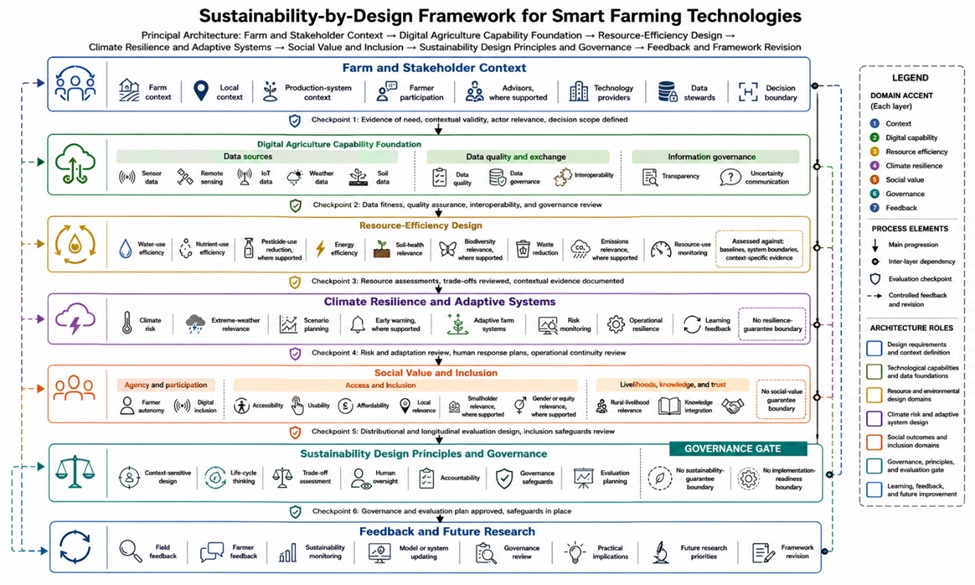
Figure 2. Sustainability-by-Design Framework for Smart Farming Technologies
Alt-text description: A conceptual framework showing farm context, stakeholder mapping, digital agriculture capabilities, resource-efficiency design, climate resilience, social value, inclusive design, trade-off assessment, governance safeguards, evaluation planning, and feedback loops.
For farmers, advisors, cooperatives, and extension services, the framework provides a way to organize questions that should precede sustainability claims or implementation decisions. These include whether the problem has been defined locally, whether farmers have influenced design objectives, whether resource baselines exist, whether recommendations are understandable and contestable, and whether affordability, maintenance, connectivity, and fallback options have been examined. Resource-use monitoring should distinguish absolute consumption from efficiency ratios, while climate-oriented functions should communicate uncertainty, response constraints, and the difference between a warning capability and demonstrated resilience. These implications are conceptual and do not prescribe particular technologies, agricultural practices, investments, or adaptation measures.
For technology developers, platform providers, data stewards, researchers, and sustainability teams, the framework emphasizes documentation, interoperability, lifecycle boundaries, validation, and accountable updating. Future systems should make data provenance, model purpose, uncertainty, responsibility, and material limitations visible to relevant users. Research should compare environmental outcomes with the energy, material, and infrastructure demands of digital systems rather than assessing only operational effects. Longer-term studies are also needed to examine how technologies affect autonomy, labor, knowledge relationships, service dependency, non-use, and benefit distribution. Environmental assessment should incorporate direct and indirect effects and should make system boundaries and uncertain inventories explicit [27].
For policymakers and other institutional actors, the framework identifies research questions concerning infrastructure inequality, data governance, interoperability, accountability, extension capacity, and the conditions needed for meaningful participation. It should not be interpreted as legal, policy, procurement, financial, engineering, or regulatory advice. Future research should test the framework across diverse production systems while avoiding unsupported transfer of indicators or assumptions between contexts. Priority areas include longitudinal resource evaluation, post-event resilience analysis, accessible and affordable design, smallholder and equity-sensitive assessment, governance effectiveness, system failure, farmer-defined social value, and independent evaluation of sustainability claims. Research should also examine when digital functions should not be adopted, when non-digital alternatives are preferable, and how frameworks can be revised when benefits are not observed or burdens are distributed unfairly.
This article proposes a sustainability-by-design framework for smart farming technologies that connects digital agriculture capabilities with resource-efficiency assessment, climate-risk reasoning, adaptive farm systems, social value, inclusive technology design, governance safeguards, evaluation planning, and controlled feedback. Its central argument is that smart farming sustainability should be investigated through context, evidence, system boundaries, life-cycle effects, trade-offs, participation, inclusion, resilience, and accountability rather than inferred from technology adoption, data availability, automation, or precision alone. The framework distinguishes design intentions and technological capabilities from validated environmental, economic, social, and resilience outcomes. It can help organize research questions, responsibilities, evidence requirements, and decision boundaries, but it does not certify sustainability, demonstrate farmer approval, guarantee social value or resilience, or establish implementation readiness. Sustainability-oriented smart farming therefore requires continual evaluation and revision as ecological conditions, climate risks, technologies, institutions, and stakeholder priorities change.
None
None
None
None
Open Access The author(s) retain copyright. This article is licensed under the Creative Commons Attribution-NonCommercial-ShareAlike 4.0 International License. It may be shared and adapted for non-commercial purposes with appropriate attribution, an indication of changes, and distribution of adaptations under the same license. Third-party material may be subject to separate terms identified in its credit line. View the license at https://creativecommons.org/licenses/by-nc-sa/4.0/.
 Agro Intelligence Research Press