Artificial intelligence is becoming embedded in precision agriculture through data-intensive monitoring, predictive models, digital platforms, advisory systems, robotics, and automated machinery. These arrangements complicate accountability because consequential outputs may result from interactions among data providers, model developers, platform operators, advisors, machinery manufacturers, system integrators, service providers, and farm operators rather than from a single actor or technical component. This article proposes a conceptual accountability framework for examining AI liability issues across agricultural AI systems without treating accountability mapping as a substitute for legal interpretation. The framework begins with agricultural use-case definition and stakeholder-role mapping, then examines data-level duties concerning quality, provenance, access, control, privacy, cybersecurity, and governance. It further maps model-level responsibilities for documentation, validation, robustness, bias assessment, explainability, uncertainty communication, and drift monitoring. Platform and advisory layers are addressed through governance, interface design, monitoring, escalation, human review, professional interpretation, and farmer-autonomy requirements. Machinery, automation, and operational risks are incorporated through control-system responsibilities, sensor-to-actuator traceability, supervisory control, fail-safe design, maintenance, incident reporting, and operational boundaries. The framework also identifies liability gaps created by fragmented evidence, unclear validation ownership, platform ambiguity, ineffective human oversight, and incomplete traceability. Its contribution is a structured method for clarifying responsibility pathways, evidence needs, decision boundaries, and governance gaps across interconnected agricultural AI layers. The framework is conceptual and does not determine legal liability, establish compliance, certify safety, allocate blame, or demonstrate deployment readiness.
Artificial intelligence in precision agriculture should be understood as part of a wider sociotechnical arrangement that connects farm data, analytical models, digital platforms, agricultural knowledge systems, machinery, and institutional governance. Digital agriculture research shows that technologies such as decision-support tools, sensors, robotics, and farm-management platforms reshape relationships among farmers, advisors, researchers, technology providers, and public or private institutions. Responsible agricultural AI therefore requires more than technical performance assessment: it also requires lifecycle governance, context-sensitive institutional capacity, and explicit responsibilities for the actors who develop, provide, configure, interpret, and use AI-enabled systems [1-3]. When these interconnected elements influence agronomic decisions or physical farm operations, accountability cannot be located solely in the algorithm. It must also consider the conditions under which data were produced, the assumptions embedded in models, the design and monitoring of platforms, the interpretation of recommendations, the integration of machinery, and the ability of human actors to intervene.
The social and ethical literature on agricultural AI identifies recurring concerns involving privacy, bias, transparency, explainability, autonomy, changing labour relations, concentrated technological power, and uncertainty over who should answer for harmful or inappropriate outcomes [4]. These concerns do not mean that every agricultural AI failure produces legal liability, nor do they establish which party would be legally responsible in a particular jurisdiction. Liability is a legal determination that may depend on applicable law, contractual relationships, evidence, causation, standards of conduct, and the facts of a specific event. Accountability is broader. It concerns whether actors can explain decisions, document their contribution, justify system design and use, respond to identified failures, and participate in correction or remediation. Ethical responsibility concerns duties that may exist even where formal legal liability is uncertain, while operational accountability concerns the allocation of monitoring, intervention, maintenance, and incident-response functions within a working agricultural system.
A layered approach is needed because agricultural AI outputs frequently pass through several transformations before they influence a farm decision or physical action. Sensor readings may be collected by one provider, stored by another, transformed by a platform, analysed by a model developed elsewhere, displayed through an interface, interpreted by an advisor, and acted upon by a farmer or automated machine. At each transition, information may be lost, assumptions may become invisible, uncertainty may be compressed, and responsibility may become ambiguous. A prediction is not identical to an advisory recommendation, and an advisory recommendation is not identical to machinery execution. Similarly, the presence of a human reviewer does not automatically make oversight meaningful. Effective human control depends on whether the reviewer has sufficient information, competence, time, authority, interface support, and a realistic opportunity to reject, modify, escalate, or stop the system’s output.
The objective of this article is to propose an original conceptual accountability framework for AI liability issues in precision agriculture across data, model, platform, advisory, machinery, and operational layers. The framework is designed to clarify actor roles, validation responsibilities, evidence trails, decision boundaries, monitoring duties, escalation pathways, and accountability gaps. It distinguishes accountability mapping from legal-liability determination and treats documentation, traceability, auditability, explainability, and human oversight as necessary but individually insufficient accountability mechanisms. The framework also introduces explicit boundaries against interpreting completion of an accountability exercise as proof of legal compliance, operational safety, certification, regulatory approval, or deployment readiness. Its intended contribution is therefore analytical and governance-oriented: it offers a structured way to ask who had control, knowledge, duties, evidence, and intervention capacity at each stage of an agricultural AI system.
AI liability in precision agriculture is best approached initially as a problem of distributed accountability rather than as a predetermined legal conclusion. Empirical work on responsible AI in agriculture indicates that responsibility is negotiated through relationships among researchers, technology developers, institutions, collaborators, users, and affected communities, rather than being held by one clearly isolated actor [5]. This distributed pattern is especially relevant when an agricultural AI service combines third-party datasets, proprietary models, platform interfaces, professional advice, and machinery supplied by different organizations. A developer may control model architecture but lack authority over local deployment. A platform provider may determine interface defaults and update practices but not the final farm decision. An advisor may interpret an output without being able to inspect the model. A farmer may act on advice while lacking access to the data transformations or validation evidence behind it. The framework must therefore distinguish contribution, control, knowledge, capacity, and decision authority instead of assuming that proximity to the final action is equivalent to complete responsibility.
Responsible and trustworthy AI provide useful governance concepts, but they should not be presented as labels that automatically resolve accountability. A multi-criteria farming framework demonstrates that responsible AI design may involve transparency, privacy, fairness, robustness, sustainability, stakeholder well-being, and farmer autonomy, with potential trade-offs among these objectives [6]. In accountability terms, this means that a system should not be assessed only through aggregate accuracy or efficiency. A technically accurate model may still lack documented provenance, communicate uncertainty poorly, create dependence on a platform, disadvantage underrepresented farm contexts, or encourage actions outside its validated use. Conversely, a transparent model may still be unreliable, insecure, or operationally inappropriate. Trustworthy AI should therefore be interpreted as an aspiration requiring evidence across technical, organizational, social, and operational dimensions rather than as a certification status or a guarantee that responsibility has been adequately allocated.
Precision-agriculture technologies may also redistribute expertise, benefits, burdens, and decision authority. Research on responsible innovation in precision agriculture shows that decision-support systems are shaped by design assumptions, institutional relationships, and unequal access to technical or agronomic knowledge [7]. These systems may influence whose expertise is treated as authoritative, which farming objectives are optimized, how uncertainty is communicated, and whether farmers can meaningfully challenge recommendations. Shared responsibility can be constructive when complementary duties are explicit—for example, when developers document model limitations, advisors evaluate local relevance, and farm operators retain clear decision authority. However, shared responsibility becomes an accountability problem when each actor assumes that another party completed the necessary validation, monitoring, explanation, or risk assessment. The concept should not become a mechanism for dispersing responsibility until no actor remains answerable for a material decision.
Accountability must also begin before model development or farm-level use. Responsible-innovation analysis of digital farming demonstrates that upstream choices about data selection, infrastructure, commercial priorities, and stakeholder inclusion can create uneven participation and unequal technological effects [8]. A system may exclude certain production settings because relevant data were unavailable, prioritize variables aligned with provider interests, or create dependencies through proprietary infrastructure. These choices can later appear as neutral technical conditions even though they reflect organizational decisions. The accountability framework therefore treats data architecture, technology procurement, system integration, and use-case definition as responsibility-bearing stages. At the same time, it establishes four boundaries: accountability mapping does not determine legal liability; documentation does not establish compliance; responsible-AI principles do not guarantee operational safety; and a completed conceptual framework does not demonstrate deployment readiness. These boundaries are necessary because accountability analysis may reveal responsibility pathways and evidence gaps, but legal, technical, and institutional conclusions require separate assessment.
Data-level accountability begins with identifying who collected, supplied, maintained, transformed, accessed, or transferred agricultural data and under what conditions. Farmers’ reluctance to participate in smart-farming data arrangements has been linked to uncertainty about data access, control, subsequent use, and the legal or organizational rules governing sharing [9]. A data provider may generate raw information, but a data steward may determine retention, correction, access, or deletion, while an intermediary may aggregate or transform the data before model development. These roles should not be collapsed into a generic category of “data owner.” Accountability requires records of collection purpose, source identity, measurement conditions, timestamps, units, permissions where applicable, and known limitations. Data quality responsibilities should address completeness, accuracy, timeliness, representativeness, calibration, and missingness. Provenance should connect raw observations to transformations and derived datasets so that reviewers can reconstruct how material model inputs were produced.
Transparency about agricultural data use is also essential because accountability depends on whether affected actors can understand what is being collected, why it is needed, who receives it, and who may benefit from its use. Smart-farming research has shown that trust is weakened when farmers are not told how their data are used or how benefits are distributed among participating actors [10]. Data documentation should therefore record variables, sampling conditions, transformations, exclusions, sharing arrangements, and material limitations. Access controls should specify which actors can retrieve or modify data, while control records should identify who may combine, commercialize, transfer, correct, or delete them. Privacy review should extend across collection, transmission, storage, processing, and sharing rather than being treated as a one-time consent exercise. Cybersecurity responsibilities should likewise be allocated across devices, networks, platforms, credentials, storage services, and connected operational systems because a security failure may affect both information governance and physical farm operations.
Agricultural data accountability cannot be resolved through ownership language alone. Analysis of agricultural data governance shows that a narrow ownership debate may obscure the more practical questions of access, control, portability, reuse, stewardship, and the duties of actors holding or processing farm data [11]. The proposed framework therefore treats ownership as a concern to be documented, not as a sufficient allocation mechanism. A party may claim ownership while another party exercises practical control over storage, transfer, modification, or commercial use. Similarly, farmer consent or contractual acceptance does not necessarily establish that data practices are understandable, proportionate, secure, or accountable. A data-governance arrangement should identify decision rights, oversight functions, review procedures, retention expectations, complaint pathways, and mechanisms for correcting inaccurate records. It should also document the boundaries between farmer authority, platform control, intermediary functions, and institutional requirements without claiming that the framework itself establishes legal rights or compliance.
Model-level accountability concerns who developed, selected, adapted, validated, deployed, monitored, and communicated the AI model. Explainable-AI scholarship in agricultural analysis demonstrates that black-box predictions can limit scrutiny of how outputs were produced and why particular variables influenced a result [12]. Model developers should document objectives, features, training assumptions, evaluation methods, known limitations, prohibited uses, and dependencies. Model deployers should separately justify why a model is suitable for the intended agricultural context and configuration. Validation should distinguish internal testing from external validation, local validation, and staged field-validation planning. It should address error patterns, robustness, calibration, uncertainty, bias, fairness, and performance across relevant farm types, crops, locations, seasons, or production practices. Post-deployment responsibility should include data-drift and model-drift monitoring, version control, revalidation triggers, rollback procedures, and communication of changed limitations. Explainability and transparency can support review, but neither proves correctness. The framework therefore includes a no-model-responsibility-sufficiency boundary: model documentation, explanation, or validation alone cannot determine responsibility for the complete agricultural AI system. Table 1 summarises data-level and model-level accountability requirements for AI systems in precision agriculture.
Table 1. Data-Level and Model-Level Accountability Requirements in Precision Agriculture AI Systems: Data Providers, Data Stewards, Data Quality, Provenance, Ownership Concerns, Access, Control, Documentation, Governance, Privacy, Cybersecurity, Model Developers, Validation, Drift Monitoring, Bias, Fairness, and Responsibility Boundaries
Accountability component | Core responsibility question | Responsible actor or role | Required evidence or practice | Accountability function | Potential output | Accountability gap | Framework role |
Data provider | Who generated or supplied the data, and under what conditions? | Farmer, farm operator, sensor provider, cooperative, public-data provider | Source identity, collection context, timestamps, permissions, known limitations | Establish data origin and answerability | Data-source record | Unverified or anonymous source | Required evidence input |
Data steward | Who maintains quality, access, correction, retention, and authorized use? | Farm organization, cooperative, research institution, platform operator | Stewardship policy, access register, correction process, retention schedule | Maintain controlled data management | Stewardship log | Stewardship duties are assumed but not allocated | Core governance role |
Data intermediary | Who transfers, aggregates, brokers, or transforms data between actors? | Platform provider, cooperative, service provider, processor | Transfer records, transformation history, recipient list, role description | Preserve accountability across data movement | Data-flow record | Responsibility disappears during aggregation | Cross-layer linkage |
Data collection | Was data collection tied to a defined and proportionate use? | Data provider, technology provider, farm operator | Collection protocol, purpose statement, sensor configuration | Connect collection to system purpose | Collection specification | Data collected without a defined purpose | Entry-stage control |
Data quality | Who evaluates completeness, accuracy, timeliness, and representativeness? | Data steward, developer, domain specialist | Quality thresholds, calibration records, missing-data analysis, anomaly review | Prevent unreliable inputs from entering models | Data-quality report | No actor accepts responsibility for defects | Validation prerequisite |
Data provenance | Can the source and transformation history of each material dataset be reconstructed? | Data steward, intermediary, developer | Provenance chain, version identifiers, transformation logs | Support traceability and causal investigation | Provenance record | Broken chain between raw and model-ready data | Evidence-trail requirement |
Data documentation | Are variables, units, sampling methods, exclusions, and limitations described? | Data steward, developer | Data dictionary, metadata, change log, limitation statement | Make data interpretable and reviewable | Dataset documentation | Data exist without contextual meaning | Transparency mechanism |
Data access | Who may access particular data and for which purpose? | Data steward, platform provider, authorized controller | Role-based permissions, access logs, scheduled review | Restrict and retrospectively examine access | Access-control matrix | Excessive or undocumented permissions | Privacy and governance control |
Data control | Who may modify, combine, transfer, commercialize, or delete the data? | Farmer where applicable, steward, platform provider, intermediary | Control-rights map, transfer restrictions, change approvals | Clarify practical decision authority | Control-allocation record | Formal ownership differs from practical control | Responsibility clarification |
Data ownership concern | Does an ownership claim obscure access, portability, stewardship, or use duties? | Governance body, platform provider, farmer organization | Rights-and-duties analysis, portability review, practical-control assessment | Prevent ownership language from replacing governance | Ownership-boundary statement | Ownership treated as sufficient accountability | No-ownership-sufficiency boundary |
Data governance | Are roles, decision rights, oversight, and challenge procedures defined? | Farm organization, cooperative, platform provider, governance institution | Governance charter, responsibility map, review body, complaint procedure | Coordinate data accountability | Data-governance plan | Fragmented or conflicting responsibilities | Core data-layer stage |
Privacy | Are personal, location, production, and commercially sensitive data protected? | Data steward, platform provider, technology provider | Data minimization, purpose review, de-identification assessment, privacy-risk record | Reduce unauthorized use and exposure | Privacy assessment | Privacy considered only at initial collection | Lifecycle safeguard |
Cybersecurity | Who protects devices, networks, credentials, storage, interfaces, and communications? | Technology provider, platform provider, system integrator, farm operator | Threat assessment, authentication, patching, backups, incident procedure | Protect confidentiality, integrity, and availability | Cybersecurity responsibility map | Duties are divided without coordination | Data-to-operation safeguard |
Model developer | Who selected objectives, features, architecture, and evaluation methods? | Model developer, research team | Development record, design rationale, feature documentation, test results | Establish answerability for model construction | Model-development dossier | Responsibility hidden behind the label “AI” | Core model-layer role |
Model deployer | Who selected and configured the model for the agricultural use case? | Platform provider, technology provider, system integrator, farm organization | Deployment rationale, configuration record, intended-use statement | Connect a general model to a specific use | Deployment record | Developer and deployer duties are conflated | Deployment-stage role |
Model documentation | Are intended uses, prohibited uses, inputs, outputs, limitations, and dependencies recorded? | Developer and deployer | Model record, version history, limitation statement, dependency list | Support scrutiny and appropriate use | Model documentation | Records are incomplete, outdated, or inaccessible | Evidence-trail mechanism |
Model validation | Who evaluates error, calibration, robustness, uncertainty, and failure patterns? | Developer, independent evaluator where feasible, domain specialist | Prespecified metrics, test sets, error analysis, robustness assessment | Determine whether evidence supports intended use | Validation report | Performance claims lack contextual analysis | Required assessment |
External validation | Was performance assessed outside the development-controlled data environment? | Independent evaluator, research partner, deployer | External dataset, evaluation protocol, context comparison | Test transportability beyond development conditions | External-validation record | Internal performance is treated as universal | Generalization boundary |
Local validation | Does the model perform appropriately in the relevant farm, crop, soil, climate, and management context? | Deployer, agronomist, farm operator, local evaluator | Local data, contextual review, uncertainty assessment | Evaluate local suitability | Local-validation statement | Generic model used without local evidence | Local-use boundary |
Field-validation planning | What staged evidence and oversight are required before outputs influence operations? | Deployer, farm organization, system integrator, domain specialist | Pilot protocol, stop criteria, oversight plan, harm-monitoring process | Structure cautious progression toward operational use | Field-validation plan | Retrospective evidence is treated as field proof | No-deployment-readiness boundary |
Model-drift monitoring | Who identifies deterioration or changed model behaviour over time? | Model deployer, platform provider | Performance dashboard, thresholds, review schedule, rollback process | Detect post-deployment degradation | Drift alert and review record | No actor owns continuing performance | Ongoing monitoring stage |
Data-drift monitoring | Who monitors changes in sensors, environments, practices, seasons, or input distributions? | Data steward, deployer, system integrator | Distribution checks, sensor-change logs, context indicators | Detect invalidated assumptions | Data-drift alert | Changed conditions remain invisible | Feedback trigger |
Bias and fairness assessment | Which groups, farm types, crops, or regions may receive systematically poorer performance? | Developer, deployer, domain and social reviewers | Subgroup analysis, representation review, impact assessment | Identify unequal errors and burdens | Bias and fairness report | Aggregate metrics conceal uneven impacts | Equity safeguard |
Robustness | How does the model behave under noise, missing data, unusual conditions, or component variation? | Developer, deployer, evaluator | Stress tests, sensitivity analysis, failure thresholds | Assess stability beyond average conditions | Robustness record | Normal-condition testing is treated as sufficient | Reliability boundary |
Explainability and transparency | Can relevant users understand the basis, limits, and status of an output? | Developer, deployer, platform provider | Audience-specific explanation, fidelity review, uncertainty statement | Support challenge and interpretation | Explanation record | Explanation is persuasive but unfaithful | Review mechanism |
Uncertainty communication | Are confidence, limitations, and out-of-distribution conditions conveyed clearly? | Developer, platform provider, advisor | Calibrated uncertainty, plain-language notice, escalation threshold | Prevent false certainty | Uncertainty statement | Precise presentation conceals weak evidence | Decision-support safeguard |
No model-responsibility sufficiency boundary | Can model evidence alone determine responsibility or legal liability? | All framework users | Explicit limitation and cross-layer review | Prevent model-centric responsibility claims | Boundary statement | Model quality is treated as complete accountability | Mandatory decision boundary |
Platform responsibility concerns the organizations that host, configure, update, monitor, and mediate access to agricultural AI services. Research on cloud-based farm advisory services shows that digital systems reshape how farmers and advisors obtain information, interpret evidence, and coordinate decisions [13]. A platform may combine data ingestion, model execution, interface design, alerting, storage, and communication functions even when separate providers supply individual components. Accountability therefore requires distinguishing the platform provider from the technology provider, system integrator, and service provider. The platform provider may control governance rules and updates; the technology provider may supply a model or sensor; the integrator may connect otherwise separate components; and the service provider may maintain or configure the system. Each role should have documented responsibilities, limitations, monitoring duties, escalation contacts, and evidence-retention practices. The existence of contracts or service terms does not by itself demonstrate that these responsibilities are understandable, technically adequate, or responsibly implemented.
Agricultural advisory responsibility should be mapped through the wider knowledge and advice network rather than assigned only to the individual who communicates a recommendation. Digitalization increasingly connects farmers, advisors, agronomists, agribusinesses, platform providers, researchers, consumers, and governance institutions through shared information infrastructures [14]. Within this network, the manuscript distinguishes model output from advisory output. A model output may be a probability, classification, estimate, or detected pattern. An advisory output is an interpreted recommendation communicated for consideration in a farm context. Agricultural advisors and agronomists may add domain knowledge, compare the output with local observations, identify implausible assumptions, and communicate limitations. However, advisor review should be required according to the consequence and uncertainty of the decision rather than treated as a universal liability-transfer mechanism. A professional review does not automatically make an unvalidated model appropriate, and the absence of specialist review does not mean that upstream developers or platform providers have no continuing responsibilities.
Interface design, platform monitoring, alerting, and escalation are accountability-bearing functions because platforms shape how users perceive and act upon AI outputs. Digital farming platforms may create path dependence or constrain available choices through defaults, categories, recommended workflows, and infrastructural lock-in [15]. An accountable interface should distinguish observations, predictions, recommendations, warnings, and machine commands. It should communicate uncertainty and limitations without presenting probabilistic outputs as certain instructions. Alert systems should use understandable severity levels and identify the action expected from the recipient. Monitoring should address reliability, abnormal outputs, complaints, security events, repeated overrides, and signs of model or data drift. Escalation pathways should identify who must be contacted when an output exceeds a confidence threshold, conflicts with field observations, raises safety concerns, or cannot be interpreted responsibly. These mechanisms support accountability only when actors have authority and resources to respond; passive logging without assigned response duties is insufficient.
Platform governance must also examine data policies, surveillance capacity, dependencies, and the practical distribution of control. Critical analysis of agricultural platforms shows that contractual terms and data policies can support extensive monitoring and extraction while farmers retain limited visibility into downstream data uses or platform practices [16]. Accountability therefore requires review of update authority, data flows, access rules, monitoring practices, interface defaults, commercial dependencies, and exit or portability conditions. Human-in-the-loop review must be meaningful: advisors or farm operators need adequate information, competence, time, and authority to question, modify, reject, or escalate an output. Farmer autonomy likewise requires more than formal consent; it includes the practical ability to understand recommendations, contest assumptions, seek alternative advice, override defaults, and avoid unreasonable dependence. The framework retains two explicit boundaries. First, farmer acceptance, advisor review, or operator action does not independently determine advisory liability. Second, platform terms, disclaimers, documentation, and audit logs do not by themselves establish that platform responsibility has been adequately fulfilled.
Agricultural robotics and automated machinery extend AI accountability from informational outputs into physical execution. Agricultural robots may redistribute control and responsibility among designers, model developers, robotics providers, machinery manufacturers, system integrators, farm operators, supervisors, and institutions, while systems-oriented design research shows that responsible operation depends on interactions across human, cyber, and physical components. Autonomous agri-food technologies also create unresolved questions concerning supervision, intervention, and responsibility when machines perform tasks with limited direct control [17-19]. Accountability analysis should therefore distinguish the manufacturer responsible for mechanical and control-system characteristics, the robotics provider supplying perception or planning functions, the integrator connecting software and machinery, and the farm operator responsible for defined inspections or supervisory actions. These responsibilities may overlap, but they should not remain implicit. The designation of a machine as autonomous does not identify which actor is legally liable for a harmful outcome, nor does it establish that the operating conditions, oversight arrangements, or safeguards were adequate.
Machinery-layer responsibility must be interpreted in relation to the particular use case and the relationships among actors, technologies, environments, and affected parties. Case-based analysis of agri-food robots indicates that ethical and responsibility questions differ across applications because systems involve distinct tasks, users, physical environments, levels of autonomy, and opportunities for human control [20]. A robotic weeding function, harvesting system, livestock-management device, or processing robot may rely on different sensing, decision, and actuation pathways. The accountability framework therefore requires a documented sensor-to-actuator chain showing how observations are collected, processed, converted into model outputs, translated into control commands, and executed by machinery. Material system states, software versions, configuration changes, intervention events, and actuator responses should be traceable. This evidence can support investigation and organizational learning, but it cannot independently establish legal causation or responsibility.
Operational accountability also requires safeguards that address more than predictive model accuracy. Safety research on automated agricultural machinery emphasizes perception, risk assessment, risk mitigation, human factors, and ergonomics as interdependent dimensions [21]. A model may classify an object correctly while a communication delay, integration fault, control-system error, or actuator defect produces unsafe behavior. Conversely, an operator may receive an alert but lack sufficient time, visibility, competence, or authority to intervene. Fail-safe design should specify how the system responds to sensor failure, uncertain inference, communication loss, power interruption, software malfunction, or conflicting commands. Where appropriate to the system, emergency stopping, safe-state transitions, bounded actuation, geofencing, fault diagnostics, and controlled restart procedures should be defined and assessed. Human supervisory control should be meaningful rather than symbolic, with realistic intervention assumptions and clear mode indications.
Maintenance, cybersecurity, operational monitoring, and incident reporting complete the machinery accountability pathway. Manufacturers, providers, service organizations, and farm operators may hold different duties for calibration, inspection, software updates, component replacement, credential protection, network security, and record preservation. Monitoring should identify abnormal behavior, repeated overrides, sensor degradation, unexpected path planning, control instability, or operation outside defined conditions. Incident and near-miss procedures should preserve relevant data, system states, versions, maintenance records, and human actions so that failures can be examined across the complete system. Nevertheless, logging does not allocate blame, and incident reporting does not constitute legal adjudication. The proposed framework therefore includes a no-operational-safety-guarantee boundary and a no-autonomous-action-responsibility-resolution boundary: accountability mapping may clarify who controlled or documented particular functions, but it does not certify machinery safety or independently determine responsibility for autonomous action.
Liability and accountability gaps emerge when responsibility is lost at the boundaries connecting data, models, platforms, advisory processes, machinery, and farm operations. Smart-farming ethics research identifies unresolved questions concerning privacy, data control, transparency, autonomy, power, and the distribution of responsibility among technology providers and agricultural users [22]. A data provenance gap may prevent reviewers from identifying whether an error originated in collection or transformation. A validation responsibility gap may arise when developers assume that deployers will conduct local assessment while deployers rely on general development results. A platform responsibility gap may occur when interface design, updates, or monitoring practices materially influence use but are treated as neutral service functions. Advisory interpretation and machinery execution create further transitions at which outputs may change status from prediction to recommendation and from recommendation to physical action. Figure 1 illustrates how liability and accountability gaps can emerge across data, model, platform, advisory, machinery, and operational layers in precision agriculture AI systems.
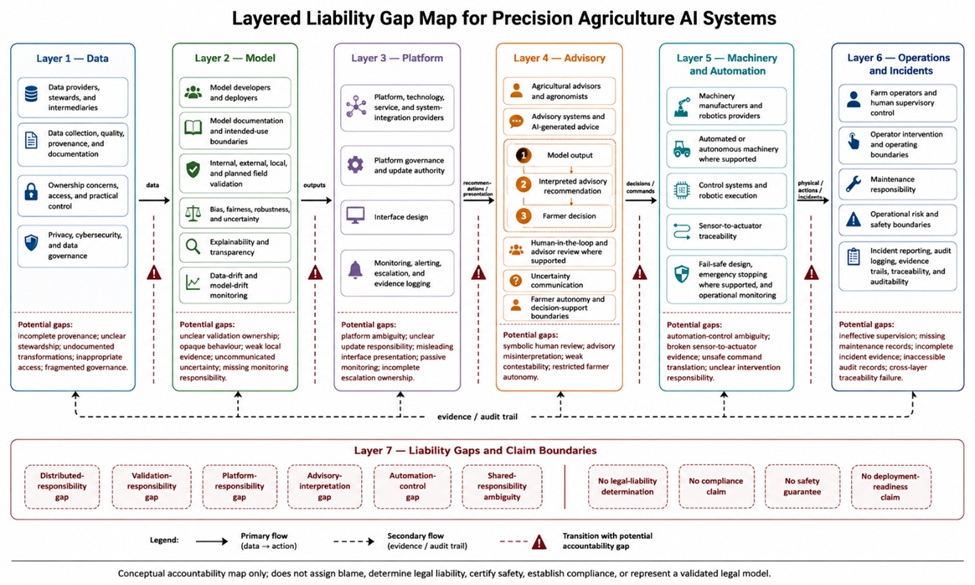
Figure 1. Layered Liability Gap Map for Precision Agriculture AI Systems
Alt-text description:
A conceptual layered map showing agricultural AI accountability gaps across data providers, model developers, platform providers, advisory actors, machinery systems, farm operators, human oversight, incident reporting, traceability, and auditability.
Distributed responsibility gaps are intensified by unequal control over data, infrastructure, technical expertise, and market access. Critical research on digital agricultural technologies shows that concentrated technological and informational power can shape who defines system objectives, controls data flows, benefits from automation, and bears the burdens of failure or dependency [23]. Actors with the greatest formal or practical control may be distant from farm-level outcomes, while farmers and operators may be highly exposed to consequences without having access to model logic, platform governance records, or system-level evidence. Shared responsibility is therefore not necessarily balanced responsibility. The framework asks which actor possessed relevant knowledge, who could change a design or operating condition, who had authority to interrupt use, who was expected to monitor performance, and who retained evidence after an incident. These questions support accountability analysis without presuming that organizational influence is equivalent to legal fault.
Additional gaps arise when human oversight, interface design, and farmer autonomy are treated as secondary concerns. Responsible-innovation scholarship emphasizes anticipation, inclusion, reflexivity, and responsiveness as means of identifying affected interests and revising technology arrangements before harms become entrenched [24]. A human oversight gap exists where a named reviewer lacks the competence, time, information, or authority required to challenge an output. An interface ambiguity gap occurs when users cannot tell whether a displayed result is an observation, probability, advisory recommendation, warning, or control command. Farmer-autonomy gaps may arise through platform lock-in, restrictive defaults, inaccessible explanations, weak contestability, or dependence on a provider for data portability and service continuity. These are accountability problems because they affect practical control and the distribution of decision authority, even where a farmer has formally accepted the service.
Privacy, cybersecurity, drift, incident evidence, traceability, and auditability create lifecycle accountability gaps that may remain hidden until a system fails. Privacy review of smart farming shows that risks can arise during collection, communication, storage, processing, and sharing, requiring responsibility across the complete data lifecycle [25]. Data drift may result from changes in climate, sensors, practices, crop conditions, or farm management, while model drift may follow updating, feedback effects, or changing relationships between inputs and outcomes. An incident evidence gap arises when versions, logs, human decisions, and machinery states are not preserved. An auditability gap arises when records exist but authorized reviewers cannot meaningfully access or interpret them. A traceability gap exists when evidence cannot be linked across layers. Table 2 maps platform, advisory, machinery, automation, operational-risk, and liability-gap concerns across agricultural AI systems.
Table 2. Platform, Advisory, Machinery, Automation, Operational-Risk, and Liability-Gap Concerns Across Agricultural AI Systems: Platform Governance, Advisory Responsibility, Human Oversight, Machinery Automation, Robotic Execution, Operational Monitoring, Incident Evidence, Traceability, Auditability, Shared Responsibility, and Legal-Claim Boundaries
Layer, component, or gap | Core accountability question | Responsible actor or role | Required evidence or condition | Potential output or consequence | Failure or responsibility gap | Safeguard or monitoring need | Boundary statement |
Platform provider | Who controls platform rules, updates, access, and data flows? | Platform provider | Governance record, update history, data-flow map, service limitations | Platform responsibility profile | Platform treated as neutral infrastructure | Governance and change monitoring | Platform operation alone does not determine legal liability |
Technology provider | Who supplies the model, sensor, interface, or connectivity component? | Technology provider | Component documentation, intended use, known limitations | Provider-role record | Component duties are unclear after integration | Configuration and dependency review | Product documentation is not safety certification |
System integrator | Who connects data, models, platforms, interfaces, and machinery? | System integrator | Architecture record, integration tests, dependency map | Integration assurance record | Failures fall between component providers | End-to-end testing and change control | Integration evidence does not guarantee safe operation |
Service provider | Who configures, hosts, maintains, or supports the service? | Service provider | Service scope, maintenance log, support and escalation contacts | Service-responsibility statement | Responsibility ends ambiguously after installation | Service monitoring and escalation | Service terms do not eliminate accountability |
Platform governance | Who approves consequential changes and access rules? | Platform provider and governance body | Decision-rights charter, approval record, review process | Governance decision log | No accountable authority for changes | Periodic governance review | Governance approval is not regulatory approval |
Platform monitoring | Who detects abnormal outputs, misuse, complaints, or reliability problems? | Platform operator, deployer, service provider | Monitoring indicators, thresholds, complaint log, response procedure | Monitoring report | Monitoring exists without response ownership | Assigned escalation and correction duties | Monitoring does not prove responsible deployment |
Interface design | Does the interface distinguish prediction, advice, warning, and command? | Platform provider, interface team, integrator | Interface specification, terminology controls, usability assessment | Interface-assurance record | Users misinterpret output status | User-centered testing and clear mode labels | Interface clarity does not validate the model |
Advisory system | Is the system descriptive, predictive, prescriptive, or controlling? | Platform provider, deployer, advisory organization | Function classification, intended-use statement | Advisory classification | Advisory tools function as implicit control systems | Decision-role review | Classification does not establish appropriate use |
AI-generated advice | Are assumptions, uncertainty, and limitations communicated? | Model deployer, platform provider, advisor | Explanation, uncertainty statement, source and version records | Advice evidence package | Advice appears certain or context-free | Risk-tiered review and escalation | Advice does not guarantee an agronomic outcome |
Agricultural advisor or agronomist | Who evaluates contextual and agronomic plausibility? | Advisor or agronomist | Review notes, contextual assumptions, conflict checks | Reviewed recommendation | Professional review becomes symbolic | Competency and review-quality monitoring | Review does not transfer all responsibility |
Human oversight | Does the human have information, time, competence, and authority to intervene? | Advisor, operator, supervisor | Training, workload assessment, override authority, interface support | Human-review record | Human presence without meaningful control | Review of overrides and intervention capacity | Human presence alone does not resolve liability |
Farmer autonomy | Can the farmer understand, reject, contest, or exit the arrangement? | Platform provider, advisor, farm organization | Choice architecture, portability, override and review options | Autonomy assessment | Defaults or dependency restrict practical choice | Contestability and dependency review | Farmer acceptance does not waive upstream accountability |
Machinery manufacturer | Which physical, control, and safety functions remain under manufacturer responsibility? | Machinery manufacturer | Design limits, hazard analysis, maintenance requirements | Machinery responsibility record | Mechanical and software duties are blurred | Safety design and maintenance monitoring | Documentation does not certify safe operation |
Robotics provider | Who supplies perception, planning, navigation, or autonomous-task functions? | Robotics provider | Algorithm, sensor, operating-domain, and test records | Robotics responsibility record | Autonomous functions are insufficiently bounded | Performance monitoring and safe-state behavior | Autonomy does not determine liability |
Control system | Who verifies state transitions, limits, and command logic? | Control developer, manufacturer, integrator | Control architecture and verification evidence | Control assurance record | Correct predictions produce unsafe commands | Diagnostics and bounded control | Model accuracy is not control-system validation |
Sensor-to-actuator chain | Can sensing, inference, command, and execution be reconstructed? | Sensor provider, developer, integrator, manufacturer | Time-synchronized logs and version records | End-to-end evidence trail | Causal pathway is broken | Traceability and latency monitoring | Traceability does not establish legal fault |
Human supervisory control | Can the operator understand system state and intervene effectively? | Farm operator or supervisor | Situation-awareness support, communication reliability, override capacity | Supervision record | Intervention is delayed or impossible | Clear modes, alerts, and tested override | Nominal supervision is insufficient |
Fail-safe design | What happens when sensing, communications, software, power, or control fails? | Manufacturer, robotics provider, integrator | Failure-mode analysis, safe-state definition, fault testing | Fail-safe specification | System continues unsafe action | Redundancy, safe stop, bounded degradation | Fail-safe claims require system-specific evidence |
Emergency stop where supported | Can hazardous movement be stopped promptly and predictably? | Manufacturer, integrator, operator | Accessible stop mechanism, testing, controlled reset | Stop-test record | Failure to stop or unsafe restart | Routine inspection and testing | Emergency stopping does not replace prevention |
Maintenance responsibility | Who calibrates, patches, repairs, and records changes? | Manufacturer, service provider, farm operator | Maintenance schedule, calibration log, change-control record | Maintenance status record | Degradation or updates remain undocumented | Preventive maintenance and post-change testing | Maintenance does not demonstrate overall safety |
Operational monitoring | Who monitors abnormal or degraded behavior? | Operator, provider, platform operator | Health indicators, thresholds, response duties | Operational monitoring report | Abnormal behavior is detected but not acted upon | Assigned intervention and escalation | Monitoring alone is insufficient |
Cybersecurity | Could unauthorized access alter data, commands, or machine state? | Provider, integrator, platform operator, farm operator | Threat model, authentication, patching, recovery plan | Cybersecurity responsibility map | Security duties are fragmented | Intrusion detection and recovery testing | Cybersecurity review does not establish compliance |
Incident evidence gap | Are versions, states, decisions, and actions preserved after an incident? | Operator, provider, manufacturer | Incident protocol and evidence-preservation procedure | Investigable incident record | Evidence is missing or overwritten | Protected reporting and retention | Evidence preservation does not allocate blame |
Auditability gap | Can an authorized reviewer assess relevant records and controls? | Provider, deployer, governance body | Audit access, structured logs, review procedures | Audit record | Proprietary or unusable evidence blocks scrutiny | Proportionate audit-access design | Auditability does not establish compliance |
Traceability gap | Can outputs and actions be linked to actors, versions, and decisions? | All responsible organizations | Shared identifiers and linked records | Traceability chain | Records cannot be joined across layers | Periodic traceability tests | Traceability supports but does not determine responsibility |
Data or model drift gap | Who detects changing inputs or deteriorating behavior? | Data steward, model deployer, platform provider | Baselines, drift indicators, thresholds, revalidation rules | Drift alert | Silent performance deterioration | Monitoring, rollback, and reassessment | Lack of detected drift does not prove reliability |
Shared responsibility ambiguity | Are duties complementary, overlapping, conflicting, or absent? | All involved organizations | Responsibility-allocation and conflict map | Shared-responsibility profile | Actors defer action to one another | Joint governance and escalation rules | Shared responsibility must not become responsibility avoidance |
No legal-liability determination boundary | Is accountability mapping being treated as legal adjudication? | All framework users | Explicit limitation statement | Non-determination notice | Unsupported legal conclusions | Separate legal interpretation where applicable | The framework does not determine legal liability |
No compliance claim boundary | Is documentation being represented as compliance? | All framework users | Explicit compliance limitation | Compliance-boundary notice | False assurance | Independent institutional and legal assessment | Framework completion does not establish compliance |
The proposed framework conceptualizes accountability as a relational and institutional process requiring answerability, evidence, assessment, correction, and the capacity to respond to identified problems. General AI accountability scholarship emphasizes that algorithms cannot be meaningfully held to account in isolation from the organizations and actors that develop, deploy, oversee, and use them, while operational ethics research shows that principles require concrete lifecycle practices and assigned procedures [26-28]. Adapted to precision agriculture, this means that accountability should be mapped across the full system rather than concentrated on model output or the final farm decision. The framework is not presented as an empirical finding or legal instrument. It is a proposed analytical structure for identifying who had relevant control, knowledge, authority, documentation duties, validation obligations, monitoring capacity, and opportunities to intervene.
The first stage defines the agricultural AI use case, intended decision, affected environment, consequence level, and prohibited uses. Stakeholder and role mapping then identifies farmers, farm operators, data providers, data stewards, intermediaries, model developers, model deployers, platform providers, technology providers, system integrators, advisors, agronomists, machinery manufacturers, robotics providers, service providers, cooperatives where supported, and relevant governance, insurance, or supply-chain actors where the evidence and context justify their inclusion. These stages should reflect the responsible-AI principles of beneficence, non-maleficence, autonomy, justice, and explicability while recognizing that such principles require contextual interpretation [29]. Role mapping should document formal duties and practical control because contractual labels may not correspond to who can access data, alter a model, change a platform default, stop machinery, preserve evidence, or respond to an incident.
The second stage maps accountability across data and model layers. Data mapping assigns responsibility for collection purpose, quality, provenance, documentation, access, control, privacy, cybersecurity, transfer, and retention. Model mapping assigns responsibility for development choices, model documentation, internal testing, external validation, local validation, field-validation planning, bias and fairness assessment, robustness, explainability, uncertainty communication, deployment configuration, and drift monitoring. Algorithm-accountability research indicates that evaluation should include the values, assumptions, organizational choices, and consequences embedded in system design and use rather than treating the algorithm as an independent moral or organizational actor [30]. The framework consequently asks not only whether a model performed well, but who selected its objective, whose data were represented, which errors were prioritized, where limitations were communicated, and who had authority to suspend or revise deployment.
The third stage maps platform, advisory, machinery, and operational responsibilities. Platform mapping covers governance rules, access arrangements, updates, interface design, alerting, monitoring, logging, service dependencies, and escalation. Advisory mapping distinguishes analytical outputs from interpreted recommendations and identifies when advisor or agronomist review is supported by the consequence and context of the decision. Machinery mapping addresses perception, control, robotic execution, integration, maintenance, fail-safe behavior, emergency intervention where supported, and sensor-to-actuator traceability. Operational-risk mapping identifies abnormal states, operating-domain limits, supervisory duties, stop conditions, cybersecurity dependencies, and incident-response responsibilities. Human oversight is allocated according to actual information, competence, authority, workload, and intervention capacity rather than through a generic human-in-the-loop designation.
The final stage designs the evidence trail and governance feedback cycle. It specifies documentation, versioning, traceability, auditability, validation records, review records, escalation events, incident evidence, data- and model-drift alerts, corrective actions, and framework updates. Privacy and cybersecurity duties are reassessed as systems, providers, and data flows change. Farmer autonomy is reviewed through explanation, contestability, portability, override capacity, and dependency. Remaining validation, responsibility, or evidence gaps are recorded for institutional, technical, or legal examination where applicable. Table 3 presents the proposed accountability framework across data, model, platform, advisory, machinery, and operational layers in precision agriculture AI systems. Figure 2 presents the proposed accountability framework for precision agriculture AI systems, integrating role mapping, evidence trails, validation responsibilities, oversight duties, incident response, traceability, auditability, and decision boundaries across data, model, platform, advisory, machinery, and operational layers.
Table 3. Proposed Accountability Framework for AI Liability in Precision Agriculture: Use-Case Definition, Stakeholder Role Mapping, Data-Layer Accountability, Model-Layer Accountability, Platform Responsibility, Advisory Responsibility, Machinery Responsibility, Operational Risk, Human Oversight, Validation Responsibility, Evidence Trails, Traceability, Auditability, Incident Response, Drift Monitoring, Farmer Autonomy, and Claim Boundaries
Framework stage | Core purpose | Required input | Accountability function | Potential output | Validation or assessment need | Failure risk | Feedback mechanism | Decision boundary |
Agricultural AI use-case definition | Define the problem, decision role, users, context, and consequence level | Use-case statement, intended outputs, operating environment | Prevent vague purposes and function creep | Approved use-case profile | Domain and stakeholder review | System used beyond its stated purpose | Periodic use-case reassessment | No claims beyond defined use |
Stakeholder and role mapping | Identify actors with control, knowledge, duties, or exposure | Actor inventory and system architecture | Establish prospective answerability | Stakeholder–role map | Review with affected actors | Hidden intermediaries or missing actors | Update when services or actors change | Role mapping does not determine liability |
Data-layer accountability mapping | Allocate collection, quality, provenance, access, control, privacy, and security duties | Data-flow and source records | Establish data-level responsibility | Data accountability map | Data-governance assessment | Data defects remain ownerless | Quality, privacy, and security review cycle | Ownership alone is insufficient |
Model-layer accountability mapping | Allocate development, documentation, validation, explanation, and drift duties | Model architecture and lifecycle record | Establish model-level answerability | Model accountability map | Technical and domain assessment | Model evidence is mistaken for system evidence | Revalidation and version review | Model evidence does not prove system safety |
Platform-layer responsibility mapping | Clarify governance, updates, access, monitoring, interface, and service duties | Platform architecture and governance records | Identify platform-provider responsibilities | Platform responsibility map | Organizational and technical review | Platform treated as neutral | Complaint, change, and monitoring feedback | Terms and logs alone are insufficient |
Advisory-layer responsibility mapping | Distinguish model output, professional interpretation, and farm decision | Advisory workflow and output classification | Allocate interpretation and communication duties | Advisory responsibility map | Agronomic and usability review | Advice presented without context | Farmer and advisor feedback | Review does not transfer all responsibility |
Machinery-layer responsibility mapping | Allocate sensing, control, actuation, maintenance, and safety duties | Machinery and robotics architecture | Establish physical-execution accountability | Machinery responsibility map | Engineering and operational assessment | Harm attributed only to the final action | Maintenance and incident feedback | No safety-certification claim |
Operational-risk mapping | Identify hazards, dependencies, abnormal states, and response duties | Hazard scenarios and operating-domain description | Connect risks to responsible controls | Operational-risk register | Scenario and failure-mode review | Combined failures are overlooked | Near-miss and anomaly review | Risk mapping does not guarantee safety |
Human oversight allocation | Specify who reviews, supervises, overrides, escalates, and stops | Risk tiers, workflows, authority structure | Make human control meaningful | Oversight allocation record | Competency, workload, and control assessment | Symbolic human-in-the-loop arrangements | Override and review-performance analysis | Human presence alone is insufficient |
Validation responsibility allocation | Assign internal, external, local, and field-validation duties | Intended-use and consequence profile | Prevent validation gaps | Validation responsibility plan | Independent review where appropriate | Each actor assumes another validated | Revalidation triggers | Validation does not determine liability |
Documentation and evidence-trail design | Define material records, versions, decisions, and retention | System maps and responsibility allocations | Support reconstruction and answerability | Evidence-trail specification | Completeness and accessibility audit | Records are incomplete or unusable | Audit and incident lessons | Documentation alone is insufficient |
Traceability design | Link data, model, platform, advice, control, and action | Identifier and logging schema | Reconstruct system pathways | Traceability architecture | End-to-end technical testing | Records cannot be connected across layers | Periodic traceability test | Traceability does not establish blame |
Auditability design | Enable authorized scrutiny of records, controls, and decisions | Access rules, structured records, review procedures | Support independent or institutional review | Auditability plan | Governance and technical assessment | Evidence exists but cannot be meaningfully reviewed | Audit findings and corrective actions | Auditability does not establish compliance |
Escalation and incident response design | Define detection, stopping, notification, investigation, and remediation | Risk thresholds, contact structure, evidence protocol | Coordinate response to uncertainty or failure | Escalation and incident plan | Simulation or tabletop assessment | Delayed response or evidence loss | Corrective-action tracking | Incident handling does not adjudicate liability |
Drift monitoring responsibility | Assign indicators, thresholds, review frequency, and responses | Baseline data and performance measures | Maintain post-deployment vigilance | Drift-monitoring plan | Statistical and domain review | Silent deterioration | Alerts, rollback, and revalidation | Monitoring does not guarantee reliability |
Cybersecurity and privacy responsibility review | Allocate protection across data and connected operational systems | Data flows, networks, threat and privacy assessments | Protect information and operational integrity | Security and privacy responsibility map | Specialist review and periodic testing | Gaps between farm, device, and platform duties | Vulnerability and incident feedback | Review does not establish compliance |
Farmer autonomy and decision-boundary review | Assess understanding, choice, override, contestability, and dependence | Interfaces, service arrangements, portability conditions | Preserve practical farmer agency | Autonomy and decision-boundary statement | Farmer-centered usability and governance review | Lock-in or nominal consent | Complaint, exit, and override patterns | Acceptance does not waive accountability |
Liability-gap identification | Record unresolved, overlapping, or missing responsibility pathways | All layer maps and evidence records | Surface issues requiring further assessment | Liability-gap register | Multidisciplinary review | Framework creates false certainty | Gap-closure and reassessment cycle | No legal-liability determination |
Governance review and framework updating | Revise roles, controls, evidence, and boundaries as systems change | Monitoring, incidents, complaints, validation, service changes | Maintain accountability relevance | Updated framework record | Periodic stakeholder and independent review | Outdated responsibilities persist | Formal revision cycle | Updating does not establish approval |
No legal-liability determination boundary | Prevent conceptual mapping from becoming adjudication | Explicit limitation statement | Preserve legal-adjacent caution | Non-determination notice | Separate legal interpretation where applicable | Unsupported blame allocation | Review of liability-related language | Framework does not determine legal liability |
No compliance claim boundary | Prevent framework completion from being presented as compliance | Explicit limitation statement | Avoid unsupported compliance claims | Compliance-boundary notice | Separate institutional and jurisdictional assessment | Documentation is equated with compliance | Update when requirements change | No compliance claim |
No safety-guarantee boundary | Prevent mapping from replacing engineering safety assessment | Explicit limitation and assessment requirement | Avoid unsupported safety assurance | Safety-boundary notice | Independent engineering assessment | Framework substitutes for testing | Incident and safety-assessment feedback | No safety guarantee |
No deployment-readiness boundary | Prevent framework completion from being treated as operational readiness | Validation, monitoring, oversight, and institutional requirements | Maintain cautious interpretation | Deployment-readiness limitation | Separate empirical and institutional assessment | Premature use | Pilot and assessment feedback | No deployment-readiness claim |
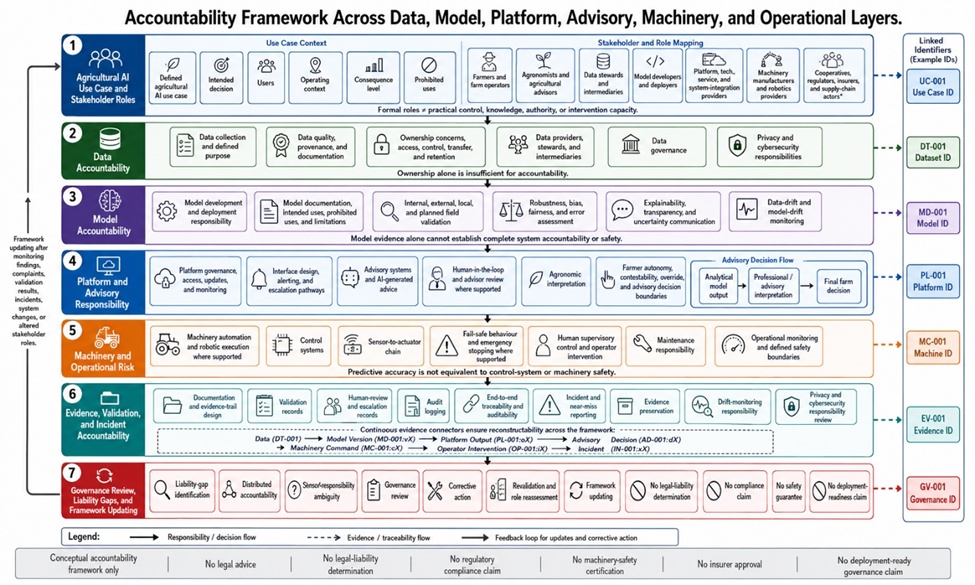
Figure 2. Accountability Framework Across Data, Model, Platform, Advisory, Machinery, and Operational Layers
Alt-text description:
A conceptual accountability framework showing precision agriculture AI use-case definition and stakeholder mapping connected to data, model, platform, advisory, machinery, and operational accountability layers, with validation, oversight, evidence trails, traceability, auditability, incident response, and decision boundaries.
For policymakers and governance institutions, the framework suggests that agricultural AI discussions should address cross-layer responsibilities rather than focus exclusively on model transparency or the conduct of end users. Policy development may benefit from distinguishing duties associated with data stewardship, model validation, platform governance, advisory interpretation, machinery integration, and incident evidence. Responsible-innovation approaches support participation by affected stakeholders and continuing review as agricultural technologies and relationships change [24]. Conceptually, governance processes could encourage clear role descriptions, accessible evidence trails, proportionate auditability, complaint and escalation pathways, and preservation of farmer autonomy. These implications are not regulatory prescriptions and do not identify a universally appropriate legal allocation. Cooperatives, insurers where relevant, and supply-chain stakeholders may participate in documentation or risk discussions when supported by context, but their involvement should not be assumed to transfer responsibility or establish legal obligations.
For managers of farms, advisory organizations, technology providers, platforms, and service operations, the framework emphasizes role clarity before implementation and reassessment throughout system use. Data stewards should know who verifies quality, provenance, access, retention, privacy, and cybersecurity. Model developers and deployers should separately document development evidence, intended use, local suitability, monitoring, and revalidation responsibilities. Platform providers should assign governance, update, alerting, complaint, and incident-response functions rather than relying on general terms or disclaimers. Advisory organizations should define when domain review is expected and ensure that reviewers have adequate information and authority. Machinery manufacturers, robotics providers, integrators, and operators should clarify control modes, operating limits, maintenance, fail-safe functions, monitoring, and evidence preservation. Automated-machinery safety evidence supports attention to perception, risk mitigation, and human factors, but implementation decisions require system-specific engineering and institutional assessment [21].
For researchers, the framework identifies a research agenda concerning the empirical distribution of responsibility across agricultural AI ecosystems. Future studies could examine whether accountability records are understandable and usable, whether local validation responsibilities are fulfilled, how advisors interpret uncertainty, whether farmers can meaningfully challenge platform outputs, how drift is detected, and whether incident evidence can be reconstructed across organizational boundaries. Privacy and cybersecurity should be studied as linked lifecycle responsibilities rather than isolated technical controls [25]. Comparative work could also investigate how farm scale, infrastructure, crop or livestock context, service models, and institutional capacity affect meaningful oversight and farmer autonomy. These are proposed research and managerial implications, not legal, insurance, procurement, compliance, machinery-operation, platform-selection, agronomic, or deployment instructions.
This article proposes a conceptual accountability framework for examining AI liability issues across data, model, platform, advisory, machinery, and operational layers in precision agriculture. Its central contribution is to replace model-centered or single-actor explanations with a structured analysis of distributed accountability, role allocation, validation responsibility, documentation, evidence trails, traceability, auditability, human oversight, operational safeguards, incident response, and governance updating. The framework distinguishes data providers from stewards and intermediaries, developers from deployers, platforms from advisors, and advisory outputs from machinery execution. It also identifies accountability gaps caused by incomplete provenance, opacity, unclear validation ownership, platform ambiguity, weak human control, fragmented incident evidence, and untraceable physical action. These mappings may support governance planning and policy discussion, but they do not independently determine legal liability, assign blame, establish compliance, certify safety, or demonstrate deployment readiness. AI liability in precision agriculture should therefore be examined through the complete chain of actors, technical transformations, decisions, and evidence rather than through model output or final-user conduct alone.
None
None
None
None
Open Access The author(s) retain copyright. This article is licensed under the Creative Commons Attribution-NonCommercial-ShareAlike 4.0 International License. It may be shared and adapted for non-commercial purposes with appropriate attribution, an indication of changes, and distribution of adaptations under the same license. Third-party material may be subject to separate terms identified in its credit line. View the license at https://creativecommons.org/licenses/by-nc-sa/4.0/.
 Agro Intelligence Research Press