Artificial intelligence is increasingly embedded in smart farming through decision-support systems that integrate sensor data, remote sensing, machinery data, farm records, and predictive analytics. Yet agricultural decision-making cannot be reduced to automated recommendations because farm decisions are shaped by agronomic uncertainty, local field conditions, economic constraints, environmental goals, labor availability, machinery limitations, farmer experience, advisory relationships, and risk preferences. This conceptual framework article develops a farmer-centered account of human-in-the-loop intelligence for AI decision support in smart farming. The framework positions AI not as a substitute for farmer judgment but as one component of an iterative socio-technical decision process. It emphasizes farmer judgment, experiential knowledge, contextual validation, explainability, uncertainty communication, human oversight, trust calibration, advisor mediation, feedback, accountability, and adaptive decision-making. The article argues that human-in-the-loop intelligence is more than human approval of algorithmic outputs; it involves interpretation, questioning, correction, practical adaptation, and responsibility for situated decisions. By integrating agricultural AI, precision agriculture decision support, farmer knowledge, responsible innovation, and human-centered design perspectives, the manuscript contributes a structured conceptual basis for designing smart farming systems that preserve farmer agency while improving the practical relevance, transparency, and accountability of AI-supported decisions.
AI decision support has become a central feature of smart farming because agricultural data are now produced across sensors, machinery, remote sensing systems, farm-management platforms, supply-chain infrastructures, and digital advisory services. These data streams can support more timely agronomic interpretation, but they also create complex dependencies among data quality, platform interoperability, analytics, ownership, and decision responsibility. Smart farming should therefore be understood as a data-intensive decision ecosystem rather than as a simple transfer of algorithmic outputs to farmers [1].
The agricultural AI literature increasingly shows that digital agriculture is not only a technical transformation but also a socio-technical reorganization of farming knowledge, advisory work, platform power, labor arrangements, and institutional relationships. Farmers, advisors, researchers, technology providers, cooperatives, and policymakers participate in shaping how digital tools are developed, trusted, interpreted, and used. Treating AI decision support as a purely technical intervention risks overlooking the social and organizational conditions that determine whether recommendations are understandable, usable, accountable, and compatible with farm realities [2].
Decision support in agriculture has long depended on the alignment between technical outputs and the practical conditions of decision-making. A successful agricultural decision-support system must connect with users’ actual decisions, timing, information needs, confidence thresholds, advisory networks, and operational constraints. This means that AI-supported decisions should not be evaluated only by whether a model can generate a prediction, classification, alert, or recommendation; they should also be evaluated by whether the recommendation can be interpreted, questioned, adapted, and responsibly integrated into farm management [3].
This article develops a conceptual framework for human-in-the-loop intelligence in farmer-centered AI decision support for smart farming. The aim is to explain how farmers, advisors, AI models, sensor systems, machinery, digital platforms, contextual knowledge, and feedback loops can interact to support agronomic decision-making while preserving human agency and accountability. The article is grounded in the view that digital agriculture requires transdisciplinary attention to governance, practical implementation, unintended consequences, business models, skills, and socio-ethical responsibilities [4].
Human-in-the-loop intelligence in agriculture refers to an iterative decision process in which AI-generated analysis is interpreted, validated, questioned, adapted, and acted upon by farmers and supporting actors. It differs from fully automated AI decision-making because the farmer remains an active decision-maker rather than a passive endpoint of prediction. It also differs from simple human approval because the human role includes contextual reasoning, practical judgment, oversight, correction, feedback, and responsibility for consequences. Human-centered AI in smart farming therefore positions intelligence as a shared human–AI capability rather than as a property of the algorithm alone [5].
In smart farming, human-in-the-loop intelligence must connect data acquisition, analytical processing, platform delivery, decision interpretation, and farm action. Agriculture 4.0 decision-support systems may include sensor networks, data platforms, predictive models, alert systems, dashboards, and farm-management interfaces, but these components only become decision support when they are connected to specific decisions such as irrigation timing, input application, crop monitoring, machinery scheduling, pest management, and risk response. The human-in-the-loop perspective makes this connection explicit by asking how a recommendation is produced, interpreted, reviewed, and translated into action [6].
Machine-learning applications in agriculture can support tasks such as classification, prediction, monitoring, detection, and optimization, yet model outputs remain partial representations of farm conditions. A prediction about crop stress, disease risk, yield potential, or input requirement may be useful, but it does not automatically resolve the decision because the farmer must consider field access, weather variability, local experience, labor availability, machinery readiness, economic exposure, and acceptable risk. Human-in-the-loop intelligence therefore treats AI outputs as decision resources that require contextual interpretation rather than as complete decisions [7].
A farmer-centered human-in-the-loop system should support interpretation before action, feedback after action, and learning across repeated decision cycles. This means that explainable recommendations, uncertainty information, farmer annotations, advisor input, outcome observations, and data-quality checks should be part of the system design. In this view, AI decision support is not a one-way pipeline from data to prescription; it is a socio-technical loop in which farmers and advisors help determine whether an output is relevant, credible, actionable, and aligned with farm goals [5].
Farmer judgment is a critical knowledge source in smart farming because many agricultural decisions are situated in local histories, field-specific patterns, tacit observations, and practical constraints that may not be fully represented in digital data. Farmers interpret soil behavior, drainage patterns, crop appearance, pest pressure, machinery limitations, and seasonal anomalies through experience accumulated across repeated cycles of observation and action. Research on agricultural decision-support systems shows that farmers’ situated knowledge shapes how digital tools are understood and used in practice [8].
Digital tools do not enter neutral decision spaces; they are interpreted within farm routines, spatial practices, advisory relationships, and existing knowledge systems. Farmers may accept, modify, delay, ignore, or reinterpret digital recommendations depending on how they fit field conditions, operational timing, confidence in the data, and previous experience with similar situations. This process of user interpretation and re-scripting shows why AI decision support should be designed for practical negotiation rather than simple compliance with a model-generated recommendation [9].
Experiential knowledge also matters because digitalization changes how agricultural knowledge is produced, circulated, and valued. AI systems may privilege data that are machine-readable, standardized, and platform-compatible, while farmer knowledge often includes local nuance, historical memory, embodied observation, and informal comparison across seasons. Farmer-centered AI must therefore avoid treating experiential knowledge as inferior to algorithmic knowledge and instead create mechanisms through which farmer observations, corrections, and contextual explanations can influence decision interpretation [10].
The complementarity between farmer knowledge and AI analysis is central to human-in-the-loop intelligence. AI can process large volumes of sensor, machinery, remote-sensing, and record-based data, while farmers can assess whether the resulting recommendation is realistic under current field, labor, weather, financial, and machinery conditions. The decision value of AI therefore depends on how well it supports farmer reasoning, not on whether it displaces farmer reasoning. A farmer-centered system should make space for judgment, disagreement, contextual adjustment, and decision responsibility [8].
AI decision-support systems in smart farming may contribute predictive analytics, crop monitoring, irrigation scheduling support, pest and disease detection, yield forecasting, input-use recommendations, and risk alerts. However, adoption barriers show that the usefulness of machine-learning decision support depends on more than technical capability. Concerns about cost, black-box recommendations, data ownership, privacy, training, workforce capacity, and trust in existing advisors can limit whether farmers accept and use AI-based tools. Human oversight is therefore required to connect AI outputs to farmer confidence, advisory support, and practical decision contexts [11].
Human oversight is also necessary because smart farming raises ethical questions about autonomy, responsibility, data control, surveillance, power asymmetries, and the distribution of benefits and risks. If an AI recommendation contributes to an inappropriate input application, missed disease response, irrigation error, or financial loss, responsibility cannot be assigned only to the model. Farmer-centered AI decision support must clarify who controls data, who interprets recommendations, who can contest outputs, who is accountable for system design, and how decision responsibility is shared without erasing farmer agency [12].
Responsible smart farming requires participation, anticipation, reflexivity, and responsiveness in the design and use of digital systems. Human oversight should therefore be understood as an active governance function rather than a final checkbox after automation has already shaped the decision pathway. Farmers and advisors need opportunities to understand the assumptions behind recommendations, express concerns, report errors, question uncertainty, and influence future tool development. This broader understanding of oversight supports responsible innovation by keeping agricultural AI aligned with affected users and contexts [13].
AI decision support should also be governed as part of diverse agricultural transition pathways rather than as a universal solution that fits all farms equally. Farm size, crop type, advisory infrastructure, digital connectivity, machinery access, data availability, institutional trust, and economic constraints all shape how AI tools can be responsibly used. Human oversight helps manage this diversity by ensuring that recommendations are not treated as context-free prescriptions but as decision inputs that require adaptation to farm goals, environmental conditions, and practical constraints [14].
Table 1 summarises the main human oversight functions required for farmer-centered AI decision support in smart farming.
Table 1. Human Oversight Functions for Farmer-Centered AI Decision Support in Smart Farming: Contextual Validation, Uncertainty Interpretation, Recommendation Review, Risk Assessment, Feedback, Accountability, Adaptation, and Decision Responsibility
Human oversight function | Core meaning | AI system role | Farmer or advisor role | Decision-support relevance | Risk if absent | Required design feature | Example smart farming decision context |
Contextual validation | Checking whether an AI output fits local farm conditions | Generates recommendation based on available data and model assumptions | Compares recommendation with field history, crop condition, machinery access, weather expectation, and operational feasibility | Prevents direct translation of model output into unsuitable action | Recommendation may be applied despite local mismatch | Context notes, field history panels, editable assumptions, and farmer annotation tools | Reviewing an irrigation recommendation during abnormal local weather or restricted water access |
Uncertainty interpretation | Understanding confidence limits and possible error sources | Communicates uncertainty, data gaps, and model limitations | Decides whether uncertainty is acceptable for the decision at hand | Supports cautious use of AI in high-risk decisions | Farmer may over-trust a recommendation that is uncertain or incomplete | Confidence ranges, uncertainty labels, data-quality warnings, and plain-language explanation | Interpreting disease-risk alerts when sensor coverage is incomplete |
Recommendation review | Examining the reasoning and practical implications of a recommendation | Provides explanation, supporting evidence, and alternative options | Reviews whether the recommendation is agronomically sensible and operationally possible | Enables informed acceptance, modification, or rejection | AI output may be followed without understanding its basis | Explanation panels, comparison views, and “why this recommendation?” features | Assessing whether to apply fertilizer at a proposed variable rate |
Risk assessment | Identifying agronomic, economic, environmental, and operational risks | Flags predicted risks and possible consequences | Weighs risks against farm goals, budget, timing, labor, and sustainability priorities | Connects prediction to decision consequences | Tool may optimize one target while creating unacceptable side effects | Multi-criteria risk summaries and scenario comparison | Choosing whether to spray when pest pressure is uncertain and market margins are low |
Farmer feedback | Returning farmer observations, corrections, and decisions to the system | Receives feedback, annotations, action logs, and outcome observations | Reports local observations, overrides, reasons for changes, and observed outcomes | Improves relevance of future recommendations and records decision rationale | System remains disconnected from user experience and observed field outcomes | Feedback buttons, annotation fields, voice/mobile input, and low-burden reporting | Recording that a model flagged crop stress caused by disease when the farmer observed machinery damage |
Advisor mediation | Supporting interpretation through trusted human intermediaries | Shares outputs with advisors or extension services | Helps translate AI outputs into farm-specific options | Strengthens practical sensemaking and reduces isolation of the farmer | Farmers may face complex recommendations without adequate support | Advisor-access permissions, shared dashboards, and consultation notes | Discussing crop-protection recommendations with a precision agriculture consultant |
Accountability | Clarifying responsibility for data, recommendations, decisions, and system limits | Logs data sources, model version, recommendation history, and system warnings | Retains decision authority while identifying provider and advisory responsibilities | Makes decision pathways auditable and contestable | Responsibility may become unclear after harmful or costly outcomes | Audit trails, data provenance, model-version records, and responsibility statements | Reviewing why a platform recommended delayed irrigation before crop stress occurred |
Decision adaptation | Modifying recommendations to fit changing conditions and learning over time | Updates recommendations when new data, feedback, or outcomes become available | Adjusts actions based on observation, experience, and changing constraints | Supports dynamic rather than one-off decision support | Recommendations may remain static despite changing farm conditions | Adaptive alerts, update histories, and farmer-controlled revision options | Adjusting nitrogen application after unexpected rainfall and revised crop condition assessment |
Trust in farmer-centered AI decision support should be understood as calibrated reliance rather than unconditional confidence in algorithmic output. Farmers may evaluate AI recommendations through perceived usefulness, uncertainty, fairness, transparency, privacy, provider responsibility, and compatibility with existing advisory relationships. In this sense, trust is not produced simply by presenting a recommendation; it emerges when farmers can understand why the system produced an output, what data informed it, what limitations remain, and whether the recommendation fits their agronomic and practical context [15].
Feedback is also shaped by the quality and governance of agricultural data-sharing relationships. AI decision-support systems often depend on data generated across farms, platforms, machinery, sensors, advisory services, and external datasets, but farmers may hesitate to provide feedback or share data when data ownership, privacy, access rights, reuse conditions, and provider accountability are unclear. Human-in-the-loop intelligence therefore requires transparent data-sharing arrangements that make feedback meaningful, safe, and practically valuable for farmers and advisors [16].
Decision adaptation occurs when AI recommendations are revised through farmer interpretation, advisor mediation, observed outcomes, new data, and changing farm constraints. A recommendation may be appropriate at the time it is generated but become less suitable after rainfall, pest movement, machinery failure, labor shortage, market change, or field observation. Digital agriculture adoption is shaped by trust, perceived relevance, usability, and institutional conditions, which means that adaptive decision support should respond to farmers’ changing decision contexts rather than assuming stable acceptance of a tool [17].
Figure 1 illustrates the iterative human-in-the-loop decision cycle through which AI recommendations, farmer judgment, contextual feedback, trust calibration, and decision adaptation interact in smart farming.
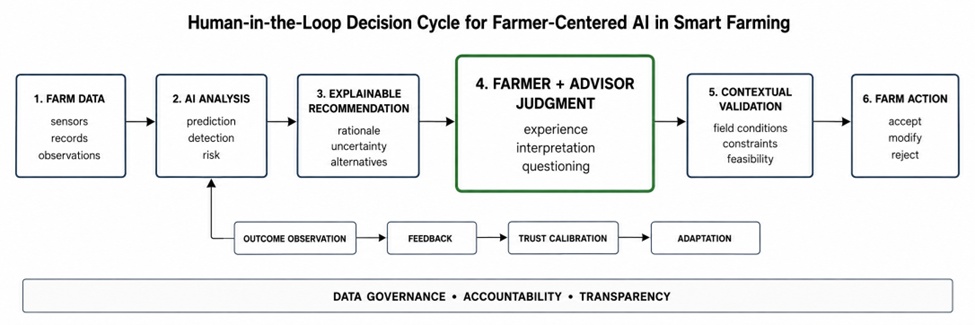
Figure 1. Human-in-the-Loop Decision Cycle for Farmer-Centered AI in Smart Farming. The figure shows an iterative cycle in which agricultural data are processed by AI decision-support systems, interpreted through explainable recommendations, evaluated by farmers and advisors using contextual knowledge, translated into farm decisions, and returned as feedback for monitoring, adaptation, trust calibration, and continuous learning.
Alt-text description: A circular decision-cycle diagram showing agricultural data flowing into an AI decision-support system, producing explainable recommendations that are reviewed by farmers and advisors. Farmer judgment, contextual knowledge, uncertainty interpretation, decision action, outcome observation, feedback, trust calibration, and model adaptation form a continuous loop.
When recommendations are explainable, contestable, and responsive to feedback, farmers can use AI as a decision-support partner while retaining responsibility for situated action [15].
Farmer-centered AI decision support should begin with decision-context analysis rather than with model capability alone. Designers need to understand who will use the system, what decision is being supported, when the recommendation is needed, what information the farmer already has, how the decision is normally made, and what constraints affect implementation. Stakeholder involvement is therefore a design requirement because agricultural decision-support systems are more likely to be useful when farmers, advisors, and other users shape the problem definition, interface, terminology, timing, and decision workflow [18].
Advisory integration is especially important because many farmers interpret complex digital information through relationships with consultants, extension agents, cooperatives, agronomists, machinery specialists, and platform support staff. Smart farming tools should therefore support shared interpretation rather than isolating the farmer in front of a dashboard. Farm advisory services can help translate digital outputs into practical sensemaking by connecting model outputs with local agronomy, farm goals, operational feasibility, and risk tolerance [19].
Farmer-centered AI should also be embedded in agricultural knowledge and advice networks rather than designed as a standalone technical product. Digitalization changes how advice is produced, circulated, commercialized, and trusted, which means that system design must account for advisor roles, peer learning, platform governance, knowledge intermediaries, and institutional relationships. A human-in-the-loop framework should therefore include advisor mediation, collaborative interpretation, and feedback channels that connect individual decisions to wider knowledge systems [20].
Explainability is another core requirement, but it should not be reduced to a visual feature or a generic model explanation. For farmers, explanation must support practical understanding, uncertainty interpretation, questioning, comparison with local knowledge, and accountability for recommendations. Explainable AI design can contribute to trustworthy AI when explanations are meaningful to users, connected to the decision context, and able to support appropriate reliance rather than blind acceptance [21].
The proposed framework begins with data lifecycle governance because AI decision support depends on the acquisition, processing, storage, sharing, interpretation, and reuse of agricultural data. Sensor and machinery data, remote sensing and geospatial data, farm-management records, weather information, soil data, and farmer observations all require quality assessment before they can responsibly inform recommendations. A farmer-centered framework must therefore include data provenance, data-quality warnings, privacy controls, ownership clarity, interoperability, and transparent data-use conditions as foundational elements [22].
The second component is the AI recommendation layer, where machine-learning methods and other analytical tools transform agricultural data into alerts, predictions, classifications, rankings, or decision options. These outputs may support crop monitoring, pest and disease detection, irrigation planning, yield forecasting, input management, and risk identification, but they should be framed as recommendations rather than automatic decisions. Agricultural machine-learning applications can support decision analysis across several agronomic domains, but their relevance depends on contextual validation and careful interpretation [23].
The third component is uncertainty-aware interpretation. Sensor coverage, data gaps, weather variability, changing crop conditions, model assumptions, and domain transfer limits can all affect the reliability of AI outputs. Machine-learning systems in agriculture rely on diverse data sources and modelling approaches, but these systems should communicate uncertainty in ways that help farmers and advisors judge whether a recommendation is sufficiently credible for the decision at hand. The framework therefore requires uncertainty labels, confidence ranges, explanation panels, alternative scenarios, and warnings when data quality is insufficient [24].
The fourth component is practical decision integration. Human-in-the-loop intelligence should connect data acquisition, model analysis, recommendation explanation, farmer review, advisor input, and machinery-supported or management-based action. Crop data management in smart farming shows that decision support must move across the chain from data collection to field application, but the final decision still requires practical alignment with machinery access, labor timing, input availability, regulatory constraints, field conditions, and farm goals [25].
The fifth component is accountable adaptive learning. Explainability, data integrity, security, and accountability mechanisms are needed so farmers and advisors can understand recommendations, contest outputs, and trace decision pathways when outcomes are uncertain or problematic [26]. The framework also closes the loop through farmer engagement, feedback, usability assessment, and learning from observed outcomes, because intelligent decision support becomes farmer-centered only when users can influence how recommendations are interpreted, corrected, and improved over time [27].
Table 2 presents the proposed human-in-the-loop intelligence framework for farmer-centered AI decision support in smart farming.
Table 2. Proposed Human-in-the-Loop Intelligence Framework for Farmer-Centered AI Decision Support in Smart Farming: Farmer Judgment, AI Recommendations, Contextual Knowledge, Explainability, Trust Calibration, Feedback, Human Oversight, Decision Adaptation, Data Governance, and Accountability
Framework component | Core purpose | Human contribution | AI contribution | Required interface or design feature | Trust or accountability function | Decision-adaptation role | Implementation consideration |
Farmer judgment | Preserve human agency in farm decisions | Interprets recommendations through agronomic experience, goals, constraints, and risk preferences | Provides decision-relevant outputs for review | Farmer-controlled decision dashboard with editable assumptions | Clarifies that final decision responsibility remains human and contextual | Allows recommendations to be accepted, modified, delayed, or rejected | Must avoid presenting AI output as a command or default prescription |
Experiential knowledge | Integrate local and historical farm knowledge | Adds field history, seasonal memory, soil understanding, pest observations, and machinery constraints | Uses structured data and prior patterns where available | Annotation tools, field notes, and local-context input fields | Makes farmer knowledge visible in the decision pathway | Supports correction of outputs that miss local conditions | Should support low-burden entry through mobile, voice, or advisor-assisted interfaces |
Contextual knowledge | Connect AI outputs to current farm realities | Assesses weather, labor, access, market conditions, field state, and operational timing | Updates recommendations using available contextual data | Context panels and scenario comparison tools | Reduces risk of context-blind recommendation use | Enables decision revision when conditions change | Must support locally relevant language and decision categories |
AI recommendations | Provide analytical decision options | Reviews relevance, practicality, and alignment with farm objectives | Generates alerts, predictions, rankings, classifications, or options | Explainable recommendation cards with supporting data | Makes algorithmic reasoning reviewable | Provides starting points for adaptive decision-making | Must communicate limits and avoid overstating certainty |
Data quality | Ensure decision outputs are based on credible inputs | Reports missing observations, sensor issues, and field-level anomalies | Detects gaps, inconsistencies, and potential data errors | Data-quality indicators and provenance labels | Supports confidence in the recommendation pathway | Triggers caution, review, or data correction before action | Requires integration across sensors, machinery, remote sensing, and records |
Explainability | Support understanding and questioning | Interprets reasons and checks whether explanations fit local knowledge | Presents drivers, assumptions, evidence, and alternatives | Plain-language explanation panels and “why this?” functions | Supports appropriate reliance and contestability | Helps farmers identify when adaptation is needed | Must be meaningful to farm users rather than only technically accurate |
Uncertainty communication | Make model limitations visible | Judges whether uncertainty is acceptable for the decision | Provides uncertainty ranges, confidence indicators, and warnings | Confidence labels, risk bands, and scenario outputs | Prevents over-reliance on uncertain recommendations | Encourages cautious adaptation under uncertain conditions | Must avoid technical jargon that obscures practical meaning |
Human oversight | Keep review, contestability, and responsibility in the loop | Reviews recommendations, evaluates risk, and decides on action | Provides logs, explanations, and decision-support evidence | Review checkpoints, override functions, and audit trails | Clarifies responsibility and supports accountability | Allows intervention before inappropriate actions occur | Should be built into routine decision workflows, not added as a final formality |
Advisor mediation | Support shared interpretation and trusted advice | Translates outputs into farm-specific options and practical guidance | Shares recommendation evidence with authorized advisors | Shared dashboards, permissions, and advisory notes | Strengthens accountability through human expertise networks | Helps adapt recommendations to farm goals and constraints | Requires privacy controls and clear data-sharing permissions |
Trust calibration | Align reliance with system capability and context | Compares outputs with experience, advisor input, and observed outcomes | Displays evidence, uncertainty, update history, and limitations | Trust-support displays and performance-history explanations | Prevents both over-trust and under-trust | Supports changing reliance as evidence accumulates | Must avoid persuasive design that pushes acceptance without understanding |
Feedback loop | Return decisions and outcomes to the system | Provides observations, corrections, reasons for overrides, and outcome reports | Uses feedback to update recommendations or improve relevance | Simple feedback tools, action logs, and outcome monitoring | Documents user experience and decision rationale | Enables learning across repeated decision cycles | Must be low-burden and useful to farmers, not only to platform providers |
Data governance | Define rights, access, transparency, and responsibility | Sets preferences for sharing, privacy, and acceptable data use | Manages permissions, interoperability, security, and provenance | Consent controls, ownership statements, and data-use logs | Builds accountability around data flows and platform behavior | Enables trusted participation in data-supported learning | Must address privacy, ownership, interoperability, and provider transparency |
Accountability | Make system limits and decision pathways traceable | Retains decision responsibility while identifying provider and advisor roles | Records data sources, model versions, recommendation history, and warnings | Audit trails, model-version records, and responsibility notices | Supports contestability and post-decision review | Helps revise future decisions after unexpected outcomes | Must clarify responsibility without shifting all risk onto the farmer |
Decision adaptation | Convert AI support into situated action | Adjusts, delays, rejects, or implements recommendations | Updates outputs as new data and feedback become available | Revision history, adaptive alerts, and scenario updates | Shows how recommendations changed and why | Enables continuous adjustment to field and farm conditions | Requires timely updates and farmer control over final action |
For AI developers and digital agriculture platform designers, the framework implies that technical performance should be paired with usability, explainability, uncertainty communication, feedback capture, and accountability mechanisms. Design teams should build systems that allow farmers and advisors to inspect recommendations, understand data inputs, report contextual corrections, and adapt outputs to real farm constraints. This direction is consistent with the broader need for decision-support systems that connect technical functions with user needs, social conditions, and responsible digital agriculture governance [2, 3].
For farm advisors, extension services, cooperatives, and precision agriculture consultants, the framework highlights the importance of mediation between AI outputs and situated farm decisions. Advisors can support farmers by interpreting uncertainty, comparing recommendations with field observations, explaining trade-offs, identifying risk, and helping adapt AI-supported options to local agronomic and economic conditions. Advisory integration is therefore not an optional supplement to AI decision support but a core mechanism through which digital tools can become understandable, trustworthy, and practically useful [19, 20].
Future research should empirically examine how farmers engage with human-in-the-loop AI systems across different farm types, crops, advisory settings, and digital maturity levels. Needed studies include participatory design research, farmer trust measurement, explainability evaluation, longitudinal human–AI interaction analysis, cross-farm comparison, advisory integration studies, responsible AI governance assessment, and decision-outcome evaluation. Such work should avoid assuming that AI benefits are automatic and should instead investigate how data quality, farmer understanding, institutional trust, feedback responsiveness, and practical decision integration shape the value of AI-supported smart farming [15, 27].
This article proposed a conceptual framework for human-in-the-loop intelligence in farmer-centered AI decision support for smart farming. The framework argues that agricultural AI should complement rather than replace farmer judgment, because farm decisions require experiential knowledge, contextual validation, uncertainty interpretation, risk assessment, advisor mediation, trust calibration, feedback, accountability, and practical adaptation. Effective smart farming AI depends not only on analytical capability but also on explainable recommendations, usable interfaces, transparent data governance, human oversight, and learning feedback loops that preserve farmer agency. By positioning intelligence as a shared socio-technical process, the framework offers a foundation for designing AI decision-support systems that are accountable, context-sensitive, and aligned with the realities of agricultural decision-making.
None
None
None
None
Open Access The author(s) retain copyright. This article is licensed under the Creative Commons Attribution-NonCommercial-ShareAlike 4.0 International License. It may be shared and adapted for non-commercial purposes with appropriate attribution, an indication of changes, and distribution of adaptations under the same license. Third-party material may be subject to separate terms identified in its credit line. View the license at https://creativecommons.org/licenses/by-nc-sa/4.0/.
 Agro Intelligence Research Press