Artificial intelligence is increasingly embedded in precision agriculture through sensing, remote observation, predictive modelling, automated classification, and decision-support applications. Technical performance alone, however, is insufficient for determining whether these systems are responsibly designed or appropriately used. This article proposes an original governance framework that connects agricultural context definition, farm-data governance, transparency, explainability, accountability, sustainability assessment, farmer participation, human oversight, risk safeguards, implementation-readiness review, monitoring, and adaptive feedback. The framework treats transparency as a requirement for documenting data provenance, data quality, model assumptions, system limitations, and decision pathways, while explainability is positioned as a task-specific means of supporting interpretation rather than proof of model validity. Accountability is structured through explicit allocation of responsibilities among developers, platform providers, data stewards, advisors, farmers, and oversight actors. Environmental, social, and economic sustainability are assessed alongside digital inclusion, usability, local relevance, farmer autonomy, and trust-building conditions. The framework also addresses algorithmic opacity, bias, model drift, poor local calibration, data misuse, cybersecurity, automation dependence, accountability gaps, and implementation overclaiming. Its principal contribution is a layered, adaptive governance model for responsible agricultural decision support. The framework supports governance planning and research design but does not establish empirical validity, legal compliance, policy acceptance, farmer approval, sustainability performance, trust, certification, or deployment readiness.
Precision agriculture increasingly depends on interconnected digital technologies that collect, integrate, and analyze farm, sensor, machinery, weather, soil, crop, remote-sensing, and, where applicable, livestock data. These systems can support observation, prediction, classification, resource allocation, and farm decision-making, but their significance extends beyond their technical functions. Digital agriculture changes relationships among farmers, advisors, technology developers, platform providers, data holders, researchers, and public institutions. It should therefore be understood as a socio-technical and institutional transformation rather than as a collection of isolated tools [1].
Responsible governance becomes necessary because the design and use of agricultural artificial intelligence can influence who defines farming problems, whose knowledge is represented, which forms of uncertainty remain visible, and how benefits and burdens are distributed. A responsible-innovation perspective broadens assessment beyond predictive performance or productivity potential by introducing anticipation of consequences, inclusion of affected actors, reflexive examination of assumptions, and responsiveness to emerging evidence and concerns [2]. These principles do not determine a single acceptable technology pathway, but they provide a basis for examining whether innovation processes recognize social, environmental, and institutional consequences before systems become embedded in agricultural practice.
Governance challenges can remain fragmented when privacy, data quality, user participation, responsibility, sustainability, and implementation risk are addressed separately or only after technical development has advanced. Such fragmentation may exclude affected farmers, workers, advisors, or rural communities from decisions about system purpose, data use, operational boundaries, and acceptable risk. Evidence from smart-farming innovation indicates that a comprehensive governance approach is needed to connect technical development with socio-ethical reflection and stakeholder inclusion [3]. Responsible AI governance must consequently operate across the system lifecycle rather than function as a final-stage ethics checklist.
Agricultural AI also redistributes informational and analytical power. Actors that control data infrastructure, proprietary models, interoperability arrangements, and platform access may acquire substantial influence over what is measured, how farm conditions are interpreted, and which decision options are presented. Governance must therefore examine data control, access, ownership claims, decision rights, farmer agency, sustainability trade-offs, and institutional accountability rather than assuming that increased data availability produces equitable or trustworthy outcomes [4]. This article develops an original responsible AI governance framework for precision agriculture that links transparency, explainability, accountability, sustainability, farmer participation, trust-building conditions, safeguards, implementation boundaries, monitoring, and adaptive revision.
Responsible AI in precision agriculture refers to the structured governance of data-intensive and algorithmic systems according to their intended agricultural purpose, affected stakeholders, data practices, explanatory requirements, responsibility arrangements, sustainability implications, and potential risks. It is distinct from general AI adoption, technical optimization, smart-farming automation, or a simple statement that a system follows ethical principles. Agricultural AI may be technically sophisticated while remaining poorly governed if its data provenance is unclear, its outputs are difficult to question, its responsibility structure is ambiguous, or its social and environmental implications have not been assessed. Ethical analysis of smart farming therefore needs to encompass data use, responsibility, institutional relationships, and wider consequences rather than focusing narrowly on model performance [5].
Trustworthy conditions cannot be reduced to accuracy, disclosure, or interface simplicity. Farmers may evaluate agricultural AI according to whether its outputs are relevant, whether risks and benefits are fairly distributed, whether the system respects practical knowledge, whether errors can be challenged, and whether responsible actors remain available when problems occur. Trust may be supported when systems and institutions demonstrate competence, reliability, transparency, responsiveness, and fair treatment, but these conditions cannot manufacture trust or guarantee continued acceptance [6]. Responsible AI governance should consequently distinguish warranted confidence from passive reliance, promotional trust claims, and dependence created by limited alternatives.
Responsibility for agricultural AI is distributed across multiple actors. Developers make choices about data processing, model architecture, testing, documentation, and updating; platform providers influence access, interoperability, infrastructure, and service continuity; data stewards manage provenance, quality, permission, retention, and reuse; advisors may interpret outputs in agronomic contexts; and farmers retain decision roles that should not be displaced without explicit justification. Research on responsible agricultural AI shows that uncertainty over who is responsible can itself become a barrier to trust and appropriate adoption [7]. Governance should therefore specify responsibilities before use, while avoiding the unsupported conclusion that a responsibility map resolves legal liability or compliance.
Agricultural AI must also remain sensitive to diversity across farm sizes, production systems, geographic regions, infrastructure conditions, advisory networks, and farmer capabilities. A model suitable for one crop, livestock system, climate, or institutional setting may be inappropriate elsewhere, even when its technical architecture is similar. Responsible governance requires local context mapping, farmer participation, uncertainty communication, human oversight, sustainability assessment, and safeguards against premature implementation claims. Responsible agricultural AI therefore requires socio-technical analysis, anticipatory inclusion, and comprehensive treatment of socio-ethical effects [1-3]. These requirements support governance planning but do not establish that a system is validated, accepted, legally sufficient, or ready for operational deployment [8].
Transparency in agricultural AI begins with visibility into what data are collected, why they are collected, where they originate, how they are transformed, who can access them, and how they contribute to outputs. Data provenance should cover source, time, location, collection method, custodianship, preprocessing, integration, and subsequent reuse. Data-quality documentation should identify missingness, sensor errors, calibration limitations, temporal gaps, geographic imbalance, and uncertainty in labels or measurements. These practices are especially important where farmers share operational data with platforms or third parties, because unclear data use and benefit distribution can undermine trust even when the technology appears technically effective [9].
Algorithmic transparency requires documentation of the model’s intended purpose, version, training context, input requirements, assumptions, update history, expected users, known limitations, and prohibited or unsupported uses. Explainability adds a different requirement: it asks how a specific output can be made intelligible to an intended user for a defined decision. Different explanation techniques may reveal feature contributions, local decision logic, model sensitivity, or broader patterns, but explanation quality depends on the model, task, data, and audience. Comparative examination of explainable AI methods in smart-agriculture settings indicates that explanation tools should be evaluated rather than treated as interchangeable indicators of responsible design [10].
User-facing explanation should connect an output to the evidence and reasoning relevant to the agricultural decision without presenting correlation as causation or probability as certainty. For a recommendation, the interface may need to identify influential inputs, data age, geographic relevance, uncertainty, competing options, and conditions under which the recommendation should not be followed. Explainable crop-decision systems demonstrate how feature-level information can make recommendations more inspectable, but an understandable explanation does not independently establish agronomic correctness, contextual suitability, or safe implementation [11]. Human review therefore remains necessary when outputs may influence consequential choices about crops, inputs, livestock, machinery, labour, or environmental management.
Interpretability should be evaluated from the perspective of intended users, including farmers and advisors with different technical backgrounds, languages, farm contexts, and decision practices. Audit trails should make it possible to reconstruct the data, model version, output, explanation, human intervention, override, and subsequent update associated with a decision. Uncertainty communication should identify limitations arising from incomplete data, model confidence, unfamiliar conditions, or changes in the farm environment. Agricultural explainability scholarship supports the use of XAI for inspection and communication while also showing that explanations do not prove accuracy, fairness, robustness, causality, safety, or compliance [12]. Table 1 summarises transparency and explainability requirements for responsible AI governance in precision agriculture.
Table 1. Transparency and Explainability Requirements for Responsible AI Governance in Precision Agriculture: Data Provenance, Data Quality Documentation, Model Documentation, Algorithmic Transparency, Interpretability, Uncertainty Communication, Decision-Support Rationale, Farmer Interpretability, Audit Trails, Human Review, and Explainability Boundaries
Governance requirement | Core transparency question | Required evidence or practice | AI governance function | Potential output | Risk of overinterpretation | Validation or oversight need | Framework role |
Data provenance | Where did each input originate, and how was it collected and transformed? | Source identifiers, timestamps, collection methods, custodians, preprocessing steps, linkage history, and reuse records | Establishes traceable input lineage | Data-provenance register | Provenance may be mistaken for proof that data are accurate or representative | Source verification, transformation audit, and stewardship review | Data-governance foundation |
Data-quality documentation | Are the data sufficiently complete, current, accurate, and contextually appropriate? | Missingness records, calibration history, coverage limits, measurement error, label uncertainty, and quality thresholds | Determines whether evidence is fit for the intended use | Data-quality statement | A summary score may conceal locally important defects | Domain review, sensor checks, and local quality testing | Pre-model safeguard |
Model documentation | What model, version, training context, assumptions, and limitations produced the output? | Model description, version history, intended use, exclusions, update record, and known limitations | Creates inspectable system records | Model-documentation file | Documentation may be treated as evidence of validated performance | Technical, agronomic, and governance review | Transparency baseline |
Algorithmic transparency | What analytical stages and dependencies shape the system output? | Architecture summary, feature definitions, preprocessing logic, decision pathway, and update rules | Makes the analytical process visible to relevant reviewers | System-process map | Full technical disclosure may remain inaccessible or commercially constrained | Layered technical and user-facing review | Cross-cutting transparency requirement |
Explainability | Why did the system produce a particular prediction or recommendation? | Task-appropriate local or global explanation and evidence of explanation fidelity | Supports examination of model reasoning | Explanation report | An explanation may be plausible but incomplete, unstable, or incorrect | Fidelity, stability, and domain-plausibility testing | Output-level safeguard |
Interpretability | Can the intended user understand the output and its practical meaning? | User-centred terminology, task-specific representation, and comprehension testing | Connects technical explanation with meaningful use | Interpretability assessment | Simplicity may be mistaken for validity | Farmer, advisor, and human-factors review | User-facing governance requirement |
Uncertainty communication | How uncertain is the output, and what conditions contribute to that uncertainty? | Confidence information, data limitations, out-of-distribution warnings, scenario bounds, and caveats | Reduces false precision and overconfidence | Uncertainty statement | Numerical confidence may be interpreted as real-world certainty | Calibration testing and agronomic interpretation | Decision-support boundary |
Input-data visibility | Which farm, sensor, weather, soil, crop, machine, remote-sensing, or livestock variables influenced the output? | Input summary, data-age indicators, source warnings, and omitted-variable notices | Enables inspection of influential evidence | Input-evidence panel | Visible variables may still be biased, incomplete, or incorrectly measured | Data-steward and user review | Human-in-the-loop input check |
Output explanation | What does the prediction or recommendation mean for the intended decision? | Plain-language meaning, units, time horizon, intended context, and practical limitations | Reduces ambiguity in system communication | User-facing output note | Clear wording may make weak evidence appear authoritative | Usability and domain-expert testing | Communication safeguard |
Decision-support rationale | How are inputs connected to the proposed decision option? | Feature contribution, agronomic rationale, alternatives, and conditions for non-use | Clarifies that AI informs rather than determines judgment | Decision-rationale summary | A rationale may be mistaken for evidence that the action is appropriate | Agronomic review and local field validation | Human-oversight support |
Farmer interpretability | Does the explanation align with practical knowledge, language, and local farming conditions? | Participatory testing with diverse farmers and farm contexts | Supports local relevance and farmer agency | Farmer-interpretability record | Familiar explanations may still be inaccurate or manipulative | Repeated local participation and feedback | Farmer-participation requirement |
Audit trail | Can data, model versions, outputs, explanations, and human actions be reconstructed? | Controlled logs, version records, access history, overrides, and correction records | Enables retrospective scrutiny and incident investigation | Audit log | Record availability does not itself allocate responsibility | Independent review and access-control testing | Auditability safeguard |
Human review | Which outputs require confirmation, override, escalation, or rejection? | Review thresholds, named reviewers, competence requirements, override rights, and escalation rules | Maintains meaningful human oversight | Human-review protocol | Human involvement may become nominal or affected by automation bias | Review-quality, workload, and override-effectiveness assessment | Human-oversight stage |
No explainability-sufficiency boundary | What cannot be established through explanation alone? | Explicit statement that explanation does not prove accuracy, causality, fairness, robustness, safety, sustainability, or compliance | Prevents governance overclaiming | Explainability-boundary statement | XAI may be presented as complete evidence of trustworthiness | Cross-functional governance review | Mandatory claim boundary |
Accountability requires more than identifying the person who receives an AI output. Agricultural AI systems are assembled through data collection, model development, platform integration, advisory interpretation, farm use, maintenance, updating, and monitoring. Responsibility should therefore be allocated across the lifecycle. Developers should document design assumptions, training limitations, testing procedures, updates, and known failure conditions. Platform providers should be accountable for integration, access management, system changes, interoperability, service continuity, and the visibility of third-party dependencies. Agricultural knowledge and advice networks also influence how digital recommendations are interpreted and used, making advisors and intermediary organizations relevant accountability actors where their involvement is supported [13].
Data stewards should be responsible for maintaining provenance, quality, access controls, purpose limitations, retention rules, correction procedures, and records of reuse. Farmers should receive understandable information about what data are collected, who can access them, how they may be combined, and whether participation or withdrawal changes the availability of services. Farmer reluctance to share data is often connected to uncertainty about control, reuse, benefit distribution, and the practical meaning of data agreements [14]. A governance framework can structure these questions, but it cannot independently determine data ownership, contractual rights, privacy compliance, or lawful processing.
Responsibility allocation must also cover the broader supply and innovation system. Technology suppliers, platform firms, equipment manufacturers, data-service providers, researchers, cooperatives, advisors, and public institutions may each shape the system while controlling only part of it. This fragmentation can generate accountability gaps when one actor attributes an error to another actor’s data, infrastructure, interpretation, or operating decision. Reviews of agricultural digitalisation show that private and public actors occupy different positions in technology development, market formation, infrastructure provision, capability building, and oversight [15]. An accountability map should therefore connect each material system function to a named actor, review process, escalation route, and documented decision boundary.
Auditability and traceability should allow reviewers to link data sources, model versions, outputs, explanations, human interventions, overrides, corrections, and subsequent updates. Monitoring should detect model drift, data-quality deterioration, recurring user difficulties, cybersecurity events, and changes in farm conditions. Feedback channels should allow farmers and advisors to report errors, contest outputs, request correction, and receive information about resulting action. Multi-level analysis of digital agricultural innovation systems demonstrates that accountability and coordination extend across farm, network, organizational, and policy contexts [16]. Transparent data practices, visible advisory relationships, and clear data-control arrangements are mutually reinforcing accountability conditions [9, 13, 14]. Nevertheless, auditability does not resolve legal liability, human oversight does not eliminate automation risk, and completion of a governance process does not establish legal compliance.
Environmental sustainability assessment should examine whether agricultural AI changes water, energy, fertilizer, pesticide, machinery, land, or biodiversity pressures across the system lifecycle. Claimed efficiencies may depend on additional sensors, connectivity, data processing, equipment replacement, or intensified production, and gains in one resource category may shift burdens to another. Rebound effects are also possible when improved efficiency lowers operating constraints and encourages greater overall use. Agricultural digitalisation and AI can contribute to environmental objectives, but their effects depend on governance conditions, production responses, and empirical assessment rather than technological capability alone [17].
Social and economic sustainability require attention to who defines desirable agricultural futures and who receives the benefits of digital transformation. Technology-centred narratives may prioritize productivity, automation, and data integration while underrepresenting alternative values concerning rural livelihoods, labour quality, food-system resilience, local knowledge, and diverse farming models. Governance should therefore make underlying assumptions visible and examine whether farmers, workers, communities, and less-resourced producers can influence system objectives. Analysis of digital-agriculture futures shows that sustainability pathways are shaped by the actors and values represented in strategic visions rather than by technology alone [18].
Digital inclusion is a material governance requirement because access to agricultural AI depends on connectivity, affordability, equipment compatibility, technical support, language, digital skills, and the ability to maintain or replace infrastructure. Unequal access can reinforce differences between large and small farms, connected and remote regions, or capital-intensive and resource-constrained production systems. Automation may also alter labour requirements, knowledge relationships, and rural-community structures. Research on automated agricultural technologies demonstrates that digital transformation can generate labour, access, dependency, and community consequences that must be included within social and economic sustainability assessment [19].
Farmer trust should be treated as a relational and institutional condition rather than as a score, design feature, or predictable result of explanation. Farmers may reasonably withhold trust when systems obscure uncertainty, restrict data control, weaken decision rights, or make challenges difficult. Participation should therefore include meaningful influence over problem definition, system requirements, acceptable trade-offs, testing, feedback, and revision. Farmers should retain the ability to question, override, or decline recommendations without being characterized as resistant to innovation. Critical analysis of precision agriculture shows that trust can be socially constructed around algorithmic authority in ways that may narrow autonomy and normalize dependence [20]. Responsible governance may support trust-building conditions, but it cannot guarantee trust, acceptance, or sustainable outcomes.
A responsible governance process should maintain a structured register of foreseeable and emerging risks. Relevant risks include algorithmic opacity, data-quality failure, poor local calibration, model drift, automation dependence, responsibility gaps, data misuse, cybersecurity incidents, exclusion, and unintended environmental or social consequences. Each risk should be linked to potential causes, affected actors, safeguards, residual uncertainty, monitoring requirements, and a decision boundary for restricting or suspending use. Transdisciplinary research on digital agriculture demonstrates that perceived risks include technical, organizational, social, economic, and systemic vulnerabilities that cannot be addressed through model testing alone [21].
Bias and fairness assessment should extend beyond statistical comparison among predefined groups. Agricultural datasets may underrepresent regions, crops, livestock systems, farm sizes, languages, management practices, or adverse conditions. Structural unfairness can also arise when access, platform control, infrastructure, bargaining power, or advisory support differs substantially among users. Political-economy analysis of digital agricultural technologies shows that ownership, labour relations, corporate concentration, and unequal influence shape the distribution of benefits and burdens [22]. Governance should therefore examine both model-level disparities and the broader institutional conditions through which AI systems are introduced.
Risk perceptions may differ among farmers, developers, advisors, platform providers, researchers, public institutions, and rural communities. One actor may view data sharing as necessary for improved services, while another may view the same arrangement as a loss of control. Similarly, automation may be interpreted as efficiency, labour substitution, reduced workload, or dependence depending on context. Governance should document these differences rather than compress them into a single organizational risk statement. Research with smart-farming governance actors illustrates that perceived benefits, uncertainties, and vulnerabilities vary across institutional roles and experiences [23]. Participatory risk assessment can expose such differences, although it cannot guarantee agreement.
Safeguards should include data-quality checks, provenance records, local validation, role assignment, human-review thresholds, override rights, audit trails, cybersecurity controls, incident-response procedures, bias monitoring, drift detection, sustainability assessment, and accessible feedback pathways. Implementation should be restricted when critical data sources, responsible actors, oversight capacity, or local evidence remain unavailable. Digital capability may inform agricultural policy and governance options, but it does not independently establish policy suitability, legal authority, regulatory compliance, or institutional legitimacy [24]. The framework therefore includes explicit boundaries against liability resolution, legal-compliance claims, sustainability guarantees, trust guarantees, and deployment-readiness claims. Table 2 maps accountability, sustainability, farmer trust, governance risks, and safeguards across agricultural AI systems.
Table 2. Accountability, Sustainability, Farmer Trust, Governance Risks, and Safeguards in Agricultural AI Systems: Responsibility Allocation, Human Oversight, Auditability, Sustainability Assessment, Farmer Participation, Digital Inclusion, Bias, Model Drift, Data Misuse, Cybersecurity, Trust Erosion, and Implementation Boundaries
Governance domain | Core governance question | Required actor, evidence, or safeguard | Responsible AI function | Potential benefit | Failure or residual risk | Validation or monitoring need | Claim boundary |
Responsibility allocation | Who is answerable for data, model, platform, advice, farm use, and follow-up? | Named responsibility map covering developers, providers, stewards, advisors, farmers, and reviewers | Prevents diffusion of responsibility | Clearer escalation and review pathways | Actors may redirect blame across organizational boundaries | Periodic role review and incident simulation | Does not resolve legal liability |
Developer accountability | Who is responsible for model assumptions, testing, documentation, and updating? | Developer assurance process and versioned technical records | Assigns responsibility for technical integrity | More inspectable development practices | Undocumented limitations or uncontrolled updates | Independent technical and agronomic review | Does not certify model safety |
Platform-provider accountability | Who governs integration, infrastructure, access, updates, and continuity? | Platform responsibility statement and dependency map | Covers system-level controls | Better visibility of infrastructure duties | Hidden subcontractors, outages, or vendor dependency | Supply-chain and service-change review | No procurement or contractual recommendation |
Data stewardship | Who maintains provenance, quality, access, purpose, retention, and correction? | Named data steward and lifecycle controls | Protects data integrity and appropriate use | More reliable and traceable data practices | Unauthorized reuse or unresolved control disputes | Data-quality, access, and purpose audits | Does not determine legal ownership |
Farmer decision role | What decision authority remains with the farmer? | Explicit decision rights, override options, and non-coercive defaults | Protects autonomy | Preserved professional judgment | Dependence, constrained alternatives, or automation bias | Farmer-participation and override monitoring | Farmers are not automatically responsible for system defects |
Human oversight | Which outputs require confirmation, rejection, override, or escalation? | Trained reviewer, thresholds, competence requirements, and escalation procedure | Interrupts inappropriate automation | Better contextual review | Human involvement may become nominal | Workload, competence, and override-effectiveness assessment | Human presence does not eliminate risk |
Auditability and traceability | Can data, model versions, outputs, explanations, and interventions be reconstructed? | Controlled logs, lineage records, and version history | Enables investigation and accountability | More effective incident analysis | Missing or inaccessible records | Independent audit and traceability testing | Audit completion does not prove compliance |
Environmental sustainability | What direct, indirect, and rebound effects arise? | Lifecycle, resource-use, biodiversity, and farm-context evidence | Structures environmental evaluation | Better-informed trade-off decisions | Efficiency gains may shift burdens or encourage intensification | Empirical and longitudinal environmental monitoring | No sustainability guarantee |
Social and economic sustainability | Who benefits, who bears costs, and how are labour and dependency affected? | Distributional, labour, affordability, and dependency assessment | Makes social and economic effects visible | More inclusive implementation planning | Exclusion, lock-in, or uneven value distribution | Farm-type and community-level review | No universal benefit claim |
Farmer participation and trust | Were farmers able to shape purpose, requirements, testing, and revision? | Documented participation and accessible feedback mechanisms | Supports contextual relevance and procedural legitimacy | Better alignment with user needs | Tokenistic consultation or manufactured trust | Independent and longitudinal farmer feedback | No trust guarantee |
Digital inclusion | Can diverse farms access, understand, and use the system? | Connectivity, affordability, language, accessibility, and skills assessment | Identifies exclusion risks | Broader potential accessibility | Reinforced digital divides | Access and usability monitoring | No universal-access claim |
Data bias and fairness | Are farms, regions, crops, users, or conditions underrepresented or disadvantaged? | Dataset audit, subgroup analysis, and structural fairness review | Detects representational and distributive inequity | More informed corrective action | Unknown bias or narrow metric-based fairness | Repeated review after updates and context changes | No fairness claim from one test |
Model drift | Has performance changed as environmental or operational conditions evolve? | Drift detection, recalibration thresholds, rollback procedures, and version controls | Detects declining relevance | Earlier identification of deterioration | Drift may occur between reviews | Continuous or risk-based monitoring | Restrict use when thresholds fail |
Poor local calibration | Is the system appropriate for the local crop, livestock, climate, soil, and management context? | Local testing, participatory review, and domain validation | Limits inappropriate transfer | More context-sensitive decision support | Limited local data or unobserved conditions | Prospective local validation | No local-readiness claim without evidence |
Data misuse and privacy risk | Are data used beyond understood purposes or exposed inappropriately? | Purpose limitation, minimization, access controls, retention rules, and review | Limits inappropriate data practices | Greater procedural clarity | Secondary use, linkage, or re-identification | Privacy-impact and access review | Does not establish legal compliance |
Cybersecurity risk | Can devices, platforms, networks, or outputs be disrupted or manipulated? | Security-by-design, updates, credential controls, segmentation, and incident response | Protects system integrity and continuity | Reduced exposure to preventable incidents | Complete cyber protection is impossible | Vulnerability testing and incident monitoring | No zero-risk security claim |
Overreliance on automation | Do users defer to recommendations despite conflict or uncertainty? | Uncertainty warnings, alternatives, review requirements, and override rights | Maintains meaningful human judgment | Lower risk of uncritical reliance | Automation bias may persist | Behavioral and override monitoring | Decision support rather than unsupervised prescription |
Trust erosion | Can secrecy, error, misuse, or weak response damage relationships? | Transparent communication, correction, explanation, and recourse | Supports institutional responsiveness | Better handling of failures | Trust may not recover after serious harm | Longitudinal feedback and incident review | Transparency alone does not create trust |
Implementation overclaiming | Is framework completion presented as proof of readiness, safety, or compliance? | Explicit claim boundaries and independent evaluation requirements | Prevents checklist-based overstatement | More cautious interpretation | Symbolic compliance or premature implementation | External empirical, legal, and contextual assessment | No deployment-readiness claim |
The proposed framework begins with AI use-case definition and stakeholder-context mapping. The intended agricultural problem, decision-support purpose, users, affected parties, consequences of error, available non-AI alternatives, and limits of automation should be documented before model selection or data acquisition. A corresponding system map should identify farm, sensor, remote-sensing, machinery, weather, soil, crop, and, where supported, livestock data, together with their sources, transformations, custodians, access pathways, and intended decision uses. Smart-farming research demonstrates that agricultural data systems involve interconnected value chains and stakeholder relationships rather than a simple transfer from farm to model [25].
The second stage assesses data governance, transparency, and explainability requirements. Data quality, provenance, stewardship, access, control, privacy, cybersecurity, interoperability, retention, and correction should be examined in relation to the defined use case. Transparency requirements should specify what developers, reviewers, advisors, and farmers need to know, while explanation requirements should identify the user, decision, method, and validation standard for each explanation. Human-centred agricultural data management provides a basis for connecting interoperable data architectures with human-machine coordination rather than treating automation as an end in itself [26].
The third stage integrates accountability, sustainability, farmer participation, bias review, and human oversight. Responsibility should be mapped across development, platform integration, data stewardship, advisory interpretation, farm use, monitoring, and error correction. Sustainability assessment should consider environmental, social, and economic consequences together, including resource-use implications, rebound effects, labour, affordability, dependency, and digital inclusion. Farmer participation should inform the use case, local relevance, interface, acceptable uncertainty, oversight design, and feedback pathway. An Agriculture 4.0 agenda oriented toward people, production, and the planet supports integrated assessment rather than isolated technical or environmental evaluation [27].
The fourth stage selects risk safeguards and conducts an implementation-readiness review. Safeguards should respond to identified risks rather than being applied as a generic checklist. A high-stakes or poorly calibrated system may require stronger human review, narrower use conditions, additional local testing, or temporary restriction. Readiness review should examine empirical validation, infrastructure, data quality, interoperability, user capability, advisory support, cybersecurity, sustainability evidence, accountability arrangements, and incident-response capacity. Responsible innovation in precision agriculture supports anticipatory, inclusive, reflexive, and responsive governance, but it does not establish that any particular system is ready for implementation [28].
The final stage establishes monitoring, farmer feedback, incident review, sustainability reassessment, model updating, documentation revision, and framework updating. Governance requirements should be reconsidered when models, datasets, interfaces, providers, farm contexts, or decision consequences change. Sustainability assessment must combine environmental effects, socially contested future pathways, and monitoring of unintended vulnerabilities [17, 18, 21]. The framework therefore functions as an adaptive governance cycle rather than a one-time approval mechanism. It does not establish legal compliance, resolve liability, guarantee farmer trust, certify sustainability, or authorize deployment. Table 3 presents the proposed responsible AI governance framework for precision agriculture. Figure 1 presents the proposed responsible AI governance framework for precision agriculture, linking transparency, explainability, accountability, sustainability, farmer trust, governance safeguards, implementation readiness, monitoring, and feedback.
Table 3. Proposed Responsible AI Governance Framework for Precision Agriculture: Use-Case Definition, Stakeholder Mapping, Data Governance, Transparency, Explainability, Accountability, Sustainability Assessment, Farmer Participation, Bias Review, Human Oversight, Risk Safeguards, Implementation Readiness, Monitoring, Feedback, and Claim Boundaries
Framework stage | Core purpose | Required input | Governance function | Potential output | Validation need | Failure risk | Feedback mechanism | Decision boundary |
AI use-case definition | Define the agricultural problem, decision purpose, users, consequences, and limits of AI involvement | Intended task, decision context, affected actors, alternatives, and error consequences | Prevents technology-first adoption | Use-case statement | Agronomic, technical, and stakeholder review | Vague purpose, mission expansion, or inappropriate automation | Revisit after testing or contextual change | No use beyond the documented scope |
Stakeholder and farmer-context mapping | Identify affected actors, capabilities, interests, knowledge, and power relations | Farm types, farmers, advisors, workers, communities, providers, researchers, and institutions | Supports inclusion and responsibility mapping | Stakeholder-context map | Participation across diverse and affected groups | Missing, marginalized, or tokenized stakeholders | Periodic remapping and stakeholder review | No universal-context assumption |
Data-governance assessment | Examine sources, quality, provenance, access, control, stewardship, privacy, security, and lifecycle | Data inventory and end-to-end flow map | Establishes responsible data practices | Data-governance dossier | Quality, provenance, access, privacy, and security review | Hidden flows, poor quality, or unauthorized use | Steward feedback and incident updates | No legal ownership or compliance determination |
Transparency-requirement definition | Specify what each actor must know about data, models, outputs, and limitations | User roles, decision stakes, system architecture, and information needs | Creates proportionate disclosure expectations | Transparency specification | Completeness and comprehension testing | Disclosure overload, secrecy, or unusable technical detail | User and reviewer feedback | Transparency does not establish accountability |
Explainability-requirement definition | Identify the explanation purpose, audience, method, and limits | Model type, task, user needs, and decision consequences | Aligns explanations with practical governance needs | Explainability requirement statement | Fidelity, stability, plausibility, and usefulness testing | Misleading, unstable, or irrelevant explanation | Explanation-quality review | Explainability does not prove validity |
Accountability mapping | Allocate responsibility across the agricultural AI lifecycle | Actor, process, platform, advisory, and decision inventory | Prevents responsibility gaps | Accountability map | Scenario testing and incident simulation | Diffusion or transfer of responsibility | Role review after incidents and updates | No legal-liability resolution |
Sustainability assessment | Evaluate environmental, social, and economic implications | Resource baselines, lifecycle evidence, labour effects, affordability, dependency, and rebound risks | Structures multidimensional trade-off analysis | Sustainability assessment | Empirical, local, and longitudinal evaluation | Greenwashing, burden shifting, or narrow efficiency claims | Updated impact monitoring | No sustainability guarantee |
Farmer trust and participation assessment | Examine participation quality, autonomy, data control, and trust-building conditions | Participation records, decision rights, user experience, and institutional safeguards | Supports legitimacy and local relevance | Trust-and-participation profile | Independent, participatory, and longitudinal assessment | Consultation theatre or manufactured trust | Farmer feedback and representation | No trust guarantee |
Bias and fairness review | Identify representational, performance, access, and structural inequities | Dataset composition, subgroup outcomes, access patterns, and institutional context | Supports equitable evaluation | Bias-and-fairness report | Statistical and distributional analysis | Narrow metric-based fairness or unrecognized exclusion | Repeat after updates and context change | No fairness claim without sufficient evidence |
Human-oversight design | Define review, override, escalation, and stopping points | Decision stakes, uncertainty, user capability, and failure consequences | Maintains meaningful human control | Oversight protocol | Simulation, workload, competence, and behavioral testing | Nominal oversight or automation bias | Override, escalation, and incident analysis | Human involvement does not eliminate risk |
Risk-safeguard selection | Match controls to opacity, bias, drift, calibration, misuse, security, exclusion, and sustainability risks | Risk register, severity, affected actors, and residual uncertainty | Prioritizes proportionate safeguards | Risk-safeguard plan | Control-effectiveness and residual-risk testing | Checklist controls without practical effect | Scheduled residual-risk review | Uncontrolled material risk prevents progression |
Implementation-readiness review | Determine whether evidence supports restricted progression to further testing or use | Validation, infrastructure, data, usability, governance, support, security, and sustainability evidence | Creates a cautious governance gate | Readiness-review record | Independent and local assessment | Premature implementation or unsupported scale-up | Post-pilot and post-change evidence review | Framework completion is not deployment approval |
Monitoring and feedback | Detect drift, incidents, exclusion, misuse, sustainability effects, and user difficulties | Performance, context, user, incident, and sustainability data | Enables adaptive governance | Monitoring and feedback log | Silent deterioration or unresolved complaints | Threshold and response-effectiveness review | Farmer, advisor, technical, and stewardship feedback | Pause, restrict, or withdraw when thresholds fail |
Framework updating | Revise requirements when evidence, actors, models, data, or contexts change | Monitoring results, incidents, stakeholder feedback, and new research | Maintains reflexive governance | Versioned framework revision | Documented review of changes and consequences | Obsolete safeguards or uncontrolled scope expansion | Formal periodic and event-triggered review | Material change requires renewed assessment |
No legal-compliance claim boundary | Separate governance planning from jurisdiction-specific legal assessment | Competent external legal or regulatory analysis | Prevents legal overclaiming | Legal-boundary statement | Independent assessment outside the framework | Governance checklist treated as compliance certification | Review after legal or use-context change | No compliance certification |
No trust-guarantee boundary | Clarify that trust remains relational, voluntary, and context-dependent | Empirical farmer and stakeholder evidence | Prevents instrumental manufacture of trust | Trust-boundary statement | Longitudinal and participatory assessment | Trust inferred from use, adoption, or disclosure | Ongoing feedback and independent evaluation | No guaranteed trust outcome |
No sustainability-guarantee boundary | Clarify that governance principles do not establish sustainable performance | Measured environmental, social, and economic evidence | Prevents unsupported sustainability claims | Sustainability-boundary statement | Lifecycle and field assessment | Green claims unsupported by outcomes | Repeated impact and trade-off review | No guaranteed sustainability outcome |
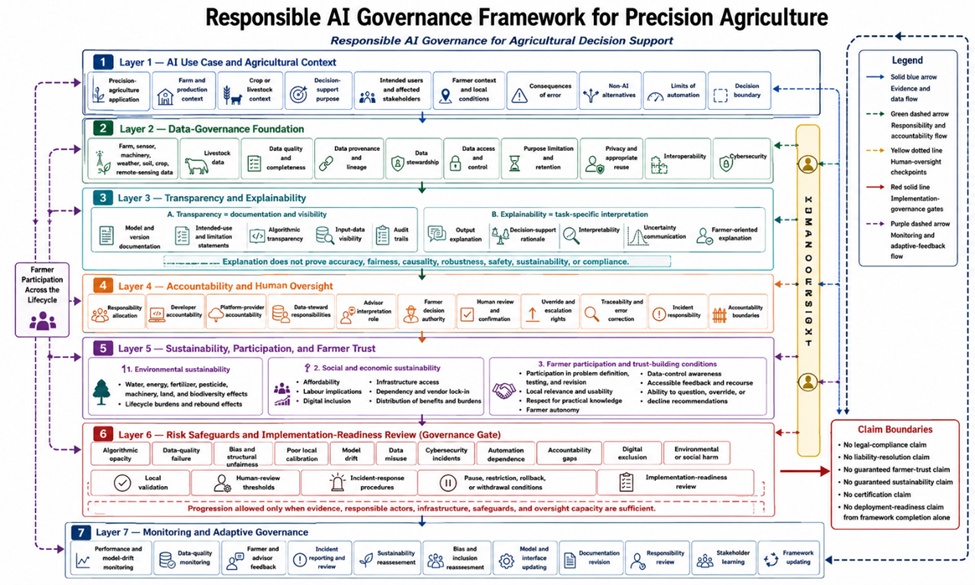
Figure 1. Responsible AI Governance Framework for Precision Agriculture
Alt-text description:
A conceptual governance framework showing precision agriculture AI use cases connected to data governance, transparency, explainability, accountability, sustainability, farmer participation, trust, risk safeguards, human oversight, monitoring, and feedback loops.
Implementation-readiness review should examine local infrastructure, affordability, connectivity, device compatibility, data availability, technical support, user capability, and differences among crop, dairy, and livestock production contexts. Access barriers may make an otherwise functional technology unsuitable for a particular region or farm type. Empirical research on agricultural technology adoption shows that access, connectivity, cost, skills, and support conditions shape whether digital tools can be used effectively [29]. Researchers and developers should therefore avoid treating pilot functionality or laboratory performance as evidence of broad practical readiness.
Developers and platform providers should design explainable interfaces that disclose uncertainty, data limitations, intended use, and conditions for non-use. Advisors and cooperatives may support interpretation and training where their roles are clearly defined, while farmers should retain meaningful authority to question or override outputs. Data stewards should maintain provenance, quality, access, and correction procedures, and system operators should monitor drift, cybersecurity risks, user difficulties, and recurring errors. Research on machine-learning decision-support systems indicates that adoption barriers include usability, relevance, data constraints, training needs, and weak alignment between technical development and farm practice [30].
Public institutions and policymakers may support research, infrastructure, interoperability, inclusion, independent evaluation, and accountable innovation without treating the proposed framework as a policy standard or legal instrument. Researchers should undertake local validation, distributional analysis, sustainability assessment, farmer-participatory evaluation, and longitudinal monitoring before making broader implementation claims. Adaptive governance should allow safeguards, documentation, responsibilities, and decision boundaries to change as evidence develops, consistent with responsible-innovation principles [28]. These recommendations are research-informed governance considerations rather than legal, regulatory, policy, financial, procurement, agronomic, contractual, or operational advice.
This article proposes a responsible AI governance framework for precision agriculture that connects agricultural use-case definition, stakeholder and farmer-context mapping, data governance, transparency, explainability, accountability, sustainability assessment, farmer participation, bias review, human oversight, risk safeguards, implementation-readiness review, monitoring, and adaptive feedback. Its central contribution is to position responsible agricultural AI as a socio-technical governance challenge rather than a property established by model accuracy, automation capability, or ethical language. The framework clarifies how data provenance, model documentation, uncertainty communication, responsibility allocation, sustainability trade-offs, farmer autonomy, digital inclusion, local validation, and feedback can be addressed through an integrated governance process. It also establishes explicit boundaries against unsupported claims of legal compliance, liability resolution, guaranteed trust, guaranteed sustainability, certification, or deployment readiness. Responsible agricultural AI should therefore be evaluated through validated performance, accountable decision support, meaningful farmer participation, context-sensitive safeguards, and continuing institutional oversight rather than technical capability alone.
None
None
None
None
Open Access The author(s) retain copyright. This article is licensed under the Creative Commons Attribution-NonCommercial-ShareAlike 4.0 International License. It may be shared and adapted for non-commercial purposes with appropriate attribution, an indication of changes, and distribution of adaptations under the same license. Third-party material may be subject to separate terms identified in its credit line. View the license at https://creativecommons.org/licenses/by-nc-sa/4.0/.
 Agro Intelligence Research Press