Agricultural artificial intelligence is commonly compared through benchmark datasets and technical metrics before any field experimentation occurs. Such comparisons can help identify promising models, reveal methodological weaknesses, and organize evidence for further testing, but they cannot establish field readiness, agronomic validity, operational safety, or deployment suitability. This article proposes a conceptual framework for benchmarking agricultural AI without field experiments. The framework separates five linked assessment domains: model readiness, technical validation, data quality, contextual fit, and deployment risk and decision validity. It addresses benchmark-task clarity, metric justification, dataset representativeness, provenance, label and ground-truth uncertainty, structured validation, domain shift, robustness, calibration, uncertainty, error patterns, bias, explainability, human oversight, and monitoring requirements. Non-empirical evaluation is treated as a structured screening process based on documentation, reported evidence, cross-context reasoning, and explicit claim boundaries. The framework produces a conditional benchmark-readiness statement and a field-validation gap register rather than a deployment decision. Its principal contribution is to distinguish benchmark performance from decision validity and deployment readiness while giving researchers, developers, evaluators, and agricultural stakeholders a transparent structure for comparing evidence before field testing. The framework is conceptual, does not replace field experiments, and should be updated as new data, validation evidence, user feedback, and operational observations become available.
Agricultural AI now supports diverse activities across precision agriculture, smart farming, digital agriculture, crop monitoring, irrigation, soil assessment, livestock observation, and advisory systems. These applications depend on interconnected data flows, analytical pipelines, and organizational arrangements, while their machine-learning tasks differ substantially in inputs, targets, users, and consequences [1, 2]. Early comparison is therefore useful, but a benchmark result is meaningful only within the task, dataset, metric, and decision context that produced it.
Benchmark datasets and model scores offer a practical basis for comparing algorithms before field trials, yet they can encourage false equivalence between technical performance and agricultural usefulness. Deep-learning results are shaped by dataset design, sample composition, preprocessing, validation procedures, and reporting choices [3]. A model may perform well on a curated test set while remaining untested under different farms, seasons, sensors, crops, management practices, or operational constraints.
The challenge is also socio-technical. Digital agriculture affects users, advisory relationships, institutional responsibilities, and the distribution of benefits and burdens, none of which can be inferred from prediction metrics alone [4]. Field readiness therefore differs from model readiness, and deployment readiness differs from both. Technical validation may support a bounded claim about performance under specified conditions, but it does not establish farmer acceptance, agronomic correctness, safe operation, or responsible integration.
This article develops an original conceptual framework for benchmarking agricultural AI without field experiments. It organizes evidence around benchmark-task definition, model and data documentation, technical validation, representativeness, contextual fit, uncertainty, robustness, deployment risk, decision validity, human oversight, monitoring, and field-validation gaps. The framework is intended for early-stage comparison and risk screening. It does not certify systems, prescribe deployment, or replace local field validation.
Agricultural benchmarks often use datasets that are convenient, public, or easy to label rather than representative of intended use. In plant-disease recognition, effectiveness depends not only on sample volume but also on visual variety, symptom expression, background, capture conditions, and class composition [5, 6]. Consequently, benchmark performance may reflect dataset regularities rather than transferable biological or agronomic information. Task definitions can also be too narrow, converting complex decisions into simplified classification or prediction problems.
Dataset availability is uneven across precision-agriculture tasks, crops, regions, and acquisition settings [7]. This creates spatial, temporal, seasonal, regional, crop-context, and farm-context biases. A dataset may overrepresent particular production systems, growth stages, sensors, or environmental conditions while omitting small farms, uncommon cultivars, rare events, or low-connectivity settings. Large sample counts do not correct systematic absence, and a benchmark task can remain poorly matched to the target context.
Disease-recognition datasets further illustrate how class imbalance, annotation inconsistency, label uncertainty, and limited field representation can distort evaluation [8]. Ground truth may itself be uncertain when symptoms overlap, expert judgments differ, or measurements contain error. Aggregate metrics can conceal poor performance on rare but consequential classes. Benchmark designers must therefore justify metrics, report disaggregated errors, document annotation procedures, and distinguish reference uncertainty from model error.
Other threats include non-independent observations, leakage between training and testing, repeated tuning against public test sets, domain shift, and benchmark overfitting. Random splits may place images from the same field, season, plant, animal, or acquisition sequence in both development and evaluation sets. Even careful non-field tests cannot reveal all operational failures. The framework therefore requires explicit no-field-readiness and no-deployment-readiness boundaries whenever field evidence, workflow testing, monitoring, and stakeholder evaluation remain absent.
Model readiness begins with documentation. The intended task, prediction unit, time horizon, inputs, outputs, preprocessing, model version, training process, excluded uses, and known limitations must be stated before scores are compared. Internal validation should use protected data and prevent preprocessing or feature selection from accessing evaluation information. Where data are spatially, temporally, or hierarchically structured, resampling must respect those dependencies because random cross-validation can produce misleading estimates [9].
External validation should use independently sourced data and explain how the external context differs from model-development conditions. Validation design should reflect the intended prediction target rather than methodological convenience [10]. For spatial applications, the evaluator must identify the quantity being estimated; a spatial cross-validation statistic is not automatically a valid estimate of map accuracy or transfer performance [11]. Metric selection must follow the evaluation question and the consequences of error.
Out-of-distribution testing, robustness checks, and generalization analysis extend validation beyond average performance. Evaluators should examine novel sensors, regions, seasons, crops, missing data, image quality, and plausible input disturbances. For broad spatial prediction, conventional validation may not reveal where predictor conditions fall outside training support [12]. Sensitivity analysis, and ablation analysis where appropriate, can clarify influential assumptions and model components, while structured error analysis can reveal systematic failure patterns hidden by aggregate metrics.
Uncertainty estimation and calibration should be assessed separately from discrimination or accuracy. Bias analysis should examine uneven coverage and errors across relevant agricultural contexts; fairness review is appropriate where benefits or burdens differ among stakeholders or farm types. Explainability should be evaluated only for a defined user and purpose, not treated as proof of correctness. Model readiness must therefore be reported as a bounded evidence profile, not as a guarantee of field validity or deployment suitability.
Table 1 summarises model readiness and technical validation criteria for benchmarking agricultural AI systems without field experiments.
Table 1. Model Readiness and Technical Validation Criteria for Benchmarking Agricultural AI Without Field Experiments: Model Documentation, Task Definition, Metric Justification, Internal Validation, External Validation, Out-of-Distribution Testing, Robustness, Generalization, Calibration, Uncertainty, Error Analysis, Bias, Fairness, Explainability, and Field-Validation Boundaries
Model readiness or validation component | Core readiness question | Required evidence or procedure | Technical validation function | Potential output | Failure or overclaiming risk | Additional assessment need | Framework role |
Model documentation | Is purpose and scope clear? | Versioned task, model, input, output, training, and limitation record | Enables reproducibility | Documentation profile | Hidden assumptions | Independent audit | Entry gate |
Task definition | Does the task match the agricultural problem? | Target, unit, horizon, user, and exclusions | Establishes evaluation object | Task specification | Proxy-task mismatch | Decision-context review | Task gate |
Metric justification | Do metrics reflect relevant errors? | Rationale and disaggregated results | Aligns metrics with questions | Metric adequacy statement | Aggregate scores conceal failure | Consequence review | Metric gate |
Internal validation | Are unseen in-domain samples protected? | Isolated preprocessing, tuning, and testing | Detects overfitting | Internal evidence profile | Leakage | Reproducibility audit | Technical layer |
Structured cross-validation | Are dependencies respected? | Grouped, spatial, temporal, or nested folds | Reduces optimistic estimates | Resampling profile | Non-IID leakage | External testing | Split-integrity check |
External validation | Is evidence independently sourced? | Independent dataset and context comparison | Tests transfer | External-validity profile | External data remain too similar | Local validation | Transfer layer |
Out-of-distribution testing | What happens beyond training support? | Held-out domains and novelty checks | Defines applicability limits | Out-of-distribution risk profile | Artificial shifts omit real change | Field monitoring | Boundary check |
Robustness and generalization | Is performance stable across plausible conditions? | Stress tests and subgroup or cross-domain results | Identifies fragility | Robustness profile | Narrow stress scenarios | Context-specific testing | Reliability layer |
Uncertainty and calibration | Are confidence estimates meaningful? | Uncertainty method and calibration evidence | Evaluates confidence quality | Uncertainty profile | False assurance | Target-context recalibration | Uncertainty layer |
Sensitivity and ablation | Which assumptions or components matter? | Planned variations or component removal | Diagnoses dependencies | Contribution profile | Dataset-specific conclusions | Independent replication | Diagnostic layer |
Error analysis | Which cases fail and why? | Case, class, subgroup, and residual review | Reveals systematic errors | Error taxonomy | Rare failures remain hidden | Agronomic review | Failure layer |
Bias and fairness | Are errors or burdens uneven? | Context-relevant subgroup analysis | Screens disparities | Bias or fairness profile | Missing metadata | Stakeholder assessment | Responsibility layer |
Explainability | Is explanation useful for a defined user? | Fidelity, stability, purpose, and limitation evidence | Supports oversight | Explainability profile | Plausibility mistaken for truth | User evaluation | Conditional check |
Claim boundaries | What remains unproven? | Gap register and explicit limitations | Prevents readiness inflation | Conditional readiness statement | Benchmark score becomes approval | Field validation | Final boundary |
Data quality assessment begins with documentation and provenance. Evaluators should record why data were collected, by whom, with which instruments or procedures, under what permissions, and through which transformations. Agricultural AI data management depends on integration, metadata, standards, validation, usability, and traceability [13]. Completeness must be assessed against the defined task because missing variables, periods, locations, or metadata can change both model performance and interpretation.
Representativeness requires more than overall dataset size. The benchmark should describe spatial, temporal, seasonal, regional, crop, cultivar, production-system, and farm-context coverage. Labels and annotations require protocols, quality controls, and, where relevant, agreement or adjudication records. Ground-truth uncertainty should be stated when reference measurements or expert diagnoses are imperfect. Class imbalance must be linked to per-class performance and error consequences rather than hidden within a single aggregate result.
Contextual fit asks whether the development evidence resembles the intended conditions of use. Mobile crop-disease classification under uncontrolled capture demonstrates why illumination, device, background, and symptom presentation matter when moving beyond curated images [14]. Domain shift should be examined explicitly when sensors, image domains, regions, or management conditions change, as transfer can degrade agricultural vision performance [15]. Non-IID structures must also be documented so that farms, fields, seasons, plants, animals, or image sequences are not split inappropriately.
Controlled-condition success does not independently establish field performance, particularly when development and field data differ materially [16]. The proposed framework therefore produces a contextual-fit profile and mismatch register rather than a guarantee. Data governance should also document access, stewardship, permitted use, retention, accountability, and change control. These checks can identify evidence gaps and support field-validation planning, but they cannot confirm local agronomic validity, farmer usability, operational reliability, or deployment readiness without direct evaluation.
Agricultural AI deployment risk cannot be inferred from prediction error alone. System outputs may interact with ecological processes, production decisions, labor arrangements, data infrastructures, and institutional responsibilities, creating downstream effects not represented by benchmark metrics. Responsible evaluation must therefore examine systemic risks, ethical safeguards, accountability, and multiple dimensions of potential impact rather than reducing readiness to a single performance score [17-19]. A non-empirical benchmark can identify plausible hazards and unresolved responsibilities, but it cannot determine their frequency or severity under actual operating conditions.
Decision validity concerns whether a model output is relevant, timely, interpretable, and sufficiently supported for a particular agricultural decision. These conditions vary across farm systems, technological pathways, production structures, and stakeholder groups [20]. The proposed framework therefore requires decision-context mapping: who receives the output, what decision it informs, which alternatives are available, what evidence is missing, and what consequences follow from false, delayed, or misunderstood outputs. Predictive accuracy remains distinct from agronomic validity because a statistically accurate target may still be an incomplete or inappropriate basis for action.
Human mediation is especially important when AI outputs enter farmer-facing or adviser-facing decision-support systems. Agricultural advisers may combine digital outputs with local knowledge, observations, production objectives, and professional judgment, while farmers determine whether information is relevant to their operational circumstances [21]. Benchmarking should consequently document interpretation responsibilities, escalation routes, override authority, uncertainty communication, and conditions requiring independent verification. Human oversight must be substantive rather than nominal: the designated reviewer needs adequate information, competence, time, and authority to question or reject an output.
Deployment-risk screening should also define operational and safety boundaries, provisional risk classifications, monitoring needs, and updating requirements. Potential model drift and data drift should be anticipated when climates, seasons, sensors, crop varieties, management practices, or user populations change. Feedback mechanisms require controlled provenance and revalidation so that corrections do not introduce new biases. These criteria support early risk identification only; they do not guarantee decision validity, operational safety, or deployment readiness.
Non-empirical evaluation begins with inspectable documentation. Benchmark-task descriptions should identify the target, unit of prediction, intended user, time horizon, exclusions, and relationship to the agricultural use case. Dataset documentation should explain motivation, composition, collection, preprocessing, intended uses, and limitations so that assumptions and potential inappropriate uses can be audited [22]. Model documentation should similarly record versions, dependencies, training procedures, evaluation conditions, uncertainty methods, and declared boundaries.
Evaluation integrity requires explicit examination of leakage, contamination, and dependence structures. Information may cross training and evaluation boundaries through preprocessing, repeated samples, grouped observations, feature construction, or repeated use of a public test set. Such leakage can inflate reported performance and weaken reproducibility [23]. A non-empirical assessment should therefore inspect split design, grouping variables, preprocessing isolation, tuning history, and test-set governance before interpreting any benchmark comparison.
Robustness, uncertainty, and external-validity evidence should be evaluated separately from average predictive performance. Uncertainty quantification can distinguish sources of limited confidence and support cautious interpretation, but uncertainty estimates may themselves be unreliable under distribution shift [24]. Reviewers should examine calibration, sensitivity, plausible perturbations, subgroup errors, out-of-distribution behavior, and the extent to which validation conditions resemble intended contexts. Missing evidence should be recorded rather than converted into a favourable readiness assumption.
Bias, fairness, and explainability reviews should be applied where relevant to the use case and available evidence. Explainability assessment should identify the intended user, explanatory purpose, method, fidelity, stability, and limitations because a plausible explanation does not necessarily describe the model faithfully or establish correctness [25]. Decision-consequence mapping, human-oversight planning, deployment-risk screening, and monitoring planning complete the non-empirical review. The resulting evidence profile identifies priorities for field validation; it does not replace field experimentation or authorize deployment.
Table 2 maps data-quality, contextual-fit, deployment-risk, decision-validity, and non-empirical evaluation criteria for agricultural AI benchmarking.
Table 2. Data Quality, Contextual Fit, Deployment Risk, Decision Validity, and Non-Empirical Evaluation Criteria for Agricultural AI Benchmarking: Representativeness, Provenance, Label Quality, Domain Shift, Contextual Fit, Risk Classification, Decision Consequence, Human Oversight, Monitoring, and Field-Experiment Boundaries
Evaluation criterion or risk component | Core screening question | Required evidence or documentation | Evaluation or risk-screening function | Potential output | Residual or failure risk | Field validation or oversight need | Boundary statement |
Data provenance and documentation | Are origins, transformations, permissions, and intended uses traceable? | Versioned dataset record and lineage | Supports reproducibility and auditability | Provenance profile | Undocumented upstream errors | Data-steward review | Documentation does not prove quality |
Representativeness | Are intended crops, regions, seasons, farms, and conditions covered? | Source–target coverage comparison | Identifies sampling gaps | Representativeness matrix | Unknown target variation | Local validation | No contextual-fit guarantee |
Label and ground-truth quality | Are labels and reference measurements sufficiently reliable? | Protocols, agreement, adjudication, and measurement uncertainty | Separates model and reference error | Label-quality profile | Biological ambiguity remains | Agronomic verification | Ground truth is not assumed exact |
Class imbalance and subgroup bias | Are rare or underrepresented cases adequately evaluated? | Class counts and disaggregated errors | Detects concealed failure | Bias-risk profile | Missing metadata limits review | Targeted data collection | Aggregate accuracy is insufficient |
Domain shift and non-IID structure | Do target distributions or dependencies differ from development data? | Domain comparisons and grouping information | Screens transfer and leakage risk | Shift-risk register | Unanticipated shifts remain | External and field testing | No generalization guarantee |
Contextual fit | Do crop, sensor, farm, workflow, and decision contexts align? | Context profile and mismatch register | Integrates applicability evidence | Conditional-fit statement | Similarity may not yield transfer | Farmer, adviser, and local review | Screening is not local validation |
Decision validity and agronomic validity | Is the output relevant and sufficient for the intended decision? | Decision pathway, rationale, alternatives, and missing evidence | Separates prediction from action | Decision-evidence gap register | Accurate outputs may remain unusable | Agronomic and user evaluation | No decision-validity guarantee |
Decision consequence and risk classification | What follows from error, delay, or misuse? | Severity, exposure, reversibility, and detectability scenarios | Prioritises further assessment | Provisional risk profile | Rare systemic consequences may be omitted | Multidisciplinary review | Classification is not certification |
Uncertainty and robustness evidence | Are confidence and stability evaluated under relevant conditions? | Calibration, stress tests, sensitivity, and limitations | Screens unreliable confidence | Reliability profile | Tested conditions remain incomplete | Context-specific validation | No safety guarantee |
Explainability and fairness | Are explanations and distributional effects appropriate to the use case? | User, purpose, fidelity, subgroup, and burden analysis | Supports responsible oversight | Conditional review profile | Persuasive explanations may be incorrect | Stakeholder evaluation | Explainability does not prove validity |
Human oversight | Who interprets, verifies, overrides, and escalates outputs? | Roles, competence, authority, and fallback procedures | Establishes accountable control | Oversight plan | Nominal oversight may fail | Workflow testing | Human presence is not safety proof |
Monitoring and updating | How will drift, incidents, overrides, and feedback be handled? | Indicators, triggers, owners, and change-control process | Defines lifecycle evidence needs | Monitoring specification | Degradation may remain undetected | Longitudinal evaluation | Benchmarking cannot replace monitoring |
Field-experiment boundary | Which important claims remain untested? | Field-validation gap register | Prevents non-field substitution | Explicit limitation statement | Evidence may still be overinterpreted | Field experimentation | No field- or deployment-readiness claim |
The proposed framework begins with agricultural AI use-case definition, benchmark-task definition, and decision-context mapping. These stages specify the agricultural problem, target, prediction unit, time horizon, intended user, operational exclusions, and potential consequences. Responsibility must be assigned explicitly because trust and accountability depend on identifiable actors who remain answerable for interpreting, communicating, and acting on AI outputs [26]. The framework does not treat the model as an autonomous decision-maker.
The second stage reviews model and data documentation. Model review addresses architecture description, versioning, training procedures, preprocessing, intended use, excluded use, and limitations. Data review addresses provenance, composition, collection conditions, completeness, labels, reference uncertainty, and governance. Human-centered requirements are considered alongside technical evidence because usable oversight depends on interaction design, explanation, user control, and operational context [27]. Documentation gaps become explicit readiness limitations rather than assumed strengths.
The third stage assesses data quality, representativeness, technical validation, and external validity. Data-centric assessment is necessary because curation, labeling, cleaning, augmentation, metadata, and lifecycle management can influence reliability independently of model architecture [28]. Technical review examines split integrity, metric justification, structured cross-validation, external data, out-of-distribution tests, robustness, generalization, uncertainty, calibration, sensitivity, ablation where supported, and error patterns. Outputs remain multidimensional evidence profiles rather than a universal readiness score.
The fourth stage integrates bias, fairness, explainability, decision validity, and deployment risk. Benchmark readiness is communicated as a bounded technical judgment rather than evidence of wider agricultural benefit, inclusion, sustainability, or successful transformation [29]. The evaluator maps error consequences, agronomic evidence gaps, contextual mismatches, operational boundaries, safety boundaries, oversight responsibilities, and monitoring requirements. Critical unresolved risks cannot be averaged away by stronger performance in another domain.
The final stage produces a benchmark-readiness statement, field-validation gap register, human-oversight and monitoring plan, and framework-update schedule. Agriculture-specific explainability evidence may support review and communication, but it cannot independently prove model correctness, decision validity, or safe use [30]. Readiness statements must therefore identify supported contexts, unsupported contexts, uncertainty, unresolved risks, and evidence still required from field experiments, user evaluation, workflow testing, and longitudinal monitoring.
Table 3 presents the proposed benchmarking framework for agricultural AI model readiness, data quality, deployment risk, and decision validity without field experiments.
Table 3. Proposed Benchmarking Framework for Agricultural AI Without Field Experiments: Use-Case Definition, Benchmark Task Definition, Decision-Context Mapping, Model Documentation, Data Documentation, Data Quality, Representativeness, Technical Validation, External Validity, Uncertainty, Robustness, Bias, Explainability, Decision Validity, Deployment Risk, Human Oversight, Field-Validation Gaps, and Deployment Boundaries
Framework stage | Core purpose | Required input | Benchmarking function | Potential output | Validation or assessment need | Failure risk | Feedback mechanism | Decision boundary |
Use-case and task definition | Establish agricultural purpose and evaluation object | User, target, horizon, context, and exclusions | Aligns benchmark with intended problem | Use-case and task specification | Agronomic and stakeholder review | Proxy-task mismatch | Revise scope | No operational recommendation |
Decision-context mapping | Separate prediction from decision support | Decision owner, alternatives, timing, and consequences | Identifies evidence needed for action | Decision pathway | User and agronomic evaluation | Accuracy becomes advice | Stakeholder feedback | No decision-validity guarantee |
Model documentation review | Establish reproducibility and scope | Model version, training, inputs, outputs, and limitations | Exposes assumptions and dependencies | Documentation profile | Independent technical audit | Hidden development choices | Version correction | Documentation is not validation |
Data documentation and quality | Establish traceability and fitness for task | Provenance, composition, labels, missingness, and governance | Identifies data defects | Data-readiness profile | Data-steward and domain review | Poor data are treated as adequate | Curate or recollect data | No data-quality guarantee |
Representativeness and contextual fit | Compare development and target conditions | Crop, region, season, farm, sensor, and workflow profiles | Identifies coverage and mismatch | Applicability matrix | Local contextual review | Unsupported transfer | Targeted evidence collection | No contextual-fit guarantee |
Technical validation | Examine methodological soundness | Splits, metrics, tuning history, external data, and errors | Screens leakage, overfitting, and transfer | Validation profile | Reproduction and independent testing | Inflated benchmark performance | Correct evaluation design | No field-validation claim |
Uncertainty, calibration, and robustness | Assess confidence and stability | Calibration, stress, sensitivity, and domain evidence | Identifies unreliable confidence | Reliability profile | Target-context evaluation | False assurance | Recalibration and retesting | No risk-elimination claim |
Bias, fairness, and explainability | Review responsible-performance conditions | Subgroup, user, explanation, and burden evidence | Supports oversight and disparity screening | Conditional responsibility profile | Missing groups or misleading explanations | Stakeholder evaluation | Revise data or interface | No fairness or correctness certification |
Decision-validity screening | Examine relevance and agronomic sufficiency | Decision map, uncertainty, rationale, and consequence analysis | Identifies missing decision evidence | Validity-gap register | Prediction is mistaken for valid action | Agronomic and user testing | Refine decision pathway | No decision-validity guarantee |
Deployment-risk classification | Organise technical and socio-technical risks | Consolidated risk register | Prioritises field and workflow assessment | Provisional risk profile | Simplified classification hides hazards | Multidisciplinary review | Reclassify with evidence | No operational-safety guarantee |
Oversight and monitoring planning | Define accountable control and lifecycle observation | Roles, overrides, indicators, triggers, and incident procedures | Specifies safeguards and evidence needs | Oversight and monitoring plan | Workflow and longitudinal testing | Nominal controls fail | Incident and drift feedback | No deployment-readiness claim |
Field-validation gap identification | State what remains unknown | All evidence profiles and unresolved questions | Converts gaps into research needs | Field-validation agenda | Field-study design review | Gaps are understated | Update after field evidence | Field experiments remain required |
Benchmark-readiness statement | Communicate bounded pre-field evidence | Domain profiles, limits, and critical gaps | Summarises readiness without aggregation | Conditional narrative statement | Independent review | Statement becomes approval | Versioned reassessment | Benchmark readiness only |
Framework updating | Maintain validity over model and context changes | New data, versions, drift, incidents, and user feedback | Supports controlled revision | Updated framework record | Change-impact assessment | Prior findings are reused silently | Governed update cycle | Earlier readiness does not automatically transfer |
Figure 1 presents the proposed benchmarking framework for agricultural AI without field experiments, linking use-case definition, benchmark task design, model readiness, data quality, contextual fit, deployment risk, decision validity, field-validation gaps, human oversight, and framework updating.
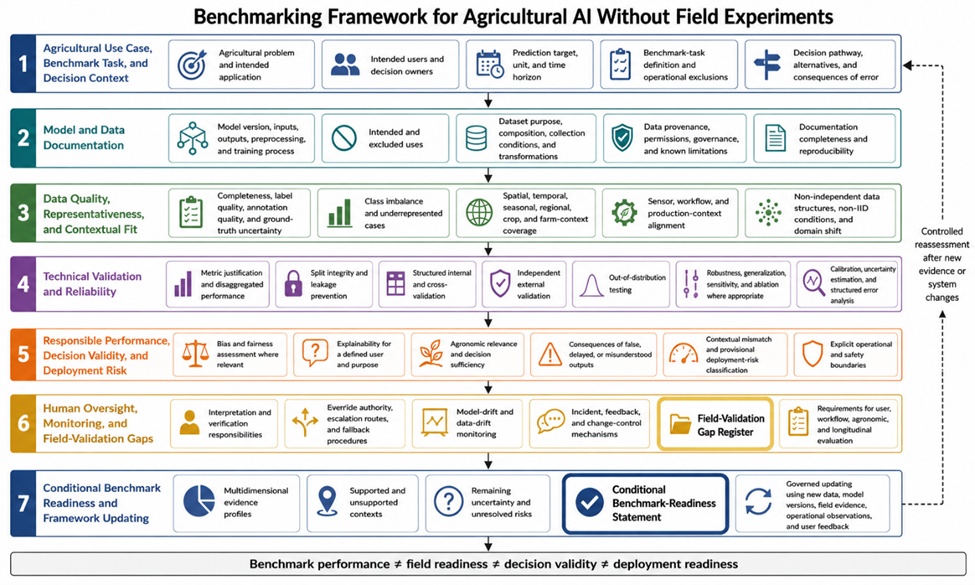
Figure 1. Benchmarking Framework for Agricultural AI Without Field Experiments
Alt-text description:
A conceptual benchmarking framework showing agricultural AI use-case definition, benchmark task design, model documentation, data quality assessment, technical validation, contextual fit, deployment risk, decision validity, human oversight, field-validation gaps, and benchmark readiness boundaries.
For researchers, developers, dataset curators, and benchmark designers, the framework supports clearer task definitions, documented data provenance, representativeness analysis, protected evaluation splits, disaggregated error reporting, and explicit uncertainty statements. Dataset documentation should be updated as collection, labeling, or permitted uses change [22]. Benchmark publications should identify unsupported contexts and explain what additional external, agronomic, and field evidence would be needed before stronger claims could be considered.
For platform providers, advisers, farmers, operators, technology evaluators, and journal reviewers, the framework provides questions for interpreting evidence rather than selecting products or prescribing actions. Particular attention should be given to contextual mismatch, uncertainty communication, human authority, fallback procedures, and benchmark-to-field validity gaps. Future research should examine how uncertainty and calibration behave across crops, seasons, sensors, and user settings, while avoiding the assumption that technically quantified uncertainty automatically improves decisions [24].
Longitudinal research is needed on model drift, data drift, feedback updating, oversight effectiveness, and changes in performance after operational conditions evolve. Comparative field studies should investigate how benchmark evidence relates to agronomic outcomes, workflow integration, user interpretation, and unintended consequences. Governance research should examine responsibility, traceability, and accountability across developers, providers, advisers, and users [17]. These are conceptual implications and proposed research directions, not agronomic, legal, policy, procurement, certification, model-selection, platform-selection, or deployment guidance.
This article proposes a conceptual framework for benchmarking agricultural AI without field experiments by linking use-case definition, benchmark-task design, model readiness, technical validation, data quality, contextual fit, deployment risk, decision validity, non-empirical evaluation, human oversight, monitoring, field-validation gaps, and framework updating. Its central contribution is a disciplined separation between benchmark performance and field readiness. Agricultural AI evidence should be interpreted through task relevance, documentation, representativeness, uncertainty, generalization limits, decision context, risk, and unresolved validation needs rather than through technical scores alone. The framework can support early comparison and research planning, but it cannot establish agronomic correctness, operational safety, farmer acceptance, or deployment readiness. Such claims require contextual evaluation, field experimentation, human-centered assessment, and longitudinal monitoring.
None
None
None
None
Open Access The author(s) retain copyright. This article is licensed under the Creative Commons Attribution-NonCommercial-ShareAlike 4.0 International License. It may be shared and adapted for non-commercial purposes with appropriate attribution, an indication of changes, and distribution of adaptations under the same license. Third-party material may be subject to separate terms identified in its credit line. View the license at https://creativecommons.org/licenses/by-nc-sa/4.0/.
 Agro Intelligence Research Press