Sustainable precision agriculture increasingly depends on the convergence of artificial intelligence, robotics, automation, and Internet of Things technologies rather than on isolated digital tools. This integrative review synthesizes how these technology domains interact across sensing, data transmission, analytics, decision support, robotic or automated actuation, and feedback within sustainability-oriented farming systems. The review uses a curated peer-reviewed literature selection and an integrative evidence-charting logic to map technology domains, agricultural applications, integration mechanisms, decision functions, sustainability relevance, and system-level challenges. The AI focus includes machine learning, deep learning, computer vision, predictive analytics, data fusion, and decision-support models used for crop monitoring, yield estimation, input optimization, pest and disease detection, and risk forecasting. The robotics and automation focus covers autonomous field robots, UAVs, smart machinery, task execution, and automated farm operations. The IoT and sensing focus includes wireless sensor networks, distributed monitoring, machinery telemetry, remote sensing, cloud and edge computing, and data platforms. The synthesis shows that technology convergence may support resource-efficient, climate-sensitive, and more responsive farm management, but only when data quality, interoperability, field robustness, explainability, affordability, governance, usability, and farmer or advisor feedback are addressed. The review contributes a system-level framing of sustainable precision agriculture as a socio-technical feedback system in which digital sensing, AI interpretation, automated action, and human decision-making must be jointly designed. Future research should prioritize validated, interoperable, transparent, and farmer-centered integration pathways rather than assuming that more automation or more data automatically improves sustainability outcomes.
Sustainable precision agriculture is increasingly described as a data-intensive transformation in which sensing, analytics, decision-support platforms, and digitally mediated farm operations reshape how agricultural systems are monitored and managed. Smart farming research has shown that data flows, platform infrastructures, and socio-economic arrangements are central to this transformation rather than secondary technical details [1, 2].
The convergence of artificial intelligence, robotics, automation, and IoT is significant because sustainable farm management requires more than collecting data or deploying autonomous machines in isolation. Crop data management illustrates this logic: field data must be acquired, processed, interpreted, translated into recommendations, and connected to variable-rate or automated action before it can support operational decisions [3].
This convergence is also socio-technical because digital agriculture changes advisory relationships, farmer agency, institutional responsibilities, labour arrangements, and the distribution of value across agricultural systems. A narrow technical review would therefore miss the social, organizational, and governance conditions that shape whether smart farming systems become useful, trusted, and sustainable in practice [4].
The aim of this integrative review is to synthesize how AI, robotics, automation, and IoT interact in sustainable precision agriculture. The review asks how these domains converge across sensing, analytics, actuation, decision support, feedback, and sustainability evaluation; which technology domains are most prominent; what system-level barriers constrain implementation; and what future research directions can support reliable, interoperable, explainable, and farmer-centered technology convergence.
Sustainable precision agriculture can be understood as a farm-management context in which site-specific data, digital monitoring, analytical interpretation, and targeted action are used to support production and environmental objectives. Precision farming scholarship emphasizes the production–environment nexus, while smart farming technology taxonomies show that sensing, mapping, decision support, automation, and machinery systems form a diverse technological landscape rather than a single intervention [5, 6].
Technology convergence in this context refers to the interaction among data acquisition, data transmission, AI-based interpretation, robotic or automated action, and feedback into future decisions. Responsible innovation scholarship cautions that these interactions should not be evaluated only by technical novelty, because digital agriculture also raises questions of inclusion, accountability, transparency, and the distribution of benefits and risks [7].
The sustainability contribution of convergent technologies is therefore conditional. AI may improve interpretation of complex data, IoT may extend real-time monitoring, robotics may execute targeted actions, and decision-support systems may make recommendations more accessible, but these functions do not automatically produce environmental or economic gains. Benefits depend on agronomic validity, appropriate scale, field robustness, user trust, maintenance capacity, affordability, and alignment with local farming objectives.
This review treats sustainable precision agriculture as a feedback-oriented system. In such a system, sensors and remote platforms generate data; AI and data-fusion methods transform data into interpretable signals; robots, UAVs, machinery, or farmers act on those signals; and monitoring systems provide feedback that can improve subsequent decisions. The central review problem is not whether one technology is superior, but how multiple technologies are integrated into reliable, accountable, and usable farm-management workflows.
The review scope includes peer-reviewed journal literature on AI, machine learning, deep learning, computer vision, robotics, automation, UAVs, IoT, wireless sensor networks, data fusion, cloud and edge computing, decision support, interoperability, governance, and sustainability-oriented smart farming. Agriculture 4.0 scholarship provides an appropriate umbrella for this scope because it connects AI, IoT, cloud systems, analytics, automation, and digital farm-management applications [8].
Eligibility was based on relevance to precision agriculture, smart farming, digital agriculture, sustainable agriculture, or agricultural systems; the presence of a clear technology domain; and the capacity of each paper to support classification by application, integration mechanism, sustainability relevance, and system-level challenge. Literature on agricultural digitization was used to identify not only technologies and expected benefits but also roadblocks affecting adoption and implementation [9].
The approach is integrative rather than statistical or count-based. It does not estimate pooled effects, compare model accuracy values, or claim measured sustainability impacts across farms. Instead, it synthesizes concepts, domains, barriers, and implementation implications. This is necessary because Agriculture 4.0 literature contains heterogeneous descriptions, technologies, advantages, disadvantages, and barriers that require interpretive synthesis rather than simple aggregation [10].
Evidence charting was organized around technology domain, agricultural application, AI component, robotics or automation component, IoT or sensor component, integration mechanism, data source, decision-support or actuation function, sustainability dimension, system-level challenge, implementation stage, limitation, and research gap. This structure allowed the review to distinguish data acquisition, processing, AI analysis, robotic action, human decision-making, workflow integration, interoperability, sustainability evaluation, and governance.
Table 1 summarises the integrative review framework used to classify AI, robotics, automation, and IoT studies in sustainable precision agriculture.
Table 1. Integrative Review Framework for AI, Robotics, Automation, and IoT in Sustainable Precision Agriculture: Technology Domain, Agricultural Application, Data Source, Integration Mechanism, Decision Function, Sustainability Dimension, Implementation Barrier, and Research Gap Category
Review dimension | Definition | Coding categories | Information extracted | Reason for inclusion | Example interpretation | Limitation of the category |
Technology domain | Main digital or automated technology emphasized in the article | AI analytics; machine learning; deep learning; computer vision; robotics; automation; IoT sensing; wireless sensor networks; UAVs; cloud or edge computing; data fusion | Primary technology focus and supporting technologies | Identifies whether the paper contributes to AI, robotics, IoT, automation, or cross-domain convergence | A paper on crop image classification is coded as AI analytics and computer vision | Some studies combine domains unevenly, making one dominant category difficult to assign |
Agricultural application | Farming problem or production context addressed | Crop monitoring; yield prediction; irrigation; nitrogen management; pest or disease detection; robotic weeding; UAV mapping; machinery automation; advisory decision support | Crop, livestock, greenhouse, field, or management application | Links technology convergence to practical farm-management functions | A UAV crop-mapping review is interpreted as remote sensing for monitoring and decision support | Application categories may be broad when studies review multiple farm functions |
Data source | Type of data used or discussed | Sensor data; images; remote sensing data; machinery telemetry; weather data; soil data; crop data; advisory or platform data; not clearly reported | Reported or reviewed input data types | Clarifies whether integration depends on heterogeneous data streams | A smart-farming architecture may combine soil sensors, weather stations, and cloud data | Review articles may not specify data sources in detail |
Integration mechanism | How technologies are connected in the farm system | AI–IoT integration; AI–robotics integration; robotics–IoT integration; cyber-physical system; data fusion; automation loop; platform integration; decision-support integration | Mechanism linking sensing, analytics, actuation, or decision support | Captures convergence rather than isolated technology descriptions | Sensor networks supply data to analytics, which inform automated irrigation decisions | Some papers imply integration without describing technical architecture |
Decision function | Role in farm decision-making or action | Prediction; classification; detection; recommendation; monitoring; optimization; actuation; feedback; advisory interpretation | Decision-support or actuation role | Connects technology to management use rather than technical capability alone | Yield prediction supports planning, while robotic weeding performs task execution | Decision quality is often discussed conceptually rather than validated in field use |
Sustainability dimension | Sustainability issue addressed or implied | Resource efficiency; input optimization; water management; reduced waste; environmental monitoring; social sustainability; governance; climate-smart management | Stated or implied sustainability relevance | Prevents unsupported claims by identifying the sustainability pathway | Precision nitrogen estimation may be interpreted as input-efficiency support | Sustainability effects are rarely measured directly across comparable conditions |
Implementation barrier | Constraint affecting adoption, scaling, or system integration | Data quality; interoperability; connectivity; field robustness; cost; energy use; maintenance; trust; governance; usability; advisory capacity | Technical, social, organizational, or governance barrier | Supports system-level interpretation of convergence limitations | A robotics paper may identify unstructured field conditions as a robustness barrier | Barriers differ by region, crop, farm size, and infrastructure context |
Research gap category | Future research need emerging from the article | Field validation; explainability; reproducibility; human-centered design; governance; scalable architectures; robust robotics; sustainability assessment; interoperability | Explicit or inferable future research need | Organizes future agenda around cross-cutting integration problems | A paper on digital advice networks indicates the need for advisory-system integration | Some gaps are inferred cautiously from limitations rather than directly stated |
Artificial intelligence contributes to precision agriculture by transforming heterogeneous agricultural data into classifications, predictions, detections, and recommendations. Deep learning has expanded the analytical capacity of agricultural systems, especially where image-rich or high-dimensional data are available, but its usefulness depends on data quality, preprocessing, model design, and validation conditions [11].
Machine learning research shows that AI methods are applied across crop, soil, water, and livestock management problems. These methods can support prediction, classification, monitoring, and decision support, yet they should be understood as components of management systems rather than replacements for agronomic interpretation or farmer judgment [12].
Predictive analytics is particularly important for yield forecasting and nitrogen-status estimation because these functions connect AI outputs to input management and planning decisions. However, such applications depend on the quality of crop, soil, weather, and sensing data, and their transferability can be limited when models are developed under conditions that differ from target farms [13].
Computer vision links image sensing with crop diagnosis, phenotyping, quality assessment, and monitoring, making it a key bridge between AI and field-level observation [14]. More recent machine-learning synthesis indicates that agricultural AI now spans multiple management domains, but the translation of models into usable, explainable, and field-ready decision-support systems remains a central challenge [15].
Agricultural robotics extends precision agriculture from observation and recommendation toward physical task execution. Field robots require navigation, perception, control, sensing, safety functions, and mechanical subsystems that can operate under variable soil, crop, weather, and terrain conditions [16]. Robotic maturity is uneven across applications, with some field operations such as scouting, weeding, spraying, seeding, and harvesting receiving more development than others, and with commercial readiness varying by task, crop, and operational environment [17].
UAVs occupy an important position between remote sensing, robotics, and decision support because they collect high-resolution spatial data while also functioning as mobile robotic platforms. Their value in precision agriculture depends on integration with image analytics, crop mapping, monitoring workflows, and decision-support systems rather than on aerial data collection alone [18].
IoT systems provide the distributed sensing layer of smart farming through connected devices, wireless sensor networks, communication protocols, and monitoring infrastructures. In agricultural settings, IoT can support real-time or near-real-time observation of soil, crop, weather, greenhouse, livestock, and machinery conditions, but its implementation is constrained by connectivity, reliability, farmer value, and deployment challenges [19].
IoT-enabled precision agriculture depends on distributed sensing, communication architecture, data management, and integration with farm operations [20]. When combined with robotics and automation, IoT can provide the monitoring and feedback needed for cyber-physical farming systems, but system performance depends on robust data transmission, interoperable platforms, maintenance capacity, energy availability, and the ability to translate sensor signals into trusted decisions or actions.
Table 2 compares the roles of AI, robotics, automation, and IoT across major precision agriculture functions.
Table 2. Comparative Roles of AI, Robotics, Automation, and IoT in Precision Agriculture: Data Collection, Sensing, Perception, Prediction, Decision Support, Actuation, Monitoring, Feedback, and Sustainability-Oriented Farm Management
Technology domain | Core function | Typical data input | Agricultural application | Decision-support or actuation role | Sustainability contribution | Integration dependency | Main limitation | Implementation requirement |
Machine learning and predictive analytics | Pattern recognition, prediction, classification, and recommendation | Crop, soil, weather, machinery, remote sensing, and management data | Yield prediction, nitrogen management, irrigation support, pest-risk forecasting | Converts farm data into forecasts or management recommendations | May support input efficiency and earlier risk detection | Requires reliable data pipelines and agronomic interpretation | Transferability and validation across farms can be limited | Context-specific validation, explainable outputs, and farmer-readable decision support |
Deep learning and computer vision | Image interpretation, detection, segmentation, and phenotyping | RGB, multispectral, hyperspectral, UAV, proximal, or machinery-mounted images | Crop monitoring, disease detection, weed identification, phenotyping, grain quality assessment | Identifies visual patterns that can inform management or automation | May improve monitoring precision and targeted intervention | Requires image acquisition, labeled datasets, computing resources, and workflow integration | Sensitive to image quality, crop stage, lighting, and dataset bias | Representative datasets, field testing, and transparent model interpretation |
Agricultural robotics | Autonomous or semi-autonomous field task execution | Navigation data, machine vision, sensor feedback, task maps, machinery telemetry | Weeding, scouting, spraying, seeding, harvesting, transport, greenhouse operations | Performs physical actuation or task execution | May support targeted operations and labour-risk reduction where appropriate | Requires perception, navigation, control, safety, and agronomic task planning | Field robustness and task generalization remain difficult | Reliable navigation, safety protocols, maintenance support, and workflow compatibility |
UAVs and aerial robotics | Mobile sensing, mapping, monitoring, and sometimes targeted application | Aerial imagery, geospatial data, crop indices, field maps | Crop scouting, stress mapping, canopy monitoring, variable-rate planning | Provides high-resolution spatial intelligence for decisions | May support targeted input use and improved crop surveillance | Requires flight planning, image analytics, regulatory compliance, and data integration | Weather, battery life, regulation, and data-processing demands | Operational protocols, analytics pipelines, and integration with farm decision systems |
IoT and wireless sensor networks | Continuous or periodic field, machinery, crop, soil, and climate monitoring | Soil moisture, temperature, humidity, nutrient status, weather, machinery telemetry | Irrigation scheduling, greenhouse control, machinery monitoring, livestock or crop observation | Supplies real-time or near-real-time data for dashboards, alerts, or automated systems | May support water management, input timing, and resource monitoring | Requires connectivity, power, sensor calibration, and platform interoperability | Sensor drift, network gaps, maintenance, and cost can constrain use | Durable sensors, reliable communication, energy planning, and maintenance capacity |
Cloud, edge, and data platforms | Data storage, processing, fusion, visualization, and decision delivery | Multi-source farm data, sensor streams, images, models, advisory inputs | Farm dashboards, recommendation systems, data fusion, decision support | Connects sensing, analytics, feedback, and user interfaces | May support coordinated decision-making and traceable management | Requires standards, interoperability, governance, cybersecurity, and user access | Platform lock-in and data governance concerns can reduce trust | Open architectures, transparent data policies, secure infrastructure, and user-centered design |
Automation and cyber-physical systems | Linking digital decisions with controlled farm operations | Sensor data, model outputs, actuator commands, machinery feedback | Precision irrigation, variable-rate application, greenhouse control, robotic task execution | Converts recommendations into automated or semi-automated action | May support resource efficiency when validated in context | Requires closed-loop feedback among sensing, analytics, actuation, and monitoring | Automation can fail when models, sensors, or actuators are poorly aligned | Fail-safe design, human oversight, field validation, and adaptive control |
Technology convergence is constrained by trust, transparency, and benefit-sharing because farmers and advisors need to understand how data are used, who benefits from data-driven services, and whether digital systems align with farm priorities. Smart farming adoption is therefore not only a question of technical readiness but also a question of relational trust and perceived fairness [21].
Data governance is another central barrier because precision agriculture depends on collecting, combining, and sharing farm data across platforms, machinery, advisors, and service providers. Farmers’ willingness to share data is shaped by ownership, access rights, control, legal uncertainty, and confidence that data will not be used against their interests [22].
Responsible innovation perspectives show that digital farming can reproduce uneven engagement if technologies are designed around narrow assumptions about farm size, capital access, data availability, or platform participation [23]. Labour and rural-community implications are also important because automation can alter work, skills, dependencies, and digital divides, creating social trade-offs alongside potential efficiency gains [24].
System-level integration therefore requires attention to technical, organizational, and social barriers at the same time. Digital agriculture scholarship identifies evidence quality, connectivity, design, advisory capacity, unintended consequences, and implementation hurdles as priorities that must be addressed before the promise of smart farming can be fully realized [25]. These challenges explain why interoperable architectures, explainable decision support, maintenance capacity, human oversight, and locally adaptable workflows are as important as sensors, models, or robots themselves.
The reviewed literature indicates that AI, robotics, automation, and IoT converge through a sensing-to-decision-to-action loop rather than through parallel technology adoption. IoT ecosystems, connected field devices, communication protocols, and data analytics provide the architecture through which farm conditions can be monitored, transmitted, processed, and connected to smart-farming decisions [26-28].
Data fusion is the integrative mechanism that helps transform heterogeneous agricultural signals into more coherent decision inputs. Because agricultural data may be incomplete, ambiguous, spatially variable, temporally irregular, or collected at different resolutions, convergence depends on methods that can combine sensor, image, machinery, weather, crop, and platform data without concealing uncertainty [29].
A technology-convergence interpretation also clarifies the roles of human decision-making and feedback. AI models may detect patterns, robots may act on task plans, IoT devices may monitor conditions, and platforms may present recommendations, but farmers and advisors remain central to interpreting outputs, judging local relevance, adjusting workflows, and deciding whether automated action is appropriate. This feedback dimension is especially important when sustainability outcomes are uncertain or context-specific.
Sustainability implications are best understood as conditional pathways rather than guaranteed outcomes. Convergent systems may support input efficiency, water management, crop monitoring, reduced waste, climate-smart decision-making, and resilience, but they can also introduce energy demand, maintenance burdens, platform dependence, data-governance risks, affordability constraints, and uneven access. The sustainability value of technology convergence therefore depends on whether technical integration is matched by agronomic validation, accountable governance, farmer-centered usability, and lifecycle-aware evaluation.
The integrative synthesis developed here groups convergence into four connected categories: sensing and monitoring infrastructure, AI-enabled interpretation, robotic or automated actuation, and platform-mediated decision support. Across these categories, the main implementation risks are weak interoperability, poor data quality, limited field robustness, insufficient explainability, cybersecurity and privacy concerns, inadequate maintenance capacity, and unclear responsibility when automated or AI-assisted decisions fail.
Table 3 synthesizes technology-convergence patterns, system-level barriers, sustainability implications, and future research priorities across the reviewed literature.
Table 3. Integrative Synthesis of AI, Robotics, Automation, and IoT for Sustainable Precision Agriculture: Technology-Convergence Patterns, System-Level Barriers, Sustainability Implications, Implementation Risks, and Future Research Priorities
Synthesis category | Dominant convergence pattern | Technology components involved | Agricultural decision domain | System-level barrier | Sustainability implication | Implementation risk | Future research priority |
Sensing-to-analytics convergence | IoT, remote sensing, machinery data, and farm platforms supply data to AI models | Soil sensors, weather stations, crop sensors, UAV imagery, machinery telemetry, cloud or edge systems, machine learning | Crop monitoring, irrigation support, yield prediction, nitrogen management, pest and disease detection | Data heterogeneity, sensor drift, missing data, connectivity gaps, inconsistent formats | May support earlier detection and more targeted management | Poor data quality may produce misleading recommendations | Develop interoperable data pipelines, uncertainty-aware analytics, and robust data-quality protocols |
Analytics-to-decision convergence | AI outputs are translated into recommendations, alerts, dashboards, or advisory interpretations | Machine learning, deep learning, computer vision, predictive analytics, dashboards, recommendation systems | Decision support for input timing, crop risk, irrigation, disease detection, and operational planning | Interpretability, model transferability, usability, farmer trust | May support more informed and context-sensitive management | Black-box recommendations may reduce trust or be ignored | Improve explainable AI, farmer-centered interfaces, and local agronomic validation |
Decision-to-actuation convergence | AI or decision-support outputs inform robotic, machinery, or automated field action | Autonomous robots, UAVs, variable-rate machinery, automated irrigation, greenhouse control systems | Weeding, spraying, scouting, irrigation, variable-rate application, robotic harvesting where supported | Field robustness, safety, navigation, maintenance, energy use, actuator reliability | May support targeted action and reduced input waste when validated | Automation errors may create crop damage, safety risks, or inefficient operations | Validate robust robotics, fail-safe automation, and human-in-the-loop actuation under field conditions |
Monitoring-to-feedback convergence | Post-action monitoring updates future recommendations and management choices | IoT sensors, UAV monitoring, machinery telemetry, farm records, advisory feedback, platform analytics | Adaptive management, seasonal planning, irrigation adjustment, crop stress monitoring | Feedback latency, platform fragmentation, lack of workflow integration | May improve learning over time and support resilience | Feedback loops may fail if monitoring is incomplete or disconnected from decisions | Design closed-loop systems that combine digital feedback with farmer and advisor judgment |
Platform and governance convergence | Data platforms coordinate sensing, analytics, recommendations, data sharing, and service relationships | Cloud platforms, edge computing, APIs, dashboards, data governance tools, cybersecurity systems | Cross-platform farm management, advisory services, data sharing, machinery coordination | Data ownership, privacy, cybersecurity, platform lock-in, unclear benefit-sharing | May improve coordination but can create dependency and inequity | Farmers may lose control over data or become dependent on proprietary ecosystems | Establish transparent governance, interoperable standards, and fair data-sharing arrangements |
Sustainability-evaluation convergence | Technical performance is assessed alongside environmental, economic, and social outcomes | AI, robotics, IoT, automation, lifecycle assessment tools, advisory systems, farm records | Resource efficiency, climate-smart management, labour implications, affordability, adoption | Lack of comparable sustainability metrics and field evidence | May clarify trade-offs between efficiency, energy use, cost, labour, and resilience | Narrow performance metrics may overstate sustainability benefits | Develop multi-dimensional sustainability assessment for convergent smart-farming systems |
Figure 1 illustrates the integrative technology-convergence framework linking AI analytics, robotic and automated actuation, IoT sensing, data platforms, decision support, sustainability goals, and system-level barriers in precision agriculture.
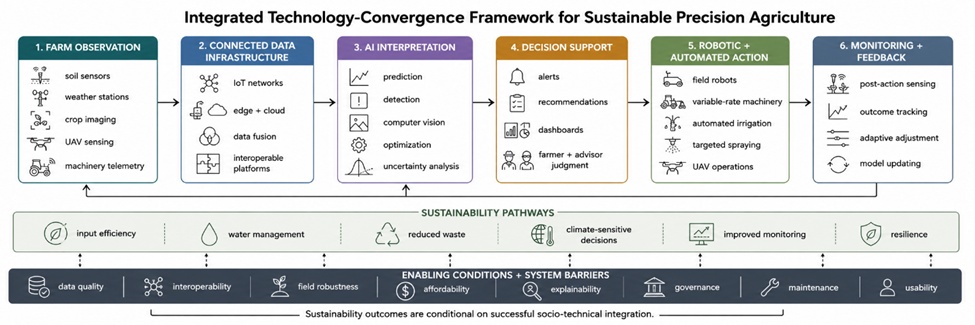
Figure 1. Integrative Technology-Convergence Framework for Sustainable Precision Agriculture. The figure shows how IoT sensing, remote sensing, machinery data, AI analytics, robotics, automation, decision-support interfaces, and farmer or advisor feedback interact within sustainable precision agriculture systems. It highlights system-level barriers, including interoperability, data quality, field robustness, affordability, usability, governance, energy requirements, and implementation capacity.
Alt-text description: A conceptual framework diagram showing IoT sensors, remote sensing, machinery data, AI analytics, robotics, automation, decision-support systems, and farmer or advisor feedback connected through data platforms and feedback loops. The framework links these technologies to sustainability goals such as resource efficiency, climate-smart management, reduced input waste, improved monitoring, and resilient farm decision-making, while showing system-level barriers including interoperability, data quality, cost, usability, governance, maintenance, and field validation.
Future research should treat digital advice networks and farmer-support systems as part of technology convergence rather than as external adoption channels. Agricultural knowledge and advice are increasingly shaped by digital platforms, data services, and decision-support tools, so research must examine how advisors, farmers, software systems, and automated machinery interact in practical decision settings [30].
Future convergence research should also evaluate Agriculture 4.0 through people, production, and planet outcomes rather than through technical feasibility alone [31]. This requires multidimensional sustainability assessment that considers input efficiency, water use, energy demand, emissions implications, labour effects, affordability, resilience, data governance, and farmer agency.
Technical research priorities include interoperable data architectures, reproducible AI workflows, robust field robotics, cyber-physical safety, edge-cloud coordination, secure data exchange, uncertainty-aware analytics, explainable decision support, and closed-loop validation across sensing, prediction, actuation, and feedback. These priorities should be tested under diverse farm sizes, crops, infrastructures, climates, and advisory arrangements rather than only under controlled or narrowly defined technical conditions.
Socio-technical research priorities include farmer-centered design, transparent governance, fair data-sharing models, advisory capacity building, small and medium-sized farm relevance, labour implications, maintenance support, and responsible automation. The next phase of sustainable precision agriculture research should ask not only whether AI, robotics, automation, and IoT can be connected, but whether their integration produces accountable, usable, affordable, resilient, and context-sensitive farm-management systems.
This integrative review synthesizes artificial intelligence, robotics, automation, and IoT as interdependent components of sustainable precision agriculture. The central contribution is a system-level interpretation of technology convergence in which sensing, data platforms, AI analytics, robotic or automated actuation, decision-support interfaces, and farmer or advisor feedback operate as connected loops rather than isolated innovations. The reviewed literature indicates that future progress depends on interoperability, field robustness, explainability, data quality, governance, affordability, maintenance capacity, farmer-centered design, and rigorous sustainability evaluation. Sustainable precision agriculture should therefore be advanced through careful socio-technical integration, not through assumptions that more data, greater automation, or autonomous systems automatically improve agricultural outcomes.
None
None
None
None
Open Access The author(s) retain copyright. This article is licensed under the Creative Commons Attribution-NonCommercial-ShareAlike 4.0 International License. It may be shared and adapted for non-commercial purposes with appropriate attribution, an indication of changes, and distribution of adaptations under the same license. Third-party material may be subject to separate terms identified in its credit line. View the license at https://creativecommons.org/licenses/by-nc-sa/4.0/.
 Agro Intelligence Research Press