Smart farming increasingly depends on data generated by sensors, machinery, farm management systems, remote monitoring tools, digital platforms, and decision-support applications. These data flows support agronomic decision-making, resource efficiency, traceability, automation, advisory services, and supply-chain coordination. As farm operations become more data-intensive, farm data becomes a strategic resource rather than a neutral technical by-product. Farm data creates governance challenges because its production, interpretation, exchange, and reuse are distributed across multiple actors and technical systems. Farmers, technology providers, platform operators, agribusiness firms, advisors, researchers, regulators, and supply-chain actors may each hold different forms of access, control, and responsibility. This creates ambiguity around ownership claims, interoperability obligations, privacy safeguards, consent practices, accountability pathways, and farmer agency. This article develops a layered conceptual framework for farm data governance in smart farming ecosystems. The framework conceptualizes farm data governance as an interaction among data production, technical interoperability, ownership and control, privacy and consent, accountability mechanisms, platform governance, institutional oversight, and farmer agency. It argues that these layers must be analysed together because weaknesses in one layer can undermine governance capacity across the ecosystem. The article synthesizes scholarship on digital agriculture, smart farming, data ownership, interoperability, privacy, accountability, platform governance, farmer agency, and responsible innovation. Rather than treating farm data governance as a purely legal or technical matter, it develops a socio-technical model of how data flows, governance responsibilities, and institutional safeguards interact. This approach supports a more integrated understanding of responsible data governance in smart farming. The proposed framework explains how farm data governance can be organized across technical, organizational, legal, ethical, platform, and institutional layers. It highlights the need for interoperable systems, transparent contracts, meaningful consent, privacy-sensitive data practices, accountable platforms, institutional oversight, and farmer participation. The article contributes a farmer-centered governance model for smart farming ecosystems that are data-driven, trustworthy, and accountable.
Smart farming marks a shift from machinery-centered modernization toward data-intensive agricultural ecosystems in which sensors, connected equipment, remote monitoring tools, farm management information systems, analytics services, and digital platforms mediate production decisions. Farm data now travels from fields, machines, soils, animals, weather systems, and advisory tools into analytics environments that support operational decisions and value-chain coordination. This transformation makes farm data a strategic resource for production optimization, automation, risk management, traceability, and platform-based value creation [1].
The governance challenge is not simply that agriculture now produces more data, but that data-driven farming reorganizes relationships among technologies, institutions, markets, advisory systems, and farmers. Digital agriculture scholarship shows that smart farming changes social relations, professional roles, advisory infrastructures, and institutional responsibilities, making it a socio-technical transformation rather than a narrow technical upgrade [2]. Farm data governance must therefore consider who can access data, who can interpret it, who can commercialize it, and who remains accountable when data-driven decisions affect farm outcomes.
Responsible innovation provides a normative foundation for analysing these questions because smart farming systems shape future agricultural pathways before their social consequences are fully settled. A governance framework should ask not only whether digital tools work, but whether they remain inclusive, responsive, reflexive, and accountable to affected actors [3]. This is especially important where data-driven systems influence farmer autonomy, advisory dependence, technology adoption, and the distribution of benefits from digital agriculture.
The aim of this article is to develop a layered conceptual framework for farm data governance in smart farming ecosystems. The framework connects ownership and control, interoperability, privacy and consent, accountability, platform governance, institutional oversight, and farmer agency as interacting constructs rather than separate problems. This framing follows ethical analyses of smart farming that link privacy, data ownership, control, trust, responsibility, and future-oriented responsible innovation in agricultural data systems [4].
Farm data becomes a governance challenge when farmers cannot easily see how data is collected, processed, shared, monetized, or returned as actionable value. Trust in smart farming depends on transparency about data use and on credible expectations that benefits are not captured only by technology providers or downstream actors. When farmers do not know what happens to their data after collection, data sharing becomes a question of legitimacy, fairness, and benefit distribution rather than a simple matter of technical transfer [5].
Farm data also differs from ordinary operational data because it can reveal commercially sensitive and strategically valuable information about farm performance, input use, yields, land management, financial exposure, production risks, and spatial patterns. Legal ambiguity around data ownership, contractual control, privacy protection, and downstream reuse can make farmers reluctant to share data even when digital tools promise agronomic or economic advantages [6]. This reluctance should be interpreted as a rational governance concern, not merely as resistance to innovation.
Governance challenges are further complicated because smart farming actors do not perceive risks and responsibilities in the same way. Regulators, agribusiness firms, technology providers, advisory organizations, and farmers may prioritize different safeguards, benefits, and acceptable uses of data. Risk perception among governance actors shapes whether farm data is framed as an innovation asset, a commercial resource, a privacy concern, a public-interest input, or a source of institutional responsibility [7].
Uneven participation also turns farm data governance into a power question. Digital farming may amplify the influence of actors with technical capacity, market access, platform infrastructure, or analytical expertise while limiting the ability of some farmers to shape the rules under which data is exchanged and used [8]. Table 1 summarises the major governance challenges created by farm data flows in smart farming ecosystems.
Table 1. Farm Data Governance Challenges in Smart Farming Ecosystems: Data Types, Actors, Ownership Ambiguities, Interoperability Frictions, Privacy Risks, Accountability Gaps, Platform Dependencies, and Farmer Agency Concerns
Governance challenge | Typical farm data involved | Main actors affected | Ownership or control ambiguity | Interoperability friction | Privacy or consent risk | Accountability gap | Platform dependency concern | Farmer agency concern |
Data capture across distributed devices | Sensor readings, machinery logs, yield maps, input records, remote monitoring data | Farmers, machinery firms, platform providers, advisors | Unclear distinction between data generator, device owner, service provider, and data controller | Device-specific formats and limited cross-platform exchange | Continuous data capture may exceed what farmers understood when adopting a service | Responsibility for inaccurate or incomplete data may be unclear | Farmers may rely on proprietary devices or cloud services to access their own data | Farmers may have limited ability to decide what is collected or retained |
Data movement into platforms | Farm management records, platform dashboards, advisory recommendations, operational histories | Farmers, platform operators, agribusiness firms, advisors | Platform terms may grant broad rights over aggregation, reuse, or analytics | APIs, export tools, and data portability may be restricted | Data reuse may occur beyond the original farm-level purpose | Limited visibility into who accessed or processed data | Switching costs increase when data histories remain locked inside one platform | Farmers may lose bargaining power over service conditions |
Data sharing across supply chains | Traceability records, certification data, production practices, sustainability metrics | Farmers, processors, retailers, certifiers, supply-chain partners | Data required for market access may blur voluntary sharing and compelled disclosure | Supply-chain actors may use different standards or reporting systems | Sensitive operational information may become visible to powerful buyers | Unclear remedies when data is misinterpreted or used unfairly | Dominant supply-chain platforms may set unilateral data-sharing rules | Farmers may have limited voice in defining acceptable data uses |
Data analytics and decision support | Predictive models, recommendations, risk scores, benchmarking outputs | Farmers, advisors, analytics providers, insurers, lenders | Derived insights may be controlled by analytics providers rather than data contributors | Model outputs may not integrate easily with existing advisory or farm systems | Analytics may infer sensitive business information from multiple data streams | Responsibility for harmful recommendations may be difficult to assign | Farmers may depend on opaque analytics for operational decisions | Farmer expertise may be displaced when recommendations are treated as authoritative |
Data aggregation and value creation | Aggregated yield patterns, regional benchmarks, market intelligence, environmental data | Farmers, platforms, researchers, policymakers, agribusiness firms | Value created from aggregated farm data may not be returned to contributors | Aggregation requires comparable data structures and shared definitions | Anonymized datasets may still reveal sensitive patterns in sparse rural contexts | Accountability for secondary use may be weak after aggregation | Platforms may capture network value from pooled data | Farmers may not participate in decisions about data value distribution |
Ownership and control are overlapping but distinct governance constructs in smart farming ecosystems. A formal ownership claim may not determine who can access, process, interpret, combine, commercialize, or restrict farm data in practice. Agricultural data governance therefore needs to move beyond a narrow ownership debate toward a broader architecture of access rights, control mechanisms, data stewardship, portability, and institutional safeguards [9].
Voluntary agricultural data codes can help clarify expectations around transparency, permission, disclosure, portability, and complaint handling. However, codes remain limited if they depend mainly on voluntary compliance without credible monitoring, enforcement, or farmer-accessible accountability mechanisms. In a layered framework, such codes should be treated as governance instruments that can support trust but cannot substitute for enforceable rights, transparent contracts, and institutional oversight [10].
Data control becomes more complex when farm data enters a wider agricultural data economy. Agricultural data may produce value through benchmarking, analytics, market intelligence, risk assessment, sustainability reporting, and supply-chain coordination, yet this value may be captured by actors other than the original data contributors. Governance must therefore address collective-action problems and value-distribution issues that cannot be solved only through individual bilateral contracts [11].
Control disputes intensify when farm data is converted into proprietary analytics, intellectual property, and AI-enabled decision-support services. In such cases, farmers may retain a relationship to the original data while companies control derived models, recommendations, aggregated insights, or commercial applications built from farm-level information. A layered governance framework must therefore distinguish data generation, data access, data interpretation, analytical control, commercial reuse, and responsibility for consequences [12].
Interoperability is often treated as a technical requirement, but in farm data governance it is also a rule-making problem about who can move data, under what conditions, and for whose benefit. Agri-food data sharing requires infrastructures that allow cross-organisational exchange while still responding to trust, privacy, and coordination concerns [13]. Without governance rules around access, purpose, quality, and responsibility, interoperability can simply accelerate uncontrolled data movement.
Semantic interoperability is especially important because farm data may carry different meanings across sensors, machinery brands, farm management systems, certification schemes, advisory tools, and supply-chain reporting platforms. Data fields that appear similar may refer to different agronomic practices, measurement units, spatial scales, time intervals, or classification systems. Agricultural supply-chain data sharing therefore requires shared vocabularies and semantic structures so that data remains interpretable when it travels across organizational and technical boundaries [14].
Platform-level interoperability adds another layer of governance difficulty because digital agriculture increasingly depends on proprietary systems, service ecosystems, and data architectures. When platform interfaces are poorly aligned, farmers may face duplicated data entry, fragmented dashboards, limited export functions, and restricted integration between tools. Interoperability architectures for digital agri-food platforms show why shared interfaces, aligned standards, and cross-platform integration mechanisms are needed to prevent isolated tools from becoming governance bottlenecks [15].
Open and FAIR-oriented agricultural data approaches can improve reuse, transparency, and collective learning, but openness cannot be treated as an unconditional good. Agricultural data varies in quality, context, sensitivity, commercial value, and re-identification risk, so data-sharing arrangements must specify who can access which data and under what conditions. Open agricultural data governance therefore requires attention to standards, metadata, portability, access rules, data quality, and sensitivity safeguards [16].
Privacy in smart farming ecosystems is not limited to personal data in the conventional sense. Farm data can expose production practices, geolocation, input strategies, yield variability, financial vulnerability, environmental performance, disease risks, and competitive intelligence. Agricultural IoT security threats demonstrate that privacy protection depends on the security of devices, networks, cloud infrastructures, and data transmission channels that collect and move farm data [17].
Accountability mechanisms must also address the power asymmetries created when analytics providers, platform operators, and agribusiness firms transform farm data into recommendations, rankings, benchmarks, or commercial intelligence. Agricultural big-data analytics can concentrate interpretive power in actors that control models, aggregated datasets, and decision-support infrastructures [18]. In a layered governance framework, accountability must therefore include transparency about data processing, auditability of automated outputs, and responsibility for harmful or unfair data-driven decisions.
Agricultural AI governance extends these concerns because automated recommendations may influence resource use, risk management, farm finance, insurance, compliance, and advisory practices. Transparency, fairness, privacy protection, responsibility, and accountability are therefore not optional ethical additions, but core governance requirements for data-driven agriculture [19]. Consent should be understood as a continuing relationship that can be updated, withdrawn, audited, and explained as data moves into new forms of analytics and reuse.
Trusted farm data sharing depends on transparent contracts, credible data-sharing rules, and shared expectations about acceptable access and reuse. Consent mechanisms are weaker when farmers must accept broad service conditions without clear information about secondary use, aggregation, retention, transfer, or dispute resolution [20]. Table 2 maps ownership, interoperability, privacy, consent, and accountability mechanisms across smart farming data governance domains.
Table 2. Governance Mechanisms for Farm Data in Smart Farming Ecosystems: Ownership Rights, Access Control, Interoperability Standards, Data-Sharing Rules, Privacy Safeguards, Consent Models, Accountability Pathways, and Trust-Building Conditions
Governance domain | Core governance question | Ownership or control mechanism | Interoperability mechanism | Privacy or consent mechanism | Accountability pathway | Trust-building condition |
Data collection | Who may collect farm data and for what purpose? | Clear allocation of collection rights among farmers, device providers, advisors, and platforms | Standardized data capture formats and metadata requirements | Prior explanation of data categories, collection frequency, retention, and purpose | Documented collection responsibilities and logs of data capture | Farmers understand what is collected before service adoption |
Data access | Who may view, retrieve, export, or restrict farm data? | Role-based access rights and farmer-facing permissions | Export tools, open APIs, and machine-readable access formats | Granular consent for different users and purposes | Access logs, audit trails, and complaint procedures | Farmers can see and manage who has access |
Data sharing | Under what conditions may farm data move across organizations? | Data-sharing agreements defining reuse, aggregation, and onward transfer | Shared standards, semantic mapping, and interoperable exchange protocols | Purpose limitation, confidentiality rules, and consent renewal | Traceable data-sharing records and breach notification duties | Sharing rules are understandable and enforceable |
Data analytics | Who may transform farm data into recommendations, scores, or benchmarks? | Rights over derived insights, model outputs, and commercial reuse | Compatible analytics outputs that can be interpreted across systems | Privacy-preserving analytics and protection against sensitive inference | Explainability, validation, liability rules, and contestation mechanisms | Farmers can question recommendations and understand their basis |
Platform governance | Who sets the rules for platform participation and data reuse? | Transparent service conditions and limits on unilateral rule changes | Cross-platform portability and interface compatibility | Clear consent for platform aggregation, retention, and secondary use | Independent oversight, monitoring, and dispute resolution | Platform rules are fair, stable, and open to review |
Institutional oversight | Who ensures that data governance remains legitimate and fair? | Regulatory safeguards, collective governance, and sector-level stewardship | Standard-setting bodies and certification of interoperable systems | Privacy-by-design expectations and enforceable consent standards | Public oversight, auditability, and sanctions for misuse | Farmers have representation in governance decisions |
The layered governance logic begins from the premise that farm data governance cannot be solved at one level of intervention. A socio-cyber-physical view of digital agricultural transformation shows that responsibility is distributed across human actors, digital systems, organizational arrangements, and institutional environments [21]. This means that governance mechanisms must connect data infrastructures with farmer practices, platform rules, advisory relationships, and regulatory oversight.
The layers can reinforce or undermine one another. For example, stronger interoperability may improve data portability and collective learning, but it may also increase exposure to privacy risks, unauthorized reuse, or unfair value capture if consent and accountability mechanisms remain weak. Perceived risk, vulnerability, and institutional trust are therefore boundary conditions that shape whether digital data use in agriculture becomes socially robust or contested [22].
Layered governance must also remain adaptive because Agriculture 4.0 does not follow a single pathway. Different production systems, farm sizes, advisory traditions, market structures, regulatory settings, and technology ecosystems create different governance needs. Managing diversity and responsibility in digital agricultural transitions requires a framework that can adjust to local conditions while retaining core principles of transparency, accountability, interoperability, privacy protection, and farmer agency [23].
Platform dependency is a particularly important boundary condition because platform operators can shape access rules, data formats, service conditions, analytics options, and switching costs. The politics of digital agricultural technologies shows that data control is linked to market power, concentration, dependency, and the ability of farmers to participate in shaping technological futures [24]. A layered framework must therefore treat platform governance as both a technical architecture issue and a political-economic accountability issue.
The proposed framework conceptualizes farm data governance as an eight-layer ecosystem composed of farm data production, technical interoperability, ownership and control, privacy and consent, accountability mechanisms, platform governance, institutional oversight, and farmer agency. Governance responsibility should be distributed across farmers, technology providers, platform operators, advisors, cooperatives, researchers, regulators, and supply-chain actors rather than assigned to a single actor [25]. This multi-actor logic recognizes that farm data moves through systems in which different participants control different points of collection, access, interpretation, reuse, and enforcement.
At the base of the framework, farm data production includes data generated through sensors, machinery, farm management systems, platforms, and decision-support tools. The technical interoperability layer then determines whether these data can move across systems through standards, APIs, semantic compatibility, and portability. Trusted agricultural data-space principles help connect interoperability with access control, consent, security, and accountability, making the platform layer a governance mechanism rather than merely an exchange infrastructure [26].
The ownership and control layer defines claims over data access, reuse, aggregation, commercialization, and derived value, while the privacy and consent layer governs sensitive information, confidentiality, cybersecurity, and permission for secondary use. The accountability layer specifies transparency, auditability, explainability, liability, and dispute resolution across data flows. Figure 1 illustrates the layered conceptual framework for farm data governance, showing how ownership, interoperability, privacy, and accountability interact across smart farming ecosystems.
The platform governance and institutional oversight layers shape the conditions under which farm data can be shared, monetized, regulated, audited, and contested. Farmer agency is placed at the top of the framework not because it is separate from technology, but because it should inform decisions across every layer, including collection, interoperability, contracts, consent, platform rules, and value distribution. Farm data governance should include mechanisms for value creation, value capture, and value return so that data contributors can understand and negotiate how benefits are generated and distributed [27]. Table 3 presents the proposed layered conceptual framework for farm data governance in smart farming ecosystems.
Table 3. Layered Conceptual Framework for Farm Data Governance in Smart Farming Ecosystems: Data Production, Technical Interoperability, Ownership and Control, Privacy and Consent, Accountability, Platform Governance, Institutional Oversight, Farmer Agency, and Research Implications
Framework layer | Core construct | Main governance function | Key actors | Mechanisms | Boundary conditions | Research implications |
Farm data production | Data generation from farm operations and digital tools | Defines what data enters the ecosystem and how it is captured | Farmers, machinery firms, sensor providers, advisors, platform operators | Data inventories, metadata, collection notices, data quality protocols | Uneven digital capacity, device dependence, data quality variation | Examine how data categories shape downstream control and value |
Technical interoperability | Capacity for data to move across systems and retain meaning | Enables portability, integration, reuse, and cross-platform exchange | Technology providers, standard-setting bodies, platforms, advisors | APIs, semantic standards, data formats, portability tools | Proprietary systems, weak standards, high switching costs | Compare interoperability models across farming systems and platforms |
Ownership and control | Claims over access, reuse, exclusion, commercialization, and derived insights | Clarifies who can use data and under what authority | Farmers, platforms, agribusiness firms, researchers, regulators | Contracts, access rights, stewardship rules, value-sharing arrangements | Legal ambiguity, unequal bargaining power, data aggregation | Analyse how control differs from formal ownership in practice |
Privacy and consent | Protection of sensitive farm information and meaningful permission | Limits inappropriate collection, inference, sharing, and reuse | Farmers, platforms, technology providers, advisors, data users | Granular consent, confidentiality rules, cybersecurity, purpose limitation | Continuous data capture, secondary use, re-identification risk | Study consent as an ongoing governance relationship |
Accountability mechanisms | Responsibility for data processing, analytics, recommendations, and harms | Makes data-driven actions explainable, contestable, and reviewable | Platforms, AI providers, advisors, regulators, farmers | Audit trails, explainability, liability rules, dispute resolution | Opaque models, unclear responsibility chains, weak enforcement | Develop models for algorithmic and platform accountability |
Platform governance | Rules set by digital service ecosystems and data platforms | Structures access, dependency, switching, data reuse, and service conditions | Platform operators, farmers, agribusiness firms, cooperatives | Transparent terms, portability, monitoring, fair participation rules | Vendor lock-in, market concentration, unilateral rule changes | Investigate platform dependency and farmer bargaining capacity |
Institutional oversight | Sector-level rules, standards, and enforcement capacity | Provides legitimacy, coordination, and safeguards beyond contracts | Regulators, cooperatives, industry bodies, researchers, public agencies | Regulation, certification, codes, collective governance, oversight bodies | Fragmented authority, regulatory lag, weak farmer representation | Compare regulatory and collective governance arrangements |
Farmer agency | Capacity of farmers to understand, negotiate, contest, and benefit from data use | Ensures governance remains farmer-centered and legitimate | Farmers, cooperatives, advisors, extension organizations, platforms | Participation, data literacy, collective representation, benefit-sharing | Power asymmetry, digital exclusion, advisory dependency | Evaluate participatory governance and responsible innovation models |
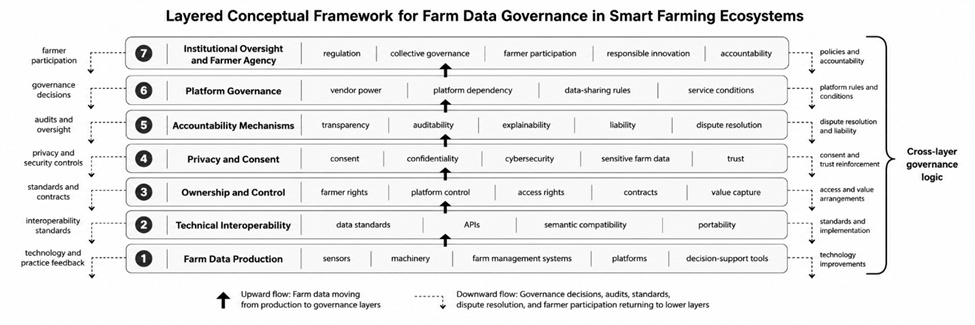
Figure 1. Layered Conceptual Framework for Farm Data Governance in Smart Farming Ecosystems: ownership, interoperability, privacy, consent, accountability, platform governance, institutional oversight, and farmer agency across farm data flows.
Alt-text description: A layered conceptual framework diagram showing farm data governance as a multi-layer ecosystem. The bottom layer shows farm data production from sensors, machinery, farm management systems, platforms, and decision-support tools. Above it are layers for technical interoperability, ownership and control, privacy and consent, accountability mechanisms, platform governance, institutional oversight, and farmer agency. Arrows show farm data moving upward from production to governance decisions and feedback loops returning from accountability and institutional oversight to farmers, platforms, and technology providers.
For practice, the framework suggests that farm data governance should begin with transparent data inventories, understandable contracts, interoperable export options, privacy-by-design safeguards, and clear accountability channels. Trust-building across agricultural data sharing requires attention to legal, technical, informational, social, and economic barriers rather than reliance on a single technical standard or legal document [28]. Farmers, cooperatives, advisors, and platform operators should therefore co-develop data-sharing rules that specify access, reuse, retention, aggregation, portability, dispute resolution, and benefit distribution.
For policymakers and standard-setting bodies, the framework points to the need for governance instruments that connect interoperability standards with rights, consent, accountability, and institutional oversight. Technical standards should be accompanied by rules on transparency, auditability, farmer representation, portability, data quality, and fair participation in platform ecosystems. Responsible innovation approaches in precision agriculture indicate that participatory processes can help align emerging technologies with the needs, values, and vulnerabilities of affected actors [29].
For research, the framework identifies several conceptual and empirical priorities without reducing the article to an empirical study. Future work should examine how ownership claims operate differently from practical control over access, analytics, and reuse in specific smart farming contexts [9]. Further research should also compare consent models, collective data governance arrangements, agricultural data spaces, platform accountability mechanisms, algorithmic explanation practices, and value-distribution models across different farming systems and institutional settings [26].
This article has developed a layered conceptual framework for farm data governance in smart farming ecosystems. The framework positions farm data governance as a multi-layer socio-technical process involving data production, technical interoperability, ownership and control, privacy and consent, accountability mechanisms, platform governance, institutional oversight, and farmer agency. Its central contribution is to show how these layers interact as data moves across farms, platforms, advisory systems, supply chains, research environments, and regulatory settings.
Farm data governance should not be reduced to ownership alone or to technical interoperability alone. Ownership claims matter, but they are insufficient without practical control over access, reuse, portability, value capture, and accountability. Interoperability matters, but it can intensify privacy, consent, and power concerns when data movement is not governed by trustworthy rules and institutional safeguards.
The framework therefore calls for smart farming ecosystems that are data-driven without being extractive, interoperable without weakening privacy, innovative without reducing farmer control, and accountable across every layer of farm data use. Such ecosystems require transparent contracts, meaningful consent, responsible platforms, institutional oversight, farmer participation, and governance mechanisms that remain sensitive to power, trust, and context. Farm data governance is most robust when technical design, legal protection, ethical responsibility, and farmer agency are treated as mutually reinforcing parts of the same ecosystem.
None
None
None
None
Open Access The author(s) retain copyright. This article is licensed under the Creative Commons Attribution-NonCommercial-ShareAlike 4.0 International License. It may be shared and adapted for non-commercial purposes with appropriate attribution, an indication of changes, and distribution of adaptations under the same license. Third-party material may be subject to separate terms identified in its credit line. View the license at https://creativecommons.org/licenses/by-nc-sa/4.0/.
 Agro Intelligence Research Press