Explainable artificial intelligence is becoming central to precision agriculture because farm-management decisions increasingly depend on algorithmic recommendations generated from sensor, remote-sensing, weather, soil, crop, and machinery data. However, technical performance alone does not make agricultural AI trustworthy. A recommendation may be statistically accurate yet remain unusable if farmers cannot understand why it was produced, how uncertain it is, whether it fits local conditions, or how it can be questioned. This article develops a farmer-centered approach to explainable AI for precision agriculture. It argues that explainability must connect model logic with farmer interpretation, contextual judgment, decision confidence, contestability, accountability, and feedback learning. The proposed perspective treats farmers not as passive recipients of algorithmic advice but as active interpreters, evaluators, and co-decision-makers within human-in-the-loop agricultural systems. By reframing explainable AI as a socio-technical decision-support requirement, the article contributes a foundation for trustworthy algorithmic decision support that is understandable, usable, context-sensitive, and accountable in real farm-management conditions.
Precision agriculture has evolved from isolated digital tools into a data-intensive smart-farming ecosystem in which agronomic, environmental, operational, and economic data are combined to support farm-management decisions. Smart farming therefore cannot be understood only as the use of sensors, platforms, or automated equipment; it is a socio-technical system in which data ownership, analytics, value creation, decision authority, and stakeholder relationships become central to farm practice [1]. At the same time, deep learning and other advanced computational methods have expanded the scope of agricultural prediction, classification, monitoring, and recommendation, creating powerful models whose internal reasoning may be difficult for farmers and advisers to understand [2].
Artificial intelligence and machine learning are now widely positioned as enabling technologies for precision agriculture because they can transform heterogeneous farm data into predictions about crop performance, input requirements, pest and disease risk, irrigation demand, yield variability, and management efficiency. Yet the growing technical sophistication of these systems also creates a practical challenge: algorithmic outputs must be interpreted within uncertain, local, and economically constrained farming environments, not merely evaluated through predictive accuracy [3].
Agricultural decision-support systems provide the bridge between data analytics and farm action, but that bridge is often fragile when systems provide recommendations without explaining their rationale, uncertainty, assumptions, or contextual limits. Decision support in Agriculture 4.0 depends on the capacity to integrate data sources, analytical methods, user interfaces, and management workflows in ways that help farmers make timely and defensible decisions [4]. For this reason, explainable AI should be treated as a decision-support requirement rather than as a technical add-on.
This article argues that explainable AI in precision agriculture must be evaluated by whether farmers can understand, question, contextualize, trust, and act on algorithmic recommendations under real farm-management conditions. The central contribution is a farmer-centered framework that links algorithmic transparency, interpretability, usability, decision confidence, contextual judgment, contestability, accountability, feedback learning, and trust calibration into a coherent logic for trustworthy agricultural decision support [4].
Explainable AI refers to the design and evaluation of AI systems whose outputs, reasoning patterns, influential variables, assumptions, and limitations can be made understandable to relevant users. In precision agriculture, this means that an algorithmic recommendation should not only state what action is suggested but should also clarify why the recommendation was produced, which data influenced it, how confident the system is, and under what farm conditions the advice may or may not apply. Interpretable machine learning in agricultural data analysis is therefore essential because farm decisions involve biological variability, weather uncertainty, soil heterogeneity, management history, and economic trade-offs [5].
The need for explainability becomes stronger as smart agriculture moves toward more automated, data-rich, and interconnected systems. Agriculture 5.0 and related smart-farming visions place AI within broader systems of sensing, connectivity, robotics, digital platforms, and decision support, but such systems risk becoming inaccessible to farmers when explanations are designed only for technical specialists. Explainable AI must therefore translate model logic into forms that support situated agricultural reasoning, including practical questions about timing, input levels, expected benefits, uncertainty, and operational feasibility [6].
Crop recommendation systems illustrate why explainability matters for precision agriculture. A recommendation to select a crop, adjust an input, or change a management practice is not self-justifying simply because a model has generated it. Farmers need to know which soil, climate, historical, and management variables shaped the recommendation, whether alternative actions were considered, and whether the explanation aligns with field-level experience. Explainable crop recommendation research shows that agricultural decision support can become more transparent when recommendation outputs are accompanied by interpretable reasons [7].
The farmer-centered challenge is therefore not to replace agronomic expertise with algorithmic authority, but to make AI outputs intelligible enough to support human judgment. Explainability in precision agriculture should enable farmers to compare algorithmic advice with local knowledge, seasonal uncertainty, market conditions, labor availability, equipment constraints, environmental goals, and risk tolerance. In this sense, XAI functions as a practical interface between computational prediction and contextual farm decision-making [5].
Farmer trust in digital agriculture depends heavily on transparency about what data are collected, how they are used, who benefits from them, and how algorithmic outputs affect farm decisions. Smart-farming technologies can generate uncertainty and mistrust when farmers cannot see how their data are handled or how value is distributed among technology providers, advisers, processors, and producers. Trust is therefore not only a psychological attitude toward technology; it is shaped by transparency, benefit-sharing, accountability, and the perceived fairness of digital agriculture arrangements [8].
Adoption of digital agriculture is also influenced by whether farmers perceive technologies as useful, reliable, compatible with their goals, and trustworthy in everyday decision-making. Profitability matters, but trust can shape whether farmers are willing to depend on digital recommendations, integrate platforms into routines, and expose farm data to external systems. Algorithmic decision support that lacks understandable explanations may weaken adoption because farmers are asked to act on advice without knowing why it is relevant or whether it fits their conditions [9].
Responsibility is a further condition of trust. When AI-supported recommendations contribute to input waste, crop loss, environmental harm, or poor economic outcomes, farmers need clarity about who is accountable: the technology developer, data provider, adviser, platform operator, or farmer-user. Responsible AI in agriculture therefore requires more than model transparency; it requires governance arrangements that make responsibility visible across the design, deployment, interpretation, and use of AI-enabled systems [10].
Trustworthy algorithmic transparency should not overload farmers with technical details that are irrelevant to decisions. Instead, transparency should be calibrated to the decision context: farmers need explanations that identify the recommendation, the main reasons behind it, the uncertainty range, the data limitations, the practical consequences, and the available alternatives. In farmer-centered precision agriculture, transparency is valuable when it strengthens appropriate trust, prevents blind reliance, and supports informed questioning of algorithmic advice [8].
Interpretability concerns whether a model’s reasoning can be understood in relation to the variables, rules, patterns, or evidence that shaped its output. In precision agriculture, interpretable crop recommendation models can reveal how soil characteristics, climate variables, nutrient levels, management history, or other farm data contribute to a recommendation. Such explanations help farmers evaluate whether the recommendation is agronomically plausible, locally relevant, and worth acting upon [11].
Usability requires that explanations be delivered in forms farmers can access and use during actual decision-making. A technically interpretable model may still be practically unusable if its explanation is hidden in complex visualizations, statistical language, or interface designs that do not match farm workflows. User-facing explainable recommendation systems show why explanation delivery matters: the explanation layer must be connected to interfaces, dashboards, or advisory formats that allow farmers to compare recommendations, inspect reasons, and understand confidence levels before acting [12].
Decision confidence depends not only on whether an explanation exists but also on whether its quality can be assessed. Explanations should be evaluated for clarity, completeness, relevance, consistency, and usefulness in the decision context. In smart-agriculture environments, explanation assessment is important because different XAI methods may produce different forms of evidence, and not all explanations are equally meaningful for field-level decisions. Explanation quality should therefore be examined as part of decision-support performance rather than assumed from the presence of an XAI method [13].
Visual explanations are particularly important for agricultural tasks involving images, remote sensing, disease diagnosis, weed detection, crop monitoring, or field-zone classification. Gradient-based visualization methods can show which regions of an image contributed to a prediction, helping users inspect whether a model focused on agronomically meaningful features or irrelevant background patterns. Such visual interpretability can support decision confidence when it helps farmers and advisers understand what the model attended to before generating a classification or recommendation [14].
Table 1 summarises the key explainability, usability, and decision-confidence requirements for farmer-centered algorithmic decision support in precision agriculture.
Table 1. Explainability, Usability, and Decision-Confidence Requirements for Farmer-Centered Algorithmic Decision Support in Precision Agriculture: Transparency, Interpretability, Uncertainty Communication, Contextual Relevance, Actionability, Contestability, Trust Calibration, and Decision Confidence
Requirement domain | Explanation function | Farmer need addressed | Decision-support implication | Risk if absent | Framework relevance |
Transparency | Shows what data, assumptions, and decision rules shape the recommendation | Knowing where the advice comes from and what it is based on | Makes algorithmic advice inspectable before action | Farmers may distrust or blindly follow opaque recommendations | Establishes the visibility needed for trustworthy AI-supported decisions |
Interpretability | Explains the main variables, patterns, or rules behind the output | Understanding why a recommendation was produced | Supports agronomic plausibility checks and comparison with experience | Recommendations may appear arbitrary or disconnected from field reality | Links model logic to farmer reasoning |
Uncertainty communication | Presents confidence levels, uncertainty ranges, and data limitations | Knowing how reliable or fragile the recommendation is | Helps farmers adjust decisions under risk and variability | Farmers may overestimate model certainty or misjudge risk | Enables calibrated trust rather than blind reliance |
Contextual relevance | Connects recommendations to local soil, weather, crop, labor, machinery, and economic conditions | Assessing whether the advice fits the farm situation | Supports adaptation of algorithmic advice to real management constraints | Advice may be technically valid but practically unsuitable | Makes explainability farm-specific and situated |
Usability | Delivers explanations through clear language, accessible visuals, and decision-oriented interfaces | Using explanations during time-sensitive farm decisions | Improves interaction between farmers, advisers, and digital tools | Explanations may exist but remain unused | Converts interpretability into practical decision support |
Actionability | Clarifies what action is recommended, why it matters, and what alternatives exist | Knowing what can be done next and with what consequences | Supports movement from prediction to management response | Outputs may remain informational but not decision-relevant | Connects explanation to farm action |
Contestability | Allows farmers to question, override, correct, or challenge recommendations | Retaining agency when algorithmic advice conflicts with local knowledge | Encourages human-in-the-loop decision-making | Farmers may feel controlled by systems they cannot challenge | Protects farmer autonomy and contextual judgment |
Trust calibration | Helps farmers judge when to rely on, question, or reject AI advice | Avoiding both overtrust and undertrust | Supports appropriate dependence on algorithmic outputs | Users may either ignore useful advice or follow poor advice | Aligns trust with system capability and contextual fit |
Decision confidence | Supports a reasoned belief that the chosen action is understandable, defensible, and context-sensitive | Feeling able to act under uncertainty | Strengthens accountable and informed farm-management decisions | Decisions may be delayed, resisted, or taken without confidence | Defines the practical outcome of farmer-centered explainability |
Opaque decision-support systems create ethical risks when farmers are asked to act on algorithmic outputs without understanding the basis, limitations, or consequences of those outputs. In digital agriculture, responsible AI requires attention to transparency, fairness, privacy, accountability, inclusiveness, and the practical effects of automated recommendations on producers and farming communities. If these safeguards are absent, explainable AI becomes more than a technical preference; it becomes a condition for responsible use of AI in agricultural decision-making [15].
Agricultural AI can also introduce operational risks when models are deployed in complex environments where weather volatility, biological variability, equipment constraints, market pressure, and incomplete data affect the outcome of any recommendation. A model may perform well under development conditions but fail when used across different soils, crops, climates, or management systems. Risk management in agricultural AI must therefore include not only accuracy testing but also explanation, monitoring, human oversight, and mechanisms for identifying when a recommendation should not be trusted [16].
The risks of opaque AI are not limited to individual farms. Agricultural AI systems can generate wider externalities when algorithmic recommendations influence input use, land management, environmental outcomes, labor relations, market access, and dependency on technology providers. Responsible AI in agriculture therefore requires systemic analysis of risks, because a technically successful model may still create uneven benefits, hidden costs, or unintended consequences across agricultural systems [17].
Opaque decision support can also affect autonomy, responsibility, and social relations in farming. When farmers cannot understand or contest algorithmic recommendations, decision authority may shift from local expertise toward remote technical systems, platforms, or data intermediaries. The social and ethical impacts of agricultural AI show why explainability must be connected to autonomy, accountability, and governance, rather than treated only as a model-level feature [18].
Farmer-centered explainability begins with the recognition that smart-farming technologies are developed within socio-ethical contexts, not neutral technical spaces. Responsible innovation in smart farming requires developers, advisers, researchers, and agricultural stakeholders to anticipate how technologies affect power relations, data control, environmental outcomes, farmer autonomy, and practical decision-making. Explainability requirements should therefore be defined before deployment, not added after farmers encounter confusion, mistrust, or harm [19].
Farmers should also participate in defining what counts as a useful explanation. Responsible innovation in Agriculture 4.0 argues for broader inclusion in the design and governance of smart-farming technologies, especially because automated and data-driven systems can reshape agricultural practice in ways that are not fully captured by efficiency or productivity metrics. A farmer-centered XAI system must therefore ask what farmers need to know, when they need to know it, and how explanation should support practical judgment [20].
Contextual relevance is a core explainability requirement because farming decisions are situated in local knowledge, field history, experience, and changing environmental conditions. Research on agricultural decision-support systems shows that farmers do not simply receive system outputs; they interpret them through situated knowledge about soils, crops, weather patterns, machinery capacity, risk exposure, and previous management outcomes. Explainable AI must therefore make room for farmer knowledge as a valid source of decision reasoning [21].
These requirements imply that explainability should support agency rather than compliance. A farmer-centered system must allow users to inspect the recommendation, understand its rationale, assess uncertainty, compare alternatives, apply local knowledge, question the advice, record disagreement, and feed outcomes back into future system learning. Such requirements align responsible smart-farming development with practical farm-management use, because explanation becomes a shared decision resource rather than a one-way technical output [19].
Figure 1 maps farmer-centered explainability requirements for trustworthy algorithmic decision support in precision agriculture.
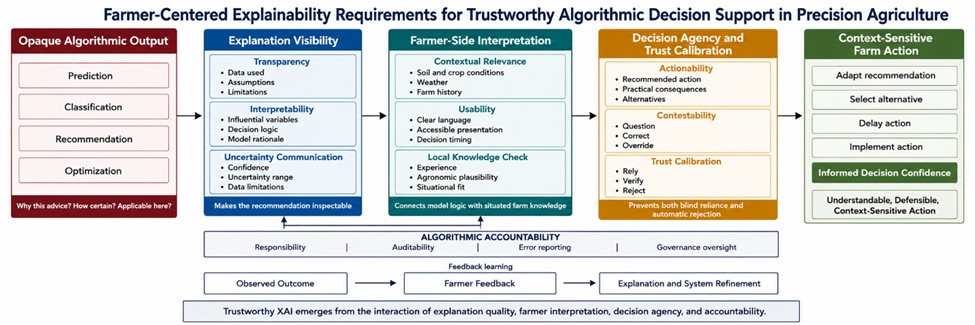
Figure 1. Farmer-Centered Explainability Requirements for Trustworthy Algorithmic Decision Support in Precision Agriculture.
Alt-text description: A conceptual requirements map showing farmer trust at the center, surrounded by explainability requirements including transparency, interpretability, uncertainty communication, contextual relevance, usability, actionability, contestability, accountability, trust calibration, and feedback learning. Arrows show how these requirements connect algorithmic outputs to farmer understanding, decision confidence, and contextual farm action.
The proposed framework treats farmer-centered explainable AI as an interdisciplinary decision-support system that integrates technical model logic, farm-management context, ethical accountability, and user interpretation. Agricultural AI cannot be designed only through computer science or agronomy because its recommendations affect human decision-making, environmental outcomes, economic risk, and institutional responsibility. A trustworthy framework must therefore connect model transparency with social, ethical, and practical dimensions of agricultural decision support [22].
The framework is organized around multiple evaluation criteria rather than a single measure of model performance. Accuracy remains important, but it is insufficient unless the system also supports transparency, interpretability, usability, fairness, contestability, accountability, and sustainability. A responsible AI framework for farming supports this multi-criteria logic because agricultural technology design must consider how systems affect users, decisions, risks, and long-term farm-system outcomes [23].
The framework also depends on knowledge integration. Data inputs, model outputs, advisory knowledge, farmer experience, agronomic constraints, and environmental goals must interact rather than remain separated across technical platforms. Digital agricultural knowledge and information systems show how digitalisation can support diversified and multifunctional agriculture when data, models, user needs, and decision processes are connected within a broader knowledge infrastructure [24].
Finally, the framework requires an integrated smart-farming architecture in which farm data inputs, AI model logic, explanation layers, farmer interpretation, contextual decision-making, monitoring, accountability, and feedback learning operate together. Integrated digital technologies can strengthen future smart agricultural systems when they connect sensing, data processing, decision support, and operational implementation. In the proposed framework, explainability is the connective layer that makes this integration understandable and governable for farmers [25].
Table 2 presents the proposed farmer-centered explainable AI framework for trustworthy algorithmic decision support in precision agriculture.
Table 2. Proposed Farmer-Centered Explainable AI Framework for Precision Agriculture: Data Inputs, Model Logic, Explanation Layer, Farmer Interpretation, Trust Calibration, Contextual Decision-Making, Algorithmic Accountability, Feedback Learning, and Research Implications
Framework component | Core function | Farmer-centered explanation role | Trust mechanism | Accountability requirement | Implementation risk | Research implication |
Farm data inputs | Integrates sensor, remote-sensing, weather, soil, crop, machinery, and management-history data | Explains what data were used, what data were missing, and how data quality affects the recommendation | Builds trust through data visibility and traceability | Requires clear data governance, consent, and provenance | Poor data quality or hidden data flows may undermine recommendations | Study how farmers interpret data provenance and data-quality warnings |
AI model logic | Produces predictions, classifications, optimizations, anomaly alerts, or recommendations | Explains the model task, influential variables, assumptions, and known limitations | Builds calibrated trust by clarifying what the model can and cannot do | Requires validation, documentation, and model-performance monitoring | High technical complexity may distance farmers from decision logic | Compare explanation methods across different agricultural AI tasks |
Explanation layer | Converts model reasoning into feature importance, rules, uncertainty ranges, confidence levels, counterfactuals, and visual explanations | Makes algorithmic reasoning understandable and decision-relevant | Supports appropriate reliance through understandable evidence | Requires explanation quality assessment and error communication | Explanations may be technically correct but practically unclear | Test which explanation formats farmers find most useful in real decisions |
Farmer interpretation | Allows farmers to compare AI advice with local knowledge, risk perception, experience, and priorities | Positions farmers as active interpreters rather than passive users | Builds trust through agency and relevance checking | Requires systems that permit questioning and override | Farmer expertise may be ignored if systems are too rigid | Examine how local knowledge shapes interpretation of AI recommendations |
Trust calibration | Helps farmers decide when to rely on, question, or reject AI advice | Communicates confidence, uncertainty, and contextual fit | Prevents overtrust and undertrust | Requires transparent confidence metrics and warning thresholds | Miscalibrated trust may cause harmful reliance or rejection | Develop measures of decision confidence and trust calibration in farming |
Contextual decision-making | Links recommendations to economics, labor, equipment, weather risk, environmental goals, and farm priorities | Explains how advice should be adapted to farm constraints | Builds trust by showing practical relevance | Requires documentation of contextual assumptions | Technically valid advice may be infeasible in practice | Study context-aware XAI across farm types and production systems |
Algorithmic accountability | Clarifies responsibility for model design, data handling, advisory use, error reporting, and harm response | Makes responsibility visible across the decision-support chain | Builds institutional trust through governance and auditability | Requires audit trails, contestability, and escalation pathways | Responsibility may become fragmented among multiple actors | Investigate governance models for accountable agricultural AI |
Feedback learning | Uses farmer feedback, observed outcomes, errors, and contextual corrections to refine future recommendations | Allows farmers to improve model and explanation relevance over time | Builds trust through responsiveness and learning | Requires feedback records, version control, and transparent updates | Feedback may be ignored, biased, or poorly integrated | Evaluate participatory feedback loops for adaptive XAI systems |
Figure 2 illustrates the proposed explainable AI framework, showing how data inputs, model logic, explanation layers, farmer interpretation, contextual decision-making, accountability, and feedback learning interact in precision agriculture.
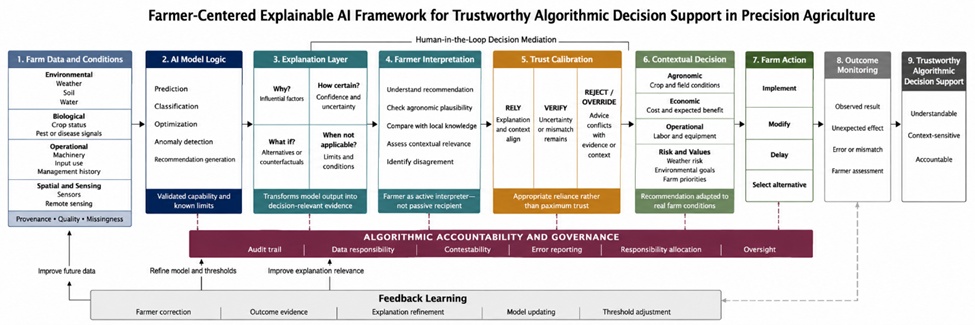
Figure 2. Farmer-Centered Explainable AI Framework for Trustworthy Algorithmic Decision Support in Precision Agriculture.
Alt-text description: A conceptual framework diagram showing farm data inputs flowing into AI model logic, followed by an explanation layer, farmer interpretation, trust calibration, contextual decision-making, farm action, outcome monitoring, algorithmic accountability, and feedback learning. Feedback arrows return from farm action and monitoring to model improvement, explanation refinement, and future decision support.
For technology developers, the framework implies that explainability should be designed from the beginning of agricultural AI development rather than appended after model optimization. Practical implementation should include transparent data-use explanations, user-relevant model summaries, uncertainty communication, contestability mechanisms, fairness checks, responsibility allocation, and protection of farmer data rights. Trust-building in farming AI depends on treating farmers as partners in responsible deployment, not merely as end users of predictive systems [26].
For researchers, the framework calls for field-based evaluation of how farmers engage with machine-learning decision-support systems under real decision conditions. Future studies should examine which explanation formats improve understanding, which uncertainty displays support trust calibration, which interface designs enable contestability, and which barriers prevent farmers from using ML-based advisory systems. Research on farmer engagement and barriers to intelligent agricultural decision-support systems shows that adoption depends on social, technical, economic, and usability factors that must be examined together [27].
For advisers, extension services, cooperatives, and agricultural institutions, the framework suggests a shift from promoting AI tools to supporting explainable decision processes. This requires training, participatory testing, shared accountability procedures, and feedback channels that allow farmers to report errors, challenge recommendations, and contribute local knowledge to system improvement. The practical goal is not to make farmers trust every algorithmic output, but to help them know when trust is warranted, when caution is needed, and when contextual judgment should override the model [26].
Explainable AI for precision agriculture should be understood as a farmer-centered decision-support requirement, not only as a technical method for interpreting machine-learning models. Agricultural recommendations become trustworthy when farmers can understand their rationale, assess uncertainty, judge contextual relevance, question assumptions, and act with informed confidence.
The framework developed in this article positions farmers as active interpreters and co-decision-makers within human-in-the-loop agricultural systems. It connects transparency, interpretability, usability, actionability, contestability, trust calibration, accountability, contextual decision-making, and feedback learning into a coherent structure for trustworthy algorithmic decision support.
The central implication is that the future of AI in precision agriculture depends not only on more accurate models but also on more understandable, accountable, and context-sensitive systems. Farmer-centered explainability can help ensure that algorithmic decision support strengthens rather than weakens farmer agency, practical judgment, and responsible digital agriculture.
None
None
None
None
Open Access The author(s) retain copyright. This article is licensed under the Creative Commons Attribution-NonCommercial-ShareAlike 4.0 International License. It may be shared and adapted for non-commercial purposes with appropriate attribution, an indication of changes, and distribution of adaptations under the same license. Third-party material may be subject to separate terms identified in its credit line. View the license at https://creativecommons.org/licenses/by-nc-sa/4.0/.
 Agro Intelligence Research Press