IoT-enabled precision agriculture connects sensors, devices, communication networks, data platforms, and decision-support systems to support more responsive agricultural monitoring and management. These systems are increasingly discussed in relation to crop monitoring, irrigation management, greenhouse control, livestock monitoring, soil assessment, and farm-level advisory services. Their value, however, depends on how reliably connected technologies function under agricultural field conditions. The evidence base remains fragmented across architecture design, sensor deployment, connectivity models, data processing, and decision-support applications. Some studies emphasize layered IoT architectures, while others focus on wireless sensor networks, cloud platforms, edge computing, communication protocols, or analytics-enabled management systems. This fragmentation makes it difficult to compare implementation models or assess whether technical designs are sufficiently aligned with agricultural decision needs. This article systematically reviews IoT-enabled precision agriculture literature with attention to four core domains: architectures, sensor networks, connectivity models, and decision-support applications. The central review question asks how IoT-enabled precision agriculture has been designed and applied through these domains, and how technical choices shape implementation reliability, scalability, interoperability, energy efficiency, cybersecurity, and decision-support relevance. The review treats IoT not as an automatically beneficial technology, but as a socio-technical system whose usefulness depends on context, integration, and field performance. The review synthesizes peer-reviewed scholarship using explicit search concepts, eligibility criteria, study-selection logic, and evidence-mapping domains. The synthesis is organized around IoT architecture classification, sensor-network typology, connectivity model comparison, decision-support application mapping, implementation barriers, technical limitations, and future research directions. Because record-level search totals and exclusion counts were not available, the study-selection process is described narratively without fabricated PRISMA counts or statistical pooling. The review identifies recurring architectural patterns, sensor-network configurations, communication trade-offs, data-processing approaches, and decision-support applications in IoT-enabled precision agriculture. It also highlights persistent limitations involving interoperability, deployment scale, energy demand, data quality, field validation, cybersecurity, usability, and farmer-centered implementation. The article contributes an evidence-focused synthesis for designing more reliable, scalable, secure, and agriculturally meaningful IoT-enabled precision agriculture systems.
IoT-enabled precision agriculture can be understood as the integration of connected sensing devices, communication networks, gateways, data-processing infrastructures, and decision-support applications within agricultural production systems. Foundational IoT-in-agriculture literature shows that these systems are designed to connect physical field conditions with digital monitoring and management capabilities [1]. This framing is important because precision agriculture depends not only on individual devices, but on the coordinated movement of data from farms to analytical and operational interfaces. The present review therefore begins from the premise that IoT-enabled agriculture is an integrated system rather than a collection of isolated technologies.
IoT and data analytics are frequently discussed together because sensor data become useful only when they are transmitted, processed, interpreted, and linked to management decisions. Agricultural IoT literature connects these systems with potential benefits such as monitoring, automation, and decision support, while also emphasizing challenges related to connectivity, data handling, security, and implementation [2]. These challenges matter because crop monitoring, soil and water management, greenhouse control, livestock monitoring, and farm advisory systems require timely and reliable data flows. A systematic review must therefore assess both technological capabilities and the conditions under which those capabilities become operationally meaningful.
The smart-agriculture literature commonly describes IoT as a way of making field conditions digitally observable through sensors, wireless links, gateways, cloud systems, and application services. This perspective supports the view that connected farms require interactions among field devices, communication infrastructures, data repositories, and management applications [3]. However, the literature is distributed across architecture studies, sensor-network studies, connectivity studies, and application-specific decision-support studies. This distribution creates a comparison problem because similar technologies may be evaluated using different assumptions, agricultural contexts, and implementation criteria.
Smart farming also depends on data integration, analytics, and interpretation within farm-management processes, not simply on deploying more sensors. Big-data scholarship in smart farming shows that data-driven agriculture depends on how heterogeneous data sources are organized, governed, interpreted, and converted into actionable management information [4]. For this reason, the aim of this article is to systematically review IoT-enabled precision agriculture through architectures, sensor networks, connectivity models, and decision-support applications. The review proceeds through defined scope and research questions, search and selection logic, architecture synthesis, sensor and connectivity comparison, decision-support analysis, evidence synthesis, research gaps, and future directions.
The scope of this systematic review is the peer-reviewed literature on IoT-enabled precision agriculture, with emphasis on architectures, sensor networks, connectivity models, and decision-support applications. Prior systematic work on IoT solutions for smart farming supports the need to classify literature by solution type, technological layer, communication approach, and agricultural application domain [5]. This review therefore treats eligible studies as relevant when they contribute to understanding how connected agricultural systems are designed, deployed, or translated into farm-management decisions. The scope includes crop, soil, irrigation, greenhouse, livestock, environmental-monitoring, and farm-management contexts when IoT, sensing, connectivity, data processing, or decision support is central to the article.
The review boundaries include peer-reviewed journal articles focused on IoT systems, wireless sensor networks, agricultural monitoring, connectivity, data processing, cloud or edge integration, and decision-support functions. Survey literature on IoT’s role in smart farming demonstrates that IoT applications span multiple agricultural domains and that review questions must account for this diversity rather than focus on a single crop or technology [6]. Accordingly, this review asks how IoT systems are architected, which sensing configurations are used, which connectivity models are reported, and how decision-support applications are positioned within precision agriculture. It also asks what implementation barriers and evidence gaps limit stronger conclusions about reliability and scalability.
The central review question is: how has IoT-enabled precision agriculture been designed and applied through architectures, sensor networks, connectivity models, and decision-support applications? A related question asks how wireless sensor networks and communication models shape the movement of agricultural data from field conditions to analytical and decision-support layers. Literature on IoT and wireless sensor networks for smart agriculture supports separating sensor-network design from connectivity design because each involves distinct constraints, including sensing accuracy, power supply, transmission range, network reliability, and application requirements [7]. This separation helps avoid treating connectivity as a background feature when it often determines whether sensor data can support timely decisions.
This review does not conduct a meta-analysis, pool performance values, or assign quality scores that were not generated through a formal appraisal procedure. It also does not fabricate database totals, screening counts, exclusion counts, or PRISMA flow statistics, because the review logic is based on transparent eligibility criteria and evidence mapping rather than numerical reconstruction. The systematic review approach is therefore expressed through explicit concepts, inclusion and exclusion boundaries, classification domains, and synthesis questions, consistent with the need to organize IoT smart-farming literature by architecture, sensing, communication, and application relevance [5]. This design enables a critical synthesis without overstating empirical comparability across heterogeneous studies.
The search strategy was organized around concept clusters rather than around a single technology label. Core search concepts included IoT, precision agriculture, smart farming, smart agriculture, wireless sensor networks, sensor networks, connectivity, edge computing, cloud computing, decision support, agricultural monitoring, and implementation challenges. Review literature on IoT applications in precision agriculture supports this broad concept structure because relevant studies may be indexed through application terms, system terms, sensing terms, or communication terms [8]. The search logic therefore aimed to capture literature that connected agricultural production or monitoring with IoT-enabled data acquisition, transmission, processing, or decision support.
Study selection prioritized articles that explained emerging IoT technologies in smart agriculture and provided enough information to support evidence mapping. Work on future smart-agriculture technologies shows that relevant literature may include sensing devices, communication protocols, cloud platforms, edge computing, automation systems, data analytics, and security considerations [9]. For this reason, screening considered whether each article contributed to at least one review domain: IoT architecture, sensing layer, sensor network, communication protocol, connectivity model, data processing, edge/cloud integration, decision-support application, interoperability, scalability, energy efficiency, cybersecurity, or implementation challenge. Articles that only mentioned agriculture or IoT superficially were not treated as eligible for synthesis.
Inclusion criteria required peer-reviewed journal status, DOI availability, clear relevance to IoT-enabled precision agriculture or smart farming, and a substantive contribution to architecture, sensing, connectivity, decision support, or implementation evidence. Exclusion criteria removed non-peer-reviewed sources, conference papers, preprints, generic IoT papers without agricultural relevance, agriculture papers without IoT or connectivity relevance, and narrowly algorithmic papers that did not contribute to system design or decision-support understanding. Recent scholarship connecting IoT, sensor technologies, sustainability, and agricultural challenges reinforces the need to retain work that links technical systems with agricultural implementation rather than only describing devices in isolation [10]. These criteria supported a focused synthesis of the eligible peer-reviewed literature.
The study-selection process used screening priorities that mapped each eligible article to architecture relevance, sensor-network relevance, connectivity relevance, decision-support relevance, agricultural application domain, and implementation relevance. This mapping made it possible to compare studies without inventing record counts, exclusion totals, or pooled effect estimates. Because IoT application reviews in precision agriculture emphasize diverse deployment areas, the screening process also preserved variation across crop monitoring, irrigation, greenhouse farming, livestock monitoring, soil monitoring, environmental sensing, and farm-management applications [8]. Table 1 summarises the systematic review search strategy, eligibility criteria, and study-selection logic.
Table 1. Systematic Review Search Strategy, Eligibility Criteria, and Study-Selection Logic for IoT-Enabled Precision Agriculture Literature: Databases, Search Concepts, Inclusion Criteria, Exclusion Criteria, Screening Priorities, and Evidence-Mapping Domains
Review component | Operational description | Purpose in the systematic review | Evidence-mapping relevance |
Search concepts | IoT, Internet of Things, precision agriculture, smart farming, smart agriculture, agricultural monitoring, wireless sensor networks, sensor networks, connectivity, edge computing, cloud computing, fog computing, decision support, irrigation management, crop monitoring, greenhouse monitoring, livestock monitoring, interoperability, scalability, cybersecurity, and energy efficiency | To capture literature distributed across system, sensing, communication, computing, and application vocabularies | Supports identification of architecture, sensing, connectivity, decision-support, and implementation literature |
Source type boundary | Peer-reviewed journal articles with DOI information | To maintain traceability, scholarly quality, and stable bibliographic identification | Reduces inclusion of non-peer-reviewed or difficult-to-verify sources |
Inclusion criteria | Clear focus on IoT-enabled precision agriculture, smart farming, wireless sensor networks, agricultural monitoring, edge/cloud/fog integration, communication protocols, decision-support systems, data platforms, or implementation challenges | To retain studies that directly inform the article’s four core review domains | Allows systematic classification by architecture, sensor network, connectivity model, application domain, and implementation relevance |
Exclusion criteria | Non-peer-reviewed material, conference papers, preprints, theses, books, reports, websites, generic IoT studies without agriculture relevance, agriculture studies without IoT or connectivity relevance, and isolated algorithm papers without system or decision-support contribution | To avoid weakly related or non-comparable evidence | Protects the synthesis from sources that cannot support precision-agriculture IoT claims |
Screening priorities | Architecture type, sensing layer, sensor-network role, communication protocol, connectivity model, data-processing layer, edge/cloud integration, decision-support function, field deployment context, interoperability, scalability, energy demand, cybersecurity, and implementation barriers | To determine whether each article could support a planned systematic review claim | Ensures that each retained source contributes to a defined synthesis domain |
Evidence-mapping domains | IoT architectures, sensor networks, connectivity models, decision-support applications, implementation barriers, evidence limitations, and future research directions | To organize the synthesis around the article’s central review question | Enables cross-domain comparison without fabricating search counts, performance values, or pooled outcomes |
IoT architectures in precision agriculture are commonly organized around sensing, communication, processing, and application layers. This layered view helps explain how field measurements become data streams, how data streams move through gateways or networks, and how processed information reaches decision-support interfaces. Literature on the evolution of IoT in precision agriculture supports this architecture-based interpretation because it connects sensors, wireless links, Internet services, and agricultural applications within a shared system model [11]. The review therefore treats architecture as the organizing logic that determines whether sensing and connectivity can support farm-management decisions.
Farm-level architecture assessment also requires attention to implementation context rather than only abstract system design. Work on IoT in arable farming shows that deployment depends on how devices, data handling, operational routines, and farm-management systems are integrated under agricultural conditions [12]. This is especially important for open-field systems where weather exposure, field size, machinery movement, maintenance capacity, and connectivity availability can affect system reliability. Architecture quality should therefore be judged by data-flow continuity, field robustness, interoperability, and usefulness for farm decisions.
Edge-cloud architecture is prominent in the reviewed literature because it distributes processing between local devices and remote computing environments. A smart farming IoT platform based on edge and cloud computing illustrates how local processing, gateways, and cloud services can be combined to support monitoring and control while reducing full dependence on centralized processing [13]. This architecture is particularly relevant when sensor data must be filtered, transmitted, visualized, or acted on with limited delay. However, edge-cloud models still require careful integration of hardware, network protocols, data services, and user interfaces.
Fog and hybrid architectures extend this logic by placing computing resources between field devices and cloud platforms. Energy-efficient edge-fog-cloud architecture literature supports the view that latency-sensitive and resource-constrained farm environments may benefit from intermediate processing layers that reduce communication load and improve responsiveness [14]. Systematic literature on IoT technology in agriculture also supports classifying architectures by sensors, devices, communication protocols, network types, and application domains [15]. The synthesis indicates that architecture reporting remains uneven, with recurring gaps in standardization, interoperability, field validation, and long-term scalability assessment.
Sensor networks provide the field-level observations that make IoT-enabled precision agriculture possible. Precision agriculture techniques include soil, crop, weather, machine, environmental, and remote-sensing inputs, and these inputs differ in spatial coverage, temporal resolution, cost, calibration needs, and decision relevance [16]. The reviewed literature therefore shows that sensor-network synthesis should begin with sensing purpose rather than with device lists. A soil-moisture sensor, a greenhouse environmental sensor, a livestock wearable, and a UAV-derived image stream each create different data-quality and connectivity requirements.
Sensor selection is context-specific because monitoring objectives vary across crops, production systems, microclimates, and management decisions. Research on monitoring ambient parameters in an IoT precision agriculture scenario demonstrates that sensor choice must be connected to the cultivation environment, measured variable, reliability requirement, and practical deployment setting [17]. This matters because poorly matched sensors can generate data that are technically available but agronomically weak. Sensor-network design should therefore account for calibration, placement density, maintenance access, power supply, data quality, and decision-support compatibility.
Smart sensors expand the scope of agricultural monitoring, but they also introduce practical constraints. Literature on IoT and smart sensors in agriculture identifies opportunities for monitoring and automation while also highlighting challenges related to cost, deployment, reliability, data quality, and field conditions [18]. These limitations are especially important when sensor networks are expected to support automated alerts or control actions. A critical review must therefore examine whether sensing systems are validated under realistic agricultural conditions and whether their outputs are interpretable by farmers, agronomists, or farm-management systems.
Connectivity models determine whether sensor observations can move from the field to processing and decision-support layers with acceptable reliability, cost, latency, and energy demand. Wireless communication literature for precision-agriculture IoT shows that communication choices should be assessed by range, power consumption, data rate, network topology, and deployment context [19]. LoRaWAN research in greenhouse precision agriculture further illustrates the relevance of LPWAN models for low-power monitoring, while also showing that performance must be interpreted in relation to the specific production environment [20]. Figure 1 integrates these findings into a system-level architecture showing how heterogeneous agricultural observations move through sensing and connectivity infrastructures, distributed edge–fog–cloud processing, and decision-support functions before generating field-level management actions, while remaining conditioned by interoperability, energy, cybersecurity, scalability, data-quality, and usability constraints.
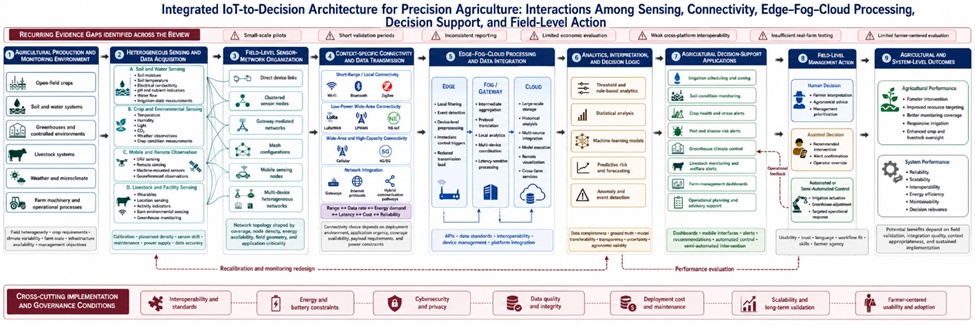
Figure 1. Integrated IoT-to-Decision Architecture for Precision Agriculture: Interactions Among Sensing, Connectivity, Edge–Fog–Cloud Processing, Decision Support, and Field-Level Action
Table 2 compares IoT architecture, sensor-network, and connectivity model characteristics reported in the reviewed precision agriculture literature.
Table 2. Comparative Synthesis of IoT Architectures, Sensor Networks, and Connectivity Models in Precision Agriculture: Sensing Layers, Edge/Cloud Integration, Communication Protocols, Deployment Contexts, Interoperability Needs, Energy Constraints, and Scalability Challenges
Review dimension | Commonly reported characteristics | Precision-agriculture relevance | Main implementation concern | Synthesis implication |
Sensing layer | Soil moisture sensors, temperature and humidity sensors, weather stations, crop sensors, greenhouse sensors, livestock sensors, irrigation sensors, UAV sensing, and remote sensing | Provides field, crop, animal, and environmental observations for monitoring and decision support | Calibration, placement, maintenance, data quality, sensor drift, and power supply | Sensor-network design should be tied to management purpose and field context |
Communication layer | LoRaWAN, ZigBee, Wi-Fi, Bluetooth, cellular, NB-IoT, 5G, LPWAN, mesh networks, gateway-based models, and Internet protocols | Transfers field data to gateways, local servers, cloud platforms, dashboards, and advisory systems | Coverage, range, energy demand, latency, cost, reliability, and data rate | Connectivity selection should be context-specific rather than technology-led |
Edge and fog processing | Local filtering, gateway-level processing, intermediate computation, event detection, and reduced transmission load | Supports faster response and lower dependence on continuous cloud transmission | Hardware constraints, maintenance, interoperability, and model updating | Distributed processing is useful when latency, bandwidth, or energy constraints are important |
Cloud integration | Data storage, visualization, analytics, historical comparison, remote access, and farm-management integration | Enables large-scale data handling, dashboards, and multi-source decision support | Connectivity dependence, data governance, cybersecurity, and platform lock-in | Cloud systems need secure and interoperable links to field devices and advisory tools |
Application interface | Dashboards, mobile applications, alerts, automated control, decision-support modules, and farm-management systems | Converts technical data streams into usable management information | Usability, language, advisory relevance, farmer trust, and workflow integration | Decision-support value depends on interpretation, not only data availability |
Scalability and interoperability | Multi-device integration, standard protocols, cross-platform data exchange, modular architectures, and repeatable deployment patterns | Determines whether systems can move beyond pilot sites to operational farm networks | Vendor fragmentation, data-format inconsistency, network heterogeneity, and maintenance burden | Future systems require open, modular, secure, and field-tested architectures |
Decision-support applications are the point at which IoT-enabled precision agriculture becomes operationally meaningful for farm management. IoT data analytics and machine-learning literature shows that sensor streams can be processed into predictions, classifications, alerts, or recommendations for agricultural decisions [21]. However, decision support should not be equated with data collection alone. It requires reliable sensing, adequate connectivity, usable interfaces, domain-specific interpretation, and management actions that are feasible in the production context.
Irrigation management is one of the most developed decision-support areas in the reviewed literature. An IoT-based fuzzy-control irrigation zoning system demonstrates how sensor data and control logic can be connected to water and energy management decisions [22]. This type of application shows the potential of combining local measurements with rule-based or intelligent control methods. At the same time, such systems require careful validation because irrigation recommendations depend on crop type, soil condition, climate, water availability, and management constraints.
Low-cost wireless sensor networks have also been applied to irrigation scheduling. Research on intelligent irrigation scheduling using a low-cost wireless sensor network shows how sensing and communication infrastructures can support more responsive irrigation decisions [23]. The relevant systematic-review claim is not that all such systems produce universal water savings, but that IoT-enabled irrigation decision support can link field measurements with scheduling logic. Evidence should therefore be interpreted according to deployment scale, field duration, sensor reliability, and the extent to which farmers can act on the recommendations.
Machine-learning and open-source approaches extend irrigation decision support by integrating field sensing, weather information, cloud services, and predictive models. An IoT-based smart irrigation management system using machine learning illustrates how sensor data and external information can be combined for recommendation and control functions [24]. More recent AI-IoT crop-monitoring literature broadens the decision-support domain toward crop health assessment, phenotyping, robotics, monitoring dashboards, and management advice [25]. These developments show that decision-support applications are expanding, but they also make data quality, interoperability, model transparency, and field usability more important.
Across the reviewed literature, IoT-enabled precision agriculture is strongest when architectures create usable data pipelines rather than isolated measurements. Agricultural big-data scholarship supports this synthesis because the value of agricultural data depends on collection, storage, processing, analysis, interpretation, and decision relevance [26]. This means that system performance should be evaluated across the full pathway from sensor acquisition to communication, processing, visualization, and action. A technically sophisticated sensor network may still have limited value if its data are not integrated into timely and trusted management decisions.
Machine-learning evidence further shows that decision-support applications should be classified by agricultural function and data type. Review work on machine learning in agriculture covers applications across crop, livestock, soil, water, and management contexts, indicating that algorithms cannot be assessed as a single undifferentiated decision-support category [27]. IoT-enabled decision support therefore needs functional mapping, such as irrigation scheduling, crop-health monitoring, nutrient management, pest alerts, livestock monitoring, greenhouse control, and yield-related forecasting. This mapping helps distinguish between applications that require real-time connectivity and those that can tolerate delayed processing.
The reviewed body of work also shows that technical feasibility must be interpreted alongside adoption readiness and implementation context. Research on smart farming technology development and application demonstrates that the relevance of digital agriculture depends on local conditions, institutional environments, infrastructure, skills, and production systems [28]. This is especially important because many IoT-enabled precision agriculture studies emphasize prototype development or pilot deployment. Evidence synthesis should therefore ask whether systems are maintainable, interoperable, economically plausible, and useful within real farm workflows.
Recurring strengths in the literature include real-time monitoring, scalable sensing concepts, automated alerts, remote management possibilities, and integration with precision agriculture practices. Recurring limitations include small deployment contexts, short validation periods, weak interoperability, limited economic evaluation, energy constraints, cybersecurity gaps, inconsistent reporting, and insufficient farmer-centered evaluation. These patterns are consistent with the broader data-pipeline and implementation concerns identified across agricultural big-data and smart farming research [26]. Table 3 presents an evidence synthesis of IoT-enabled decision-support applications and implementation challenges in precision agriculture.
Table 3. Evidence Synthesis of IoT-Enabled Decision-Support Applications in Precision Agriculture: Irrigation Management, Soil Monitoring, Crop Health, Greenhouse Control, Livestock Monitoring, Pest and Disease Alerts, Data Integration, Deployment Barriers, and Future Research Implications
Decision-support application | Typical IoT input sources | Common decision-support function | Key implementation challenge | Future research implication |
Irrigation management | Soil moisture sensors, weather data, flow meters, evapotranspiration estimates, and field gateways | Scheduling, zoning, alerts, and automated or semi-automated control | Sensor calibration, soil variability, water availability, connectivity continuity, and farmer override needs | Validate irrigation systems across crops, soils, climates, and management regimes |
Soil monitoring | Soil moisture, temperature, electrical conductivity, pH, nutrient sensors, and georeferenced field data | Soil-condition tracking, nutrient planning, stress detection, and advisory support | Sensor cost, spatial heterogeneity, drift, maintenance, and interpretation limits | Develop robust, low-power, calibrated soil-monitoring networks with agronomic interpretation |
Crop health and pest alerts | Crop sensors, imaging, UAV data, weather data, disease-risk indicators, and field observations | Stress alerts, disease-risk warnings, crop-status dashboards, and management recommendations | Data noise, ground-truth limitations, model transferability, and usability | Improve explainable AI-IoT systems that combine sensing, agronomy, and farmer feedback |
Greenhouse control | Temperature, humidity, CO₂, light, substrate, irrigation, and ventilation data | Climate control, irrigation control, fertigation support, and anomaly alerts | Dense sensor placement, energy demand, actuator integration, and reliability requirements | Benchmark edge and LPWAN systems under controlled-environment agriculture conditions |
Livestock monitoring | Wearables, location sensors, environmental sensors, feeding data, and activity indicators | Health monitoring, behavior alerts, location tracking, and welfare-related advisory support | Device durability, battery life, animal comfort, data interpretation, and connectivity in barns or open areas | Expand validated animal-centered sensing models that respect welfare and operational feasibility |
Farm-management advisory systems | Multi-source data from sensors, machinery, weather platforms, remote sensing, and historical records | Dashboards, recommendations, planning support, and operational alerts | Data integration, interoperability, platform lock-in, trust, skills, and workflow alignment | Prioritize open architectures, cross-platform data exchange, and human-centered interface design |
A major research gap concerns the socio-technical conditions under which IoT-enabled precision agriculture is adopted, trusted, maintained, and used. Social-science scholarship on digital agriculture, smart farming, and Agriculture 4.0 shows that future research must address governance, data ownership, advisory systems, user skills, farmer agency, and institutional context [29]. These issues are not secondary to technical design because they shape whether IoT systems become embedded in farm-management routines. Future studies should therefore evaluate usability, farmer acceptance, economic feasibility, maintenance burdens, and advisory relevance alongside technical performance.
Data governance, integrity, and traceability also require stronger attention in future IoT-enabled agriculture systems. Blockchain scholarship in agriculture suggests that distributed ledger technologies may have roles in trust, traceability, and data integrity, although they should be treated as possible governance tools rather than universal solutions [30]. For IoT-enabled precision agriculture, the broader lesson is that data flows need accountable architectures, clear ownership rules, secure exchange mechanisms, and auditable records when decisions affect production, sustainability claims, or supply-chain relationships. Future research should test governance mechanisms in realistic farm-data ecosystems rather than assuming that technical traceability alone solves trust problems.
Security, privacy, interoperability, and scalability should be treated as core design requirements rather than late-stage additions. Smart-agriculture literature on development modes, technologies, and security challenges demonstrates that connected agricultural systems face risks involving data privacy, cyberattacks, heterogeneous devices, and platform fragmentation [31]. Future work should benchmark open architectures, low-power connectivity, resilient networks, explainable decision support, cross-platform integration, and context-specific deployment models under real agricultural conditions. The next phase of IoT-enabled precision agriculture research should therefore connect technical robustness with farmer-centered design, responsible data governance, and scalable implementation pathways.
This systematic review examined IoT-enabled precision agriculture through architectures, sensor networks, connectivity models, and decision-support applications. The synthesis shows that IoT systems should be understood as integrated pathways connecting field sensing, communication infrastructure, data processing, analytics, and farm-management action. Their contribution depends on whether these pathways are reliable, interpretable, maintainable, and relevant to agricultural decisions.
The review also shows that IoT-enabled precision agriculture should not be evaluated only through technical novelty. Architecture design, sensing reliability, connectivity performance, interoperability, energy efficiency, cybersecurity, scalability, usability, and field validation are central to determining whether systems can support practical farm management. Decision-support value emerges when sensor data are transformed into recommendations or control actions that farmers and agricultural managers can trust and apply.
Future IoT-enabled precision agriculture systems should be technically robust, agriculturally meaningful, farmer-centered, interoperable, secure, and scalable across diverse farming contexts. Stronger evidence is needed from long-term deployments, multi-site comparisons, open architectures, transparent analytics, and human-centered interfaces. The most promising direction is not simply more connected devices, but better integrated systems that align digital capability with agricultural realities.
None
None
None
None
Open Access The author(s) retain copyright. This article is licensed under the Creative Commons Attribution-NonCommercial-ShareAlike 4.0 International License. It may be shared and adapted for non-commercial purposes with appropriate attribution, an indication of changes, and distribution of adaptations under the same license. Third-party material may be subject to separate terms identified in its credit line. View the license at https://creativecommons.org/licenses/by-nc-sa/4.0/.
 Agro Intelligence Research Press