Digital twins are increasingly discussed as a next step in smart farming because they promise to connect physical agricultural systems with digital representations, sensor data, simulation models, analytics, and decision-support functions. However, the agricultural literature remains uneven in how it defines, architects, enables, and applies digital twins across crop, livestock, greenhouse, irrigation, and farm-management systems. This original scoping review maps the peer-reviewed literature on digital twins in smart farming with attention to architecture types, enabling technologies, data requirements, application domains, implementation challenges, and research gaps. The review follows a scoping logic rather than an effect-estimation or performance-benchmarking design: it charts how studies conceptualize digital twins, distinguishes full or emerging digital twin capability from static models and monitoring dashboards, and classifies evidence by architecture, technology, data pipeline, analytics function, feedback mechanism, implementation stage, and limitation. The synthesis shows that agricultural digital twins are commonly positioned as cyber-physical and decision-support infrastructures that may combine IoT sensing, remote sensing, machinery and environmental data, cloud or edge computing, simulation, AI analytics, visualization, and farm-management interfaces. Application clusters are strongest in controlled-environment agriculture, irrigation and water management, crop monitoring, aquaponics, livestock monitoring, greenhouse visualization, and emerging optimization or automation settings. Across the mapped literature, the main contribution is a structured classification of digital twin architectures and application patterns while preserving conceptual caution: real-time data, AI prediction, or visualization alone does not create a digital twin. The review identifies future research needs in architecture standardization, semantic interoperability, field validation, real-time updating, uncertainty communication, data governance, farmer-centered usability, scalability, and sustainability assessment.
Digital twins have entered smart farming as a way to connect physical agricultural entities with digital representations that can be updated through data streams, interpreted through models, and used to support decisions. In agricultural settings, this concept is broader than a static digital model because it normally involves a physical system, a virtual representation, a data connection, model updating, analytics or simulation, and some form of feedback to management or operations [1–3]. This distinction is important because many digital agriculture systems use sensors, dashboards, remote sensing, or prediction tools, but not all of them meet the conceptual threshold of a digital twin.
The relevance of digital twins in smart farming reflects the broader shift toward cyber-physical and data-intensive agriculture. Agricultural production increasingly depends on sensing, connected devices, automation, AI-enabled analytics, and decision-support environments that can represent changing field, greenhouse, livestock, irrigation, and farm-operational conditions [4]. Within this transformation, the digital twin paradigm is best understood as a systems-integration concept rather than as a single technology, software platform, or universal model.
A scoping review is needed because the agricultural digital twin literature is expanding across several partially connected domains, including smart-farming infrastructure, controlled-environment agriculture, crop monitoring, livestock systems, irrigation, aquaponics, edge-cloud computing, reinforcement learning, and sustainability-oriented decision support. The field includes conceptual frameworks, review papers, prototype-oriented studies, simulation environments, architecture proposals, and domain-specific implementations. As a result, a generic narrative review would risk flattening important differences among architecture types, levels of physical-digital coupling, data requirements, analytics functions, and implementation maturity [3].
The aim of this review is to map how digital twins are conceptualized, architected, enabled, and applied across smart farming systems. The mapping questions are: how are digital twins defined and positioned in smart farming literature; what architecture types are used; which enabling technologies and data sources support them; which application domains are most commonly addressed; how do studies connect digital twins to monitoring, simulation, prediction, optimization, decision support, or automation; and what limitations and research gaps remain for robust, interoperable, farmer-centered digital twin systems?
In the agricultural context, digital twins may be understood as smart-farming infrastructure when they integrate physical production systems, data acquisition, computational models, analytics, visualization, and management feedback. This infrastructure framing is important because digital twins are not simply digital replicas placed beside farm systems; they depend on the organized coupling of data flows, model behavior, decision services, and context-specific operational goals. Sustainability-oriented discussions of agricultural digital twins therefore require careful interpretation because potential environmental or resource-management benefits depend on data quality, system integration, validation, and local production conditions [5].
Digital twin infrastructure also depends on enabling layers that are already common in smart agriculture, including IoT sensors, communication networks, cloud or edge services, AI analytics, and user-facing decision tools. Reviews of smart-agriculture digital twin implementation show that these components are necessary but not sufficient: a sensor network can supply data, a dashboard can visualize measurements, and an AI model can predict outcomes, yet a digital twin requires these components to be organized into a physical-digital system with updating and decision relevance [6]. This is why the review treats IoT, AI, and visualization as enabling technologies rather than as automatic evidence that a full digital twin exists.
Digital twins are also infrastructural because they require orchestration across heterogeneous data sources, models, software services, domain knowledge, and decision workflows [7]. In smart farming, this orchestration may involve soil and climate data, crop or animal measurements, machinery records, remote sensing, weather data, farm-management information systems, simulation models, and advisory interfaces. The practical value of a digital twin depends on whether these elements can be combined into a coherent representation of the agricultural system being managed, rather than remaining isolated data streams or disconnected analytical tools.
This review therefore distinguishes digital twins from related concepts that often overlap with them. A digital model may represent a crop, animal, greenhouse, or irrigation system without being continuously updated from physical data. A simulation model may test scenarios without being connected to ongoing farm operations. A monitoring dashboard may display sensor data without predictive, simulation, or feedback capability. A farm-management information system may organize records without maintaining a dynamic digital representation of a physical process. Digital twins may include elements of all these systems, but they require stronger physical-digital coupling and decision-oriented updating than any one of them alone.
This article follows a scoping review logic designed to map the breadth and structure of the literature rather than to estimate effect sizes, compare intervention outcomes, or rank technologies by performance. The scope includes peer-reviewed journal articles that address digital twin definitions, architectures, enabling technologies, data requirements, agricultural applications, decision-support functions, implementation barriers, or research gaps in smart farming and related agricultural systems. Sustainability-oriented studies were included when they directly discussed digital twins or digital-twin-relevant agricultural systems and when their claims could be mapped cautiously as evidence clusters, open challenges, or future directions rather than assumed outcomes [8].
Eligibility focused on journal articles within the approved search window that included a DOI and had enough information to classify the paper by digital twin relevance, agricultural domain, architecture type, enabling technology, data source, analytics or simulation function, feedback mechanism, implementation stage, limitation, and research gap. Studies were excluded when they used “digital twin” only superficially, lacked agricultural relevance, focused only on generic AI, IoT, remote sensing, or simulation without digital twin relevance, or could not be mapped to the review categories. Greenhouse horticulture was treated as a distinct application cluster because controlled environments often permit denser sensing, more structured model updating, clearer visualization needs, and tighter links between monitoring and control than many open-field settings [9].
The search and screening process was conducted as a curated scoping selection rather than a full PRISMA-ScR count-based search. Candidate literature was identified across scholarly databases and publisher platforms, including ScienceDirect, IEEE Xplore, MDPI, ACS, Nature/Springer, and other relevant journal sources. Part 1 generated a verified candidate pool of 48 records and a final included set of 32 peer-reviewed journal articles, but it did not generate transparent duplicate-removal counts, title-abstract exclusion counts, full-text exclusion counts, or exclusion-reason frequencies. For this reason, the manuscript does not claim PRISMA-ScR compliance and does not invent a count-based PRISMA flow.
Data charting classified each included article by digital twin type, agricultural domain, architecture type, physical system represented, data sources, enabling technologies, analytics or simulation function, feedback or control mechanism, application purpose, implementation stage, main limitation, and research gap. Crop-monitoring studies were charted as a separate cluster because the literature often links digital twins to sensing, remote monitoring, environmental data, prediction, and partial decision support, while only some studies demonstrate stronger physical-digital updating or operational feedback [10]. Table 1 summarises the scoping review mapping framework used to classify digital twin studies in smart farming.
Table 1. Scoping Review Mapping Framework for Digital Twins in Smart Farming: Architecture Type, Enabling Technologies, Data Requirements, Application Domain, Analytics Function, Feedback Mechanism, Implementation Stage, and Research Gap Category
Mapping dimension | Definition | Coding categories | Information extracted | Reason for inclusion | Example interpretation | Limitation of the category |
Digital twin definition | How the article defines or positions a digital twin | Explicit DT definition; partial DT; DT-like architecture; enabling concept | Definition language, physical-digital coupling, updating logic | Prevents treating every model or dashboard as a DT | A crop model with no live updating is coded as a model, not a full DT | Some papers use DT language inconsistently |
Architecture type | How the DT system is structurally organized | Cyber-physical; IoT-enabled; simulation-based; data-driven; hybrid model-data; cloud-edge; decision-support | Physical layer, data layer, model layer, analytics layer, interface layer | Identifies how DTs are built and compared | A greenhouse DT may combine sensing, simulation, visualization, and control | Architecture details are sometimes incomplete |
Enabling technologies | Technologies supporting the DT | IoT; remote sensing; machinery data; cloud; edge; AI; simulation; data fusion; visualization | Sensors, platforms, models, algorithms, interfaces | Separates enabling tools from the DT concept itself | IoT supplies data but does not alone constitute a DT | Technology labels may be broad or underspecified |
Data requirements | Data needed for model updating and decision support | Sensor data; environmental data; soil data; crop data; animal data; machinery data; management records | Data source, frequency, integration method, quality issue | DT fidelity depends on relevant and reliable data | Irrigation DTs require soil-water, weather, and operational data | Many papers do not report data quality in detail |
Application domain | Agricultural system or decision context | Crop; livestock; greenhouse; irrigation; aquaponics; vertical farm; soil/climate; farm operations | Production system, management problem, decision target | Maps evidence clusters across smart farming | Controlled-environment studies form a strong cluster | Some applications overlap across domains |
Analytics function | Computational role of the DT | Monitoring; simulation; prediction; optimization; anomaly detection; decision support; automation | Analytical method, model purpose, output type | Clarifies whether the DT is descriptive, predictive, prescriptive, or control-oriented | A Q-learning vertical-farm DT is coded as optimization-oriented | Papers may claim analytics functions without full validation |
Feedback mechanism | How digital outputs influence decisions or operations | Advisory feedback; dashboard feedback; semi-automated control; autonomous control; not clearly reported | Recommendation pathway, control loop, human role | Feedback distinguishes DTs from passive visualization | A DSS recommending irrigation actions is advisory feedback | Feedback is often described conceptually rather than operationally |
Implementation stage | Maturity of the reported DT | Conceptual; review; architecture proposal; prototype; simulation; applied study; field implementation | Evidence type, deployment setting, validation status | Avoids overstating maturity | A ROS-Gazebo greenhouse system is simulation/prototype-oriented | Boundaries between prototype and implementation may be unclear |
Research-gap category | Main limitation or future need | Validation; interoperability; scalability; data quality; usability; governance; integration; sustainability assessment | Reported limitation, unresolved issue, future work | Supports future research synthesis | A greenhouse sensor-selection paper may highlight microclimate data fidelity | Some gaps are inferred from article scope rather than directly stated |
The scoped literature shows that agricultural digital twin architectures are typically organized around layered relationships among the physical system, data-acquisition infrastructure, digital representation, analytics or simulation layer, visualization interface, and decision-support pathway. In controlled-environment agriculture, architecture proposals often begin with the production environment as the physical referent and then connect environmental sensing, crop-system representation, and optimization-oriented services that may support productivity-oriented decisions [11]. This architecture pattern is particularly visible in greenhouse, vertical farming, hydroponic, and aquaponic settings, where boundaries of the physical system are easier to define than in many open-field environments.
A broader agricultural architecture pattern treats digital twins as layered cyber-physical systems in which physical farm entities are linked to virtual models through data exchange and service functions. Such architectures usually include a physical layer, data-communication layer, virtual-model layer, analytics layer, and application layer for decision support or management services [12]. This layered pattern is useful for scoping because it separates enabling infrastructure from digital twin functionality: sensors and connectivity enable data exchange, models and analytics enable interpretation, and user or control interfaces enable feedback to agricultural decisions.
Decision-support architectures are especially prominent in aquaponics and related controlled food-production systems. In an urban aquaponics digital twin, decision support is created by connecting sensed system states, digital representations, and management-oriented reasoning so that users can interpret system behavior and act on recommendations [13]. This type of architecture is important because it demonstrates that agricultural digital twins may be most practically valuable when they support human and managerial decisions, rather than when they are presented as fully autonomous systems.
Hydroponic and aquaponics-factory studies further illustrate hybrid architecture requirements, including physical-digital grow-bed representation, water-quality and environmental data acquisition, interface development, data integration, and potential feedback to operations [14]. At a larger production-system scale, aquaponics factory digital twins show that architecture design must also address integration across biological, hydraulic, environmental, and operational subsystems, making validation and interoperability central research needs rather than secondary implementation details [15].
Digital twins in smart farming depend on enabling technologies that supply, integrate, model, analyse, and communicate agricultural data. Big-data infrastructures, IoT sensing, and AI-enabled automation provide important foundations for digital twin development, but each must be interpreted carefully because none of them independently constitutes a digital twin [16–18]. A smart-farming big-data system can aggregate heterogeneous farm records, sensor streams, spatial data, machinery logs, and weather information, yet it becomes digital-twin-relevant only when these data contribute to an updated representation of a physical agricultural system and support simulation, prediction, decision reasoning, or feedback.
Reliable sensing and connectivity are therefore foundational data requirements. Agricultural IoT technologies support data acquisition from soil sensors, environmental sensors, irrigation devices, livestock wearables, machinery systems, greenhouse controllers, and other connected farm assets [19]. However, the review scope indicates that agricultural digital twins require more than data availability: they need appropriate temporal resolution, spatial relevance, data quality control, contextual interpretation, and mechanisms for updating digital representations. Poorly integrated sensor networks may improve monitoring but still fall short of digital twin functionality when data are not connected to models, analytics, or decisions.
Cloud and edge computing appear as important architectural enablers because agricultural digital twins may need to process high-volume or near-real-time data while remaining usable in farm environments. Edge-cloud architectures can support crop monitoring and detection when physical data streams are connected to analytics and user-facing services, as shown in recent tomato-monitoring digital twin work [20]. This pattern is especially relevant for smart farming because data may be generated in distributed field, greenhouse, or machinery environments where connectivity, latency, computing cost, and local decision needs differ substantially across production contexts.
The data requirements identified across the scoped literature include physical-system measurements, environmental observations, operational records, remote-sensing inputs, crop or animal status indicators, and management data. These data must be linked to simulation models, AI analytics, visualization tools, and decision-support interfaces in ways that preserve domain meaning. Interoperability is therefore not only a software concern but also a semantic and agronomic requirement: soil moisture, greenhouse temperature, animal movement, irrigation timing, crop imagery, and machinery activity must be represented in forms that can be interpreted by both computational models and farm decision-makers.
Table 2 compares enabling technologies and data requirements reported across digital twin studies in smart farming.
Table 2. Enabling Technologies and Data Requirements for Digital Twins in Smart Farming: IoT Sensors, Remote Sensing, Machinery Data, Cloud and Edge Computing, Simulation Models, AI Analytics, Data Fusion, Interoperability, and Visualization
Enabling technology or data component | Role in digital twin development | Typical agricultural data sources | Architecture layer supported | Decision-support function | Implementation requirement | Common limitation | Research implication |
IoT sensors | Provide physical-system measurements for digital updating | Soil moisture, temperature, humidity, water quality, animal movement, greenhouse climate | Physical and data-acquisition layers | Monitoring, alerts, state estimation | Reliable sensing, calibration, connectivity, maintenance | Sensor drift, missing data, limited spatial coverage | Develop quality-aware sensing strategies and adaptive sensor placement |
Remote sensing | Adds spatial and temporal observation of crops and environments | Satellite imagery, UAV imagery, multispectral or thermal observations | Data-acquisition and data-fusion layers | Crop monitoring, stress detection, spatial decision support | Georeferencing, temporal alignment, image preprocessing | Cloud cover, revisit frequency, resolution mismatch | Improve fusion between remote sensing and in-situ digital twin data |
Machinery data | Connects operations and field activities to digital representations | Tractor logs, implement data, input application records, machine telemetry | Operational data layer | Farm operations, input optimization, traceability | Data access, standard formats, platform integration | Proprietary formats and fragmented machinery ecosystems | Advance open interfaces for farm machinery and digital twin platforms |
Weather and climate data | Provides environmental context for model updating and prediction | Weather stations, forecasts, greenhouse climate records, climate databases | Context and simulation layers | Irrigation, crop-risk assessment, disease-risk support | Local relevance, temporal resolution, uncertainty handling | Coarse spatial resolution or forecast uncertainty | Integrate uncertainty-aware climate inputs into agricultural DTs |
Soil data | Represents below-ground production conditions | Soil moisture, texture, nutrients, salinity, pH, temperature | Physical-state and simulation layers | Irrigation, fertility, crop growth support | Sampling design, sensor calibration, spatial mapping | High spatial heterogeneity and expensive dense sensing | Develop scalable soil-data fusion and uncertainty representation |
Cloud computing | Supports storage, analytics, and platform-level integration | Multisource farm data, model outputs, historical records | Platform and analytics layers | Large-scale analytics, visualization, farm-management integration | Secure data transfer, scalable architecture, governance rules | Connectivity dependence and data-governance concerns | Study cloud architectures that balance scalability, privacy, and usability |
Edge computing | Processes data near the farm system | Greenhouse sensor streams, crop images, local machine data | Edge analytics and response layer | Near-real-time monitoring, detection, local decision support | Local processing hardware, model deployment, maintenance | Resource limits and deployment complexity | Evaluate edge-cloud coordination for robust farm-level DTs |
Simulation models | Represent system behaviour and scenario responses | Crop models, water-balance models, greenhouse climate models, aquaponics process models | Digital representation and analytics layers | What-if analysis, prediction, optimization support | Model calibration, validation, domain adaptation | Limited transferability across contexts | Strengthen model validation and hybrid model-data approaches |
AI analytics | Extracts patterns, predictions, and classifications | Images, sensor streams, animal behaviour data, crop and climate records | Analytics and decision-support layers | Prediction, anomaly detection, optimization, automation support | Training data, validation, explainability, monitoring | Data bias, opacity, weak field validation | Develop explainable and uncertainty-aware AI for DT decision support |
Data fusion | Integrates heterogeneous data into coherent representations | Sensor, remote-sensing, machinery, weather, soil, crop, and management data | Integration layer | State estimation, context-aware decisions, model updating | Semantic alignment, temporal synchronization, quality control | Inconsistent formats and missing metadata | Build interoperable data models and fusion pipelines for agricultural DTs |
Interoperability | Allows systems, models, and platforms to exchange meaningful data | FMIS data, machinery data, sensor networks, model outputs | Cross-layer architecture requirement | Cross-platform decision support and lifecycle management | Standards, APIs, ontologies, governance agreements | Fragmented platforms and proprietary systems | Prioritize semantic interoperability and open architecture research |
Visualization and interfaces | Makes DT states and recommendations interpretable to users | Dashboards, VR environments, maps, alerts, model outputs | User-interface and feedback layer | Human interpretation, decision confidence, advisory feedback | User-centered design, readable outputs, contextual explanation | Risk of passive dashboards without feedback logic | Evaluate farmer- and advisor-centered DT visualization and usability |
Irrigation and water management are among the clearest application areas for agricultural digital twins because they can connect soil-water status, environmental conditions, crop needs, irrigation infrastructure, and management decisions. Digital twin irrigation systems may support water-saving decisions when data streams and decision logic are connected to a physical irrigation context [21]. Nevertheless, these systems should be interpreted as decision-support infrastructures rather than as automatic guarantees of water savings, because effectiveness depends on sensing quality, model calibration, crop context, farm constraints, and implementation conditions.
Crop-monitoring and crop-management applications show how digital twins may support more individualized or context-aware production decisions. Work on mandarin digital twins demonstrates the potential for crop-specific digital representations that can connect plant or orchard information with predictive analysis and management support [22]. This evidence cluster is important because it moves beyond generic field monitoring toward more precise representations of crop condition, although broader transferability across crops, regions, production systems, and data environments still requires further study.
Greenhouse and controlled-environment agriculture applications show a relatively strong fit with digital twin logic because the physical system can be bounded, monitored, modelled, visualized, and adjusted more readily than many open-field systems. Virtual reality-based greenhouse digital twins highlight the importance of visualization and human interaction, showing that the user interface is not a decorative layer but part of how system states and digital representations become actionable for managers, advisors, and operators [23]. Greenhouse digital twins may therefore support monitoring, scenario interpretation, training, and decision support, but they still require evidence on usability and operational value.
Livestock and robotic greenhouse applications expand the scope of digital twins beyond crop monitoring and irrigation. Livestock digital twins may use animal sensor data, behavioural indicators, computer vision, and analytics to support monitoring, welfare assessment, and farmer or veterinary decision-making, but they also raise ethical, governance, and interpretation challenges [24]. Robotic greenhouse digital twin environments show how simulation and deep learning may support automation research, yet simulation-based performance should not be treated as equivalent to validated field deployment [25]. These examples reinforce the need to classify applications by implementation stage and feedback maturity.
The scoped literature shows that digital twins in smart farming are concentrated around a small number of evidence clusters rather than evenly distributed across all agricultural domains. Water-management studies form a visible cluster because irrigation decisions can be connected to sensor data, environmental context, water-demand reasoning, and sustainability-oriented management goals [26]. This cluster is promising for scoping synthesis because it connects data requirements, decision support, and resource management, but the literature still requires stronger evidence on validation, interoperability, and implementation across diverse farm types and climatic conditions.
Optimization and adaptive decision-making are emerging themes, particularly where digital twins are combined with reinforcement learning or other prescriptive analytics. Reinforcement-learning-based digital twins may support adaptive control and optimization, but the agricultural evidence remains early-stage and requires careful treatment because safety, explainability, data availability, and field validation remain unresolved [27]. This suggests that optimization-oriented digital twins should be framed as a future-facing research direction unless the reviewed study provides clear operational evidence.
Controlled-environment agriculture, including vertical farms and greenhouses, offers another strong pattern because environmental variables, production schedules, and resource inputs can often be more tightly monitored and adjusted. Vertical-farm digital twins using Q-learning illustrate how data, simulation, and adaptive decision logic can be integrated for production-strategy optimization in controlled settings [28]. However, these systems should not be generalized uncritically to open-field agriculture, where weather exposure, spatial heterogeneity, machinery coordination, labour variability, and biological uncertainty create more complex modelling and feedback conditions.
A cross-cutting synthesis theme is that digital twin fidelity depends heavily on sensor selection, data quality, and the ability to represent spatial and temporal variability. Greenhouse microclimate studies show that sensor placement and heterogeneous local conditions can affect the quality of digital representations and the usefulness of monitoring outputs [29]. This insight extends beyond greenhouses: agricultural digital twins require not only more data but better-positioned, better-calibrated, better-integrated, and better-contextualized data.
Overall, the literature is best described as a mixed field of conceptual frameworks, reviews, architecture proposals, simulation-oriented studies, prototype systems, and selected applied demonstrations. The evidence is stronger for describing digital twin potential, architecture components, enabling technologies, and application clusters than for proving generalized productivity, sustainability, economic, or automation outcomes. Consequently, the scoping synthesis emphasizes mapping, classification, and conceptual boundary-setting rather than performance ranking.
Table 3 synthesizes the main architecture, technology, application, and research-gap patterns identified across the scoped digital twin literature.
Table 3. Scoping Synthesis of Digital Twins in Smart Farming: Architecture Patterns, Enabling Technologies, Application Domains, Implementation Stages, Limitations, and Research Gaps
Synthesis category | Dominant pattern in the literature | Representative digital twin function | Application domain | Data or technology dependency | Main implementation barrier | Research gap | Future research priority |
Conceptual definition | DTs are framed as physical-digital systems, but terminology varies | Clarifying distinction from models, dashboards, and DSS tools | Cross-cutting smart farming | Conceptual models, system boundaries, data-connection logic | Inconsistent use of “digital twin” | Lack of agricultural DT maturity criteria | Develop clear definitions and maturity typologies |
Cyber-physical architecture | Layered architectures link physical systems, data, models, analytics, and interfaces | Physical-digital coupling and system-state updating | Greenhouse, aquaponics, crop systems, farm operations | IoT, data platforms, simulation, visualization | Fragmented integration across layers | Limited architecture standardization | Create interoperable reference architectures |
IoT-enabled monitoring | Sensors provide real-time or near-real-time farm observations | Monitoring and state estimation | Soil, irrigation, greenhouse climate, livestock, machinery | Sensor networks, connectivity, calibration | Sensor drift, missing data, limited coverage | Weak data-quality reporting | Build quality-aware DT data pipelines |
Simulation-based twins | Models support scenario testing and system behaviour representation | What-if analysis and predictive reasoning | Greenhouse, irrigation, aquaponics, vertical farming | Simulation models, calibration data, domain expertise | Model transferability and validation | Limited field-calibrated simulation evidence | Advance hybrid model-data validation |
AI/data-driven twins | AI supports detection, prediction, classification, and optimization | Prediction, anomaly detection, adaptive decision support | Crop monitoring, robotics, livestock, vertical farming | Training data, computing resources, labelled observations | Opacity, bias, weak external validation | Limited explainability and uncertainty communication | Integrate explainable and uncertainty-aware AI |
Edge-cloud architecture | Computing is distributed between local devices and cloud platforms | Near-real-time analytics and scalable storage | Tomato monitoring, greenhouse systems, distributed farm assets | Edge hardware, cloud infrastructure, data transfer | Connectivity, cost, maintenance, security | Few context-specific deployment studies | Evaluate robust edge-cloud DT deployment |
Visualization and human interaction | Interfaces translate digital representations into usable information | Dashboards, VR, decision interpretation | Greenhouses, farm management, training, advisory contexts | Visualization tools, user-interface design, contextual data | Passive visualization without decision feedback | Limited farmer-centered usability evidence | Test user-centered DT interfaces with farmers and advisors |
Irrigation and water management | Strong application cluster around resource management | Irrigation scheduling and water-use decision support | Irrigation systems and water management | Soil-water data, weather data, models, sensors | Site-specific calibration and interoperability | Limited cross-context validation | Develop scalable water-management DTs |
Controlled-environment agriculture | Strong fit because systems are bounded and sensor-rich | Monitoring, optimization, simulation, feedback | Greenhouse, hydroponics, aquaponics, vertical farms | Climate sensors, control systems, growth data, simulation | Transferability beyond specific facilities | Limited multi-site validation | Compare DT architectures across controlled environments |
Livestock systems | Emerging cluster around animal monitoring and welfare | Behaviour monitoring, welfare support, advisory decisions | Livestock farming | Wearables, computer vision, physiological data, AI | Ethics, data governance, animal variability | Limited animal-centered validation | Develop welfare-sensitive livestock DT frameworks |
Automation and robotics | Simulation environments support robotic and autonomous research | Robotic planning, grasping, simulated feedback | Greenhouse robotics and automation | Simulation platforms, AI, robot sensors, control systems | Simulation-to-reality gap | Limited operational closed-loop validation | Study safe field deployment and human oversight |
Sustainability support | Sustainability is frequently discussed but often indirectly evidenced | Resource-use assessment and decision support | Irrigation, crop management, smart agriculture | Environmental data, models, sustainability indicators | Overstated benefits without validation | Weak outcome measurement | Link DTs to verified sustainability assessment methods |
Figure 1 illustrates the scoping synthesis map linking digital twin architectures, enabling technologies, smart farming applications, implementation barriers, and future research directions.
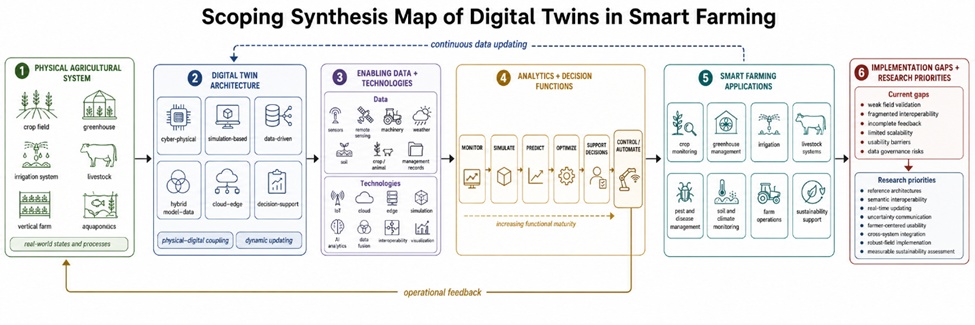
Figure 1. Scoping Synthesis Map of Digital Twins in Smart Farming. The figure integrates the main scoping review categories by linking architecture types, enabling technologies, agricultural data requirements, application domains, implementation barriers, and future research directions for digital twins in smart farming.
Alt-text description: A conceptual synthesis map showing digital twin architectures connected to enabling technologies, data requirements, smart farming applications, implementation barriers, and research gaps. Architecture types connect to IoT, remote sensing, data fusion, simulation, AI analytics, cloud and edge computing, visualization, decision support, crop systems, livestock systems, greenhouse systems, irrigation, monitoring, optimization, interoperability gaps, validation gaps, and future research priorities.
The first research gap is conceptual and architectural clarity. Broad reviews of digital twins in agriculture and forestry indicate that the field still needs stronger validation, interoperability, scalability, data-quality management, and domain-specific integration [30]. Future studies should specify whether they present a conceptual digital twin, a partial digital twin, a digital twin-like architecture, a simulation environment, a monitoring dashboard, or an operational physical-digital system. Without this clarity, the literature risks overstating maturity and comparing systems that do not share the same technical or functional boundaries.
The second gap concerns interoperability, standardization, and complete feedback loops. Recent reviews of agricultural digital twin progress identify fragmented architectures, limited standardization, incomplete integration, and open issues in physical-digital feedback [31]. Future work should therefore prioritize semantic interoperability, reusable data models, cross-platform interfaces, and transparent architecture documentation. Agricultural digital twins will be difficult to scale if each system is built around isolated data structures, proprietary platforms, incompatible machinery formats, or domain-specific models that cannot be connected to broader farm-management workflows.
The third gap concerns farmer-centered implementation. Comprehensive reviews of agricultural digital twin technology point toward the need for robust, interoperable, validated, context-aware, and farmer-centered systems rather than universal one-size-fits-all architectures [32]. Future research should examine how farmers, advisors, veterinarians, greenhouse managers, irrigation specialists, and other users interpret digital twin outputs, manage uncertainty, and incorporate recommendations into real decisions. Visualization, explainability, trust, workload, local knowledge, and advisory relationships should be treated as core design concerns rather than as secondary interface features.
The fourth gap concerns validation, governance, and sustainability assessment. Digital twins may support monitoring, simulation, prediction, optimization, and decision support, but the literature does not justify broad claims that they automatically improve productivity, reduce environmental impacts, or eliminate human decision-making. Future studies should validate digital twin outputs under real production conditions, report uncertainty and data limitations, address data ownership and governance, evaluate lifecycle maintenance requirements, and connect sustainability claims to measurable assessment frameworks. Scoping evidence suggests that the field’s next stage should move from promising architectures toward transparent, validated, interoperable, and usable digital twin ecosystems.
This scoping review mapped digital twins in smart farming by organizing the literature around definitions, architecture types, enabling technologies, data requirements, application domains, analytics functions, feedback mechanisms, implementation stages, limitations, and research gaps. The synthesis shows that digital twins have potential as smart-farming infrastructure when they connect physical agricultural systems with updated digital representations, simulation or analytics, visualization, and decision-support pathways. At the same time, the review emphasizes conceptual caution: sensors, dashboards, AI models, remote-sensing systems, and simulations do not become digital twins unless they are integrated into meaningful physical-digital and decision-oriented systems. The field now requires stronger architecture standardization, semantic interoperability, data governance, uncertainty communication, farmer-centered usability, field validation, scalability, and sustainability assessment before digital twins can be treated as mature infrastructure across diverse agricultural contexts.
None
None
None
None
Open Access The author(s) retain copyright. This article is licensed under the Creative Commons Attribution-NonCommercial-ShareAlike 4.0 International License. It may be shared and adapted for non-commercial purposes with appropriate attribution, an indication of changes, and distribution of adaptations under the same license. Third-party material may be subject to separate terms identified in its credit line. View the license at https://creativecommons.org/licenses/by-nc-sa/4.0/.
 Agro Intelligence Research Press