Agricultural artificial intelligence increasingly combines sensor measurements, remote sensing, farm records, predictive modelling, and digital decision support. Yet agricultural context cannot be adequately represented through machine-readable data or model performance alone. Farming decisions are also shaped by tacit knowledge, farmer expertise, local ecological understanding, seasonal experience, farm history, cultural relationships, and institutional power. This article proposes a conceptual framework for integrating these dimensions into context-aware agricultural AI without treating local or Indigenous knowledge as extractable technical inputs. The framework begins with context-aware use-case definition and farm, agroecological, cultural, and historical context mapping. It then distinguishes tacit, experiential, situated, local, Indigenous, traditional ecological, scientific, and model-based knowledge while preserving differences in authority, representation, and validation. Participatory design, farmer-centered design, knowledge co-production, human oversight, local validation, knowledge sovereignty, Indigenous data sovereignty, access control, and ethical review are positioned as interconnected requirements rather than optional additions. The framework also addresses knowledge extraction, misappropriation, decontextualization, translation loss, contextual bias, algorithmic opacity, consent ambiguity, unequal benefit distribution, and trust overclaiming. Its principal contribution is a staged architecture that links knowledge plurality with contextual interpretation, governance safeguards, uncertainty communication, feedback, and explicit decision boundaries. The framework is intended to guide conceptual development and research design. It does not authorize knowledge use, establish community or Indigenous approval, validate Indigenous knowledge through AI, guarantee cultural appropriateness or trust, or demonstrate operational or deployment readiness.
Agricultural AI is commonly associated with sensor networks, predictive analytics, automation, digital platforms, and data-driven decision support. These technologies operate, however, within social, institutional, economic, and environmental systems rather than isolated computational environments. Their functions and consequences depend on how data are produced, who controls infrastructures, which agricultural objectives are prioritized, and how affected actors participate in innovation. Context-aware agricultural AI must therefore connect technical data ecosystems with responsible and socially situated innovation rather than equating increased data availability with improved contextual understanding [1-3].
This challenge is especially important because agricultural decisions are rarely reducible to stable optimization problems. Crop, soil, livestock, weather, labour, financial, ecological, and market conditions interact with farmer priorities and institutional constraints. Smart-farming development consequently raises questions concerning responsibility, inclusion, anticipation, reflexivity, and responsiveness throughout the technology lifecycle [4]. Context-awareness should be understood as the capacity to identify these dependencies, communicate their uncertainty, and restrict recommendations when relevant contextual information or governance authority is absent.
Tacit knowledge, farmer expertise, local knowledge, and Indigenous knowledge further complicate conventional assumptions about AI inputs. Some agricultural understanding develops through repeated practice, embodied observation, historical memory, relationships with landscapes, and culturally grounded systems of responsibility. Such knowledge may be difficult, inappropriate, or impermissible to encode. Its significance cannot be measured solely by whether it improves predictive accuracy. Respectful integration may instead require recognition of knowledge that remains outside the model, participation in defining system boundaries, and governance that determines whether knowledge may be accessed at all.
This article develops an original conceptual framework for integrating plural knowledge domains into context-aware agricultural AI. It distinguishes data integration from knowledge integration, participation from authorization, technical validation from community validation, and explainability from ethical legitimacy. The framework organizes context mapping, knowledge-holder identification, representation boundaries, participatory design, knowledge sovereignty, model–context alignment, human oversight, local validation, ethical review, feedback, and explicit no-deployment-readiness boundaries. Its purpose is to guide careful framework development, not to prescribe universal governance procedures or agricultural actions.
Digitalisation changes not only the volume and speed of agricultural information but also how knowledge is produced, mediated, interpreted, and valued [5]. Agricultural AI may process sensor data, remote-sensing observations, weather forecasts, soil indicators, crop measurements, and farm-management records. Models transform these inputs into classifications, forecasts, alerts, or decision options. Nevertheless, model knowledge remains a computational representation shaped by selected variables, labels, objectives, and training conditions. It cannot be assumed to represent the complete farm, social, or ecological context.
Context-awareness must therefore extend beyond model architecture. Digital agriculture operates within agricultural innovation systems that connect farmers, advisers, researchers, technology firms, public institutions, infrastructures, policies, and markets [6]. A recommendation may be technically plausible yet locally unsuitable because of limited connectivity, labour availability, equipment access, financial constraints, advisory capacity, or data-governance concerns. Context-aware decision support should identify these dependencies before presenting outputs as actionable and should record conditions under which the system should defer to human interpretation.
Farming diversity also challenges universal models of digital transformation. Production scale, cropping systems, livestock arrangements, agroecological conditions, farm ownership, skills, infrastructure, risk exposure, and institutional support differ substantially across settings. Agriculture 4.0 consequently involves multiple transition pathways with different distributions of responsibility, opportunity, and risk [7]. Contextual fit requires assessing whether the intended use corresponds to the specific farm and whether system assumptions privilege particular production models, data-rich settings, or actors with greater technical and economic capacity.
At the biophysical level, context mapping can connect soil, crop, weather, management, landscape, and economic information to farm-system objectives [8]. Remote sensing and in-field sensors may reveal spatial or temporal patterns, while models may help organize scenarios or identify anomalies. These functions are potentially useful but remain partial. Cultural context, seasonal interpretation, farm history, resource constraints, and locally meaningful environmental relationships may not appear in standard datasets. Conceptual alignment between data, model, decision, and farm context is therefore necessary but cannot independently demonstrate
Tacit knowledge develops through practical engagement and may be expressed through judgment, timing, attention, and embodied recognition rather than explicit rules. Farmers and advisers often make sense of digital information by relating it to farm conditions, previous outcomes, and operational constraints [9]. A sensor anomaly, forecast, or model alert may acquire meaning only when interpreted alongside field appearance, animal behaviour, machinery limitations, or recent management. Context-aware AI should support this interpretive work rather than presume that digital outputs are self-explanatory.
Farmer expertise operates across interconnected social, cyber, and physical conditions [10]. Experiential and situated knowledge may include farm history, seasonal observation, soil texture and moisture assessment, crop appearance, weather interpretation, management memory, pest or disease patterns, and, where relevant, livestock behaviour. These forms of knowledge do not constitute a uniform dataset. They vary among people, locations, tasks, and periods. The framework therefore treats expertise as a source of interpretation, constraint identification, and decision authority, while recognizing that experience may also be incomplete or uncertain.
Digital advisory systems should enable interaction rather than deliver one-directional recommendations. Extension and advisory relationships can help farmers interpret uncertainty, compare options, identify discrepancies, and connect digital information with local agronomic understanding [11]. Advisor mediation may be particularly important when outputs have significant economic, environmental, or animal-welfare implications. Nevertheless, advisers should not become passive transmitters of platform recommendations. Human oversight requires sufficient expertise, independence, time, and authority to question or reject an output.
Farmer-centered design and local testing can identify communication, usability, and decision-context requirements that developers may overlook [12]. Farmers should be able to explain goals, revise preferences, contest assumptions, and retain meaningful control over decisions. Participation does not require complete digitization of experience. A legitimate outcome may be to record only a contextual constraint, preserve a narrative explanation, or leave knowledge unencoded. Accordingly, the proposed framework includes a no-full-digitization boundary and a no-farmer-replacement boundary: AI may organize evidence and options, but it should not be presented as a substitute for accountable farmer judgment.
Local, Indigenous, and traditional ecological knowledge must not be treated as interchangeable labels or undifferentiated inputs. Local knowledge may refer to place-based understanding developed through experience within a particular farming or ecological setting. Indigenous knowledge is connected to distinct peoples, knowledge systems, relationships, responsibilities, histories, and governance authorities. Traditional ecological knowledge may describe relational understandings of environmental change, species, water, soils, climate, and landscapes. Respectful engagement requires maintaining the integrity of different knowledge systems, meaningful community involvement, and Indigenous data-governance principles rather than assimilating knowledge into a single computational hierarchy [13-15].
Knowledge co-production is not automatically equitable. Processes described as collaboration may still allow external institutions to define the problem, control funding, select categories, own infrastructures, and determine how contributions are interpreted. Respect for Indigenous knowledge sovereignty therefore requires more than inviting participation; it may require institutions to redistribute decision-making space and recognize that knowledge holders can restrict, condition, or refuse involvement [16]. The framework consequently places Indigenous knowledge governance review before data collection, knowledge elicitation, model selection, or platform design.
Where locally or culturally governed knowledge is relevant, its potential role should be defined cautiously. Authorized knowledge may help identify contextual questions, interpret environmental change, describe historical conditions, or expose gaps in scientific and sensor-based representations. Landscape, biodiversity, water, soil, and climate-adaptation knowledge may be relevant where supported and appropriately governed. However, technical usefulness does not create permission. Machine readability, interoperability, or possible predictive value does not override knowledge sovereignty, cultural sensitivity, access restrictions, confidentiality, community authority, or benefit-sharing considerations where applicable [15].
The proposed approach therefore establishes three mandatory boundaries. First, integration does not authorize extraction, standardization, unrestricted reuse, or commercialization of knowledge. Second, agreement between an AI output and a knowledge statement does not validate Indigenous knowledge or place AI above another knowledge system. Third, usability testing, translation, technical accuracy, or individual participation cannot establish cultural appropriateness or community approval. Community consent or free, prior, and informed consent may be relevant in particular settings, but their meaning and adequacy require community-specific governance. The conceptual framework can identify these governance questions; it cannot answer them on behalf of knowledge holders.
Knowledge integration can become extractive when farmers or knowledge holders provide observations, histories, or interpretations while external organizations retain control over data, models, infrastructures, and resulting value. Transparency about data use, access, control, and benefit distribution is therefore central; participation or data provision should not be interpreted as evidence of trust [17]. Knowledge-extraction and misappropriation risks arise when contributions are collected for unspecified future purposes, reused beyond their original context, commercialized without appropriate authority, or treated as transferable technical assets.
Power asymmetry also shapes who defines the problem, selects categories, determines success criteria, and decides whether knowledge is sufficiently credible. Digital agriculture can reproduce inequalities in technology access, ownership, labour, skills, and bargaining capacity [18]. Unequal benefit distribution may persist even when participation is formally offered. Consent ambiguity is especially significant where individual agreement is treated as collective authorization or where participation occurs under institutional, financial, or technological dependency. Participatory processes must therefore examine authority, representation, refusal, and continuing control rather than merely counting participants.
Digital infrastructures are not neutral containers. Their standards, interfaces, ownership arrangements, and interoperability requirements privilege particular forms of knowledge and agricultural practice [19]. Over-standardization may detach observations from place, season, relationships, language, and history, while translation into variables or ontologies can erase uncertainty and relational meaning. Open-data or data-sharing objectives likewise cannot override Indigenous authority over data concerning Indigenous Peoples, territories, identities, resources, or knowledge [20]. Technical access, data custody, and legal ownership should not be conflated with legitimate governance authority.
Model bias, dataset bias, and contextual bias occur when training data, objectives, labels, or system assumptions poorly represent intended settings. Algorithmic opacity can prevent farmers and advisers from identifying why an output conflicts with experience, while persuasive explanations may encourage overreliance. Ethical principles, trust claims, or aggregate performance metrics cannot independently resolve these problems. Context-aware AI requires explicit representation limits, contextual-error assessment, access controls, local validation, human review, and no-deployment-readiness boundaries. Table 1 summarises tacit, local, and Indigenous knowledge domains, integration challenges, ethical risks, participation needs, validation needs, and framework roles in context-aware agricultural AI.
Table 1. Tacit, Local, and Indigenous Knowledge Integration Requirements and Challenges in Context-Aware Agricultural AI: Farmer Expertise, Experiential Knowledge, Local Knowledge, Indigenous Knowledge, Traditional Ecological Knowledge, Knowledge Sovereignty, Consent, Power Asymmetry, Misappropriation Risk, Decontextualization Risk, Validation, and Ethical Boundaries
Knowledge domain or integration challenge | Core context or risk question | Required knowledge source, governance, or condition | Potential AI or decision-support role | Risk of misuse, extraction, or misinterpretation | Participation or validation need | Ethical safeguard | Framework role |
Tacit knowledge and farmer expertise | Which decisions depend on embodied experience, judgment, and farm history? | Farmer-led interpretation, seasonal observation, management memory, and stated representation limits | Qualify alerts, identify constraints, and interpret anomalies | Treating partial descriptions as complete digital knowledge | Farmer participation and local review | No full-digitization or farmer-replacement claim | Human interpretation and oversight layer |
Local and situated knowledge | What understanding is valid only within a particular place, season, or production system? | Provenance, scope, local contributors, and current conditions | Add contextual constraints or explanations | Decontextualization and inappropriate transfer | Local validation and continuing correction | Explicit geographic and temporal limits | Contextual-fit layer |
Indigenous and traditional ecological knowledge | Who has authority to determine whether knowledge may be accessed or represented? | Indigenous knowledge sovereignty, Indigenous data sovereignty, and community-specific governance | Only an authorized, delimited contextual role | Extraction, misappropriation, disclosure, or epistemic hierarchy | Governance determined by relevant Indigenous authority | No AI-validation-of-knowledge or authorization claim | Pre-technical governance gate |
Knowledge extraction and misappropriation | Is knowledge being collected mainly to create external technical or commercial value? | Purpose limitation, authority review, access conditions, and benefit consideration | May trigger redesign, minimization, or non-collection | Unauthorized reuse, linkage, publication, or commercialization | Knowledge-holder review and refusal options | No extraction claim boundary | Exclusion and lifecycle-governance screen |
Decontextualization and translation loss | What meaning is lost when narratives, practices, or relationships become variables? | Source context, language, provenance, uncertainty, and non-representation options | Store bounded annotations or constraints | Simplification, changed meaning, and false universality | Iterative interpretation with contributors | Preserve distinctions among observation, inference, and measurement | Representation-boundary review |
Power, consent, and unequal benefits | Who defines purposes, controls decisions, and receives value? | Authority mapping, participation terms, and transparent value flows | Support governance questions and documented restrictions | Tokenism, coercion, consent ambiguity, or unequal benefit distribution | Shared agenda setting and context-specific governance | Participation does not equal authorization or trust | Stakeholder-authority assessment |
Data ownership, access, and cultural sensitivity | Who may access raw data, derived profiles, locations, and linked information? | Data governance, access control, confidentiality, and cultural restrictions | Restrict visibility, retention, linkage, and reuse | Surveillance, re-identification, disclosure, or cultural harm | Farmer, knowledge-holder, or community review as applicable | Data minimization and role-based access | Data-governance layer |
Model, dataset, and contextual bias | Does the model perform appropriately for the intended users and conditions? | Provenance, subgroup coverage, objective review, local evidence, and user feedback | Detect mismatch and restrict recommendations | Unequal errors, opacity, over-standardization, and trust overclaiming | Local testing, explanation review, and human oversight | No ethical-sufficiency or deployment-readiness claim | Model–context alignment and validation gate |
Context-first design begins, and user feedback | Detect mismatch and restrict recommendations | Unequal errors, opacity, over-standardization, and trust overclaiming | Local testing, explanation review, and human oversight | No ethical-sufficiency or deployment-readiness claim by defining the agricultural decision, affected actors, expected consequences, and excluded uses before selecting data or models. Farmer-centered and human-centered design then examine whether the proposed function reflects farmers’ goals, capacities, working conditions, autonomy, and opportunities to contest outputs. Uneven infrastructure, resources, farm scale, and digital capability can determine who benefits from digital farming and who is excluded [21]. Contextual fit must therefore be treated as a design requirement rather than a post-development adjustment.
Knowledge elicitation should be purpose-limited and should not presume that every relevant observation must become structured data. Digital platforms may support georeferenced observations, monitoring, and feedback when participation, provenance, interpretation, and scope remain explicit [22]. Data minimization, access control, privacy, confidentiality, and culturally sensitive restrictions should apply throughout collection, storage, linkage, analysis, and reuse. Where consent is applicable, system design should make purposes and material changes visible without assuming that generic individual permission resolves collective authority.
Participatory design and co-design should extend across problem framing, requirements, prototyping, evaluation, and revision [23]. Knowledge co-production requires reciprocal interpretation while preserving differences among scientific agronomic knowledge, farmer expertise, local knowledge, and Indigenous knowledge systems. Participation should clarify which decisions are genuinely shared, who may decline involvement, and how disagreements are documented. It cannot by itself establish trust, eliminate power asymmetry, authorize Indigenous knowledge use, or prove cultural appropriateness.
Context-aware outputs should communicate relevant data provenance, assumptions, uncertainty, alternatives, and known limits. Explainability must be adapted to farmer and adviser needs, while human oversight should provide meaningful authority to modify, reject, or halt recommendations. Agricultural AI also requires systemic evaluation of data risks, narrow optimization, unequal adoption, and scaling externalities [24]. Local or community validation where supported should remain bounded to the conditions and authorities actually involved. Feedback-enabled learning must preserve provenance and must not silently expand data uses or weaken governance restrictions.
The proposed framework organizes agricultural AI around contextual fit rather than model performance alone. Its evaluative orientation combines implications for people, agricultural production, and environmental systems with explicit attention to social and ethical impacts [25, 26]. The framework is conceptual: it identifies questions, relationships, governance gates, validation needs, and decision boundaries that may guide research and design. It does not prescribe a universal technical architecture or governance process.
The first stages are context-aware use-case definition, farm and agroecological context mapping, and stakeholder and knowledge-holder mapping. These stages establish the proposed decision, intended users, affected non-users, physical conditions, institutional dependencies, knowledge sources, governance authorities, and excluded functions. Tacit knowledge recognition, farmer expertise integration, and local knowledge integration then identify where contextual interpretation is required and where knowledge should remain narrative, partial, restricted, or unrepresented. Indigenous knowledge governance review precedes any proposed collection or representation. Technical data-management principles must remain subordinate to people- and purpose-oriented Indigenous governance where relevant [27].
The next stages review knowledge sovereignty, data governance, participation, applicable consent questions, and representation boundaries. Model and data-context alignment then assesses training provenance, feature meaning, objectives, coverage gaps, and contextual transfer. Contextual bias assessment examines whether recommendations systematically fail for particular farms, production systems, seasons, resource conditions, or stakeholder groups. Ethical principles can inform this work, but principles alone cannot establish accountable or contextually valid AI practice [28].
An explainability and uncertainty layer translates model outputs into qualified decision-support information. Human oversight and advisor mediation provide interpretation, escalation, correction, and rejection pathways. Local validation considers performance and meaning within the intended farm context, while community validation may be relevant only where appropriate authorities define and conduct it. Feedback links observed discrepancies, changing conditions, governance decisions, and user concerns to model revision, contextual remapping, scope restriction, or discontinuation.
The final stages address ethical review, possible benefit-sharing considerations, practical implications, long-term feedback, and framework updating. Cross-cutting boundaries prohibit knowledge-extraction claims, AI validation of Indigenous knowledge, unsupported cultural-appropriateness or trust claims, farmer replacement, and deployment-readiness claims. Table 2 presents the proposed conceptual framework for integrating tacit, local, and Indigenous knowledge into context-aware smart farming AI systems.
Table 2. Proposed Conceptual Framework for Context-Aware Agricultural AI: Use-Case Definition, Farm and Agroecological Context Mapping, Stakeholder and Knowledge-Holder Mapping, Tacit Knowledge Recognition, Farmer Expertise Integration, Local Knowledge Integration, Indigenous Knowledge Governance Review, Knowledge Sovereignty, Contextual Bias Assessment, Explainability, Human Oversight, Local Validation, Ethical Review, Feedback Loops, and Deployment Boundaries
Framework stage | Core purpose | Required input | Framework function | Potential output | Validation or governance need | Failure risk | Feedback mechanism | Decision boundary |
Context-aware use-case definition | Bound the decision problem | Purpose, users, consequences, alternatives, exclusions | Define scope and non-goals | Bounded use-case statement | Farmer and stakeholder review | Technology-led scope creep | Revise when needs change | No development without explicit purpose |
Farm and agroecological context mapping | Describe material and temporal conditions | Farm system, soils, crops or livestock, weather, resources, history | Identify relevant context and missing information | Context profile | Farmer and domain review | Transfer from dissimilar conditions | Seasonal updating | Generic data do not establish fit |
Stakeholder and knowledge-holder mapping | Identify affected actors and authorities | Users, advisers, data subjects, communities, developers, institutions | Separate participation from decision authority | Stakeholder–authority map | Review by affected actors | Exclusion of less powerful groups | Add actors as impacts emerge | One participant cannot authorize others |
Tacit, farmer, and local knowledge integration | Preserve human interpretation and situated meaning | Experience, judgment, local observations, farm history | Add constraints, narratives, or human-review points | Scoped contextual input | Farmer or local validation | Full-digitization and decontextualization | Correction and withdrawal | Non-representation remains legitimate |
Indigenous knowledge governance review | Determine whether proposed activity is permissible | Relevant authority and community-specific governance | Trigger governance before technical design | Restriction, redesign, or no-use decision | Determined by relevant Indigenous authority | Generic permission replacing sovereignty | Continuing governance review | Framework cannot authorize use |
Knowledge sovereignty and data governance | Define control throughout the data lifecycle | Access, custody, reuse, linkage, retention, deletion | Translate authority into technical restrictions | Governance conditions | Knowledge-holder and institutional review | Custody mistaken for authority | Periodic audit | No collection without legitimate basis |
Participation, consent, and representation boundaries | Clarify participation and what may be encoded | Purpose, contributors, sensitivity, collective implications | Select full, partial, metadata-only, or no representation | Participation and representation record | Context-specific governance | Tokenism or consent ambiguity | Revisit after material changes | Framework does not certify consent |
Model–data alignment and contextual bias assessment | Test suitability for the intended setting | Training provenance, objectives, context profile, subgroup evidence | Detect mismatch and unequal errors | Alignment and bias register | Technical, farmer, and domain review | Aggregate accuracy concealing local failure | Monitor discrepancies | Misaligned models must be restricted |
Explainability and uncertainty | Support comprehension without false certainty | Output, provenance, assumptions, limitations, confidence | Produce qualified explanations and warnings | Interpretable decision support | Comprehension testing | Persuasive but misleading explanation | Record misunderstanding | Explanation does not prove correctness |
Human oversight and advisor mediation | Retain accountable judgment | Reviewer roles, expertise, escalation thresholds | Review, modify, reject, or stop outputs | Human-reviewed outcome | Adequate authority and competence | Symbolic oversight or automation bias | Log overrides and disagreements | AI remains advisory |
Local and community validation where supported | Assess bounded contextual meaning and consequences | Local evidence, scenarios, user interpretation, governance requirements | Identify unacceptable outputs or uses | Revision, restriction, or refusal | Relevant farmers, advisers, or community authorities | Developers claiming validation for others | Repeat after system changes | Validation is context-bounded |
Ethical review, feedback, and framework updating | Examine harms, benefits, accountability, and change | Risk register, value flows, incidents, feedback, new evidence | Redesign, restrict, update, or discontinue | Versioned framework and unresolved questions | Independent and context-specific review | Checklist ethics and premature scaling | Scheduled and event-triggered review | No ethical-sufficiency or deployment-readiness claim |
Figure 1 presents the proposed conceptual framework for integrating tacit, local, and Indigenous knowledge into context-aware agricultural AI, linking knowledge domains, participatory design, governance safeguards, contextual interpretation, human oversight, validation, feedback, and decision boundaries.
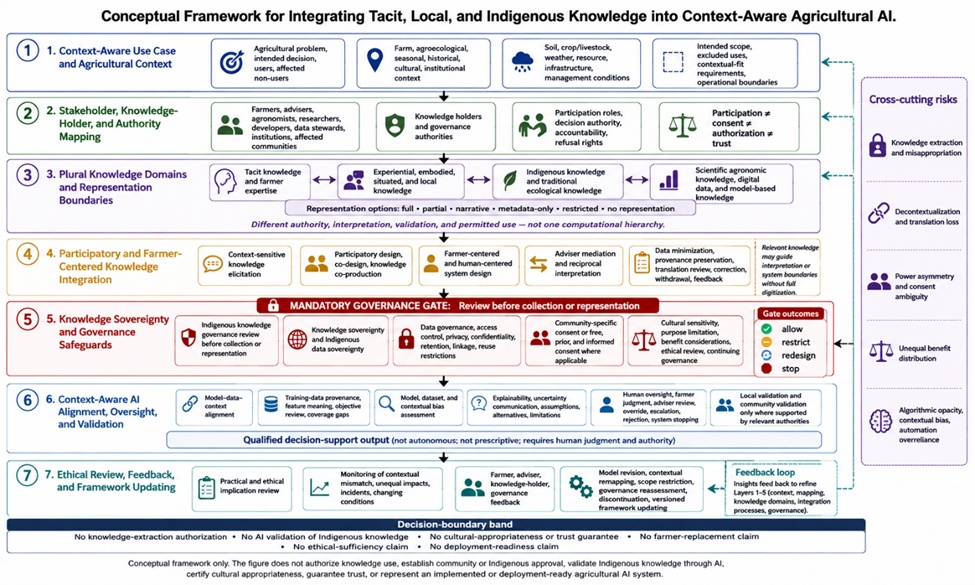
Figure 1. Conceptual Framework for Integrating Tacit, Local, and Indigenous Knowledge into Context-Aware Agricultural AI
Alt-text description: A conceptual framework showing agricultural AI connected to farm context, tacit farmer expertise, local knowledge, Indigenous knowledge, participatory design, knowledge sovereignty, ethical safeguards, contextual bias assessment, explainability, human oversight, validation, feedback, and deployment boundaries.
For farmers, advisers, agronomists, cooperatives, and extension services, the framework emphasizes that digital recommendations should be interpreted through farm history, current conditions, resource constraints, uncertainty, and farmer-defined objectives. Human oversight, accessible explanations, local validation, and feedback mechanisms may reduce contextual mismatch, but they cannot guarantee trust or correct decisions. Farmer autonomy requires meaningful options, override capacity, data-use transparency, and the ability to contest or discontinue system use.
For Indigenous Peoples and local communities where applicable, proposed agricultural AI initiatives should begin with authority and governance questions rather than knowledge collection. Knowledge sovereignty, Indigenous data sovereignty, cultural sensitivity, access restrictions, confidentiality, applicable consent processes, and benefit-sharing considerations may determine whether an activity should proceed, be redesigned, or not occur. These determinations cannot be made by AI developers, platform providers, researchers, or this conceptual framework on behalf of relevant knowledge holders.
For developers, data stewards, public institutions, researchers, and policymakers, the framework suggests a research agenda centered on contextual bias evaluation, participatory governance, data minimization, uncertainty communication, accountability, and long-term monitoring. These implications are conceptual rather than prescriptive. They do not constitute legal advice, cultural-protocol guidance, Indigenous governance or data-sovereignty advice, policy recommendations, procurement guidance, platform-selection advice, agronomic instructions, or deployment procedures.
This article contributes a conceptual framework for integrating tacit, local, and Indigenous knowledge into agricultural AI through context-first design, farmer expertise, plural knowledge recognition, participatory processes, knowledge sovereignty, ethical safeguards, human oversight, local validation, feedback, and explicit decision boundaries. Its central proposition is that smart-farming systems should be evaluated not only through data availability or model performance but also through contextual fit, representation limits, authority, farmer autonomy, cultural sensitivity, uncertainty, validation, and governance. The framework can help structure future research and design questions, but it does not authorize knowledge use, establish community or Indigenous approval, validate Indigenous knowledge through AI, certify cultural appropriateness, guarantee trust, or demonstrate operational safety or deployment readiness.
None
None
None
None
Open Access The author(s) retain copyright. This article is licensed under the Creative Commons Attribution-NonCommercial-ShareAlike 4.0 International License. It may be shared and adapted for non-commercial purposes with appropriate attribution, an indication of changes, and distribution of adaptations under the same license. Third-party material may be subject to separate terms identified in its credit line. View the license at https://creativecommons.org/licenses/by-nc-sa/4.0/.
 Agro Intelligence Research Press