Foundation models are becoming relevant to precision agriculture because they can connect sensing, remote sensing interpretation, multimodal data integration, knowledge retrieval, advisory communication, and farm decision-support workflows. Their broad capability, however, does not establish agronomic validity, trustworthy performance, operational safety, or deployment readiness. This article develops an original governance and technical safeguard framework for responsible agricultural foundation models. The framework treats these models as potential components of decision infrastructure and integrates trustworthy artificial intelligence requirements with data governance, validation, human oversight, farmer participation, monitoring, and explicit claim boundaries. It identifies requirements concerning data quality, provenance, documentation, transparency, explainability, interpretability, uncertainty communication, robustness, generalization, bias, fairness, privacy, cybersecurity, accountability, auditability, and traceability. It also maps risks arising from opaque pretraining data, uncertain data control, hallucination, factual error, agronomic invalidity, platform dependency, model drift, data drift, and unclear responsibility. Technical safeguards include data screening, domain-adaptation assessment, external and local validation, robustness testing, bias and fairness review, factual and agronomic checking, human-in-the-loop review, and continuing monitoring. Responsible deployment principles add purpose limitation, context sensitivity, incident response, withdrawal planning, and non-autonomy boundaries. The contribution is a structured conceptual framework that connects governance questions with technical evidence and accountable actors without claiming legal compliance, guaranteed trustworthiness, farmer approval, or deployment readiness.
Foundation models are broad AI systems that can be adapted to many downstream tasks. In precision agriculture, they may connect image analysis, textual knowledge, spatial information, temporal observations, sensor streams, and management records. Current agricultural foundation-model research spans language, vision, multimodal analysis, decision support, and robotics, while also identifying unresolved problems involving data availability, domain adaptation, distribution shift, resource demands, and contextual validity [1, 2]. Their significance therefore lies not only in model scale, but in their possible role as reusable infrastructure for agricultural information processing.
Large language models illustrate both the promise and fragility of this infrastructure. They may support agricultural question answering, information retrieval, summarisation, and advisory communication, yet fluent language can hide unsupported claims, outdated knowledge, or missing local context. Agricultural LLM applications consequently raise concerns about hallucination, bias, factual reliability, privacy, and the suitability of general-purpose language capability for specialised agronomic settings [3]. Similar concerns apply when broad visual or multimodal representations are transferred into crop, soil, disease, or remote-sensing workflows without adequate evaluation.
Responsible use requires more than technical performance. Agricultural AI is embedded in relationships among farmers, advisors, developers, data stewards, cooperatives, platform providers, extension services, and public institutions. Ethical and responsible agricultural AI therefore requires accountability, transparency, explainability, privacy, fairness, data governance, stakeholder participation, and meaningful human oversight alongside model accuracy [4]. These issues become more consequential when outputs may affect resource allocation, crop-management choices, risk interpretation, or control over agricultural data.
This article proposes a governance and technical safeguard framework for responsible foundation models in precision agriculture. It does not certify models or prescribe universal deployment procedures. Instead, it links use-case definition, stakeholder mapping, data governance, validation, uncertainty communication, human review, monitoring, accountability, and decision boundaries. The central argument is that foundation models may support agricultural decision infrastructure only when their role, evidence base, limitations, responsible actors, technical safeguards, and residual risks are made visible and subject to continuing review.
Vision foundation models may provide reusable visual representations for crop, disease, weed, soil-surface, or field-condition analysis. Their value depends on the relationship between pretraining data, downstream agricultural tasks, adaptation data, and evaluation context. Agricultural vision-foundation-model research indicates that generic representations require task-specific specialisation and downstream assessment before they can be interpreted as suitable for agricultural use [5]. Reusability should therefore be treated as a technical opportunity rather than evidence of agronomic validity.
Adaptation techniques include linear probing, fine-tuning, parameter-efficient methods, transfer learning, and knowledge distillation. These methods may reduce the resources needed to specialise models, but their performance remains sensitive to dataset composition, labels, crop coverage, and differences between development and intended-use settings. Comparative agricultural evidence suggests that adapted visual representations can support disease and weed identification, yet benchmark or cross-dataset results do not independently establish field readiness [6]. Adaptation must remain an assessable stage with explicit evidence requirements.
Geospatial and remote-sensing foundation models extend decision infrastructure to satellite and other spatial observations. Potential applications include crop monitoring, land interpretation, environmental assessment, and regional analysis. However, sensor variation, spatial resolution, temporal frequency, geographic transfer, modality heterogeneity, and scale dependence create substantial constraints. Reviews of remote-sensing foundation models identify continuing barriers involving data harmonisation, architecture, downstream reasoning, and transfer across regions and tasks [7]. Agricultural use therefore requires context-specific evaluation rather than assumptions of universal transferability.
Large language, vision-language, multimodal, and time-series foundation models may combine imagery, spatial data, weather, sensors, management histories, and textual knowledge. Prompting and retrieval-augmented generation may support knowledge access, while multimodal architectures may connect evidence across farm workflows. Reviews of large vision and language models in agriculture nevertheless identify challenges involving grounding, bias, privacy, reliability, and responsible use [8]. These systems should thus be framed as bounded decision-support components, not autonomous agricultural authorities.
Trustworthy agricultural AI combines technical reliability, social legitimacy, institutional responsibility, and stakeholder experience. Trust cannot be reduced to benchmark accuracy. It also depends on whether responsibility is assigned, farmers can challenge outputs, data practices are transparent, and risks and benefits are fairly distributed. Agricultural research on responsibility, trust, and ethical impact shows that trustworthy use requires explicit accountability and attention to consequences beyond model performance [9, 10]. Trust should therefore be assessed and calibrated rather than assumed.
Transparency, explainability, and interpretability serve different functions. Transparency concerns system purpose, data flows, limitations, and responsible actors. Explainability concerns whether relevant output factors can be communicated to users, while interpretability concerns whether qualified reviewers can inspect model behaviour. Explainable-AI research shows that methods differ in objective, fidelity, scope, and suitability for different audiences [11]. An explanation is insufficient when it is misleading, unstable, difficult to understand, or detached from uncertainty.
Validation, robustness, generalization, privacy, cybersecurity, and accountability are also essential. Validation tests fitness for a defined use; robustness tests stability under plausible disruption; and generalization examines transfer across farms, crops, seasons, sensors, and regions. Privacy and cybersecurity protect sensitive data and system integrity, while accountability identifies actors with authority to respond to failure. Trustworthy-AI scholarship treats these as interdependent technical, organisational, and social conditions rather than isolated checklist items [12].
Human oversight, farmer participation, autonomy, auditability, and traceability complete the requirement set. Human review must provide authority to question, override, or stop model-supported action. Farmer participation should influence use-case design, risk identification, evaluation, and feedback. Auditability requires inspectable evidence, while traceability links outputs to data, models, prompts, retrieval sources, and workflow decisions. None of these requirements guarantees trustworthiness; together they structure evidence, scrutiny, and residual-risk disclosure. Table 1 summarises trustworthy agricultural AI requirements for responsible foundation models in precision agriculture.
Table 1. Trustworthy Agricultural AI Requirements for Responsible Foundation Models in Precision Agriculture: Data Quality, Provenance, Documentation, Transparency, Explainability, Interpretability, Uncertainty Communication, Validation, Robustness, Bias, Fairness, Privacy, Cybersecurity, Human Oversight, Farmer Participation, Accountability, Auditability, Traceability, and Trust Boundaries
Trustworthy AI requirement | Core governance question | Required evidence or practice | Trust function | Potential output | Failure risk | Evaluation or oversight need | Framework role |
Data quality | Are inputs accurate and representative? | Quality, missingness, label, sensor, and coverage checks | Reduces input error | Quality report | Biased or unstable output | Data and domain review | Entry gate |
Data provenance | Can sources and transformations be traced? | Source, custody, processing, and version records | Supports accountability | Provenance register | Unverifiable lineage | Data-governance audit | Traceability layer |
Data documentation | Are scope and limitations visible? | Dataset description and known exclusions | Exposes assumptions | Dataset dossier | Hidden gaps | Independent review | Risk-planning input |
Model documentation | Are model design, adaptation, and limitations recorded? | Version, training, prompts, retrieval, and intended-use records | Supports reproducibility | Model dossier | Undisclosed change | Technical sign-off | Accountability evidence |
Transparency | Do stakeholders understand purpose and limits? | Use disclosure and limitation statement | Supports informed use | Transparency notice | Hidden automation | Governance review | Cross-cutting requirement |
Explainability | Are explanations suitable and faithful? | Stakeholder-matched explanation and fidelity test | Supports scrutiny | User explanation | Misleading rationale | Technical and usability review | Output safeguard |
Interpretability | Can specialists inspect behaviour? | Diagnostic and expert analysis | Supports investigation | Interpretation record | False confidence | Specialist assessment | Diagnostic safeguard |
Uncertainty communication | Are limits and low-confidence conditions visible? | Calibration, warnings, and abstention rules | Reduces overreliance | Uncertainty statement | Confident misuse | Calibration and comprehension review | Consequential-use safeguard |
Validation | Is the model fit for its defined use? | Prespecified tests, baselines, and errors | Tests fitness | Validation dossier | Benchmark overclaim | Independent review | Readiness gate |
Robustness | Does performance withstand disruption? | Noise, missing-data, and stress tests | Tests stability | Robustness profile | Brittle behaviour | Scenario review | Reliability gate |
Generalization | Where does performance transfer? | External, local, temporal, and subgroup tests | Defines boundaries | Generalization statement | Context failure | External/local validation | Use-scope limit |
Bias assessment | Which systematic distortions exist? | Disaggregated testing and data-gap analysis | Identifies bias | Bias register | Unequal errors | Multidisciplinary review | Risk identification |
Fairness assessment | Are disparities unjustified? | Contextual criteria and impact analysis | Supports equity | Fairness assessment | Metric-only fairness | Stakeholder review | Governance gate |
Privacy | Are sensitive data protected? | Minimisation, access, retention, and privacy tests | Protects interests | Privacy assessment | Leakage or inference | Privacy review | Data safeguard |
Cybersecurity | Are data and model pathways protected? | Threat modelling, controls, and monitoring | Protects integrity | Security record | Manipulation or disruption | Security review | Technical safeguard |
Human oversight | Can qualified people intervene? | Roles, escalation, override, and workload design | Preserves control | Oversight protocol | Rubber-stamping | Human-factors review | Non-autonomy boundary |
Farmer participation | Have affected farmers shaped evaluation? | Participation and documented feedback | Supports relevance | Participation record | Tokenism | Inclusion review | Feedback mechanism |
Farmer trust | Is reliance calibrated to evidence? | Trust and communication assessment | Supports appropriate reliance | Trust record | Overtrust or rejection | Longitudinal review | Assessed outcome |
Farmer autonomy | Is meaningful choice preserved? | Opt-out, alternatives, and contestability | Protects agency | Autonomy statement | Dependency | Governance review | Deployment boundary |
Accountability | Are responsible actors identifiable? | Responsibility and remedy matrix | Prevents diffusion | Accountability map | Unowned failure | Organisational review | Core governance function |
Auditability | Can evidence be independently examined? | Logs, documents, and retained tests | Enables assurance | Audit trail | Unverifiable claims | Independent audit | Assurance mechanism |
Traceability | Can outputs be reconstructed? | Versioned data, model, prompt, and workflow logs | Supports investigation | Trace record | Failed diagnosis | Technical review | Incident foundation |
No trustworthiness-guarantee boundary | Is residual uncertainty explicit? | Limitation and residual-risk statement | Prevents overclaim | Boundary declaration | Framework treated as certification | Independent final review | Mandatory limitation |
Governance risk begins with opaque pretraining and adaptation data. Agricultural models may combine satellite observations, sensors, images, weather records, soil data, crop information, and textual knowledge obtained through multiple organisations. When origin, processing, representation, or permitted use are unclear, it becomes difficult to judge whether outputs rest on suitable evidence or whether contributors retain meaningful control. Smart-farming ethics research has identified persistent concerns involving privacy, autonomy, inequality, data power, and responsible innovation [13].
Farm-data access and control create a second accountability gap. Farmers may contribute operational and commercially sensitive information without clear visibility into how it is retained, reused, combined, or transferred. Uncertainty over ownership, access, and secondary use can weaken willingness to participate in digital agricultural systems [14]. Privacy must therefore be considered together with control and autonomy, while cybersecurity must address manipulation, insecure integrations, poisoned retrieval sources, and compromised model components.
Responsibility is further complicated by distributed development and deployment. One organisation may pretrain a model, another may adapt it, a platform may integrate it, an institution may procure access, and an advisor or farmer may interpret the output. Responsibility can be shifted unless authority, evidence duties, monitoring obligations, and escalation pathways are specified. Research on responsible smart-farming innovation argues for integrated processes that connect technology development, stakeholder participation, and continuing socio-ethical assessment [15]. Human oversight must be assessed within this structure, because assigning a reviewer does not ensure competence, time, independence, or authority.
Platform dependency, weak auditability, limited traceability, model drift, data drift, and readiness overclaiming add further risk. Proprietary platforms may control data access, interfaces, updates, interoperability, pricing, and withdrawal options. Research on agricultural platformisation shows how concentrated infrastructures can reinforce dependency and asymmetric control [16]. The framework therefore preserves four limits: it does not determine legal compliance; formal roles do not establish accountability sufficiency; human review does not guarantee error prevention; and benchmark or framework conformity does not establish deployment readiness.
Technical safeguards begin with data-quality screening, provenance tracking, and dataset and model documentation. Agricultural inputs should be examined for missingness, measurement error, label quality, geographic coverage, seasonal relevance, and compatibility across modalities. Documentation should identify data sources, transformations, model versions, adaptation procedures, prompts, retrieval resources, intended uses, and limitations. Uncertainty methods can support risk communication, but their estimates remain dependent on assumptions and calibration quality [17].
Bias and fairness review should examine agricultural data, labels, model design, evaluation methods, and workflow effects. Aggregate accuracy may conceal unequal performance across crops, regions, farm types, technologies, or user groups. Fairness criteria must therefore be selected according to the affected stakeholders and decision context. Machine-learning research shows that bias can enter at multiple stages and that different fairness definitions may conflict [18].
Benchmarking should be separated from external, local, and field validation. External validation tests transfer beyond development data, while local validation examines the intended crop, location, season, sensor, and workflow. Robustness testing should assess noise, missing inputs, environmental variation, prompt changes, and retrieval failures. Model- and data-drift monitoring remain necessary because agricultural conditions and model behaviour change over time [19].
Generative systems require hallucination monitoring, factual verification, and agronomic validity review. Fluent output may contain unsupported or contextually unsuitable claims. Claim-level checking should therefore be combined with reliable sources and qualified agricultural interpretation. Hallucination research confirms that generated text may remain plausible while being unfaithful or factually incorrect [20].
Human-in-the-loop review should define reviewer competence, evidence access, escalation duties, and override authority. Traceability should connect outputs to relevant data, prompts, retrieval sources, model versions, and reviewer actions. Auditability should examine governance, model, and application layers without implying certification [21]. Table 2 maps the principal risks and safeguards.
Table 2. Governance Risks, Accountability Gaps, and Technical Safeguards for Agricultural Foundation Models: Opaque Pretraining Data, Data Provenance, Privacy, Cybersecurity, Bias, Fairness, Hallucination, Factual Accuracy, Agronomic Validity, Model Drift, Data Drift, Validation, Explainability, Human Review, Auditability, and Deployment Boundaries
Risk, gap, or safeguard | Core accountability or technical question | Required input or procedure | Governance or safeguard function | Potential output | Residual or failure risk | Validation or oversight need | Framework role |
Pretraining opacity | What inherited data and limitations shaped the model? | Available training descriptions and limitation review | Exposes inherited uncertainty | Limitation statement | Unavailable information | Independent review | Initial risk screen |
Data provenance | Can sources and transformations be traced? | Versioned lineage records | Supports accountability | Provenance register | Incomplete metadata | Data audit | Traceability layer |
Privacy and cybersecurity | Are sensitive data and system integrity protected? | Minimisation, access controls, threat testing, monitoring | Reduces exposure and manipulation | Risk register | Leakage or attack | Specialist review | Data and system safeguard |
Bias and fairness | Are errors or burdens unequally distributed? | Disaggregated testing and impact review | Detects distortion | Bias/fairness report | Hidden groups or metric conflict | Stakeholder review | Equity gate |
Validation | Is the model fit for the defined setting? | Benchmark, external, local, robustness, and field-validation plans | Tests bounded fitness | Validation dossier | Overgeneralization | Independent review | Evidence gate |
Hallucination and factual accuracy | Are generated claims supported? | Prompt tests, grounding, and claim verification | Detects unsupported output | Error log | Undetected claims | Domain review | Generative safeguard |
Agronomic validity | Is output appropriate for local agricultural conditions? | Crop, soil, weather, and management review | Tests contextual relevance | Agronomic review | Missing context | Qualified review | Consequential-use gate |
Explainability and uncertainty | Are explanations faithful and limitations visible? | Fidelity, calibration, and comprehension tests | Supports calibrated reliance | Explanation and warning | Misleading confidence | Technical and user review | Communication safeguard |
Human review | Can a qualified person reject or stop action? | Roles, escalation, override, and workload design | Preserves human control | Review record | Automation bias | Human-factors review | Non-autonomy mechanism |
Drift monitoring | Have inputs or model behaviour changed? | Baselines, alerts, versioning, and revalidation | Detects degradation | Drift report | Silent change | Continuing oversight | Post-use safeguard |
Auditability and traceability | Can decisions and evidence be reconstructed? | Logs, documents, versions, and access | Supports investigation | Audit trail | Missing evidence | Independent audit | Assurance mechanism |
Deployment boundary | Is readiness assessed separately? | Residual-risk synthesis | Prevents overclaim | Boundary statement | Checklist treated as approval | Multidisciplinary review | Mandatory limitation |
Figure 1 illustrates the technical safeguard pipeline for responsible foundation models in precision agriculture, linking data provenance, model documentation, validation, robustness, uncertainty, explainability, human oversight, monitoring, and deployment boundaries.
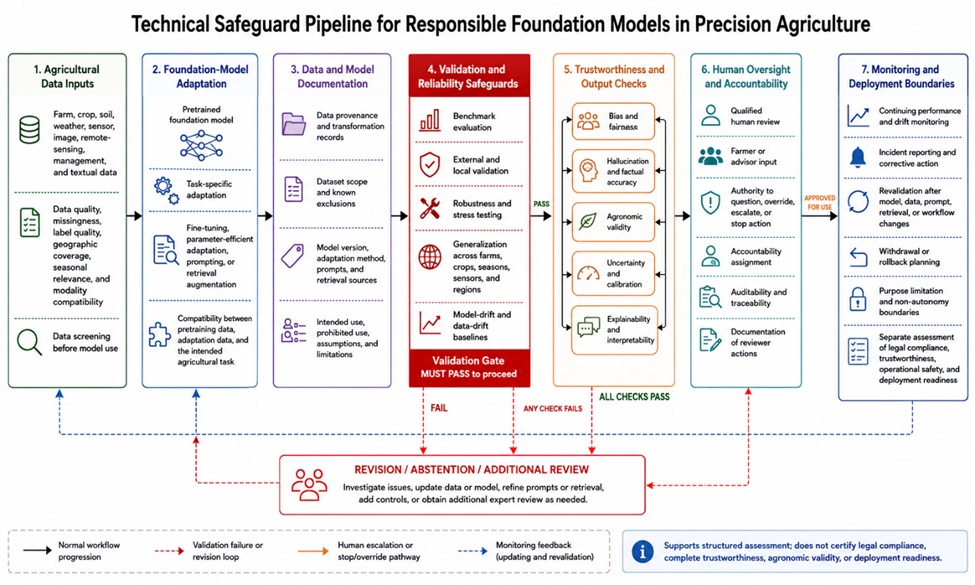
Figure 1. Technical Safeguard Pipeline for Responsible Foundation Models in Precision Agriculture
Alt text: A left-to-right pipeline connecting agricultural data, model adaptation, documentation, validation, risk checks, human oversight, monitoring, and deployment boundaries.
Responsible deployment begins with purpose limitation, use-case definition, and risk classification. Each system should have a defined task, user, output, consequence, and prohibited-use statement. Higher-consequence applications require stronger evidence and more restrictive boundaries. Human-centred AI emphasises meaningful human control rather than automation as the default objective [22].
Human oversight should assign complementary human and machine roles. Reviewers need sufficient context, competence, time, and authority to question or reject outputs. Hybrid intelligence similarly treats value as dependent on appropriate allocation of human and computational capabilities [23]. Human presence alone does not guarantee effective oversight.
Farmer participation should influence use-case selection, risk identification, evaluation, and feedback. Farmers should be able to contest unsuitable assumptions and understand data practices, limitations, and alternatives. Responsible-innovation research in farming supports participation, inclusion, and contextual assessment [24]. Consultation should not be represented as universal farmer approval.
Deployment assessment must also address local validation, privacy, cybersecurity, explainability, uncertainty, auditability, monitoring, incident reporting, and withdrawal capacity. Digital agriculture is embedded in organisational, institutional, and power relationships that affect adoption and accountability [25]. These principles provide conceptual guidance rather than legal, procurement, agronomic, or operational instructions.
The proposed framework connects cooperative governance, organisational AI governance, and practical safeguard implementation. Responsible AI requires coordinated actors, lifecycle structures and processes, and procedures that translate principles into evidence and reviewable outputs [26-28]. Governance and technical safeguards are therefore paired at every stage.
The first stage defines the agricultural use case and maps stakeholders, decision context, data sources, provenance, pretraining information, adaptation procedures, data-control arrangements, privacy, cybersecurity, risks, and accountable actors. Its purpose is to clarify scope and responsibility before technical evaluation begins.
The second stage selects trustworthy-AI requirements and technical safeguards. It plans validation, bias and fairness review, explanations, uncertainty communication, human oversight, and farmer participation. Requirements should be proportionate to the use case and produce inspectable evidence.
The third stage reviews readiness, monitoring, drift, incidents, withdrawal, feedback, and framework updating. Ethics-based auditing can identify governance gaps and support correction but does not certify trustworthiness [29]. Changes to data, models, prompts, retrieval resources, or workflows require renewed assessment.
The framework also recognises organisational incentives and public-interest effects. Governance must consider whether providers or deployers possess adequate authority, resources, and motivation to disclose limitations and respond to failures [30]. Table 3 presents the framework stages.
Table 3. Proposed Governance and Technical Safeguard Framework for Responsible Foundation Models in Precision Agriculture: Use-Case Definition, Stakeholder Mapping, Data Provenance, Model Documentation, Data Governance, Privacy, Cybersecurity, Risk Mapping, Validation, Bias and Fairness Review, Explainability, Uncertainty, Human Oversight, Farmer Feedback, Monitoring, Incident Response, Framework Updating, and Claim Boundaries
Framework stage | Core purpose | Required input | Governance function | Technical safeguard function | Potential output | Validation or assessment need | Failure risk | Feedback mechanism | Decision boundary |
Use-case definition | Define task and limits | User, workflow, output, consequence | Establishes scope | Selects relevant tests | Use-case charter | Domain review | Function creep | Scope revision | Purpose limit |
Stakeholder mapping | Identify affected and responsible actors | Farmer, advisor, provider, institution roles | Allocates participation and authority | Identifies workflow constraints | Stakeholder map | Inclusion review | Exclusion | Stakeholder feedback | No implied approval |
Data and provenance review | Assess source, quality, and control | Data inventory and lineage | Supports stewardship | Enables quality screening | Data register | Data audit | Opaque data | Corrective action | No ownership ruling |
Model documentation | Record model and adaptation choices | Versions, prompts, retrieval, fine-tuning | Assigns disclosure duties | Supports reproducibility | Model dossier | Technical review | Hidden changes | Version updates | No suitability guarantee |
Privacy and security review | Identify exposure and integrity risks | Data flows and threat model | Allocates responsibility | Tests controls | Risk register | Specialist testing | Leakage or attack | Control updates | No complete-security claim |
Risk and accountability mapping | Connect failures to responsible actors | Hazard and role analysis | Prevents responsibility diffusion | Links risks to controls | Accountability map | Multidisciplinary review | Unowned risk | Escalation | Roles are not sufficient alone |
Safeguard and validation planning | Select tests and evidence | Risk profile and endpoints | Assigns safeguard ownership | Defines validation and monitoring | Safeguard plan | Independent review | Weak evidence | Plan revision | Planning is not validation |
Human oversight and participation | Preserve control and contextual input | Roles, authority, farmer feedback | Supports legitimacy and accountability | Implements review and override | Oversight protocol | Human-factors review | Tokenism or rubber-stamping | Continuing feedback | No autonomous authority |
Readiness review | Integrate evidence and unresolved risk | Governance and technical records | Enables bounded decision | Assesses residual limitations | Readiness report | Independent review | Checklist approval | Corrective reassessment | No automatic readiness |
Monitoring and incident response | Detect change and respond | Logs, thresholds, escalation, rollback | Sustains accountability | Detects drift and supports withdrawal | Monitoring record | Periodic revalidation | Silent degradation | Incident learning | Approval is time-bounded |
Framework updating | Revise safeguards and responsibilities | Audits, incidents, research, feedback | Maintains relevance | Updates tests and controls | Revised framework | Change assessment | Static governance | Scheduled review | No retrospective certification |
Claim boundaries | Prevent legal, trust, autonomy, or readiness overclaim | Residual-risk statements | Limits assurance claims | Requires separate evidence | Boundary declaration | Final independent review | Framework treated as certification | Reassessment | Conceptual framework only |
Figure 2 presents the proposed governance and technical safeguard framework for responsible foundation models in precision agriculture, integrating agricultural use-case definition, trustworthy AI requirements, governance safeguards, technical safeguards, responsible deployment principles, monitoring, and feedback updating.
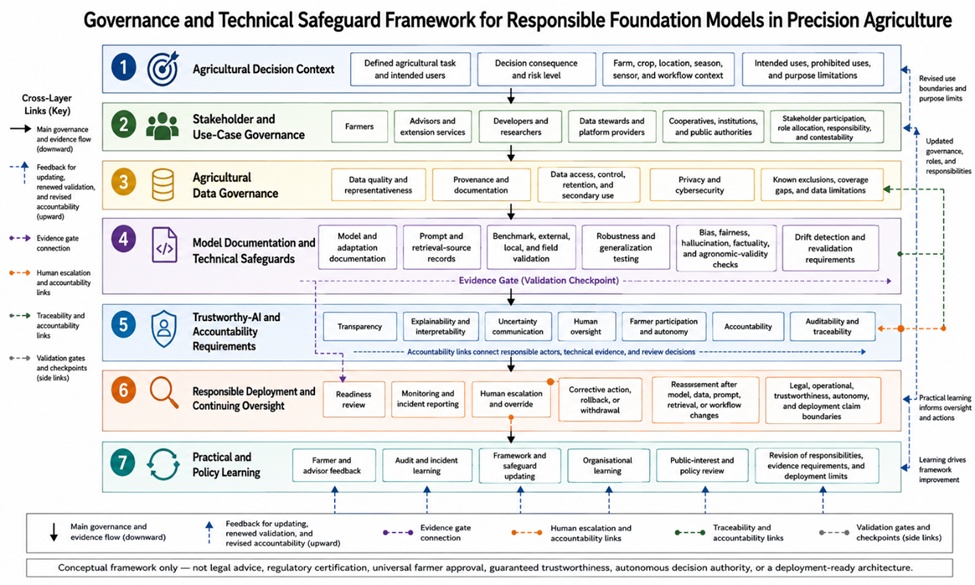
Figure 2. Governance and Technical Safeguard Framework for Responsible Foundation Models in Precision Agriculture
Alt text: A layered framework connecting agricultural decision context, stakeholders, data governance, technical validation, trustworthy AI, responsible deployment, monitoring, and policy learning.
Farmers, advisors, cooperatives, and extension services need understandable uncertainty communication, meaningful review rights, and visible data-control arrangements. Unclear access and reuse conditions can weaken farmer participation and trust [14]. Farmer-centred evaluation should therefore assess comprehension, autonomy, contestability, and dependence on platforms.
Developers, platform providers, data stewards, and researchers should create documentation and validation infrastructure together. Provenance records, model histories, disaggregated errors, security findings, and monitoring evidence should remain independently inspectable. Layered auditing supports assurance but should not be treated as certification [21].
Public institutions and policymakers may need capacity for validation, participation, audit access, incident learning, and accountability review. Responsible innovation requires inclusion [24], while ethics-based auditing can support corrective governance learning [29]. Public-interest review should also examine organisational incentives and platform dependency [30]. These implications are conceptual, not legal or regulatory prescriptions.
The proposed framework links agricultural foundation models, trustworthy-AI requirements, governance risks, technical safeguards, responsible deployment principles, accountability, monitoring, and feedback updating. It emphasises evidence, validation, transparency, farmer participation, and meaningful human oversight before readiness claims are made. The framework supports structured evaluation but does not establish legal compliance, complete trustworthiness, autonomous decision authority, farmer approval, operational safety, or deployment readiness.
None
None
None
None
Open Access The author(s) retain copyright. This article is licensed under the Creative Commons Attribution-NonCommercial-ShareAlike 4.0 International License. It may be shared and adapted for non-commercial purposes with appropriate attribution, an indication of changes, and distribution of adaptations under the same license. Third-party material may be subject to separate terms identified in its credit line. View the license at https://creativecommons.org/licenses/by-nc-sa/4.0/.
 Agro Intelligence Research Press