Precision agriculture increasingly depends on sensor data generated by soil sensors, crop sensors, weather stations, machinery systems, unmanned aerial vehicles, satellite platforms, and farm management information systems. These technologies allow farms to observe spatial and temporal variability with a level of detail that was not previously available in conventional management. However, the existence of more data does not automatically lead to better decisions. Raw sensor observations must be cleaned, calibrated, validated, interpreted, translated into agronomic meaning, connected to decision-support logic, and assessed against the practical realities of farm work. This article develops a decision-intelligence framework for explaining how sensor data becomes actionable farm decisions in data-driven precision agriculture. The central argument is that decision intelligence depends on the full pathway from data capture to action, not on sensing or modeling alone. The article synthesizes scholarship on precision agriculture, smart farming, agricultural sensor systems, data processing, analytical modeling, decision-support systems, farmer judgment, contextual interpretation, and feedback learning. It treats precision agriculture as a human-in-the-loop management process rather than as a purely automated technical pipeline. The proposed framework contributes to precision agriculture scholarship by showing how sensor data can be transformed into decision-ready information, how decision-support recommendations must be interpreted by farmers, and how implemented actions generate feedback for adaptive farm management.
Precision agriculture has become one of the most important expressions of data-driven transformation in contemporary farming. It brings together sensor networks, remote sensing, machinery data, farm management information systems, digital platforms, data analytics, and decision-support tools to observe field variability and guide more precise management. Yet the defining feature of this transformation is not simply the production of large data volumes. Its practical value depends on whether heterogeneous data streams can be organized, processed, interpreted, and converted into information that helps farmers decide what action to take, where to take it, when to take it, and with what expected consequence [1].
Decision-support systems have long been presented as a bridge between precision agriculture technologies and practical farm management. However, decision-support development has also shown that technical sophistication alone does not guarantee adoption, implementation, or improved decision quality. A sensor platform may produce frequent measurements, a model may produce accurate predictions, and a dashboard may display attractive visualizations, but these outputs do not necessarily become useful farm decisions. For decision support to matter, it must connect analytical outputs to real management problems, operational timing, farmer priorities, and the practical conditions under which a decision must be made [2].
This article addresses a core conceptual weakness in many discussions of data-driven precision agriculture: the assumption that data naturally leads to decisions. Farm decisions are not made by data alone. They are made through a socio-technical process in which digital outputs interact with farmer judgment, advisory relationships, local knowledge, institutional arrangements, economic constraints, risk perception, labour capacity, equipment availability, and trust in the technology provider or platform. Precision agriculture therefore needs a decision-intelligence perspective that explains how data, analytics, people, context, and action are connected [3].
The aim of this article is to develop an original decision-intelligence framework for data-driven precision agriculture. The framework explains how sensor data moves through quality assessment, preprocessing, analytical translation, decision-support logic, contextual interpretation, farmer judgment, farm action, outcome monitoring, and feedback learning. It also recognizes that precision agriculture decisions are not only technical decisions about input placement or field monitoring; they are farm-management decisions that must balance productivity, profitability, environmental performance, resource efficiency, and long-term system resilience [4].
Sensor data in precision agriculture come from multiple sources, including soil moisture probes, nutrient sensors, electrical conductivity sensors, crop canopy sensors, weather stations, machinery telemetry, yield monitors, UAV imagery, satellite imagery, and environmental monitoring systems. These technologies expand the observational capacity of farms by making field conditions more visible, measurable, and comparable across space and time. Internet of Things architectures further increase this capacity by connecting field devices, communication networks, cloud systems, and data services, although such integration also introduces challenges involving connectivity, interoperability, data ownership, system maintenance, and reliability under harsh agricultural conditions [5].
In arable farming, sensor data are deeply shaped by field heterogeneity and operational context. Soil texture, topography, drainage, crop growth stage, machinery traffic, input history, and weather conditions all influence what a sensor measures and how that measurement should be interpreted. A soil moisture value, for example, has different management meaning depending on soil type, rooting depth, crop stage, rainfall forecast, irrigation capacity, and yield objective. For this reason, sensor data cannot be treated as neutral technical inputs detached from agronomic context; they are field-situated observations that require interpretation before they can inform action [6].
The reliability of sensor data is central to the entire data-to-decision pathway. Calibration errors, missing values, sensor drift, communication failures, noisy readings, poorly documented metadata, inconsistent spatial resolution, and weak temporal alignment can all distort the information that enters analytical models. When these weaknesses are ignored, a decision-support system may appear precise while actually producing unreliable recommendations. Data quality assessment is therefore not a secondary technical step; it is a decision safeguard that determines whether sensor observations are trustworthy enough to support farm-management choices [7].
Sensor data also vary in their degree of decision readiness. Some measurements are directly linked to immediate action, such as soil moisture readings used to support irrigation timing. Others require substantial processing before they become actionable, such as multispectral imagery that must be corrected, indexed, classified, and interpreted as crop stress or biomass variation. A decision-intelligence approach therefore treats sensor data as the beginning of a pathway rather than as the decision itself. The key question is not only whether data have been captured, but whether they have been transformed into information that is accurate, timely, interpretable, context-sensitive, and operationally usable [7].
Raw sensor outputs must pass through several processing steps before they can support decision-making. Cleaning removes impossible values, duplicate records, sensor noise, and corrupted observations. Validation checks whether measurements are plausible in relation to field conditions, reference data, and expected biological or physical ranges. Calibration aligns sensor readings with trusted benchmarks, while feature extraction converts raw observations into meaningful variables such as vegetation indices, soil-water trends, canopy temperature anomalies, crop stress indicators, nutrient-status estimates, and machinery-performance metrics. Machine learning can support this transformation by converting large and heterogeneous agricultural datasets into classifications, predictions, detections, and risk signals that are easier to use in management reasoning [8].
Analytical translation requires careful alignment between model choice and decision purpose. A model designed to classify crop disease symptoms is not equivalent to a model designed to forecast irrigation demand, estimate yield, detect nutrient deficiency, or optimize machinery movement. Each decision problem requires different data inputs, temporal windows, spatial resolutions, validation strategies, and performance criteria. Precision agriculture therefore needs analytical workflows that begin with the decision question rather than with the availability of data or the attractiveness of a particular algorithm. The model should serve the farm-management problem, not the other way around [9].
The importance of agronomic meaning becomes clear in applications such as yield prediction and nitrogen-status estimation. A yield model is useful not only because it predicts an outcome, but because it may help farmers evaluate spatial variability, adjust input strategies, plan harvest logistics, or compare management scenarios. A nitrogen-status model is useful not only because it estimates a crop condition, but because it can inform the timing, location, and rate of nutrient application. In both cases, analytical translation succeeds when model outputs are connected to agronomic variables that farmers recognize and can act upon [10].
Interpretability, visualization, uncertainty communication, and actionability are essential for turning analytical outputs into decision-ready information. A prediction that lacks explanation, a map that hides uncertainty, or an alert that does not indicate what action is feasible may create confusion rather than support. Artificial intelligence and machine learning become valuable in precision agriculture when they help farmers and advisors understand what is happening, why it matters, what choices are available, what risks are involved, and what action is practical under current farm conditions [11]. Table 1 summarises the analytical translation pathway from sensor data to decision-ready information in precision agriculture.
Table 1. Analytical Translation Pathway From Sensor Data to Decision-Ready Information in Precision Agriculture: Data Capture, Cleaning, Quality Assessment, Fusion, Modeling, Uncertainty Handling, Visualization, Interpretability, and Actionability
Pathway stage | Data function | Analytical task | Decision relevance | Risk if weak | Farm-management implication |
Data capture | Records field, crop, weather, machinery, remote-sensing, or platform observations | Select relevant sensor sources, sampling frequency, spatial scale, and metadata requirements | Establishes what the farm system can observe and what decisions can realistically be informed | Data are collected because they are available, not because they answer a management question | Farmers may receive information that is abundant but poorly aligned with actual decisions |
Cleaning | Removes noise, duplicated records, corrupted values, impossible readings, and inconsistent formats | Detect outliers, correct errors, standardize units, align timestamps, and prepare data for analysis | Improves the reliability of downstream indicators and model outputs | False signals, biased features, and misleading trends enter the decision system | Poor cleaning may cause unnecessary irrigation, fertilization, spraying, or scouting |
Calibration | Aligns sensor values with reference measurements, ground truth, or trusted benchmarks | Check sensor drift, correct measurement bias, compare with field observations, and document calibration status | Determines whether measurements are accurate enough for decision support | Sensor readings appear precise but do not reflect field reality | Management actions may overapply or underapply inputs because the measurement base is wrong |
Validation | Checks whether data are plausible in relation to field conditions and agronomic expectations | Compare readings across sensors, field zones, weather records, crop stage, and historical patterns | Identifies unreliable observations before they influence recommendations | Implausible measurements are treated as valid evidence | Farmers may respond to errors rather than real crop or soil conditions |
Quality assessment | Evaluates completeness, timeliness, accuracy, resolution, uncertainty, and metadata quality | Identify missing data, gaps, low-confidence zones, weak metadata, and uncertainty levels | Clarifies whether data are decision-ready or require caution | Hidden uncertainty creates overconfidence in recommendations | Farmers cannot judge whether advice should be trusted, delayed, or checked manually |
Data fusion | Combines multiple data sources into a more complete management picture | Integrate soil, crop, weather, UAV, satellite, machinery, and farm-record data | Captures interactions among field conditions that single data streams may miss | Data streams conflict, operate at incompatible scales, or are poorly harmonized | Recommendations may ignore key relationships among water, nutrients, weather, crop status, and machinery operations |
Feature extraction | Converts raw observations into agronomic indicators | Generate vegetation indices, moisture trends, canopy metrics, stress indicators, risk scores, or zone maps | Links technical data to variables with management meaning | Computed features are technically valid but agronomically irrelevant | Analytics may produce outputs that cannot guide timing, rate, location, or method of action |
Modeling | Produces predictions, classifications, detections, optimizations, or scenarios | Apply statistical models, machine-learning algorithms, simulation tools, or optimization methods | Supports forecasting, diagnosis, comparison, and recommendation generation | Overfitting, weak validation, poor transferability, or hidden assumptions distort advice | Recommendations may fail when field conditions differ from model assumptions or training data |
Uncertainty handling | Communicates confidence, error, probability, and sensitivity | Estimate uncertainty ranges, threshold confidence, model error, and scenario sensitivity | Supports risk-aware decision-making rather than deterministic advice | Farmers receive single-point recommendations without knowing confidence or risk | Decision-makers cannot judge whether to act, wait, verify, or choose a lower-risk option |
Visualization | Presents complex outputs in understandable forms | Produce maps, dashboards, alerts, ranking tables, trend graphs, and decision summaries | Makes spatial and temporal patterns accessible to farmers and advisors | Poor design creates information overload or misleading interpretation | Farmers may miss important signals or overreact to visually prominent but low-confidence outputs |
Interpretability | Explains why an output or recommendation was produced | Show drivers, thresholds, assumptions, trade-offs, and relevant evidence | Enables scrutiny, learning, trust, and adaptation | Black-box recommendations reduce contestability and farmer confidence | Farmers may reject advice, follow it blindly, or be unable to adapt it to local conditions |
Actionability | Converts decision-ready information into feasible farm operations | Specify timing, rate, location, method, equipment needs, labour implications, and monitoring plan | Turns information into implementable farm action | Good analysis remains disconnected from practical operations | Data value is lost if recommendations cannot be implemented under real farm constraints |
Decision intelligence in precision agriculture can be defined as the structured connection between data, analytics, decision logic, human judgment, action implementation, and learning. It is not equivalent to simply collecting sensor data, applying a model, or displaying a recommendation. Rather, it describes the full management logic through which farm observations are transformed into actionable choices. In this sense, decision intelligence begins with sensing but becomes meaningful only when data are converted into information that can guide irrigation, fertilization, pest management, crop monitoring, harvest planning, and other operational decisions [12].
A decision-intelligence perspective differs from conventional decision support because it focuses on the entire pathway from field observation to implemented action. Edge and cloud computing architectures can connect sensors, gateways, databases, analytics engines, dashboards, and advisory tools, but such infrastructure does not by itself guarantee decision value. The important question is whether the architecture enables timely movement from field data to validated information, from information to recommendation, and from recommendation to an action that a farmer can evaluate and implement [13].
Decision intelligence also requires system integration across the different layers of smart farming. Connectivity, sensor hardware, computing resources, data standards, analytics, visualization interfaces, advisory services, and farm machinery must operate as a coordinated system. When these components remain fragmented, farmers may receive disconnected data streams, duplicated alerts, incompatible maps, or recommendations that cannot be reconciled with existing farm records and operations. Integrated decision intelligence therefore depends on linking technical systems with management workflows [14].
The logic of decision intelligence is especially important because agricultural big data often creates an opportunity-solution gap. Farms may generate large quantities of data without knowing which management problem the data should solve, which threshold should trigger action, which model output is relevant, or which recommendation is economically and agronomically feasible. A decision-intelligence framework closes this gap by requiring every data stream and analytical process to be connected to a specific farm problem, a decision point, an action pathway, and a feedback mechanism [15].
Farmer judgment is not a limitation of digital agriculture; it is a central component of responsible and effective decision intelligence. Farmers evaluate recommendations through experience, trust, transparency, perceived benefit, and knowledge of their own fields. If a system provides advice without explaining how data were collected, how recommendations were generated, or how uncertainty was handled, farmers may reasonably question whether the recommendation deserves confidence. Trust is therefore not a soft issue outside the technical system; it is part of whether digital advice can become farm action [16].
Contextual decision-making is also shaped by agricultural knowledge and advice networks. Farmers rarely interpret digital recommendations in isolation. They may discuss data outputs with agronomists, extension workers, input suppliers, machinery operators, cooperative staff, technology providers, or other farmers. These networks help translate digital signals into practical decisions, especially when recommendations involve uncertainty, cost, timing, or trade-offs among competing objectives. Decision intelligence therefore includes the social infrastructure through which data are interpreted and acted upon [17].
Digital outputs must be converted into situated agricultural knowledge. A dashboard may show crop stress, a model may predict yield variability, or a platform may issue a nutrient recommendation, but the farmer must still ask whether the signal fits known field history, recent rainfall, soil conditions, pest pressure, machinery access, labour availability, and financial constraints. The same analytical output may justify immediate action in one field, delayed action in another, and no action in a third. Contextual interpretation is therefore the step that prevents data-driven farming from becoming context-blind farming [18].
A major risk of poorly designed decision support is the reduction of farmer agency. When systems hide assumptions, simplify uncertainty, impose fixed thresholds, or present recommendations as if they are neutral and automatic, they can shift decision authority away from farmers without making the underlying value judgments visible. A farmer-centered decision-intelligence framework should therefore make recommendations interpretable, contestable, adaptable, and compatible with farmer goals, while supporting production, environmental stewardship, and social legitimacy [19].
A data-to-decision pathway begins when a farm condition is observed, but it becomes useful only when that observation leads to a meaningful management choice. Precision irrigation provides a clear example. Soil moisture readings, weather data, crop water status, evapotranspiration estimates, and irrigation-system performance indicators may all contribute to an irrigation decision. Yet the decision itself requires more than measurement: it requires interpreting water need, choosing timing and rate, considering water availability, accounting for energy cost, and monitoring crop response after irrigation [20].
Remote sensing provides another important data-to-decision pathway. Satellite and airborne observations can reveal crop vigor, canopy cover, biomass patterns, stress zones, vegetation indices, and field variability. However, imagery becomes decision-relevant only after correction, classification, interpretation, and connection to agronomic questions. A remote-sensing layer may show spatial difference, but farmers and advisors must still determine whether the difference reflects nutrient stress, water stress, pest damage, soil variability, crop stage, or another management factor [21].
UAV-based precision agriculture adds finer spatial resolution and flexible timing to crop monitoring, field scouting, and variable-rate planning. UAV imagery may help detect localized crop stress, assess emergence, monitor weed pressure, identify drainage problems, or support targeted intervention. Nevertheless, UAV data require preprocessing, georeferencing, stitching, index calculation, validation, and field interpretation before they can guide farm action. The data-to-decision pathway therefore depends on turning high-resolution observation into practical knowledge about where action is needed and what type of action is justified [22].
Failures can occur at every point in the data-to-decision pathway. Poor sensor calibration can distort the starting point, incomplete data can weaken analysis, weak interoperability can fragment the evidence base, opaque models can reduce trust, irrelevant thresholds can generate poor recommendations, and unusable interfaces can prevent action. These failures are especially consequential in resource-constrained settings, where cost, infrastructure, digital literacy, advisory access, and equipment availability influence whether decision-support tools can be adopted and used effectively. Inclusive decision intelligence must therefore be designed for practical farm conditions, not only for ideal high-technology environments [23].
The proposed decision-intelligence framework for data-driven precision agriculture contains nine interacting components: sensor data capture, data quality assessment, analytical translation, decision-support logic, contextual interpretation, farmer judgment, farm action, outcome monitoring, and feedback learning. These components form an adaptive management loop rather than a linear pipeline. The framework begins with data, but its purpose is not data production; its purpose is to support better decisions through a structured connection between observation, interpretation, action, and learning [24].
The first component, sensor data capture, concerns the collection of soil, crop, weather, machinery, UAV, satellite, and platform data. The second component, data quality assessment, evaluates calibration, missing data, noise, uncertainty, metadata, and fitness for decision use. The third component, analytical translation, converts processed data into indicators, predictions, classifications, visualizations, thresholds, and risk estimates. These components establish whether the system has created decision-ready information rather than simply accumulated technical observations [24].
The fourth component, decision-support logic, converts analytical outputs into management options, alerts, scenarios, or recommendations. The fifth and sixth components, contextual interpretation and farmer judgment, ensure that these recommendations are tested against field history, local knowledge, weather risk, labour availability, equipment constraints, cost, trust, and farmer priorities. This human-in-the-loop structure is necessary because responsible smart farming must consider socio-ethical questions, stakeholder participation, and the consequences of embedding digital systems into farm decision authority [25].
The final components are farm action, outcome monitoring, and feedback learning. Farm action turns a recommendation into an implemented operation, such as irrigation, fertilization, spraying, scouting, planting, or variable-rate application. Outcome monitoring then evaluates the consequences of that action through crop response, soil condition, resource use, yield, cost, and environmental indicators. Feedback learning uses those outcomes to update models, thresholds, assumptions, and future recommendations. Because farms differ by scale, crop, infrastructure, advisory support, capital access, and farmer goals, the framework must remain flexible enough to support diverse and responsible transition pathways in digital agriculture [26]. Table 2 presents the proposed decision-intelligence framework for data-driven precision agriculture.
Table 2. Proposed Decision-Intelligence Framework for Data-Driven Precision Agriculture: Sensor Data, Data Quality, Analytical Translation, Decision-Support Logic, Farmer Judgment, Contextual Constraints, Farm Action, Monitoring, Feedback Learning, and Research Implications
Framework component | Core function | Decision role | Human-in-the-loop requirement | Implementation risk | Research implication |
Sensor data capture | Collects observations from soil sensors, crop sensors, weather stations, machinery systems, UAVs, satellites, and farm platforms | Establishes the observational foundation for precision agriculture decisions | Farmers, agronomists, and advisors should define which variables matter for the decision problem | Data are collected because sensors are available rather than because they answer a management question | Research should examine how sensor selection affects decision quality, not only data quantity |
Data quality assessment | Evaluates calibration, completeness, accuracy, timeliness, spatial resolution, metadata, and uncertainty | Determines whether data are trustworthy enough to enter decision-support workflows | Users need clear indicators of data confidence, sensor limitations, and missing information | Poor-quality data may be treated as reliable evidence | Future work should develop practical data-quality standards for farm decision systems |
Preprocessing and integration | Cleans, harmonizes, georeferences, formats, and fuses heterogeneous data streams | Converts raw observations into usable analytical inputs | Users need transparent data provenance and understandable preprocessing logic | Incompatible systems, data silos, and weak interoperability prevent integrated decisions | Research should advance interoperable farm-data architectures and cross-platform standards |
Analytical translation | Converts processed data into indicators, predictions, classifications, thresholds, maps, and risk scores | Links sensor patterns to agronomic meaning and management questions | Farmers and advisors need outputs that explain what the analysis means and why it matters | Accurate models may produce outputs that remain non-actionable | Research should evaluate models according to decision relevance, interpretability, and field usefulness |
Decision-support logic | Produces recommendations, alerts, options, scenarios, rankings, and decision thresholds | Turns analytical outputs into possible management choices | Users need to compare alternatives, understand trade-offs, and adjust recommendations | Recommendations may be rigid, poorly timed, or disconnected from farm realities | Future systems should make assumptions, thresholds, and alternatives visible |
Contextual interpretation | Tests recommendations against field history, weather risk, soil conditions, input costs, labour, machinery, market expectations, and environmental goals | Determines whether a recommendation fits the specific farm situation | Farmer and advisor knowledge must be included before implementation | Context-free recommendations may be technically valid but practically unsuitable | Research should develop context-sensitive thresholds and adaptive advisory methods |
Farmer judgment | Applies experience, trust, risk tolerance, goals, and local knowledge to the recommendation | Acts as the central decision gate before farm action | Farmer agency, contestability, and explanation should be preserved | Automation may displace judgment or hide value choices | Research should examine trust, contestability, and farmer-centered explanation in decision intelligence |
Farm action implementation | Converts recommendations into irrigation, fertilization, pest control, planting, harvesting, scouting, or variable-rate operations | Transforms decision intelligence into real operational change | Farmers decide timing, rate, method, equipment use, and acceptable risk | A recommendation may be impossible to implement because of labour, machinery, cost, or timing constraints | Studies should connect digital recommendations to machinery logistics and operational feasibility |
Outcome monitoring | Tracks crop response, soil condition, water use, input efficiency, pest pressure, yield, cost, and environmental effects | Determines whether the implemented action achieved its intended result | Farmers and advisors should interpret outcomes against goals, constraints, and seasonal conditions | Systems may generate recommendations without learning from consequences | Future research should develop outcome-based evaluation for decision-support systems |
Feedback learning | Uses observed outcomes to refine models, thresholds, data priorities, and future recommendations | Makes precision agriculture adaptive over time | Farmers should be able to validate, challenge, and contextualize system learning | Feedback loops may reinforce bias if local knowledge and uncertainty are ignored | Research should examine transparent model updating, adaptive decision thresholds, and long-term learning |
Figure 1 illustrates the decision-intelligence framework, showing how sensor data is transformed into farm decisions through analytical translation, farmer judgment, action, and feedback learning.
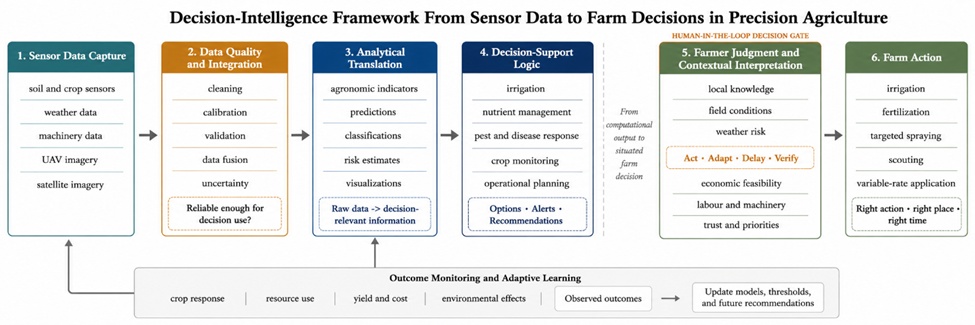
Figure 1. Decision-Intelligence Framework From Sensor Data to Farm Decisions in Precision Agriculture: data capture, preprocessing, analytical translation, decision-support logic, farmer judgment, contextual decision-making, farm action, monitoring, and feedback learning.
Alt-text description:
A conceptual framework diagram showing sensor data flowing through data capture, preprocessing, data quality assessment, data fusion, analytics, decision-support logic, contextual interpretation, farmer judgment, farm action, monitoring, and feedback learning. Feedback arrows return from implemented farm actions and observed outcomes to data collection, model updating, decision thresholds, and future recommendations.
For farmers, agronomists, advisors, and technology providers, the framework implies that precision agriculture should be evaluated by decision quality, not only by sensor performance, platform sophistication, or model accuracy. Digital twins are especially relevant for future decision intelligence because they can connect real-time data, simulation, monitoring, and adaptive learning, allowing farm systems to test scenarios and compare possible interventions before or after action [27].
For platform developers, cooperatives, researchers, and policymakers, the framework highlights the need for sensor calibration standards, interoperable data systems, transparent model assumptions, uncertainty communication, farmer-centered interfaces, participatory design, and feedback-enabled advisory tools. Scaling decision intelligence will also require attention to infrastructure, market power, platform ownership, advisory capacity, digital skills, and the actors who shape the direction of agricultural digitalization [28].
Future research should examine how human-in-the-loop decision intelligence works in real farm settings over time. Important research priorities include contextual decision thresholds, farmer trust, recommendation contestability, model interpretability, uncertainty visualization, feedback learning, long-term field validation, and the relationship between digital recommendations and actual farm actions. Research should also ask who benefits from decision-intelligence systems, who controls the data infrastructure, and how digital agriculture can support diverse farms rather than reinforcing uneven access to technological capacity [28].
This article has developed a decision-intelligence framework for explaining how sensor data becomes farm decisions in data-driven precision agriculture. The framework shows that farm action emerges through a structured sequence of data capture, data quality assessment, preprocessing, analytical translation, decision-support logic, contextual interpretation, farmer judgment, implementation, monitoring, and feedback learning.
Precision agriculture should not be judged only by data volume, sensor accuracy, platform sophistication, or model performance. Its value depends on whether data are translated into understandable, actionable, context-sensitive, and farmer-centered decisions that can be implemented under real farm conditions and improved through experience.
The future of precision agriculture should therefore be data-rich without being context-poor, analytically advanced without reducing farmer agency, and decision-oriented without losing uncertainty, local knowledge, or feedback learning. Decision intelligence offers a way to design such systems by treating farmers, data, analytics, actions, and learning as parts of one adaptive management process.
None
None
None
None
Open Access The author(s) retain copyright. This article is licensed under the Creative Commons Attribution-NonCommercial-ShareAlike 4.0 International License. It may be shared and adapted for non-commercial purposes with appropriate attribution, an indication of changes, and distribution of adaptations under the same license. Third-party material may be subject to separate terms identified in its credit line. View the license at https://creativecommons.org/licenses/by-nc-sa/4.0/.
 Agro Intelligence Research Press