Data science has become a central analytical foundation of precision agriculture, enabling researchers and practitioners to transform heterogeneous farm, crop, soil, climate, machinery, sensor, and remote-sensing data into decision-relevant knowledge. This original bibliometric and thematic review examines how precision agriculture data science has evolved as a research field, how its knowledge structures are organized, and which methodological and application frontiers are shaping its future direction. The review follows a transparent bibliometric logic by distinguishing database searching, eligibility screening, metadata cleaning, keyword normalization, bibliometric indicators, thematic mapping, and interpretive synthesis. Because verified database-export counts were not available in the present working environment, the manuscript does not report invented publication totals, citation rankings, cluster sizes, or network metrics. Instead, it develops a cautious bibliometric-thematic framework grounded in the approved reference set and in clearly stated methodological safeguards. The review focuses on research evolution from early sensor analytics and remote observation toward machine learning, deep learning, big data, IoT-enabled systems, data fusion, decision support, and sustainable smart farming. It also examines knowledge structures around journals, keywords, co-occurrence logic, thematic clusters, and emerging research fronts. The main contribution is an integrated synthesis of precision agriculture data science as a field shaped by technical innovation, methodological fragmentation, data-quality constraints, interoperability challenges, explainability needs, reproducibility demands, and farmer-centered implementation concerns. The review provides a future agenda for more robust, transparent, usable, and responsible data science in precision agriculture.
Data science has become a central driver of precision agriculture because farm-management decisions increasingly depend on the ability to extract actionable knowledge from heterogeneous, high-volume, and spatially distributed data. Machine learning and deep learning have expanded the analytical repertoire of agricultural research by enabling classification, prediction, detection, estimation, and decision-support tasks across crop, soil, livestock, and production contexts [1, 2]. In this setting, precision agriculture is no longer defined only by variable-rate application or geospatial sensing; it is increasingly shaped by the full data pipeline linking acquisition, preprocessing, modelling, interpretation, and operational decision-making.
The emergence of data-intensive agriculture has also changed the scale and organization of research knowledge. Deep learning applications have strengthened image-based and high-dimensional analysis in agricultural systems, including computer-vision tasks associated with crop monitoring, disease detection, and production assessment [2]. These developments have intensified the need for bibliometric and thematic review approaches that can map not only the topics being studied, but also the relationships among methods, journals, keywords, application domains, and emerging fronts.
Smart farming further extends precision agriculture into connected data ecosystems in which sensors, platforms, analytics, and decision-support services interact across farm operations and agri-food value chains. Big data scholarship has shown that smart farming involves data capture, storage, sharing, interpretation, and governance questions that go beyond narrow algorithmic performance [3]. A bibliometric review of precision agriculture data science therefore needs to distinguish research visibility from research quality, technical novelty from operational usefulness, and keyword growth from practical implementation.
The field is also socio-technical. Digital agriculture scholarship emphasizes that technologies such as AI, robotics, sensor networks, decision-support systems, and data platforms are embedded in institutional, advisory, economic, ethical, and farmer-centered contexts [4]. The aim of this review is to map the evolution of data science in precision agriculture, identify visible knowledge structures and thematic clusters, interpret emerging research frontiers, and develop a future agenda for robust, transparent, reproducible, interoperable, and usable agricultural data science.
In precision agriculture, data science can be understood as the integrated use of data acquisition, data cleaning, data fusion, statistical modelling, machine learning, visualization, optimization, and decision-support methods to improve the interpretation of farm and environmental variability. Updated agricultural machine-learning literature indicates that supervised, unsupervised, and hybrid modelling approaches have been applied across crop monitoring, yield prediction, disease detection, irrigation support, soil analysis, and machinery-related decision contexts [5]. This positions data science as a connective layer between field observation and management action.
Crop yield prediction illustrates how precision agriculture data science links environmental data, agronomic variables, remote observations, and predictive modelling. Systematic evidence on yield prediction shows that machine-learning models are frequently used to integrate weather, soil, vegetation, management, and remote-sensing variables into predictive workflows [6]. However, the value of these workflows depends not only on model accuracy, but also on data quality, temporal transferability, spatial generalizability, uncertainty communication, and whether predictions can support decisions under real farming constraints.
Remote sensing and UAV analytics have expanded the observational foundations of precision agriculture. UAV-based precision agriculture applications demonstrate how imagery, vegetation indices, spatial sampling, and field-level monitoring can support crop assessment and management decisions [7]. Within a data science framework, such systems are important because they create high-resolution data streams that require preprocessing, feature extraction, model selection, validation, and translation into agronomic interpretation.
Data science in precision agriculture is therefore broader than the use of algorithms. It includes the design of data pipelines, the integration of multi-source data, the cleaning of inconsistent metadata, the selection of appropriate modelling approaches, the interpretation of outputs, and the communication of uncertainty to decision-makers. It also connects precision agriculture with smart farming, digital agriculture, AI-enabled decision support, and sustainability-oriented farm management, while raising persistent questions about reproducibility, interoperability, explainability, data ownership, and farmer-centered usability.
This review was designed as a bibliometric and thematic review rather than a generic narrative review. Bibliometric review design requires explicit decisions about database searching, metadata export, deduplication, screening, author-keyword cleaning, index-keyword normalization, indicator selection, and science-mapping interpretation. The bibliometrix framework is relevant because it demonstrates how bibliographic records can be processed for descriptive bibliometrics, conceptual structure analysis, keyword analysis, and science mapping when reliable metadata exports are available [8].
The planned search strategy uses major bibliographic databases as primary sources and supplementary publisher or scholarly search interfaces only for checking metadata, DOI completeness, and topical relevance. Bibliometric indicators are interpreted cautiously because citation visibility and publication patterns can be influenced by indexing coverage, disciplinary citation practices, publication age, database selection, language, journal scope, and search-string construction [9]. Consequently, citation counts, journal visibility, or keyword frequency should not be treated as direct measures of research quality or practical importance.
The methodological workflow distinguishes the bibliometric dataset from the manuscript reference set. Software choice matters because tools differ in export compatibility, network construction, visualization logic, clustering options, and reproducibility support [10]. For this reason, the planned protocol specifies DOI-first deduplication, title-normalized duplicate checking, keyword cleaning rules, field-code adaptation by database, and transparent reporting of missing metadata. No record totals, screening counts, citation metrics, network centrality values, or cluster sizes are reported unless they are generated from an actual export.
The interpretive aim of the method is to move from bibliometric mapping to thematic synthesis. Bibliometric research should not stop at descriptive statistics; it should use mapping outputs to clarify intellectual structure, conceptual relationships, theoretical contribution, and future research direction [11]. In this manuscript, thematic interpretation is therefore tied to approved charted evidence, including machine learning, deep learning, big data, UAV analytics, remote sensing, IoT systems, crop data management, explainability, sustainability, socio-ethical concerns, and farmer-centered research priorities.
Table 1 summarises the bibliometric search, screening, data-cleaning, and thematic mapping protocol used to analyze data science research in precision agriculture.
Table 1. Bibliometric Search, Screening, Data-Cleaning, and Thematic Mapping Protocol for Data Science Research in Precision Agriculture: Databases, Search Terms, Eligibility Criteria, Deduplication, Metadata Fields, Bibliometric Indicators, Keyword Normalization, and Cluster Interpretation
Protocol component | Operational definition | Implementation rule | Data field required | Quality-control action | Risk of bias or limitation | Reporting requirement |
Database selection | Identification of bibliographic sources for precision agriculture data science records | Use major bibliographic databases as primary sources; use publisher pages and scholarly search only for metadata checking | Database name; export date; record type | Record database used for each export | Database coverage may favor certain journals, languages, or disciplines | Report each database searched and avoid claims beyond database coverage |
Search-string design | Boolean expression linking precision agriculture terms with data science terms | Combine precision agriculture, smart farming, digital agriculture, AI, ML, big data, analytics, remote sensing, IoT, and decision-support terms | Title; abstract; keywords | Adapt field codes to each database | Search terms may miss papers using different terminology | Report full search strings and field restrictions |
Eligibility screening | Selection of records that match topic, document type, and metadata requirements | Include peer-reviewed journal articles focused on agricultural data science; exclude non-peer-reviewed and off-topic items | Title; abstract; keywords; journal; DOI | Title/abstract screening followed by metadata checking | Borderline records may be excluded if agricultural relevance is weak | State inclusion and exclusion criteria |
Deduplication | Removal of duplicate records across databases | Apply DOI-first matching, then normalized title matching, then manual author-year-title inspection | DOI; title; authors; year | Preserve one complete metadata record per paper | Missing DOI or title variation can reduce duplicate detection | Report method and verified duplicate count only if generated |
Metadata cleaning | Correction and standardization of exported bibliographic fields | Standardize author names, journal titles, years, DOIs, abstracts, and keywords | Authors; journal; year; DOI; abstract; keywords | Check missing or inconsistent fields | Incomplete records may reduce mapping reliability | Report excluded records only if screening log exists |
Keyword normalization | Cleaning of author and index keywords before co-occurrence analysis | Lowercase terms; merge spelling variants; harmonize singular/plural forms; document synonym merges | Author keywords; index keywords | Maintain cleaning dictionary | Over-normalization may erase meaningful conceptual differences | Report major keyword-cleaning decisions |
Bibliometric indicators | Measures used to interpret research evolution and knowledge structure | Use annual output, journal distribution, keyword co-occurrence, citation visibility, collaboration signals, and thematic density only when data support them | Year; source; keywords; references; citations; affiliations | Avoid unsupported rankings | Indicators reflect visibility and database coverage, not quality | Explain interpretive limits for each indicator |
Thematic mapping | Interpretation of conceptual clusters from keywords and structured reading | Label clusters using top terms, representative records, and thematic logic | Keywords; abstract; title; selected full text | Cross-check labels against charted evidence | Algorithmic clusters may be sensitive to threshold and cleaning rules | Report clusters as interpretations, not objective facts |
Cluster interpretation | Narrative explanation of research themes and evolution | Link clusters to precision agriculture domains and data science methods | Keywords; abstracts; application fields | Avoid unsupported “hot topic” claims | Cluster names may overstate coherence | Use cautious wording such as “the dataset suggests” |
Synthesis and agenda | Translation of mapped evidence into research gaps and future priorities | Integrate bibliometric patterns with thematic reading | Cluster labels; limitations; applications; methods | Distinguish evidence from author interpretation | Agenda may reflect reference-set scope | State limitations and avoid generalizing beyond evidence |
Figure 1 presents the bibliometric review workflow used to identify, clean, analyze, and thematically interpret records on data science in precision agriculture.
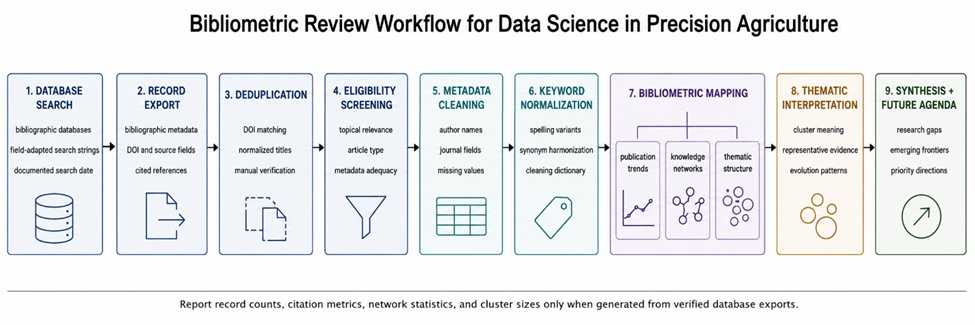
Figure 1. Bibliometric Review Workflow for Data Science in Precision Agriculture. The figure shows the workflow from database searching and record export to deduplication, eligibility screening, metadata cleaning, bibliometric analysis, thematic cluster interpretation, and synthesis of emerging frontiers. All record counts must be generated from the actual Part 1 search and screening process and must not be invented.
Alt-text description: A bibliometric review workflow diagram showing database searching, record export, duplicate removal, title and abstract screening, eligibility assessment, metadata cleaning, keyword normalization, bibliometric indicator analysis, thematic clustering, interpretation, and synthesis of research gaps and emerging frontiers. Count boxes must use only verified numbers from the bibliometric search process.
Q1-journal-publication-ready figure prompt: Create a clean, high-resolution bibliometric review workflow diagram titled “Bibliometric Review Workflow for Data Science in Precision Agriculture.” Use a professional Q1-journal style suitable for publication in precision agriculture, data science, or bibliometric review journals. The figure should show a left-to-right or top-to-bottom workflow with the following stages: database search, record export, duplicate removal, eligibility screening, metadata cleaning, keyword normalization, bibliometric indicator analysis, network or co-occurrence analysis, thematic cluster interpretation, bibliometric-thematic synthesis, and future agenda development. Include count boxes only if verified counts were generated in Part 1; otherwise use count-free process labels. Use clear boxes, arrows, consistent typography, and colorblind-safe colors. Do not use database logos, software logos, copied VOSviewer screenshots, copied Bibliometrix plots, maps, flags, photographs, or copyrighted imagery. Ensure the figure remains understandable in grayscale and suitable for 300 dpi journal export.
Publication-trend interpretation in this review is restricted to defensible bibliometric logic rather than invented numerical outputs. Prior digital-agriculture bibliometric studies show that science-mapping approaches can identify technology-centered streams, strategic themes, and research-evolution structures in digital agriculture when based on documented search strings, database exports, and keyword-network procedures [12, 13]. In the present manuscript, these prior studies support the methodological claim that publication evolution should be interpreted through transparent mapping rules rather than unsupported claims about growth rates, rankings, or dominance.
Knowledge-structure analysis is especially useful for identifying how specialized subfields form within the broader precision agriculture data science literature. Bibliometric analysis of deep learning in precision agriculture shows that deep-learning research can be treated as a distinct analytical subfield within AI-enabled agricultural research [14]. This supports the interpretation that precision agriculture data science contains method-specific knowledge structures, including machine learning, deep learning, remote sensing analytics, IoT data systems, and predictive decision-support applications.
Smart farming bibliometric mapping further indicates that digital agriculture research can be organized into thematic clusters rather than a single unified research stream. Theme mapping and bibliometric analysis of smart farming demonstrate how co-citation, co-word, and thematic mapping approaches can be used to interpret conceptual organization and research evolution across smart farming topics [15]. For precision agriculture data science, this means that knowledge structures should be read as interacting clusters of methods, data sources, applications, and socio-technical concerns.
Precision agriculture bibliometrics can also support research-agenda formation when bibliometric outputs are integrated with thematic interpretation. Recent bibliometric work on precision agriculture connects mapped research structures to future agenda development, including technology applications, challenges, and emerging opportunities [16]. This review follows that logic by treating publication trends and knowledge structures as inputs into a broader synthesis of methodological robustness, implementation readiness, explainability, interoperability, and sustainability.
Table 2 summarises the publication-trend and knowledge-structure indicators used to interpret the evolution of precision agriculture data science.
Table 2. Publication-Trend and Knowledge-Structure Indicators for Precision Agriculture Data Science: Annual Output, Journal Distribution, Author Collaboration, Citation Visibility, Keyword Co-Occurrence, Co-Citation Patterns, Country or Institution Signals, and Thematic Density
Bibliometric indicator | What it measures | Interpretive value | Required data source | Possible bias | Recommended interpretation | Relevance to research evolution |
Annual output | Number of eligible records by publication year | Indicates temporal expansion or contraction of indexed literature | Verified bibliographic export with publication years | Database coverage and indexing delays | Interpret as publication visibility, not field maturity | Helps identify whether research activity appears to intensify or diversify |
Journal distribution | Distribution of records across journals | Shows disciplinary venues and publication outlets | Journal/source title field | Database and journal-indexing bias | Avoid ranking journals as “best” based only on frequency | Reveals whether the field is concentrated or dispersed across domains |
Author collaboration | Co-authorship patterns and collaboration networks | Indicates social organization of research | Author and affiliation metadata | Name ambiguity and incomplete affiliation data | Treat as collaboration signal, not productivity quality | Shows whether data science research is interdisciplinary or fragmented |
Citation visibility | Citation counts or cited-reference patterns where available | Suggests visibility and intellectual linkage | Citation metadata and reference lists | Age bias, language bias, field citation norms | Never treat citation count as direct quality evidence | Helps identify visible knowledge anchors and older foundational work |
Keyword co-occurrence | Frequency with which terms appear together | Reveals conceptual proximity among methods and applications | Author keywords and index keywords | Keyword inconsistency and synonym variation | Interpret after documented keyword normalization | Supports identification of thematic clusters and methodological trajectories |
Co-citation patterns | Sources cited together by later records | Indicates perceived intellectual relatedness | Cited-reference metadata | Requires complete reference lists; favors older works | Interpret as intellectual-structure signal | Helps identify foundational or bridging literature |
Bibliographic coupling | Records sharing references | Indicates similarity among contemporary papers | Reference lists for each record | Sensitive to reference-list length and coverage | Use to detect current research fronts where data permit | Useful for emerging-frontier mapping |
Country or institution signals | Geographic or organizational metadata in publications | Indicates distribution of indexed research activity | Affiliation metadata | Affiliation cleaning problems and database coverage | Avoid claims of national superiority | Shows possible institutional concentration or collaboration patterns |
Thematic density | Internal development of a keyword cluster | Indicates whether a theme appears internally connected | Keyword network and clustering output | Threshold and cleaning sensitivity | Interpret relative to network method and dataset size | Helps distinguish consolidated themes from emerging or peripheral themes |
Thematic centrality | Connection of a theme to other themes | Indicates whether a cluster bridges broader knowledge structures | Keyword network and thematic-map output | Algorithm sensitivity and term ambiguity | Treat as structural position, not importance | Helps identify cross-cutting areas such as IoT, AI, and decision support |
Remote sensing analytics represents a major thematic cluster in precision agriculture data science because it links field observation, spatial variability, crop condition assessment, and model-based interpretation. Agricultural remote sensing scholarship shows that satellite, airborne, and proximal sensing data can be used to estimate vegetation status, crop biophysical variables, and environmental conditions, while also requiring careful attention to scale, calibration, uncertainty, and agronomic interpretation [17]. In bibliometric and thematic terms, this cluster functions as a bridge between data acquisition and decision-oriented analytics.
A second cluster centers on integrated precision agriculture techniques, including sensing, positioning, geospatial analysis, IoT-enabled monitoring, and decision-support practices. Precision agriculture is best understood as a system of interacting technologies rather than as a single tool, because data-driven management depends on the coordination of sensors, field machinery, analytics, and operational decision rules [18]. This cluster explains why research evolution in the field has moved from isolated measurement toward integrated data-to-decision systems.
Big data analytics forms a third cluster that links heterogeneous agricultural data sources to predictive modelling, platform-based decision support, and multi-scale farm management. Agricultural big data research highlights the importance of data volume, variety, velocity, processing pipelines, storage, and analytical workflows in transforming agricultural observations into usable knowledge [19]. Within the mapped literature, this cluster supports the interpretation that precision agriculture data science increasingly depends on data integration and computational infrastructure.
Predictive agronomy is another visible research-evolution pathway, especially in relation to yield prediction, nutrient-status estimation, crop stress detection, and irrigation support. Machine-learning research on yield and nitrogen-status estimation shows that predictive analytics can connect remote sensing, soil information, crop status, and management variables, although model transferability and validation remain persistent concerns [20]. Thermal remote sensing further illustrates how sensor-derived signals can be translated into stress detection and water-management support, making it a specialized subcluster within remote sensing analytics and decision support [21].
Table 3 presents the thematic clusters and research-evolution patterns identified in the precision agriculture data science literature.
Table 3. Thematic Clusters and Research-Evolution Patterns in Precision Agriculture Data Science: Remote Sensing Analytics, Machine Learning Prediction, IoT and Big Data Systems, Decision Support, Data Fusion, Sustainability Applications, Explainable AI, and Farmer-Centered Digital Agriculture
Thematic cluster | Core research focus | Dominant data science methods | Typical agricultural application | Knowledge-structure interpretation | Evolution pattern | Methodological limitation | Future development pathway |
Remote sensing analytics | Conversion of spatial and spectral observations into crop and environmental indicators | Image analytics, vegetation-index analysis, machine learning, temporal modelling | Crop monitoring, biomass estimation, stress detection, field variability mapping | Bridges observational data and agronomic interpretation | Moving from descriptive imagery toward predictive and decision-oriented analytics | Scale mismatch, atmospheric effects, ground-truth limitations, and transferability constraints | Multimodal remote sensing, uncertainty-aware mapping, and stronger field validation |
Machine learning prediction | Modelling relationships among crop, soil, climate, sensor, and management variables | Supervised learning, ensemble models, regression, classification, feature selection | Yield prediction, nutrient-status estimation, pest and disease detection | Forms a central analytical cluster in precision agriculture data science | Shifting from model comparison toward operational prediction and decision support | Risk of overfitting, limited external validation, and weak uncertainty communication | Open benchmarks, cross-site validation, interpretable modelling, and reproducible pipelines |
Deep learning analytics | Use of high-dimensional models for visual and complex agricultural data | CNNs, deep neural networks, representation learning, image classification | Disease detection, weed recognition, crop classification, image-based phenotyping | Specialized AI subfield connected to computer vision and remote sensing | Expanding from controlled image tasks toward field-scale monitoring | Data hunger, black-box behaviour, and limited generalizability across conditions | Explainable deep learning, robust datasets, and domain adaptation |
IoT and big data systems | Continuous farm-data capture, connectivity, storage, and analytics | Sensor analytics, stream processing, cloud analytics, edge analytics | Irrigation monitoring, machinery data, environmental sensing, livestock and crop monitoring | Infrastructure-oriented cluster supporting real-time decision systems | Moving from sensor deployment toward connected data ecosystems | Connectivity, interoperability, cybersecurity, and data-governance challenges | Edge-to-cloud architectures, standards-based interoperability, and secure data-sharing models |
Data fusion | Integration of heterogeneous data streams across spatial, temporal, and operational scales | Multisource integration, feature fusion, sensor fusion, geospatial analytics | Combining UAV, satellite, soil, climate, and management data | Cross-cutting cluster linking data sources and modelling workflows | Increasingly important as farms generate multimodal data | Inconsistent metadata, incompatible formats, missing values, and resolution mismatch | FAIR data practices, harmonized metadata, and fusion models with uncertainty estimates |
Decision support | Translation of analytics into management recommendations | Predictive analytics, optimization, rule-based systems, dashboards, decision models | Irrigation scheduling, fertilization, pest control, yield planning | Application-facing cluster connecting models with farm decisions | Evolving from diagnostic analytics toward prescriptive and advisory systems | Limited usability, weak farmer participation, and unclear actionability | Participatory design, explainable recommendations, and context-aware advisory tools |
Sustainability applications | Use of data science to support resource efficiency and environmental objectives | AI, optimization, remote sensing, climate analytics, scenario modelling | Input-use efficiency, climate-smart management, environmental monitoring | Links technical analytics with sustainability outcomes | Moving from production optimization toward environmental and resilience goals | Sustainability outcomes may be assumed rather than measured | Longitudinal evaluation, environmental indicators, and whole-farm assessment |
Explainable AI and farmer-centered digital agriculture | Transparency, usability, trust, and human interpretation of data-driven tools | Explainable AI, interpretable ML, participatory design, uncertainty communication | Farmer-facing decision support and advisory systems | Socio-technical cluster linking algorithmic outputs to human decisions | Emerging from concerns over black-box systems and adoption barriers | Explanations may be technically correct but practically unusable | Farmer-centered XAI, contextual explanation design, and responsible AI evaluation |
Crop data management is an emerging frontier because precision agriculture increasingly depends on the ability to organize data across acquisition, storage, processing, interpretation, and action. Scholarship on crop data management argues that advanced smart farming requires data infrastructures capable of supporting decision-making across the full pipeline from data capture to management recommendation [22]. This makes data management a foundational frontier rather than a secondary technical issue.
Data-centric AI is also becoming important because agricultural AI performance depends heavily on the quality, representativeness, annotation, provenance, and reusability of datasets. Recent data-centric AI research in the agrifood domain shifts attention from model novelty alone toward dataset design, data curation, missing-data handling, augmentation, benchmarking, and evaluation practices [23]. This frontier is particularly relevant for precision agriculture because field data are often noisy, seasonal, site-specific, and difficult to standardize.
Explainable AI is another frontier for precision agriculture data science, especially when predictions influence farm-management decisions. General XAI research provides concepts for interpreting black-box systems, clarifying model behaviour, and communicating reasons behind algorithmic outputs [24]. In agricultural decision support, this frontier must be adapted carefully because useful explanations should be agronomically meaningful, uncertainty-aware, and understandable to farmers, advisors, and other decision-makers.
Sustainable precision agriculture connects data-driven analytics with resource efficiency, climate-smart decision support, environmental monitoring, and responsible technology adoption. Data-driven AI applications for sustainable precision agriculture show how analytics can support productivity and sustainability goals, but they also indicate the need for implementation-oriented evaluation [25]. Agricultural IoT research further shows that real-time farm data streams, sensor networks, connectivity, and edge-to-cloud infrastructures remain essential foundations for advanced smart farming, while raising persistent challenges around interoperability, scalability, and reliability [26].
The bibliometric and thematic evidence suggests that precision agriculture data science is organized around interacting technical and socio-technical knowledge structures. Responsible innovation research in smart farming shows that digital agricultural systems create socio-ethical challenges related to stakeholder inclusion, power, accountability, responsibility, and the organization of innovation processes [27]. This means that thematic synthesis should not interpret AI, remote sensing, IoT, or big data as purely technical clusters; it should also examine how these clusters affect farmers, advisors, institutions, and agricultural decision systems.
The synthesis also indicates that data science research must confront translational hurdles between analytical possibility and practical farm value. Digital agriculture scholarship identifies barriers that can prevent technical advances from delivering their full promise, including gaps in evidence, infrastructure, skills, incentives, data access, and usable decision support [28]. For precision agriculture data science, these barriers are central because even technically strong models may fail to produce meaningful outcomes if they are not validated, interpretable, interoperable, and embedded in real decision contexts.
Sustainability-oriented interpretation requires particular caution. Future-oriented analyses of digital agriculture show that claims about digital transformation and sustainable food systems can reflect different visions of agricultural futures, including productivity-oriented, platform-centered, ecological, and socially inclusive pathways [29]. Therefore, the thematic movement toward sustainable smart farming should not be treated as automatic evidence that data science improves sustainability; instead, sustainability claims require explicit evaluation of environmental, agronomic, social, and economic outcomes.
The mapped field also remains uneven in who benefits from data-intensive agriculture. Research on big data in farming shows that perceptions of agricultural data systems include concerns about scale, access, value distribution, and whether digital tools serve large farms more effectively than diverse farming contexts [30]. This is important for bibliometric synthesis because visible research themes may overrepresent technologically intensive production systems while underrepresenting smallholder settings, advisory realities, farmer learning processes, and locally adapted decision practices.
Overall, the synthesis positions precision agriculture data science as an evolving field that has progressed from sensing and prediction toward connected, AI-enabled, and sustainability-oriented decision systems, while remaining fragmented by data-quality, interoperability, explainability, reproducibility, and adoption challenges. Socio-ethical and inclusion-oriented perspectives are therefore necessary to interpret technical clusters responsibly and to avoid overstating the practical reach of highly visible data-science themes [27, 30].
Table 4 synthesizes the main bibliometric patterns, thematic frontiers, research gaps, and future agenda for data science in precision agriculture.
Table 4. Bibliometric and Thematic Synthesis of Data Science in Precision Agriculture: Knowledge Structures, Emerging Frontiers, Methodological Gaps, Interoperability Challenges, Explainability Needs, Farmer-Centered Design, Reproducibility, and Future Research Agenda
Synthesis domain | Observed bibliometric or thematic pattern | Main evidence basis | Research gap | Practical implication | Future research priority | Caution for interpretation |
Research evolution | Movement from sensor-centered analytics toward AI-enabled, integrated decision support | Charted evidence on ML, DL, remote sensing, UAVs, big data, and IoT | Limited longitudinal validation of operational decision outcomes | Tools may remain experimental if not tested across seasons and farms | Multi-year, multi-location validation studies | Do not infer maturity from topic visibility alone |
Knowledge structures | Method-specific clusters around ML, DL, remote sensing, big data, IoT, and decision support | Bibliometric and review evidence from mapped subfields | Fragmentation across technical communities and application domains | Knowledge may remain siloed across journals, tools, and disciplines | Cross-domain synthesis and shared terminology | Keyword co-occurrence does not prove conceptual integration |
Remote sensing analytics | Strong connection between spatial observation and crop monitoring | Remote sensing and UAV review evidence | Scale mismatch, limited ground truth, and uncertainty handling | Remote-sensing outputs may be difficult to translate into management action | Fusion of satellite, UAV, proximal, and field data with uncertainty estimates | High-resolution imagery does not guarantee better decisions |
Machine learning prediction | Predictive analytics for yield, nutrients, disease, and crop status | ML and yield-prediction review evidence | Overfitting, site specificity, and weak external validation | Models may not generalize beyond training conditions | Open benchmarks, transparent reporting, and external validation | Accuracy metrics alone do not demonstrate farm usefulness |
IoT and big data systems | Increasing dependence on connected farm data infrastructures | Big data and IoT evidence | Interoperability, connectivity, metadata, and data-governance gaps | Data streams may remain underused without integration standards | Edge-to-cloud architectures and interoperable data models | Sensor abundance should not be equated with actionable intelligence |
Data fusion | Growing need to integrate heterogeneous spatial, temporal, and operational data | Charted cross-cutting evidence | Missing metadata, incompatible formats, and uncertain provenance | Poor fusion can reduce model reliability | FAIR-aligned data pipelines and uncertainty-aware fusion methods | Fusion claims require transparent data lineage |
Explainable AI | Rising need for interpretable decision support | XAI and farmer-centered evidence | Explanations often lack agronomic and user-context relevance | Farmers may distrust opaque recommendations | Farmer-centered explanation design and uncertainty communication | Technical interpretability is not the same as practical understandability |
Reproducibility | Growing concern over repeatable data-science workflows | Data-centric AI and methodological evidence | Limited open code, datasets, preprocessing details, and evaluation protocols | Results may be difficult to compare or reuse | Reproducible workflows, open benchmarks, and reporting standards | Reproducibility cannot be assumed from publication alone |
Sustainability | Increasing linkage between AI, smart farming, and sustainable agriculture | Sustainable PA and digital-agriculture futures evidence | Environmental benefits are often asserted rather than evaluated | Digital tools may shift burdens or create uneven benefits | Whole-system sustainability assessment and climate-smart evaluation | Sustainability claims require measured outcomes |
Farmer-centered design | Recognition that decision support must fit real users and contexts | Socio-ethical, perception, and priority-setting evidence | Limited participatory design and usability testing | Tools may fail adoption despite technical sophistication | Co-design with farmers, advisors, and institutions | Adoption should not be reduced to individual farmer willingness |
Figure 2 illustrates the integrated bibliometric and thematic synthesis linking research evolution, knowledge structures, thematic clusters, emerging frontiers, and future research priorities in precision agriculture data science.
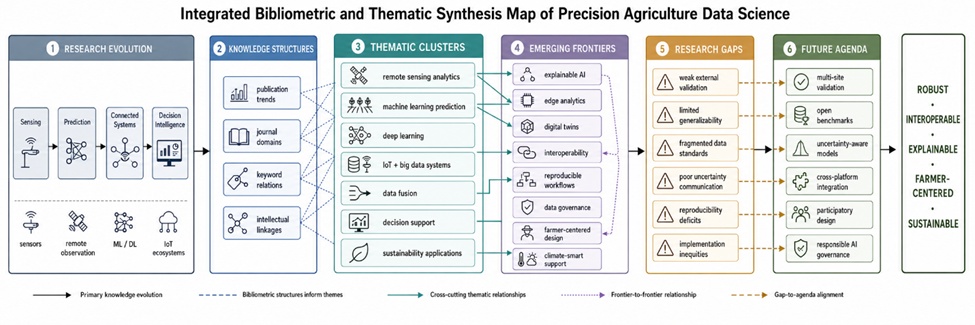
Figure 2. Integrated Bibliometric and Thematic Synthesis Map of Precision Agriculture Data Science. The figure links the evolution of data science research in precision agriculture to knowledge structures, thematic clusters, emerging frontiers, methodological gaps, and future research priorities. It summarizes how remote sensing analytics, machine learning, IoT, big data, data fusion, decision support, explainable AI, interoperability, sustainability, and farmer-centered design interact as research domains.
Alt-text description: A conceptual synthesis map showing precision agriculture data science at the center, connected to research evolution, knowledge structures, thematic clusters, and emerging frontiers. Surrounding nodes include remote sensing analytics, machine learning, deep learning, IoT and big data systems, data fusion, decision support, explainable AI, interoperability, reproducibility, sustainability, farmer-centered design, and future research priorities.
Future research should prioritize stakeholder-informed questions about data access, interoperability, evidence quality, usability, governance, environmental outcomes, and real-world implementation. Priority-setting work in digital agriculture shows that research agendas should include the concerns of farmers, advisors, researchers, industry, and policy actors rather than being defined only by technology developers or model-performance benchmarks [31]. For precision agriculture data science, this implies that future bibliometric and thematic work should examine not only what methods are published, but also whose problems those methods address.
A second priority is to connect data-science workflows to sustainable agricultural-system design. Digital agriculture can support sustainability only when analytics are linked to system-level goals such as input efficiency, resilience, environmental protection, productivity, and adaptive management [32]. Future research should therefore evaluate whether models improve farm decisions under real environmental and economic constraints, rather than relying only on retrospective accuracy or controlled-case demonstrations.
A third priority is to strengthen Agriculture 4.0 implementation readiness by addressing infrastructure, interoperability, skills, governance, and practical integration. Agriculture 4.0 scholarship identifies trends, challenges, and opportunities across sensors, automation, data platforms, AI, and smart farming systems, but also highlights the importance of aligning technological opportunity with adoption conditions and operational realities [33]. Precision agriculture data science should therefore advance from isolated proof-of-concept studies toward interoperable, validated, explainable, and maintainable decision-support ecosystems.
The future agenda should be organized around four connected directions. Methodologically, the field needs stronger data-quality reporting, external validation, open benchmarks, uncertainty quantification, and reproducible workflows. Practically, it needs farmer-centered interfaces, advisory integration, cross-platform data exchange, and decision-support tools that communicate uncertainty and recommended action clearly. Socio-technically, it needs participatory design, responsible AI governance, and attention to unequal access across farm types. Sustainability-oriented research should evaluate environmental and agronomic outcomes directly, while stakeholder-informed research-priority processes can help ensure that future precision agriculture data science addresses real decision needs [31].
This bibliometric and thematic review has mapped precision agriculture data science as an evolving field shaped by machine learning, deep learning, remote sensing analytics, UAV data, IoT systems, big data, data fusion, decision support, sustainability applications, and socio-technical concerns. The review distinguishes bibliometric dataset logic from manuscript reference use and avoids unsupported counts, rankings, citation metrics, cluster sizes, or claims of research dominance. Its main contribution is an integrated interpretation of research evolution, knowledge structures, thematic clusters, emerging frontiers, and future priorities. The synthesis shows that precision agriculture data science has moved beyond data collection toward connected decision systems, but its future relevance depends on stronger validation, data quality, interoperability, explainability, reproducibility, farmer-centered design, responsible data governance, and measured sustainability outcomes.
None
None
None
None
Open Access The author(s) retain copyright. This article is licensed under the Creative Commons Attribution-NonCommercial-ShareAlike 4.0 International License. It may be shared and adapted for non-commercial purposes with appropriate attribution, an indication of changes, and distribution of adaptations under the same license. Third-party material may be subject to separate terms identified in its credit line. View the license at https://creativecommons.org/licenses/by-nc-sa/4.0/.
 Agro Intelligence Research Press