Unmanned Aerial Vehicle (UAV)-mounted edge computing (UMEC) offers a cost-effective, highly mobile solution for providing computation offloading to Internet of Forestry Things (IoFT) applications in forested environments that suffer from infrastructure deficits. Consolidating multiple IoFT applications onto fewer UAV-mounted servers can enhance resource efficiency and reduce deployment costs, provided all applications' Quality of Service (QoS) criteria are met. Nonetheless, prevailing application placement approaches in UMEC typically overlook the variability inherent in aggregated computing resource needs. This work examines resource allocation and application placement challenges in UMEC through the lens of fine-grained cooperative overbooking. First, a Two-tenant Cooperative Resource Overbooking (2CROB) method is developed for the two-tenant overbooking scenario, allowing tenants to absorb one another's resource demand violations (RDVs) within a shared cooperative overbooking area. Within 2CROB, a problem of minimizing aggregated resource demand is structured and solved by a tailored bisection search algorithm. Second, for multi-tenant overbooking scenarios, a Proportional Fairness-based Cooperative Resource Overbooking (PF-MCROB) scheme is developed, along with a bisection search algorithm to pinpoint the minimum aggregate demand. Subsequently, building on PF-MCROB, a First-Fit Decreasing-based Cooperative Application Placement (FFD-CAP) strategy is introduced to pack applications into the minimum feasible number of servers. Numerical evaluations demonstrate that the proposed cooperative overbooking mechanisms yield superior savings in computing resources when incorporating more tenants with higher or heterogeneous resource demand violation ratios (RDVRs); moreover, the FFD-ACP scheme slashes the number of deployed UAVs by roughly one-third relative to standard overbooking practices. Hence, deploying efficient cooperative overbooking for application placement can markedly lower both deployment and operational costs, elevate onboard resource utilization, and boost revenue streams in UMEC-supported IoFT deployments.
As a paramount global ecosystem, forests play an irreplaceable role in preserving planetary ecological equilibrium, counteracting soil loss, capturing atmospheric CO2, addressing climate change, and furnishing an array of resources [1, 2]. The Forestry 4.0 concept has lately attracted considerable scholarly and practical attention [3]. By modernizing information and communication technology foundations, embedding intelligent sensing networks, and advancing digitization and smart capabilities across the entire forestry value chain, Forestry 4.0 aims to bolster forest productivity, sustainability, and resilience, thereby securing effective governance and the enduring development of forest assets [4, 5]. Within this framework, the Internet of Forestry Things (IoFT) and unmanned aerial vehicles (UAVs) fulfill critical functions across diverse domains, including live environmental surveillance, data harvesting and interpretation, wildfire alert and tracking, timber stock assessment, and airborne transport [6-9]. IoFT relies on a multitude of inexpensive, energy-frugal sensors or edge nodes dispersed throughout woodland expanses to capture assorted environmental metrics. However, the lack of communication infrastructure, such as cellular base stations, pronounced wireless signal degradation in forested landscapes, and finite onboard energy budgets pose substantial hurdles to delivering ubiquitous coverage, massive device connectivity, and dependable data aggregation for IoFT workloads. Consequently, the synergy between UAVs and IoFT has attracted growing interest, as versatile and economically viable UAVs can readily penetrate remote or inaccessible terrain, extend radio coverage, address service blackspots, improve energy efficiency, and prolong the battery lifespan of existing IoFT infrastructure [10, 11].
In a typical IoFT setup, distributed low-cost edge devices or sensors possess modest storage, battery reserves, and processing power, rendering local task execution unfeasible. Accordingly, raw measurement data are first amassed by these edge components before being dispatched to centralized cloud data centers for warehousing, advanced analytics, and decision support. Cloud platforms deliver extensive virtualized compute, storage, and networking resources under an elastic, usage-based cost model for IoFT workloads, easing the operational burden of deploying and sustaining varied IoFT applications [12]. Yet, major cloud facilities are frequently located in remote areas where electricity is abundant and cheap; thus, an IoFT task may traverse long-haul, congested communication paths linking edge devices to the remote data center, inducing substantial end-to-end latency [13]. Mobile edge computing (MEC) has lately surfaced as a potent paradigm for offloading computational workloads to proximate edge data centers, thereby shrinking end-to-end delay for a host of burgeoning applications with rigorous latency or deadline stipulations, including virtual/augmented reality, intelligent dwellings, smart urban systems, smart energy grids, and connected autonomous vehicles [14, 15]. Within cellular infrastructure, a base station (BS) can harvest data from mobile terminals and steer tasks toward the associated edge data center (EDC) [16]. In locales with sparse or absent infrastructure, UAV-aided MEC holds considerable appeal due to its inherent agility and low operational costs [17, 18].
Depending on the task offloading mechanism, extant UAV-aided MEC frameworks can be broadly categorized into UAV-relayed MEC (UREC) and UAV-mounted Edge Computing (UMEC). Under UREC, the UAV behaves as an aerial BS, ferrying gathered data to terrestrial MEC servers; with UMEC, the UAVs themselves host computing servers and execute tasks in-flight [19]. The UREC paradigm suffers from inefficient long-range offloading and elevated communication energy consumption due to the large spans between UAVs and ground gateways. Conversely, UMEC can trim end-to-end delay and pare communication energy. However, the compute capacity of an onboard server is constrained by the UAV's payload, dimensional constraints, and power budget, thereby limiting the number of offloadable tasks. Hence, computational tasks emanating from IoFT edge devices may be offloaded directly onto a UAV-mounted server or relayed to a ground-based server, with the offloading decision jointly factoring in service latency, energy expenditures of both UAVs and edge devices, flight trajectory optimization, task granularity, communication resource scheduling, and multi-node collaboration involving UAVs and fixed servers [17, 20].
Each IoFT application comprises numerous task requests arising from ground-level edge devices; these are processed inside virtual machines (VMs) hosted on a virtualization layer executing on the aerial or ground server [21]. A server's computational fabric is abstracted into VMs—logical enclaves for running software stacks—each configured to cater to a distinct application [22]. Hence, application placement constitutes an antecedent step before task offloading and resource distribution can occur: an application must first be sited on a server before its tasks can be directed there.
Owing to the scarcity of onboard computing assets, efficiently situating IoFT applications and provisioning services in UMEC is non-trivial. When a UAV-mounted server hosts multiple IoFT applications with time-varying resource consumption, adopting a resource overbooking policy can unlock higher utilization. Overbooking, a well-established resource governance tactic for handling volatile demand, is widely deployed across domains such as cloud data centers, network slicing, and mobile edge computing [23-25]. Given the intrinsic dynamism of resource needs from heterogeneous services, overbooked assets include CPU cycles, memory capacity, power envelopes, and wired/wireless link bandwidth [26-28]. Broadly, resource overbooking is a policy in which service providers confirm more reservations than the capacity actually allocated to fulfil the service [29]—in simpler terms, the total resource claims of admitted tenants exceed the provider's physical resource ceiling. Across industries, overbooking can maximize resource utilization, boost provider profitability, and reduce tenant costs.
This paper marries the overbooking principle with resource allocation and application placement for UMEC-driven IoFT, devising an effective cooperative resource overbooking and application placement strategy that trims the necessary UAV fleet size while robustly safeguarding all applications' Quality of Service (QoS) constraints. The procedural flow underpinning the proposed cooperative resource overbooking and application placement methodologies appears in Figure 1, and the principal contributions are delineated below:
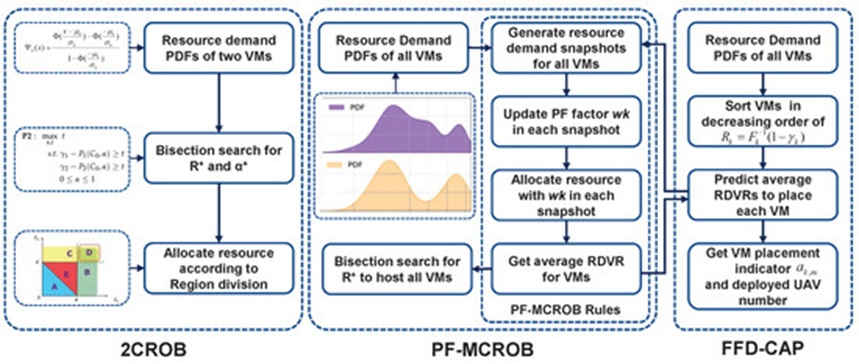
Figure 1. Flowchart of proposed methods.
• A cooperative resource overbooking architecture is introduced for the two-tenant overbooking context, accompanied by formalized resource allocation policies that enable two tenants to buffer resource demand violations jointly (RDVs) inside a cooperative overbooking zone.
• Drawing upon the Two-tenant Cooperative Resource Overbooking (2CROB) rules, a closed-form characterization of each tenant’s RDVR is derived under truncated normally distributed resource demands, and a problem of minimizing the aggregate resource demand is posed subject to per-tenant RDVR constraints. This optimization is subsequently decomposed into a sequence of linear subproblems, and a bisection search procedure is engineered to determine the minimal aggregated resource demand within 2CROB.
• A Proportional Fairness-based Cooperative Resource Overbooking (PF-MCROB) framework is formulated for multi-tenant overbooking settings, complemented by a bisection search algorithm that computes the minimized aggregate resource demand.
• Leveraging PF-MCROB, a First Fit Decreasing-based Cooperative Application Placement (FFD-CAP) algorithm is conceived, which consolidates multiple VMs onto a single server solely when all VMs’ RDVR guarantees remain intact under PF-MCROB stipulations.
• Simulation evidence substantiates the 2CROB theoretical derivations and corroborates the practical effectiveness of the 2CROB, PF-MCROB, and FFD-CAP proposals.
The organizational structure of the remainder unfolds as follows. Section 2 surveys related scholarly contributions. Section 3 formulates the system model. The resource allocation mechanics and theoretical underpinnings of 2CROB are expounded in Section 4. Section 5 elaborates on the PF-MCROB and FFD-ACP schemes. Section 6 reports numerical experiments that validate the analytical results. Section 7 furnishes concluding remarks.
In the MEC paradigm, the challenge of placing applications is also known as the VM Placement (VMP) problem or the service provisioning issue, which governs how individual services—comprising server-side code and associated data—are replicated and positioned within the storage capacity of each edge cloud [30]. Numerous researchers have tackled the VMP challenge within cellular MEC environments [30-34]. Wang et al. [31] explored strategies for situating VMs with minimal hardware footprint for a range of mobile cloud services. They cast the VMP task as a mixed-integer linear program to meet the distinct latency requirements of varied applications while minimizing total hardware consumption. Zhao and Liu [32] focused on VM distribution across a multi-MEC-server landscape, aiming to reduce average response time in edge networks constrained by server capacity ceilings. Zhang et al. [33] proposed a combined edge server location and service placement model to jointly select edge server sites and map each service to a suitable edge server. Their optimization sought to maximize overall profit under a suite of constraints, including server count, BS positions, request rates and fees, and per-server storage and compute limits [33]. The contributions by Wang et al. [31], Zhao and Liu [32], and Zhang et al. [33] excluded task-level compute or communication resource assignment and instead gauged QoS through user-experienced delay drawn from queuing formulations, an approach we likewise employ. Ouyang et al. [34] constructed an integrated VMP and request-scheduling optimization framework that accounts for terminal mobility and enables live VM relocation across MEC servers to meet latency targets. They harnessed Lyapunov optimization to curtail the long-term user-perceived delay while respecting a migration cost budget [34]. A shared supposition in these works is that VM resource needs are fixed, a premise at odds with the reality of time-varying aggregate demand per VM. Farhadi et al. [30] recognized the fluctuating resource consumption of data-heavy applications. They proposed a two-timescale structure for combined service placement and request scheduling, in which services are sited across edge clouds on a coarse-scale frame. Task requests are dispatched on a fine-grained slot basis. They disentangled the task-level resource allocation aspect from the application-level VMP aspect and crafted polynomial-time approximation algorithms for each separately.
Within cellular MEC, services or VMs can be shifted or duplicated across ground-based servers, with data flowing over a well-provisioned wired backhaul. In UMEC, however, the communication throughput and onboard compute muscle are tightly squeezed by UAV battery and payload restrictions, rendering in-flight VM migration or replication impractical for a UAV mid-mission. As a result, the application placement must stay static after the UAV launches. Before departure, a meaningful amount of application-specific data—spanning databases, software libraries, executables, and trained inference models—must be staged on the onboard server, and any application updates or swaps can happen only offline once the UAV returns to its ground depot [35]. Sound application placement can boost the compute service quality delivered from the air, uphold application QoS promises, trim the UAVs fleet required, and slash operating overhead in UMEC. To date, very few efforts have specifically probed the UMEC application placement problem [36]. Qu et al. [37] pioneered this area by jointly tuning service placement, UAV flight path, task scheduling, and computation resource assignment to reduce the total energy drain across all ground user devices. Li et al. [35] enable UAVs to revisit the depot to refresh application placement, jointly optimizing flight trajectories, energy top-ups, and placement to lift the multi-UAV fleet's long-term energy efficiency.
While a rich body of research has examined application placement in cellular MEC or UMEC, the bulk of it still centers on resource allocation through the lens of individual task offloading and placement, or else presumes that a VM's aggregate compute demand across all tasks remains invariant. In truth, the application placement and task offloading problems ought to be handled on distinct timescales, and decoupling them drastically lowers complexity, mirroring the prevalent practice [30, 35, 37]. During application placement, providers should account for the volatile nature of an application's or a VM's combined resource appetite at a macro level. In UMEC, a VM is entrusted with processing tasks from edge nodes within the same application, and the compute resource granted to each newly arrived task—measured in CPU cycles—is determined by the offloaded data size and the task's deadline. Task arrivals follow a stochastic pattern, with the arrival rate influenced by the UAV's coverage footprint and movement path [38]. Hence, the aggregated compute demand of an IoFT application or its hosting VM can be portrayed as a stochastic process. At the onset of each resource allocation period, a VM presents a virtual resource ask to the provider—i.e., the UAV server—reflecting its present needs stemming from all active tasks. The provider then allocates virtual resources to each VM, guided by the QoS thresholds of the hosted applications and the physical server's available capacity. Even though Farhadi et al. [30], Li et al. [35], and Qu et al. [37] incorporated time-varying resource appetites of data-intensive applications, they remain fixated on per-task QoS indicators, such as user-experienced latency. Consequently, application-level QoS gauges—such as each VM's service-level agreement (SLA) violations (SLAVs)—should be adopted during application placement.
Scholarly work on resource overbooking can be broadly sorted into two streams: oversubscription driven by revenue management, and statistical multiplexing bounded by Quality of Service (QoS) constraints. The former harks back to airline reservation systems selling seats beyond physical capacity to buffer against passenger no-shows, thereby maximizing yield [39]. Within this revenue management-focused oversubscription thread, researchers typically focus on formulating reservation, overbooking, and cancellation policies, refining the trade-off between penalties and compensation for no-shows or cancellations, and ultimately increasing revenue [25, 40]. Tenant actions around reserving and canceling are commonly modeled as stochastic processes or forecast using various prediction mechanisms [41]. Individual tenant QoS is not rigidly enforced, provided sufficient restitution is offered [42].
Under QoS-constrained statistical multiplexing, the requirement is that tenants' QoS or resource-demand violation ratio (RDVR) must remain strictly below their agreed thresholds. Illustrating with bandwidth overbooking, production data center traffic traces show that a sizable share of dynamic traffic streams are generally weakly correlated and seldom peak in unison [43]. Through multiplexing, idle bandwidth shed by one tenant can be lent to a co-resident tenant facing a momentary spike in demand [44]. Hence, combining multiple tenants' resource requirements is more efficient, while each tenant's individual QoS remains intact by capping the combined demand's violation rate. Guerin et al. [45] delved into bandwidth overbooking in packet-switched networks. They coined the term equivalent bandwidth for single- and multiplexed connections, denoting the bandwidth required to achieve a link's desired buffer overflow probability (BOP) [45]. At a given BOP target, the equivalent bandwidth of multiplexed connections is far below the sum of the equivalent bandwidths of all isolated connections. Urgaonkar et al. [39] laid out two feasibility criteria for CPU and network resource overbooking on shared platforms, revealing that the combined demand's violation probability must fall below the smallest RDVR threshold among all tenants. Wang et al. [46] modeled the time-varying bandwidth requirements of VMs as Gaussian random variables. They formulated the VM bandwidth overbooking problem as a stochastic bin packing (SBP) problem to reduce the server count for energy savings [46]. Zhang et al. [47] and Liu et al. [48] employed the Gaussian bandwidth overbooking principle separately for virtual network embedding within data center fabrics and for deterministic routing across stochastic time-varying networks. Sexton et al. [49] split network slicing resources into two groups: assured resources and auxiliary resources. Should the assured portion dip below the instantaneous demand of certain slice tenants, the slice provider attempts to reallocate auxiliary resources to those tenants while respecting a system overload probability cap. The auxiliary pool can be allotted proportionally among tenants to lift revenue. They also furnished a quantitative dissection of the two-slice scenario with uniformly distributed resource demands.
Recently, researchers have begun to incorporate revenue management-based oversubscription into the resource allocation fold of cellular MEC, aiming to increase utilization of both computing and communication assets [25, 50]. Yet, QoS-constrained statistical multiplexing remains rare in both cellular MEC and UMEC scholarship. Despite the breadth of published work on resource booking, the bulk of it privileges provider-side gains over tenants' differentiated needs. In oversubscription rooted in revenue management, tenants’ RDVR limits may be sacrificed in exchange for compensation that swells the provider's bottom line. Under QoS-constrained statistical multiplexing, the RDVRs of individual tenants are safeguarded by keeping the aggregate demand's violation rate in check. However, this prescription is overly blunt for the demands of fine-grained resource management in overbooking, because a single breach of the combined demand does not necessarily translate into every tenant suffering its own resource shortfall. Thus, meeting the divergent QoS requirements across all applications becomes the linchpin for crafting new overbooking rules governing resource allocation and application placement in UMEC settings. Table 1 contrasts the attributes of the previously discussed resource allocation and application placement approaches.
Table 1. Resource allocation and application placement methods surveyed.
Ref. | Task scheduling | Application placement | Scenario | Allocated resources | QoS metric | Overbooking |
Supported | Supported | Cellular MEC | Computing and communication resources | Request deadline | No | |
Not considered | Supported | Cellular MEC | Computing resources | Service latency | No | |
Not considered | Supported | Cellular MEC | Computing resources | Service latency | No | |
Not considered | Supported | Cellular MEC | Computing resources | Service latency | No | |
Supported | Supported | Cellular MEC | Computing and communication resources | User-perceived latency | No | |
Supported | Supported | UMEC | Computing and communication resources | No specific QoS metric defined | No | |
Supported | Supported | UMEC | Computing and communication resources | User-experienced latency | No | |
Supported | Not considered | Cellular MEC | Computing resources | Risk | Yes | |
Supported | Not considered | Cellular MEC | Computing resources | Computation time | Yes | |
Ours | Supported | Supported | UMEC | Computing resources | RDVR | Yes |
Depicted in Figure 2 is a canonical UMEC-enabled IoFT landscape populated by M rotary-wing UAVs. Each UAV houses an onboard server, while a dense scattering of low-cost IoFT devices blankets the forest terrain. These edge nodes harvest data on behalf of K IoFT applications, spanning contamination sensing, environmental parameter logging, wildlife monitoring, fire surveillance, and resource inventory tracking. Given the paucity of cellular infrastructure in this zone, the UMEC network shoulders the burden of providing computational services to edge devices.
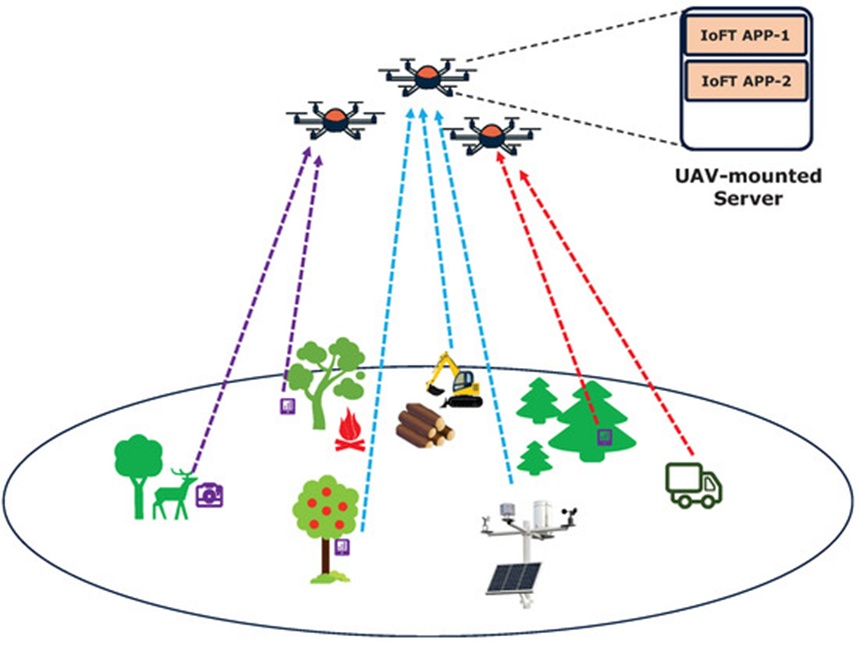
Figure 2. UAV-mounted edge computing for various IoFT applications.
Let the UAV collection be denoted by 𝒰={𝑈1,𝑈2,…,𝑈𝑀}. All of these UAV-mounted servers share identical computational capacity, each offering 𝑅𝑐 computing resources. As every application resides on a server as a VM, our model uses 𝑉𝑘 to denote both the k-th application and its corresponding VM, with the application/VM ensemble denoted by 𝒱 = y 𝒱={𝑉1,𝑉2,…,𝑉𝐾}. Each UAV-mounted server can run multiple VMs, while each VM processes exclusively the computing tasks offloaded from ground devices affiliated with a single IoFT application. This paper focuses on application/VM-level computing resource allocation, assuming that computing resources are the performance bottleneck during UMEC offloading. For simplicity, the communication segment of data offloading is omitted here; instead, we assume that each device's collected data can be uploaded to its intended UAV without delay. The migration or replication of applications/VMs among UAVs is not permitted.
The application placement indicator variables are set out as follows:
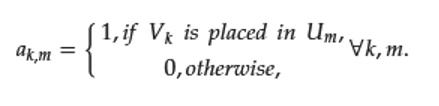 (1)
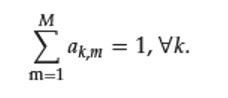
Should 𝑎𝑘,𝑚=1 hold, VM 𝑉𝑘 is situated on UAV 𝑈𝑚, requiring 𝑈𝑚 to pre-load the application data of 𝑉𝑘 ahead of mission launch. To enforce that each VM is assigned to exactly one UAV, 𝑎𝑘, must obey:
 (2)
The mission allocation indicator variable for 𝑈𝑚 is written as:
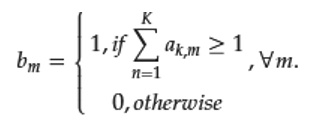 (3)
When 𝑏𝑚=0, UAV 𝑈𝑚 is spared any offloading duties. Hence, the count of UAVs necessary to deliver all K IoFT application services across the forest works out to .
The virtual computing resource overbooking construct features two stakeholders: the resource provider and the resource tenants. Within the proposed UMEC arrangement, the onboard physical server and the VMs are respectively cast as the computing resource provider and the tenants. A slot is treated as the smallest time grain for executing a full cycle of computing resource allocation. In each slot, each VM first tallies the cumulative resource demand from all its active computing tasks offloaded from ground devices and relays it to the server. The server then allocates computing resources to each VM based on incoming demand and available capacity. Finally, each VM assesses whether its resource demand ends up violated or satisfied. The resource demand quantity of VM 𝑉𝑘 during the t-th slot is captured by (𝑡), and the resource amount apportioned to 𝑉𝑘 is marked as 𝑅𝑘,(𝑡) when 𝑉𝑘 is hosted on 𝑈𝑚. Consequently, at the t-th slot, the total of resources handed out to all VMs on 𝑈𝑚 must stay within 𝑅𝑐, i.e.,
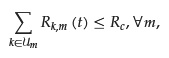 (4)
Where 𝒰𝑚 stands for the index set of VMs placed on 𝑈𝑚, meaning 𝒰𝑚={𝑘|𝑎𝑘,𝑚=1}. The VM's RDVR serves as the QoS performance yardstick for each application. Accordingly, the average RDVR of VM 𝑉𝑘 across the whole span of T slots, labeled 𝑃𝑘, must not exceed the stipulated cap, formulated as:
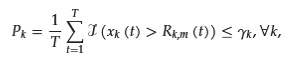 (5)
Where ℐ(𝑦)=1 if y proves true, and 𝛾𝑘 is the RDVR ceiling set for 𝑉𝑘. We further assume that (𝑡) is tendered independently in each slot, and the resource demand of 𝑉𝑘 can be captured by a random variable 𝑋𝑘 with probability density function (PDF) (𝑥) and cumulative density function (CDF) (𝑥). It is likewise presumed that the resource demands spanning all VMs, {𝑋𝑘,1≤𝑘≤𝐾}, are K independent yet non-identically distributed random variables. Moreover, the PDF and CDF of each 𝑋𝑘 are known in advance of application placement, having been extracted, for instance, from historical data traces [24].
The attendant application placement and computing resource allocation problem in UMEC can be formalized as an optimization problem 𝐏𝟎, whose objective is to minimize the number of deployed UAVs. Inside 𝐏𝟎, the placement indicator variables 𝑎𝑘, and the resource allocation variables 𝑅𝑘,(𝑡) for each VM act as the decision variables.
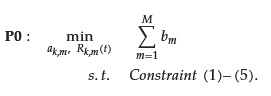 (6)
Problem 𝐏𝟎 resists direct solution owing to the split between placement indicators 𝑎𝑘, and resource allocation variables 𝑅𝑘,(𝑡). On top of that, 𝑅𝑘,(𝑡) must be settled online, seeing that the resource demand 𝑥𝑘(𝑡) materializes only within the t-th slot and stays unknown beforehand. In this paper, cooperative overbooking-based resource allocation and application placement schemes are architected by pursuing two elementary steps: first, work out the smallest aggregate resource amount capable of housing a given batch of VMs so that all of their RDVR properties remain intact; second, pinpoint the minimal server count needed to house all VMs.
In this section, the resource allocation rules grounded in cooperative overbooking are laid out for the basic two-tenant overbooking scenario, followed by the associated minimal aggregate resource quantity.
If every VM commands a private resource pool and these pools are walled off from one another, overbooking is ruled out, and a fixed resource volume must be earmarked for each VM to preserve its RDVR threshold. Should VM 𝑉𝑘 be granted a steady resource quantity 𝑅𝑘 for the duration of T slots, Eq. 5 can be recast as:
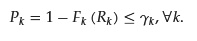 (7)
Thus, the resource volume to accommodate VM 𝑉𝑘 must fulfill 𝑅k≥𝐹−1(1−𝛾𝑘). To illustrate with a two-VM placement instance, suppose 𝑋1 and 𝑋2 each obey independent Truncated Normal Distributions, designated as 𝑋𝑘∼𝑇𝑁(𝜇𝑘,𝜎2𝑘;𝑎𝑘,𝑏𝑘), whose PDFs take the form:
 (8)
In (8), 𝑎𝑘 and 𝑏𝑘 demarcate the truncation boundaries of 𝑋𝑘, Φ(𝑥) is the standard normal distribution function, and 𝑓𝑔(𝑥), along with 𝐹𝑔(𝑥), separately represent the PDF and CDF of the parent general normal distribution characterized by mean 𝜇𝑘 and variance 𝜎2𝑘. For this paper, we fix 𝑎𝑘=0 and 𝑏𝑘=∞. The corresponding CDF of the zero-truncated normal variable 𝑋𝑘 emerges as:
 (9)
Using the two-VM placement case as an example, with the CDF from (9) and the parameters 𝜇1=𝜇2=0, 𝜎1=𝜎2=1, and 𝛾1=𝛾2=0.01, the least amount of dedicated resource for each VM calculates to:
𝑅𝑘=Ψ−1(1−𝛾𝑘)=𝜎𝑥Φ−1(1−𝛾𝑘/2)= 2.58. So, the minimum aggregate resource volume under resource isolation for this two-VM arrangement comes to 5.16.
The essence of overbooking lies in resource sharing. Hence, several VMs can tap into a single resource pool. In a traditional overbooking approach, the collective resource demand across all VMs, 𝑌=∑, is treated as a novel random variable, and its RDVR must sit beneath the lowest 𝛾𝑘 [39, 46], a condition written as:
 (10)
Where (𝑥) denotes the CDF of the combined demand, and 𝑅∗ signifies the minimum necessary resource amount. One can verify that within the very same two-VM placement case, the minimum aggregate resource volume called for is 𝑅=𝐹−1(1−𝛾1)=3.97. Put differently, the conventional overbooking policy yields a 23% reduction in computing resource consumption.
Although traditional overbooking can deliver substantial resource savings compared with non-overbooking, it focuses on the violation probability of the pooled resource demand rather than the distinct RDVR targets of individual tenants. In truth, this is a rather blunt instrument and yields imprecise resource governance. Revisiting the two-tenant example, whenever 𝑋1+𝑋2 > 𝑅, an aggregate demand violation is registered, yet that does not mean both tenants simultaneously suffer a shortfall. The compound event 𝑋1+𝑋2 > 𝑅 can be decomposed into multiple sub-events to enable finer-grained resource distribution. If 𝑋1 > 𝑅 while 𝑋2 < 𝑅, the provider can allocate sufficient resources to 𝑉2 and channel the leftovers to 𝑉1. In that situation, only the demand of 𝑉1 is breached. Analogously, if 𝑋1+𝑋2 > 𝑅 while both 𝑋1 and 𝑋2 lie below 𝑅, the provider retains the leeway to pick which tenant receives a full allocation and which receives a best-effort supplement. Consequently, the RDVR behaviour of each tenant depends jointly on the statistical properties of their resource demands and on the overbooking allocation rules in effect.
The precise cooperative overbooking resource allocation rules are introduced below, following the regional partitioning sketched in Figure 3. The two-dimensional plane spanned by the resource demands of the two tenants is carved into several regions.
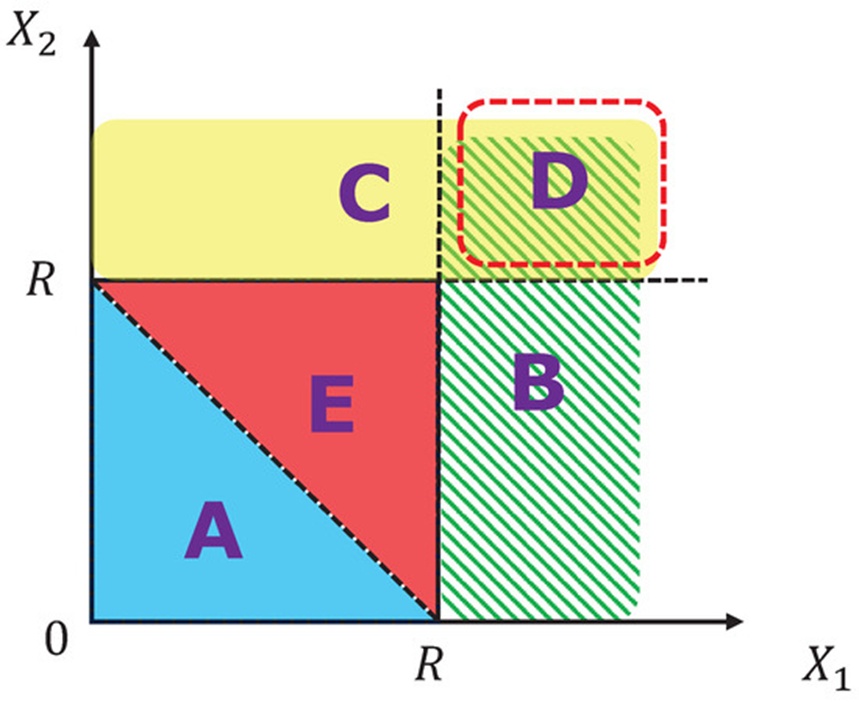
Figure 3. Region division for two-tenant cooperative overbooking.
· Region A (blue) captures the event 𝑋1+𝑋2 < 𝑅, where the demands of both tenants can be met entirely.
· Region B (green diagonal lines) captures the event 𝑋1 > 𝑅, where 𝑉1 will experience an RDV.
· Region C (yellow) captures the event 𝑋2 > 𝑅, where 𝑉2 will experience an RDV.
· Region D (red box outline) is the overlap of Regions B and C, denoting simultaneous violation of the demands of 𝑉1 and 𝑉2.
· Region E (red) captures the event where 𝑋1+𝑋2 > 𝐶 yet 𝑋1 and 𝑋2 are both below 𝐶. Within this zone, one tenant can be fully serviced while the other incurs an RDV. The parameter 𝛼 codifies this cooperative overbooking policy: inside Region E, the demands of 𝑉1 and 𝑉2 are violated with probabilities 𝛼 and 1−𝛼, respectively. Region E is thus termed the cooperative overbooking region.
Under the cooperative overbooking rules, the RDVR of 𝑉1 is a function of R and 𝛼, and it can be written as:
 (11)
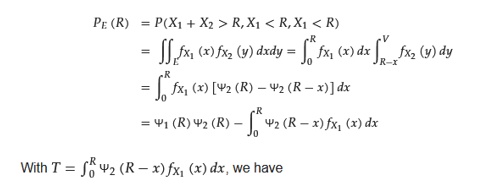
Where (𝑅) denotes the probability that 𝑋1 falls within Region B, and 𝑃𝐸(𝑅) denotes the probability that both 𝑋1 and 𝑋2 land in the cooperative overbooking region. Using the PDF from (9), (𝑅) and (𝑅) are derived as follows.
 (12)
 (13)
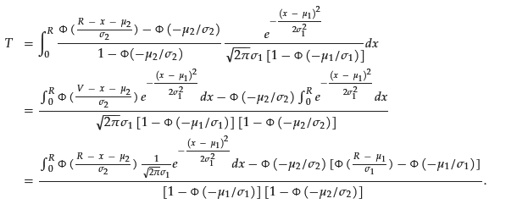 (14)
Thus, (𝑅) can be expressed as:
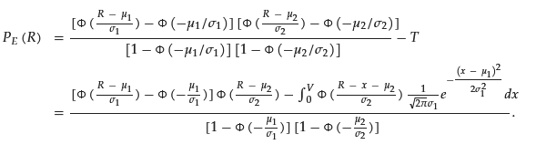 (15)
For a given value of V, the integral in (15) can be evaluated numerically.
Similarly, 𝑃2(𝑅,𝛼) can be expressed as:
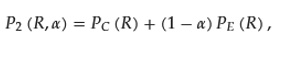 (16)
Where:
 (17)
And 𝑃2(𝑅,𝛼) can be separately restated as follows.
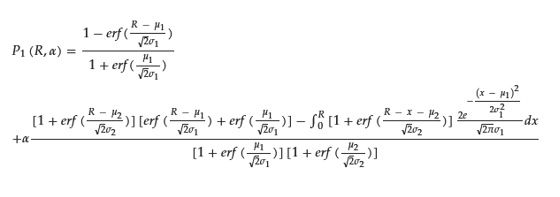 (18)
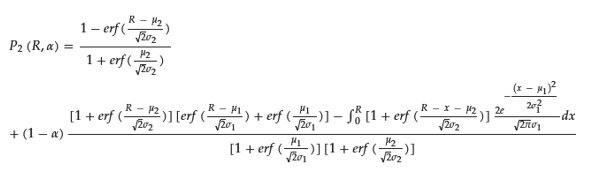 (19)
Two special cases merit attention.
(1) If both
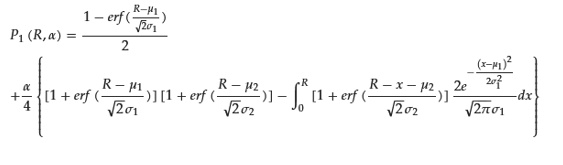 (20)
And:
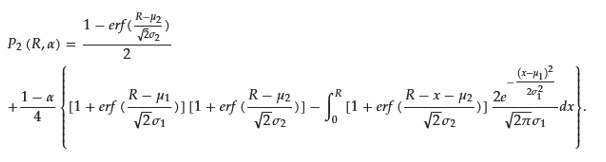 (21)
(2) If 𝜇1=𝜇2=0 under the zero-truncated normal distribution, 𝑋1 and 𝑋2 become the absolute values of two independent zero-mean Gaussian variables with variances 𝜎21 and 𝜎22, respectively. Given 𝑒𝑟(0) = 0, 𝑃1(𝑅,𝛼) and 𝑃2(𝑅,𝛼) likewise simplify respectively to:
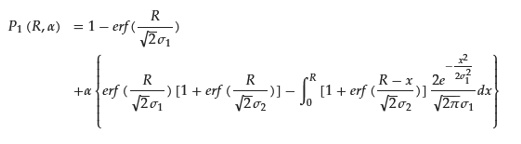 (22)
And:
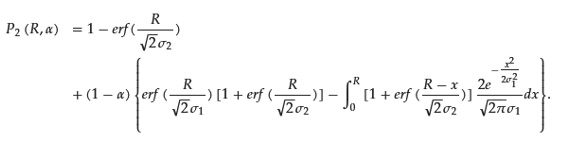 (23)
Referring once more to the two-VM placement case from Section 4.1, the expressions (22) and (23) give 𝑃1(3.64,0.5) = 𝑃2(3.64,0.5) = 0.01. Hence, the minimum aggregate resource volume required with 2CROB in this two-VM scenario is 3.64, yielding an additional 8.3% reduction in total resource consumption beyond traditional overbooking.
Under the overbooking rules, the goal is to determine the optimal 𝛼∗ and the minimal aggregate resource volume 𝑅∗ such that (𝑅∗,∗) ≤ 𝛾𝑘 is satisfied for all tenants. The resulting optimization problem 𝐏𝟏 can be formulated as follows.
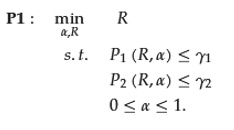 (24)
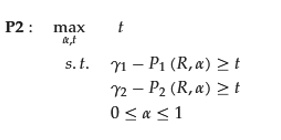
Problem 𝐏𝟏 is non-convex, meaning its optimal 𝑅∗ cannot be extracted by solving 𝐏𝟏 directly. Introduce an auxiliary variable t defined by:
 (25)
Treating 𝑅0 as a fixed constant, if 𝑅0 < 𝑅∗, the first two constraints of problem 𝐏𝟏 cannot be met simultaneously, resulting in 𝑡 < 0. On the other hand, if 𝑅0 ≥ 𝑅∗, it should be possible to find an 𝛼 such that 𝑡 ≥ 0 holds. Thus, problem 𝐏𝟏 can be decomposed into a succession of sub-problems 𝐏𝟐, each associated with a different value of 𝑅0; the optimal 𝑡∗ obtained from each sub-problem 𝐏𝟐 reveals whether the supplied 𝑅0 falls short of or exceeds the optimal 𝑅∗ of the original problem 𝐏𝟏. Problem 𝐏𝟐 is a linear optimization program, readily solvable by tools such as CVX. A bisection search algorithm is constructed to converge toward the optimal minimum aggregate resource quantity 𝑅∗ in two-tenant cooperative overbooking; during every iteration, problem 𝐏𝟐 is solved to narrow the search bracket. The pseudocode is presented in Algorithm 1 below. Once the iterations terminate, the right endpoint of the concluding search interval is taken as 𝑅∗, and the optimal 𝛼∗ retained corresponds to this 𝑅∗.
The iteration count of the bisection search algorithm is on the order of (log2(𝑅max/Δ)). In each iteration, 𝑃1(𝑅0,𝛼) and 𝑃2(𝑅0,𝛼) are computed for the given 𝑅0, and the linear optimization problem 𝐏𝟐 is solved. The expression for 𝑃1(𝑅0,𝛼) in (18) contains a numerical integration step with complexity 𝒪(𝑁0), where 𝑁0 is the number of discretization points spanning the integration range. The complexity of a standard linear optimization problem is (𝑎2𝑏), where a is the number of variables and b the number of constraints. Therefore, the overall computational complexity of the bisection search algorithm for the minimum aggregate resource quantity 𝑅∗ within 2CROB amounts to (𝑁0log2(𝑅max/Δ)).
 (26)
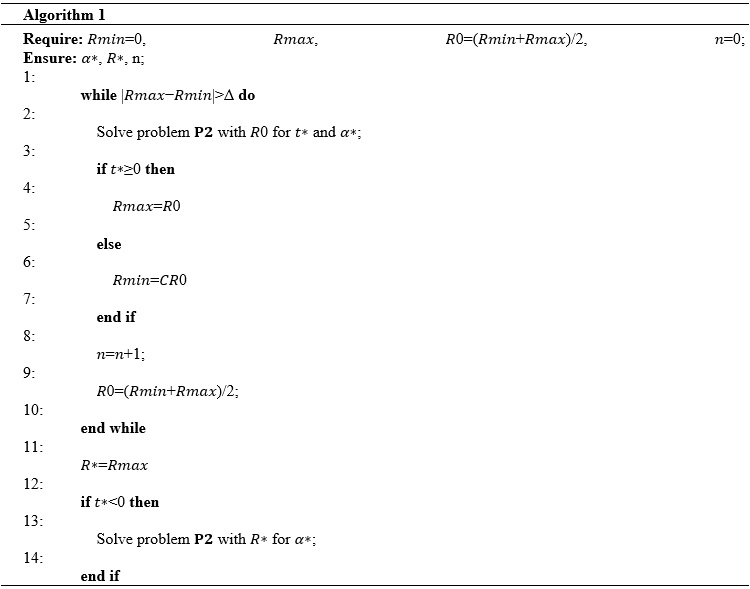
Algorithm 1. Bisection Search Algorithm for Minimum Aggregated Resource Amount in 2CROB
The cooperative overbooking resource-allocation approach introduced in Section 4 recovers the minimum aggregate resource volume while preserving each tenant's RDVR guarantee in the two-tenant setting. That said, the minimum aggregate resource volume hinges on both tenants' resource demands being expressible through closed-form PDFs; failing that, the RDVR derivations and the optimization problem cannot be formulated. Moreover, the region-partitioning logic grows combinatorially with the number of tenants, rendering those allocation rules unsuitable for multi-tenant overbooking. Hence, a broadly applicable cooperative resource overbooking framework tailored to general multi-tenant cases must be designed, on top of which the application placement strategy can then be erected.
A central takeaway from Section 4 is that the spirit of cooperative resource overbooking should let tenants share the burden of resource demand violations. In contrast, each tenant's RDVR remains strictly bounded by its threshold. Thus, in multi-tenant cooperative overbooking, whenever the instantaneous total resource demand outstrips the available resource pool R, a priority ordering can be established by comparing each tenant's current RDVR against its RDVR threshold. The tenant whose present RDVR sits furthest below its cap is assigned the highest interrupt priority, i.e., the first to be denied resources. After denying a sufficient set of high-priority tenants, the aggregate demand of the survivors can be driven below R. Within the proposed PF-MCROB scheme, the interrupt priority assigned to VM 𝑣𝑘 during the t-th slot is captured by the PF factor (𝑡), and computing resources are distributed to each VM in the t-th slot according to the rules below.
(1) Should the sum of all VMs' resource demands fall below R, every VM receives its full requested allocation.
(2) When the total demand exceeds R, the PF factor for each VM is computed, given by:
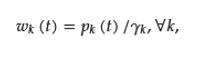 (27)
Where 𝑝𝑘(𝑡)=𝑁𝑅𝐷𝑉𝑘(𝑡)/(𝑡−1) represents the running average RDVR of the k-th tenant as the t-th slot begins, and 𝑁𝑅𝐷𝑉𝑘(𝑡) counts the RDV incidents accumulated by the k-th VM up to that point. Resources are preferentially granted to VMs with smaller values of (𝑡). To implement this, VMs are ranked in descending order of (𝑡), and the 𝑘∗-th VM is chosen to forfeit its allocation, where:
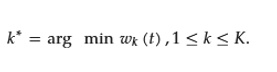 (28)
If the remaining VMs' total demand still overshoots R, the VM with the next-smallest PF factor is suspended, and the procedure iterates until the residual aggregate demand drops below R.
Under the PF-MCROB scheme, for a multi-tenant cooperative overbooking case where the resource demand distributions and RDVR caps 𝛾𝑘 of all VMs are known beforehand, a minimum aggregate resource demand 𝑅∗ exists such that every VM's average RDVR can be individually kept beneath its respective ceiling, i.e.:
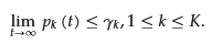 (29)
Manifestly, if the allocated resource amount dips under 𝑅∗, the average RDVR of at least one VM will overshoot its permissible limit. Note that (𝑡) is the average RDVR estimate obtained from a sufficiently large sample. Therefore, once the resource demand distributions (𝑥) and RDVR caps 𝛾𝑘 are specified, the provider can discern whether a candidate resource amount 𝑅0 is greater or smaller than 𝑅∗. The provider may generate a large number of random resource-demand snapshots per VM via Monte Carlo sampling, execute resource allocation under the PF-MCROB rules for each snapshot, and compile the final average RDVR for each VM. If condition (29) is satisfied across all VMs, then 𝑅0≥𝑅∗; otherwise, 𝑅0<𝑅∗. Anchored in this rationale, a bisection search algorithm is formulated to identify the minimum aggregate resource demand 𝑅∗ within PF-MCROB. The corresponding pseudocode is laid out in Algorithm 2. For the two-VM placement example from Section 4.1, the bisection search under PF-MCROB yields a minimum aggregate resource demand of 3.64, which is practically identical to the 2CROB outcome.
The iteration count of the bisection search algorithm remains on the order of (log2(𝑅max/Δ)). Inside each iteration, 𝐾𝑁1 resource demand samples are drawn, where K and 𝑁1 stand for the number of VMs and the number of snapshots, respectively. For each snapshot, a Boolean check is executed. Whenever the cumulative demand across all VMs surpasses 𝑅0, K PF factors must be refreshed and sorted in descending sequence, after which suitable VMs are selected for suspension. Sorting K PF factors carries complexity (𝐾log2𝐾), and picking the VMs to suspend entails (𝐾) effort. Consequently, the computational complexity of the bisection search algorithm for the minimum aggregate resource quantity 𝑅∗ under PF-MCROB works out to (𝑁1𝐾log2𝐾log2(𝑅max/Δ)).
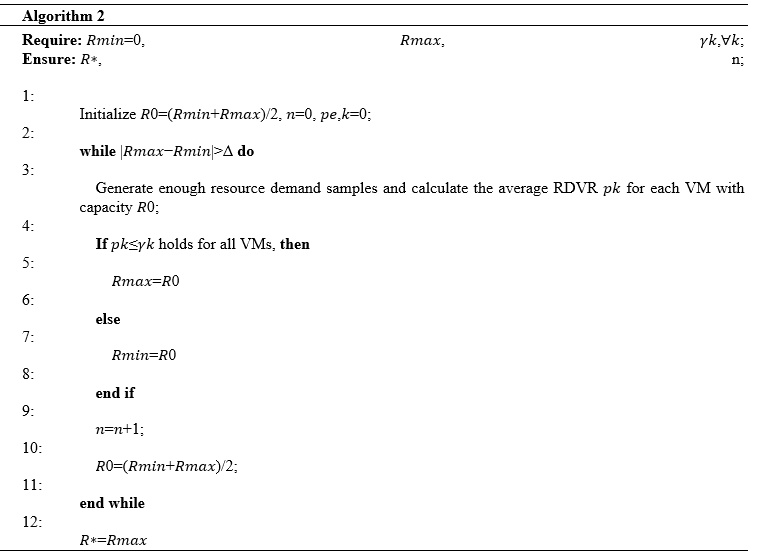
Algorithm 2. Bisection Search Algorithm for Minimum Aggregated Resource Amount in PF-MCROB
Within the application placement optimization problem 𝐏𝟎, the aim is to field as few UAVs as possible while hosting as many applications/VMs as feasible, all without compromising each VM's RDVR performance. Broadly, for a given VM ensemble, a smaller minimum aggregate resource demand 𝑅∗ translates into fewer physical servers needed to house those VMs. Hence, calculating the minimum aggregate resource demand for a group of VMs and trimming the server count are fundamentally two sides of the same coin.
In the cloud computing domain, the VMP problem under dynamic resource demands is often mapped to the SBP problem. In SBP, a collection of independent random variables is supplied, and the goal is to ascertain the fewest unit-capacity bins necessary to pack all items while keeping each bin's overflow probability—the likelihood of exceeding its capacity—under a predefined constant [46]. The SBP formulation is rooted in the conventional overbooking philosophy and likewise addresses the RDVR of the aggregated demand rather than the distinct RDVR requirements of individual VMs. SBP is NP-hard and is typically addressed using heuristics such as First Fit (FF) and FFD [51]. Under FF, a VM is inserted into the earliest server that reports sufficient available capacity; under FFD, VMs are first arranged in descending order before FF is applied.
The cornerstone of effective application placement is the ability to judge whether the RDVR requirements of all co-located VMs can be simultaneously honored when they share a server with resource capacity 𝑅𝑐. This determination is precisely what the proposed PF-MCROB scheme supplies. Accordingly, by building upon the classical FFD-based Stochastic Bin Packing algorithm, an FFD-CAP algorithm is devised. The core concept of FFD-CAP is to sequence VMs in descending order and assign each VM to the first server that meets its RDVR threshold. The pseudocode appears in Algorithm 3. To begin, all VMs are sorted in descending order of their minimum resource demands Rk = F_k^(-1) (1-γk),∀𝑘. The algorithm then attempts to place VM 𝑣𝑘 inon the active servers, inspecting them in ascending index order; it assigns VM 𝑣𝑘 to the earliest active server that can accommodate it without violating any VM's RDVR threshold. The assessment of whether VM 𝑣𝑘 can be packed into server 𝑈𝑛 involves predicting the average RDVRs of all VMs residing in 𝑈𝑛—now including 𝑣𝑘—via the PF-MCROB scheme. Should no active server be able to admit 𝑣𝑘, a fresh, empty server is brought online to host 𝑣𝑖. The procedure concludes once every VM has been successfully placed, at which point the VM placement indicators 𝑎𝑖, ators 𝑎𝑖,1 ≤ 𝑖≤ 𝐾 are output, with 𝑎𝑖=𝑚 indicating that VM 𝑉𝑖 has been packed into server 𝑈𝑚.
During initialization, the minimum resource demands Rk = F_k^(-1)(1 - γk) are computed for all VMs. When the inverse functions F_k^(-1) (𝑥) are unavailable in closed form, each 𝑅𝑘 can be recovered through bisection search at a complexity of (log2(1/Δ)). Executing FFD on K constant-size VMs incurs complexity (𝐾log2𝐾). Each time a VM is evaluated for placement on a server, FFD-MCROB is invoked with 𝑁1 snapshots. Therefore, the computational complexity of the FFD-CAP algorithm sums to (𝐾log2(1/Δ)+𝑁1𝐾log2𝐾).
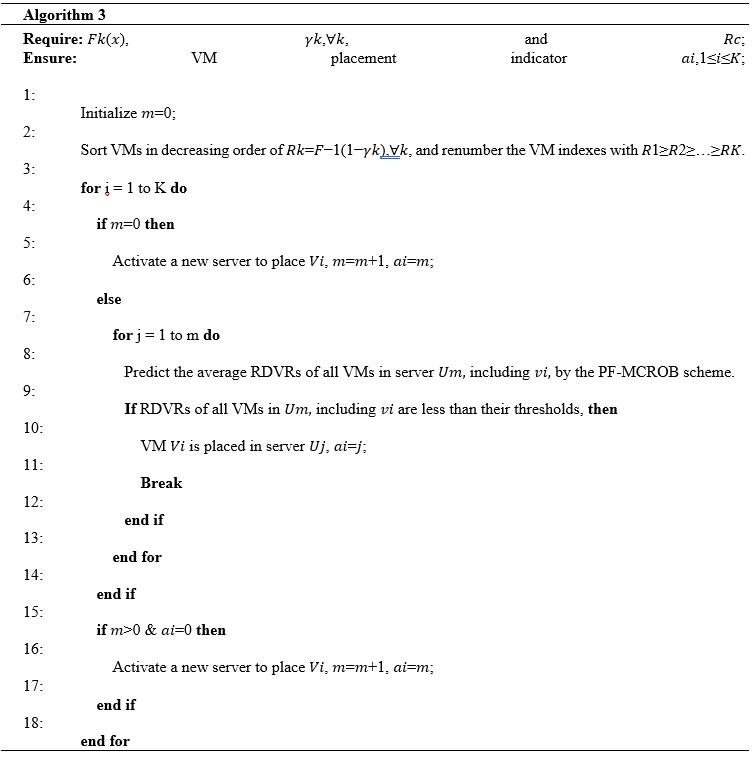
Algorithm 3. FFD-based Cooperative Application Placement Algorithm
Figures 4 and 5 display the smallest aggregate resource pools necessary to satisfy the RDVR limits of both VMs when employing non-overbooking (NonOB), traditional overbooking (TradOB), and the 2CROB strategy introduced in this work. The stochastic demands of the VMs follow two mutually independent truncated normal distributions across three illustrative two-VM configuration scenarios: Case 1 sets 𝜇1 = 𝜇2 = 0, 𝜎1 = 𝜎2 = 1; Case 2 uses 𝜇1 = 𝜇2 = 0, 𝜎1 = 1, 𝜎2 = 3; and Case 3 adopts 𝜇1 = 𝜎1 = 2, 𝜇2 = 𝜎2 = 3. The demand patterns in the first two cases correspond to zero-truncated normal laws with means fixed at zero, meaning the demand realizations effectively represent the magnitudes of draws from zero-mean Gaussian populations. These two cases capture situations in which the VM demands are governed by matching and mismatched distributions. In the third case, the demands are drawn from non-identical general zero-truncated normal distributions possessing strictly positive means. The chosen parameter settings and RDVR bounds are intended to reflect representative two-VM co-location conditions, allowing a comprehensive dissection and side-by-side appraisal of the alternative overbooking mechanisms.
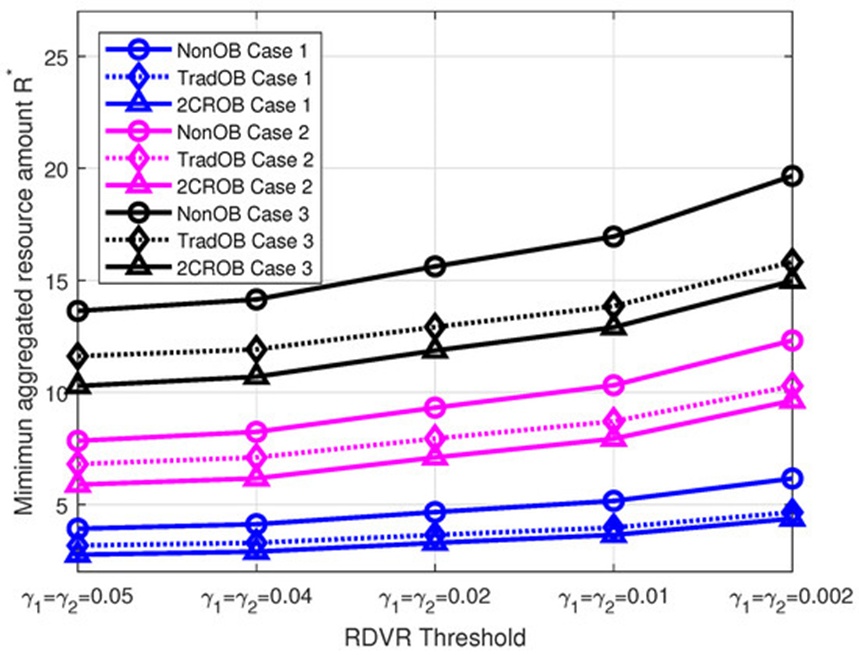
Figure 4. Minimum aggregated resource amounts of different overbooking strategies with identical RDVR thresholds.
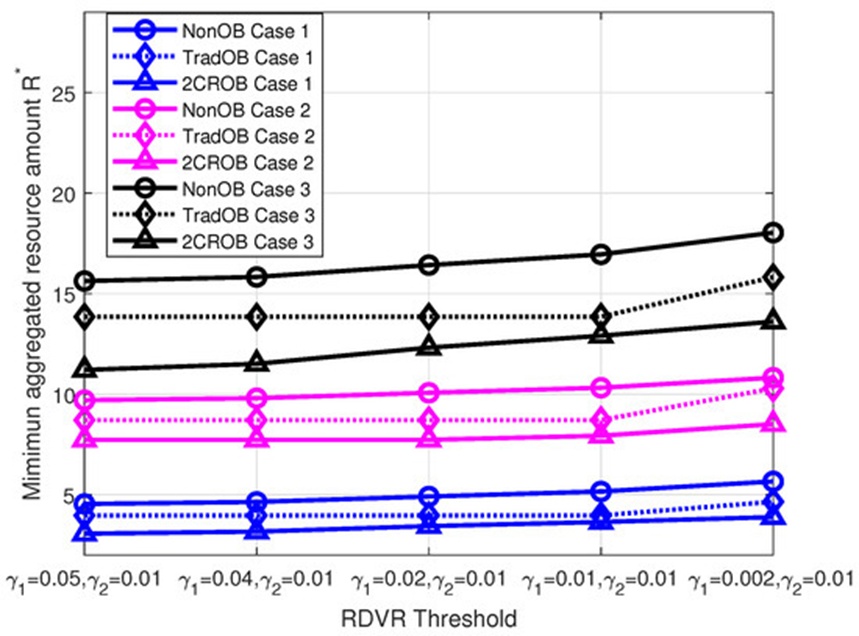
Figure 5. Minimum aggregated resource amounts of different overbooking strategies with differentiated RDVR thresholds.
The minimal aggregate resource volumes for the trio of schemes shown in Figures 4 and 5 are derived from separate computational pathways. The 2CROB results are obtained by executing the bisection search procedure described in Section 4.4. The NonOB baseline implements strict resource partitioning, where VM 𝑉𝑘 receives a dedicated, invariant resource block
In every scenario plotted in Figure 4, the two VMs operate under an equal RDVR bound, whereas the limits diverge between the VMs for the scenarios in Figure 5. A clear pattern visible across both figures is that 2CROB consistently demands the smallest aggregate resource footprint, regardless of whether the underlying demand distributions or the RDVR limits are symmetric or asymmetric. The resource saving ratio (RSR), formulated as (𝑅𝑇𝑟𝑎𝑑𝑂𝐵−𝑅2𝐶𝑅𝑂𝐵)/𝑅𝑇𝑟𝑎𝑑𝑂𝐵 and computed from the data in Figures 4 and 5, is depicted in Figure 6. Broadly speaking, 2CROB extracts larger fractional savings in configurations featuring elevated and unequal RDVR caps. With 2CROB, the total resource commitment can contract by upwards of 6% under equal thresholds and by more than 11% under differentiated thresholds.
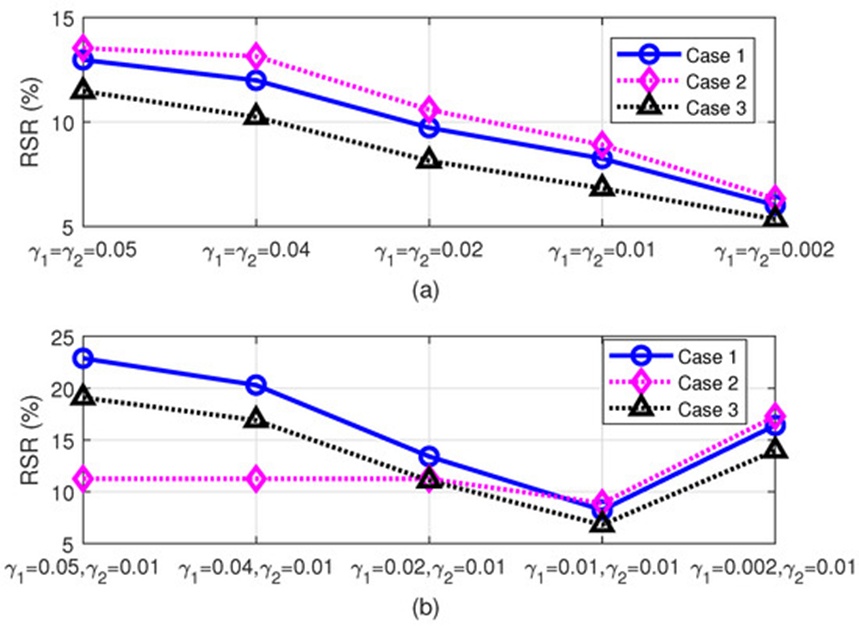
Figure 6. Resource-saving ratios for 2CROB across different cases: (a) Identical RDVR thresholds, and (b) Differentiated RDVR thresholds.
The best-fit 𝛼∗ values recovered from the scenarios in Figures 4 and 5 are shown in Figure 7. In perfectly symmetric settings where the means, variances, and RDVR limits coincide, the optimum settles at 𝛼∗ = 0.5. A noteworthy observation for Case 2 with distinct RDVR limits is that 𝛼∗ jumps to 1 once 𝛾1 reaches or exceeds 0.02. This signals that the entirety of RDV occurrences originating within the cooperative overbooking zone are charged to 𝑢1, and the bottleneck that floors the aggregate resource volume is the RDVR of 𝑢2, driven solely by Region C events, (𝐶). Accordingly, the aggregate volume plateaus at 7.73 when 𝛼 = 1, consistent with the relation (7.73) = 𝛾2, and this accounts for the flat trajectory of the magenta triangle-marked curve in Figure 5 beyond 𝛾1 = 0.02. Within Case 2, the tenant 𝑢2—characterised by a wider spread and a tighter RDVR allowance—forms the binding constraint on further shrinkage of the total resource pool, as its RDVR ceiling is reached earlier than that of its counterpart.
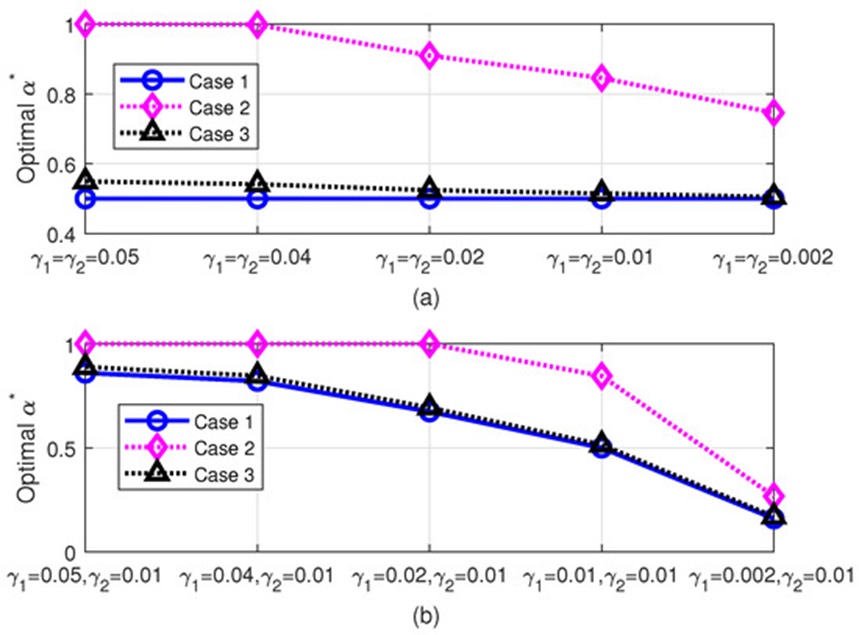
Figure 7. Optimal 𝛼∗ of 2CROB in different cases: (a) Identical RDVR thresholds, and (b) Differentiated RDVR thresholds.
Figure 8 presents the simulated RDVR outcomes for 𝑢1 and 𝑢2 alongside the matching 𝑅∗ data from Figure 5 and 𝛼∗ data from Figure 7. The simulation workflow generates abundant demand samples for the two tenants, distributes available computing capacity according to the 2CROB protocol, and tabulates the long-term average RDVRs for each tenant. When the optimal sharing parameter sits below unity, the empirical average RDVRs of both tenants can closely track their respective limits; when 𝛼∗ equals 1, the mean RDVR realised by 𝑢1 undershoots its permitted ceiling 𝛾1. This phenomenon, too, follows from assigning every Region E violation to 𝑢1, leaving no further room for 𝑢1 to absorb additional violationsr to relieve pressure on 𝑢2's RDVR or to enable a lower aggregate resource volume.
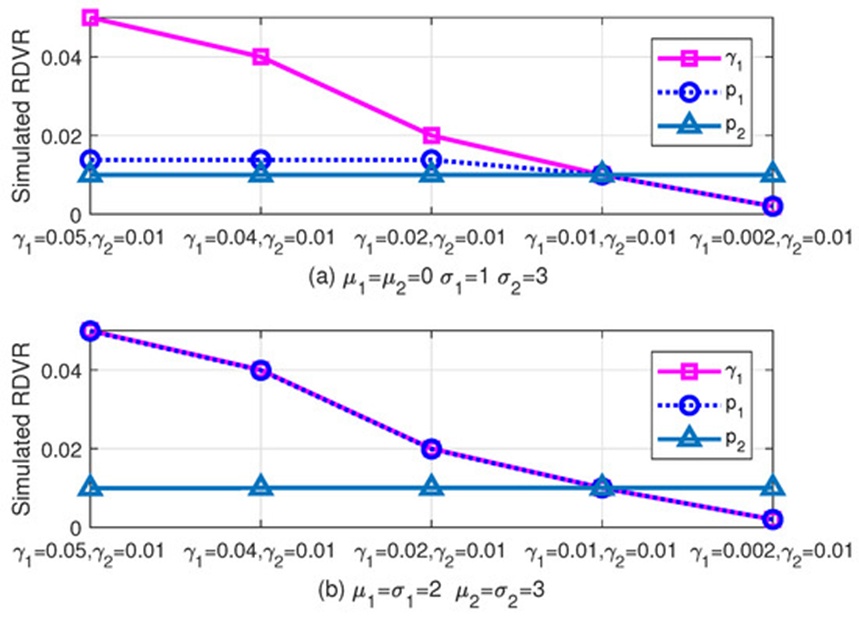
Figure 8. Optimal 𝛼∗ of 2CROB in different cases: (a) Case 2 with differentiated RDVR thresholds, and (b) Case 3 with differentiated RDVR thresholds.
A cross-validation exercise comparing 2CROB against PF-MCROB is conducted using two-VM overbooking instances, with the resultant minimum aggregate volumes 𝑅∗ and attained RDVRs plotted in Figure 9. Across all tested configurations, the final aggregate volumes required by PF-MCROB register slightly above those of 2CROB. In the regime where 𝛼∗ < 1, the mean RDVRs delivered by the two schemes coincide and also approach the stipulated thresholds. For Case 1 under 𝛼∗ = 1, the RDVR of 𝑢2 under PF-MCROB matches the 2CROB benchmark, whereas the RDVR realised by 𝑢1 through PF-MCROB is incrementally lower. The evidence in Figure 9 confirms that the PF-MCROB scheme can nearly replicate the optimal minimal aggregate volume attained by 2CROB, while 2CROB squeezes out marginally higher resource utilisation whenever 𝛼∗ < 1.
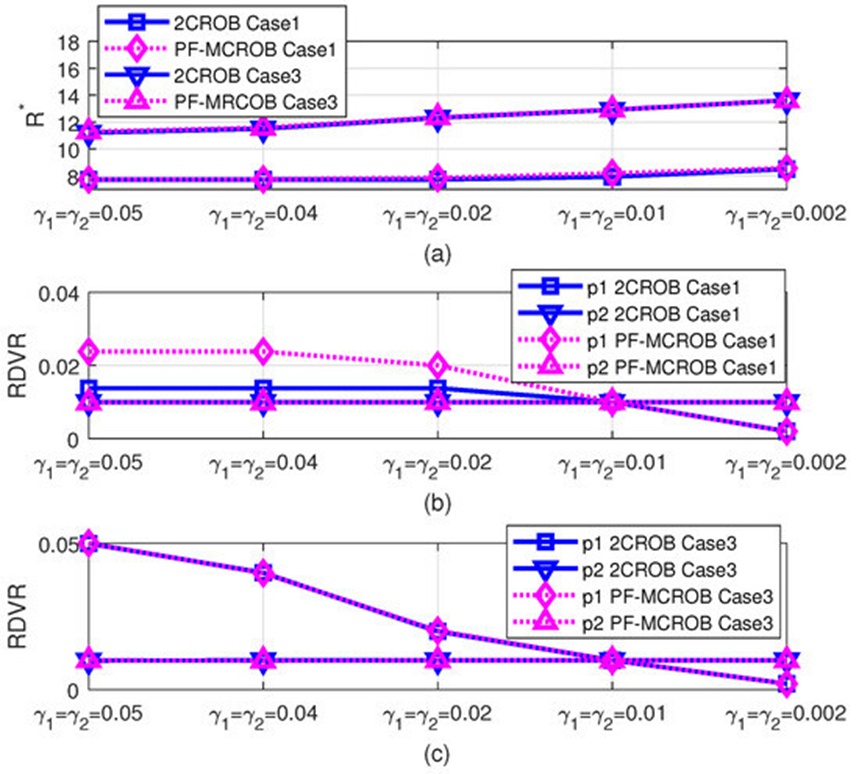
Figure 9. Performance comparison of 2CROB and PF-MCROB in two-VM overbooking cases: (a) Minimum aggregated resource amounts 𝑅∗ in Case 1 and Case 3, (b) Achieved RDVRs in Case 1, and (c) Achieved RDVRs in Case 3.
The natural habitat for PF-MCROB is the multi-VM overbooking regime, a territory where 2CROB loses direct applicability. Figure 10 compares the minimal aggregate resource pools produced by NonOB, TradOB, 2CROB, and PF-MCROB across four-VM placement scenarios. The curves for NonOB, TradOB, and 2CROB are constructed using the identical methodology outlined in Section 6.1. The per-VM demand distribution parameters and RDVR limits for each scenario are catalogued in Table 2. Extending 2CROB to the four-VM context involves dividing the VMs into two independent pairs, enforcing the 2CROB discipline within each pair, and walling off the resource pools of the two pairs from one another. The PF-MCROB scheme presented here yields the lowest aggregate resource volumes across all four contenders in every tested case, regardless of distribution homogeneity or heterogeneity or RDVR bounds. The margin of improvement over traditional overbooking is especially pronounced when the VMs operate under non-uniform RDVR limits. The root cause is that traditional overbooking forces the aggregate demand to comply with the single most stringent RDVR cap across all co-located VMs.
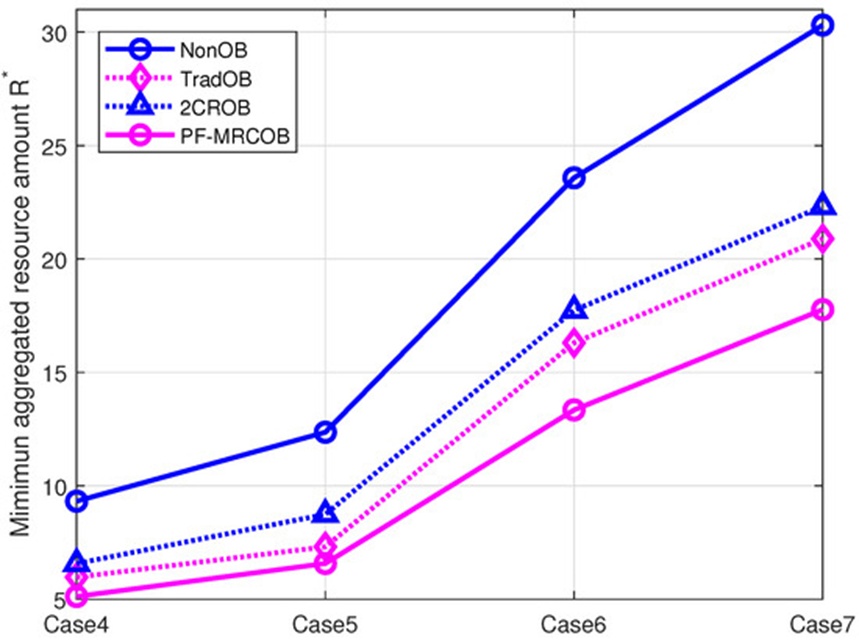
Figure 10. Minimum aggregated resource amounts of different overbooking strategies in four-VM placement cases.
Table 2. Four-VM placement cases in Figure 10.
Resource demand distribution parameter | RDVR threshold | |
Case 4 | 𝜇1 = 𝜇2 = 𝜇3 = 𝜇4 = 0 | 𝛾1 = 𝛾2 = 𝛾3 = 𝛾4 = 0.02 |
Case 5 | 𝜇1 = 𝜇2 = 𝜇3 = 𝜇4 = 0 | 𝛾1 = 𝛾2 = 𝛾3 = 𝛾4 = 0.002 |
Case 6 | 𝜇1 = 𝜇2 = 0𝜇3 = 𝜇4 = 1 | 𝛾1 = 0.05, 𝛾2 = 0.01 |
Case 7 | 𝜇1 = 𝜇2 = 1𝜇3 = 2𝜇4 = 3 | 𝛾1 = 0.02, 𝛾2 = 0.01, |
The convergence trajectory of the bisection search procedure embedded within PF-MCROB is traced in Figure 11, showing that the algorithm homes in on the target minimal aggregate demand within seven to eight iterations. To shed further light on the general behaviour of PF-MCROB, Figures 12 and 13 respectively illustrate the minimal aggregate resource volumes of NonOB, TradOB, and PF-MCROB for progressively larger groups of homogeneous VMs, and the associated RSR gains of PF-MCROB over TradOB. As shown in Figure 13, the proposed PF-MCROB framework progressively unlocks larger fractional resource savings as the degree of VM consolidation on a shared server increases.
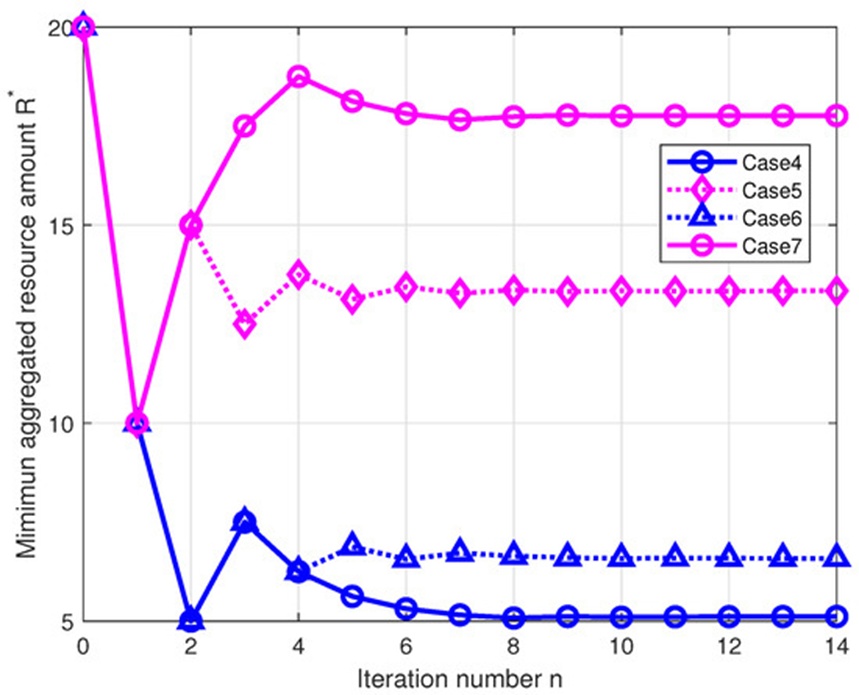
Figure 11. Iteration steps of the bisection search algorithm in PF-MCROB.
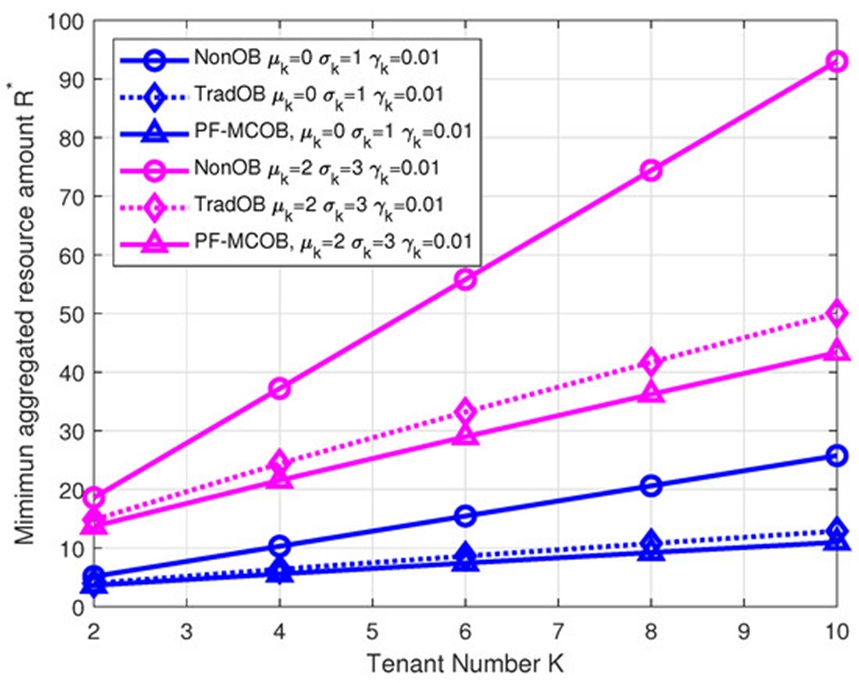
Figure 12. Minimum aggregated resource amounts of different overbooking strategies in K-homogeneous VM placement cases.
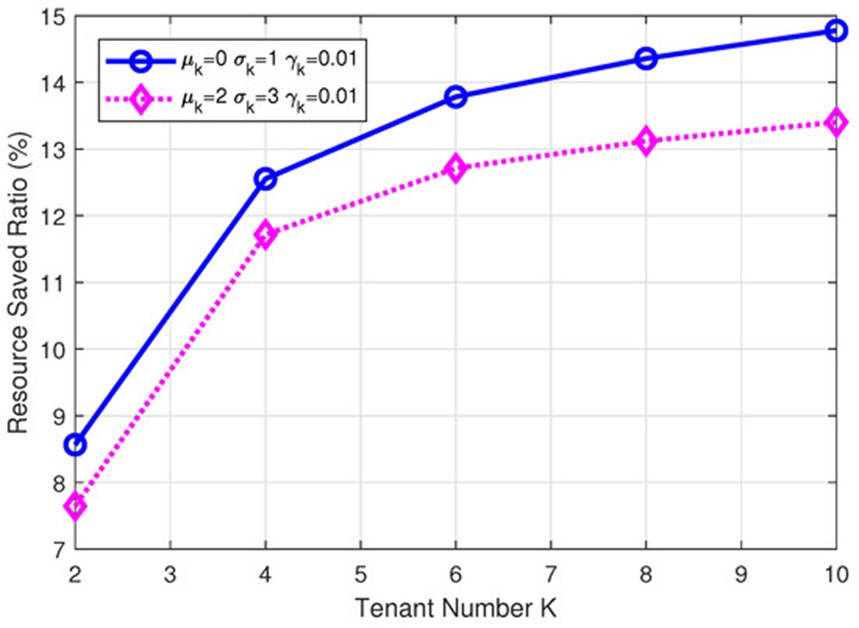
Figure 13. RSR of PF-MCROB in K-homogeneous VM placement cases.
To assess the superiority of the FFD-ACP method against competing placement strategies, we monitor the packing sequence of fifty applications and determine the resulting minimal UAV fleet size. Every VM exhibits resource demand that conforms to an independent Truncated Normal Distribution, where the location parameter 𝜇𝑘 is sampled uniformly across the interval [0,1] and the scale parameter 𝜎𝑘 is sampled uniformly across [1, 2]. The permissible RDVR ceilings are randomly drawn from the pool {0.002, 0.01, 0.02, 0.03, 0.04}. Figure 14 illustrates the operational progression of three distinct placement policies taken from a single simulation trial: placement without any overbooking (NonOB AP), placement driven by conventional overbooking (TradOB AP), and the FFD-ACP algorithm advanced in this work. The NonOB AP baseline mirrors the FFD-VMP technique described by Kumaraswamy and Nair [51]. The TradOB AP alternative represents a reduced-complexity derivative of FFD-ACP, wherein the admission test for packing a VM onto an already-active server checks exclusively whether the severest RDVR limit among co-located VMs remains unbreached, expressed as .
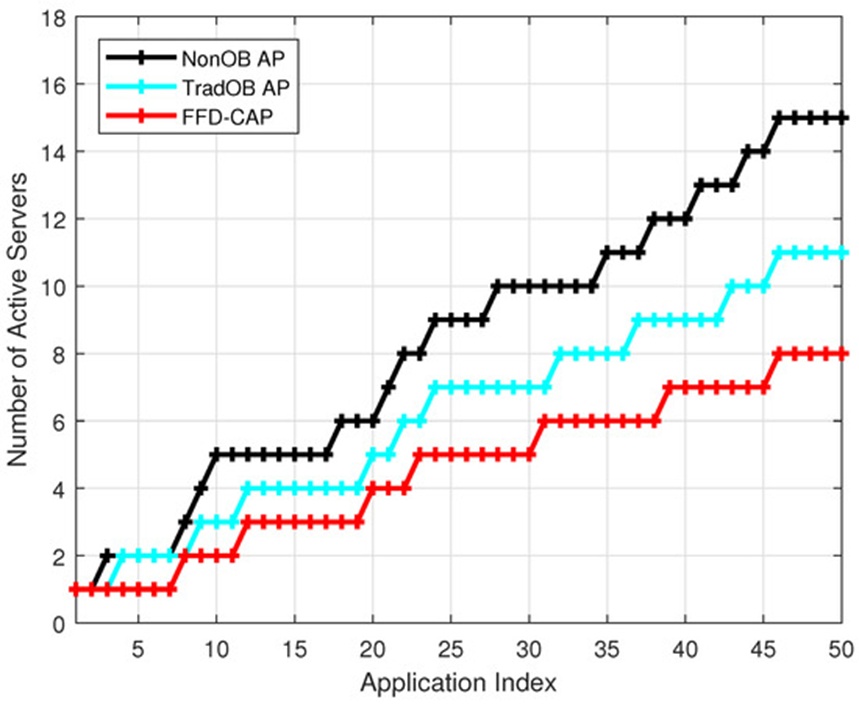
Figure 14. Executing processes of different application placement schemes from one simulation instance.
In the depicted realisation, FFD-ACP successfully accommodates all 50 IoFT applications using only 8 UAVs while upholding their individual RDVR commitments—a near-halving of the fleet compared to what NonOB AP demands. The minimal active servers tallied by the three competing approaches across 50 independent simulation repetitions are shown in Figure 15, which reveals that FFD-ACP reduces the UAV count required by traditional overbooking by roughly one-third. The implications are a considerable uplift in onboard resource exploitation and revenue generation, paired with a meaningful contraction in the upfront investment required for UMEC-powered IoFT deployments.
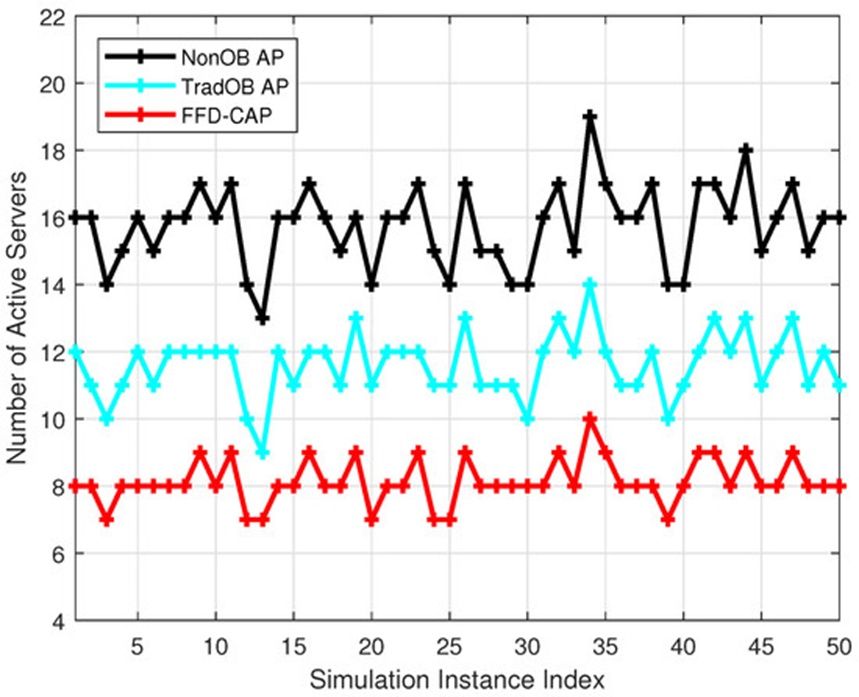
Figure 15. Minimum number of active servers of different application schemes from fifty simulation instances.
This study has examined the coupled resource allocation and application placement problem arising in UMEC settings for IoFT services. A pair of cooperative resource overbooking constructions was engineered—one addressing the two-tenant overbooking case and another extending to arbitrary numbers of tenants—whereby hosted applications or their corresponding VMs can pool their RDV occurrences to compress the total resource reservation. Two separate bisection search routines were devised to locate the minimum aggregate resource volumes for the dual-tenant and multi-tenant scenarios, respectively. Leveraging the multi-tenant cooperative overbooking framework, an FFD-ACP procedure was then formulated to consolidate applications into a minimised set of UAV-borne servers. Simulation-based evaluation substantiated the merit of the proposed contributions, demonstrating that the fractional resource savings unlocked by cooperative overbooking become increasingly substantial as the tenant count grows and as RDVR allowances are set higher or made more diverse; additionally, FFD-ACP proved capable of eliminating one-third of the otherwise necessary UAVs. Collectively, the cooperative resource overbooking and application placement solutions outlined here can substantially pare back deployment costs and amplify the operational profitability of UMEC platforms. That said, several boundaries of the current work warrant acknowledgement.
To begin with, both 2CROB and PF-MCROB presuppose that the resource demands of distinct VMs are statistically independent and that their PDFs have been reliably inferred from historical measurement logs. In settings where VM demands display interdependence or where the underlying distributions remain unidentified, the proposed mechanisms cease to function. Beyond that, the scope of this paper was confined to computing resource overbooking. In contrast, the same philosophy could be transposed to additional resource types—link bandwidth, energy budgets, and storage volumes—paving the way toward multidimensional overbooking. Moreover, the VM's demand distribution is itself contingent on the UAV's sensing radius, the population of ground devices, and the influx rate of MEC task submissions. Accordingly, future enhancements to UMEC application placement could pursue joint optimisation across a richer set of decision variables, including UAV flight trajectories, communication bitrates, and energy-efficiency targets.
The authors would like to thank the Editor-in-Chief, Editor, and anonymous reviewers for their valuable reviews.
None
This work was supported by the National Natural Science Foundation of China (62101415).
None
Open Access The author(s) retain copyright. This article is licensed under the Creative Commons Attribution-NonCommercial-ShareAlike 4.0 International License. It may be shared and adapted for non-commercial purposes with appropriate attribution, an indication of changes, and distribution of adaptations under the same license. Third-party material may be subject to separate terms identified in its credit line. View the license at https://creativecommons.org/licenses/by-nc-sa/4.0/.
 Agro Intelligence Research Press