Smart farming has become a central direction in digital agricultural transformation, yet adoption among small and medium-sized farms remains uneven because readiness depends on more than technology availability. This article develops a conceptual digital readiness maturity model for smart farming adoption among small and medium-sized farms. The model is literature-grounded and designed to classify farms across progressive readiness stages rather than treating adoption as a binary decision. It integrates core readiness dimensions, including digital infrastructure, connectivity, device and machinery access, data availability and quality, data literacy, digital skills, affordability, perceived usefulness, trust, data privacy and ownership, farm-management routines, advisory support, cooperative networks, institutional support, interoperability, sustainability orientation, and farmer-centered usability. The proposed maturity logic distinguishes five levels: non-digital or initial readiness, basic digital access, connected and data-aware farming, integrated smart farming use, and adaptive learning-oriented smart farming. The article contributes to smart farming adoption research by positioning maturity as a staged, context-sensitive capability-building process. For small and medium-sized farms, the model provides a practical conceptual tool for identifying readiness gaps, prioritizing support interventions, and aligning digital transformation with farm goals, advisory capacity, institutional conditions, and farmer decision contexts.
Smart farming has become a major pathway through which digital technologies, data systems, automation, remote sensing, sensors, platforms, and decision-support tools are being introduced into agricultural production and farm management. However, recent smart farming scholarship increasingly shows that digital agriculture is not simply a technical shift from conventional tools to advanced devices; it is a socio-technical transformation involving farmers, advisory systems, institutions, platform providers, data governance arrangements, and changing expectations about responsible innovation. This means that adoption should be understood through the interaction between technological possibilities and the practical, social, organizational, and institutional conditions under which farmers make decisions [1–3].
The uneven adoption of precision and smart farming technologies is especially important for small and medium-sized farms because these farms often operate with tighter resource constraints, more limited specialized labor, and greater dependence on external advisory and service networks. Cross-regional evidence on precision agriculture adoption indicates that technology uptake varies across farm contexts, regions, and farmer characteristics, making it inappropriate to assume a single adoption pathway for all farms [4]. A readiness perspective is therefore needed to explain why farms with apparent access to similar technologies may differ substantially in their ability to use those technologies in meaningful farm-management decisions.
A digital readiness maturity model responds to this challenge by shifting the analytical focus from whether a farm has adopted a particular tool to whether the farm has the conditions required to adopt, adapt, maintain, and learn from smart farming technologies. In this article, digital readiness refers to the farm-level and system-level capacity to make purposeful use of digital tools in ways that fit farm goals, decision routines, data capabilities, financial constraints, advisory relationships, and institutional conditions. This framing avoids treating smart farming as a simple yes-or-no adoption outcome and instead positions adoption as a progressive capability-building process.
The aim of this article is to develop a conceptual maturity model for assessing digital readiness for smart farming adoption among small and medium-sized farms. The model classifies farms across five progressive maturity levels, from non-digital or initial readiness to adaptive, learning-oriented smart farming capability. It is intended to support researchers, policymakers, extension services, cooperatives, technology developers, precision agriculture service providers, and farm advisors in identifying readiness gaps, prioritizing interventions, and designing context-sensitive digital transformation pathways.
Smart farming adoption should be understood as a readiness challenge because farm-level adoption is shaped by more than the availability of precision agriculture technologies. Evidence on precision agriculture adoption among crop farmers shows that farm characteristics, farmer perceptions, management conditions, and perceived relevance influence whether technologies are taken up and used in practice [5]. For small and medium-sized farms, this means that readiness cannot be inferred from technology supply alone; it must be assessed through the farm’s capacity to access, understand, finance, operate, maintain, and integrate digital tools.
Smart farming adoption also depends on the perceived fit between digital technologies and the farm’s economic and managerial realities. Research on smart farming adoption factors among grain farmers shows that adoption is influenced by economic, technological, and farm-structure conditions rather than by technological availability in isolation [6]. This supports the view that digital readiness must include financial affordability, perceived usefulness, expected risk, technology access, and the farmer’s ability to connect digital outputs to day-to-day and seasonal decisions.
A maturity perspective is particularly useful because digital transition is rarely linear, complete, or uniform across all farm functions. Research on smart farming technology adoption and digital transition highlights that adoption factors operate across broader transition processes rather than as a single moment of uptake [7]. This implies that a farm may be advanced in one dimension, such as smartphone use or basic digital record-keeping, while remaining less ready in other areas, such as data interoperability, sensor integration, advisory support, or decision-support use.
For small and medium-sized farms, adoption should therefore be conceptualized as the gradual development of readiness across multiple interacting dimensions. A farm may move from informal experimentation with digital tools to more connected data use, then to integrated decision-support routines, and eventually to adaptive learning based on data feedback and advisory interpretation. However, this movement depends on affordability, trust, skills, institutional support, and perceived decision value, so maturity should not be interpreted as a universal ranking of farms or as evidence that more technology always means better farming.
Digital infrastructure forms the technical foundation of smart farming readiness, but infrastructure should be understood broadly. Big data in smart farming depends on data availability, data quality, data exchange, analytics, governance, and interoperability; IoT-enabled agriculture depends on sensors, devices, connectivity, and data flows; and precision agriculture enabling technologies depend on machinery, hardware access, and compatibility with farm operations [8–10]. These studies support the claim that digital infrastructure includes not only internet access but also the ability to generate, store, connect, interpret, and use farm data.
For small and medium-sized farms, infrastructure readiness begins with basic digital access but extends into the reliability and compatibility of the farm’s digital environment. A farm may have mobile internet access but lack stable field connectivity, sensor coverage, compatible machinery, data-storage capacity, or software that can communicate across systems. This creates a gap between technology availability and practical on-farm usability because tools that appear accessible in principle may remain difficult to use when farm infrastructure is fragmented or fragile.
Farm-level capacity also includes the ability to maintain digital systems over time. Smart farming tools often require updates, troubleshooting, calibration, data cleaning, subscription management, and coordination with machinery dealers, software providers, advisers, and platform operators. These practical maintenance requirements are especially significant for farms that do not employ specialized digital staff and must combine digital tasks with everyday production, labor, and financial responsibilities.
Infrastructure readiness should therefore be assessed as a layered capability rather than a single access condition. At lower maturity levels, readiness may involve basic connectivity, mobile-device access, and simple record-keeping. At higher maturity levels, readiness includes interoperable sensors, machine-generated data, decision-support software, reliable data storage, compatible machinery, and routines for turning data into farm-management decisions. This layered view makes it possible to distinguish farms that have digital access from farms that have genuine smart farming capacity.
Digital readiness depends strongly on farmer skills, confidence, perceived usefulness, and usability. Research on farmers’ expectations and experiences of smart farming technologies shows that gaps can exist between what farmers expect digital tools to provide and how they experience those tools in practice [11]. This supports the inclusion of farmer-centered usability, confidence, and perceived decision value as readiness dimensions, because a technology that is technically available may still be poorly aligned with the farmer’s skills, time, language, interface preferences, or decision routines.
Affordability is another central readiness condition because smart farming tools often involve purchase costs, subscription fees, repair costs, maintenance responsibilities, data-service charges, and potential dependency on external providers. Research on precision farming tool adoption among Italian farmers supports the importance of farmer and farm characteristics in shaping adoption, including conditions that affect whether farmers can move from interest to practical use [12]. For small and medium-sized farms, affordability should be interpreted not only as the initial price of technology but also as the ongoing ability to sustain use without undermining farm financial resilience.
Small and medium-sized farms may require tailored support because their adoption constraints are often closely connected to family labor, local knowledge, farm size, available capital, and the perceived fit of technology with existing practices. A qualitative study of small-scale commercial family farms in the North China Plain shows that precision agriculture adoption involves cost, skills, usability, perceived fit, and local decision contexts [13]. This evidence supports the need for a maturity model that does not treat smaller farms as simply less advanced, but instead examines whether digital tools are accessible, usable, affordable, and meaningful within their specific farm-management conditions.
Technology access should also include training access, repair and maintenance services, local advisory support, and the availability of trusted intermediaries who can help farmers interpret digital outputs. A farm may possess a device or subscribe to a platform without having the capacity to use it confidently in decisions about irrigation, fertilization, pest monitoring, machinery operations, labor planning, or marketing. Skills and affordability are therefore not secondary adoption barriers; they are central components of digital readiness and should be evaluated alongside infrastructure and connectivity.
Table 1 summarises the core digital readiness dimensions that shape smart farming adoption among small and medium-sized farms.
Table 1. Digital Readiness Dimensions for Smart Farming Adoption Among Small and Medium-Sized Farms: Infrastructure, Connectivity, Device Access, Data Capacity, Digital Skills, Affordability, Trust, Advisory Support, Organizational Routines, Institutional Support, and Interoperability
Readiness dimension | Core meaning | Farm-level indicators | Typical readiness barrier | Decision-support relevance | Small and medium-sized farm consideration | Required support mechanism | Potential maturity signal |
Digital infrastructure | Availability of the basic technical foundation for digital farming | Mobile devices, computers, software access, data storage, power reliability | Fragmented or unreliable digital setup | Enables basic data capture and access to digital services | Smaller farms may rely on shared or low-cost digital tools | Rural digital investment, affordable software, local technical support | Farm can reliably access and maintain basic digital tools |
Internet connectivity | Stable connection for data transfer, cloud platforms, remote monitoring, and advisory communication | Field connectivity, broadband access, mobile coverage, platform access | Weak or unstable rural connection | Supports timely decision-support updates and communication | Farms in remote areas may face unequal service quality | Connectivity policy, cooperative infrastructure, offline-capable tools | Farm can use connected services during key management periods |
Device and hardware access | Access to suitable devices, sensors, machinery interfaces, and compatible equipment | Smartphones, tablets, sensors, GPS devices, machinery terminals | Devices are costly, outdated, or incompatible | Enables data capture from fields, machinery, livestock, or environment | Smaller farms may need scalable or shared access models | Equipment-sharing, service providers, modular technology packages | Farm uses appropriate devices without excessive financial strain |
Sensor and machinery compatibility | Ability of digital tools to work with existing machinery and farm systems | Compatible machinery, sensor integration, data export functions | Legacy machinery or closed systems limit integration | Supports automated or semi-automated decision workflows | Machinery replacement may be unrealistic for smaller farms | Retrofit solutions, interoperability standards, machinery support | Farm can connect machinery or sensor outputs to management decisions |
Data availability and quality | Presence of usable, relevant, and sufficiently reliable farm data | Field records, yield data, soil data, input records, sensor data | Data are incomplete, inconsistent, or difficult to interpret | Determines whether decision support is meaningful | Smaller farms may have informal records or limited historical data | Data templates, record-keeping support, quality checks | Farm maintains usable data for repeated decisions |
Data literacy | Ability to understand, interpret, question, and apply digital information | Farmer can read dashboards, compare trends, identify anomalies | Data outputs are misunderstood or ignored | Converts digital outputs into practical decisions | Farmers may need learning formats linked to everyday tasks | Training, peer learning, adviser interpretation | Farmer uses data outputs to support management choices |
Digital skills | Practical competence in operating digital tools and services | Platform use, device operation, troubleshooting, data entry | Low confidence or lack of time for learning | Affects sustained use of decision-support systems | Skills gaps may be amplified by limited staff capacity | Hands-on training, extension support, help desks | Farm can operate tools without constant external intervention |
Financial affordability | Ability to purchase, subscribe to, maintain, and upgrade digital tools | Budget capacity, cost-benefit reasoning, subscription management | High upfront and recurring costs | Determines whether decision-support use can be sustained | Smaller farms may need lower-risk entry pathways | Financing schemes, cooperative purchasing, service models | Digital investments are aligned with farm cash flow and goals |
Perceived usefulness | Farmer judgement that a tool adds value to decisions | Clear link to farm problems, visible decision relevance | Tool appears complex, irrelevant, or weakly adapted | Increases likelihood that outputs influence action | Value must be specific to farm type and management priorities | Demonstrations, locally relevant use cases, adviser mediation | Farmer can identify where the tool improves decisions |
Trust and risk perception | Confidence in technology, providers, data use, and advisory interpretation | Provider transparency, data control, reliability experience | Fear of data misuse, lock-in, or poor recommendations | Affects willingness to share data and follow recommendations | Smaller farms may have weaker bargaining power with platforms | Transparent data terms, trusted advisers, accountable providers | Farmer trusts outputs enough to consider them in decisions |
Data privacy and ownership | Clarity over who controls, accesses, shares, and benefits from farm data | Data agreements, consent processes, platform terms | Unclear ownership or benefit-sharing arrangements | Shapes willingness to participate in data-driven services | Smaller farms may need simplified and fair data governance | Data governance guidance, cooperative negotiation, legal support | Farm understands and manages data-sharing conditions |
Farm-management routines | Integration of digital tools into planning, monitoring, and review practices | Regular record-keeping, review meetings, decision logs | Digital tools remain separate from management routines | Determines whether digital outputs affect real decisions | Smaller farms may need lightweight routines that fit labor realities | Advisory coaching, templates, workflow design | Digital information is used in recurring farm decisions |
Advisory and extension support | Availability of trusted human support for learning and interpretation | Extension contact, adviser access, peer learning, technical advice | Farmers lack help when problems occur | Helps translate data into context-sensitive recommendations | External support may substitute for limited in-house expertise | Digital extension, local advisers, demonstration farms | Farm has reliable support for learning and troubleshooting |
Cooperative or network support | Collective support through farmer groups, cooperatives, or service networks | Shared services, group purchasing, data cooperatives, peer exchange | Farm acts alone and cannot access scale benefits | Supports shared learning and lower-cost access | Smaller farms may benefit strongly from collective arrangements | Cooperatives, farmer networks, platform governance models | Farm participates in networks that reduce adoption risk |
Institutional and policy support | Wider enabling environment for finance, standards, training, connectivity, and governance | Grants, training programs, policy incentives, interoperability guidance | Weak institutional support leaves farms to manage transition alone | Shapes long-term sustainability of digital adoption | Smaller farms may depend on targeted public or cooperative support | Rural policy, financing support, standards, extension investment | Farm readiness is reinforced by stable external support |
Interoperability | Ability of tools, data formats, platforms, and machinery to work together | Data export, API access, compatible systems, open formats | Closed systems create lock-in and fragmented decisions | Enables integrated decision support across farm functions | Smaller farms need simple integration without high technical burden | Standards, platform accountability, adviser support | Farm can combine data across tools for practical decisions |
Sustainability orientation | Alignment of digital use with environmental, economic, and social farm goals | Input-use monitoring, soil-health decisions, risk management | Digital use is disconnected from farm sustainability priorities | Helps connect smart farming to meaningful long-term outcomes | Benefits depend on local goals and implementation quality | Sustainability advisory tools, context-specific indicators | Digital tools support farm-defined sustainability decisions |
Farmer-centered usability | Fit between technology design and farmer needs, routines, language, and constraints | Simple interfaces, relevant alerts, adaptable settings | Tools are too complex or poorly adapted to farm realities | Improves likelihood that decision support is used appropriately | Smaller farms need low-burden, practical, and flexible tools | Participatory design, local testing, user support | Farmer can use tools confidently within normal farm work |
Organizational readiness refers to the extent to which farm-management routines, decision processes, labor arrangements, record-keeping practices, and learning mechanisms are prepared to absorb digital tools into everyday farm work. Digitalisation of agricultural knowledge and advice networks shows that smart farming readiness depends on knowledge infrastructures and advisory relationships, not only on individual farmer interest or technological supply [14]. This means that farms require pathways for learning, interpretation, troubleshooting, and reflection if digital tools are to become part of operational and strategic management.
Institutional readiness is equally important because digital agriculture changes how knowledge is produced, circulated, trusted, and applied in agricultural systems. Digitalisation has implications for agricultural knowledge because farmers increasingly interact with data-mediated recommendations, platform-based services, digital advisory tools, and new forms of expertise [15]. For small and medium-sized farms, this creates a need for institutional arrangements that help farmers interpret digital information without weakening the value of farmer experience, local knowledge, or contextual judgement.
Farm advisers, extension professionals, cooperatives, machinery dealers, digital service providers, and producer networks can act as intermediaries between smart farming tools and farm-management practice. Research on advisers in smart farming shows that advisers can support digital innovation by helping farmers make sense of technologies, adapt them to local contexts, and translate digital outputs into practical decisions [16]. This supports the inclusion of advisory and extension support as a core readiness dimension in the proposed maturity model.
Organizational and institutional readiness also shape whether digital tools remain isolated experiments or become embedded in recurring decision routines. A farm may own connected devices or collect data, but limited record-keeping habits, weak advisory access, fragmented platform relationships, unclear data governance, or inadequate financing support can prevent those tools from influencing management decisions. Digital readiness therefore requires alignment between farm-level routines and the broader support environment, including advisory systems, cooperative networks, policy incentives, data governance arrangements, and financing mechanisms.
A maturity model provides a structured way to describe progressive readiness without reducing farms to a simple adopted-or-not-adopted category. Digital transformation maturity literature shows that maturity models are useful when they define staged development and multidimensional capability requirements rather than treating transformation as a single technical threshold [17]. For smart farming adoption, this means that maturity levels should reflect increasing capability across infrastructure, skills, data use, organizational routines, advisory support, institutional conditions, trust, and decision integration.
Capability maturity logic is particularly relevant because smart farming adoption requires farms to develop practical capacities over time. Digital transformation capability maturity assessment research supports the idea that maturity levels should describe the development of technical, organizational, and managerial capabilities [18]. In the context of small and medium-sized farms, this implies that readiness should be assessed through the farm’s ability to connect digital infrastructure with farm-management routines, not merely by counting technologies present on the farm.
Small and medium-sized farms require a maturity structure that is sensitive to resource constraints, limited specialized staff, and the importance of practical usability. Research on digital maturity dimensions for small and medium-sized enterprises supports the relevance of organizational capacity, skills, resources, and digital strategy when assessing maturity in smaller organizations [19]. Applied to farming, this means that digital readiness should account for family labor, seasonal time pressure, affordability, local service access, and the need for technologies that fit existing farm-management realities.
The proposed maturity levels also need to connect digital capability with farm organization and business-model fit. Research on organizational digital transformation maturity in small and medium-sized enterprises supports the view that maturity progression involves changes in routines, value creation, organizational learning, and business-model alignment [20]. For smart farming, higher maturity is therefore not defined by the most advanced technology alone, but by whether digital tools become usable, trusted, financially sustainable, and meaningfully integrated into farm decisions.
Readiness and maturity should remain conceptually distinct. Readiness refers to the preparedness of a farm to adopt, use, and sustain smart farming practices, whereas maturity refers to the progressive development of capability across levels of digital integration. Literature on readiness and maturity models for Industry 4.0 supports the need to distinguish preparedness from advanced maturity and to avoid treating maturity as a simple accumulation of technologies [21]. This distinction is important because a farm may be ready to begin with basic digital access without yet being mature in integrated or adaptive smart farming.
Table 2 presents the proposed maturity levels for assessing digital readiness for smart farming adoption among small and medium-sized farms.
Table 2. Proposed Maturity Levels for Digital Readiness in Smart Farming Adoption: Initial, Basic Access, Connected Awareness, Integrated Use, and Adaptive Learning-Oriented Smart Farming
Maturity level | Level name | Digital infrastructure condition | Data and decision-support capability | Skills and advisory support | Organizational readiness | Institutional support need | Typical smart farming use | Transition priority |
Level 1 | Initial readiness | Limited or unreliable digital infrastructure; minimal device access; weak connectivity | Farm data are informal, fragmented, paper-based, or absent from decision-support tools | Limited digital confidence; little or no structured training or advisory support | Farm decisions rely mainly on experience, informal observation, and traditional records | High need for basic connectivity, awareness-building, trust formation, and entry-level support | Occasional use of basic mobile communication or non-integrated digital information | Build basic access, confidence, awareness, and low-risk entry points |
Level 2 | Basic digital access | Basic smartphone, computer, or internet access is available, but field-level connectivity and device compatibility remain limited | Simple digital records, weather apps, messaging tools, or basic online information may support decisions | Farmer can use basic tools but may need support for troubleshooting and interpretation | Digital tools are used occasionally but are not yet embedded in routine management | Need for affordable tools, introductory training, local advisory support, and service access | Basic digital communication, online information search, simple record-keeping, or mobile advisory contact | Move from access to purposeful data awareness and routine use |
Level 3 | Connected and data-aware farming | Farm has more reliable connectivity, selected devices, and some compatible hardware or software | Data are collected more regularly and used to inform selected operational decisions | Farmer or staff have growing data literacy; advisers help interpret selected outputs | Some digital routines emerge in planning, monitoring, or reviewing farm operations | Need for interoperability guidance, advisory interpretation, financing support, and data governance clarity | Use of sensors, digital field records, GPS-enabled services, decision-support dashboards, or platform tools in selected areas | Strengthen data quality, interoperability, skills, and advisory-supported interpretation |
Level 4 | Integrated smart farming use | Multiple digital systems, devices, machinery interfaces, and software tools are connected across farm functions | Data from different sources support recurring operational and strategic decisions | Farmer, workers, and advisers can interpret outputs and adjust management actions | Digital tools are integrated into planning, input management, monitoring, and evaluation routines | Need for platform accountability, data-sharing safeguards, advanced advisory services, and financing continuity | Integrated precision input decisions, machinery data use, remote monitoring, decision-support software, and structured digital records | Improve integration, trust, sustainability alignment, and organizational learning |
Level 5 | Adaptive learning-oriented smart farming | Infrastructure is reliable, interoperable, scalable, and adaptable to changing farm goals | Data systems support feedback, learning, scenario thinking, and adaptive decision-making | Digital skills are embedded in farm routines and supported by trusted advisory and peer networks | Farm uses digital feedback to refine goals, evaluate practices, and adapt management strategies | Need for long-term institutional support, fair data governance, interoperability standards, and innovation ecosystems | Adaptive use of decision support, integrated data ecosystems, sustainability-oriented monitoring, and continuous improvement routines | Sustain learning, responsible data use, farmer-centered value, and context-sensitive innovation |
Figure 1 illustrates the progressive maturity pathway through which small and medium-sized farms may move from limited digital readiness to adaptive smart farming capability.
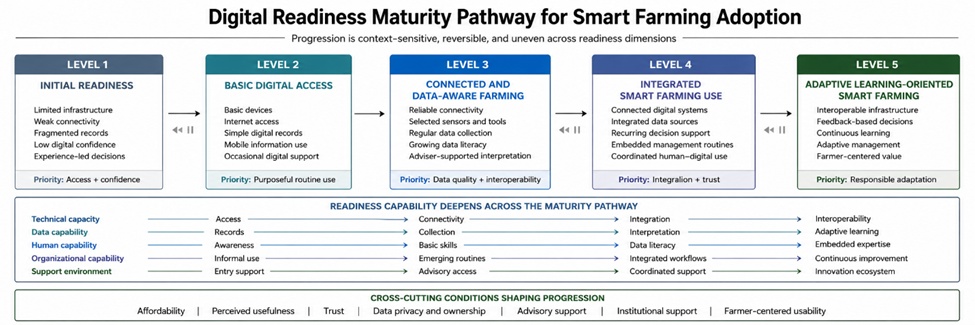
Figure 1. Digital Readiness Maturity Pathway for Smart Farming Adoption. The figure shows five progressive maturity levels for small and medium-sized farms, beginning with non-digital or initial readiness and moving through basic digital access, connected and data-aware farming, integrated smart farming use, and adaptive learning-oriented smart farming. Each level reflects increasing capability across infrastructure, data use, skills, affordability, organizational routines, advisory support, institutional support, and decision integration.
Alt-text description: A stepwise maturity pathway diagram showing five levels of digital readiness for smart farming adoption. The levels progress from initial readiness to basic access, connected awareness, integrated smart farming use, and adaptive learning-oriented smart farming, with readiness dimensions such as infrastructure, skills, affordability, data use, advisory support, institutional support, and decision integration increasing across the pathway.
The proposed conceptual maturity model integrates readiness inputs, maturity progression, and adoption outcome domains for small and medium-sized farms. Trust, transparency, benefit-sharing, data privacy, data ownership, ethical safeguards, and responsible innovation are included because data-driven smart farming depends on farmers’ willingness to engage with digital systems under conditions they regard as legitimate and fair [22–24]. These dimensions are especially important where digital platforms, advisory systems, or service providers collect farm data and influence decision-support recommendations.
The model also treats interoperability and data integration as advanced readiness conditions rather than optional technical features. Research on digital twins in smart farming supports the importance of integrated data flows, modelling, sensing, and decision-support architectures for more advanced smart farming applications [25]. In the proposed model, farms at higher maturity levels are therefore expected to connect data across devices, machinery, software, advisory interpretation, and management routines, while lower maturity levels may rely on isolated tools or fragmented records.
Sustainability orientation is included to ensure that digital maturity is not equated with technology intensity alone. Digital agriculture can support the design of more sustainable agricultural systems when digital tools are aligned with context-specific goals, data quality, management interpretation, and decision needs [26]. The model therefore avoids claiming that smart farming automatically improves sustainability, profitability, resilience, or productivity; instead, it frames benefits as conditional on implementation quality, farmer capability, advisory support, and fit with farm goals.
The final readiness layer concerns actual use, behavioral intention, perceived usefulness, and facilitating conditions. Research on farmers’ behavioral intentions and actual use of smart products shows that adoption depends on more than positive attitudes; farmers also need conditions that allow smart products to become useful in practice [27]. In the proposed model, higher maturity therefore requires that digital systems move beyond awareness or experimentation and become part of repeated farm-management decisions, while still complementing farmer judgement rather than replacing it.
Figure 2 displays the proposed conceptual maturity model linking readiness dimensions, maturity levels, support mechanisms, and smart farming adoption outcomes for small and medium-sized farms.
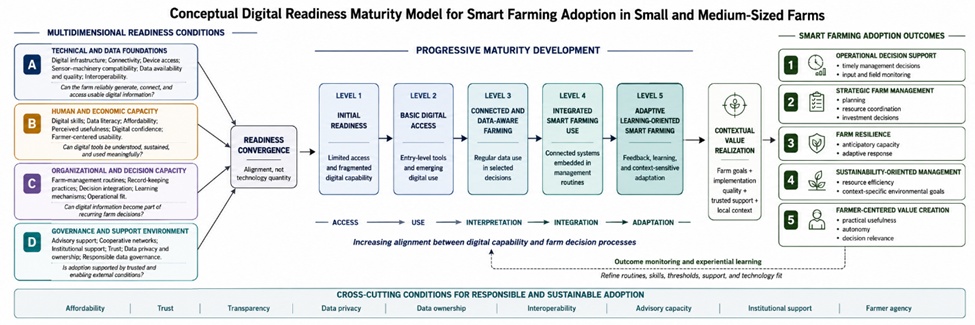
Figure 2. Conceptual Digital Readiness Maturity Model for Smart Farming Adoption in Small and Medium-Sized Farms. The model links readiness inputs, including infrastructure, connectivity, data capacity, digital skills, affordability, trust, organizational routines, advisory support, and institutional conditions, to five maturity levels and three adoption outcome domains: operational decision support, strategic farm management, and sustainable smart farming capability.
Alt-text description: A conceptual model diagram showing readiness dimensions feeding into five maturity levels for smart farming adoption. Infrastructure, connectivity, data capacity, digital skills, affordability, trust, organizational routines, advisory support, and institutional conditions connect to adoption outcomes, including operational decision support, strategic farm management, and sustainable smart farming capability for small and medium-sized farms.
The model can be used by researchers, advisers, policymakers, cooperatives, and technology developers as a diagnostic and design tool. Researchers can use it to structure empirical studies of readiness variation across farm types, regions, and production systems. Extension services and advisers can use it to identify whether a farm requires support with basic access, data literacy, affordability, decision routines, trust, or interoperability. Cooperatives and service providers can use it to design shared services, lower-risk access models, and farmer-centered digital support. Policymakers can use it to align connectivity investment, financing mechanisms, advisory capacity, data governance, and interoperability policy with the staged nature of farm digital transformation.
For extension services and advisory systems, the maturity model suggests that smart farming support should be staged rather than delivered as a generic technology-promotion package. Digital advisory networks and advisers in smart farming can help farmers interpret tools, build confidence, and adapt digital outputs to farm-management contexts [14, 16]. Practical interventions should therefore distinguish between farms needing basic access and awareness, farms needing help with data quality and interpretation, and farms ready for more integrated decision-support systems.
For technology providers, cooperatives, rural development agencies, and policymakers, the model highlights the importance of affordability, interoperability, trust, and data governance. Big data and platform-based smart farming depend on usable data flows, while trust, transparency, ownership, benefit-sharing, and ethical safeguards shape whether farmers are willing to participate in data-driven systems [8, 22–24]. This implies that smart farming adoption strategies should include fair data terms, transparent service models, modular technologies, shared-access arrangements, interoperability standards, and local support mechanisms.
Future research should empirically refine and validate the proposed maturity model across production systems, farm sizes, countries, and institutional environments. Studies could examine whether the maturity levels require adaptation for livestock, horticulture, arable systems, mixed farms, or cooperative farming contexts. Further work should also develop participatory readiness-assessment instruments, test longitudinal maturity pathways, compare advisory models, and explore how small and medium-sized farms interpret digital value, risk, trust, and sustainability orientation. Research on small-scale family farms, SME digital maturity, and readiness-model design can guide this future validation while preserving the model’s context-sensitive logic [13, 19, 21].
This article developed a conceptual digital readiness maturity model for smart farming adoption among small and medium-sized farms. The model contributes to smart farming adoption research by reframing adoption as a staged readiness process shaped by infrastructure, connectivity, device access, data capacity, digital skills, affordability, perceived usefulness, trust, data governance, organizational routines, advisory support, institutional conditions, interoperability, sustainability orientation, and farmer-centered value. It avoids treating smart farming as a binary decision or a technology-driven pathway that automatically improves farm outcomes. Instead, it positions digital transformation as a context-sensitive process in which farms move through progressive maturity levels according to their goals, constraints, support networks, and capacity to integrate digital tools into meaningful decision-making. For researchers, advisers, cooperatives, policymakers, and technology developers, the model offers a structured framework for identifying readiness gaps, targeting interventions, and supporting responsible, practical, and adaptive smart farming adoption.
None
None
None
None
Open Access The author(s) retain copyright. This article is licensed under the Creative Commons Attribution-NonCommercial-ShareAlike 4.0 International License. It may be shared and adapted for non-commercial purposes with appropriate attribution, an indication of changes, and distribution of adaptations under the same license. Third-party material may be subject to separate terms identified in its credit line. View the license at https://creativecommons.org/licenses/by-nc-sa/4.0/.
 Agro Intelligence Research Press