Smart farming is increasingly promoted as a pathway for improving agricultural productivity, resource efficiency, climate responsiveness, and data-driven decision-making. Its core technologies include sensors, digital platforms, machine learning, remote sensing, robotics, automation, and decision-support systems. These tools are often presented as mechanisms for making agriculture more precise, predictable, and adaptive. However, smart farming is not only a technical shift in agricultural tools. It also changes how knowledge is produced, how decisions are justified, how risks are distributed, and how farmers interact with platforms, advisers, suppliers, regulators, and markets. A critical review perspective is therefore needed to examine the social, institutional, political, and ecological consequences of agricultural digitalization. This article critically reviews smart farming as a socio-technical transformation rather than a purely technical modernization process. It examines how datafication, digital governance, farmer adoption, platform dependency, power asymmetry, and sustainability tensions shape the meaning and consequences of smart farming. The central argument is that smart farming should be evaluated through its effects on data control, farmer agency, institutional accountability, and ecological responsibility. The review synthesizes scholarship on digital agriculture, precision agriculture, smart farming, data governance, adoption barriers, farmer-centered challenges, sustainability claims, and responsible innovation. It does not treat technology adoption as a simple matter of farmer willingness or technical readiness. Instead, it situates adoption within broader arrangements of infrastructure, affordability, trust, knowledge, governance, and market pressure. The article contributes a critical synthesis of smart farming evidence and develops a forward-looking agenda for research and governance. It argues that smart farming futures should be designed around transparency, participation, interoperability, accountable digital systems, social equity, and ecological care. The review therefore reframes smart farming as a contested transformation whose benefits depend on how digital systems are governed, adopted, and made accountable.
Smart farming has become a major transformation in contemporary agriculture because it brings together sensors, remote sensing, data platforms, farm management systems, automation, artificial intelligence, and precision decision-support tools. Yet the smart farming literature shows that these technologies cannot be understood only as discrete technical instruments, because they also reshape skills, advisory systems, policy expectations, farmer identities, data relations, and agricultural knowledge practices [1]. This makes smart farming a socio-technical field in which digital tools and social organization develop together. The central problem is therefore not whether smart farming is technically possible, but how its possibilities are structured by institutions, markets, governance arrangements, and farmer participation.
Datafication is central to this transformation because farm operations are increasingly converted into data flows that connect machinery, soils, crops, animals, weather, logistics, inputs, and market information. Big Data in smart farming extends agricultural decision-making beyond the individual farm by linking production data with advisory systems, value-chain actors, service providers, and platform-based infrastructures [2]. This creates new opportunities for prediction and optimization, but it also raises questions about interoperability, ownership, business models, data quality, and the distribution of value. A critical review must therefore examine whether data-driven agriculture strengthens farmer decision-making or shifts control toward actors that own platforms, algorithms, and data infrastructures.
Smart farming is frequently framed through the language of productivity, efficiency, optimization, and climate-smart modernization. However, Agriculture 4.0 also raises social and environmental concerns because technologies that improve production may still generate unequal access, deskilling, surveillance, dependency, or narrow sustainability metrics [3]. The promise of making agriculture work for people, production, and the planet remains conditional rather than automatic. This article therefore treats smart farming as a contested transformation whose outcomes depend on how digital systems are designed, governed, adopted, and evaluated.
The aim of this article is to critically review smart farming as a socio-technical transformation involving data, governance, adoption, and sustainability challenges. The analysis examines how digital agriculture reorganizes farmer agency, knowledge systems, power relations, institutional responsibility, and sustainability priorities. Responsible transition pathways require attention to diversity among farms, uneven capacities, inclusion and exclusion, and the governance of game-changing technologies before they become locked into agricultural systems [4]. The article proceeds through sections on socio-technical transformation, datafication and governance, adoption barriers, sustainability tensions, critical synthesis, research gaps, and a future research agenda.
Smart farming should be understood as a socio-technical transformation because digital tools are embedded in advisory systems, infrastructures, markets, institutions, regulations, and farmer practices. Treating socio-ethical issues as late-stage concerns risks separating technical design from the social relations that make technologies usable, trustworthy, and legitimate [5]. A critical perspective therefore asks not only what smart farming can do, but who defines its purposes, who benefits from its outputs, and who bears its risks. This reframing is essential because technologies that appear efficient at the device level may still produce dependency, exclusion, or unaccountable decision-making at the system level.
Responsible innovation offers a way to move beyond narrow adoption narratives and toward reflexive shaping of agricultural digitalization. Smart farming should not be governed only by asking whether users accept technologies after they are developed; it should involve anticipation, inclusion, reflexivity, and responsiveness during the innovation process itself [6]. This matters because technological trajectories can become difficult to redirect once infrastructures, platforms, and business models are established. A socio-technical view therefore makes responsibility a design and governance issue rather than a communication strategy.
Digital agriculture also changes the relationship between social, cyber, and physical systems. Smart farming platforms connect farmers, machines, sensors, animals, crops, soils, software, advisers, and regulators in ways that redistribute responsibility across human and non-human actors [7]. This creates implementation challenges because accountability can become fragmented when decisions emerge from interactions among farmers, algorithms, service providers, and digital infrastructures. The socio-technical transformation is therefore not simply digital tool adoption, but a reorganization of how agricultural knowledge and action are coordinated.
The politics of smart farming become visible when digital agricultural technologies are examined through ownership, labor, surveillance, and control. Digital systems can create decision-support opportunities while also intensifying dependence on proprietary platforms, external analytics, and corporate data infrastructures [8]. These risks are especially important where farmers have limited bargaining power, weak data rights, or insufficient alternatives to dominant technology providers. Smart farming therefore reconfigures power relations in agriculture, making governance, autonomy, and accountability central to any critical assessment.
Datafication converts farm activities, soils, crops, animals, machinery, weather, inputs, and management decisions into digital traces that can be stored, analyzed, shared, and monetized. This process can improve decision support, but it also creates trust deficits when farmers cannot see how their data are used, who benefits from them, or whether promised value is fairly distributed [9]. Trust is therefore not a soft social factor outside smart farming systems. It is a core condition for data sharing, adoption, and responsible digital governance.
Legal ambiguity around farm data ownership and control can become a significant barrier to smart farming adoption. Farmers may be reluctant to share data when laws, contracts, and platform terms do not clearly define rights, obligations, access, portability, and liability [10]. This reluctance should not be interpreted as irrational resistance to innovation. It reflects a governance gap in which farmers are asked to participate in data-intensive systems without adequate assurance over control, privacy, and future use.
The ethical agenda for smart farming must connect data access, power distribution, privacy, human impacts, and accountability. Data governance is not only a technical question of cybersecurity or storage architecture, because data flows can reshape who has authority to define agricultural problems and prescribe solutions [11]. Algorithmic decision-making also raises questions about explainability, responsibility, and the status of farmer judgment when recommendations are generated through opaque systems. In this sense, digital governance is central to farmer autonomy and to the legitimacy of smart farming as a transformation.
Codes of conduct and contractual arrangements can support trust in agricultural data sharing, but they cannot by themselves resolve deeper power asymmetries between farmers and platform actors. When governance relies mainly on voluntary principles or private agreements, farmers may still face limited negotiating capacity, weak enforcement options, and dependence on technical systems they cannot easily audit or exit [12]. Table 1 summarises major datafication and digital governance challenges in smart farming systems.
Table 1. Datafication and Digital Governance Challenges in Smart Farming Systems: Data Ownership, Privacy, Interoperability, Platform Dependency, Algorithmic Accountability, Farmer Participation, Institutional Capacity, and Trust
Governance challenge | Critical issue in smart farming systems | Socio-technical implication | Farmer-centered concern | Governance response needed |
Data ownership | Farm-generated data may be controlled through unclear contracts, platform terms, or service agreements. | Agricultural value shifts toward actors that aggregate, analyze, and commercialize data. | Farmers may lose control over data produced through their land, labor, machinery, animals, or management decisions. | Clear rights over access, reuse, portability, benefit-sharing, and withdrawal. |
Privacy and consent | Data streams can reveal production strategies, financial vulnerability, land use, input choices, and operational behavior. | Privacy becomes a collective and commercial issue, not only an individual one. | Consent may be formal but not meaningful when farmers lack alternatives or bargaining power. | Transparent consent models, plain-language contracts, and limits on secondary use. |
Interoperability | Proprietary systems may limit compatibility among machinery, sensors, software, advisory tools, and data platforms. | Technical fragmentation can create lock-in and reduce innovation diversity. | Farmers may be forced into single-vendor ecosystems or costly workarounds. | Open standards, data portability, and public-interest interoperability policies. |
Platform dependency | Decision support may become tied to subscription services, proprietary analytics, and external technical support. | Agricultural decision-making may shift toward platform providers and away from local knowledge systems. | Farmers may become dependent on vendors for maintenance, updates, analytics, and interpretation. | Competition safeguards, exit rights, local technical capacity, and accountable service models. |
Algorithmic accountability | Recommendations may be generated by opaque models using uncertain data quality or assumptions. | Responsibility becomes blurred when decisions involve farmers, software, advisers, and technology firms. | Farmers may be blamed for outcomes they could not fully inspect or contest. | Explainability, auditability, liability rules, and mechanisms for contesting algorithmic advice. |
Farmer participation | Technologies may be designed around scalability and optimization rather than farmer priorities. | Innovation pathways can marginalize local knowledge and situated decision-making. | Farmers may be positioned as data suppliers or end-users rather than co-designers. | Participatory design, advisory involvement, and farmer representation in governance forums. |
Institutional capacity | Regulators, advisory systems, and farmer organizations may lack resources to oversee digital agriculture. | Governance may lag behind innovation, allowing private infrastructures to set de facto rules. | Farmers may have limited support for interpreting contracts, risks, and digital recommendations. | Strengthened extension systems, legal literacy, digital advisory capacity, and public governance infrastructure. |
Trust | Opaque data use, uneven benefits, and weak accountability can reduce willingness to participate. | Trust becomes a system property produced by governance, design, and institutional practice. | Farmers may hesitate to share data or adopt tools when benefits and risks are unclear. | Transparent benefit-sharing, enforceable safeguards, trusted intermediaries, and ongoing accountability. |
Adoption barriers in smart farming include more than the cost of devices, software, connectivity, and maintenance. Farmer engagement with precision agriculture is shaped by the material arrangements of farms, the knowledge practices through which technologies are interpreted, and the ways tools fit or fail to fit existing work routines [13]. This means adoption cannot be reduced to a binary choice between acceptance and rejection. A farmer may value digital tools while still questioning whether they match the scale, labor conditions, risk exposure, or practical complexity of the farm.
Economic incentives and policy support can encourage precision agriculture uptake, but they do not erase differences among farms. Adoption intentions vary with perceived usefulness, farm size, expected return, advisory exposure, technical confidence, and skepticism about whether benefits will justify costs [14]. Generic adoption incentives may therefore favor already-capitalized farms while leaving smaller or less digitally connected farms behind. A critical adoption analysis must ask who is positioned to benefit from digital tools and who is expected to absorb the risks of experimentation.
The adoption literature also shows that smart farming implementation is often fragmented because studies emphasize discrete factors rather than the full adoption process. Precision agriculture adoption depends on relative advantage, compatibility, complexity, trialability, observability, motivation, and support, but these factors interact across time rather than operating as isolated variables [15]. This creates an evidence limitation when adoption is measured only by use rates or stated intentions. A stronger farmer-centered approach would examine how farmers move from awareness to experimentation, adaptation, dependence, rejection, or selective use.
Farm advisers are critical intermediaries in smart farming because farmers rarely adopt digital systems in isolation. Advisers help translate data outputs, compare technology options, troubleshoot systems, and integrate digital recommendations into farm-specific decisions [16]. Yet advisers also require new skills, institutional support, and independence from vendor-driven advisory models. Farmer-centered adoption therefore depends not only on individual capability, but also on the quality of advisory systems, trust relationships, and the governance of digital expertise.
Smart farming is often associated with environmental improvement because precision technologies can support targeted input use, emissions mitigation, productivity gains, and economic efficiency. However, these benefits are conditional on appropriate implementation, farmer uptake, machinery availability, data quality, and the economic viability of precision interventions [17]. A technology that reduces inputs in one context may be unaffordable, poorly calibrated, or underused in another. Sustainability claims therefore require attention to context rather than assumptions of automatic environmental benefit.
Precision farming sits at the nexus of production and environmental management because it can reduce waste while also changing the distribution of benefits across agricultural systems. Larger and better-resourced farms may be more able to adopt precision systems, capture efficiency gains, and comply with data-intensive sustainability requirements [18]. This creates a tension between environmental optimization and social equity. If sustainability depends on technologies that are unevenly accessible, smart farming may widen structural inequalities even while improving selected environmental indicators.
Digital agriculture can contribute to sustainable agricultural systems when it integrates economic, environmental, and social objectives into decision-making. Yet sustainable system design requires more than data analytics; it requires models, incentives, governance arrangements, and stakeholder engagement that reflect soil, climate, profitability, risk, and social legitimacy together [19]. Narrow optimization can improve a particular input or yield metric while ignoring resilience, biodiversity, farmer autonomy, or long-term ecological care. Critical sustainability assessment must therefore move beyond efficiency alone.
Digitalisation and ecologisation may converge in some agricultural pathways, but they may also conflict or produce exclusions. Digital tools can support agroecological monitoring, traceability, and adaptive management, but they can also reinforce productivist models that prioritize control, standardization, and capital-intensive optimization [20]. This contradiction is central to the sustainability debate in smart farming. The key question is whether digital systems support ecological transition or merely make existing intensive systems more technically efficient.
The reviewed evidence suggests that smart farming is best understood as a transformation in what farming is, who controls agricultural knowledge, and how authority is performed. Smart technologies do not simply represent neutral improvements to farm management; they enact particular forms of access, sovereignty, and control [21]. This means that critical synthesis must examine the worlds that digital farming systems create, not only the efficiencies they claim. A socio-technical review therefore asks how smart farming reorganizes the relationship among farmers, land, data, machines, and markets.
A recurring assumption in smart farming discourse is that more data will lead to better decisions. Yet algorithmic rationality can narrow what counts as valid agricultural knowledge by privileging measurable, model-ready, and platform-readable information over tacit, experiential, and context-specific farmer judgment [22]. This does not mean that algorithms have no value. It means their value depends on whether they complement farmer knowledge or displace it through opaque authority.
Another contradiction concerns data extraction and agricultural sovereignty. Precision agriculture can generate new information resources, but those resources may be captured by actors whose control over platforms and analytics allows them to accumulate value from farm-level data [23]. This data-grab dynamic extends power struggles from land and inputs into information infrastructures. Smart farming therefore creates a governance challenge around who owns, accesses, interprets, and profits from agricultural data.
Platformized digital agriculture can reinforce broader agri-food power relations when digital infrastructures become tied to commodity chains, input suppliers, finance, logistics, and market coordination. In such contexts, the promise of optimization may coexist with exclusion, dependency, opacity, and uneven benefit distribution [24].
Figure 1 synthesizes these interactions by showing how smart farming technologies generate datafication processes that are mediated by governance arrangements, farmer-centered adoption conditions, and sustainability tensions, producing divergent outcomes for farmer agency, institutional accountability, platform dependency, social equity, and ecological responsibility.
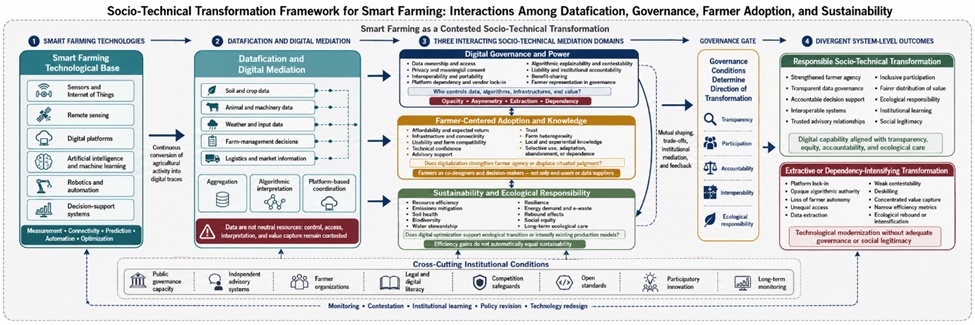
Figure 1. Socio-Technical Transformation Framework for Smart Farming: Interactions Among Datafication, Governance, Farmer Adoption, and Sustainability
Table 2 presents a critical synthesis of evidence on smart farming adoption, governance, and sustainability challenges.
Table 2. Critical Synthesis of Smart Farming Evidence: Socio-Technical Assumptions, Adoption Barriers, Governance Risks, Sustainability Tensions, Evidence Limitations, and Research Implications
Critical domain | Common assumption in smart farming discourse | Main challenge identified in the reviewed literature | Evidence limitation | Research implication |
Data and governance | More data will produce better agricultural decisions. | Data ownership, access, privacy, interoperability, and benefit-sharing remain contested. | Many discussions identify governance risks, but fewer specify enforceable institutional mechanisms. | Study farmer-centered data rights, trusted intermediaries, data portability, and accountability rules. |
Algorithmic decision-making | Algorithmic recommendations are more objective than human judgment. | Opaque models may narrow agricultural knowledge and reduce farmers’ ability to contest advice. | Technical accuracy is often easier to measure than explainability, responsibility, or farmer autonomy. | Examine accountable AI, explainable decision support, liability, and the role of situated farmer knowledge. |
Adoption | Low uptake mainly reflects farmer resistance or lack of awareness. | Adoption is shaped by affordability, usability, infrastructure, risk, advice, farm heterogeneity, and trust. | Adoption studies can understate long-term adaptation, selective use, abandonment, and dependence. | Move beyond adoption rates toward longitudinal research on use, non-use, adaptation, and farmer agency. |
Farmer participation | Technologies can be designed first and socially adjusted later. | Farmers may be treated as end-users or data suppliers rather than co-designers. | Participation is often advocated but not embedded in technology governance or platform design. | Investigate participatory design, farmer representation, and upstream inclusion in innovation pathways. |
Platform dependency | Integrated platforms improve convenience and efficiency. | Proprietary ecosystems can create lock-in, reduce interoperability, and shift power toward vendors. | Platform power is difficult to assess when contracts, algorithms, and business models are opaque. | Analyze platform governance, competition, interoperability standards, and exit rights. |
Sustainability | Precision and automation are inherently sustainable. | Efficiency gains may coexist with rebound effects, e-waste, energy use, inequality, and productivist intensification. | Sustainability is often assessed through narrow indicators rather than broad ecological and social outcomes. | Develop multi-dimensional sustainability assessment including biodiversity, soil health, emissions, equity, and governance. |
Institutional capacity | Governance can follow technological innovation. | Regulation, extension, advisory systems, and farmer organizations may lag behind private digital infrastructures. | Institutional readiness is less visible than technical innovation but strongly affects outcomes. | Study public governance capacity, digital advisory systems, legal literacy, and institutional accountability. |
Power relations | Digital tools are neutral instruments for modernization. | Smart farming redistributes decision authority, value capture, and risk across agri-food systems. | Power is often discussed conceptually but less often measured across specific platform and supply-chain arrangements. | Combine political economy, rural studies, and digital governance approaches in future smart farming research. |
A major research gap concerns how digitalisation restructures agricultural knowledge and advice networks over time. The digitalisation of advisory systems changes who produces advice, how expertise is validated, and how farmers evaluate competing sources of platform-generated, adviser-mediated, and experience-based knowledge [25]. Yet the long-term consequences for independence, trust, professional roles, and farmer autonomy remain insufficiently understood. Future research should therefore examine knowledge systems as dynamic socio-technical infrastructures rather than as neutral channels for technology transfer.
Further research is also needed on how digital tools interact with situated farmer knowledge and practical judgment. Digitalisation can change what farmers know, how they know it, and which forms of knowledge are recognized as legitimate within advisory, platform, and policy systems [26]. A critical gap remains around the conditions under which digital tools strengthen farmer agency rather than deskill decision-making. Comparative studies across farm sizes, regions, crop systems, livestock systems, and ownership models would help clarify when digital systems support or constrain farmer-centered innovation.
Institutional capacity is another underdeveloped area in smart farming research. Organisational responses to digital agriculture can be reactive, uneven, and shaped by uncertainty over roles, responsibilities, and capabilities within agricultural knowledge and innovation systems [27]. This matters because responsible digital transformation requires more than technology providers and willing adopters. It requires institutions able to govern data, support farmers, interpret risk, maintain advisory independence, and align digital innovation with public-interest sustainability goals.
A future research agenda for critical smart farming studies should treat big data in farming as an activity system that links farmers, technologies, data flows, advisory relationships, markets, and institutions. Big data should not be examined only as an informational resource, because its value and risks emerge through the activities, incentives, conflicts, and responsibilities of multiple actors [28]. Research should therefore investigate how data are produced, interpreted, contested, monetized, and translated into action. This would support a more relational understanding of datafication in farming.
Future governance research should also connect digital agriculture more directly to climate, biodiversity, water, soil, and ecological outcomes. Digitalization and artificial intelligence may help achieve environmental targets, but only if legal frameworks, liability rules, data access arrangements, incentive structures, and regulatory capacities are designed to prevent narrow or harmful uses [29]. This requires research that evaluates both environmental benefits and governance conditions. Smart farming sustainability should be assessed through ecological consequences, institutional accountability, and social distribution, not only through technical performance.
Finally, future smart farming research should prioritize upstream inclusion and uneven engagement. Responsible innovation requires attention to whose values are embedded in digital farming systems, whose problems are prioritized, and whose capacities are assumed during design [30]. Studies should examine participatory technology design, platform power, interoperability standards, labor implications, digital inclusion, accountable artificial intelligence, and long-term sustainability assessment. The goal should be smart farming systems that are technically capable, socially legitimate, farmer-centered, ecologically responsible, and institutionally accountable.
This article has critically reviewed smart farming as a socio-technical transformation involving data, governance, adoption, and sustainability challenges. The central contribution is to move beyond a technology-centered view of digital agriculture and examine how smart farming reorganizes relationships among farmers, platforms, advisers, institutions, markets, and ecosystems. Smart farming is therefore not simply a set of tools for improving efficiency. It is a transformation in agricultural knowledge, authority, responsibility, and power.
Smart farming should not be judged only by productivity, efficiency, automation, or technological sophistication. It must also be evaluated by how it redistributes data control, decision authority, risks, benefits, and responsibilities across agricultural systems. Digital tools can support better decisions, but they can also create opacity, dependency, exclusion, and new forms of value extraction. The question is not whether smart farming is good or bad in general, but under what governance conditions it becomes socially legitimate and ecologically responsible.
Responsible smart farming requires more than adoption incentives and technical improvements. It requires farmer-centered design, transparent data governance, interoperability, trusted advisory systems, institutional accountability, and meaningful attention to power relations. It also requires sustainability assessment that includes ecological, social, economic, and governance dimensions together. Without these conditions, smart farming may reproduce existing inequalities while presenting them as innovation.
The future of smart farming should be digitally capable without being extractive, innovative without being exclusionary, and sustainable without ignoring farmers, ecosystems, and governance. Achieving this future requires critical research, participatory design, accountable institutions, and a willingness to challenge assumptions of automatic technological progress. Smart farming will contribute to sustainable agricultural transformation only if its digital infrastructures are shaped by transparency, equity, farmer agency, and ecological care.
None
None
None
None
Open Access The author(s) retain copyright. This article is licensed under the Creative Commons Attribution-NonCommercial-ShareAlike 4.0 International License. It may be shared and adapted for non-commercial purposes with appropriate attribution, an indication of changes, and distribution of adaptations under the same license. Third-party material may be subject to separate terms identified in its credit line. View the license at https://creativecommons.org/licenses/by-nc-sa/4.0/.
 Agro Intelligence Research Press