Precision agriculture is increasingly shaped by sensors, remote sensing, artificial intelligence, automated machinery, digital platforms, and data-driven decision support. However, technical capability alone does not establish whether a smart farming system is usable, locally appropriate, socially responsible, environmentally beneficial, resilient under disruption, or worthy of farmer reliance. This conceptual article proposes a human-centered precision agriculture framework that places farmers, farm workers, agricultural advisors, local knowledge, farm conditions, usability, accessibility, explainability, decision confidence, human oversight, and responsible governance at the center of system design. The framework integrates sustainability and resilience assessment with user-centered artificial intelligence, participatory design, transparent data practices, uncertainty communication, accountable decision support, and iterative learning. It distinguishes decision confidence from decision quality, explainability from guaranteed trust, participation from assured adoption, and technological potential from demonstrated sustainability or resilience. The proposed structure organizes human-centered smart farming into interconnected stages covering problem definition, stakeholder mapping, farmer-needs assessment, data and system context, sustainability and resilience requirements, explainability design, participation, oversight, governance, evaluation, and feedback. Its main contribution is a socio-technical framework for structuring research and design priorities while maintaining explicit boundaries around empirical validation, farmer autonomy, responsible implementation, and claims of system readiness.
Precision agriculture combines spatially and temporally differentiated data with sensing, analytics, decision-support tools, and automated or semi-automated interventions. Smart farming extends this orientation through connected devices, cloud services, platforms, machine learning, and data-sharing relationships that link farms with technology providers, advisors, researchers, supply-chain actors, and service organizations [1]. Digital agriculture is therefore not only a technical modernization process. It is also a socio-technical transformation that can alter agricultural work, professional roles, skills, knowledge relationships, institutional responsibilities, access to resources, and the distribution of decision-making power [2].
A human-centered interpretation shifts attention from what a system can technically calculate toward how it is understood, used, questioned, governed, and adapted within agricultural practice. Under this interpretation, farmers are not passive recipients of automated recommendations, and farm workers, advisors, cooperatives, data stewards, and local institutions are not peripheral to system performance. Responsible smart farming requires anticipatory reflection, meaningful inclusion, responsiveness to affected users, and consideration of the social purposes toward which innovation is directed [3]. Human-centered precision agriculture consequently treats technological functionality as one component within a broader system of human agency, local knowledge, work practices, environmental responsibilities, economic constraints, and governance relationships.
This perspective is important because the outcomes of Agriculture 4.0 are neither uniform nor predetermined. Different combinations of robotics, artificial intelligence, digital platforms, sensing systems, and advisory services may produce different patterns of inclusion, dependence, sustainability, labor change, and institutional control. Technology pathways that are beneficial in one production system may be impractical, exclusionary, or environmentally ambiguous in another. Responsible transition therefore requires attention to diversity, power, institutional context, and the possibility that apparently advanced solutions may generate new vulnerabilities or reinforce existing inequalities [4].
This article develops an original conceptual framework for human-centered precision agriculture. Its objective is to connect human-centered design, farmer participation, user-centered artificial intelligence, explainability, sustainability, resilience, decision confidence, data governance, human oversight, and implementation boundaries within a coherent socio-technical structure. The framework does not prescribe agronomic actions, endorse particular technologies, or claim that participation, transparency, or technical sophistication will automatically produce adoption, trust, sustainability, resilience, or better decisions. Instead, it provides a structured basis for defining design requirements, evaluating conceptual relationships, identifying governance safeguards, and organizing future empirical research on responsible smart farming systems.
Human-centered precision agriculture can be defined as a socio-technical approach in which digital agricultural systems are designed around the needs, capabilities, rights, knowledge, constraints, and decision responsibilities of the people who use or are affected by them. It links the physical conditions of farms with digital infrastructures, data flows, institutional arrangements, and human relationships. A socio-cyber-physical perspective is useful because it makes clear that sensing devices, models, interfaces, farm practices, service organizations, regulatory environments, and stakeholder responsibilities operate as an interconnected system rather than as independent technical components [5]. Human-centered design within this setting must therefore address both immediate user interaction and the wider organizational and institutional environment in which that interaction occurs.
This approach differs from technology-centered automation, which may begin with a technical capability and subsequently search for an agricultural application. It also differs from generic smart farming when digital connectivity, prediction, or automation is treated as sufficient evidence of practical value. Human-centered precision agriculture begins with the agricultural problem, the farm context, the affected users, and the consequences of potential system failure. Socio-ethical concerns should consequently be integrated throughout problem framing, design, development, evaluation, and revision rather than appended after a system has already been constructed [6]. Anticipation, inclusion, reflexivity, and responsiveness become design functions that help reveal whose objectives are prioritized, whose knowledge is represented, and who retains authority over consequential decisions.
Usability is central to this distinction. A technically sophisticated tool may still be unsuitable when it does not align with farm workflows, seasonal decision calendars, available skills, infrastructure limitations, or the interpretive practices of intended users. Agricultural decision-support tools create value through the relationship between their functions and the actions users can reasonably perform in a particular context [7]. Human-centered system design should therefore examine whether information is timely, understandable, actionable, and compatible with existing practices. It should also consider whether users can inspect inputs, question outputs, record exceptions, communicate local observations, and reject recommendations without losing access to essential services.
Human-centered precision agriculture also extends beyond direct farmer–machine interaction. Agricultural knowledge is produced and interpreted through networks involving farmers, farm workers, advisors, extension services, researchers, cooperatives, technology providers, and other intermediaries. Digitalisation may reconfigure these relationships by changing how expertise is accessed, how advice is delivered, and how data are exchanged [8]. The proposed framework therefore includes agricultural advisors where they are available and appropriate, while avoiding the assumption that advisory support is universal, neutral, or equally accessible. Digital inclusion, language, literacy, connectivity, affordability, accessibility, and local institutional capacity must be treated as substantive design requirements rather than secondary implementation considerations.
Sustainability in human-centered precision agriculture includes environmental, social, and economic dimensions. Environmental considerations may involve resource-use efficiency, soil and water protection, energy demand, input targeting, emissions, and ecological effects. Social sustainability concerns inclusion, labor, access, autonomy, skills, and the distribution of benefits and burdens. Economic sustainability concerns affordability, maintenance requirements, uncertainty, long-term viability, and the relationship between technological investment and farm-specific objectives. Digital agriculture may help structure the design and comparison of more sustainable agricultural systems when sustainability goals, boundaries, assumptions, and trade-offs are explicitly defined [9]. It should not, however, be assumed that a data-driven system is sustainable merely because it is precise, automated, or information-rich.
Precision technologies may improve the targeting of inputs and support more differentiated management, but their environmental and economic effects vary across technologies, production systems, user capacities, and institutional settings. Potential reductions in resource use may be offset by energy consumption, infrastructure requirements, rebound effects, costs, unequal access, or inappropriate recommendations. Evidence at the production–environment interface therefore supports a conditional interpretation in which sustainability outcomes require empirical assessment rather than technological presumption [10]. The framework accordingly includes baseline definition, impact indicators, trade-off analysis, independent evaluation, and periodic reassessment as necessary elements of sustainability-oriented design.
Resilience concerns the ability of agricultural systems to anticipate, absorb, adapt to, and recover from disturbances. Climate resilience relates to changing weather patterns, extreme events, and uncertainty. Production resilience concerns the continuity or recovery of crops, livestock, and farm outputs. Operational resilience concerns the capacity to function during sensor failure, connectivity loss, platform interruption, power disruption, inaccurate data, or service withdrawal. Smart farming may support adaptation through timely information, site-specific management, and improved coordination, but these opportunities depend on infrastructure, competence, management capacity, and the continued availability of human judgment [11]. Resilience cannot be reduced to prediction accuracy or technical redundancy because social relationships, service access, fallback procedures, and institutional responsiveness also affect recovery.
Local context determines how sustainability and resilience requirements should be interpreted. Farm size, production system, climate, labor availability, connectivity, language, market conditions, and access to independent advice influence whether a digital system can be used meaningfully. Global inequalities in connectivity, data infrastructure, affordability, and digital services create unequal opportunities to benefit from data-driven farming [12]. A human-centered framework must therefore include accessibility, digital inclusion, low-bandwidth alternatives, local adaptation, and manual or non-digital fallback pathways. It must also retain explicit no-sustainability-guarantee and no-resilience-guarantee boundaries because responsible design can improve alignment and evaluation without independently proving environmental benefit, economic viability, social fairness, or performance under future disturbances.
Explainability in agricultural artificial intelligence concerns the capacity of a system to provide information that helps users understand how outputs were produced, which inputs were influential, what assumptions were made, and where uncertainty or limitations remain. Interpretability refers more specifically to the extent to which model behavior or relationships can be comprehended by relevant users or reviewers. In agricultural analysis, prediction accuracy alone is insufficient when users cannot inspect the basis of a recommendation, identify implausible relationships, or determine whether a model is operating outside its intended context [13]. Explainability should therefore be linked to the decision task, the user’s role, the consequences of error, and the type of understanding required.
User-centered explainability requires more than attaching a technical explanation method to an existing model. Feature-attribution displays, local explanations, visual summaries, rule-based accounts, and comparative rationales can differ substantially in fidelity, comprehensibility, and practical usefulness. Agricultural explanation systems should be designed for intended audiences such as farmers, advisors, agronomists, data specialists, or governance reviewers rather than for an undefined generic user. Comparative assessments of explainable artificial intelligence in smart-agriculture settings show that explanation methods have distinct strengths and limitations and require audience-sensitive presentation and evaluation [14]. The presence of an explanation should not be treated as evidence that a model is accurate, fair, safe, or suitable for operational use.
A user-centered AI system should make relevant inputs visible, document data provenance and data quality, disclose model purpose and limitations, communicate uncertainty, and provide a rationale for why a recommendation is presented rather than an alternative. These functions are also governance mechanisms because they help expose hidden assumptions, missing data, inappropriate generalization, and responsibility gaps. Agricultural AI can create systemic risks and externalities that extend beyond the immediate accuracy of a model, including environmental effects, economic concentration, exclusion, dependency, and consequences for food-system actors [15]. Human-in-the-loop review, escalation procedures, model documentation, incident reporting, and accountability mapping are therefore necessary complements to explainability.
Explainability must also be separated from trust. A clear interface may increase understanding, but it cannot independently demonstrate that reliance is warranted. Trust depends on a wider combination of technical performance, data quality, institutional conduct, fairness, accountability, user experience, and the ability to challenge or override system outputs. Agricultural AI ethics research identifies transparency and explainability as important but incomplete components of responsible design alongside autonomy, justice, accountability, labor effects, environmental consequences, and power relations [16]. The proposed framework therefore includes a no-explainability-sufficiency boundary and a no-trust-guarantee boundary. Its objective is not to maximize trust, but to support informed, conditional, and revisable reliance while preserving farmer judgment, professional interpretation, and meaningful human oversight.
Farmer participation is a design and governance process through which farmers can influence problem definition, system requirements, data practices, interface choices, evaluation criteria, and the conditions under which decision-support outputs are used. Participation should not be limited to collecting preferences after core technical decisions have already been made. Evidence from smart-farming data relationships indicates that farmer trust is affected by whether organizations explain how data are collected and used, how benefits are distributed, and who exercises control over resulting information [17]. Transparency and benefit-sharing are therefore trust-building conditions, but they do not independently guarantee trust because reliance also depends on demonstrated competence, fairness, accountability, and experience over time.
Co-design and participatory design can provide more substantive forms of involvement by enabling farmers and other affected users to shape system goals, prototypes, explanations, workflow arrangements, and feedback mechanisms. Such participation is especially important when digital agriculture may distribute opportunities unevenly or concentrate data, infrastructure, and bargaining power among a limited set of organizations. Competing visions of agricultural big data show that access, inclusion, institutional support, and co-creation influence whether digital development serves a broad farming community or primarily benefits well-resourced actors [18]. Participation should consequently influence the allocation of decision rights and benefits rather than operate merely as a method for encouraging acceptance of a predetermined technology.
Decision confidence refers to a user’s ability to understand available information, compare alternatives, recognize uncertainty, and determine whether an output is sufficiently relevant for further consideration. It is distinct from trust because a farmer may understand an explanation while remaining appropriately cautious about the organization or model that produced it. It is also distinct from decision quality because confidence can be misplaced. Farmers’ perceptions of smart-farming technologies vary according to production system, prior experience, farm conditions, accessibility, perceived usefulness, and available advisory support [19]. Decision-confidence support should therefore be calibrated to specific users and contexts rather than inferred from interface clarity or generalized assumptions about farmer needs.
Farmer autonomy requires meaningful authority to accept, modify, postpone, or reject system outputs. Decision rights, consent arrangements, data controls, override mechanisms, and opportunities to contribute local knowledge should be defined explicitly. Human oversight may include farmer review, advisor involvement where appropriate, or escalation to agronomic and technical expertise for consequential or uncertain recommendations. Smart-farming risks are interpreted differently by actors according to their values, responsibilities, and expectations, making transparent deliberation and accountability necessary when disagreements remain [20]. The framework therefore incorporates a no-adoption-guarantee boundary and a no-decision-quality-claim boundary: participation does not ensure adoption, and increased confidence does not prove that a decision is correct.
Human-centered system requirements begin with a user-needs assessment that identifies the agricultural problem, intended users, decision timing, work practices, local conditions, and consequences of system error. Farm workflow integration should determine when information becomes available, who interprets it, and how it interacts with existing records, equipment, labor responsibilities, and advisory relationships. Agricultural advisors may help farmers contextualize digital outputs, compare them with field observations, and interpret uncertainty, but smart-farming systems can also alter advisor roles, service models, and access to data [21]. Advisor involvement should therefore be treated as a context-dependent oversight and learning pathway rather than a universal requirement.
A farmer feedback loop should permit users to identify incorrect inputs, record unusual conditions, question explanations, report observed outcomes, and propose changes to system requirements. Feedback must be accompanied by a defined process for review, response, documentation, and revision; collecting comments without acting on them does not constitute meaningful participation. Digital agricultural extension research emphasizes the importance of two-way learning, locally relevant content, adaptive service design, and connections between digital communication and wider knowledge networks [22]. Feedback mechanisms should similarly support reciprocal learning rather than one-directional delivery of recommendations.
Usability, accessibility, and digital inclusion must be assessed across intended user groups. Relevant factors include language, literacy, disability, device availability, connectivity, cost, technical support, interface complexity, and the time required to interpret system outputs. Actual use of smart-farming technologies is affected by individual characteristics, farming-system conditions, experience, and perceived barriers, demonstrating that technical availability does not establish practical usability [23]. Systems should consequently provide comprehensible interfaces, accessible alternatives, low-bandwidth functions where relevant, and clear visibility of material inputs, data-quality concerns, uncertainty, and decision rationale.
Implementation readiness requires evidence across technical, human, organizational, economic, environmental, and governance dimensions. A system may operate as designed in a technical setting while remaining unsuitable for a particular farm because of cost, support limitations, uncertain returns, workflow disruption, weak oversight, inaccessible interfaces, or insufficient evidence of sustainability and resilience. Farmer intentions toward precision technologies vary with incentives, financial conditions, perceived risk, farm heterogeneity, and access to support [24]. Readiness review should therefore identify unresolved requirements rather than function as certification, and the framework must preserve a no-farmer-replacement boundary under which digital decision support supplements rather than displaces farmer judgment. Table 1 summarises human-centered system requirements for sustainable, resilient, and explainable smart farming systems.
Table 1. Human-Centered System Requirements for Sustainable, Resilient, and Explainable Smart Farming Systems: User Needs, Local Context, Farm Workflow Integration, Explainability Interfaces, Uncertainty Communication, Decision-Support Rationale, Farmer Feedback, Co-Design, Accessibility, Digital Inclusion, Sustainability Assessment, Resilience Assessment, Governance Safeguards, and Human Oversight
System requirement | Core design question | Required input | Human-centered function | Potential output | Failure risk | Evaluation need | Decision boundary |
User needs assessment | What decisions and problems do intended users consider important? | Interviews, observation, workflow evidence, task analysis, and user priorities | Prevents technology-first problem selection | Prioritized and bounded user-needs statement | Developer assumptions replace expressed needs | Validation with diverse intended users | A stated need does not automatically justify automation |
Local context mapping | Which regional, cultural, infrastructural, and institutional conditions affect usefulness? | Climate, language, markets, connectivity, service access, and local institutions | Grounds the system in its place of use | Local-context profile | Superficial localization of a generic system | Review by local users and relevant experts | Transferability must be demonstrated rather than assumed |
Farm workflow integration | How will the system interact with actual farm tasks and decision timing? | Production calendar, labor roles, equipment, records, and existing tools | Aligns digital functions with practical work | Workflow-integrated use pathway | Added workload, duplication, or poorly timed outputs | Observation-based workflow evaluation | Integration does not establish net operational benefit |
Data quality documentation | Are data sufficiently complete, timely, calibrated, and representative for the intended decision? | Missingness records, calibration evidence, timestamps, transformations, and quality checks | Allows users and reviewers to judge evidential reliability | Data-quality statement and warning indicators | Poor data produce false precision | Continuous technical and domain-specific review | Inadequate data may require system abstention |
Explainability interface | Can users access explanations relevant to their role and task? | User roles, explanation needs, model outputs, and interface prototypes | Supports inspection, comprehension, and questioning | Role-specific explanation interface | Technically detailed but practically irrelevant explanation | Comprehension, fidelity, and task-based usability testing | An explanation does not validate the recommendation |
Uncertainty communication | Are material uncertainties, limitations, and data gaps visible? | Calibrated uncertainty, scenario ranges, and known failure modes | Supports cautious interpretation | Confidence range, uncertainty category, or limitation notice | False certainty or confusing probability displays | Calibration and user-comprehension evaluation | Confidence does not establish decision quality |
Decision-support rationale | Why is an option presented, and what alternatives or trade-offs exist? | Decision objectives, constraints, assumptions, and alternatives | Preserves deliberation and user choice | Comparative decision rationale | Hidden optimization priorities or value assumptions | Agronomic, technical, and user review | Recommendations remain contestable and non-binding |
Human oversight design | Which outputs require human review, and who has authority? | Risk classification, user roles, expertise, and escalation criteria | Preserves judgment and accountability | Review, modification, rejection, and escalation protocol | Symbolic or overloaded oversight | Evaluation of authority, workload, and intervention quality | High-consequence outputs require meaningful review |
Farmer feedback loop | Can farmers correct data, add context, report outcomes, and challenge outputs? | Accessible feedback functions and response responsibilities | Enables learning and system correction | Feedback record and revision log | Feedback is collected but ignored | Assessment of response quality and feedback closure | Feedback does not substitute for independent validation |
Co-design process | How do users influence consequential design choices? | Representative participants, facilitation, prototypes, and decision records | Shares design influence and integrates experiential knowledge | Co-designed requirements and revised prototypes | Tokenism, consultation fatigue, or dominance by powerful participants | Participation-quality and influence audit | Co-design does not guarantee adoption or responsibility |
Accessibility | Can users with different language, literacy, ability, and device needs use core functions? | Accessibility requirements, language options, device constraints, and user testing | Reduces avoidable exclusion | Accessible interfaces and alternative formats | Important user groups are excluded by default assumptions | Testing with diverse users | One interface should not be assumed suitable for all users |
Digital inclusion | Are connectivity, cost, infrastructure, and support barriers addressed? | Affordability, broadband, device, training, and service-access assessment | Broadens practical opportunity to participate | Inclusion strategy and non-digital or low-bandwidth alternatives | Benefits concentrate among well-resourced farms | Distributional and access monitoring | Digital access cannot be presumed |
Sustainability assessment | Which environmental, social, and economic effects require evaluation? | Baselines, indicators, system boundaries, and trade-off criteria | Links system design to explicit sustainability questions | Multidimensional sustainability-evaluation plan | Sustainability inferred from precision or automation | Empirical and, where relevant, longitudinal impact assessment | No sustainability guarantee |
Resilience assessment | How will the system and farm function during shocks or component failures? | Climate scenarios, dependency maps, failure modes, and fallback processes | Supports preparedness, adaptation, and recovery planning | Resilience-testing and continuity plan | Technical redundancy is mistaken for whole-system resilience | Stress testing and incident-based evaluation | No resilience guarantee |
Governance safeguard | Which safeguards correspond to identified data, AI, power, and externality risks? | Risk register, data flows, affected groups, and responsibility analysis | Converts responsible-AI principles into actionable controls | Governance-safeguard portfolio | Principles remain symbolic and unenforced | Governance audit and ongoing monitoring | Safeguards do not constitute certification |
Accountability mapping | Who is responsible for data, model, interface, service, and decision failures? | Actor roles, contracts, escalation duties, and redress mechanisms | Prevents responsibility gaps | Accountability and escalation matrix | Responsibility is diffused among providers and users | Incident simulation and accountability review | Responsibility must not be transferred ambiguously |
Implementation readiness review | Is there sufficient evidence and support for a bounded evaluation? | Technical, human, economic, sustainability, resilience, and governance evidence | Prevents premature deployment claims | Readiness profile with unresolved gaps | Checklist is treated as proof of operational suitability | Independent staged review | Conceptual readiness is not deployment readiness |
No farmer-replacement boundary | Which judgments and authorities must remain human-led? | Decision criticality, local knowledge, expertise, and override rules | Protects farmer agency and professional judgment | Defined human-decision boundary | Gradual de facto replacement through automation dependence | Audit of actual control and override practices | The system supports rather than replaces farmer judgment |
The proposed human-centered precision agriculture framework begins with problem and farm-context definition, stakeholder and user mapping, farmer-needs assessment, and data and system-context mapping. These stages establish what agricultural decision is being addressed, whose interests and responsibilities are involved, which forms of knowledge are relevant, and what physical, digital, organizational, and institutional dependencies shape the system. Ethical analysis of smart farming demonstrates that questions of data ownership, privacy, power, responsibility, and effects on human life are integral to digital agricultural development [25]. The framework therefore treats governance conditions as foundational design inputs rather than external constraints considered only after a technology has been developed.
The next stages comprise sustainability assessment, resilience assessment, explainability-requirement definition, user-centered AI design, participation and co-design, and decision-confidence support. Sustainability and resilience are expressed as assessment domains whose criteria must be defined for the relevant farm and production context. Explainability requirements specify which users require which forms of understanding and for what decisions. User-centered AI design connects model functions, data, interfaces, workflow needs, accessibility, and uncertainty communication. Participation and co-design create opportunities to incorporate farmer knowledge and challenge design assumptions. However, human-centered methods can reproduce inequalities when participation is constrained by power, resources, digital capacity, or predetermined technical objectives [26]. The framework therefore includes participation-quality review rather than assuming that the use of co-design terminology establishes responsible development.
Human-oversight design, governance-safeguard selection, system-evaluation planning, practical-implication mapping, and future-research updating form the framework’s accountability and learning stages. Oversight design specifies who can inspect, modify, reject, or escalate system outputs. Governance safeguards address data rights, documentation, externalities, provider responsibilities, complaints, correction, and redress. Evaluation planning connects technical performance with usability, accessibility, sustainability, resilience, decision-confidence calibration, and governance effectiveness. Digital agriculture is shaped by a diverse supply-side ecosystem that includes agribusiness firms, machinery manufacturers, software companies, start-ups, telecommunications providers, research organizations, and public institutions [27]. Implementation assessment must consequently account for provider dependency, market concentration, interoperability, service continuity, and the allocation of public and private responsibilities.
The framework operates through iterative feedback rather than a linear path ending in automated recommendation delivery. Farmer observations, advisor input where supported, system incidents, data-quality changes, usability findings, sustainability evidence, resilience testing, and governance concerns can return the process to earlier stages. A revised understanding of the farm problem may change data requirements; a usability finding may require interface redesign; a failure event may alter oversight rules; and new evidence may change the framework’s evaluation priorities. Feedback updating should be documented so that changes to models, interfaces, assumptions, responsibilities, and intended uses remain traceable.
The proposed contribution is a conceptual architecture for organizing human-centered research and design, not a validated operational model. Its boundary conditions state that explainability does not guarantee trust, participation does not guarantee adoption, decision confidence does not establish decision quality, and responsible design does not prove sustainability or resilience. The framework also preserves a no-autonomy-replacement boundary under which farmers and appropriately qualified human actors retain defined decision authority. Empirical work is required to determine how the stages interact in particular agricultural settings, whether the specified requirements are feasible, and how outcomes should be evaluated over time. Table 2 presents the proposed human-centered precision agriculture framework. Figure 1 presents the proposed human-centered precision agriculture framework, linking sustainability, resilience, explainability, user-centered AI design, farmer participation, decision confidence, human oversight, governance safeguards, and feedback.
Table 2. Proposed Human-Centered Precision Agriculture Framework: Farm Context Definition, Stakeholder Mapping, Farmer Needs Assessment, Data and System Context, Sustainability, Resilience, Explainability, User-Centered AI Design, Participation, Decision Confidence, Human Oversight, Governance Safeguards, Evaluation Planning, Feedback, and Claim Boundaries
Framework stage | Core purpose | Required input | Conceptual function | Potential output | Validation need | Failure risk | Feedback mechanism | Decision boundary |
Problem and farm-context definition | Define the agricultural problem and its operational setting | Farm objectives, constraints, production system, environment, and workflow | Prevents generic or technology-led problem framing | Bounded problem statement | Farmer, worker where relevant, advisor where supported, and agronomic review | Solving a technically convenient but practically irrelevant problem | Reassessment when goals or conditions change | No automation decision is justified at this stage |
Stakeholder and user mapping | Identify affected users, responsible actors, and power relationships | Farmers, farm workers, advisors, providers, data stewards, researchers, institutions, and communities | Makes participation rights and responsibilities visible | Stakeholder and responsibility map | Review for missing or underrepresented groups | Indirectly affected or less powerful actors are omitted | Periodic update as actors and dependencies change | Stakeholder inclusion does not imply equal authority |
Farmer needs assessment | Establish farmer priorities, capabilities, constraints, and decision practices | Direct user research, observation, task evidence, and local knowledge | Converts lived needs into design requirements | Prioritized farmer-needs specification | Validation across diverse intended users | Needs of early adopters or dominant participants are generalized | Iterative review and contradiction logging | Expressed needs do not guarantee technology adoption |
Data and system context mapping | Map data sources, infrastructure, platforms, and dependencies | Sensor, remote-sensing, weather, soil, crop, livestock where relevant, and provider information | Connects physical, informational, and organizational foundations | Data-flow, provenance, quality, and dependency map | Technical, agronomic, security, and governance audit | Hidden data transformations or provider dependencies | Update after data, model, or supplier changes | Unsupported data should not drive consequential outputs |
Sustainability assessment | Define environmental, social, and economic questions and indicators | Baselines, boundaries, stakeholder priorities, and trade-off criteria | Makes sustainability an explicit, testable domain | Sustainability-assessment plan | Context-specific empirical assessment | Technical efficiency is treated as overall sustainability | Monitoring and reassessment of unintended effects | No sustainability guarantee |
Resilience assessment | Identify shocks, vulnerabilities, dependencies, and recovery requirements | Climate, production, operational, infrastructure, and service-failure scenarios | Treats resilience as a socio-technical system property | Resilience and continuity evaluation plan | Scenario testing, field evidence, and incident review | Unknown, compound, or social disruptions are ignored | Post-incident learning and scenario revision | No resilience guarantee |
Explainability requirement definition | Specify what each user must understand and why | User roles, decisions, error consequences, model type, and explanation goals | Aligns explanation design with practical decisions | Explanation-requirements specification | Fidelity and comprehension testing | Generic explanations are produced without user relevance | Revision following user and reviewer feedback | Explanation does not prove accuracy or fairness |
User-centered AI design | Align models, interfaces, workflows, and access conditions with intended users | Needs, context, data, accessibility, uncertainty, and explanation requirements | Integrates technical design with human use | Prototype decision-support configuration | Model validation, usability evaluation, and accessibility testing | Accuracy optimization displaces human requirements | Iterative prototyping and testing | User-centered design does not prove implementation readiness |
Participation and co-design process | Enable affected users to influence consequential design choices | Representative participation, accessible methods, prototypes, and decision records | Incorporates diverse knowledge, values, and concerns | Participation-informed requirements and design revisions | Assessment of representation and actual influence | Tokenism, fatigue, power imbalance, or extraction of local knowledge | Feedback closure and documented design responses | Participation does not eliminate governance risk |
Decision-confidence support | Help users interpret evidence, alternatives, uncertainty, and rationale | Explanations, data-quality information, alternatives, and uncertainty communication | Supports informed and revisable deliberation | Context-specific decision-support account | Evaluation of comprehension, calibration, and outcomes | Interface increases confidence without improving understanding | Post-decision reflection and outcome feedback | Decision confidence is not decision correctness |
Human-oversight design | Define review points, authority, overrides, and escalation | Decision criticality, expertise, roles, workload, and risk thresholds | Preserves meaningful human judgment | Oversight and escalation protocol | Testing of authority, timeliness, competence, and workload | Human review becomes symbolic or automatic | Override, incident, and reviewer-feedback analysis | Human authority remains final where designated |
Governance-safeguard selection | Match controls to data, AI, organizational, and distributional risks | Risk register, actor map, data flows, externalities, and rights analysis | Operationalizes responsible governance | Context-specific safeguard portfolio | Independent governance review | Broad principles lack enforceable procedures | Monitoring, reporting, correction, and redress | Safeguards do not establish certification |
System-evaluation planning | Define multidimensional criteria before implementation claims are made | Technical, usability, accessibility, sustainability, resilience, and governance indicators | Prevents narrow performance assessment | Evaluation protocol and evidence plan | Representative and independent testing | Selective metrics conceal human or environmental failure | Evaluation-driven redesign | Model performance alone does not establish system quality |
Practical-implication mapping | Identify bounded implications for users, designers, institutions, and researchers | Conceptual synthesis, stakeholder roles, evidence gaps, and constraints | Translates the framework without prescribing farm actions | Role-specific conceptual implications | Review by affected stakeholders | Implications become operational or procurement prescriptions | Revision after empirical research | Conceptual guidance is not agronomic, legal, or financial advice |
Future-research updating | Revise the framework as evidence, technologies, and risks change | New studies, evaluations, incidents, user feedback, and institutional developments | Keeps the framework provisional and adaptive | Versioned framework update | Transparent evidence and change review | The framework is treated as fixed or validated | Documented evidence-to-revision process | Updated components require renewed validation |
No trust-guarantee boundary | Prevent explanation and participation from being equated with trust | Evidence of performance, fairness, accountability, and user experience | Defines trust as conditional and revisable | Warranted-reliance criteria | Design becomes persuasive rather than informative | Longitudinal and context-specific trust research | Trust recalibration following errors or governance changes | Trust is not a guaranteed framework output |
No sustainability-guarantee boundary | Separate sustainability intention from demonstrated outcome | Empirical impact evidence, system boundaries, and counterfactual analysis | Prevents unsupported environmental or social claims | Sustainability claim boundary | Precision or efficiency is presented as proof of sustainability | Independent impact and lifecycle evaluation | Monitoring of trade-offs and unintended effects | Sustainability remains an empirical question |
No autonomy-replacement boundary | Preserve farmer and qualified human decision authority | Decision-rights mapping, override functions, and accountability rules | Prevents gradual displacement of human control | Human-authority and refusal boundary | Automation dependence makes nominal choice meaningless | Audit of actual control, pressure, and override use | Grievance, refusal, and authority-review mechanisms | The framework supports rather than replaces human judgment |
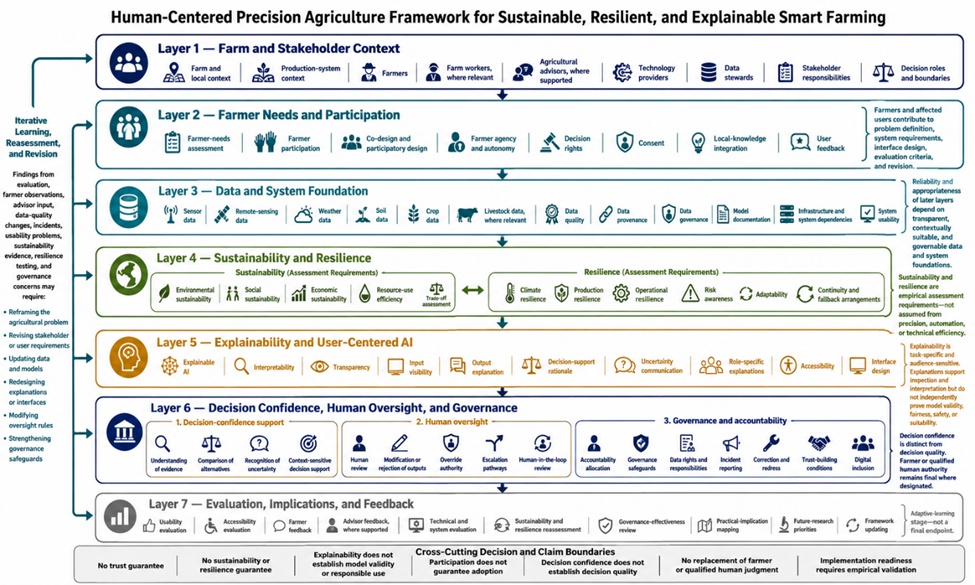
Figure 1. Human-Centered Precision Agriculture Framework for Sustainable, Resilient, and Explainable Smart Farming
Alt-text description:
A conceptual framework showing farm context and stakeholder mapping connected to farmer needs, sustainability, resilience, explainability, user-centered AI, participation, decision confidence, human oversight, governance safeguards, evaluation planning, and feedback loops.
For farmers, farm workers, advisors, cooperatives, and extension services, the framework highlights the need to define user roles, preserve decision rights, connect digital outputs with local knowledge, and provide meaningful channels for explanation, feedback, refusal, and escalation. Advisory organizations may need new competencies for interpreting data-intensive systems and helping users compare model outputs with contextual evidence [21]. Digital extension initiatives should similarly emphasize reciprocal learning and locally adaptable communication rather than treating technology as a substitute for agricultural knowledge networks [22]. These implications concern system design and research priorities; they do not prescribe specific farm-management actions.
For technology developers and researchers, future work should combine model evaluation with usability, accessibility, explainability, data-quality, sustainability, resilience, and governance assessment. Digital inclusion requires explicit attention because connectivity and data infrastructure remain unevenly distributed [12]. Agricultural XAI research should evaluate whether explanations are faithful, comprehensible, and relevant to actual decisions rather than assuming that technical explanation availability is sufficient [13]. Agricultural-AI risk research should also examine externalities, dependency, organizational responsibility, and failure across wider food and farming systems [15]. Human-centered methods themselves require reflexive evaluation because participation can remain constrained by unequal power and capacity [26].
For policymakers, data stewards, cooperatives, research institutions, and service organizations, the framework identifies accountability, interoperability, data rights, provider responsibility, independent evaluation, and redress as important areas for further study. Smart-farming ethics research shows that data ownership and power relations should be considered alongside privacy and technical performance [25]. Supply-side structures also warrant attention because market concentration, service dependency, and unequal access can shape which technologies are available and whose interests they serve [27]. These observations are conceptual implications and future research directions rather than legal, regulatory, financial, procurement, or implementation advice. Long-term socio-technical research is required to examine how trust, autonomy, sustainability, resilience, usability, and decision practices evolve after systems enter real agricultural settings.
This article proposes a human-centered precision agriculture framework that integrates farm and local context, stakeholder mapping, farmer needs, sustainability, resilience, explainability, user-centered artificial intelligence, farmer participation, decision confidence, human oversight, governance safeguards, evaluation, and iterative learning. Its central contribution is to reposition smart farming as a socio-technical design challenge in which technical performance is necessary but insufficient. Precision agricultural systems should also be examined according to whether they preserve human agency, communicate uncertainty, accommodate local knowledge, remain accessible, distribute responsibilities clearly, and support responsible and revisable decision-making. The framework does not guarantee trust, adoption, sustainability, resilience, decision quality, or implementation readiness, and it does not replace farmer or expert judgment. Instead, it provides a structured conceptual basis for future empirical investigation and for designing smart farming systems whose value is judged not by technical sophistication alone but by their capacity to remain locally relevant, accountable, understandable, and supportive of human decision authority.
None
None
None
None
Open Access The author(s) retain copyright. This article is licensed under the Creative Commons Attribution-NonCommercial-ShareAlike 4.0 International License. It may be shared and adapted for non-commercial purposes with appropriate attribution, an indication of changes, and distribution of adaptations under the same license. Third-party material may be subject to separate terms identified in its credit line. View the license at https://creativecommons.org/licenses/by-nc-sa/4.0/.
 Agro Intelligence Research Press