Smart farming increasingly operates through interconnected socio-technical ecosystems rather than through isolated technologies deployed at farm level. These ecosystems involve farmers, advisors, technology and platform providers, data intermediaries, equipment and input suppliers, cooperatives, public institutions, research and extension organizations, and agri-food supply-chain actors. This article develops a conceptual ecosystem model for examining how these stakeholders contribute to data-driven agricultural innovation and how value may be created, captured, and distributed through their interactions. The model-building approach integrates stakeholder roles, multidirectional data and knowledge flows, analytics and advisory services, platform coordination, institutional support, co-production, and co-innovation. It distinguishes farmer value, platform value, supply-chain value, public value, knowledge value, and sustainability value while treating value capture and distribution as separate analytical questions. Governance dimensions include data access, control, sharing, interoperability, portability, stewardship, transparency, accountability, trust, participation, digital inclusion, dependency, and power imbalance. The principal contribution is a structured framework that connects innovation processes with governance and distributional boundaries rather than assuming that technological deployment automatically produces shared value or farmer benefit. The model is intended to support conceptual analysis, stakeholder dialogue, and future empirical research. It does not establish the effectiveness, fairness, policy suitability, commercial viability, or implementation readiness of any particular smart farming ecosystem.
Smart farming is commonly associated with sensor networks, connected machinery, remote sensing, analytics, automation, and digitally mediated farm-management services. Yet these technical elements operate through relationships among data generators, service providers, equipment manufacturers, advisors, platform operators, researchers, public bodies, and agri-food organizations. Smart farming should therefore be understood as both a data-intensive technical configuration and a socio-institutional transformation that can reorganize knowledge, work, market relationships, and influence across agricultural systems [1, 2]. This broader interpretation shifts attention from whether a digital tool functions technically to how its data, services, decisions, and consequences are distributed across an ecosystem of interdependent actors.
A smart farming ecosystem is related to, but distinct from, a digital agriculture ecosystem, an agricultural innovation system, an innovation network, and a platform ecosystem. Digital agriculture describes the broader use of digital technologies and data across farms, rural areas, supply chains, and agricultural institutions. Precision agriculture generally refers more specifically to spatially or temporally differentiated management supported by measurement and analysis. An agricultural innovation system emphasizes the organizations, institutions, policies, and relationships through which agricultural knowledge and innovation are produced and used. Digitalization modifies these systems by connecting technological development, advisory relationships, research infrastructures, value-chain actors, and public institutions across multiple levels [3]. A smart farming ecosystem model must consequently account for overlapping but non-identical technological, organizational, institutional, and market boundaries.
Ecosystem analysis is especially relevant because data-driven agricultural innovation rarely emerges from a single organization. Technologies may depend on compatible equipment, reliable connectivity, standardized data, analytics providers, trusted intermediaries, advisory interpretation, farmer participation, institutional support, and access to complementary services. An ecosystem can remain technically sophisticated yet organizationally fragile when actors lack viable roles, incentives, capabilities, or trusted governance arrangements. Research on digital innovation ecosystems in agri-food settings indicates that complementarity, orchestration, actor viability, and coordinated design are central to ecosystem development [4]. These conditions do not guarantee equitable outcomes, but they help explain why technology availability alone is insufficient to produce sustained and socially legitimate innovation.
The objective of this article is to propose a conceptual ecosystem model for multi-stakeholder value creation in smart farming. The model links stakeholder identification, role mapping, data-flow analysis, data governance, innovation processes, value creation, value capture, value distribution, dependency risks, inclusion, trust, accountability, practical implications, and future research. Its central argument is that smart farming ecosystems should be evaluated through the relationships by which data and knowledge are generated, transformed, exchanged, governed, and used. The proposed contribution is not an operational standard or validated implementation framework. It is an analytical structure for clarifying how different actors may contribute to innovation, how multiple forms of value may arise, where benefits and burdens may diverge, and which governance questions require empirical investigation.
Agricultural innovation ecosystem thinking extends beyond linear models in which research produces a technology that is subsequently transferred to farmers. An ecosystem perspective instead recognizes interacting niches, heterogeneous participants, complementary capabilities, and multiple innovation pathways that evolve within wider institutional and market environments. This approach is useful for smart farming because digital change may proceed through different combinations of technologies, organizational arrangements, advisory practices, commercial services, and public interventions. Such diversity also raises questions of directionality and responsibility: the existence of numerous innovation pathways does not ensure that they address diverse farming needs or distribute benefits fairly [5, 6]. Ecosystem boundaries must therefore be defined carefully enough to identify relevant relationships without treating every actor or activity in the food system as part of a single undifferentiated network.
Within these boundaries, stakeholder interdependence is expressed through knowledge and service relationships as well as through technology exchange. Agricultural advisors, extension organizations, research institutions, agribusinesses, platform providers, and farmers may jointly influence how digital information is interpreted and incorporated into practice. Digitalization can alter established advisory networks by introducing automated recommendations, remote support, platform-mediated communication, and new information providers. It can also create hybrid arrangements in which human expertise is combined with analytics and farmer knowledge. Reviews of agricultural knowledge and advice networks show that digital technologies can reconfigure who produces, controls, validates, and communicates agricultural knowledge [7]. Advisors and extension services should therefore be conceptualized as active ecosystem intermediaries rather than as passive channels for transmitting technical outputs.
Co-production and co-innovation provide further mechanisms for organizing interdependence. Co-production involves stakeholders in defining problems, specifying data requirements, interpreting outputs, or shaping service design. Co-innovation extends this interaction by coordinating complementary experimentation and development across organizations. These processes may improve contextual relevance, but participation should not be assumed to be inclusive merely because stakeholders are consulted. Responsible smart farming development requires anticipation of possible consequences, inclusion of affected groups, reflexive examination of underlying assumptions, and responsiveness to emerging concerns [8]. Trust, accountability, and representation must therefore be built into innovation processes rather than treated as outcomes that will automatically arise after technology deployment.
Platform ecosystems add another layer of coordination by linking users, data, applications, equipment, analytics, and service providers through shared digital infrastructures. Platforms may lower interaction costs and support service combinations, but they can also centralize rule-setting, define technical interfaces, control access, and influence which innovations become visible or viable. Interoperability is consequently both a technical and an institutional concern. Common formats and interfaces may support data exchange, yet meaningful interoperability also depends on semantic consistency, data quality, permission structures, and the capacity to move between providers. In the proposed model, ecosystem coordination is therefore treated as a conditional capability that must be examined alongside governance, participation, portability, and dependency rather than as evidence of collaboration or shared value by itself.
Farmers occupy a central position in smart farming ecosystems because they contribute farm data, operational knowledge, decision contexts, feedback, and practical evaluation of digital services. Their role is not limited to adopting technologies or supplying raw data. Farmers interpret local conditions, combine formal recommendations with experiential knowledge, and determine whether digital outputs are relevant to particular production practices. Participation may nevertheless be weakened when data uses, commercial purposes, or expected benefits are unclear. Evidence from smart farming stakeholders indicates that trust is closely related to transparency about how data are used and whether benefits are plausibly shared with those who contribute them [9]. Farmer value should therefore be assessed through farmer-defined needs and experiences rather than inferred from platform activity, data volume, or technology uptake.
Farm data can include field records, sensor measurements, remote-sensing observations, machine outputs, soil and crop information, weather information, input-use records, and other operational data. These categories differ in origin, sensitivity, contextual meaning, and potential reuse. Data access determines who can view or retrieve information; data control concerns who can authorize use or impose conditions; and data sharing concerns how information moves across organizational boundaries. Farmers may hesitate to contribute data when ownership, access, secondary use, or legal responsibilities are uncertain [10]. The proposed model therefore separates data generation from legitimate access and use. It also treats portability, revocation, provenance, and purpose limitation as governance questions rather than assuming that data contribution transfers unrestricted authority to an ecosystem operator.
Technology providers, platform providers, equipment manufacturers, input suppliers, and analytics organizations supply different but overlapping capabilities. Technology providers may develop sensors, software, connectivity tools, or decision-support applications. Equipment providers connect machines and operational processes to digital infrastructures, while input suppliers may offer data-enhanced recommendations or bundled services. Platform providers organize interactions among data sources, applications, and users. These arrangements can expand available services, but design priorities may favour highly capitalized or standardized production systems. Uneven engagement with digital farming shows that technologies can be oriented toward the needs of particular users while other farmers remain poorly represented or unable to participate [11]. Digital inclusion must therefore address affordability, connectivity, language, skills, scale, usability, and the capacity to influence design.
Data intermediaries and agricultural advisors occupy bridging positions between data production, analytics, service delivery, and practical use. A data intermediary may facilitate access, integration, exchange, stewardship, or controlled reuse, whereas an advisor may translate analytical outputs into context-sensitive guidance. These functions can reduce complexity, but they can also introduce new dependencies when intermediary roles, incentives, or responsibilities are opaque. Digital platforms may coordinate knowledge and services while simultaneously standardizing decisions, embedding preferred practices, and increasing reliance on proprietary infrastructures [12]. Farm workers should also be recognized where digital systems affect task organization, monitoring, automation, or skill requirements, although worker-specific outcomes remain insufficiently established in the evidence base used here. Their inclusion in the model is therefore a proposed analytical requirement rather than a claim of demonstrated benefit or harm.
Public institutions can influence smart farming ecosystems through research support, infrastructure investment, extension capacity, innovation coordination, education, competition oversight, and the articulation of public-interest objectives. Their role is not to determine a single desirable technological pathway but to help address collective-action problems, capability gaps, and societal concerns that individual firms or farms may not resolve independently. Mission-oriented agricultural innovation scholarship suggests that public institutions can contribute directionality and coordination while remaining attentive to legitimacy, actor diversity, and contested understandings of desirable transformation [13]. Public value should therefore be assessed through transparent objectives and evidence of societal outcomes rather than inferred from institutional participation alone.
Cooperatives, producer organizations, research organizations, and extension services may strengthen collective learning, representation, and access to expertise. Cooperatives can potentially aggregate member needs, pool technical capacity, or negotiate with service providers, but cooperative status does not itself ensure inclusive decision-making or equitable benefit distribution. Research organizations can support validation and co-design, while extension services can connect digital tools with local knowledge and capability building. Participatory digital value-chain initiatives indicate that farmer-friendly design and meaningful involvement can improve the contextual relevance of monitoring and information services [14]. Such findings support the inclusion of collective and knowledge-based intermediaries in the ecosystem model, while leaving their effectiveness subject to organizational context and empirical validation.
Supply-chain actors include organizations involved in procurement, processing, logistics, distribution, and retail, where these functions are relevant to the ecosystem being analysed. They may use digital information for traceability, quality assessment, inventory coordination, forecasting, contracting, or market matching. Food processors and retailers can therefore contribute demand information, product specifications, and coordination capabilities, but they may also impose data requirements or standards that transfer costs and risks toward producers. Digitalization across the food commodity chain can reorganize relationships among input firms, farms, processors, distributors, and retailers while increasing the strategic importance of data and platform control [15]. Supply-chain value must consequently be distinguished from farmer value, and improved coordination must not be treated as evidence of fair prices, equitable bargaining, or shared benefit.
Financial actors may be relevant where digital information is used to support payments, insurance, credit assessment, or investment decisions, although their role should be included only when supported by the defined ecosystem boundary and appropriate evidence. Across public, cooperative, research, extension, financial, and supply-chain relationships, data stewardship is needed to maintain provenance, quality, permissions, and accountability throughout the data lifecycle. Participatory governance can help affected actors scrutinize ecosystem rules, while trust depends on credible competence, transparency, and access to remedy. Public support for digital agriculture should remain sensitive to farm heterogeneity, unequal capabilities, market concentration, and uncertain environmental or resilience effects [16]. Table 1 summarises stakeholder roles and data-flow functions in smart farming innovation ecosystems.
Table 1. Stakeholder Roles and Data-Flow Functions in Smart Farming Ecosystems: Farmers, Advisors, Technology Providers, Platform Providers, Data Intermediaries, Equipment Providers, Input Suppliers, Cooperatives, Public Institutions, Research Organizations, Extension Services, Supply-Chain Actors, Data Access, Data Sharing, Interoperability, and Data Stewardship
Stakeholder or data-flow component | Core ecosystem question | Required relationship or input | Ecosystem function | Potential value contribution | Dependency or exclusion risk | Governance need | Conceptual model role |
Farmers | Can farmers influence data use, service design, and evaluation? | Farm knowledge, operational context, data permissions, and feedback | Data generation, contextual interpretation, practical decision-making, and innovation assessment | Farmer-defined informational, advisory, operational, or learning value | Loss of control, weak bargaining power, unsuitable services, or platform lock-in | Representation, transparency, access rights, portability, and recourse | Central ecosystem actor and primary feedback source |
Farm workers where supported | How do digital systems affect work organization, monitoring, safety, and skills? | Worker experience, task information, and participation in impact assessment | Operational implementation and contribution of workplace knowledge | Potential work-quality, safety, or process value where empirically supported | Surveillance, deskilling, displacement, or exclusion from decision-making | Worker participation, proportional monitoring, and accountability | Conditional affected-stakeholder layer requiring further evidence |
Agricultural advisors | How are analytical outputs combined with agronomic and local knowledge? | Professional expertise, farmer context, interpretable analytics, and continuing dialogue | Translation, contextualization, validation, and relationship-based advice | Advisory, learning, and decision-support value | Disintermediation, automation bias, or dependence on opaque tools | Explanation duties, conflict disclosure, professional accountability, and human oversight | Human knowledge intermediary |
Technology providers | Which technical capabilities are supplied and maintained? | Hardware, software, connectivity, models, documentation, and support | Development, integration, maintenance, and technical innovation | Functional and technical capability | Proprietary dependence, unsupported tools, and asymmetric technical knowledge | Interoperability, transparency, support obligations, and performance validation | Technical capability provider |
Platform providers | How are actors, applications, data, and services coordinated? | Digital infrastructure, interfaces, participation rules, and governance processes | Aggregation, matching, access management, service integration, and ecosystem orchestration | Platform, transaction, and network value | Gatekeeping, unilateral rule changes, concentration, and switching barriers | Participatory rule-setting, portability, auditability, and contestability | Ecosystem coordination layer |
Data intermediaries | Who facilitates data access, exchange, integration, or stewardship? | Trusted authority, metadata, permissions, standards, and technical capacity | Brokering, integration, controlled reuse, and lifecycle management | Reduced transaction costs, improved discoverability, and reusable data services | New intermediary concentration, conflicts of interest, or opaque reuse | Role clarity, independence, audit trails, and conflict safeguards | Data-governance bridge |
Equipment providers | Can machine and equipment data connect with other ecosystem systems? | Machine interfaces, operational metadata, maintenance services, and data permissions | Data capture, automation, diagnostics, and physical execution | Equipment optimization, maintenance, and operational value | Proprietary formats, tied services, and switching costs | Open interfaces, portability, cybersecurity, and support accountability | Physical–digital interface |
Input suppliers | How are input products connected to analytics and recommendations? | Product information, field data, decision rules, and service relationships | Input planning, recommendation services, and bundled support | Supply, information, and advisory value where contextually appropriate | Biased recommendations, commercial conflicts, and service dependency | Conflict transparency, recommendation validation, and user choice | Commercial complementor |
Cooperatives | Can collective organization strengthen member capability and representation? | Member mandates, pooled resources, representative structures, and shared priorities | Aggregation, negotiation, shared services, learning, and coordination | Collective knowledge, access, and bargaining value | Elite capture, unequal member influence, or internal exclusion | Member accountability, transparent mandates, and inclusive governance | Collective intermediary |
Public institutions | Which enabling, coordinating, and oversight functions are justified? | Public mandate, infrastructure, research capacity, social objectives, and evaluation evidence | Coordination, public investment, capability building, and public-interest oversight | Public knowledge, inclusion, infrastructure, and societal value | Overcentralization, ineffective intervention, or public subsidy of private capture | Legitimacy, proportionality, transparency, and outcome evaluation | Enabling and oversight layer |
Research organizations | How is independent evidence generated and incorporated? | Scientific expertise, datasets, validation methods, and stakeholder collaboration | Knowledge production, testing, co-design, and critical evaluation | Scientific, methodological, and knowledge value | Misaligned research priorities or dependence on restricted data | Reflexivity, disclosure, reproducibility, and participatory priority setting | Evidence and validation actor |
Extension services | How are digital services connected to local support and capability building? | Local networks, training resources, trusted relationships, and farmer feedback | Outreach, interpretation, education, and inclusion support | Learning, access, and locally relevant advisory value | Unequal geographic coverage, inadequate capacity, or digital-only exclusion | Inclusive delivery, service-quality monitoring, and sustained capacity | Inclusion and knowledge channel |
Financial actors where supported | How are agricultural data used in payment, insurance, credit, or investment processes? | Valid data, transparent assessment criteria, consent, and contextual interpretation | Financial-service assessment and transaction support | Potential access, risk-assessment, or transaction value where demonstrated | Discriminatory scoring, data overreach, exclusion, or coercive dependence | Explainability, proportional data use, human review, and remedy | Conditional financial-service actor |
Supply-chain actors | How are data used across procurement, processing, logistics, distribution, and retail? | Traceability data, quality information, logistics records, market signals, and agreed standards | Coordination, procurement, quality management, and product-flow organization | Supply-chain, traceability, and market-coordination value | Asymmetric standards, transferred compliance costs, or disproportionate capture | Purpose limitation, transparent requirements, and fair participation | Vertical value-chain layer |
Farm data | Who controls information generated through farm activities? | Provenance, contextual metadata, permissions, and defined purposes | Foundation for analysis, services, research, and coordination | Farmer, platform, research, and supply-chain value | Unauthorized reuse, decontextualization, or loss of control | Access, control, consent, benefit review, and auditability | Primary ecosystem data asset |
Sensor data | Are measurements accurate, maintained, and appropriate for the intended use? | Calibration, maintenance, metadata, temporal context, and quality assurance | Continuous or periodic observation of farm conditions | Monitoring, alerting, and decision-support value | Poor quality, surveillance, device dependence, or false precision | Quality standards, uncertainty disclosure, and purpose limitation | High-frequency observational input |
Remote-sensing data | How are spatial observations connected to farm-level context? | Imagery, location, timing, ground validation, and processing metadata | Spatial monitoring, classification, and modelling | Scalable observation and planning value | Misclassification, weak ground truth, or unequal access | Validation, provenance, licensing clarity, and uncertainty communication | Spatial data input |
Machine data | Can equipment-generated information move between systems? | Machine interfaces, timestamps, identifiers, ownership clarity, and export capability | Performance monitoring, automation, and maintenance analysis | Diagnostic, operational, and maintenance value | Proprietary lock-in, inaccessible formats, or tied maintenance services | Portability, interface standards, and user access rights | Equipment-data input |
Operational data | How are routine activities, inputs, outputs, and decisions represented? | Accurate records, contextual descriptions, and agreed collection purposes | Workflow analysis, service personalization, and management support | Management, coordination, and benchmarking value | Excessive monitoring, decontextualized comparison, or administrative burden | Proportional collection, contextual interpretation, and retention limits | Process-data input |
Farmer knowledge | How is experiential and place-based knowledge incorporated? | Dialogue, co-design, recognition, and opportunities to challenge outputs | Contextual validation, problem definition, interpretation, and adaptation | Practical, experiential, and adaptive knowledge value | Marginalization by standardized models or extraction without recognition | Attribution, reciprocal learning, and participatory interpretation | Human knowledge foundation |
Data access | Who may view, retrieve, or use each data category? | Identity controls, authorization, purpose specification, and review procedures | Enables legitimate participation in services and research | Controlled collaboration and service value | Unauthorized, discriminatory, or structurally unequal access | Role-based permissions, logging, review, and revocation | Governance gateway |
Data control | Who can authorize use, impose conditions, or withdraw permission? | Defined authority, usable controls, and transparent consequences | Structures decision rights over data use | Greater agency and confidence in participation | Nominal control that cannot be exercised in practice | Accessible controls, portability, negotiation capacity, and recourse | Autonomy safeguard |
Data sharing | Under what conditions may data move between organizations? | Consent, agreements, standards, security, metadata, and trusted infrastructure | Enables collaboration, integration, research, and service development | Knowledge, coordination, and network value | Secondary-use opacity, re-identification, or loss of control | Stewardship, auditability, purpose limitation, and withdrawal mechanisms | Interorganizational data flow |
Interoperability | Can heterogeneous systems exchange data with consistent meaning? | Common formats, semantic standards, APIs, identifiers, and metadata | Enables integration across devices, platforms, and organizations | Portability, service combination, and reduced duplication | Superficial compatibility, dominant standards, or semantic error | Open standards, conformance testing, and governance of standard setting | Technical coordination condition |
Data portability | Can participants retrieve and transfer usable information? | Export functionality, complete metadata, documented formats, and receiving-system compatibility | Supports switching, reuse, and continuity | Choice, reduced lock-in, and ecosystem mobility | Data may be technically exportable but practically unusable | Portability quality assessment and switching support | Dependency-mitigation mechanism |
Data stewardship | Who maintains data quality, provenance, permissions, and accountability over time? | Defined custodianship, lifecycle rules, metadata, resources, and audit records | Responsible data management and controlled reuse | Trustworthy, reliable, and sustainable data use | Steward concentration, unclear duties, or weak enforcement | Transparent responsibilities, oversight, and periodic review | Institutional governance safeguard |
Data-driven agricultural innovation depends on the capacity to combine heterogeneous information without removing the context needed to interpret it responsibly. Sensor measurements, remote-sensing observations, machine records, soil and crop information, weather data, and operational records may originate from different devices, organizations, temporal scales, and technical formats. Data integration therefore requires more than technical transfer. It depends on shared semantics, reliable metadata, data-quality controls, permission structures, and institutional arrangements that make exchange credible to those contributing and using the information. Research on agri-food data sharing indicates that technological interoperability must be combined with trusted governance and stewardship arrangements if data are to support sustained collaboration [17]. Within the proposed ecosystem logic, interoperability is consequently treated as an enabling condition rather than proof that data are accurate, legitimately shared, or useful for a particular decision.
Agricultural innovation also emerges through interaction among physical production environments, digital infrastructures, and social institutions. Physical conditions determine what can be observed and acted upon; cyber components collect, transmit, process, and model information; and social components establish priorities, interpret outputs, allocate responsibility, and determine whether technologies are accepted or contested. A socio-cyber-physical interpretation shows that these dimensions cannot be separated without obscuring how digital transformation affects different actors and rural settings [18]. Analytics services and platform coordination should therefore be evaluated in relation to farm conditions, institutional capacity, market structures, user knowledge, and the distribution of decision authority. This integrated perspective prevents data-driven innovation from being reduced to algorithmic performance alone.
Decision support and advisory services convert integrated information into alerts, forecasts, comparisons, classifications, or recommended options. Their value depends on the appropriateness of the underlying data, the validity of analytical methods, the transparency of limitations, and the ability of users or advisors to interpret outputs within specific farming contexts. Digital agricultural knowledge systems demonstrate how sensor, remote-sensing, modelling, and stakeholder information can be combined to support multifunctional farm decisions, while also showing the need for participatory requirements and subsequent validation [19]. Co-production and co-innovation are therefore positioned in the model as processes through which farmers, advisors, researchers, technology providers, and other participants may define problems, test assumptions, interpret results, and revise system functions. They are not treated as guarantees of consensus, adoption, or improved outcomes.
Agricultural data have potential rather than intrinsic value. Raw observations become useful only when they are made accessible under legitimate conditions, checked for quality, contextualized, processed, interpreted, and connected to a decision, service, or learning process. Reviews of data-value creation in agriculture show that value emerges through linked stages involving data generation, processing, analysis, delivery, and use [20]. Failure can occur at any point through poor-quality inputs, incompatible systems, biased models, inaccessible services, weak explanations, or loss of user trust. Digital inclusion is equally important because connectivity, affordability, literacy, language, scale, and technical support shape who can participate in innovation processes. The proposed model therefore includes an explicit no innovation-success claim boundary: the presence of integrated data, analytics, co-production, or platform coordination does not independently establish successful innovation.
Multi-stakeholder value creation begins with relationships among data contributors, service providers, platform operators, equipment and input suppliers, advisors, institutions, and users. Agricultural data-sharing platforms may create value by combining data assets, management capabilities, and participant contributions; supply-side configurations influence which technologies and services are developed and who is positioned to capture returns; and sustainability-oriented platform value remains conditional on farmer-centred design, trust, participation, and governance [21-23]. The proposed logic therefore defines value creation as the production of potentially useful information, services, relationships, knowledge, coordination capabilities, or public benefits. It does not equate ecosystem growth, data accumulation, platform participation, or technological sophistication with shared value.
Farmer value may arise through improved access to information, context-sensitive advice, learning, operational support, or decision options. Platform value may arise through coordination, network participation, service aggregation, or control of digital infrastructure. Supply-chain value may include traceability, quality information, logistics coordination, or market matching, while public value may involve knowledge generation, inclusion, research infrastructure, or progress toward publicly defined objectives. However, platform collaboration can also intensify datafication, concentration, and dependency when dominant organizations control participation rules, interfaces, and data resources [24]. Each value category must therefore be examined independently, because value created for one actor can coexist with costs, dependency, or reduced autonomy for another.
Value capture concerns the appropriation of financial returns, strategic control, data advantages, market position, or decision authority. Value distribution concerns how benefits, costs, risks, and responsibilities are allocated across ecosystem participants. These dimensions should not be inferred from aggregate estimates of productivity, service use, or network growth. Operational efficiency, risk reduction, resource-use improvement, and market coordination may represent possible value pathways where evidence supports them, but such outcomes can differ by farm type, location, production system, capability, and contractual position. Advisory value similarly depends on whether analysis is interpreted transparently and combined with farmer knowledge rather than presented as an unquestionable automated recommendation.
Shared value exists only when meaningful benefits are demonstrated for multiple stakeholder groups without concealing unequal burdens or loss of control. The model therefore distinguishes farmer value, platform value, public value, supply-chain value, knowledge value, and sustainability value before examining possible overlap among them. It also introduces power imbalance, data asymmetry, digital exclusion, platform dependency, and innovation dependency as countervailing analytical dimensions. The no farmer-benefit guarantee boundary prevents provider-defined performance measures from being treated as evidence of farmer value, while the no shared-value guarantee boundary prevents total ecosystem value from being interpreted as fair distribution. These boundaries convert broad value claims into questions that require actor-specific, longitudinal, and distributional evidence.
The proposed conceptual model begins with ecosystem boundary definition. The analyst must specify the relevant agricultural activities, technologies, data categories, institutions, geographic context, supply-chain relationships, and affected groups. This stage is followed by stakeholder identification and role mapping, which distinguish data generators, technology and service providers, intermediaries, collective organizations, public institutions, knowledge actors, financial actors where relevant, and supply-chain participants. Ethical scholarship on smart farming indicates that ownership, access, power, privacy, and responsibility must be treated as core dimensions rather than secondary concerns [25]. These considerations inform who should be included in the ecosystem and which relationships require scrutiny.
The second part of the model maps data flows and evaluates the conditions under which data are collected, accessed, controlled, combined, shared, transferred, and maintained. Data-governance assessment addresses permissions, purposes, provenance, quality, interoperability, portability, stewardship, transparency, and accountability. The model also asks whether participants have the infrastructure, affordability, skills, language support, and organizational capacity required to engage. Research on sustainable digital agriculture for smallholders shows that digital ecosystems depend on interconnected technical, institutional, financial, educational, and service conditions and that gaps in these conditions can reproduce exclusion [26]. Digital inclusion is consequently treated as a structural ecosystem requirement rather than an optional adoption intervention.
The third part maps innovation processes and the relationships through which data may become usable knowledge or services. It includes data integration, analytics, decision support, advisory interpretation, platform coordination, knowledge exchange, co-production, and co-innovation. Farmer knowledge and other situated forms of expertise are represented as inputs that can challenge, contextualize, or revise analytical outputs. Participatory agricultural data governance research further suggests that affected communities should have opportunities to shape data rights, acceptable uses, collective priorities, and understandings of benefit [27]. In the model, participatory governance therefore extends beyond consultation and concerns the substantive capacity to influence ecosystem rules and evaluation criteria.
The fourth part separates value-creation mapping from value-capture and value-distribution assessment. Potential value pathways are identified for farmers, platforms, supply chains, public institutions, research and knowledge networks, and sustainability-related objectives. The model then asks who obtains financial returns, data advantages, influence, or control and who bears participation costs, monitoring burdens, risks, or switching constraints. Dependency and exclusion assessment examines platform lock-in, proprietary interfaces, limited portability, digital capability gaps, concentrated market power, and the marginalization of less-represented groups. Trust and accountability mapping subsequently identifies expectations, assigned responsibilities, explanation processes, audit mechanisms, complaint routes, and possibilities for correction or remedy.
The final part involves governance-safeguard selection, practical-implication mapping, future-research updating, and feedback. Safeguards may include stewardship arrangements, interoperable standards, portability processes, participatory forums, transparent data-use descriptions, conflict disclosure, independent assessment, distributional review, dependency monitoring, and accessible remedies. Their inclusion in the model indicates areas for evaluation rather than evidence that they will be effective in all contexts. Feedback from observed outcomes, stakeholder experiences, incidents, exclusions, and changing technologies should be used to revise boundaries, roles, data flows, safeguards, and research priorities. Table 2 presents the proposed conceptual ecosystem model for multi-stakeholder value creation in smart farming.
Table 2. Proposed Conceptual Ecosystem Model for Multi-Stakeholder Value Creation in Smart Farming: Ecosystem Boundaries, Stakeholder Roles, Data Flows, Data Governance, Innovation Processes, Value Creation, Value Capture, Value Distribution, Dependency Risks, Inclusion, Trust, Accountability, Practical Implications, Future Research, and Claim Boundaries
Ecosystem model stage | Core purpose | Required input | Conceptual function | Potential output | Validation need | Failure risk | Feedback mechanism | Decision boundary |
Ecosystem boundary definition | Specify which actors, technologies, agricultural activities, data relationships, and institutions are included | Geographic, sectoral, technological, organizational, and supply-chain scope | Establishes a transparent unit of analysis | Defined ecosystem boundary | Stakeholder review and contextual verification | Omission of influential actors or excessive boundary expansion | Periodic reassessment when technologies or relationships change | The boundary is an analytical choice, not a universally fixed ecosystem |
Stakeholder identification | Identify contributing, affected, governing, and potentially excluded groups | Actor mapping, affected-party analysis, and contextual knowledge | Makes participation and exposure visible | Stakeholder inventory | Review by diverse ecosystem participants | Marginalized or indirect stakeholders remain invisible | Open nomination and revision process | Inclusion in the inventory does not establish representation |
Role mapping | Clarify capabilities, responsibilities, incentives, and dependencies | Evidence on technical, institutional, commercial, knowledge, and user roles | Links actors to ecosystem functions and risks | Role–relationship map | Empirical verification of actual practices | Idealized, duplicated, or ambiguous role assignments | Actor feedback and role revision | A conceptual role is not an enforceable duty |
Data-flow mapping | Trace data generation, transfer, processing, combination, storage, and use | Data categories, sources, recipients, purposes, interfaces, and permissions | Reveals multidirectional data relationships | Data-flow map | Technical audit and stakeholder verification | Hidden secondary use, incomplete flows, or inaccurate assumptions | Logging, review, and incident reporting | A mapped flow does not demonstrate legitimate or beneficial use |
Data-governance assessment | Examine access, control, sharing, portability, stewardship, and lifecycle responsibilities | Governance rules, agreements, permissions, technical controls, and participant experience | Identifies governance strengths, ambiguities, and risks | Data-governance profile | Legal, technical, ethical, and empirical review | Nominal rules are treated as effective practice | Complaints, audit findings, and revision procedures | The assessment does not constitute legal or regulatory approval |
Innovation-process mapping | Explain how data and knowledge become services, decisions, or practices | Development stages, data capabilities, user needs, advisor input, and validation processes | Connects technical development with co-production and implementation contexts | Innovation-process pathway | Project-level testing and comparative study | Linear, provider-centred, or technology-determinist representation | Iterative design and stakeholder feedback | The pathway does not prove innovation success |
Value-creation mapping | Identify mechanisms through which potential value may arise | Data, knowledge, infrastructure, services, relationships, and stakeholder-defined needs | Links ecosystem activities to possible forms of value | Farmer, platform, public, supply-chain, knowledge, or sustainability value pathways | Outcome measurement and causal assessment | Potential value is reported as realized benefit | User-defined outcome review | Conceptual value pathways are not demonstrated outcomes |
Value-capture assessment | Identify who appropriates financial, strategic, informational, or control-related returns | Revenue structures, ownership, access advantages, market position, and decision authority | Separates value generation from appropriation | Value-capture map | Financial, organizational, and qualitative evidence | Non-financial capture or indirect control remains hidden | Periodic review of ownership, revenue, and control | The assessment is not financial, investment, or procurement advice |
Value-distribution assessment | Examine allocation of benefits, costs, risks, and responsibilities | Actor-specific outcome data, burden mapping, and distribution indicators | Tests whether ecosystem value is shared and for whom | Distribution profile | Longitudinal and disaggregated evidence | Aggregate indicators conceal unequal outcomes | Stakeholder review and indicator refinement | Ecosystem value does not establish equitable distribution |
Dependency and exclusion risk assessment | Identify lock-in, concentration, access barriers, and loss of future choice | Switching costs, interoperability, portability, affordability, skills, infrastructure, and market structure | Connects ecosystem participation with autonomy and inclusion | Dependency and exclusion risk register | Comparative and longitudinal research | Risks become visible only after dependency is established | Trigger-based reassessment and exit monitoring | Risk identification does not eliminate dependency or exclusion |
Trust and accountability mapping | Clarify expectations, responsibility, explanation, recourse, and remedy | Stakeholder trust evidence, responsibility allocation, audit records, and escalation pathways | Connects relational trust with answerability and correction | Trust–accountability map | Incident review and participant evaluation | Trust substitutes for formal accountability or responsibility remains fragmented | Complaints, audit, remediation, and public reporting | Trust is not proof of competence or fairness |
Governance-safeguard selection | Match identified risks with proportionate proposed safeguards | Risk profile, stakeholder priorities, feasibility evidence, and institutional capacity | Structures candidate governance responses | Safeguard portfolio | Implementation and effectiveness testing | Symbolic, incompatible, or weakly enforced safeguards | Performance review and revision | Proposed safeguards do not establish governance sufficiency |
Practical-implication mapping | Translate model findings into contextual questions for stakeholders and institutions | Role maps, governance gaps, value pathways, and capacity constraints | Identifies areas for cautious organizational learning and evaluation | Conceptual implications and researchable propositions | Feasibility and context-specific assessment | Implications are mistaken for operational prescriptions | Practitioner feedback and comparative evaluation | No legal, policy, financial, procurement, agronomic, or commercial advice |
Future-research updating | Revise evidence gaps and model propositions as knowledge accumulates | New studies, pilot findings, stakeholder feedback, and technological change | Keeps the model provisional, transparent, and cumulative | Updated research agenda and model version | Transparent evidence-review process | Model ossification or selective use of evidence | Version control and scheduled review | Updating does not validate the complete ecosystem model |
No shared-value guarantee boundary | Prevent ecosystem participation from being equated with fair multi-actor benefit | Actor-specific value and distribution evidence | Maintains distinction between potential value and equitable realization | Explicit shared-value limitation | Comparative distributional research | Shared-value language hides trade-offs or concentration | Reassessment through distribution review | The model does not guarantee shared value |
No farmer-benefit guarantee boundary | Prevent provider-defined outputs from being treated as farmer value | Farmer-defined indicators, diverse farm evidence, and counterfactual assessment | Keeps farmer value explicit and testable | Farmer-value validation agenda | Longitudinal farm-level research | Technology uptake substitutes for farmer outcome evidence | Farmer-led evaluation and revision | The model does not guarantee farmer benefit |
No implementation-readiness boundary | Prevent premature operationalization of a conceptual structure | Technical, organizational, legal, financial, governance, and stakeholder-readiness evidence | Separates conceptual analysis from deployment | Explicit non-readiness statement | Pilot, comparative, and implementation research | The model is treated as a standard or deployment roadmap | Stage-gate review and readiness reassessment | The model is not platform-certified, policy-approved, or deployment-ready |
Figure 1 presents the proposed conceptual ecosystem model for multi-stakeholder value creation in smart farming, linking stakeholder roles, data flows, innovation processes, value creation, value capture, governance safeguards, practical implications, and future research.
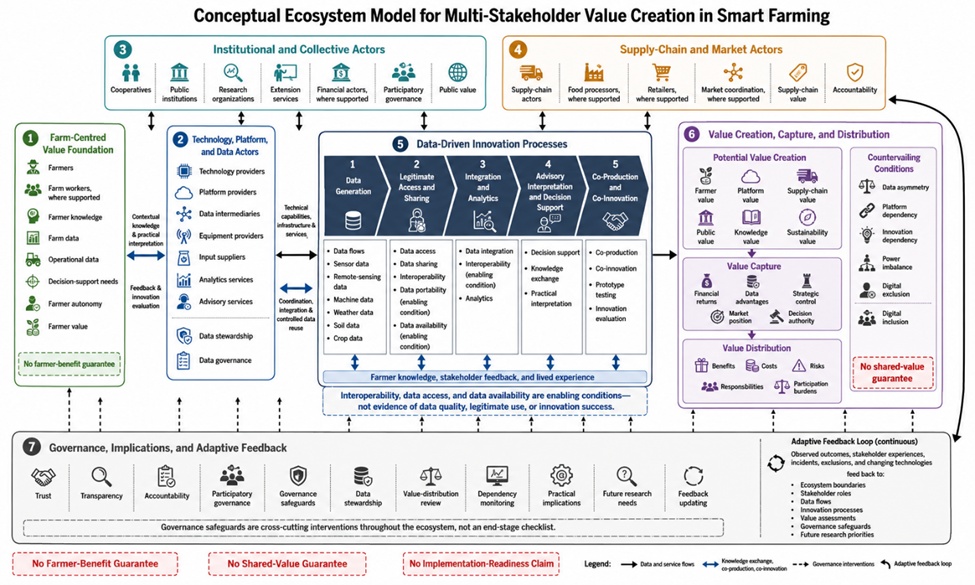
Figure 1. Conceptual Ecosystem Model for Multi-Stakeholder Value Creation in Smart Farming
Alt-text description:
A conceptual ecosystem model showing smart farming stakeholders connected by data flows, innovation processes, value creation, value capture, value distribution, governance safeguards, trust, accountability, practical implications, future research, and feedback loops.
For farmers, advisors, cooperatives, extension organizations, and research institutions, the model provides a structure for asking how digital services correspond to locally defined needs, how farmer knowledge is incorporated, and how data-use arrangements affect autonomy and trust. Evaluation should examine whether farmers can understand data purposes, retrieve or transfer their information, challenge analytical outputs, and influence service or governance design. Advisors and extension services require evidence on how automated tools alter professional roles, explanation duties, and relationships with farmers. Cooperatives merit comparative study as possible providers of collective infrastructure, representation, negotiation, or stewardship, while remaining subject to scrutiny regarding internal accountability and inclusion. These implications are conceptual and do not prescribe organizational structures, contracts, data-sharing terms, or farm-management practices.
For technology providers, platform operators, data intermediaries, equipment manufacturers, input suppliers, supply-chain actors, and financial actors where relevant, future research should compare how technical architecture and business organization influence interoperability, switching costs, data access, transparency, value capture, and dependency. Longitudinal ecosystem studies are needed to determine whether portability works in practice, whether data intermediaries reduce or relocate concentration, and whether platform coordination expands meaningful choice. Research should also distinguish technical conformance from semantic interoperability and investigate how proprietary interfaces, bundled services, recommendation conflicts, and concentrated platform power affect different farming systems. Value-distribution analysis should examine both financial and non-financial outcomes rather than assuming that network participation produces balanced returns.
For public institutions and policymakers, the model identifies research questions concerning enabling infrastructure, competition, public data resources, extension capacity, digital inclusion, participatory governance, accountability, and long-term ecosystem evaluation. Public interventions should be examined for their effects on farmer value, market concentration, service accessibility, public value, and the distribution of risks and responsibilities. Future empirical work should test the proposed stages across contrasting production systems, farm sizes, regional infrastructures, governance arrangements, and platform configurations. Mixed-method and longitudinal designs could assess trust formation, data stewardship, dependency, worker impacts, environmental claims, and feedback updating. These directions are not legal, regulatory, financial, procurement, agronomic, operational, or commercial recommendations; they are research priorities for determining whether particular ecosystem arrangements are effective, legitimate, inclusive, and contextually appropriate.
This article proposes a conceptual ecosystem model for analysing multi-stakeholder value creation in smart farming through the relationships among stakeholder roles, data flows, data-driven innovation processes, value creation, value capture, value distribution, governance safeguards, practical implications, future research, and feedback updating. The model places farmers and farmer knowledge within a wider socio-technical network of advisors, technology and platform providers, data intermediaries, equipment and input suppliers, cooperatives, public institutions, research and extension organizations, financial actors where relevant, and agri-food supply-chain participants. Its principal contribution is to separate technological capability from ecosystem performance and to distinguish potential value from its capture and distribution. Data-driven agricultural innovation should therefore be evaluated through farmer value, shared-value boundaries, accountability, inclusion, trust, autonomy, interoperability, stewardship, and dependency rather than through data accumulation or technology deployment alone. The model supports structured conceptual analysis and future empirical validation, but it does not guarantee innovation success, equitable outcomes, farmer benefit, governance sufficiency, commercial viability, policy suitability, or implementation readiness.
None
None
None
None
Open Access The author(s) retain copyright. This article is licensed under the Creative Commons Attribution-NonCommercial-ShareAlike 4.0 International License. It may be shared and adapted for non-commercial purposes with appropriate attribution, an indication of changes, and distribution of adaptations under the same license. Third-party material may be subject to separate terms identified in its credit line. View the license at https://creativecommons.org/licenses/by-nc-sa/4.0/.
 Agro Intelligence Research Press