Generative artificial intelligence is expanding the conversational and interpretive functions available within precision-farming decision support, yet fluent responses may contain factual inaccuracies, unsupported claims, fabricated evidence, agronomically invalid interpretations, local-context mismatches, or understated uncertainty. This article develops a conceptual artificial-intelligence safety framework for managing these risks in generative agricultural decision-support systems. The framework treats hallucination risk as a socio-technical safety problem rather than solely as a language-model defect. It links agricultural use-case definition, advisory-output classification, farm-level consequence assessment, data and knowledge provenance, retrieval and response grounding, hallucination screening, factual verification, agronomic-validity review, uncertainty communication, human oversight, expert escalation, farmer feedback, traceability, accountability, monitoring, and controlled updating. Generative outputs are differentiated according to whether they provide information, interpretation, scenario explanation, or recommendation-like content, because the evidentiary and review requirements increase with potential consequence. Validation is similarly separated into factual checking, external evaluation, local-context assessment, agronomic review, and future field-validation planning. The framework establishes decision boundaries against unsupported agronomic advice, autonomous farm action, hallucination-elimination claims, safety guarantees, and deployment-readiness claims. It also allocates responsibilities among developers, platform providers, data stewards, knowledge-base curators, agricultural reviewers, and farmers while preserving farmer autonomy. The main contribution is an integrated safety model for structuring how hallucination-prone generative outputs may be interpreted, reviewed, restricted, escalated, recorded, and updated within precision-farming decision support. The framework is conceptual and does not independently establish advisory correctness, operational safety, legal compliance, or deployment readiness.
Precision farming increasingly combines sensor observations, weather information, soil and crop data, remote-sensing products, farm-management records, analytical models, and digital platforms to support agricultural decisions. These systems are not purely technical artefacts: they operate within agricultural knowledge networks, institutional arrangements, commercial relationships, farmer practices, and locally specific production environments. Their outputs therefore depend not only on model capability but also on data quality, task definition, system integration, stakeholder roles, and the conditions under which information is interpreted and used [1-3]. The introduction of large language models, foundation models, vision-language systems, and retrieval-supported generation adds a conversational layer capable of synthesising information and explaining apparent implications, but it also creates new routes through which unsupported or misleading content can enter farm decision-support workflows.
Hallucination risk is especially significant when generated language resembles authoritative farm advice. A response may be grammatically coherent and contextually persuasive while containing an incorrect factual statement, an unsupported inference, fabricated evidence, an invalid agronomic interpretation, or an assumption that does not fit the farm’s crop, soil, climate, management history, or production objective. These failure forms should not be collapsed into one undifferentiated category. Hallucination concerns content generated without adequate grounding; factual inaccuracy concerns claims that conflict with reliable evidence; agronomic invalidity concerns interpretations or recommendations that are biologically or operationally unsuitable; and local-context mismatch concerns outputs that may be broadly plausible but inappropriate for the intended setting. Model reliability refers to the consistency of system behaviour, whereas model validity concerns whether an evaluated system is suitable for a specified task, population, environment, and decision purpose.
Agricultural AI safety consequently requires more than model-performance reporting. Responsible use depends on reliability assessment, transparent data practices, documentation of limitations, meaningful human involvement, accountability, privacy protection, cybersecurity, and safeguards against harmful or misleading recommendations [4]. These requirements become more demanding when outputs influence decisions concerning irrigation, nutrients, pests and diseases, crop monitoring, weather-related risk, or other resource-sensitive activities. A general-purpose model may assist with information organisation or explanation, but its apparent confidence does not establish that its output is current, locally valid, supported by traceable evidence, or suitable for consequential use. Agricultural decision support must therefore distinguish between information provision and advice-like outputs whose interpretation could affect farm resources, production conditions, or user behaviour.
This article proposes an original conceptual AI safety framework for managing hallucination risk in generative agricultural decision support. The framework links hallucination-risk identification, advisory-output classification, farm-level consequence analysis, evidence grounding, factual and agronomic review, uncertainty communication, human oversight, expert escalation, farmer confirmation, decision boundaries, accountability allocation, traceability, monitoring, incident learning, and controlled updating. Its purpose is not to establish a universal validation protocol or prescribe farm-management actions. Instead, it structures the questions, responsibilities, review gates, and claim limitations that should be considered before a generated output is treated as decision support. The central argument is that generative agricultural systems should be judged by the quality of their evidence, validation, oversight, and boundary enforcement rather than by conversational fluency, response speed, or general model capability [4].
Hallucination in generative AI refers broadly to content that is unsupported by the relevant source material, supplied data, or established evidence, although its manifestation varies across dialogue, question answering, summarisation, data-to-text generation, and multimodal systems. In an agricultural setting, hallucination may appear as an invented observation, an unsupported causal explanation, a fabricated source, a claim that exceeds retrieved evidence, or an answer that fills missing farm context with unstated assumptions. Generated citations can appear credible while referring to non-existent or misrepresented sources, and polished conversational language can create an impression of truth-sensitive reasoning that the generation process does not necessarily possess [5-7]. Hallucination should therefore be separated from ordinary imprecision, incomplete explanation, model unreliability, and invalid agronomic judgement, even though these failure categories can occur together in the same output.
Factual inaccuracy concerns whether a generated statement is correct, while unsupported output concerns whether the statement can be traced to accepted evidence. A claim may be factually correct by coincidence yet remain unsupported within the actual decision-support workflow. Conversely, an output may cite a genuine source but misstate its findings or extend them beyond the context in which they are valid. Fabricated evidence and fabricated source attribution are especially serious because they give unsupported content an appearance of verification [6]. Overconfident output adds a second layer of risk by presenting weak, incomplete, or conflicting evidence in categorical language. Because users often rely on linguistic cues when judging credibility, confident wording can obscure uncertainty, discourage further checking, and increase the likelihood that informational content will be interpreted as actionable advice [7].
Agricultural hallucination risk is also produced upstream of text generation. Poor sensor calibration, incomplete farm records, incorrect field boundaries, stale weather data, low-quality imagery, uncertain soil measurements, or missing provenance can distort the context supplied to the model. Ambiguous farmer queries may omit crop variety, location, growth stage, production objective, timeframe, prior intervention, or other material conditions, encouraging the model to generate assumptions rather than request clarification. Knowledge-base drift may occur when curated agricultural sources become outdated, inconsistent, or incorrectly indexed, while model drift may arise after model, prompt, retrieval, or interface changes. Agronomic invalidity and local-context mismatch may remain even where retrieved facts are individually correct, because agricultural decisions depend on interactions among biological conditions, management constraints, farmer experience, local knowledge, and temporal circumstances [5].
Retrieval-augmented generation can help connect outputs to external agricultural knowledge, but it does not remove hallucination risk. Retrieval may return irrelevant, outdated, conflicting, or geographically inappropriate evidence; ranking may prioritise superficially similar material; and the generation stage may ignore, distort, or overextend the retrieved context. Retrieval quality and response grounding must therefore be evaluated separately, with claim-level links between generated statements and supporting evidence. Hallucination detection, source checking, knowledge-base curation, and human review may reduce selected risks where they are properly designed and validated, but none creates a hallucination-free system [8]. An explicit no-hallucination-elimination boundary and no-advisory-correctness-guarantee boundary are thus necessary: passing proposed checks may support more cautious interpretation, but it cannot independently guarantee factual completeness, agronomic validity, local suitability, operational safety, or deployment readiness.
Generative decision support can translate complex agricultural information into conversational explanations, summaries, comparisons, clarification questions, and scenario descriptions. In crop production, large language models may provide value when they help organise textual knowledge, make technical information more accessible, or support interaction with broader analytical systems, but their appropriate role depends on the task, the evidence available, and the consequence of error [9]. A safety framework should therefore classify outputs before evaluating them. Information retrieval, explanation, interpretation, scenario comparison, and recommendation-like language should not be treated as equivalent. As an output moves closer to a proposed farm-management action, stronger grounding, validation, human review, and decision-boundary controls become necessary.
Generative systems may be connected conceptually to sensor data, weather services, remote-sensing products, farm records, and analytical models, allowing them to explain patterns across heterogeneous inputs. Such integration can improve accessibility but also compounds failure pathways because incorrect data, weak retrieval, model error, and misleading language can be combined into a single persuasive response [10]. For irrigation, nutrient, pest, disease, weather-risk, crop-monitoring, or remote-sensing questions, the system should not infer that access to one data stream is sufficient for advice. Soil moisture alone, for example, does not represent the full decision context for irrigation; an image-based pattern does not by itself establish a diagnosis; and a forecast does not guarantee a particular farm outcome. These are decision boundaries, not agronomic instructions.
Agricultural knowledge bases and retrieval systems may support more grounded generative outputs by providing domain-specific evidence, terminology, and contextual information. However, useful grounding requires curated sources, transparent inclusion criteria, version control, relevance assessment, and evaluation of whether the retrieved material fits the crop, region, season, and intended decision [11]. Farmer-facing explanations should disclose material assumptions, missing data, uncertainty, and alternative interpretations in understandable language. Advisor-facing outputs may require more detailed evidence maps showing data provenance, source alignment, model version, unresolved conflicts, and the reasons an output was classified at a particular risk level. Neither form should obscure uncertainty merely to improve readability.
Farm-level consequences depend on how an output is interpreted and whether it crosses from explanation into prescription. A misleading scenario explanation may distort risk perception; an unsupported interpretation of remote-sensing data may direct attention away from relevant field observations; and recommendation-like wording may be acted upon even when the system labels itself as advisory. Integrating generative models with crop-management decision systems therefore requires staged evaluation, local assessment, and strict separation between conversational generation and autonomous control [12]. High-risk or insufficiently grounded queries should be deferred to qualified review. Human oversight must occur before consequential reliance, and no generated output should directly trigger machinery, resource application, or another farm-management action solely because it has passed automated screening.
Risk interpretation begins by classifying the intended output according to potential consequence, reversibility, uncertainty, and required expertise. A low-consequence informational explanation does not require the same review as recommendation-like content that could influence resource use or crop management. Human-centred AI design shows that high automation need not require low human control; a system may assist with information processing while preserving meaningful human authority, contestability, and responsibility [13]. Within agricultural decision support, this means that farmers and qualified reviewers must be able to inspect assumptions, challenge generated claims, reject outputs, request more evidence, and prevent automated execution. Human involvement must be substantive rather than ceremonial, because a nominal review step can otherwise become a mechanism for transferring responsibility without improving safety.
Validation should be separated into complementary functions. Factual accuracy checking asks whether claims agree with reliable and current evidence. Agronomic-validity review asks whether the interpretation is biologically, environmentally, and operationally coherent. External validation examines performance outside development data, while local validation considers the intended crops, soils, climate, language, users, and workflows. Field-validation planning specifies what future empirical evaluation would require but does not constitute completed field validation. Explainability can support these processes by exposing influential variables, model reasoning structures, or relationships among data and outputs, yet an explanation is not proof that the underlying claim is correct or agronomically suitable [14]. An understandable error remains an error, and a plausible explanation can itself be misleading.
Local and experiential knowledge are essential because agricultural knowledge cannot be reduced completely to digitised records or general textual sources. Farmers, agronomists, extension professionals, and other agricultural knowledge actors may recognise seasonal, spatial, historical, or operational conditions that are absent from the system’s data [15]. Farmer feedback may identify an incorrect assumption, a missing constraint, or a mismatch between the output and observed field conditions. Agricultural advisor review may help evaluate consequence and contextual validity where relevant, but neither farmer confirmation nor expert participation guarantees correctness. Review quality depends on competence, authority, time, access to traceable evidence, awareness of automation bias, and the ability to defer or reject the output.
Validation and review should therefore be embedded within an iterative responsible-development process involving anticipation, stakeholder inclusion, reflection, responsiveness, monitoring, and revision [16]. Consequential outputs require traceable records of inputs, retrieved evidence, model version, generated claims, uncertainty disclosures, escalation decisions, and human review. Monitoring should examine model and knowledge-base drift, recurrent grounding failures, inappropriate confidence, boundary violations, and disagreement between automated and human assessments. A no-validation-sufficiency boundary is necessary because successful evaluation in one setting does not demonstrate universal reliability, and a no-deployment-readiness boundary is necessary because a conceptual safety framework does not establish operational capacity, field validity, organisational assurance, or safe real-world performance. Table 1 summarises hallucination risks, generative decision-support consequences, validation needs, and human-review requirements for agricultural AI.
Table 1. Hallucination Risk, Generative Decision Support, Farm-Level Consequences, Validation, and Human Review in Agricultural AI: Factual Inaccuracy, Unsupported Outputs, Fabricated Evidence, Agronomic Invalidity, Local-Context Mismatch, Uncertainty Underreporting, Risk Classification, Human Oversight, Expert Escalation, Farmer Feedback, and Decision Boundaries
Risk, consequence, or review component | Core safety question | Potential source or required evidence | Risk manifestation or safety function | Potential farm-level consequence or output | Validation or review need | Residual or failure risk | Framework role |
Factual inaccuracy | Is each generated factual claim correct and current? | Farm inputs, traceable agricultural sources, timestamps, and contextual metadata | Incorrect statement about a crop, condition, observation, or evidence source | Misinterpretation of the farm situation or evidence base | Independent factual verification and source checking | Correct facts may still be incomplete or agronomically irrelevant | Factual-accuracy gate |
Unsupported output | Can each material claim be linked to accepted data or evidence? | Claim-source map, retrieved passages, supplied records, and provenance | Plausible statement generated without adequate support | Speculation may be interpreted as established knowledge | Claim-level grounding review | An output may appear grounded while exceeding its source | Unsupported-output flag and deferral |
Fabricated evidence | Has the system invented a measurement, observation, document, or finding? | Original records, source identifiers, and retrieval logs | Non-existent evidence presented as real | False confidence in an interpretation or decision | Evidence existence and authenticity checks | Subtle fabrication may evade automated detection | Mandatory rejection and incident review |
Fabricated source attribution | Do cited sources exist and support the attributed claim? | Verified article metadata, DOI, authorship, and relevant text | Invented or misrepresented citation | Unsupported advice may appear authoritative | Bibliographic and claim-level verification | Genuine sources may still be quoted inaccurately | Source-verification control |
Overconfident output | Is certainty stronger than the underlying evidence allows? | Evidence quality, model limits, conflicting sources, and missing data | Definitive language under uncertainty | Reduced likelihood of further checking or escalation | Confidence-language and evidence-strength review | Users may still over-trust qualified wording | Confidence restriction |
Uncertainty underreporting | Are missing information, alternatives, and limitations visible? | Structured uncertainty fields and evidence-gap assessment | Omission of ambiguity or plausible alternatives | Output may be treated as complete | Standardised uncertainty review and user-comprehension check | Generic caveats may be ignored | Mandatory uncertainty communication |
Agronomic invalidity | Is the interpretation coherent for the crop and production context? | Crop stage, soil, climate, management history, and local constraints | Factually plausible but biologically or operationally unsuitable reasoning | Potentially harmful or ineffective decision interpretation | Qualified agronomic review | Expert disagreement and incomplete local knowledge | Agronomic-validity gate |
Local-context mismatch | Does the output fit the intended location, season, system, and farmer objective? | Local data, management conditions, farmer knowledge, and advisor input | General information applied to an unsuitable context | Ineffective or misleading support | Local validation and farmer confirmation | Conditions may change after review | Local-context gate |
Outdated knowledge | Is the supporting evidence sufficiently current for the intended use? | Publication dates, observation dates, knowledge-base versions, and update records | Use of stale or superseded information | Decision support may not reflect current risks or practices | Freshness review and controlled updating | Recent sources may remain uncertain or locally irrelevant | Knowledge-freshness control |
Poor retrieval quality | Did retrieval select relevant, credible, and context-matched sources? | Search query, ranking output, source quality, and relevance assessment | Irrelevant or weak documents used as grounding | Misleading response presented as evidence based | Retrieval evaluation and human sampling | High-ranked sources may still conflict | Retrieval-quality gate |
Weak response grounding | Does generated language remain faithful to retrieved evidence? | Retrieved text, generated claims, and entailment relationships | Output overstates, distorts, or ignores the source | False interpretation of otherwise valid evidence | Claim-source alignment review | Automated grounding checks may miss nuance | Response-grounding gate |
Data quality failure | Are sensor, imagery, weather, soil, crop, and record inputs usable? | Calibration, completeness, anomaly, representativeness, and missingness checks | Corrupted or incomplete input shapes generated interpretation | Incorrect farm-state representation | Data-quality screening and domain review | Valid-looking data may remain unrepresentative | Input-acceptance gate |
Data provenance gap | Can each input and transformation be reconstructed? | Source, ownership, timestamp, processing, and version metadata | Untraceable data used in a consequential output | Failure cannot be investigated or responsibility allocated | Provenance audit | Provenance records may document but not correct weak data | Traceability requirement |
Ambiguous farmer query | Is sufficient context available to answer the question? | Crop, location, growth stage, objective, timeframe, and prior actions | Model fills omitted context with assumptions | Apparently specific but contextually unsupported response | Clarification request and assumption review | User-provided context may still be incomplete | Query-completeness gate |
Model drift | Has behaviour changed following model, prompt, tool, or interface updates? | Version records, regression tests, and monitored output characteristics | Previously evaluated controls no longer behave consistently | New or recurrent failure patterns | Version-specific re-evaluation | Testing cannot cover all conditions | Post-change validation trigger |
Knowledge-base drift | Has the grounding corpus become stale, inconsistent, or corrupted? | Curation records, source conflicts, indexing, and update history | Retrieval quality deteriorates despite unchanged model | Outdated or contradictory decision support | Curator review and version control | Curated sources may remain incomplete | Knowledge-base governance |
Risk classification | How consequential, reversible, and uncertain is potential reliance? | Intended use, decision type, affected resources, severity, and reversibility | Assigns control intensity and review requirements | Informational release, restricted output, escalation, or prohibition | Multidisciplinary classification review | Underclassification may bypass safeguards | Determines the safety pathway |
Consequence severity assessment | What could happen if the output is wrong or misunderstood? | Crop, environmental, economic, operational, and human implications | Evaluates scope, duration, and reversibility | Consequence profile | Domain and stakeholder review | Indirect effects may be omitted | Sets validation and escalation thresholds |
External validation | Does performance extend beyond development conditions? | Independent data and predefined evaluation criteria | Tests generalisation | Bounded validation statement | Methodological review | External evidence may not match the intended farm context | Generalisation evidence |
Local validation | Is the system suitable for the intended agricultural setting? | Local crops, soils, climate, language, users, and workflows | Assesses contextual fit | Local-suitability assessment | Local farmer, advisor, and domain review | Seasonal and spatial variation remain | Contextual evidence gate |
Field-validation planning | What evidence would future real-world assessment require? | Protocol, outcome measures, safeguards, stopping rules, and oversight | Structures future evaluation without claiming completion | Field-validation plan | Independent methodological and ethical review | A plan may be mistaken for completed testing | Future research stage |
Advisory output review | Does the response remain within the approved output class? | Output taxonomy, wording controls, uncertainty, and source map | Detects recommendation-like or prohibited language | Approval, revision, escalation, or blocking | Reviewer and boundary-control assessment | Advice may be implied indirectly | Output-boundary gate |
Human-in-the-loop review | Can a human materially change or stop the output before consequential use? | Reviewer authority, competence, evidence access, time, and independence | Approves, revises, rejects, or escalates | Documented review disposition | Rubber-stamping and automation bias | Meaningful oversight requirement | |
Agricultural advisor review where supported | Is professional agricultural interpretation required? | Local agronomic context and complete traceability package | Reviews validity and consequence | Advisor-reviewed interpretation or deferral | Qualified expert assessment | Professional review does not guarantee correctness | Domain-escalation pathway |
Expert escalation | Which unresolved cases require specialist attention? | High severity, evidence conflict, rarity, or local mismatch | Routes the case to an appropriate reviewer | Escalation record or deferred response | Incorrect routing or delayed review | Named expert role and response criteria | High-risk safeguard |
Farmer feedback | Does the output reflect observed conditions, constraints, and objectives? | Farmer observations and confirmation of assumptions | Detects contextual mismatch and supports correction | Confirmation, correction, rejection, or new evidence | Farmer participation and comprehension support | Feedback may be incomplete or influenced by the system | Local feedback loop |
Output traceability | Can the complete generation and review process be reconstructed? | Inputs, prompt, retrieval, model version, output, checks, and reviewers | Enables verification and investigation | Trace package | Missing or inaccessible logs | Audit and governance review | Accountability infrastructure |
Monitoring | Do output behaviour and control performance remain within acceptable bounds? | Drift indicators, grounding failures, deferrals, incidents, and feedback | Detects emerging risk | Alert, investigation, revision, or suspension | Human triage and governance review | Unreported failures may remain hidden | Post-release safety loop |
No validation-sufficiency boundary | Are validation findings restricted to their tested scope? | Context, sample, methods, limitations, and uncertainty | Prevents universal reliability claims | Bounded validation language | Independent methodological review | Readers may overgeneralise limited evidence | Claim limitation |
No deployment-readiness boundary | Is conceptual completeness distinguished from operational readiness? | Evidence of implementation, field testing, assurance, resourcing, and governance | Prevents premature deployment claims | Explicit conceptual-status statement | Independent readiness assessment would be required separately | Framework detail may be mistaken for operational maturity | Final safety-integrity boundary |
Safety principles become meaningful only when they are translated into operationally identifiable controls, assigned responsibilities, review stages, records, and escalation procedures. Applied AI-ethics methods commonly include impact assessment, documentation, auditing, stakeholder engagement, risk review, and lifecycle monitoring, although their maturity and effectiveness vary across settings [17]. For generative agricultural decision support, these mechanisms should begin with a clearly documented use case specifying the intended users, permitted data, allowable output classes, excluded decisions, expected review process, and foreseeable consequences of misuse. A conversational system designed to explain agricultural information should not gradually assume a recommendation or control function merely because users request increasingly specific answers. Use-case definition is therefore a continuing boundary rather than a one-time project description.
Risk thresholds determine how controls change as the potential consequence of an output increases. Informational content may require basic grounding and uncertainty disclosure, whereas recommendation-like content may require factual verification, agronomic review, local validation, human authorisation, and expert escalation. Ethical governance of AI requires practical mechanisms for verification, transparency, oversight, and institutional accountability rather than reliance on trust in designers or confidence in automated outputs [18]. In the proposed framework, high-risk query deferral is a safety function rather than a system failure. When evidence is insufficient, local context is incomplete, or potential consequences exceed the system’s approved role, the appropriate output is a clarification request, restricted informational response, or referral to qualified human review.
Decision boundaries should be enforced at several points. At the interface level, the system should distinguish explanation from recommendation-like language and display material uncertainty prominently. At the generation level, it should restrict claims that lack source support or exceed retrieved evidence. At the workflow level, it should prevent unreviewed outputs from directly initiating machinery, irrigation, nutrient application, pest control, procurement, or other consequential actions. At the governance level, it should define who may approve, revise, reject, suspend, or escalate an output. General ethical principles cannot by themselves demonstrate that these controls are effective, consistently applied, or suitable for a particular agricultural environment [19]. The framework therefore includes explicit no-autonomous-action, no-hallucination-elimination, no-safety-guarantee, and no-deployment-readiness boundaries.
Safety controls should also be proportionate to consequence severity and should preserve transparency, contestability, and meaningful human authority. Algorithmic accountability depends on whether affected users can understand the basis of a decision, challenge its assumptions, and identify the actors responsible for its design and use [20]. Source traceability, response grounding, farmer confirmation, expert-review triggers, monitoring, and incident reporting can support these functions, but each remains fallible. Monitoring may fail to detect unreported harm; farmer confirmation may be influenced by persuasive system language; and expert review may be superficial when evidence is incomplete or workloads are high. Feedback and knowledge-base updating should consequently be controlled, versioned, and verified so that unconfirmed corrections, anecdotal reactions, or model-generated claims do not become new sources of error.
Accountability begins with transparency about how farm data are collected, transformed, shared, and used. Farmers’ trust in smart-farming services is affected by whether providers explain what happens to data, who benefits from their use, and how decisions are made [21]. In generative decision support, these concerns extend to the relationship between input data and output language. A farmer should be able to determine which observations, records, retrieved sources, and assumptions contributed to a consequential response. Farmer autonomy also requires the ability to question, reject, or correct an output without being treated as non-compliant with the system. Confirmation should therefore function as contextual verification rather than as a mechanism for transferring responsibility for system defects to the farmer.
Data stewardship responsibilities include access control, quality assurance, retention, provenance, consent, and appropriate reuse. Agricultural data may contain commercially sensitive information about production conditions, land, inputs, performance, and management practices. Unclear ownership, access, and privacy arrangements can reduce farmers’ willingness to participate in digital systems and weaken the legitimacy of data-driven advice [22]. The proposed framework assigns a data-steward role for maintaining input records and a knowledge-base curator role for selecting, reviewing, versioning, and retiring agricultural sources. These roles may be performed by individuals or organisations, but their responsibilities should remain distinguishable. Data provenance does not prove accuracy, and knowledge-base curation does not eliminate outdated, contested, or locally unsuitable evidence.
Developer and platform accountability should likewise be separated. Developers are responsible for documenting model purpose, known limitations, evaluation conditions, version changes, and foreseeable failure modes. Platform providers control interfaces, integrations, access, monitoring, output restrictions, and escalation pathways. Agricultural advisors may contribute contextual or professional review where appropriate, but they should not be expected to endorse opaque outputs lacking traceable evidence. The social and ethical effects of agricultural AI extend across developers, technology providers, farmers, workers, advisors, communities, and institutions, making single-actor accountability inadequate [23]. A human review record should therefore identify what evidence was examined, what changes were made, why the output was approved or rejected, and which uncertainties remained unresolved.
Auditability requires records that allow a consequential output to be reconstructed, including relevant inputs, retrieval results, model and knowledge-base versions, generated claims, automated screening results, uncertainty disclosures, escalation decisions, and human interventions. Incident reporting should preserve these records and distinguish suspected hallucination, factual error, agronomic invalidity, boundary violation, privacy failure, cybersecurity event, and misuse. Platform concentration, unequal access, data control, and asymmetric bargaining power can shape which incidents are visible and whose interests determine corrective action [24]. Accountability must therefore include the capacity to investigate systemic patterns rather than attributing every failure to individual user judgement. The framework maps conceptual responsibilities but does not determine legal liability, prove regulatory compliance, or establish that named roles have sufficient authority, competence, or resources.
The proposed framework treats hallucination risk as a systemic property of the relationship among agricultural data, knowledge resources, generative models, platform design, human interpretation, institutional responsibility, and farm-level consequence. Agricultural AI risks can emerge from data selection, model behaviour, optimisation goals, deployment arrangements, uneven adoption, and wider externalities, while responsible smart-farming innovation also requires attention to privacy, power, autonomy, inclusion, and the purposes served by technology [25-27]. The framework therefore does not position hallucination detection as an isolated software function. It organises a sequence of preventive, interpretive, review, accountability, and learning stages through which generative agricultural outputs can be restricted or escalated according to their intended use and potential consequence.
The first stages establish the context within which any output may be generated. Agricultural use-case definition specifies permitted users, tasks, inputs, output classes, exclusions, and intended decision relationships. Stakeholder and responsibility mapping identifies developers, platform providers, data stewards, knowledge-base curators, agricultural reviewers, farmers, and relevant institutional actors. Advisory-risk classification then distinguishes information provision, explanation, interpretation, scenario analysis, recommendation-like content, and prohibited autonomous action. Data-quality and provenance review assesses whether sensor, soil, weather, crop, imagery, farm-record, and textual inputs are sufficiently complete, current, plausible, and traceable. Knowledge-base curation review evaluates source quality, currency, relevance, conflict, geographic fit, and version history before information is made available for retrieval.
The next stages focus on generation and validation. Retrieval and response-grounding review examines whether selected sources are relevant and whether generated claims remain faithful to them. Generative output remains a draft until hallucination-risk screening identifies unsupported statements, fabricated evidence, source-attribution errors, contradictions, overconfidence, and uncertainty underreporting. Factual accuracy checking verifies material claims independently of linguistic quality, while agronomic-validity review examines whether an interpretation is coherent for the relevant crop, environment, management setting, and local constraints. Uncertainty communication records missing data, conflicting evidence, plausible alternatives, and the limits of model and review processes. Decision-boundary enforcement then determines whether the output may be released as bounded information, must be revised, requires human review, or should be deferred.
Human review and expert escalation provide a further decision gate rather than an automatic approval mechanism. Reviewers require access to the complete evidence and traceability package, authority to alter or reject the response, and sufficient competence to interpret its intended use. Farmer feedback and confirmation can expose missing constraints, incorrect assumptions, or differences between system representations and observed conditions. Agricultural knowledge and advice increasingly operate through connected networks in which farmers, advisors, researchers, technology organisations, and data intermediaries have interacting roles [28]. Generative systems should therefore be embedded in these human knowledge networks rather than positioned as self-sufficient advisory authorities. Output traceability and audit logging record the complete pathway, while monitoring and incident reporting identify drift, recurring grounding failures, inappropriate confidence, escalation problems, or decision-boundary violations.
The final stages support controlled learning without implying that safety has been established. Verified corrections may inform knowledge-base updating, model or prompt review, interface revision, reviewer training, or changes to risk thresholds. Framework updating should occur after material system changes, incidents, new evidence, stakeholder feedback, or changes in the agricultural context. Every revision should preserve the distinction between conceptual safeguards and demonstrated operational performance. The framework contains explicit no-agronomic-advice, no-autonomous-decision, no-hallucination-elimination, no-safety-guarantee, and no-deployment-readiness boundaries. Table 2 presents the proposed safety framework for managing hallucination risk in generative agricultural decision support. Figure 1 presents the proposed safety framework for managing hallucination risk in generative agricultural decision support, linking advisory-risk classification, data grounding, validation, human review, decision boundaries, accountability, monitoring, and feedback updating.
Table 2. Proposed Safety Framework for Managing Hallucination Risk in Generative Agricultural Decision Support: Use-Case Definition, Responsibility Mapping, Advisory-Risk Classification, Data Provenance, Retrieval Grounding, Hallucination Screening, Factual Accuracy, Agronomic Validity, Uncertainty Communication, Decision Boundaries, Human Review, Farmer Feedback, Audit Logging, Monitoring, Incident Reporting, and Claim Boundaries
Framework stage | Core purpose | Required input | Safety function | Potential output | Validation or oversight need | Failure risk | Feedback mechanism | Decision boundary |
Agricultural use-case definition | Specify permitted tasks, users, contexts, and exclusions | Intended users, agricultural setting, data, decisions, and foreseeable consequences | Prevent ambiguous or expanding system scope | Approved use-case statement | Farmer, advisor, technical, and safety review | Scope creep or unintended reliance | Periodic use-case review | No use outside the documented scope |
Stakeholder and responsibility mapping | Identify actors affected by or responsible for the system | Developer, platform, data, knowledge, advisor, farmer, and institutional roles | Allocate control and review functions | Responsibility map | Multi-stakeholder review | Unowned controls or conflicting authority | Revision after organisational change | Does not determine legal liability |
Advisory-risk classification | Match output class to potential consequence | Intended output, severity, reversibility, uncertainty, and affected resources | Determine required safeguards | Informational, restricted, escalated, or prohibited class | Domain and safety review | Underclassification | Reclassification after incidents or new evidence | High-risk and prohibited outputs cannot proceed automatically |
Data quality and provenance review | Assess whether inputs are reliable and reconstructable | Sensor, weather, soil, crop, imagery, record, and metadata inputs | Reject incomplete, implausible, stale, or untraceable data | Accepted, qualified, or rejected input set | Data steward and domain oversight | Valid-looking but misleading data | Error reporting and data correction | Rejected data cannot support consequential output |
Knowledge-base curation review | Maintain relevant and traceable agricultural evidence | Candidate sources, dates, geographic scope, conflicts, and versions | Control source inclusion, updating, and retirement | Versioned agricultural knowledge base | Agricultural and evidence-review expertise | Stale, biased, conflicting, or incomplete content | Scheduled curation and correction process | Curation does not establish universal validity |
Retrieval-quality review | Assess whether retrieved evidence fits the query and context | Query, ranking results, source metadata, and relevance criteria | Detect irrelevant or weak retrieval | Accepted or revised retrieval set | Technical and domain sampling | Superficially similar but unsuitable sources | Retrieval-error logging | Poor retrieval prevents grounded generation |
Response-grounding review | Ensure generated claims remain faithful to evidence | Retrieved passages, input data, and generated claim map | Detect unsupported extension or source distortion | Grounded, revised, or blocked claim set | Automated checks and human review | Nuanced mismatch may evade detection | Reviewer corrections | Ungrounded material claims are blocked |
Generative output generation | Produce bounded explanatory or decision-support text | Approved inputs, sources, risk class, and output template | Restrict generation to permitted functions | Draft output | Automated controls and later review | Recommendation leakage or unstated assumptions | Output-monitoring data | Draft status until required gates are passed |
Hallucination-risk screening | Identify fabricated, unsupported, contradictory, or overconfident content | Draft output, evidence map, sources, and input records | Flag hallucination-related failure patterns | Flag list, rejection, or review request | Automated screening plus human verification | False negatives and false positives | Incident and reviewer feedback | Passing screening does not prove absence of hallucination |
Factual accuracy checking | Verify material claims against current evidence | Claim list, source evidence, farm inputs, and timestamps | Remove incorrect or unverifiable facts | Verified, disputed, or unsupported claim record | Independent checking for consequential outputs | Source misinterpretation or incomplete evidence | Correction records | Disputed material claims prevent release |
Agronomic validity review | Assess biological, contextual, and operational coherence | Verified facts, crop, soil, climate, management history, and local constraints | Identify invalid agricultural interpretation | Approve, revise, reject, or escalate | Qualified agronomic review where appropriate | Expert disagreement or missing local context | Farmer and reviewer feedback | No unreviewed recommendation-like output |
External validation | Evaluate performance outside development conditions | Independent data, predefined tasks, and evaluation criteria | Assess bounded generalisation | External-validation statement | Methodological review | Independent data may still be unrepresentative | Research updates | Does not establish local suitability |
Local validation | Evaluate fit within the intended agricultural environment | Local crops, soils, climate, language, users, and workflows | Detect contextual mismatch | Local-suitability assessment | Local stakeholders and domain experts | Seasonal or spatial variation | Longitudinal local feedback | No generalisation beyond evaluated settings |
Field-validation planning | Specify evidence needed for possible future operational evaluation | Protocol, outcomes, safeguards, stopping rules, and oversight | Structure future empirical work | Field-validation plan | Independent methodological and ethical review | Plan may be mistaken for completed validation | Protocol revision | Planning does not establish field validation |
Uncertainty communication | Make evidence limits and alternatives visible | Data gaps, conflicts, assumptions, model limits, and validation findings | Counter false certainty | Structured uncertainty statement | Reviewer and user-comprehension assessment | Caveats may be vague or ignored | User questions and comprehension feedback | Material uncertainty prevents categorical advice |
Decision-boundary enforcement | Restrict outputs according to approved authority | Risk class, prohibited language, action pathways, and evidence status | Block advisory or autonomous-action leakage | Release, revision, escalation, or deferral | Product and safety governance | Indirect wording may bypass restrictions | Boundary-violation monitoring | No prohibited or autonomous output |
Human review | Preserve meaningful human authority over consequential output | Trace package, reviewer competence, authority, and review criteria | Approve, revise, reject, or suspend | Documented review disposition | Competent and independent review | Automation bias or rubber-stamping | Reviewer disagreement and audit findings | Review occurs before consequential reliance |
Expert escalation | Route unresolved or high-consequence cases | Risk triggers, evidence conflict, rarity, and local mismatch | Obtain specialist interpretation | Expert review request or deferred response | Named reviewer role and response process | Incorrect routing or unavailable expertise | Escalation metrics | System does not answer unresolved high-risk queries |
Farmer feedback and confirmation | Verify assumptions, constraints, observations, and intended use | Farmer knowledge, field observations, objectives, and accessible output summary | Preserve autonomy and detect local mismatch | Confirmation, correction, rejection, or escalation | Voluntary, understandable participation | Persuasive language may influence confirmation | Structured feedback review | Farmer may reject the output without penalty |
Output traceability and audit logging | Reconstruct how each consequential output was produced and reviewed | Inputs, prompts, retrieval, versions, output, checks, and human actions | Support verification and investigation | Traceable output record | Access, retention, and audit governance | Missing, altered, or inaccessible records | Audit findings | Untraceable outputs cannot support consequential decisions |
Monitoring and drift review | Detect changing behaviour and control performance | Grounding errors, deferrals, disagreements, version changes, and user reports | Identify model or knowledge-base drift | Alert, investigation, revalidation, or suspension | Human triage and governance review | Hidden or unreported failure | Monitoring review cycle | Material drift suspends the affected function |
Incident reporting | Preserve and investigate suspected misleading or harmful outputs | User report, trace record, severity, and system context | Support corrective action and organisational learning | Incident record and response | Independent or cross-functional investigation | Underreporting or blame shifting | Incident closure and lessons learned | Reporting does not replace prevention |
Feedback updating | Incorporate verified corrections without accepting unvalidated claims | Farmer, advisor, reviewer, audit, and incident feedback | Control how feedback affects the system | Accepted, rejected, or deferred correction | Evidence review and version control | Incorrect feedback may introduce new errors | Feedback disposition record | Only verified feedback informs controlled updates |
Knowledge-base updating | Add, revise, or retire sources under governance | New evidence, conflict analysis, correction requests, and update rationale | Maintain source integrity and freshness | New knowledge-base version | Curator and domain approval | New conflicts or bias | Change log and post-update testing | Updated content requires affected-use-case review |
Framework updating | Revise safeguards after evidence or context changes | Monitoring, incidents, audits, system changes, and stakeholder feedback | Maintain conceptual relevance | Revised framework version | Governance approval | Static controls become obsolete | Scheduled and event-triggered review | Revision is not certification |
No agronomic-advice claim boundary | Prevent the framework from becoming a farm-management prescription | Manuscript and system language | Limit outputs to safety-oriented decision support | Explicit restriction statement | Domain and editorial review | Readers may infer operational advice | Clarification and correction | No crop-specific management instruction |
No autonomous-decision claim boundary | Preserve human control over consequential actions | Interface, integration, and actuator analysis | Prevent direct execution from generated output | Human-authorisation requirement | Technical and operational verification | Hidden or indirect automation | Integration audits | No autonomous farm action based solely on generative output |
No hallucination-elimination claim boundary | Prevent mitigation from being described as complete prevention | Residual-risk evidence and control limitations | Maintain realistic assurance | Residual-risk statement | Technical and editorial review | Users may infer hallucination-free performance | Incident evidence and revised warnings | Hallucination risk cannot be eliminated by one control |
No safety-guarantee boundary | Prevent process compliance from being equated with safe decisions | Validation scope, unresolved risks, and control limitations | Restrict assurance claims | Explicit non-guarantee statement | Safety-governance review | Checklist compliance replaces substantive judgement | Audit and incident learning | Framework use does not guarantee safety |
No deployment-readiness boundary | Separate conceptual structure from operational maturity | Evidence of implementation, testing, governance, assurance, and resources | Prevent premature deployment claims | Conceptual-status statement | Independent readiness assessment outside the article | Framework detail may imply maturity | Future empirical research | Framework is not operationally validated or deployment-ready |
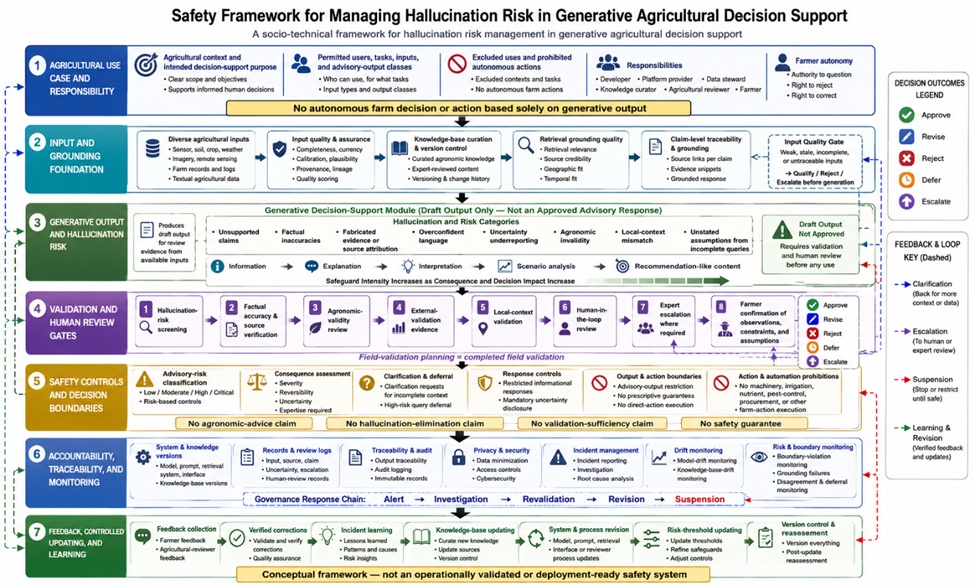
Figure 1. Safety Framework for Managing Hallucination Risk in Generative Agricultural Decision Support
Alt-text description: A conceptual safety framework showing generative agricultural decision-support outputs moving through data grounding, hallucination screening, factual accuracy checks, agronomic validity review, uncertainty communication, decision boundaries, human review, expert escalation, farmer feedback, accountability, monitoring, and updating loops.
For farmers, agricultural advisors, extension services, cooperatives, and other knowledge intermediaries, the framework highlights the need to distinguish conversational accessibility from evidentiary reliability. Users require clear disclosure of data sources, assumptions, uncertainty, output classification, and the limits of system authority. Local validation and expert escalation are particularly important where an apparently general answer may be affected by crop variety, soil conditions, climate, production system, management history, or farmer objectives. Future studies should examine how different users interpret uncertainty language, traceability displays, deferral messages, and distinctions between information and recommendation-like content. Research should also assess whether human-review designs genuinely improve challenge and correction or instead produce automation bias and administrative sign-off.
For developers, platform providers, data stewards, and knowledge-base curators, priority areas include agricultural hallucination evaluation, claim-level grounding assessment, source-verification methods, curated knowledge governance, model and retrieval drift monitoring, and privacy- and cybersecurity-aware traceability. Retrieval-supported generation should be evaluated as a multi-stage process in which source selection, ranking, contextual fit, evidence interpretation, and language generation may fail independently [8]. Longitudinal research is needed to determine how model updates, seasonal changes, knowledge-base revisions, and shifting agricultural conditions affect previously assessed controls. Incident-reporting research should investigate practical taxonomies, reporting incentives, evidence preservation, independent review, and mechanisms for converting verified incidents into controlled system and framework updates.
For researchers and policymakers, the framework identifies a need for interdisciplinary work linking technical evaluation with agronomy, agricultural knowledge systems, human factors, ethics, governance, and rural digital inclusion. Local and experiential knowledge should be studied as part of validation rather than as an informal supplement to supposedly complete digital information [15]. Accountability research should examine whether developers, platforms, advisors, cooperatives, data actors, and public institutions possess sufficient authority and resources to perform their assigned responsibilities, while farmer-trust research should consider transparency, data use, benefit distribution, and meaningful autonomy [21]. These implications are conceptual research directions rather than agronomic advice, legal advice, policy prescriptions, procurement recommendations, platform-selection guidance, or deployment instructions.
This article contributes a conceptual AI safety framework for managing hallucination risk in generative agricultural decision support by linking risk interpretation, advisory-output classification, farm-level consequence assessment, data and knowledge grounding, factual verification, agronomic-validity review, uncertainty communication, human oversight, expert escalation, farmer feedback, decision boundaries, accountability, monitoring, incident reporting, and controlled updating. The framework treats hallucination as one element of a broader socio-technical safety problem that also includes factual inaccuracy, unsupported output, fabricated evidence, local-context mismatch, weak validation, overconfidence, and responsibility gaps. Its central implication is that agricultural generative systems should not be evaluated through conversational fluency or apparent model confidence. Safer decision-support workflows require traceable evidence, proportionate validation, meaningful human authority, explicit uncertainty, accountable roles, and enforceable restrictions on advice-like or autonomous action. These controls may help organise risk management, but they do not eliminate hallucination, guarantee agronomic correctness, establish legal compliance, certify operational safety, or demonstrate deployment readiness.
None
None
None
None
Open Access The author(s) retain copyright. This article is licensed under the Creative Commons Attribution-NonCommercial-ShareAlike 4.0 International License. It may be shared and adapted for non-commercial purposes with appropriate attribution, an indication of changes, and distribution of adaptations under the same license. Third-party material may be subject to separate terms identified in its credit line. View the license at https://creativecommons.org/licenses/by-nc-sa/4.0/.
 Agro Intelligence Research Press