Digital twin technology has moved from industrial cyber-physical systems into agriculture as part of the wider shift toward intelligent, data-intensive farming. In farming contexts, digital twins are expected to connect physical production systems with virtual models that can monitor, simulate, and support decisions in near real time. Yet the agricultural literature remains fragmented across crop, soil, water, livestock, sensor, modelling, and innovation studies. This scoping review maps the emerging evidence on digital twins in intelligent farming systems. Its objective is to classify the applications, architectures, and translation barriers reported in peer-reviewed research. The review focuses on how digital twin concepts are adapted to agriculture rather than treating the term as a generic label for digital monitoring. The review follows a scoping logic to chart the breadth of the field rather than evaluate intervention effectiveness. A total of 29 peer-reviewed articles were used to map conceptual definitions, technical architectures, agricultural applications, and implementation constraints. The evidence was organised around three guiding questions: what architectures are proposed, what agricultural domains are covered, and what barriers restrict translation. The mapped literature shows that agricultural digital twins are most often framed around IoT-enabled sensing, cloud or edge data processing, simulation models, decision dashboards, and feedback loops. Applications are concentrated in crop management, greenhouse production, irrigation, autonomous machinery, and livestock monitoring, while soil-system and whole-farm twins remain less mature. The literature also reveals persistent barriers related to data interoperability, connectivity, cost, skills, governance, standards, and uncertain return on investment. The review concludes that digital twins hold significant promise for intelligent farming but remain concentrated at the prototype and demonstration stages. Moving from research concepts to practical farm systems requires coordinated progress in data infrastructure, modular architectures, validation studies, standards, and farmer-centred implementation models. The review provides a structured map for future digital agriculture research and practice.
Digital twins are increasingly discussed as a next-stage digital agriculture innovation because they promise more than conventional monitoring, decision support, or simulation. In agriculture, the concept has been introduced as a virtual representation of a farm object, process, or system that remains connected to its physical counterpart through data flows and modelling functions [1]. Verdouw, Tekinerdogan, Beulens, and Wolfert position digital twins in smart farming as a bridge between physical production systems and digital decision environments, making the concept especially relevant to intelligent farming systems [2]. This review therefore begins from the premise that agricultural digital twins are cyber-physical knowledge systems rather than simple software tools.
The migration of digital twin thinking from manufacturing to agriculture raises conceptual and practical questions because farming systems are open, biologically variable, weather-dependent, and spatially distributed. Nasirahmadi and Hensel argue that the agricultural digital twin paradigm must account for living systems, environmental uncertainty, and operational heterogeneity rather than simply transferring industrial templates [3]. Reviews of greenhouse horticulture and smart agriculture similarly show that digital twins are being interpreted through diverse technical designs and application settings rather than a single settled definition [4, 5]. This definitional diversity makes a scoping review appropriate because the field is still emerging and conceptually uneven.
The core problem addressed in this review is that digital twin research in farming is expanding faster than its architectures, applications, and translation pathways are being systematically mapped. Purcell and Neubauer describe the state of agricultural digital twin research as promising but still dispersed across environmental sustainability, simulation, sensor systems, and decision support debates [6, 7]. Specific implementations range from controlled-environment agriculture and irrigation management to cattle monitoring, mandarin production, aquaculture, and autonomous agricultural vehicles [8-13]. This spread creates a need to clarify what kinds of systems are being built, which agricultural domains are most represented, and where evidence remains thin.
This article asks three mapping questions: what digital twin architectures are proposed for intelligent farming systems, what crop, soil, water, and livestock applications are represented, and what barriers restrict translation into practice. The review also recognises that digital twins sit within a broader digital agriculture ecosystem shaped by IoT, big data, 5G connectivity, platformisation, and responsible innovation concerns [14-17]. By combining technical and socio-organisational perspectives, the article avoids treating digital twin adoption as a purely engineering problem. The structure proceeds from conceptualisation and scope to architectures, applications, barriers, synthesis, and a future research and practice agenda.
A digital twin in agriculture can be understood as a dynamic virtual counterpart of a physical farming entity, process, or system that is connected to data streams and capable of supporting interpretation, simulation, or decision-making. Pylianidis, Osinga, and Athanasiadis emphasise that the agricultural digital twin involves more than a static model because it requires a meaningful link between the physical and virtual domains [1]. Verdouw, Tekinerdogan, Beulens, and Wolfert similarly distinguish smart farming digital twins from ordinary farm information systems by stressing representation, connectivity, analysis, and feedback [2]. This distinction is important because many systems labelled as digital twins are closer to dashboards, sensor platforms, or decision-support prototypes than full cyber-physical twins.
The innovation promise of agricultural digital twins lies in their capacity to support real-time decision-making, scenario testing, lifecycle monitoring, and anticipatory management. In greenhouse horticulture, digital twins are proposed as tools for integrating climate control, crop modelling, energy management, and production optimisation in controlled environments [4]. In irrigation and water-saving systems, digital twin designs link field data, simulation, and control logic to improve resource efficiency [9]. Similar ambitions appear in livestock and aquaculture, where digital twins are expected to support health, welfare, growth, and system-level management through continuous data integration [10, 12].
However, the promise of agricultural digital twins currently exceeds their practical maturity. Reviews of smart agriculture and digital twins repeatedly note that the literature contains many conceptual frameworks and prototypes but fewer systems validated across diverse farms, seasons, scales, and production contexts [5, 6]. Wider digital agriculture studies also show that adoption depends on infrastructure, skills, trust, business models, and socio-ethical conditions rather than technical feasibility alone [16-19]. Agricultural digital twins should therefore be treated as an evolving innovation trajectory whose success depends on both architecture and translation capacity.
This article uses a scoping review approach because digital twin research in intelligent farming systems is still heterogeneous, interdisciplinary, and unevenly consolidated. The methodological orientation follows the PRISMA Extension for Scoping Reviews, which supports transparent mapping of concepts, evidence types, knowledge clusters, and gaps in emerging fields [20]. The review does not estimate effect sizes, compare interventions statistically, or present new empirical data. Instead, it charts how digital twins are defined, designed, applied, and constrained across the selected literature.
The evidence base consists of 29 peer-reviewed journal articles published between 2017 and 2024 and selected for relevance to agricultural digital twins, intelligent farming architectures, application domains, and implementation barriers. Foundational digital agriculture studies on big data, IoT, architecture frameworks, 5G, and social science perspectives were included because agricultural digital twins depend on these surrounding infrastructures and adoption conditions [14-16, 21, 22]. Domain-specific articles on greenhouse production, irrigation, livestock, aquaculture, autonomous vehicles, and crop-oriented digital twins were used to identify application clusters [8-13, 23]. This approach reflects the fact that the digital twin field in agriculture cannot be mapped only through papers using the exact phrase “digital twin.”
Data charting was organised around three analytical categories: architecture, application domain, and translation barrier. Architectural information included sensing layers, communication infrastructure, cloud or edge processing, data fusion, modelling paradigms, simulation components, feedback mechanisms, and user interfaces, drawing on agricultural IoT and systems architecture literature [18, 21, 22, 24-26]. Application information was charted across crop, soil, water, livestock, aquaculture, greenhouse, and machinery-oriented uses, while barriers were interpreted through adoption, responsible innovation, labour, rural community, and socio-ethical studies [16, 17, 19, 27-29]. This mapping strategy enabled a structured synthesis of both technical design patterns and the practical conditions that shape whether digital twins can move from prototype systems into usable farming practice.
Digital twin architectures in farming systems typically begin with an IoT-enabled sensing layer that captures environmental, biological, and operational data from fields, greenhouses, livestock units, machinery, and aquaculture facilities. Agricultural IoT studies show that sensors, weather stations, imaging devices, and connected machinery provide the basic data infrastructure on which more advanced twin systems depend [22]. Popović, Latinović, Pešić, Zečević, Krstajić, and Djukanović demonstrate how precision agriculture platforms can integrate ecological monitoring and farm data streams into a connected architecture [24]. These foundations are essential because a digital twin cannot remain dynamically linked to its physical counterpart without reliable sensing and communication infrastructure.
The second architectural layer involves data transmission, storage, integration, and processing across cloud, edge, and hybrid computing environments. Verdouw, Sundmaeker, Tekinerdogan, Conzon, and Montanaro show that IoT-based food and farm systems require architectures capable of managing heterogeneous data sources, platform services, interoperability requirements, and user-facing applications [21]. Connectivity innovations such as 5G are increasingly presented as enabling conditions for near-real-time digital agriculture, especially where high-volume sensor, image, and machine data must be transferred across distributed farming environments [14]. However, Villa-Henriksen, Edwards, Pesonen, Green, and Sørensen caution that practical IoT implementation in arable farming remains constrained by coverage, device integration, farm workflow compatibility, and maintenance requirements [18].
The modelling core of agricultural digital twins varies from relatively simple monitoring models to advanced simulation engines and hybrid analytics. Tekinerdogan and Verdouw provide systems architecture design patterns that are useful for distinguishing twins built around data ingestion, modelling services, decision interfaces, and feedback mechanisms [25]. Broader modelling work on the notion of digital twins also clarifies that the virtual component must be structured enough to represent system behaviour rather than merely visualise sensor data [26]. In farming, this modelling core may include physics-based crop models, machine-learning surrogates, greenhouse climate simulations, irrigation optimisation models, animal health analytics, or combined data-driven and mechanistic approaches [4, 8-10].
The mapped literature suggests that agricultural digital twin architectures can be classified by complexity, real-time capability, and degree of operational feedback. At the simplest end are monitoring-oriented twins that visualise connected farm data, while more advanced systems combine sensing, prediction, simulation, decision support, and control loops. Fully operational twins remain uncommon because they require robust data pipelines, validated models, interoperable platforms, and decision interfaces that fit farm management routines [1, 2, 5]. Table 1 classifies the digital twin architectures found in the farming systems literature.
Table 1. Digital Twin Architectures in Intelligent Farming Systems: Components, Data Flows, and Modelling Paradigms
Architecture type | Core components | Data flow pattern | Modelling paradigm | Typical farming use | Translation maturity |
Monitoring-oriented digital twin | Sensors, dashboards, farm databases, visual analytics | Physical system to digital dashboard with limited feedback | Descriptive analytics and rule-based interpretation | Field monitoring, greenhouse status tracking, livestock condition display | Relatively feasible but often closer to smart monitoring than a full digital twin |
Simulation-centred digital twin | Crop, climate, irrigation, or animal model linked to farm data | Farm data calibrate a virtual model used for scenario testing | Physics-based or process-based simulation | Crop growth, greenhouse climate, irrigation planning, aquaculture production | Scientifically valuable but often weakly connected to real-time decision workflows |
Data-driven predictive digital twin | IoT streams, machine-learning models, cloud analytics, alert systems | Continuous data ingestion supports prediction and recommendation | Machine learning, time-series modelling, computer vision, surrogate modelling | Yield prediction, disease warning, animal health alerts, machinery optimisation | Promising but dependent on high-quality labelled data and external validation |
Hybrid cyber-physical digital twin | Sensors, simulation models, machine learning, edge or cloud computing, feedback interface | Bidirectional data flow between physical system, virtual model, and decision interface | Hybrid mechanistic and data-driven modelling | Irrigation control, greenhouse optimisation, controlled-environment agriculture | Advanced prototype stage; limited evidence of routine farm deployment |
Autonomous or control-oriented digital twin | Connected machinery, control algorithms, simulator, operational decision layer | Real-time data inform automated or semi-automated action | Control modelling, simulation, reinforcement or optimisation logic | Autonomous vehicles, robotic operations, precision input management | Technically ambitious but constrained by safety, reliability, cost, and standards |
Figure 1 maps the core architectural layers through which agricultural digital twins connect physical farming systems, data infrastructure, virtual modelling, and decision interfaces.
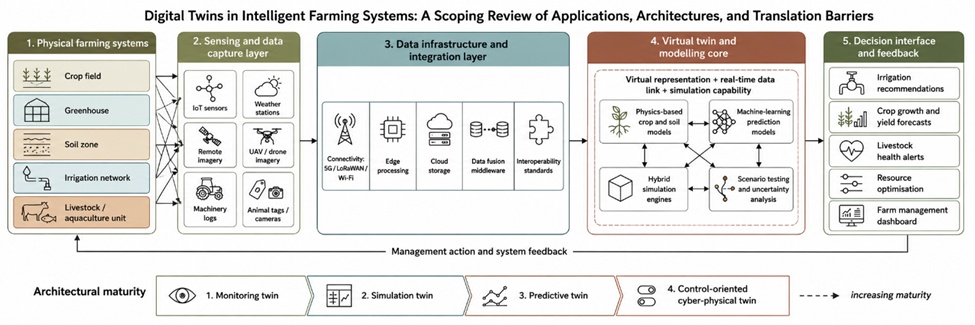
Figure 1. Layered Architecture of Digital Twins in Intelligent Farming Systems: From Physical Farm Data to Virtual Models and Decision Feedback
Crop applications are the most visible area of agricultural digital twin research because crop growth, health, and productivity have long been supported by modelling, sensing, and decision-support traditions. Digital twins in greenhouse horticulture are especially prominent because controlled environments allow tighter integration of climate data, crop response models, and management decisions [4]. Chaux, Sanchez-Londono, and Barbieri demonstrate how controlled-environment agriculture can use a digital twin architecture to optimise productivity through monitored and simulated production conditions [8]. Kim and Heo’s mandarin digital twin further illustrates the potential for crop-specific and even individualised agricultural management when sensor data and virtual representation are closely linked [11].
Soil applications are less developed as explicit digital twins, although soil moisture, nutrient status, carbon dynamics, and root-zone conditions are central to intelligent farming. Much of the soil-related evidence appears indirectly through smart farming, IoT, and big data research that treats soil as one data layer within broader farm analytics [15, 22]. This creates an important gap because soil processes are spatially heterogeneous, temporally dynamic, and difficult to measure continuously. For soil digital twins to mature, future architectures will need stronger integration of proximal sensing, remote sensing, process-based soil models, and uncertainty-aware decision support.
Water and irrigation applications are among the clearest examples of where digital twin thinking can support practical sustainability goals. Alves, Maia, and Lima develop a smart farming digital twin for irrigation management, showing how data-driven modelling and system representation can support water-saving decisions [9]. Such applications are attractive because irrigation systems have measurable inputs, outputs, constraints, and operational decisions that can be represented within a cyber-physical framework. Nevertheless, water-focused twins still face challenges when moving from experimental or controlled settings to diverse farms with variable infrastructure, connectivity, and water governance conditions.
Livestock and aquaculture applications show a smaller but growing digital twin cluster focused on health, behaviour, welfare, and production monitoring. Han, Lin, Clark, Vucetic, and Lomax propose an AI-based digital twin model for cattle caring, indicating how animal data streams can be linked to predictive models and management support [10]. Føre, Alver, Alfredsen, Rasheed, Hukkelås, Bjelland, Su, Ohrem, Kelasidi, Norton, and Papandroulakis extend the discussion to intensive aquaculture, where digital twins may support environmental monitoring, fish welfare, feeding, and production control [12]. Compared with crop and greenhouse systems, livestock twins face additional complexity because animal behaviour, welfare, disease dynamics, and ethical monitoring requirements complicate both modelling and translation.
Technological barriers are the most frequently visible constraints in the agricultural digital twin literature. Digital twins require reliable sensors, stable connectivity, interoperable data formats, calibrated models, and continuous data flows, yet many farms operate with fragmented systems and uneven digital infrastructure [18, 21]. The broader literature on IoT and big data in smart farming shows that data quality, integration, ownership, and interoperability problems predate digital twins and are likely to intensify as architectures become more complex [15, 22]. These issues make it difficult to transform isolated prototypes into dependable farm-scale systems.
Economic barriers are also central because the costs of sensors, connectivity, platforms, modelling expertise, data storage, and maintenance may exceed the perceived benefits for many farms. Dibbern, Romani, and Massruhá identify adoption barriers in digital agriculture that include investment cost, unclear value proposition, and uneven capacity to absorb new technologies [27]. Digital twin systems may face even greater economic scrutiny because they often require multiple layers of infrastructure before benefits become visible. This is especially important for small and medium-sized farms, where return on investment is uncertain and technical risk can discourage adoption.
Organisational and social barriers shape whether digital twins are trusted, used, and embedded in farm decision routines. Klerkx, Jakku, and Labarthe show that digital agriculture adoption is influenced by advisory systems, skills, power relations, institutional arrangements, and farmer agency rather than technology availability alone [16]. Rose and Chilvers argue that responsible innovation is necessary in Agriculture 4.0 because digital systems can reshape who defines problems, who controls data, and who benefits from optimisation [17]. Eastwood, Klerkx, Ayre, and Dela Rue similarly emphasise that smart farming development must address socio-ethical challenges rather than treating farmers as passive users of technical systems [19].
Figure 2 synthesises the interconnected translation barriers that prevent agricultural digital twins from moving from prototype systems to routine farm-level implementation.
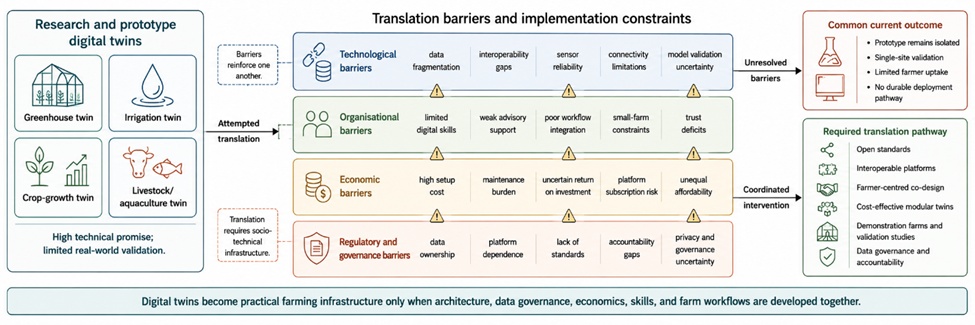
Figure 2. Translation Barrier Map for Agricultural Digital Twins: Why Prototype-Rich Systems Struggle to Become Practical Farming Infrastructure
Regulatory and governance constraints include unresolved questions about data ownership, platform accountability, standards, labour effects, rural inequality, and the distribution of digital benefits. Rotz, Gravely, Mosby, Duncan, Finnis, Horgan, LeBlanc, Martin, Neufeld, Nixon, Pant, Shalla, and Fraser show that automation and digital agriculture can reshape labour and rural communities in unequal ways [28]. Rose, Wheeler, Winter, Lobley, and Chivers argue that Agriculture 4.0 must work for people, production, and the planet, which means translation cannot be measured only through technical performance [29]. Table 2 catalogues the translation barriers and implementation constraints inhibiting digital twin adoption in agriculture.
Table 2. Translation Barriers to Digital Twin Implementation in Farming: Technological, Organisational, Economic, and Regulatory Constraints
Barrier category | Specific constraint | How it affects digital twin implementation | Most affected systems | Implication for translation |
Technological | Fragmented data systems and weak interoperability | Prevents continuous integration of sensor, machinery, weather, crop, and livestock data | Whole-farm twins, multi-platform systems, supply-chain-linked twins | Requires open architectures, shared data models, and interoperability standards |
Technological | Sensor reliability, calibration, and durability | Reduces confidence in real-time representation of physical farm conditions | Field crops, soil monitoring, livestock housing, aquaculture | Requires robust low-maintenance sensing systems and validation protocols |
Technological | Connectivity gaps and latency | Limits real-time or near-real-time feedback, especially in rural and remote areas | Irrigation, autonomous machinery, livestock, distributed field systems | Requires hybrid edge-cloud designs and rural connectivity investment |
Organisational | Limited digital skills and advisory capacity | Makes it difficult for farms to interpret, maintain, and act on digital twin outputs | Small and medium-sized farms, mixed farms, low-resource settings | Requires training, advisory intermediaries, and farmer-centred interface design |
Organisational | Poor workflow integration | Digital twin insights may not align with actual timing, labour routines, or decision authority | Greenhouse management, irrigation scheduling, animal health monitoring | Requires co-design with farmers, advisors, technicians, and service providers |
Economic | High implementation and maintenance cost | Creates uncertainty about whether benefits justify investment | Sensor-intensive and control-oriented twins | Requires modular, scalable, and cost-effective twin architectures |
Economic | Uncertain return on investment | Reduces willingness to adopt systems whose benefits are long-term, indirect, or difficult to quantify | Sustainability-oriented, soil, climate adaptation, and whole-farm twins | Requires demonstration projects and economic evaluation across farm types |
Regulatory and governance | Data ownership and platform dependence | Raises concerns about who controls farm data, models, recommendations, and value extraction | Platform-based smart farming ecosystems | Requires transparent contracts, data rights, and governance frameworks |
Regulatory and governance | Lack of standards and accountability mechanisms | Makes it difficult to compare, certify, audit, or regulate digital twin systems | Autonomous, predictive, and decision-support twins | Requires sector-level standards, auditability, and accountability rules |
The mapped evidence shows a field that is conceptually energetic but practically uneven. Agricultural digital twins are increasingly framed as advanced cyber-physical systems, yet many reported designs remain closer to connected monitoring, simulation, or decision-support prototypes than fully operational digital twins [1, 2, 6]. This does not reduce their relevance, but it indicates that the field is still negotiating the boundary between ordinary digital agriculture and digital twin-based intelligent farming. The scoping synthesis therefore positions digital twins as an emerging architecture of integration rather than a mature category of deployed farm technology.
Three clusters dominate the literature: conceptual and review-oriented work, architecture and platform design, and domain-specific prototypes. Conceptual and review papers clarify the meaning of digital twins in agriculture, greenhouse horticulture, smart farming, and sustainability contexts [3-7]. Architecture-focused studies provide the underlying logic of IoT, systems design patterns, communication infrastructure, and modelling frameworks needed to construct twins [14, 21, 24-26]. Application papers then show how this logic is being tested in controlled-environment agriculture, irrigation, cattle care, mandarin production, aquaculture, and autonomous agricultural vehicles [8-13, 23].
The major gap is not a lack of technical imagination but a lack of translation evidence across real farms, seasons, users, and institutional settings. Adoption studies in digital agriculture show that infrastructure, cost, skills, trust, labour, ethics, and governance shape whether digital tools become meaningful in practice [16, 17, 19, 27-29]. Digital twin research often acknowledges these issues but rarely designs implementation pathways around them from the beginning. As a result, the field remains prototype-rich but application-poor, with strong potential for integration but limited evidence of durable farm-level transformation.
The research agenda should prioritise clearer definitions, stronger validation, and more realistic architectural design. Future studies should distinguish monitoring systems, simulation platforms, predictive dashboards, and fully coupled digital twins so that claims are not overstated [1, 26]. Validation should move beyond laboratory demonstrations and single-case prototypes toward multi-season, multi-farm, and multi-context assessment, especially for irrigation, crop growth, livestock, and aquaculture systems [9-12]. Research should also test lightweight and modular digital twins that can operate under limited connectivity, limited data availability, and constrained farm budgets.
A second research priority is the development of hybrid modelling strategies that combine mechanistic understanding with data-driven learning. Greenhouse, crop, irrigation, and livestock twins require models that can represent biological processes while also adapting to real-time sensor data and farm-specific conditions [4, 8, 10, 11]. Hybrid designs may be particularly useful because purely data-driven models can struggle when data are sparse, biased, or non-transferable across farms. Work on IoT architectures, 5G connectivity, and systems design patterns provides a technical foundation, but the next step is to link these foundations to practical implementation and evaluation [14, 21, 22, 25].
The practice agenda should focus on enabling conditions rather than expecting farms to adopt complex twins independently. Open data standards, interoperable platforms, trusted advisory services, farmer training, and demonstration projects are needed to reduce the translation burden [16, 18, 27]. Responsible innovation frameworks should be embedded into digital twin development so that data rights, farmer agency, labour effects, and rural equity are addressed before systems scale [17, 19, 28, 29]. Practical progress will depend on interdisciplinary development teams that include farmers, engineers, agronomists, animal scientists, data scientists, advisors, platform providers, and governance specialists.
This scoping review mapped digital twins in intelligent farming systems across applications, architectures, and translation barriers. The evidence shows that agricultural digital twins are being developed as integrative cyber-physical systems that connect farm data, virtual models, simulations, and decision interfaces. Their strongest current presence is in crop, greenhouse, irrigation, livestock, aquaculture, and autonomous machinery applications.
The review also shows that the field remains concentrated at the prototype and conceptual stage. Digital twin architectures are becoming more sophisticated, but routine farm deployment is limited by data fragmentation, sensor reliability, connectivity gaps, cost, skills, workflow integration, data governance, and standards. These barriers are interconnected, meaning that technical progress alone will not be sufficient to move digital twins into everyday farming practice.
The central contribution of this review is a structured map of where agricultural digital twin research stands and what must happen next. Future progress requires practical architectures, stronger validation, open standards, farmer-centred design, and governance frameworks that protect both innovation and agricultural livelihoods. Digital twins may become important infrastructure for intelligent farming, but only if they are developed as usable, accountable, and context-sensitive systems rather than as isolated technological demonstrations.
None
None
None
None
Open Access The author(s) retain copyright. This article is licensed under the Creative Commons Attribution-NonCommercial-ShareAlike 4.0 International License. It may be shared and adapted for non-commercial purposes with appropriate attribution, an indication of changes, and distribution of adaptations under the same license. Third-party material may be subject to separate terms identified in its credit line. View the license at https://creativecommons.org/licenses/by-nc-sa/4.0/.
 Agro Intelligence Research Press