The convergence of artificial intelligence and the Internet of Things is creating new possibilities for adaptive farming systems. In agricultural settings, this convergence allows sensor networks, machine learning models, communication infrastructures, and automated decision support tools to operate as interconnected cyber-physical systems. Yet many current smart farming architectures remain technically fragmented and do not fully connect operational decisions with sustainability feedback. A central problem is that sensing, intelligence, agronomic reasoning, and sustainability assessment are often treated as separate system layers. Sensor data may support monitoring, machine learning may support prediction, and sustainability indicators may be reported after implementation, but these functions are rarely organised as a continuous adaptive loop. This separation limits the ability of farming systems to learn from environmental consequences and adjust decisions in real time. This article proposes a conceptual architecture for AIoT-enabled adaptive farming systems. The architecture integrates distributed sensor networks, edge-based intelligence, agronomic knowledge models, and sustainability feedback mechanisms into a closed-loop system. It is designed for farming environments where decisions must be locally responsive, scientifically grounded, and aligned with long-term resource stewardship. The article is based on a conceptual design synthesis of peer-reviewed literature published. The synthesis draws on agricultural IoT, edge computing, machine learning, crop monitoring, remote sensing, smart farming platforms, and sustainability-oriented digital agriculture. No new empirical data are presented. The resulting architecture specifies four interacting layers: sensing, edge intelligence, agronomic knowledge integration, and sustainability feedback. It defines how sensor observations move through edge analytics and knowledge-informed decision support before being evaluated against sustainability indicators that feed back into future control actions. The article contributes a systems blueprint for adaptive farming architectures that are not only intelligent and data-driven but also environmentally responsive and sustainability-oriented.
Artificial intelligence of things has become a central concept for intelligent agriculture because it joins distributed sensing, networked devices, machine intelligence, and decision support within a single cyber-physical logic. Earlier smart farming research emphasised the value of agricultural data streams and the need to transform fragmented farm observations into actionable knowledge, especially as digital agriculture expanded across field, greenhouse, livestock, and supply-chain contexts [1]. The growing use of machine learning in agriculture further shows that predictive models can support yield estimation, disease detection, irrigation scheduling, and resource optimisation when connected to relevant data infrastructures [2, 3]. However, the architectural question is no longer whether agriculture can be digitised, but how sensing, inference, knowledge, and feedback should be organised into adaptive systems.
Current smart farming architectures often represent sustainability as a downstream performance outcome rather than as an active feedback signal in the control system. Digital agriculture studies have shown that smart farming platforms increasingly combine sensing, connectivity, analytics, and management interfaces, but many remain focused on technical monitoring or decision automation rather than adaptive sustainability governance [4, 5]. This creates a structural gap between operational farm intelligence and long-term environmental objectives, because water use, soil condition, carbon implications, and biodiversity effects may be assessed separately from real-time decisions. In an adaptive AIoT architecture, sustainability indicators should not merely evaluate the system after decisions are made; they should shape how future decisions are recommended, constrained, and revised.
The aim of this article is to propose a conceptual architecture for AIoT-enabled adaptive farming systems that closes the loop from sensors to sustainability feedback. The architecture is positioned within debates on digital agriculture, smart farming, Agriculture 4.0, and the social and technical reconfiguration of farm decision-making [6, 7]. It links four layers: distributed sensor-based monitoring, edge intelligence for local inference, agronomic knowledge integration for domain-grounded reasoning, and sustainability feedback for adaptive control. By combining these layers, the article develops a system design that treats intelligent farming as an evolving feedback process rather than a sequence of isolated digital tools.
The article proceeds by first situating AIoT within intelligent agriculture and identifying why integrated architectures are needed. It then examines sensor-based farm monitoring as the observational foundation of adaptive farming, including in-situ, aerial, and remote sensing data sources [8, 9]. The later sections develop the roles of edge intelligence, agronomic knowledge integration, sustainability feedback, and the proposed conceptual architecture. The contribution is a forward-looking systems design that can guide research, platform development, pilot implementation, and future evaluation of adaptive AIoT farming systems.
AIoT in agriculture builds on the maturation of IoT infrastructures that connect sensors, machines, weather stations, mobile devices, drones, and farm management platforms. Reviews of agricultural IoT show that smart farming increasingly depends on heterogeneous sensing and communication systems capable of collecting field-level data across variable spatial and temporal scales [7, 9]. At the same time, data-driven agricultural intelligence has expanded through machine learning and deep learning methods that convert images, sensor readings, and historical farm records into predictions and recommendations [2, 3]. AIoT therefore represents a shift from connected monitoring toward connected intelligence, where data acquisition and automated reasoning become mutually dependent.
The agricultural value of AIoT lies in its capacity to support real-time, localised, and context-aware decisions. Smart farming platforms based on edge and cloud computing already show how computation can be distributed between local devices and remote services to improve responsiveness and reduce dependence on centralised processing [5]. Communication technologies, including low-power wide-area networks and emerging high-bandwidth infrastructures, are important because agricultural environments often involve remote locations, intermittent connectivity, and dispersed assets [10]. These constraints make AIoT architectures especially relevant for farming systems that require timely decisions under environmental uncertainty.
Despite these advances, existing architectures remain incomplete when they do not integrate agronomic reasoning and sustainability feedback into the same adaptive cycle. Agriculture 4.0 literature often describes technologies such as sensors, robotics, cloud platforms, artificial intelligence, and digital services as parts of a broader transformation, yet the system-level integration of these elements remains uneven [11-13]. Reviews of smart farming technologies also identify persistent challenges related to interoperability, scalability, data quality, user adoption, and environmental relevance [14, 15]. The conceptual gap addressed here is the absence of an architecture that systematically joins AIoT sensing, edge inference, agronomic knowledge, and sustainability feedback as a continuous adaptive control system.
The sensing layer is the observational foundation of AIoT-enabled adaptive farming. It includes in-situ soil probes for moisture, temperature, salinity, and nutrients; plant sensors for canopy condition and stress; local weather stations for microclimate monitoring; machinery-mounted sensors for operational data; and imaging systems for crop and field assessment [9, 16]. These technologies provide the raw signals from which edge intelligence can infer crop status, resource demand, disease risk, and management needs. Without reliable sensor-based monitoring, adaptive control becomes speculative rather than evidence-driven.
Sensor technologies differ substantially in the variables they capture and the decisions they can support. Soil moisture sensors may inform irrigation timing, nutrient sensors may guide fertilisation, weather stations may support pest and disease risk models, and remote sensing may detect spatial variability in crop vigour across larger areas [16, 17]. Drone and satellite imagery expand the scale of observation, while ground sensors improve temporal continuity and local precision. The architecture proposed in this article therefore treats sensing not as a single input channel, but as a multi-resolution data acquisition layer that must combine fixed, mobile, proximal, and remote observations.
Data quality is a major architectural concern because agricultural sensor data are exposed to environmental noise, calibration drift, connectivity loss, missing values, and spatial heterogeneity. Studies of IoT-enabled smart farming emphasise that sensor networks must be designed for robustness, energy efficiency, interoperability, and field-level reliability rather than laboratory conditions [7, 10]. AI-based decision support can only be trustworthy when the underlying data pipeline includes validation, cleaning, synchronisation, metadata management, and uncertainty handling. Table 1 classifies the sensor technologies and their data characteristics for AIoT-enabled adaptive farming.
Table 1. Sensor Technologies for AIoT-Enabled Adaptive Farming: Types, Variables, Spatial-Temporal Resolution, and Data Quality Considerations
Sensor technology | Main variables captured | Typical spatial-temporal resolution | Role in adaptive farming | Data quality considerations |
Soil moisture and temperature probes | Volumetric water content, soil temperature, soil moisture dynamics | Point-level observations with high temporal frequency | Supports irrigation scheduling, drought stress detection, and local water-use adjustment | Requires calibration by soil type; vulnerable to placement bias, sensor drift, and missing data |
Soil nutrient and salinity sensors | Nitrogen, phosphorus, potassium proxies, electrical conductivity, salinity | Point-level or zone-level readings, often periodic rather than continuous | Supports fertilisation planning, nutrient stress identification, and salinity management | Nutrient measurements may be indirect; affected by soil chemistry, moisture, and calibration limits |
Weather stations and microclimate sensors | Air temperature, humidity, rainfall, wind, solar radiation, evapotranspiration proxies | Farm-level or field-level readings with frequent time intervals | Supports disease risk, irrigation demand, frost alerts, heat stress monitoring, and operational planning | Sensor siting affects representativeness; extreme events can cause gaps or measurement errors |
Plant and canopy sensors | Leaf temperature, chlorophyll proxies, canopy reflectance, crop stress signals | Plant-level, row-level, or canopy-level observations with variable frequency | Supports crop stress detection, phenology tracking, and localised management actions | Signals can be confounded by cultivar, growth stage, light conditions, and sensor orientation |
Drone imagery | Multispectral, RGB, thermal, and vegetation index data | High spatial resolution with campaign-based temporal frequency | Supports within-field variability mapping, pest and disease scouting, and crop vigour assessment | Weather, flight altitude, image stitching, illumination, and processing pipelines affect reliability |
Satellite imagery | Vegetation indices, land surface temperature, crop cover, biomass proxies | Moderate to coarse spatial resolution with recurring revisit cycles | Supports regional monitoring, seasonal trend analysis, and broad spatial benchmarking | Cloud cover, revisit limitations, mixed pixels, and atmospheric correction influence data quality |
Machinery and implement sensors | Seeding rate, yield monitor data, fuel use, application rate, equipment status | Operation-level or pass-level data linked to machinery movement | Supports variable-rate operations, field performance mapping, and operational efficiency feedback | Requires georeferencing accuracy, equipment calibration, and integration with farm records |
Livestock and environmental sensors | Animal movement, feeding behaviour, housing climate, water use, physiological proxies | Animal-level or facility-level observations with high temporal frequency | Supports welfare monitoring, feed optimisation, disease alerts, and resource management | Data may be affected by sensor attachment, animal behaviour, battery life, and network coverage |
Sensor fusion is necessary because no single sensing modality can represent the full biophysical and operational complexity of farming. Remote sensing applications in precision agriculture demonstrate the value of spatially extensive observation, but they must often be complemented by ground measurements to interpret stress, soil variability, and management causes [16]. Similarly, crop data management research shows that agricultural decision systems require integration across sensor streams, farm records, platform data, and contextual knowledge [8]. The sensor layer in the proposed architecture therefore performs not only data collection but also alignment, filtering, and contextualisation before data are passed to edge intelligence and agronomic reasoning layers.
Edge intelligence is the computational layer that allows AIoT-enabled farming systems to process data close to where it is generated. In agriculture, this matters because farm decisions often need to be made under time pressure, such as when irrigation demand changes rapidly, disease risk increases, or machinery operations must be adjusted during fieldwork [5]. Cloud platforms remain valuable for long-term storage, model training, and cross-farm analytics, but relying only on cloud computation can create latency and connectivity problems in rural environments [18]. Edge computing therefore supports a more resilient architecture in which local inference can continue even when network access is limited.
The edge layer converts sensor streams into immediate decision-relevant signals. For example, local machine learning models can estimate irrigation need, classify crop stress, detect disease symptoms, or forecast short-term operational demand using data from soil sensors, weather stations, imagery, and farm records [2, 19]. This capability is especially important for adaptive farming because decisions must be responsive to local biophysical conditions rather than delayed by centralised processing. Edge intelligence also reduces unnecessary data transmission by filtering, compressing, or summarising raw sensor data before they are sent to cloud services.
A key design challenge is balancing model complexity with field deployability. Deep learning has demonstrated strong potential in agricultural image analysis and prediction tasks, but edge devices often face limits in processing power, energy availability, storage, and maintenance capacity [2, 18]. Lightweight models, model compression, federated updates, and selective cloud-edge partitioning can help align computational intelligence with practical farm constraints. The proposed architecture therefore treats edge intelligence as a distributed decision engine rather than a single device or algorithm.
Real-time decision support should not be understood as full automation without agronomic oversight. AI-based agricultural systems can improve irrigation, pesticide use, yield prediction, and input management, but their outputs must be interpreted through farm context, crop stage, environmental risk, and management objectives [17, 20]. In the proposed architecture, edge intelligence produces provisional recommendations, alerts, risk scores, and control signals that are then checked against agronomic knowledge and sustainability feedback. This design prevents edge AI from becoming an isolated optimisation layer disconnected from scientific and environmental reasoning.
Agronomic knowledge integration is the layer that connects data-driven intelligence with established crop science, management principles, and biological constraints. Sensor data and machine learning predictions are useful, but they do not automatically explain whether a detected pattern is agronomically meaningful or whether a recommended intervention is appropriate for a crop’s growth stage [8]. Crop yield prediction research shows that machine learning models can identify powerful statistical relationships, yet such models require careful interpretation because yield outcomes are shaped by weather, soil, cultivar, management, pests, and temporal interactions [19]. Agronomic knowledge therefore provides the interpretive structure needed to make AIoT recommendations scientifically grounded.
This knowledge layer can include crop phenology models, irrigation thresholds, nutrient management rules, pest and disease risk models, weather-based advisory logic, and local best-practice guidelines. Precision agriculture research has shown that remote sensing and sensor data become more useful when connected to crop growth processes and management zones rather than interpreted as isolated indicators [16]. In adaptive farming systems, agronomic knowledge helps transform observations such as canopy stress, soil water deficit, or disease probability into context-sensitive management options. It also allows the architecture to distinguish between short-term anomaly detection and biologically significant changes requiring intervention.
Hybrid intelligence is central to the proposed architecture because it combines data-driven models with codified agronomic constraints. AI can identify patterns from sensor streams, but agronomic rules can restrict unsafe recommendations, explain plausible causes, and prioritise interventions according to crop stage, environmental risk, and production goals [3, 17]. This is particularly important where AI outputs conflict with farmer experience or where model confidence is low. By embedding agronomic knowledge into the decision pathway, the system becomes more transparent, accountable, and adaptable to local farming conditions.
Agronomic knowledge integration also addresses the problem of transferability across farms and regions. Reviews of digital and smart agriculture show that technologies often struggle when moved between different crops, soils, climates, infrastructures, and management cultures [6, 14]. A knowledge-informed architecture can support localisation by adjusting thresholds, rules, models, and decision priorities to specific agroecological contexts. In this sense, the agronomic knowledge layer functions as a translation mechanism between generic AI capability and situated farm decision-making.
The sustainability feedback layer is what distinguishes adaptive AIoT farming from conventional smart monitoring or decision support. Many digital agriculture systems evaluate productivity, efficiency, or input savings, but adaptive control requires sustainability indicators to be monitored continuously and returned to the decision system as feedback signals [1, 13]. These indicators may include water-use efficiency, energy demand, carbon-related proxies, soil health, nutrient loss risk, biodiversity pressure, and resilience under climate variability. When sustainability becomes part of the control loop, the system can revise recommendations based not only on immediate agronomic performance but also on longer-term environmental consequences.
Figure 1 explains how an AIoT-enabled farming system converts real-time observations into adaptive decisions through agronomic validation and sustainability-based learning.
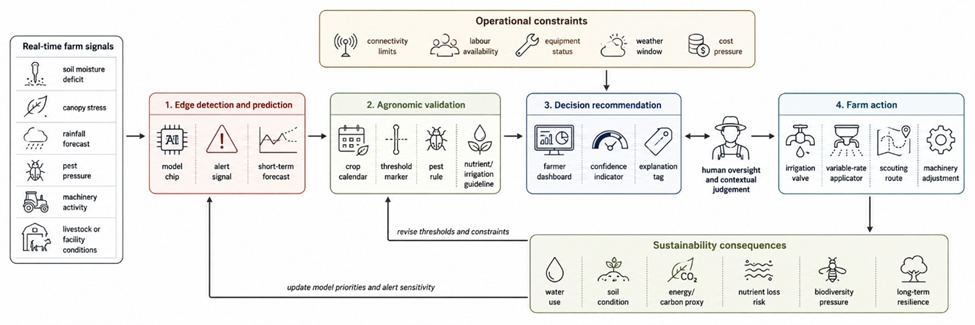
Figure 1. Adaptive Decision Pathway in AIoT-Enabled Farming: From Real-Time Farm Signals to Agronomic Validation, Sustainability Evaluation, and Revised Control Actions
Adaptive control depends on learning from the results of prior decisions. If an irrigation recommendation reduces short-term crop stress but increases water-use intensity beyond acceptable thresholds, the feedback layer should adjust future irrigation logic, thresholds, or optimisation priorities [17]. Similarly, if pest control recommendations reduce disease risk but create unacceptable ecological pressure, sustainability feedback can trigger alternative strategies or require human review. This feedback logic moves AIoT farming beyond technical optimisation toward responsible and environmentally responsive decision-making.
Sustainability feedback also requires multi-scale monitoring because environmental outcomes emerge across different temporal and spatial horizons. Some indicators, such as soil moisture or energy use, can be monitored frequently, while others, such as soil organic matter, biodiversity, or long-term adaptation capacity, require slower and more cumulative assessment [21, 22]. Precision farming at small scale further illustrates that adaptive technologies must remain feasible for diverse farm sizes and resource conditions rather than assuming uniform access to advanced infrastructures [22]. The architecture therefore uses sustainability feedback as both a real-time correction mechanism and a long-term learning layer.
The feedback layer should not operate as a purely technical scoring system. Digital agriculture research shows that adoption, governance, farmer autonomy, data ownership, and institutional arrangements influence whether smart farming systems deliver practical and sustainable value [6, 23]. Therefore, sustainability feedback must be designed with transparent indicators, farmer-adjustable priorities, and explainable trade-offs between productivity, resource conservation, cost, and ecological risk. In the proposed architecture, sustainability feedback closes the loop by sending evaluated outcomes back to the edge and knowledge layers, where future decisions are adapted.
The proposed AIoT-enabled adaptive farming architecture consists of four interacting layers: sensor-based monitoring, edge intelligence, agronomic knowledge integration, and sustainability feedback. The sensing layer captures field, crop, weather, machinery, and environmental data through heterogeneous devices and platforms [9, 24]. The edge intelligence layer performs local processing, anomaly detection, prediction, and short-term decision support using machine learning models deployed near the data source [18, 25]. The agronomic knowledge layer contextualises those outputs using crop models, management rules, phenology logic, and domain constraints.
Figure 2 presents the proposed AIoT-enabled adaptive farming architecture as a closed-loop system linking sensing, edge intelligence, agronomic knowledge, decision support, and sustainability feedback.
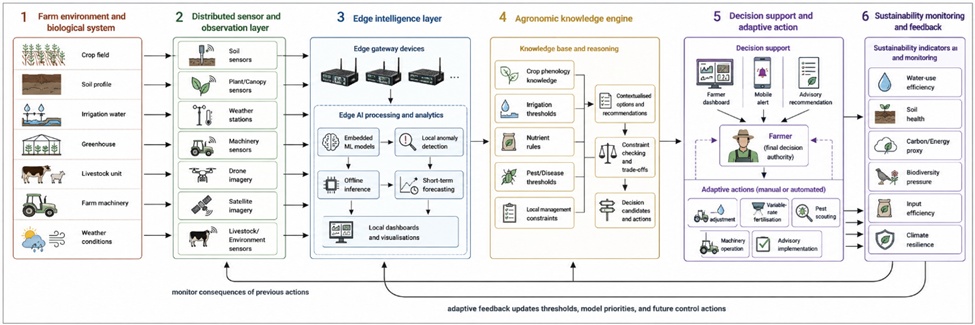
Figure 2. Proposed Closed-Loop AIoT Architecture for Adaptive Farming: Integration of Sensor Networks, Edge Intelligence, Agronomic Knowledge, Decision Support, and Sustainability Feedback
The architecture operates through a continuous data and control flow rather than a linear pipeline. Sensor data are first cleaned, synchronised, and summarised before being processed by edge models that generate alerts, risk scores, and provisional recommendations [5, 10]. These outputs are then evaluated by the agronomic knowledge layer, which checks whether recommendations are consistent with crop stage, soil condition, weather risk, pest thresholds, and management objectives. Decision support outputs are delivered to farmers, farm managers, or automated controllers, while sustainability indicators evaluate the consequences of those decisions.
The distinctive feature of the architecture is the feedback path from sustainability monitoring back into adaptive control. After an action is taken, such as irrigation adjustment, fertiliser application, disease scouting, or variable-rate operation, sustainability indicators are monitored and compared against operational goals and environmental thresholds [13, 26]. The system then updates decision rules, model priorities, alert thresholds, or recommended actions according to observed outcomes. Table 2 presents the proposed conceptual architecture with its layers, components, data flows, and control loops.
Table 2. Proposed AIoT-Enabled Adaptive Farming Architecture: Layers, Components, Data Flows, and Sustainability Feedback Loops
Architecture layer | Core components | Main data flows | Decision function | Sustainability feedback role |
Layer 1: Sensor-based monitoring | Soil sensors, weather stations, plant sensors, drones, satellite imagery, machinery sensors, livestock and facility sensors | Field observations flow into local gateways and edge devices after cleaning, timestamping, georeferencing, and quality screening | Creates the real-time observational foundation for adaptive decisions | Provides baseline data for water, soil, energy, crop, and environmental indicators |
Layer 2: Edge intelligence | Edge gateways, embedded ML models, anomaly detectors, local dashboards, offline inference engines | Cleaned sensor streams flow into edge models that produce alerts, classifications, forecasts, and short-term recommendations | Enables low-latency inference and local decision support under limited connectivity | Adjusts immediate recommendations when resource-use or environmental thresholds are exceeded |
Layer 3: Agronomic knowledge integration | Crop models, phenology rules, pest thresholds, nutrient guidelines, irrigation logic, local management rules | Edge outputs flow into a knowledge engine where AI recommendations are checked against crop science and local agronomic context | Converts AI outputs into biologically meaningful and management-relevant options | Constrains decisions so that productivity gains do not violate agronomic or environmental limits |
Layer 4: Sustainability feedback | Water-use indicators, carbon and energy proxies, soil health metrics, biodiversity risk indicators, resilience indicators | Post-decision outcomes flow back into the edge and knowledge layers as feedback signals | Evaluates whether decisions improve or harm long-term sustainability performance | Closes the adaptive loop by updating thresholds, decision priorities, and future control actions |
Cross-layer governance mechanism | Interoperability standards, data quality protocols, farmer control settings, explainability interfaces, audit trails | Metadata, model outputs, decisions, and feedback records circulate across the full architecture | Supports transparency, traceability, and system-level coordination | Ensures that sustainability feedback remains interpretable, auditable, and adjustable by users |
Adaptive control loop | Sensor → edge intelligence → agronomic knowledge engine → decision support → sustainability monitor → adaptive control → sensor | Continuous loop connecting observation, inference, decision, outcome monitoring, and system adjustment | Enables learning from previous actions and environmental consequences | Turns sustainability from a final evaluation metric into an active driver of future farm decisions |
The architecture is conceptual rather than prescriptive, meaning that its implementation can vary across crop systems, farm sizes, connectivity conditions, and management goals. In a high-connectivity farm, the cloud may support model retraining and cross-season analytics, while the edge layer handles immediate inference and control [5, 18]. In a low-connectivity setting, lightweight edge models and local agronomic rules may be prioritised to preserve operational reliability. Across all settings, the core architectural principle remains the same: adaptive farming requires a closed loop connecting sensors, intelligence, knowledge, decision-making, sustainability evaluation, and revised action.
The first practical implication is that AIoT farming systems should be designed as integrated architectures rather than collections of disconnected digital tools. Developers and farm technology providers need to ensure that sensors, communication protocols, edge devices, decision models, knowledge bases, dashboards, and sustainability indicators can exchange data through interoperable structures [10, 11]. Smart farming architecture research suggests that platform fragmentation remains a major barrier to scalable implementation, especially when devices and software systems cannot communicate effectively [4, 15]. Open interfaces, standardised metadata, and modular design principles are therefore essential for making adaptive AIoT systems practical.
A second implication concerns pilot implementation and validation. The proposed architecture should be tested in real farms across different crops, climate zones, farm sizes, and resource conditions, because smart farming technologies often perform differently outside controlled or prototype environments [14, 22]. Pilot studies should evaluate not only prediction accuracy or system uptime, but also decision usefulness, farmer trust, input efficiency, environmental feedback quality, and adaptability over multiple seasons. Such validation would help determine whether closed-loop AIoT systems can produce sustained agronomic and sustainability benefits.
Future research should develop stronger sustainability feedback metrics and examine how they can be operationalised within real-time decision support. Emerging work on smart agriculture and AIoT highlights the importance of architectures that combine sensing, analytics, connectivity, and adaptive decision-making, but sustainability feedback remains underdeveloped as a formal design component [25, 26]. Researchers should also study governance issues such as data ownership, explainability, accountability, and farmer control, because adaptive systems can reshape decision authority on farms [6]. The next stage of research should therefore move from isolated technical performance toward architecture-level evaluation of adaptive, explainable, and sustainability-responsive AIoT farming.
This article proposed a conceptual architecture for AIoT-enabled adaptive farming systems. Its central contribution is the integration of distributed sensor networks, edge intelligence, agronomic knowledge, and sustainability feedback into a single adaptive control loop. The architecture responds to the fragmentation of existing smart farming systems by treating sustainability not as a final reporting category, but as an active feedback signal that shapes future decisions.
The proposed architecture provides a blueprint for building farming systems that are locally responsive, data-driven, agronomically grounded, and environmentally accountable. It clarifies how sensor observations can move through edge analytics and knowledge-informed decision support before being evaluated through sustainability indicators. This closed-loop logic allows farming systems to learn from the consequences of action and adjust management decisions over time.
Future development of AIoT-enabled adaptive farming should involve collaboration among agronomists, engineers, computer scientists, sustainability researchers, platform developers, and farmers. The architecture should be refined and tested across diverse agroecological contexts, including farms with different connectivity conditions, production systems, and sustainability priorities. Such collaborative validation is necessary if adaptive AIoT farming is to become not only technically intelligent, but also practically useful and environmentally responsible.
None
None
None
None
Open Access The author(s) retain copyright. This article is licensed under the Creative Commons Attribution-NonCommercial-ShareAlike 4.0 International License. It may be shared and adapted for non-commercial purposes with appropriate attribution, an indication of changes, and distribution of adaptations under the same license. Third-party material may be subject to separate terms identified in its credit line. View the license at https://creativecommons.org/licenses/by-nc-sa/4.0/.
 Agro Intelligence Research Press