Agricultural artificial intelligence is increasingly shaped by a precision paradigm that treats good farming as the increasingly fine-grained optimization of inputs, outputs, risks, and operational decisions. This paradigm is attractive because it promises measurable efficiency, predictive control, and scalable decision support across complex farming systems. In climate-sensitive agriculture, however, the same orientation can narrow what counts as a good decision. The problem is that climate-sensitive farming is not merely a technical setting in which better data automatically produce better outcomes. Farmers must act under uncertainty, ecological variability, long time horizons, and ethically contested trade-offs involving productivity, resilience, livelihoods, and environmental stewardship. These conditions expose the limits of optimization as a sufficient guide for responsible agricultural AI. This article develops a conceptual framework that shifts the guiding principle of agricultural AI from precision to prudence. Prudence is understood as practical wisdom: the capacity to deliberate well about what is fitting, responsible, and contextually appropriate when action is necessary but certainty is unavailable. The framework therefore reorients AI from prescribing optimal decisions to supporting wise and accountable judgment. The article is based on a conceptual synthesis peer-reviewed publications across agricultural ethics, responsible innovation, precision agriculture, AI governance, climate adaptation, and science and technology studies. It critiques precision agriculture as an optimization paradigm, articulates prudence as a responsible AI principle, and develops a framework for climate-sensitive decision support. Two tables contrast the precision and prudence paradigms and present the proposed conceptual framework. The central argument is not that agricultural AI should abandon data, modelling, prediction, or decision support. Rather, responsible AI for climate-sensitive farming should use these capacities to enlarge human judgment rather than replace it. A prudent AI system helps farmers deliberate under uncertainty, compare trade-offs, question recommendations, and remain accountable for decisions that are ecological, social, and moral as well as technical.
Agricultural AI has largely developed within a precision paradigm that assumes better farming can be achieved through more granular measurement, prediction, and optimization. Smart farming research has emphasized sensors, platforms, analytics, and automated advice, while social science reviews show that digital agriculture is increasingly framed as an innovation system built around data-intensive decision support [1]. This framing is attractive to AI developers and agribusiness because it converts agricultural complexity into computationally tractable problems of efficiency, targeting, and control.
Yet the promise of precision has also generated ethical and political concerns about what is lost when farming is translated into data streams and optimization targets. van der Burg, Bogaardt, and Wolfert argue that smart farming raises ethical questions about responsibility, autonomy, and the future direction of agricultural innovation [2]. Rose and Chilvers similarly warn that Agriculture 4.0 requires a broader responsible innovation lens rather than a narrow focus on technical performance [3]. The central question is therefore not whether AI can make farming more precise, but what happens when optimization fails in the face of climate uncertainty.
Climate-sensitive farming intensifies this question because decisions are made amid unstable weather, changing pest and disease pressures, contested land-use priorities, and long-term ecological consequences. Tzachor, Devare, King, Avin, and Ó hÉigeartaigh argue that responsible AI in agriculture requires systemic attention to risks and externalities rather than confidence in isolated model performance [4]. If agricultural AI systems are designed mainly to maximize yield, reduce input use, or improve prediction accuracy, they may underrepresent the practical ambiguity and ethical stakes embedded in climate adaptation.
This article proposes prudence as an alternative guiding principle for responsible agricultural AI. Prudence does not reject measurement, prediction, or analytical support, but it refuses to treat optimization as equivalent to good judgment. Building on responsible innovation debates in smart farming [5] and critiques of principle-based AI ethics [6, 7], the article constructs a prudence-based conceptual framework for AI decision-making in climate-sensitive farming.
Precision agriculture is often presented as a corrective to wasteful or generalized farming because it promises to apply the right input, in the right place, at the right time, and in the right amount. This promise depends on the assumption that relevant variation can be detected, modelled, and translated into actionable recommendations. Fielke, Taylor, and Jakku show that digital agricultural advice networks increasingly reorganize knowledge around data infrastructures and advisory platforms [8]. The precision paradigm therefore frames farming as a problem of information resolution: once uncertainty is sufficiently measured, better decisions should follow.
The difficulty is that this framing can reduce farming to the management of measurable variables while backgrounding qualitative, relational, and ethical dimensions of agricultural practice. Duncan, Glaros, Ross, and Nost show how innovation discourses in precision agriculture often privilege novelty and technical progress while leaving open the question of who benefits from these systems [9]. Gardezi and Stock further argue that algorithmic forms of trust in precision agriculture can shift authority toward platforms and computational systems [10]. Optimization may therefore appear neutral while quietly reorganizing expertise, responsibility, and decision power.
Under climate stress, the limits of optimization become more visible because past data may lose predictive value, objectives may conflict, and local conditions may change faster than models can stabilize. Bronson’s responsible innovation analysis shows that engagement with digital farming is uneven, meaning that the benefits and burdens of precision tools are not distributed equally [11]. Jakku, Taylor, Fleming, Mason, Fielke, Sounness, and Thorburn demonstrate that trust in smart farming depends not only on data quality but also on transparency and benefit-sharing [12]. These findings suggest that agricultural optimization is never purely technical; it is embedded in social relations and institutional arrangements.
The critique developed here is not that precision agriculture is useless, but that optimization is ethically insufficient as a governing logic for climate-sensitive AI. Table 1 contrasts the precision optimization paradigm with the prudence paradigm across key dimensions. Fielke, Garrard, Jakku, Fleming, Wiseman, and Taylor conceptualize digital agricultural innovation systems as multi-level arrangements shaped by policy, technology, and institutional coordination [13]. A prudence paradigm begins from this wider setting and asks whether AI supports responsible deliberation rather than merely producing a technically optimized recommendation.
Table 1. Precision Optimization vs. Prudence Paradigm: Contrasting Logics, Assumptions, and Implications for Agricultural AI
Dimension | Precision optimization paradigm | Prudence paradigm | Implication for agricultural AI |
Core question | What is the technically optimal action? | What is the wise and contextually fitting action? | AI should support deliberation, not only calculation. |
Dominant value | Efficiency, prediction, control, productivity | Practical wisdom, responsibility, resilience, stewardship | System goals should include ethical and ecological judgment. |
View of uncertainty | A deficit to be reduced through more data | A condition to be interpreted and lived with responsibly | Interfaces should communicate uncertainty rather than hide it. |
View of farmers | Data providers, adopters, or users of recommendations | Situated decision-makers with tacit and contextual knowledge | AI should strengthen farmer agency and interpretive authority. |
Decision logic | Optimize measurable variables against predefined targets | Compare trade-offs in relation to place, time, values, and consequences | Outputs should present options, assumptions, and consequences. |
Treatment of climate stress | A variable to be forecast or managed | A dynamic source of disruption, ambiguity, and long-term responsibility | Models should avoid false certainty and support adaptive reasoning. |
Accountability model | Responsibility may diffuse across platforms, models, vendors, and users | Responsibility remains visible, contestable, and institutionally supported | AI governance should clarify who answers for outcomes and harms. |
Prudence, or practical wisdom, names the capacity to deliberate well about what should be done in a particular situation when rules, calculations, and predictions cannot fully determine the answer. In the context of agricultural AI, prudence shifts attention from whether a model can optimize a target to whether it helps decision-makers act responsibly under uncertainty. Eastwood, Klerkx, Ayre, and Dela Rue show that smart farming requires a comprehensive approach to socio-ethical challenges rather than fragmented technical fixes [5]. Prudence extends this insight by treating ethical judgment as internal to good decision-making, not as an external constraint added after optimization.
As a responsible AI principle, prudence differs from accuracy, transparency, or fairness because it concerns the quality of situated judgment. Dara, Hazrati Fard, and Kaur propose recommendations for ethical and responsible AI in digital agriculture, including attention to accountability, transparency, privacy, and human responsibility [14]. Those principles are necessary, but prudence asks how they are interpreted in particular farming situations where values conflict and no single metric can define success. Ryan’s mapping of agricultural AI ethics likewise indicates that social and ethical impacts must be considered alongside technical possibilities [15].
Prudence is therefore best understood as judgment under uncertainty rather than optimization under assumed stability. Jobin, Ienca, and Vayena show that AI ethics guidelines frequently converge around abstract principles, while Mittelstadt argues that principles alone cannot guarantee ethical AI without practical mechanisms and judgment [6, 7]. A prudence-based agricultural AI framework answers this problem by connecting principle to practice: it asks how farmers, advisors, developers, and institutions can deliberate responsibly when data are incomplete, consequences are distributed, and climate futures remain uncertain.
Climate-sensitive farming decisions are difficult because they combine ecological variability, economic risk, social obligation, and long-term stewardship within the same act of judgment. A farmer deciding whether to irrigate, delay planting, shift crop varieties, alter grazing patterns, or invest in diversification is not simply selecting the highest predicted output. Waldman, Todd, Omar, Blekking, Giroux, Attari, Baylis, and Evans show that agricultural decision-making under climate uncertainty involves behavioural, informational, and contextual constraints that cannot be reduced to a single optimization rule [16]. The problem is therefore not a lack of data alone, but the need to decide responsibly when the future remains unstable.
Climate-sensitive decisions are also multi-objective because productivity, soil protection, water conservation, livelihood security, and climate resilience may point in different directions. Soubry, Sherren, and Thornton argue that farmer perceptions of climate change must be taken seriously rather than treated as secondary to expert or technical assessment [17]. This matters because climate adaptation decisions often depend on lived experience of local change, not only on externally generated forecasts. AI systems that convert these decisions into narrow prescriptions risk suppressing precisely the interpretive complexity that makes adaptation possible.
The logic of optimization is especially strained when historical data no longer provide a reliable guide to future conditions. Gardezi, Michael, Stock, Vij, Ogunyiola, and Ishtiaque show that climate-smart agriculture involves organizational and temporal priorities, meaning that what appears optimal in the short term may be inadequate for longer-term resilience [18]. A model may recommend a decision based on yield, input efficiency, or immediate profitability while failing to register cumulative ecological risk. Prudence requires that such recommendations be treated as provisional contributions to deliberation, not as authoritative conclusions.
Climate-sensitive farming also involves contested values because different actors may define success differently. Alexander, Yarborough, and Smith argue that building trust in agricultural AI and food-system technology requires careful attention to responsibility and the social conditions under which AI is adopted [19]. When farmers face choices about whether to plant drought-tolerant varieties, conserve scarce water, maintain livestock numbers, or shift land use, the decision carries ethical as well as technical significance. A responsible AI system should therefore clarify uncertainty, trade-offs, and value assumptions rather than presenting a singular optimized answer.
Farmer judgment is not a residue left over after data-driven systems have done their work; it is a central capacity through which agricultural decisions become meaningful, situated, and accountable. Ogunyiola and Gardezi show that big data and algorithms can reshape farmers’ social identities, suggesting that AI systems do not merely support decisions but also affect how farmers understand their own expertise [20]. This is especially important in climate-sensitive farming, where expertise includes memory of land, sensitivity to seasonal anomalies, and practical understanding of local constraints. Prudence therefore begins by recognizing farmer judgment as an irreplaceable element of responsible AI decision-making.
Tacit knowledge and local expertise are valuable because they help interpret signals that may be ambiguous, incomplete, or not yet captured in formal data systems. van der Velden, Klerkx, Dessein, and Debruyne describe precision agriculture through embodied understandings, showing that technological mediation does not eliminate the bodily and experiential dimensions of farming [21]. A farmer may read soil moisture, animal behaviour, wind patterns, or crop stress in ways that exceed modelled categories. AI designed for prudence should make room for this interpretive work rather than treating it as noise.
Contextual adaptation also requires systems that support learning over time rather than enforce rigid prescription. McCampbell, Schumann, and Klerkx show that responsible design in digital agriculture is difficult in complex realities, particularly where social, infrastructural, and institutional conditions shape what technology can responsibly do [22]. This means that AI should be adaptable to farm scale, climate exposure, labour availability, knowledge practices, and local governance. Prudent AI is therefore not a replacement for adaptive management, but a tool that helps farmers reflect, compare, revise, and justify decisions under changing conditions.
Responsible AI discussions commonly emphasize transparency, fairness, accountability, explainability, privacy, and human oversight, and these principles are clearly relevant to agriculture. Dara, Hazrati Fard, and Kaur argue that ethical digital agriculture requires concrete attention to responsible data use, accountability, and human-centred governance [14]. However, the agricultural setting complicates generic AI ethics because farms are ecological workplaces, economic units, family livelihoods, cultural landscapes, and climate-adaptation sites at the same time. Responsible agricultural AI must therefore be evaluated by how it supports wise action in context, not only by whether it satisfies general principles.
The governance challenge is also intensified by data ownership, platform dependence, and uneven power relations in agricultural technology markets. van der Burg, Wiseman, and Krkeljas argue that trust in farm data sharing depends on more than formal permission, because farmers need confidence in how data will be used and who will benefit [23]. Gardezi, Adereti, Stock, and Ogunyiola similarly frame responsible innovation in precision agriculture as a question of how technological development can be oriented toward social responsibility rather than narrow adoption [24]. Prudence adds that responsible AI must preserve the farmer’s capacity to question, reinterpret, and refuse system recommendations.
Existing responsible AI principles are necessary, but they remain insufficient when they are applied as checklists detached from decision practice. Prutzer, Gardezi, Rizzo, Emery, Merrill, Ryan, Oikonomou, Alvez, Adereti, Anjum, Badireddy, Bhattarai, Brugler, Cheney, Clay, Clay, Dadkhah, Faulkner, Joshi, Koliba, McMaine, Michael, Musayev, O’Neil-Dunne, Pinder, Ricketts, Schroth, Turnbull, and Zia show that responsibility in precision agriculture innovation must be rethought through interdisciplinary collaboration and practical engagement [25]. This supports the central argument of this article: agricultural AI should be judged not only by accuracy, adoption, or efficiency, but by whether it improves the quality of deliberation under uncertainty. Prudence therefore functions as the bridge between abstract ethics and situated agricultural judgment.
The proposed framework reorients agricultural AI from precision optimization toward prudential decision support. Its first element is decision contextualisation, which requires AI systems to model uncertainty explicitly and represent decisions in relation to climate exposure, farm constraints, ecological conditions, and farmer-defined priorities. Tzachor, Devare, King, Avin, and Ó hÉigeartaigh argue that responsible agricultural AI requires systemic understanding of externalities, which supports the need to situate model outputs within broader consequences [4]. In this framework, contextualisation prevents AI from presenting an answer as optimal when the underlying situation is unstable, incomplete, or value-laden.
The second element is judgment support, which means AI should offer options, scenarios, assumptions, and trade-offs rather than prescriptions. Gardezi and Stock’s analysis of algorithmic governmentality in precision agriculture shows that trust can be constructed through systems that appear objective while relocating authority into algorithmic infrastructures [10]. To avoid this displacement, prudential AI should make its reasoning contestable and its recommendations revisable. The aim is not to remove expertise from the farmer but to give the farmer better material for practical reasoning.
Figure 1 presents the article’s prudence-based conceptual framework, showing how agricultural AI can move from narrow precision optimization toward context-sensitive judgment support, uncertainty-aware deliberation, and accountable climate-sensitive decision-making.
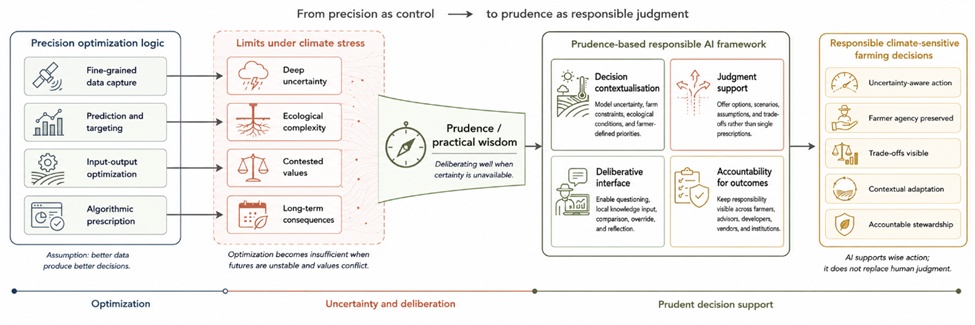
Figure 1. From Precision to Prudence: A Conceptual Framework for Responsible AI Decision-Making in Climate-Sensitive Farming
The third element is a deliberative interface that allows farmers and advisors to question outputs, compare alternatives, add local knowledge, and identify ethical or ecological concerns. Fielke, Taylor, and Jakku show that digital agricultural knowledge and advice networks are changing how advice is produced and circulated [8]. A deliberative interface should therefore be designed not as a command channel but as a space for reflection, dialogue, and situated interpretation. The fourth element is accountability for outcomes, which keeps responsibility visible across farmers, developers, advisors, vendors, and institutions rather than allowing responsibility to dissolve into the system.
The framework’s design principles are uncertainty communication, trade-off visibility, farmer override, contextual learning, data responsibility, and accountable governance. Table 2 presents the proposed conceptual framework for responsible AI decision-making based on the prudence paradigm. These principles build on responsible innovation work in smart farming [3, 5], while responding to the limits of generic AI ethics identified by Jobin, Ienca, and Vayena and by Mittelstadt [6, 7]. The framework therefore treats prudence as an organizing logic for system design, not merely as a philosophical ideal.
Table 2. Proposed Conceptual Framework: From Precision to Prudence — Elements, Decision Logic, and Design Principles for Climate-Sensitive Agricultural AI
Framework element | Core decision logic | AI system role | Farmer role | Design principle | Responsible outcome |
Decision contextualisation | Situate each decision within climate, ecological, economic, and social conditions. | Model uncertainty, local constraints, and scenario boundaries. | Define relevant context, constraints, and priorities. | Make assumptions, uncertainty ranges, and contextual limits visible. | Decisions are grounded in real farming conditions rather than abstract optimization. |
Judgment support | Present possible courses of action and their trade-offs. | Generate options, scenarios, risk profiles, and consequence maps. | Interpret options in relation to experience, values, and farm goals. | Avoid single-answer prescription when uncertainty or value conflict is high. | AI strengthens practical reasoning instead of replacing it. |
Deliberative interface | Enable questioning, reflection, and revision before action. | Explain outputs, allow comparison, invite user correction, and show evidence pathways. | Question, override, annotate, and adapt recommendations. | Design interaction as dialogue rather than command. | Farmer agency and contextual expertise remain central. |
Accountability for outcomes | Keep responsibility traceable across the human-AI system. | Record assumptions, data sources, changes, and recommendation pathways. | Make accountable decisions with awareness of risks and responsibilities. | Clarify roles among farmers, developers, advisors, vendors, and institutions. | Responsibility is visible, contestable, and institutionally supported. |
Contextual adaptation | Support learning as climate and farm conditions change. | Update models with caution, monitor drift, and flag reduced confidence. | Integrate new experience, local observation, and adaptive management. | Treat model performance as conditional and revisable. | AI remains responsive to changing agroecological realities. |
Ethical trade-off governance | Recognize conflicts among yield, resilience, livelihood, equity, and sustainability. | Display trade-offs and affected stakeholders where relevant. | Deliberate about what is fitting, not only what is efficient. | Build value-sensitive evaluation into decision support. | Agricultural AI contributes to wise and responsible climate adaptation. |
For practice, the framework implies that agricultural AI systems should be designed primarily as decision support for prudence rather than as decision automation. Alexander, Yarborough, and Smith’s analysis of responsibility and trust in AI agriculture suggests that confidence in these systems depends on more than performance metrics [19]. Interfaces should communicate confidence levels, uncertainty ranges, scenario assumptions, and trade-offs in language that farmers can interrogate. Training should likewise cultivate AI-augmented practical wisdom, helping farmers use models critically rather than defer to them passively.
For developers and agribusiness, the framework requires a shift from product claims of optimization toward design practices that preserve farmer agency and contextual adaptation. Gardezi, Joshi, Rizzo, Ryan, Prutzer, Brugler, and Dadkhah identify both challenges and opportunities for building trust in AI farming, making clear that trust is relational and institutional as well as technical [26]. Developers should therefore test not only whether systems predict accurately, but whether they improve deliberation, reveal uncertainty, and support responsible action. Vendors should also avoid interface designs that conceal assumptions or pressure farmers toward automated compliance.
For research, the prudence framework opens new questions about how agricultural AI can be evaluated beyond accuracy, yield, and input efficiency. Ryan’s review of the social and ethical impacts of agricultural AI shows the need for deeper work on how AI reshapes agricultural practice, power, and responsibility [15]. Future studies should compare prudence-oriented systems with precision-oriented systems, examine how farmers interpret uncertainty displays, and investigate how deliberative interfaces affect agency, trust, and climate adaptation. Philosophical research is also needed to connect practical wisdom with AI governance in ways that are concrete enough to guide design.
This article has argued that the shift from precision to prudence is both a critique of dominant agricultural AI and a constructive proposal for responsible decision-making in climate-sensitive farming. Precision remains valuable when it improves observation, modelling, and awareness, but it becomes insufficient when it equates good farming with technical optimization. Climate-sensitive agriculture requires a wider account of good judgment.
The proposed prudence framework does not reject artificial intelligence, data, or predictive modelling. It seeks to civilise them within the practical, ethical, and ecological demands of farming under uncertainty. Responsible AI should help farmers deliberate, compare, question, adapt, and remain accountable for decisions whose consequences extend beyond immediate performance metrics.
A broader conversation is therefore needed about what “good AI” means in agriculture. Good AI is not only accurate, efficient, scalable, or precise. In climate-sensitive farming, good AI must also be prudent: capable of supporting wise, situated, and responsible action when certainty is unavailable and the stakes are high.
None
None
None
None
Open Access The author(s) retain copyright. This article is licensed under the Creative Commons Attribution-NonCommercial-ShareAlike 4.0 International License. It may be shared and adapted for non-commercial purposes with appropriate attribution, an indication of changes, and distribution of adaptations under the same license. Third-party material may be subject to separate terms identified in its credit line. View the license at https://creativecommons.org/licenses/by-nc-sa/4.0/.
 Agro Intelligence Research Press