Artificial intelligence is increasingly presented as a transformative force in agriculture, promising more precise decisions, better resource use, improved productivity, and more resilient farming systems. Yet much of this promise has been shaped around large-scale, capital-intensive, data-rich farms in high-income settings. This creates a structural mismatch between dominant agricultural AI imaginaries and the everyday realities of smallholder farming. Smallholder farmers operate under conditions that are often treated as barriers to technological adoption rather than as core design conditions. Limited connectivity, intermittent electricity, restricted access to smartphones, low disposable income, linguistic diversity, and uneven access to advisory support all shape how digital tools are encountered and used. When these realities are ignored, agricultural AI risks widening rather than narrowing existing inequalities. This article develops a Smallholder-Centred AI Model for agriculture. The model reorients agricultural AI around four foundational principles: low-resource design, inclusion and affordability, context-awareness, and farmer participation. It argues that these principles must not be added after technical development but must structure the design, governance, and evaluation of AI from the beginning. The article concludes that AI can serve smallholder agriculture only when smallholders are positioned as active participants in the intelligence of the system. A smallholder-centred approach requires technologies that work with limited infrastructure, respond to local agroecological and social contexts, respect farmer knowledge, and remain affordable and accountable. The future of agricultural AI must therefore be judged not only by predictive accuracy but by its capacity to support inclusive, locally grounded, and farmer-led transformation.
Artificial intelligence is rapidly becoming part of the global agricultural transformation, but this transformation is unevenly distributed. Reviews of smart farming and digital agriculture show that much of the technical and institutional architecture of agricultural AI has been developed around data-intensive production systems, platform integration, and large-scale farm management [1]. This raises a central development question: what would AI in agriculture look like if it were designed for and with smallholder farmers rather than adapted to them after the fact? The answer requires moving beyond technological diffusion and toward a conceptual model that treats smallholder realities as the starting point of design.
Smallholders remain central to global food systems, yet their contributions are often underestimated in digital agriculture debates. Lowder, Sánchez and Bertini show that small farms continue to occupy a crucial place in global agricultural production, while Ricciardi, Ramankutty, Mehrabi, Jarvis and Chookolingo demonstrate that smallholders produce a substantial share of the world’s food [2, 3]. Their significance means that exclusion from AI-enabled agriculture is not a marginal issue but a core question for food security, rural development, and technological justice. If AI systems are built primarily for industrial farms, they risk bypassing the farmers whose livelihoods and production systems are most exposed to climate, market, and infrastructure shocks.
The current literature on digital agriculture already warns that smart farming is not only a technical transition but also a social and institutional transformation. Klerkx, Jakku and Labarthe argue that digital agriculture must be examined through social science lenses that address power, adoption, governance, and knowledge relations [4]. Rose and Chilvers similarly call for responsible innovation in Agriculture 4.0, while Rose, Wheeler, Winter, Lobley and Chivers emphasise that smart farming must work for people, production, and the planet [5, 6]. These arguments are especially important for smallholder settings, where the costs of exclusion are intensified by poverty, infrastructure gaps, and dependence on agriculture for livelihoods.
This article proposes a Smallholder-Centred AI Model as a conceptual and practical alternative to mainstream AI approaches in agriculture. The model draws from digital agriculture scholarship, ICT4D evidence, and critical development perspectives to argue that low-resource design, inclusion, affordability, context-awareness, and farmer participation should form the foundation of agricultural AI [7, 8]. Rather than asking how smallholders can be prepared for existing AI systems, the article asks how AI systems must be redesigned to become usable, meaningful, and accountable in smallholder farming contexts. This reframing positions smallholders not as passive beneficiaries of innovation but as co-producers of agricultural intelligence.
Smallholder agriculture is not simply a smaller version of industrial farming. It is often characterised by small and fragmented plots, mixed cropping, family labour, limited capital, seasonal liquidity constraints, and dependence on local ecological knowledge [2, 3]. These conditions shape how farmers make decisions and how they evaluate the usefulness of external advice. Agricultural AI designed for uniform fields, continuous data streams, and high-capital machinery therefore begins from assumptions that often do not match smallholder realities.
The diversity of smallholder systems is a fundamental design parameter for AI. Farms may combine crops, livestock, off-farm labour, informal markets, seed saving, shared machinery, and community-based decision-making, which means that optimisation cannot be reduced to yield alone [4]. Wolfert, Ge, Verdouw and Bogaardt show that big data in smart farming depends on data integration, platform infrastructure, and organisational capacity that are unevenly available across farming systems [1]. For smallholders, an AI recommendation is useful only if it fits labour availability, input affordability, weather uncertainty, household priorities, and local market access.
Mainstream agricultural AI often frames smallholder constraints as adoption barriers, but a smallholder-centred perspective treats them as design conditions. Studies of digital divides in agriculture show that technology can reshape labour, community relations, and access to opportunity in unequal ways when it is introduced without attention to social context [7]. Bronson’s responsible innovation lens also shows that uneven engagement with digital farming can reproduce existing exclusions when the needs and capacities of less powerful actors are not central to design [8]. In smallholder contexts, therefore, the problem is not only whether farmers adopt AI but whether AI has been designed around the realities farmers actually face.
Figure 1 in-text call-out sentence: Figure 1 illustrates why mainstream agricultural AI is misaligned with smallholder farming realities and how the article reframes those realities as design foundations for smallholder-centred AI.
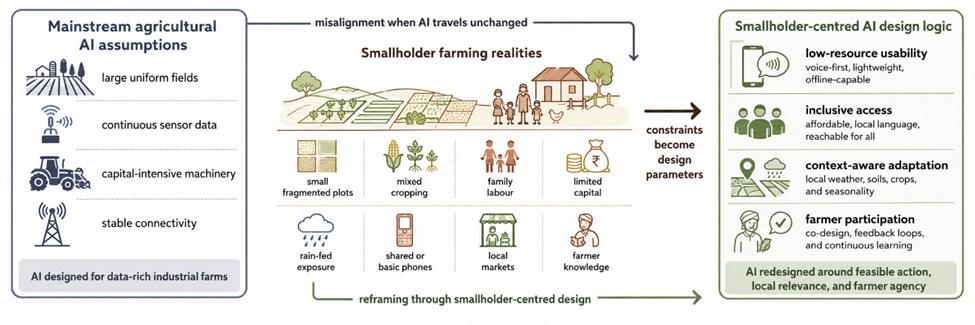
Figure 1. Reframing Smallholder Farming from an AI Adoption Barrier to a Design Foundation for Inclusive Agricultural Intelligence.
Climate and market vulnerability further distinguish smallholder farming as an AI context. Mobile and digital advisory studies in African smallholder settings indicate that farmers often seek information on weather, prices, pests, and timing, but their ability to act on information depends on local resources and institutional support [9, 10]. Quandt, Salerno, Neff, Baird, Herrick, McCabe, Xu and Hartter show that mobile phone use can be associated with productivity benefits, yet such benefits emerge within specific social and infrastructural conditions [11]. A smallholder-centred AI model must therefore link prediction with feasible action rather than assuming that information alone produces transformation.
Low-resource digital agriculture begins from the recognition that connectivity, electricity, devices, literacy, and technical support cannot be assumed. Emeana, Trenchard and Dehnen-Schmutz show that mobile phone-enabled agricultural services have expanded opportunities in Africa, but they also face sustainability challenges related to access, cost, institutional support, and long-term use [12]. Ayim, Kassahun, Addison and Tekinerdogan similarly show that ICT adoption in African agriculture is shaped by infrastructure, skills, trust, relevance, and affordability [13]. These findings suggest that smallholder AI must be lightweight, accessible, and resilient to unreliable digital environments.
Successful low-resource digital tools often rely on channels that are less glamorous than advanced AI but more usable in practice. SMS, voice-based systems, feature phones, shared phones, offline-first applications, and extension-mediated digital services can reduce the distance between digital innovation and everyday farming practice [9, 12]. Krell, Giroux, Guido, Hannah, Lopus, Caylor and Evans demonstrate that smallholder use of mobile phone services depends not only on availability but also on relevance, trust, and fit with existing information-seeking behaviour [10]. For AI design, the lesson is that intelligence should not be equated with interface complexity; the smartest system may be the one that works through the simplest and most reliable channel.
Low-resource design also requires attention to local institutional arrangements. Digital agriculture services may be delivered through cooperatives, input suppliers, extension agents, public platforms, farmer groups, or private intermediaries, each of which affects trust, affordability, and accountability [14, 15]. Agyekumhene, de Vries, van Paassen, Macnaghten, Schut and Bregt show that trust mediates cooperation in digital platforms for smallholder finance, while Daum, Villalba, Anidi, Mayienga, Gupta and Birner show that digital tools for tractor hire depend on local service arrangements rather than software alone [14, 15]. Smallholder-centred AI must therefore be designed as a socio-technical service embedded in rural institutions, not merely as an algorithm delivered to an individual device.
Inclusion is not an automatic outcome of digital agriculture; it must be deliberately designed. Studies of smart farming ethics and responsible innovation show that digital systems can redistribute benefits, risks, and decision-making power in ways that disadvantage farmers with fewer resources [8, 16]. In smallholder settings, exclusion may occur through language, literacy, gendered phone access, age, disability, cost, or distance from advisory networks. A smallholder-centred AI model therefore treats inclusion as a design requirement rather than as a later implementation concern.
Gender and social difference are especially important because digital access is often mediated through household and community power relations. Hackfort’s review of inequalities in digital agriculture shows that data-driven technologies may reproduce unequal access to information, markets, land, and institutional support when social structures are ignored [17]. Digital agriculture in the Global South must therefore avoid assuming a single universal “farmer user” who owns a smartphone, reads dominant languages, controls farm decisions, and can pay for recurring digital services. Inclusive AI must recognise that farmers are socially differentiated and that technology can deepen inequality when designed for the already connected.
Affordability is equally central to inclusion. Birner, Daum and Pray show that the digital revolution in agriculture is shaped by supply-side actors, business models, platform providers, and market incentives that influence who can access digital services [18]. When AI is delivered mainly through private subscriptions, proprietary platforms, or high-cost devices, smallholders may be reduced to data sources rather than empowered users. More inclusive models could include cooperative subscriptions, public extension platforms, shared village-level access points, farmer organisation partnerships, and subsidised public-interest AI.
The inclusion challenge is therefore not only about access to devices but about the terms under which smallholders participate in digital agriculture. Lajoie-O’Malley, Bronson, van der Burg and Klerkx show that dominant digital agriculture futures are often shaped by high-level policy and industry visions that may not fully reflect the priorities of marginalised farmers [19]. Abdulai’s critique of digital agriculture narratives in Sub-Saharan Africa similarly warns that digital farming may become a new form of unequal development if it reinforces neoliberal market dependence rather than farmer capability [20]. A smallholder-centred AI model must therefore measure success through equity, usability, affordability, and farmer agency, not only through adoption rates or algorithmic performance.
Context-awareness is the principle that agricultural AI must be designed around local agroecological, cultural, infrastructural, and market conditions. Generic models trained on data from capital-intensive, temperate, mechanised systems may perform poorly when applied to mixed cropping, rain-fed production, informal markets, and locally specific pest or soil conditions [1, 4]. The issue is not only technical transferability but also social relevance. A recommendation that is agronomically plausible but unaffordable, culturally inappropriate, or impossible under local labour conditions is not useful intelligence.
Smallholder-centred AI must therefore learn from local data without requiring impossible volumes of high-quality digital records. Abdulai argues for digitalisation futures in smallholder farming systems that are grounded in social practice rather than abstract technological modernisation [21]. This implies AI models that can operate with sparse data, farmer feedback, extension observations, seasonal histories, and community validation. Context-adaptive AI should combine limited digital signals with locally meaningful categories, rather than forcing smallholder systems into data structures designed elsewhere.
Context also includes the lived reality of engagement with digital tools. Abdulai, Tetteh Quarshie, Duncan and Fraser show that smallholder farmers in Northern Ghana encounter digital tools through practical realities of access, usefulness, trust, and social mediation [22]. Their findings suggest that digital agriculture is not experienced as a neutral technical layer but as part of everyday farming, household decision-making, and institutional relationships. Context-aware AI should therefore ask whether a model’s output can be understood, trusted, and acted upon within the farmer’s real decision environment [23].
Local adaptation also requires attention to different national and regional pathways of smallholder digitalisation. Xie, Luo and Zhong show that smallholder involvement in digital agriculture in China reflects specific institutional, market, and platform arrangements [24]. This cautions against treating “the Global South” as a single uniform context. The Smallholder-Centred AI Model therefore proposes modularity: core design principles remain constant, while interfaces, data sources, advisory channels, governance arrangements, and affordability mechanisms are adapted to each local setting.
Farmer participation is central because smallholders possess situated knowledge that AI systems do not automatically capture. This knowledge includes soil behaviour, seasonal signals, seed performance, pest histories, livestock interactions, labour timing, water availability, and informal market intelligence. McCampbell, Schumann and Klerkx show that good intentions in digital agriculture can fail when design processes do not adequately engage with the complexity of low-income farming realities [25]. A smallholder-centred approach therefore begins by involving farmers in defining the problem before building the digital solution.
Participation must extend beyond consultation into co-design, interpretation, and revision. McCampbell, Adewopo, Klerkx and Leeuwis show that farmer readiness to use phone-based agronomic advice depends on whether digital tools align with farmer capacities, expectations, and advisory needs [26]. This means that farmers should help shape the form of the question, the acceptable types of evidence, the preferred interface, and the interpretation of outputs. AI becomes more useful when farmers can challenge, correct, and contextualise its recommendations.
Local knowledge also provides a pathway toward hybrid intelligence. In this model, intelligence is not located only in the algorithm but in the interaction between farmer judgement, community experience, extension knowledge, and computational pattern recognition. Etwire, Buah, Ouédraogo, Zougmoré, Partey, Martey, Dayamba and Bayala show that weather and market information services are valuable when they connect to farmers’ practical decisions and trusted communication channels [9]. The same principle applies to AI: prediction must be converted into locally meaningful advice through human interpretation and feedback.
Farmer-to-farmer learning can strengthen this hybrid intelligence by validating AI recommendations through community experience. Digital tools may support learning networks, but they should not replace local deliberation or collective knowledge exchange [10, 11]. Gumbi, Gumbi and Twinomurinzi’s review of sustainable digital agriculture for smallholder farmers highlights the importance of sustainability, usability, and socio-technical fit in smallholder digital systems [27]. A participatory AI system should therefore include mechanisms for farmer feedback, community review, correction of wrong recommendations, and continuous adaptation to local experience.
The proposed Smallholder-Centred AI Model is organised around four interacting layers: a Low-Resource Interface Layer, a Context-Adaptation Layer, a Participatory Knowledge Layer, and an Inclusive Governance Layer. These layers respond directly to evidence that digital agriculture must be treated as a socio-technical system shaped by infrastructure, institutions, power, and user capability [4, 16]. The model rejects the assumption that agricultural AI can simply be transferred from high-resource farms to smallholder contexts. Instead, it treats smallholder constraints and knowledge systems as the architecture within which AI must operate.
The Low-Resource Interface Layer ensures that farmers can interact with AI through accessible channels such as voice, image capture, SMS, interactive voice response, assisted extension interfaces, or offline-first applications. This layer draws on evidence that mobile-enabled agricultural services can expand access but must address affordability, sustainability, trust, and usability [12, 13]. It also recognises that many smallholders may share devices, have limited literacy, or depend on intermittent connectivity. The interface should therefore minimise text, reduce data requirements, support local languages, and remain functional when internet access is unreliable.
Figure 2 presents the operational architecture of the proposed Smallholder-Centred AI Model and shows how low-resource interfaces, local adaptation, farmer knowledge, and inclusive governance interact.
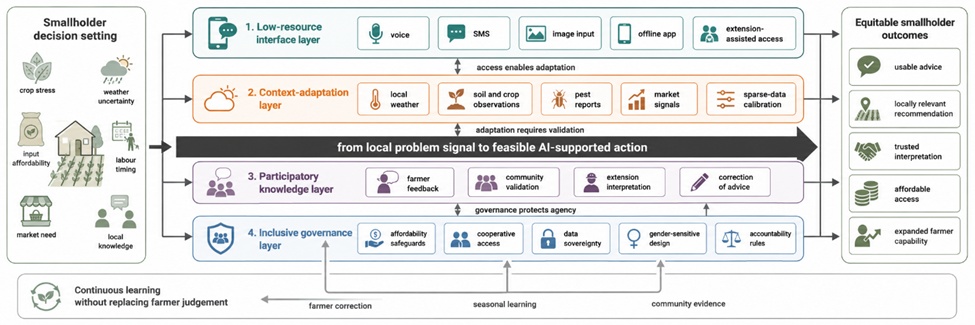
Figure 2. Operational Architecture of the Smallholder-Centred AI Model Linking Low-Resource Access, Local Adaptation, Farmer Knowledge, and Inclusive Governance.
The Context-Adaptation Layer enables AI to learn from local agroecological, institutional, and market conditions. Rather than relying only on externally trained models, this layer supports lightweight local calibration through farmer observations, extension records, community data, weather signals, soil conditions, pest reports, and seasonal feedback [21, 22]. The Participatory Knowledge Layer then allows farmers and local intermediaries to validate, correct, and reinterpret AI recommendations through feedback loops and community learning. Table 1 presents the proposed Smallholder-Centred AI Model with its design principles, components, and expected outcomes.
Table 1. Proposed Smallholder-Centred AI Model for Inclusive Digital Farming: Design Principles, Components, and Operational Characteristics
Model layer | Core design principle | Main components | Operational characteristics | Expected outcome |
Low-Resource Interface Layer | AI must work within limited connectivity, low literacy, shared devices, and intermittent electricity. | Voice interaction, SMS, interactive voice response, image-based input, offline-first mobile tools, extension-assisted interfaces. | Uses minimal text, supports local languages, reduces data use, functions offline where possible, and allows assisted access through trusted intermediaries. | Wider usability among farmers with limited smartphones, literacy, bandwidth, or technical support. |
Context-Adaptation Layer | AI must learn from local agroecological, cultural, and market conditions rather than assuming universal transferability. | Local weather signals, soil and crop observations, pest reports, market information, seasonal histories, extension records, farmer-generated data. | Enables lightweight local calibration, sparse-data learning, region-specific recommendations, and adjustment to crop diversity, input availability, and labour constraints. | More relevant and actionable recommendations for smallholder decision environments. |
Participatory Knowledge Layer | Farmer knowledge must shape the problem definition, data interpretation, and refinement of AI advice. | Farmer feedback loops, community validation, farmer-to-farmer learning, participatory design workshops, extension-farmer interpretation sessions. | Treats farmers as co-producers of intelligence, allows correction of inappropriate advice, and integrates tacit and experiential knowledge with computational outputs. | Greater trust, local legitimacy, and practical usefulness of AI recommendations. |
Inclusive Governance Layer | AI must be affordable, accountable, gender-sensitive, and governed in ways that protect farmer agency. | Cooperative access models, public extension delivery, transparent data rules, affordability safeguards, gender-responsive design, data sovereignty mechanisms. | Prevents extractive platform dependency, supports shared access, embeds accountability, and evaluates success through equity and capability outcomes. | More equitable digital farming systems that expand rather than restrict smallholder capabilities. |
The four layers interact as a continuous design logic rather than as separate technical modules. The interface layer determines who can use the system, the context-adaptation layer determines whether recommendations fit local realities, the participatory knowledge layer determines whether AI remains accountable to farmer experience, and the governance layer determines whether benefits are distributed fairly [17, 19]. Together, these layers shift agricultural AI from a technology-centred model to a capability-centred model. In this view, the value of AI lies not in replacing farmer judgement but in expanding the practical choices available to smallholders.
For AI developers, the model implies that smallholder-centred design must begin before data collection and model development. Developers should treat low bandwidth, device sharing, local language diversity, mixed cropping, and farmer feedback as core design inputs rather than as deployment problems [25, 26]. Technical success should be assessed through usability, actionability, inclusion, and trust, alongside predictive accuracy. This requires interdisciplinary teams that include farmers, extension workers, agronomists, social scientists, local language experts, and community organisations.
For policymakers and development agencies, the model highlights the need for public-interest digital agriculture. If AI services are left mainly to private platform markets, the benefits may flow toward farmers and regions that are already more commercially attractive [18, 20]. Public funding can support open advisory infrastructures, cooperative data systems, local-language tools, and extension-mediated AI services. Policy should also guard against extractive data practices that turn smallholders into sources of value without giving them meaningful control or benefit.
For extension systems, the model suggests that AI should complement rather than replace human advisory relationships. Extension agents can mediate AI outputs, support interpretation, collect local feedback, and help identify when recommendations are unsuitable for specific farm conditions [9, 14]. This is especially important where farmers trust interpersonal advisory networks more than anonymous digital platforms. AI should therefore strengthen rural knowledge systems rather than displace the social relations through which agricultural advice becomes credible.
Future research should test the Smallholder-Centred AI Model across diverse agroecological and institutional contexts. Comparative studies are needed to examine how the model performs in rain-fed systems, irrigated smallholder systems, peri-urban farming, cooperative settings, and digitally marginal regions [24, 27]. Research should also examine long-term outcomes for livelihoods, gender equity, data sovereignty, climate resilience, and farmer autonomy. The most important question is not whether smallholders can adopt AI, but whether AI can be reshaped to serve smallholder-defined goals.
The future of AI in agriculture will be unjust if it continues to privilege the conditions of large, data-rich, industrialised farms while treating smallholders as peripheral users. Smallholder farmers are central to global food systems, yet they face digital, economic, social, and infrastructural barriers that mainstream AI often fails to recognise. A more equitable agricultural AI agenda must begin from these realities rather than attempt to retrofit them into existing technological models.
This article has proposed a Smallholder-Centred AI Model that places low-resource design, inclusion, context-awareness, and farmer participation at the centre of digital farming. The model reframes AI as a socio-technical and participatory system rather than a stand-alone predictive technology. Its contribution is conceptual and practical: it identifies the design layers through which AI can become more usable, affordable, locally grounded, and accountable to smallholder farmers.
A global commitment to smallholder-first AI innovation is now needed. This requires developers, policymakers, researchers, extension systems, and farmer organisations to evaluate AI not only by technical sophistication but by whether it expands farmer capability and strengthens local agricultural knowledge. Agricultural AI will become genuinely transformative only when smallholders are not merely included in digital farming but recognised as central participants in shaping its intelligence.
None
None
None
None
Open Access The author(s) retain copyright. This article is licensed under the Creative Commons Attribution-NonCommercial-ShareAlike 4.0 International License. It may be shared and adapted for non-commercial purposes with appropriate attribution, an indication of changes, and distribution of adaptations under the same license. Third-party material may be subject to separate terms identified in its credit line. View the license at https://creativecommons.org/licenses/by-nc-sa/4.0/.
 Agro Intelligence Research Press