Intelligent agriculture is often presented as the next great leap in farming: a data-rich, sensor-driven, algorithmically guided transformation of how food is produced. By combining artificial intelligence, Internet of Things infrastructures, remote sensing, robotics, and big data analytics, it promises to make farming more precise, efficient, and responsive. Yet much of this promise remains tied to an older and narrower ambition: producing more output per hectare. This perspective argues that intelligent agriculture has inherited and digitally extended the yield-maximization logic of twentieth-century productivist agriculture. The problem is not that yield is unimportant, but that yield has become too dominant as the organizing measure of agricultural progress. When farming systems are judged primarily by short-term productivity, the underlying ecological foundations of production can be degraded while the system still appears technically successful. The article advances a reframing of intelligent agriculture around three interconnected goals: soil health, biodiversity, and long-term farm resilience. These are not secondary environmental concerns to be considered after productivity has been secured. They are the living infrastructure of agriculture and the conditions through which future productivity, livelihoods, and food security become possible. The central claim is that the future of intelligent agriculture should not be defined by producing more at any cost. It should be defined by producing with care: sustaining soil function, enhancing biodiversity, and strengthening the adaptive capacity of farms under climate uncertainty. This requires not simply better technologies, but a deliberate change in the goals, metrics, and values that guide agricultural innovation.
Farming systems have never been surrounded by more data, sensors, models, satellites, platforms, and computational power, yet the ecological foundations of agriculture remain under severe pressure. The expansion of smart farming and big-data agriculture has made it possible to observe fields, livestock, inputs, machinery, and markets at unprecedented resolution, but this digital visibility has not automatically translated into ecological recovery [1]. The paradox is that agriculture can become more precisely managed while soils lose structure, biodiversity declines, and farms become more exposed to climate shocks. This raises a fundamental question: what if the central problem is not the lack of intelligence in agriculture, but the narrow goals to which that intelligence is applied?
The dominant development path of intelligent agriculture has been shaped by productivity, efficiency, and profitability, often framed through precision input management and yield optimization. Reviews of digital agriculture show that smart farming has been promoted as a route to better decisions, improved resource use, and more competitive farm enterprises, but its technical architectures frequently reproduce the assumption that agricultural progress means producing more with finer control [2, 3]. This assumption narrows what digital tools are asked to see, measure, and optimize. It also risks turning ecological complexity into a management problem only insofar as it affects output.
This perspective argues that intelligent agriculture must be reframed around soil health, biodiversity, and long-term farm resilience. Sustainable agricultural redesign cannot be reduced to technical intensification alone, because future food security depends on the condition of the ecological systems that make production possible [4]. Soil organic matter, microbial communities, pollinators, natural enemies, landscape heterogeneity, and adaptive farming capacities are not peripheral to intelligent agriculture. They are central indicators of whether agricultural intelligence is sustaining or undermining the system it seeks to improve.
The article proceeds by first presenting the central perspective that intelligent agriculture has been captured by productivist logic. It then critiques yield maximization as a guiding paradigm, before showing in Part 2 how soil health, biodiversity monitoring, and resilience can become core objectives of digitally supported farming. The argument builds on literature showing both the promise and the risks of digital innovation in agriculture, including concerns about technology governance, social consequences, and responsibility in agricultural transitions [5, 6]. The aim is not to reject digital agriculture, but to redirect it toward ecological stewardship.
The central perspective of this article is that intelligent agriculture has too often treated the farm as an optimization machine rather than a living ecosystem. Digital platforms, machine-learning models, and precision technologies are commonly designed to identify constraints to productivity and remove them through better timing, targeting, and control [1, 2]. This orientation can be powerful when it reduces waste or improves decision quality, but it becomes problematic when it treats soil, biodiversity, water, and climate variability mainly as variables to be managed for output. A farm is not only a production surface; it is a dynamic social-ecological system.
Figure 1 illustrates how yield-centric intelligent agriculture can be reframed into a resilience-oriented model centred on soil health, biodiversity, and long-term farm adaptive capacity.
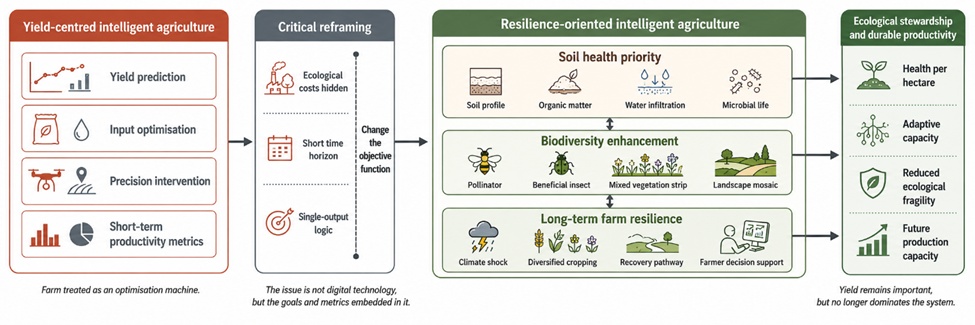
Figure 1. Conceptual Reframing of Intelligent Agriculture from Yield Maximization to Soil Health, Biodiversity, and Long-Term Farm Resilience
Digital technologies are not inherently yield-centric. Their purposes are shaped by the values, business models, indicators, and policy incentives embedded in their design and use, as emphasized in debates on responsible Agriculture 4.0 pathways [5]. The same sensing infrastructure used to detect nutrient deficiency for yield improvement could also monitor soil cover, compaction risk, carbon trends, and biological activity. The same image-recognition systems used to identify weeds for elimination could also document plant diversity, beneficial insects, and ecological habitat quality.
The task, therefore, is not to choose between intelligent agriculture and agroecology, but to ask what kind of intelligence agriculture needs. Agroecological transition scholarship emphasizes diversity, recycling, synergies, resilience, and co-creation of knowledge as principles for sustainable food systems [7]. These principles suggest a different digital agenda: one in which data systems make ecological relationships visible, AI supports multi-objective decisions, and farm management values long-term adaptive capacity as much as immediate output. Intelligent agriculture should become less a machinery of extraction and more an infrastructure of care.
The yield-maximization paradigm is not new, but intelligent agriculture gives it new technical power. Precision agriculture and smart farming have often been justified by their ability to increase productivity, reduce input costs, and improve economic performance, reinforcing the idea that technological progress is measured primarily through yield and efficiency gains [2]. Digital systems can make this logic appear objective because models, dashboards, and forecasts translate complex farm realities into quantified performance indicators. Yet what is quantified is not neutral; it reflects what designers, funders, markets, and policies decide is worth optimizing.
The historical problem with productivist agriculture is that it often separated production gains from ecological costs. Sustainable intensification debates have shown that agricultural redesign must address multiple outcomes, because yield growth alone does not guarantee biodiversity conservation, soil restoration, climate mitigation, or rural well-being [4, 8]. When digital agriculture adopts yield as its dominant objective, it risks repeating this separation with more sophisticated instruments. It may optimize fertilizer placement, irrigation timing, or harvest logistics while leaving deeper questions of soil degradation, biological simplification, and vulnerability unresolved.
The yield paradigm also shapes what counts as useful data. In many digital farming systems, soil is represented through nutrient availability, moisture status, and input-response curves, while biodiversity appears mainly as pests, weeds, or disease threats to be detected and controlled [3]. This framing narrows ecological intelligence into production intelligence. Table 1 contrasts the yield-maximization paradigm with the proposed resilience-oriented paradigm across key dimensions of intelligent agriculture.
Table 1. Yield Maximization vs. Resilience-Oriented Intelligent Agriculture: Contrasting Goals, Metrics, and Design Priorities
Dimension | Yield-maximization intelligent agriculture | Resilience-oriented intelligent agriculture |
Primary goal | Increase short-term output per hectare through more precise control of inputs, timing, and management operations. | Sustain productive capacity over time by strengthening soil health, biodiversity, and adaptive farm resilience. |
View of the farm | Treats the farm mainly as a production unit whose performance can be optimized through data-driven efficiency. | Treats the farm as a living social-ecological system shaped by soil processes, species interactions, climate stress, and farmer knowledge. |
Dominant performance metric | Yield, profitability, input-use efficiency, and operational productivity. | Soil organic matter, soil structure, microbial activity, biodiversity indicators, climate recovery capacity, livelihood stability, and sufficient yield. |
Role of AI and data analytics | Predict constraints to yield and recommend interventions that maximize output or reduce production losses. | Support multi-objective decision-making that balances production with ecological regeneration, risk reduction, and long-term system health. |
Soil interpretation | Soil is mainly a medium for nutrient supply, water availability, and yield response. | Soil is a living foundation of agriculture, including carbon storage, biological communities, aggregation, infiltration, and water-holding capacity. |
Biodiversity interpretation | Biodiversity is often treated as a threat when it appears as pests, weeds, or disease vectors. | Biodiversity is treated as functional infrastructure supporting pollination, natural pest regulation, nutrient cycling, and landscape resilience. |
Time horizon | Focuses on seasonal or annual gains, often aligned with immediate market and production targets. | Focuses on multi-year adaptive capacity, recovery from shocks, and the ability of farms to remain viable under climate uncertainty. |
Technology design priority | More precise detection, prediction, automation, and intervention for production optimization. | Ecological monitoring, diversified decision support, farmer interpretation, and stewardship-oriented feedback loops. |
Risk | Can create efficient but brittle systems that depend on high control, narrow metrics, and input-intensive production pathways. | May require more complex metrics and slower evaluation, but supports durable productivity and ecological integrity. |
Policy implication | Rewards production volume, technological adoption, and efficiency gains. | Rewards verified soil improvement, biodiversity enhancement, reduced vulnerability, and resilience-building practices. |
This contrast does not imply that yield should disappear from intelligent agriculture. Farmers need viable production, and digital tools can help reduce waste, improve timing, and protect crops under real economic constraints [9]. The problem is the elevation of yield from one important outcome to the dominant organizing principle of agricultural intelligence. A resilience-oriented paradigm would still care about productivity, but it would ask whether productivity is being achieved by strengthening or depleting the ecological foundations of farming.
Soil health should become a primary objective of intelligent agriculture, not merely a hidden input beneath yield prediction. Contemporary soil science defines soil quality and soil health through interacting physical, chemical, and biological dimensions, including structure, nutrient cycling, organic matter, biological activity, and the capacity to sustain ecosystem functions [10]. This broader view challenges digital agriculture to move beyond treating soil as a nutrient reservoir or moisture variable. If the soil is the living base of agriculture, then intelligent agriculture must learn to see it as living.
The concept of soil health also reframes what counts as valuable agricultural data. Soil carbon, aggregate stability, infiltration, compaction, microbial diversity, and biological functioning are not secondary indicators; they are central signs of whether farming is building or eroding future productive capacity [11]. Regenerative agriculture literature has similarly emphasized that soil is the foundation from which water retention, nutrient cycling, climate mitigation, and farm resilience emerge [12]. A digitally intelligent farm should therefore ask not only how much crop can be produced this season, but whether the soil is becoming more capable of supporting life over time.
Digital tools can support this reframing if they are designed around soil health indicators rather than only short-term input response. Machine learning and digital soil mapping can estimate spatial variation in soil properties, while remote sensing can help assess soil organic carbon patterns and support more targeted soil management decisions [13, 14]. Spectral imaging and remote-sensing approaches are already being developed for soil organic carbon estimation, showing that digital observation can be directed toward ecological condition rather than yield alone [15]. The challenge is to integrate these tools into decision systems that reward soil-building practices, not only yield-improving interventions.
Yet current soil sensing often remains trapped within the productivity paradigm. A minimum suite of soil health indicators has been proposed for agricultural assessment, but these indicators must be translated into practical decision interfaces that farmers can use without reducing soil health to another narrow dashboard score [16]. Soil health research from diverse farming contexts also shows that ecosystem services, climate adaptation, and soil function are deeply connected, especially where farmers face resource constraints and environmental stress [17]. Intelligent agriculture should therefore make soil health visible, actionable, and economically meaningful, while preserving its ecological complexity.
Biodiversity should be treated as a key performance indicator of intelligent agriculture. Agricultural diversification has been shown to promote multiple ecosystem services without necessarily compromising yield, which directly challenges the assumption that ecological complexity is a barrier to production [18]. Biodiversity can support pollination, pest regulation, soil processes, landscape stability, and climate adaptation, making it a functional part of farming rather than an external conservation concern. A farm that produces high yields while eroding biodiversity is not truly intelligent; it is borrowing against its ecological future.
Digital agriculture can help bring biodiversity into routine farm decision-making if monitoring is expanded beyond pest detection. Global evidence shows that biodiversity-mediated benefits can support crop production, particularly when landscapes sustain pollinators, natural enemies, and other beneficial organisms [19]. This means that sensors, cameras, and analytical models should not only identify threats to crops, but also recognize beneficial species and ecological interactions. The goal should shift from monitoring biodiversity for control to monitoring biodiversity for understanding.
Emerging ecological technologies create important opportunities for this shift. Machine learning has advanced image-based species identification, enabling automated recognition of plants, insects, and other organisms when supported by suitable data and expert validation [20]. Passive acoustic monitoring also offers new possibilities for assessing ecological activity and biodiversity patterns across agricultural landscapes [21]. These tools could allow intelligent farms to observe ecological change continuously, but their value depends on whether they are embedded in stewardship-oriented management rather than only in surveillance and intervention systems.
The deeper issue is how biodiversity is interpreted within agricultural intelligence. Smaller and diversified farms have been associated with higher biodiversity and, in some contexts, strong productivity outcomes, indicating that scale, structure, and diversity matter for sustainability [22]. Agroecological principles further emphasize diversity, synergies, recycling, and co-creation of knowledge as foundations for resilient food systems [7]. Intelligent agriculture should therefore build biodiversity metrics into farm platforms, advisory systems, and policy verification tools, so that ecological richness becomes a visible sign of performance rather than an invisible by-product.
Farm resilience refers to the capacity of farming systems to absorb shocks, adapt to changing conditions, transform when necessary, and sustain livelihoods over time. A resilience framework for farming systems emphasizes that performance cannot be judged only through short-term output, because farms must also cope with climate volatility, market instability, labor constraints, ecological degradation, and policy change [23]. Intelligent agriculture can contribute to resilience, but only if it is designed to support adaptation rather than intensify dependence on brittle production models. A farm that is optimized for normal conditions may fail when normal conditions disappear.
This distinction is crucial under climate change. Digital systems are often strongest at prediction, early warning, scenario analysis, and decision support, all of which can help farmers anticipate drought, pest outbreaks, heat stress, and supply disruptions [24]. However, prediction alone is not resilience if it leads farmers toward uniform, input-intensive, and highly specialized systems with limited adaptive capacity. Resilience-oriented intelligence must help farmers diversify options, test alternatives, and recover from disturbance, not simply optimize the current system more efficiently.
Agroecological transitions show that resilience and adaptability are built through ecological processes as well as social learning. Assessing resilience in such transitions requires attention to soil management, crop diversity, farmer knowledge, institutional support, and the capacity to reorganize practices over time [25]. Digital tools can support these processes by tracking long-term changes, documenting ecological benefits, and helping farmers compare management pathways under uncertainty. They should function as aids to adaptive judgment, not substitutes for it.
Farm resilience is also experienced subjectively by farmers, who interpret their capacity to cope through farm structure, resources, identity, knowledge, and perceived control. Recent work on perceived resilience shows that farm and farmer attributes shape how resilience is understood and enacted in practice [26]. This matters because intelligent agriculture can either strengthen farmer agency or deepen platform dependence, depending on how tools are governed and designed [6]. Long-term resilience therefore requires both ecological robustness and social empowerment.
Reframing intelligent agriculture means changing the guiding question from “How can we produce more per hectare?” to “How can we sustain more health per hectare?” This does not reject yield, but relocates it within a broader set of goals: soil health, biodiversity health, climate resilience, livelihood stability, and ecological regeneration [4, 9]. Digital agriculture can still use sensors, AI, platforms, and analytics, but their success should be judged by whether they strengthen the living conditions of farming. Intelligence should mean the capacity to understand relationships, not only to optimize outputs.
This reframing also changes AI design. Instead of building models around a single objective such as yield prediction or input efficiency, researchers can develop multi-objective systems that represent trade-offs among production, soil carbon, biodiversity, water use, risk exposure, and resilience [24]. Digital soil mapping, remote sensing, image recognition, and acoustic monitoring already show that ecological indicators can be measured and modeled, but they must be integrated into decision-support systems that farmers can interpret and contest [14, 20, 21]. A resilience-oriented system would not hide ecological trade-offs behind a recommendation; it would make them visible.
Figure 2 shows how AI, sensors, remote sensing, and ecological data streams can be redirected from control-oriented optimisation toward soil, biodiversity, and resilience stewardship.
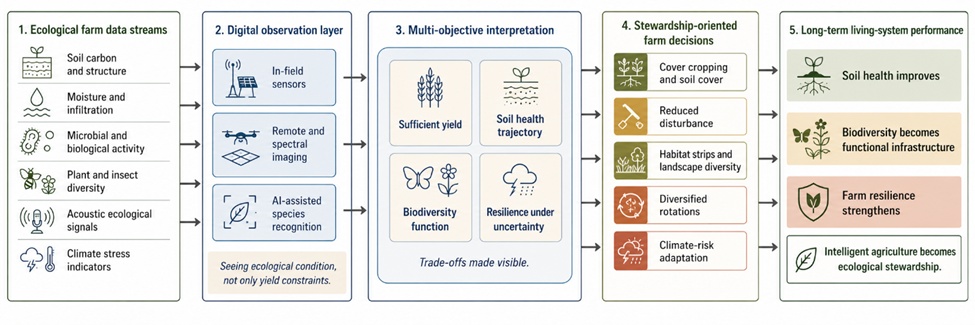
Figure 2. Digital-Ecological Stewardship Pathway for Reorienting Intelligent Agriculture Toward Soil, Biodiversity, and Resilience Outcomes
The business model of intelligent agriculture must also change. If platforms earn value mainly by increasing sales of inputs, machinery, data services, or proprietary subscriptions, then ecological stewardship will remain secondary to commercial expansion [5]. Regenerative and agroecological perspectives suggest that technology should support soil-building, biodiversity enhancement, and local adaptation rather than lock farmers into standardized optimization pathways [12, 27]. Intelligent agriculture should therefore become a public-interest and farmer-centered infrastructure for stewardship, not merely a private machinery of precision control.
Researchers should prioritize multi-objective AI systems that optimize across yield, soil health, biodiversity, climate risk, and farmer-defined goals. This requires moving beyond narrow prediction benchmarks toward models that can represent ecological processes, uncertainty, and long-term consequences [13, 23]. Soil health indicator suites, digital soil mapping, and remote sensing should be linked with agronomic and ecological knowledge so that decision support reflects living-system performance rather than isolated production variables [11, 16]. Research evaluation should reward tools that improve ecological decision quality, not only predictive accuracy.
Technology developers should build interfaces that make ecological outcomes visible, understandable, and actionable for farmers. A dashboard for intelligent agriculture should show soil cover, carbon trends, compaction risk, pollinator habitat, beneficial insect activity, diversification options, and resilience indicators alongside yield and profit [18, 19]. Farmer-facing platforms should also support interpretation, uncertainty, and local knowledge, because ecological stewardship cannot be automated through generic prescriptions [3]. The design aim should be to strengthen farmer judgment, not replace it with black-box optimization.
Policy makers and funders should create incentives that make soil health, biodiversity, and resilience economically visible. Digital verification could support payments for soil carbon, biodiversity enhancement, reduced vulnerability, and landscape-level ecological benefits, but only if verification systems are transparent, inclusive, and sensitive to local conditions [17, 22]. Public funding should support digital-ecological synergies, open standards, farmer data rights, and independent assessment of whether intelligent agriculture is delivering long-term public value [5, 24]. The core policy task is to ensure that the next generation of agricultural technology is guided by ecological outcomes rather than by yield maximization alone.
Intelligent agriculture stands at a crossroads. It can continue to refine the yield-maximization paradigm with more sensors, faster models, and more precise interventions. Or it can become part of a deeper transformation in which farming is understood as the care of living systems under conditions of uncertainty.
This perspective has argued for the second path. Soil health, biodiversity, and long-term farm resilience should not be treated as optional sustainability add-ons to digital agriculture. They should become the core goals that determine what is measured, what is optimized, what is funded, and what is celebrated as agricultural intelligence.
The future of farming will not be secured by data alone. We already possess many of the tools needed to observe soil, monitor biodiversity, anticipate risk, and support adaptive management. What is needed now is the wisdom and will to redirect those tools toward sustaining life on the land.
None
None
None
None
Open Access The author(s) retain copyright. This article is licensed under the Creative Commons Attribution-NonCommercial-ShareAlike 4.0 International License. It may be shared and adapted for non-commercial purposes with appropriate attribution, an indication of changes, and distribution of adaptations under the same license. Third-party material may be subject to separate terms identified in its credit line. View the license at https://creativecommons.org/licenses/by-nc-sa/4.0/.
 Agro Intelligence Research Press