Agri-food systems increasingly rely on analytics, artificial intelligence, machine learning, environmental monitoring, and decision-support tools to evaluate sustainability performance. These systems can estimate resource use, model environmental impacts, detect risks, and inform actions across farms, supply chains, markets, and governance settings. As analytics become embedded in sustainability decisions, their outputs increasingly shape how environmental problems are recognised and acted upon. Yet sustainability analytics does not become useful or responsible simply because it produces indicators, predictions, rankings, or dashboards. Environmental metrics may be technically sophisticated while remaining difficult for farmers, firms, auditors, regulators, and communities to interpret or challenge. This creates an explainability problem in which users need to understand not only what an analytic system reports, but also how the result was produced, what assumptions it contains, and what consequences may follow from acting on it. This article develops a conceptual framework for explainable sustainability analytics in agri-food systems. The framework treats explainability as a system-level requirement for linking environmental impact interpretation, risk explanation, responsibility attribution, human review, and accountability safeguards. It argues that sustainability analytics should be evaluated not only by predictive performance or measurement coverage, but also by whether it supports transparent, contestable, and context-sensitive decision-making. The article contributes a structured framework for interpreting environmental impact, explaining risk, attributing responsibility, and supporting accountable review in agri-food decision contexts. It positions explainable sustainability analytics as an approach that connects data, models, indicators, explanation mechanisms, human judgement, and governance safeguards. In doing so, it provides a foundation for sustainability analytics that is more interpretable, trustworthy, and actionable.
Agri-food systems are increasingly shaped by data-intensive infrastructures that collect, integrate, and analyse information from sensors, machines, satellites, platforms, farm-management systems, and supply-chain records. Big data in smart farming has expanded the technical capacity to monitor production conditions, model resource use, and support management decisions across agricultural systems [1]. These developments create new opportunities for sustainability analytics, but they also make sustainability decisions dependent on data flows, platform architectures, and model-mediated interpretations.
The rise of digital agriculture has also shown that analytics is never only a technical matter. Social-science research on digital agriculture highlights how adoption, trust, skills, institutions, power relations, and governance arrangements influence whether digital tools become meaningful in practice [2]. For explainable sustainability analytics, this means that environmental indicators must be interpreted within the social and organisational contexts in which farmers, advisers, firms, auditors, and regulators make decisions.
Agriculture 4.0 has been framed as a transformation that should serve people, production, and the planet rather than narrow efficiency objectives alone [3]. This framing is important because sustainability analytics can affect livelihoods, environmental stewardship, market access, certification, public claims, and regulatory obligations. If analytics systems are used to guide sustainability decisions, they must make their assumptions, limitations, and decision implications understandable to those affected by them.
Responsible AI in digital agriculture requires attention to transparency, accountability, fairness, privacy, trust, and the broader consequences of automated decision support [4]. Building on this concern, this article develops a framework for explainable sustainability analytics that connects four central interpretive dimensions: environmental impact interpretation, risk explanation, responsibility attribution, and human review with accountability. The aim is to clarify how agri-food sustainability analytics can move beyond measurement and optimisation toward transparent, contestable, and responsible decision support.
Sustainability analytics can be defined as the use of data, indicators, models, algorithms, and decision-support systems to assess environmental performance, resource use, climate exposure, supply-chain impacts, and sustainability responsibilities. In agriculture, deep learning has been applied to tasks such as crop monitoring, disease detection, yield prediction, weed recognition, and environmental sensing, demonstrating the growing role of complex models in agricultural decision chains [5]. These capabilities can support sustainability assessment, but they can also produce outputs that are difficult for non-specialist users to inspect or justify.
The explainability problem arises when sustainability outputs are multi-dimensional, uncertain, model-dependent, and consequential. Explainable AI for sustainable agriculture links interpretability to trust, resource-use reasoning, and decision support, especially when users need to understand why a model produced a recommendation rather than merely receive the recommendation itself [6]. In this sense, explainability is not a cosmetic layer added after modelling; it is part of how sustainability information becomes usable for action.
Producing a sustainability indicator is different from making that indicator interpretable, actionable, contestable, and accountable. Responsible AI in agriculture requires systemic understanding of risks and externalities because model outputs may affect environmental decisions, market opportunities, labour relations, technology dependence, and ecological outcomes [7]. Sustainability analytics therefore becomes an explainability problem when users cannot see how predictions, thresholds, rankings, or warnings connect to underlying data, assumptions, uncertainties, and consequences.
The proposed framework treats explainability as a core requirement of sustainability analytics rather than an optional technical feature. An explainable system should clarify what is being measured, why it matters, how the model reasons, what uncertainties remain, who may be affected, and how a decision can be reviewed. This shifts the focus from analytic output alone to the relationship among data, interpretation, responsibility, and accountable action in agri-food systems [6].
Environmental impact interpretation is the first substantive dimension of explainable sustainability analytics. Life-cycle assessment in agri-food systems shows that environmental interpretation depends on transparent choices about system boundaries, functional units, allocation rules, data quality, impact categories, and trade-off reasoning [8]. These choices determine whether analytics can meaningfully explain carbon emissions, water use, energy demand, land occupation, eutrophication, biodiversity pressures, soil effects, waste, and resource efficiency.
Agri-food environmental impacts are difficult to interpret because they vary across products, producers, regions, practices, and supply-chain configurations. Large differences in food-system impacts across production contexts demonstrate why explainable analytics should avoid presenting average product-level scores as if they fully describe environmental performance [9]. Users need disaggregated explanations that clarify where impacts arise, which practices contribute most, and how comparisons change across contexts.
Digital agriculture can support environmental interpretation when data-driven tools are connected to management decisions and system redesign. Sustainable agricultural systems require analytics that helps users reason about alternative practices, resource allocation, production constraints, and environmental consequences rather than simply optimise a single performance indicator [10]. Explainable sustainability analytics should therefore translate environmental measurements into decision-relevant interpretations that farmers, advisers, firms, auditors, and regulators can evaluate.
Supply-chain sustainability assessment adds another layer of interpretive complexity because impacts may occur far from the point where data are collected or decisions are made. Life-cycle assessment of food supply chains requires coherent links among goal definition, scope, inventory modelling, impact assessment, and interpretation so that conclusions remain traceable to methodological choices [11]. For the proposed framework, this means environmental impact interpretation must make indicator construction, data provenance, uncertainty, assumptions, and comparison logic visible before analytics outputs are used to justify sustainability claims.
Risk explanation is the second interpretive dimension of explainable sustainability analytics. Agri-food sustainability decisions often involve production risks, climate risks, resource risks, supply-chain disruptions, compliance exposure, financial uncertainty, reputational harm, and unintended ecological consequences. Managing the risks of artificial intelligence in agriculture requires attention to who may be exposed to model error, opacity, automation pressure, bias, and governance failure [12]. In this framework, risk explanation means clarifying not only the probability of an adverse outcome, but also its drivers, affected actors, uncertainty conditions, and decision implications.
Explainable risk analytics should help users understand how environmental hazards are detected and why a warning, classification, or scenario is generated. Expert-driven explainable AI for agricultural climate hazards shows that explanation mechanisms can reveal relevant drivers of risk and make hazard detection more interpretable for agricultural decision contexts [13]. This matters because farmers, advisers, insurers, regulators, and supply-chain actors may need to act before evidence is complete or before environmental effects are fully visible. Risk explanation therefore requires an explicit connection between model signals, domain expertise, scenario assumptions, and practical response options.
Decision transparency depends on the quality, precision, and contextual reliability of the information used in smart agriculture. The concept of information precision in smart agriculture highlights that data and recommendations should be assessed according to their fitness for operational decisions, not merely their technical availability [14]. In sustainability analytics, this means that uncertainty ranges, missing data, sensor limitations, spatial resolution, model thresholds, and indicator sensitivity should be communicated in ways that support judgement. A transparent decision system should make clear when an output is robust enough for action and when it should trigger further review.
Explainable AI methods in agriculture can translate model outputs into interpretable evidence for users and reviewers, especially when decision consequences are uncertain or contested [15]. Risk explanation and decision transparency therefore operate together: risk explanation clarifies what could go wrong and why, while decision transparency clarifies how an analytic output should be interpreted, challenged, or acted upon. Together, these functions prevent sustainability analytics from becoming an opaque authority that silently directs environmental decisions. Table 1 summarises the interpretive functions required for explainable sustainability analytics in agri-food systems.
Table 1. Interpretive Functions of Explainable Sustainability Analytics in Agri-Food Systems: Environmental Impact Interpretation, Risk Explanation, Decision Transparency, Responsibility Attribution, and Human Review Requirements
Interpretive function | Core question addressed | Required explanation mechanism | Agri-food decision relevance | Accountability requirement |
Environmental impact interpretation | What environmental effect is being measured, compared, or prioritised? | Indicator definition, boundary explanation, data provenance, assumptions, uncertainty ranges, and trade-off logic | Supports interpretation of carbon, water, energy, soil, biodiversity, waste, land-use, and resource-efficiency indicators | Document indicator choices, assumptions, and limitations so claims can be reviewed |
Risk explanation | What risk is present, what drives it, and who may be affected? | Driver analysis, scenario explanation, uncertainty communication, threshold justification, and sensitivity interpretation | Supports climate-risk management, production planning, supply-chain resilience, compliance, and environmental warnings | Clarify risk ownership, exposure, mitigation duties, and conditions for escalation |
Decision transparency | How did the analytic system produce a recommendation or classification? | Model logic summaries, feature relevance, decision thresholds, confidence levels, and data-quality statements | Supports farm advice, certification, procurement, resource allocation, and sustainability reporting | Provide traceable decision records, reviewable thresholds, and contestability pathways |
Responsibility attribution | Which actors, decisions, systems, or supply-chain stages contributed to an impact or risk? | Provenance mapping, actor-role mapping, causal contribution reasoning, platform responsibility mapping, and shared-responsibility explanation | Supports supply-chain accountability, reporting, audits, producer claims, retailer obligations, and regulatory oversight | Avoid oversimplified blame while making responsibility allocation visible and reviewable |
Human review | Who can inspect, challenge, revise, or override analytic outputs? | Review protocols, escalation rules, expert judgement integration, audit trails, and correction mechanisms | Supports high-stakes environmental decisions, compliance decisions, investment choices, and public sustainability claims | Assign review duties, record interventions, preserve audit trails, and enable correction |
Responsibility attribution is the third interpretive dimension of explainable sustainability analytics. Agricultural big data analytics can redistribute power among farmers, technology providers, platforms, agribusinesses, retailers, and institutions that control data access and analytic interpretation [16]. When sustainability analytics assigns environmental performance scores or recommends operational changes, it may implicitly assign responsibility for impacts, risks, or corrective actions. An explainable framework must therefore make visible how responsibility is constructed, who has agency, and which actors control the conditions under which decisions are made.
Farm data sharing illustrates why responsibility attribution cannot be reduced to a technical matter of data ownership or system access. Trust in agricultural data sharing depends on clarity about rights, permitted uses, obligations, governance rules, and the ability of participants to understand and contest data practices [17]. In sustainability analytics, these issues become more consequential when data are used for certification, market access, compliance, benchmarking, or claims about environmental performance. Responsibility attribution should therefore include transparent data-use logic as well as environmental impact logic.
Food supply chains further complicate responsibility attribution because environmental impacts are distributed across production, processing, transport, storage, retail, consumption, and waste-management stages. Blockchain-based food traceability frameworks show how provenance infrastructures can support supply-chain transparency when records are verifiable and interpretable [18]. However, traceability alone does not create accountability unless users can understand what the records mean and how responsibilities are assigned across actors. Explainable sustainability analytics must connect provenance with interpretive rules for contribution, obligation, and corrective action.
A responsibility-aware analytics system should avoid both under-attribution and over-attribution. Under-attribution occurs when environmental impacts are presented as system-level outcomes without clarifying actor roles, while over-attribution occurs when analytics assigns blame to visible actors who may lack control over upstream or platform-mediated conditions. The ethics of power in agricultural big data shows why responsibility must be analysed through control over data, infrastructures, contracts, algorithms, and decision consequences [16]. The framework therefore treats responsibility attribution as a relational process that links environmental evidence, actor capacity, decision authority, and governance safeguards.
Human review is the fourth interpretive dimension of explainable sustainability analytics. Human-in-the-loop roles in cyber-physical agricultural systems show that agricultural automation depends on contextual judgement, supervision, and intervention when system outputs interact with changing field, machine, and environmental conditions [19]. In sustainability analytics, human review is necessary when outputs influence environmental management, compliance, investment, market access, risk response, or public sustainability claims. Review should not be treated as symbolic approval after an automated output is produced; it should be built into the analytic workflow.
Human-centred AI in smart farming positions farmers, agronomists, advisers, and domain experts as active participants in interpreting and governing analytics rather than passive recipients of automation [20]. This is especially important when environmental data are incomplete, local conditions differ from model assumptions, or sustainability indicators conflict with operational constraints. Human reviewers can identify implausible outputs, detect missing contextual variables, question indicator weights, and examine whether recommended actions are socially or environmentally appropriate. Accountability depends on giving reviewers enough information, authority, and time to perform these functions meaningfully.
Human–robot interaction in agriculture also demonstrates that accountability extends to safety, workload, collaborative control, and the practical conditions under which humans interact with automated systems [21]. In sustainability analytics, similar concerns arise when users must interpret dashboards, warnings, rankings, or recommendations while managing time pressure, uncertainty, and institutional demands. A system may be technically explainable but practically unreviewable if explanations are poorly timed, overly complex, hidden behind interfaces, or disconnected from user responsibilities. Human review therefore requires usable explanations that fit real decision environments.
Accountability requires more than human presence; it requires defined duties, documentation, audit trails, escalation routes, and correction mechanisms. Human-centred smart farming reinforces the need to design AI systems around human judgement, domain expertise, and responsible intervention rather than around automation alone [20]. Explainable sustainability analytics should specify who can challenge an output, who can override a recommendation, who must document a decision, and who is accountable if an analytic claim proves misleading. This converts explainability from a model property into a governance practice.
The proposed Explainable Sustainability Analytics Framework consists of five interdependent dimensions: analytics inputs, environmental impact interpretation, risk explanation and decision transparency, responsibility attribution, and human review with accountability safeguards. Explainable AI concepts and taxonomies provide a basis for distinguishing explanation types, audiences, purposes, and responsible-AI conditions [22]. In this framework, analytics inputs include data sources, indicators, models, assumptions, and decision contexts. These inputs become explainable only when the system shows how they shape environmental interpretations, risk assessments, responsibility claims, and decision pathways.
Explanation should be designed for human reasoning rather than for technical disclosure alone. Social-science insights into explanation in artificial intelligence emphasise that useful explanations are often selective, contrastive, socially situated, and oriented toward the user’s question [23]. For agri-food sustainability analytics, this means a farmer may need an explanation of why one irrigation action is recommended over another, while an auditor may need an explanation of how a carbon indicator was constructed. The framework therefore links each explanation to an audience, decision purpose, uncertainty condition, and accountability function.
The framework also requires that explanations be actionable. Actionable explainable AI shows how explanation can support adaptive classification, textual interpretation, and practical intervention rather than only post-hoc model inspection [24]. In agri-food systems, actionable explanations should help users revise management practices, request additional evidence, adjust assumptions, document exceptions, or escalate decisions for review. This implementation logic ensures that explainability supports environmental action rather than simply describing analytic outputs. Figure 1 presents the proposed Explainable Sustainability Analytics Framework, showing how agri-food data, indicators, models, and assumptions are translated into environmental impact interpretation, risk explanation, responsibility attribution, and accountable human review.
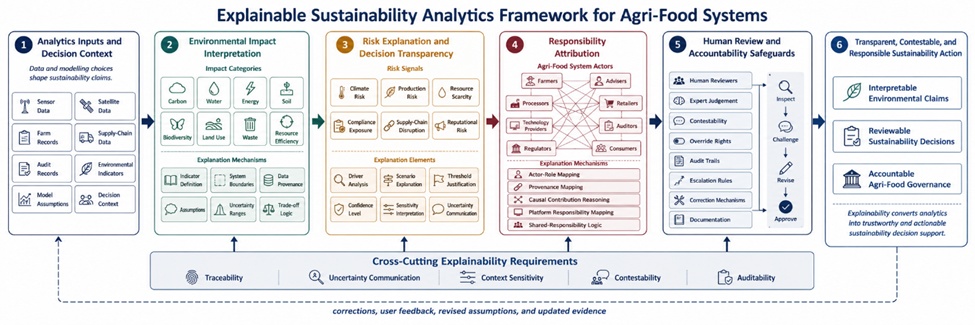
Figure 1. Explainable Sustainability Analytics Framework for Interpreting Environmental Impact, Risk, Responsibility, and Accountability in Agri-Food Systems
Agriculture 5.0 and explainable AI for smart agriculture suggest that trust, transparency, and practical decision use must be integrated into intelligent agricultural systems [25]. The proposed framework therefore connects data and models to interpretive mechanisms, review pathways, governance safeguards, and sustainability actions. It treats explainable sustainability analytics as a coordinated system in which environmental impact interpretation, risk explanation, responsibility attribution, and human review reinforce one another. Table 2 presents the proposed Explainable Sustainability Analytics Framework for interpreting environmental impact, risk, and responsibility in agri-food systems.
Table 2. Proposed Explainable Sustainability Analytics Framework for Agri-Food Systems: Analytics Inputs, Interpretive Mechanisms, Risk Explanations, Responsibility Attribution, Accountability Safeguards, and Implementation Logic
Framework dimension | Analytics inputs | Interpretive mechanisms | Risk explanations | Responsibility attribution | Accountability safeguards | Implementation logic |
Analytics inputs | Sensor data, satellite data, farm records, supply-chain data, audit records, environmental indicators, and model assumptions | Data provenance, boundary clarification, data-quality explanation, and indicator-construction logic | Input uncertainty, missing data, measurement error, and scenario sensitivity | Clarifies who produced, controlled, modified, or relied on data and models | Data documentation, access rules, version control, and reviewable assumptions | Begin with traceable data and explicit modelling choices before generating sustainability claims |
Environmental impact interpretation | Carbon, water, energy, soil, biodiversity, land-use, waste, and resource-efficiency metrics | Indicator explanation, impact-category reasoning, comparison logic, uncertainty ranges, and trade-off interpretation | Environmental uncertainty, indirect effects, rebound effects, and metric conflict | Links impacts to practices, supply-chain stages, and decision contexts without oversimplified blame | Transparent assumptions, audit-ready evidence, and documented indicator limitations | Convert environmental measurements into context-sensitive and reviewable interpretations |
Risk explanation and decision transparency | Climate-risk models, production forecasts, hazard alerts, compliance dashboards, and decision thresholds | Driver explanation, feature relevance, confidence levels, threshold justification, and scenario narratives | Climate hazards, production losses, resource scarcity, compliance exposure, and reputational risk | Identifies exposed actors, decision makers, and parties responsible for mitigation or escalation | Threshold documentation, uncertainty communication, and contestability channels | Help users understand what could happen, why it matters, and when action is justified |
Responsibility attribution | Traceability records, contracts, platform rules, farm-management decisions, procurement data, and reporting evidence | Actor-role mapping, causal contribution reasoning, provenance interpretation, and shared-responsibility logic | Attribution errors, data misuse, misplaced blame, and hidden platform influence | Clarifies obligations among farmers, processors, retailers, technology providers, regulators, and consumers | Responsibility logs, governance rules, audit trails, and appeal mechanisms | Make responsibility visible while recognising distributed agency and systemic causation |
Human review and accountability | Expert annotations, reviewer decisions, override records, audit findings, user feedback, and correction requests | Human-in-the-loop review, exception handling, contextual interpretation, and decision documentation | Review failure, automation bias, unsafe reliance, and ignored local knowledge | Assigns review duties, decision authority, correction responsibility, and escalation roles | Oversight protocols, correction pathways, review logs, and independent audit options | Ensure analytics remains contestable, correctable, and accountable before decisions become consequential |
For practice, explainable sustainability analytics should be implemented as a governance and decision-support capability rather than only as a technical interface. Digital innovations for sustainable and resilient agricultural systems should be assessed according to whether they improve sustainability outcomes, resilience, and system redesign, not only whether they increase data availability or operational efficiency [26]. Agricultural technology firms, food businesses, certification bodies, auditors, retailers, and public agencies should therefore develop explainability standards for indicator design, uncertainty communication, model documentation, responsibility mapping, and review procedures. These standards can help ensure that environmental claims are traceable, decision thresholds are defensible, and sustainability actions remain open to challenge.
Implementation also requires attention to infrastructure, skills, inclusion, and adoption conditions. Research on agricultural ICT adoption shows that digital innovation is shaped by capacity, access, institutional support, user readiness, and contextual constraints [27]. Future applications of explainable sustainability analytics should therefore be designed for different farm sizes, advisory systems, regulatory contexts, supply-chain positions, and levels of digital maturity. Without such attention, explainability may remain available mainly to well-resourced organisations while smaller producers and less powerful actors face opaque sustainability requirements.
Future research should empirically test how different users interpret environmental explanations, risk explanations, responsibility attributions, and review mechanisms across agri-food contexts. Multi-criteria decision analysis for food-sector sustainability assessment highlights the importance of making indicators, weighting choices, methods, and trade-off reasoning explicit when sustainability decisions involve competing values [28]. Research should compare explanation formats, user-centred dashboards, responsibility attribution models, audit-trail designs, and governance mechanisms for high-stakes sustainability decisions. It should also examine how explainable sustainability analytics can support credible reporting without turning complex environmental responsibilities into oversimplified scores.
This article has developed a conceptual framework for explainable sustainability analytics in agri-food systems. The framework argues that sustainability analytics must do more than calculate environmental indicators, predict risks, or display dashboards. It must help users interpret environmental impacts, understand uncertainty and risk, attribute responsibility carefully, and review decisions through accountable governance safeguards. Explainable sustainability analytics can therefore become a foundation for agri-food decision systems that are transparent, responsible, and environmentally meaningful.
None
None
None
None
Open Access The author(s) retain copyright. This article is licensed under the Creative Commons Attribution-NonCommercial-ShareAlike 4.0 International License. It may be shared and adapted for non-commercial purposes with appropriate attribution, an indication of changes, and distribution of adaptations under the same license. Third-party material may be subject to separate terms identified in its credit line. View the license at https://creativecommons.org/licenses/by-nc-sa/4.0/.
 Agro Intelligence Research Press