Smart farming has entered a phase in which agricultural fields, machines, livestock systems, greenhouses, and advisory platforms increasingly generate continuous streams of digital information. Sensors promise greater precision, faster monitoring, and more responsive management, yet their proliferation has not automatically improved farmer decision-making. Many farms now face a paradox in which more data are available than can be interpreted, trusted, or acted upon in routine agronomic practice. The central problem addressed in this article is the widening gap between sensor abundance and actionable agronomy. Smart farming systems often excel at data collection but remain less effective at filtering, prioritising, and translating data into decisions that farmers can use under time, labour, weather, and resource constraints. This creates a data-to-decision gap that reduces the practical value of agricultural digitalisation. The objective of the article is to propose a conceptual pathway for reducing data overload in smart farming systems. The pathway moves from sensor data acquisition to information filtering, decision relevance, decision translation, and actionable agronomic delivery. It is designed to help researchers, developers, advisors, and farm managers evaluate not only whether data are collected, but whether they are converted into usable decisions. The proposed pathway identifies four sequential stages: sensor data acquisition, information filtering and relevance assessment, decision translation, and actionable agronomy delivery. Three tables support the framework by cataloguing sensor sources, classifying filtering strategies, and presenting the full pathway. The article concludes that the value of smart farming should be judged less by the amount of data generated and more by the quality, usability, and timeliness of the agronomic decisions enabled.
Smart farming has expanded rapidly through soil probes, crop sensors, weather stations, unmanned aerial vehicles, machine telemetry, irrigation controllers, and farm management platforms that continuously collect operational and environmental data. Wolfert, Ge, Verdouw, and Bogaardt [1] framed big data as a defining feature of smart farming, while Tzounis, Katsoulas, Bartzanas, and Kittas [2] showed that Internet of Things architectures have intensified the density and frequency of agricultural data streams. This technological expansion has strengthened the belief that more measurement will produce better farming, yet the link between abundant data and better decisions remains uneven.
The central weakness in much smart farming discourse is that data generation has advanced faster than decision translation. Kamilaris, Kartakoullis, and Prenafeta-Boldú [3] reviewed big data analytics in agriculture as a growing field, but their work also implies that analytical capacity does not automatically guarantee field-level usability. Elijah, Rahman, Orikumhi, Leow, and Hindia [4] similarly described the benefits of IoT and data analytics while identifying persistent challenges in data management, integration, and interpretation.
This article argues that agricultural digitalisation has become highly capable at sensing farm conditions but less capable at producing decision-relevant agronomic guidance. Lindblom, Lundström, Ljung, and Jonsson [5] emphasised that decision support systems must contribute to sustainable intensification, which requires more than technical sophistication. Rose and Chilvers [6] further argued that Agriculture 4.0 needs responsible innovation, suggesting that the practical and social consequences of digital tools must be considered alongside their technical promise.
The aim of this article is to propose a conceptual pathway that bridges the gap between sensor abundance and actionable agronomy. The pathway draws on literature on digital agriculture, decision support, user-centred design, and agricultural knowledge systems, including the social science synthesis of Klerkx, Jakku, and Labarthe [7] and the advisory systems analysis of Eastwood, Ayre, Nettle, and Dela Rue [8]. The article proceeds by examining sensor abundance, defining data overload as an agronomic problem, developing filtering and relevance principles, explaining data-to-decision translation mechanisms, and presenting a practical pathway for reducing overload.
Sensor abundance in smart farming refers to the multiplication of measurement devices and digital observation systems across the agricultural production environment. Soil moisture sensors, electrical conductivity sensors, canopy reflectance tools, weather stations, machine-mounted monitors, satellite imagery, drone imagery, and livestock or facility sensors all contribute to a more densely monitored farm system. Tzounis, Katsoulas, Bartzanas, and Kittas [2] described IoT-enabled agriculture as a networked environment in which sensors, communication systems, and analytics combine to support automated monitoring and control.
The growth of sensor deployment has been reinforced by advances in machine learning, remote sensing, and automated data pipelines. Liakos, Busato, Moshou, Pearson, and Bochtis [9] showed that machine learning applications in agriculture rely on diverse data sources, while Boursianis, Papadopoulou, Diamantoulakis, Liopa-Tsakalidi, Barouchas, Salahas, Karagiannidis, Wan, and Goudos [10] highlighted the contribution of unmanned aerial vehicles and IoT to smart farming architectures. As these systems mature, the farm becomes less a set of isolated production activities and more a continuously sensed information environment.
Sensor abundance has clear agronomic potential because it can improve detection, monitoring, forecasting, and intervention. Walter, Finger, Huber, and Buchmann [11] argued that smart farming can support sustainable agriculture, while Saiz-Rubio and Rovira-Más [12] positioned crop data management as a pathway from smart farming toward Agriculture 5.0. However, the same abundance that supports precision also generates overlapping indicators, duplicate alerts, incompatible dashboards, and competing interpretations.
The data produced by smart farming systems vary in temporal frequency, spatial resolution, biological meaning, and decision relevance. Soussi, Zero, Sacile, Trinchero, and Fossa [13] described the rise of smart sensors and smart data for precision agriculture, while Son, Chen, and Syu [14] linked artificial intelligence applications to precision and sustainable agriculture. Table 1 catalogues the types of sensors deployed in smart farming and the volume and variety of data they generate.
Table 1. Sensor Types and Data Characteristics in Smart Farming: Sources, Variables, and Contributing Factors to Data Overload
Sensor or data source category | Common variables generated | Data characteristics | Contribution to data overload | Agronomic decision relevance |
Soil sensors | Soil moisture, temperature, salinity, electrical conductivity, nutrient proxies, compaction indicators | High-frequency, location-specific, often continuous | Multiple readings across zones can produce excessive alerts without clear thresholds | Irrigation timing, nutrient planning, soil health monitoring, traffic management |
Crop and canopy sensors | Vegetation indices, canopy temperature, chlorophyll proxies, biomass estimates, stress signals | Spatially variable, seasonally dynamic, strongly affected by crop stage | Signals may be difficult to interpret without phenological and local context | Stress detection, growth assessment, input adjustment, harvest planning |
Weather and microclimate sensors | Rainfall, temperature, humidity, wind speed, solar radiation, evapotranspiration estimates | Time-sensitive, rapidly changing, linked to external forecasts | Frequent updates can overwhelm users when not tied to specific management windows | Spraying decisions, irrigation scheduling, frost protection, disease risk monitoring |
Machinery and equipment telemetry | Fuel use, working speed, implement status, yield monitor data, route patterns, downtime records | Operational, machine-specific, often produced automatically | High-volume telemetry can become disconnected from biological agronomy | Machinery logistics, field efficiency, yield mapping, maintenance planning |
Remote sensing and drone imagery | Multispectral imagery, thermal imagery, spatial anomaly maps, vegetation index layers | High-resolution, spatially dense, visually complex | Large image layers require processing and interpretation before decision use | Field scouting, variable-rate management, crop stress diagnosis |
Livestock, greenhouse, and facility sensors | Temperature, humidity, animal movement, feeding behaviour, water use, facility climate indicators | Continuous, controlled-environment or animal-centred, often alarm-based | Repeated alarms may cause alert fatigue when thresholds are poorly calibrated | Welfare monitoring, climate control, feeding management, disease detection |
Farm management and platform data | Records of inputs, operations, yields, costs, labour, compliance, and advisory recommendations | Heterogeneous, multi-source, often fragmented across platforms | Fragmented platforms create integration burdens and duplicated information | Whole-farm planning, compliance, profitability analysis, strategic decisions |
Data overload in smart farming occurs when the quantity, speed, fragmentation, or complexity of agricultural information exceeds the capacity of farmers and advisors to interpret it for practical decisions. Tantalaki, Souravlas, and Roumeliotis [15] described the rise of data-driven decision-making in precision agriculture, but the very growth of big data can create management problems when data are not transformed into usable signals. In this sense, overload is not simply a technological inconvenience; it becomes an agronomic constraint because it affects the timing and quality of farm decisions.
The symptoms of agricultural data overload include ignored dashboards, delayed responses to alerts, inconsistent interpretation of sensor outputs, and declining trust in digital recommendations. Zhai, Martínez, Beltran, and Martínez [16] identified challenges in Agriculture 4.0 decision support systems, including the need to manage complexity and improve practical applicability. Fielke, Taylor, and Jakku [17] also showed that digitalisation changes agricultural knowledge and advice networks, meaning that overload can affect not only individual farmers but also the advisory relationships through which decisions are made.
Data overload increases cognitive load because farmers must interpret sensor readings while also considering weather uncertainty, labour constraints, machinery availability, input costs, biological variability, and market pressures. Eastwood, Turner, and Romera [18] argued for farmer-centred design because farmers must be active co-designers when technologies address complex agricultural challenges. Ingram, Maye, Bailye, Barnes, Bear, Bell, Cutress, Davies, de Boon, Dinnie, Gairdner, Hafferty, Holloway, Kindred, Kirby, Leake, Manning, Marchant, Morse, Oxley, Phillips, Regan, Rial-Lovera, Rose, Schillings, Williams, Williams, and Wilson [19] similarly identified digital agriculture research questions that foreground the practical complexity of farm decision environments.
The agronomic significance of overload is that it weakens the pathway from sustainable intensification goals to actual management action. Khan, Ray, Sargani, Ihtisham, Khayyam, and Ismail [20] presented agricultural technology as a gateway to sustainable agriculture, while Talaviya, Shah, Patel, Yagnik, and Shah [21] linked artificial intelligence to optimisation of irrigation, pesticides, and herbicides. Yet optimisation is unlikely to deliver sustainable outcomes if farmers receive too many signals, cannot identify the most relevant recommendation, or distrust the interface through which advice is delivered.
Information filtering is the second stage in the proposed pathway because raw sensor data must be reduced before it can become useful agronomic information. Zhai, Martínez, Beltran, and Martínez [16] showed that agricultural decision support systems face major challenges in converting complex digital inputs into practical decision support, while Tantalaki, Souravlas, and Roumeliotis [15] linked data-driven agriculture to the need for structured data management. Filtering therefore functions as a decision-oriented selection process rather than a simple technical compression process.
Temporal filtering helps farmers distinguish between signals that require immediate action and those that can be reviewed later. Weather-linked decisions, pest alerts, irrigation scheduling, and machinery deployment are time-sensitive, whereas seasonal yield analysis or long-term soil monitoring may require slower interpretation. Abioye, Hensel, Esau, Elijah, Abidin, Ayobami, Yerima, and Nasirahmadi [22] illustrated this logic in precision irrigation management, where machine learning and digital farming tools become useful only when water-related data are connected to specific irrigation decisions.
Spatial filtering is equally important because smart farming data often vary across fields, management zones, rows, soil types, and crop development stages. Vallejo-Gómez, Osorio, and Hincapié [23] showed that smart irrigation systems require spatially meaningful information, not merely large volumes of sensor readings. Mesías-Ruiz, Pérez-Ortiz, Dorado, de Castro, and Peña [24] similarly emphasised that precision crop protection depends on contextual interpretation of spatial variability, disease pressure, weed distribution, and field-level risk.
Decision relevance depends on matching information to the farmer’s actual decision question, available action options, and operating constraints. Rose, Parker, Fodey, Park, Sutherland, and Dicks [25] argued that stakeholder involvement improves agricultural decision support systems, while Gonzalez, Martinez-Fernandez, Ruiz-Canales, Molina-Martinez, Egea, and Montesinos [26] highlighted user-centred design as essential for shared agricultural interfaces. Table 2 classifies information filtering and prioritisation strategies applicable to agricultural sensor data.
Table 2. Information Filtering and Decision Relevance Strategies: Methods for Reducing Agricultural Data Overload and Enhancing Decision Utility
Filtering or prioritisation strategy | Core function | Agricultural example | Overload reduction mechanism | Decision utility contribution |
Temporal filtering | Separates urgent signals from background monitoring data | Irrigation alert triggered only when soil moisture deficit coincides with crop-stage sensitivity | Reduces continuous data streams into time-relevant warnings | Supports timely intervention without constant dashboard checking |
Spatial filtering | Aggregates or separates data by management zone, field, row, or soil type | Crop stress maps grouped into actionable field zones | Converts dense spatial layers into manageable agronomic units | Enables variable-rate or zone-specific decisions |
Contextual filtering | Interprets sensor values using crop stage, soil type, weather, and management history | Nitrogen signal interpreted differently before and after rainfall | Prevents misleading interpretation of isolated readings | Improves local relevance and agronomic validity |
Risk-based filtering | Prioritises data linked to high-impact or high-probability threats | Disease alert shown only when humidity, temperature, and crop susceptibility align | Suppresses low-priority alerts and highlights meaningful risk | Directs attention to decisions with greatest agronomic consequence |
Threshold and rule-based filtering | Uses agronomic rules or expert thresholds to determine when data become actionable | Soil moisture threshold linked to irrigation recommendation | Translates continuous measurements into decision triggers | Makes recommendations transparent and explainable |
AI-assisted filtering | Uses machine learning to detect patterns, anomalies, and predicted outcomes | Model predicts crop stress risk from weather, canopy, and soil data | Identifies hidden patterns across multiple variables | Enhances anticipatory decision-making |
Human-centred interface filtering | Presents only role-specific, decision-specific, and understandable information | Farmer dashboard shows “spray window closing tomorrow” rather than multiple raw variables | Reduces cognitive burden and interface clutter | Aligns information with workflow and user capability |
Actionable agronomy means that agricultural information is presented in a form that can be understood, trusted, and used at the point of decision. It is not enough for a system to report that canopy temperature is rising, soil moisture is declining, or a disease-risk index has changed. As Lindblom, Lundström, Ljung, and Jonsson [5] argued in relation to decision support for sustainable intensification, digital systems must support the decisions farmers actually need to make.
Farmer usability requires simplicity without oversimplification. A useful dashboard should not hide important uncertainty, but it should avoid forcing farmers to interpret multiple raw indicators when a clear recommendation is possible. Eastwood, Ayre, Nettle, and Dela Rue [8] showed that advisory services must make sense of digital information in ways that are meaningful for farm practice, especially as knowledge moves into cloud-based and platform-mediated environments.
Trust is central to actionable agronomy because farmers are unlikely to follow recommendations that appear opaque, poorly timed, or disconnected from local conditions. Rose and Chilvers [6] argued that responsible innovation in Agriculture 4.0 requires broader attention to social and practical consequences, while Espig, Fielke, Finlay-Smits, Jakku, Turner, Robinson, Hunter, and Lacey [27] linked responsible digital agri-food innovation to institutional and user-oriented design concerns. Actionability therefore depends on the perceived legitimacy of both the information and the system that delivers it.
Compatibility with existing farm operations is another condition of usability. Karunathilake, Le, Heo, Chung, and Mansoor [28] described smart farming as a path shaped by innovations and opportunities, but those opportunities become practical only when digital recommendations fit labour routines, machinery availability, input access, and seasonal windows. The most usable agronomic advice is not necessarily the most technically detailed advice; it is the advice that can be interpreted, adapted, and implemented within the realities of farming.
Data-to-decision translation mechanisms are the processes through which raw measurements become practical recommendations. Rule-based systems use predefined agronomic thresholds, expert logic, and causal assumptions to transform sensor values into management signals. Zhai, Martínez, Beltran, and Martínez [16] showed that decision support in Agriculture 4.0 depends on system designs capable of linking data, models, and user-facing recommendations.
Data-driven artificial intelligence can extend this translation process by detecting patterns that are difficult to specify in advance. Liakos, Busato, Moshou, Pearson, and Bochtis [9] reviewed machine learning in agriculture and showed its relevance for prediction, classification, and decision support across multiple applications. Talaviya, Shah, Patel, Yagnik, and Shah [21] similarly connected artificial intelligence to irrigation, pesticide, and herbicide optimisation, demonstrating how computational models can support input decisions when properly contextualised.
Semantic reasoning and knowledge organisation are important because agricultural data only become meaningful when linked to concepts such as crop stage, soil condition, disease risk, management history, and feasible intervention. Saiz-Rubio and Rovira-Más [12] emphasised crop data management as a key step toward Agriculture 5.0, while Mouratiadou, Lemke, Chen, Park, Gaiser, and Nendel [29] framed digital agricultural knowledge and information systems as innovation ecosystems. These perspectives suggest that translation requires structured knowledge architectures, not isolated data pipelines.
Translation is also socio-cognitive because farmers interpret recommendations through experience, habit, local knowledge, risk tolerance, and trust in advisors or technologies. Klerkx, Jakku, and Labarthe [7] showed that digital agriculture is shaped by social relations, institutional arrangements, and knowledge systems, not only by technical capacity. Eastwood, Turner, and Romera [18] further argued that farmer-centred design helps identify the affordances that allow farmers to become co-designers of solutions to complex agricultural challenges.
The proposed conceptual pathway begins with sensor abundance but does not treat data acquisition as the final achievement of smart farming. Instead, it positions data acquisition as the first stage in a longer process that must include data reduction, relevance matching, decision translation, and delivery at the point of action. Wolfert, Ge, Verdouw, and Bogaardt [1] established the importance of big data in smart farming, but the pathway developed here argues that big data must be converted into small, timely, decision-relevant information units.
Figure 1 illustrates the proposed pathway through which sensor abundance is progressively reduced, filtered, translated, and delivered as actionable agronomic guidance at the point of farm decision-making.
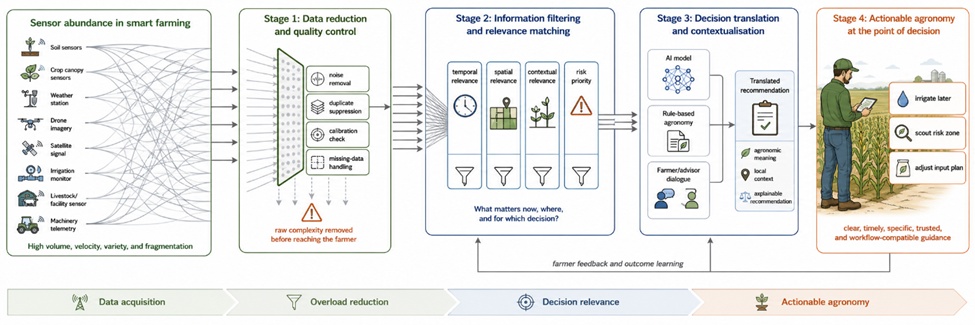
Figure 1. Conceptual Pathway for Reducing Data Overload and Translating Smart Farming Sensor Data into Actionable Agronomic Decisions
Stage 1 is data reduction and quality control, where duplicated, noisy, low-quality, or irrelevant sensor inputs are removed or corrected before they enter the decision environment. Kamilaris, Kartakoullis, and Prenafeta-Boldú [3] showed that big data analytics in agriculture depends on reliable processing, while Elijah, Rahman, Orikumhi, Leow, and Hindia [4] identified data management and integration as persistent challenges for IoT-based agriculture. This stage protects farmers from being exposed to raw complexity that should be handled upstream by the information system.
Stage 2 is information filtering and relevance matching, and Stage 3 is decision translation and contextualisation. These stages connect technical signals to agronomic questions such as whether to irrigate, scout, spray, delay machinery operations, adjust inputs, or seek advisory confirmation. Ingram, Maye, Bailye, Barnes, Bear, Bell, Cutress, Davies, de Boon, Dinnie, Gairdner, Hafferty, Holloway, Kindred, Kirby, Leake, Manning, Marchant, Morse, Oxley, Phillips, Regan, Rial-Lovera, Rose, Schillings, Williams, Williams, and Wilson [19] identified digital agriculture priorities that point toward this need for decision-specific research, and Fielke, Taylor, and Jakku [17] showed that digital knowledge and advice networks must adapt to changing information flows.
Stage 4 is actionable agronomy delivered at the point of decision, where the farmer receives concise, trustworthy, locally relevant, and timely guidance. For example, rather than presenting separate streams of soil moisture, evapotranspiration, weather forecast, crop stage, and pump-status data, the system may recommend delaying irrigation for 24 hours because rainfall probability and crop tolerance make immediate watering unnecessary. Table 3 presents the full conceptual pathway from sensor data to actionable agronomy.
Table 3. Proposed Conceptual Pathway: From Sensor Abundance Through Information Filtering and Decision Relevance to Actionable Agronomy
Pathway stage | Main purpose | Key processes | Design principle | Example of practical output |
Sensor abundance and data acquisition | Capture farm, crop, soil, weather, machinery, and facility conditions | Sensor deployment, remote sensing, telemetry, platform data collection | Collect data only when it can plausibly support a management decision | Soil moisture, canopy stress, weather, and machinery data enter the system |
Stage 1: Data reduction and quality control | Remove noise, duplication, poor-quality data, and irrelevant signals | Data cleaning, validation, calibration, missing-value handling, anomaly review | Protect farmers from raw data complexity before it reaches the interface | Faulty soil probe reading is suppressed rather than shown as a false alert |
Stage 2: Information filtering and relevance matching | Select information that matters for a specific agronomic decision | Temporal filtering, spatial aggregation, risk ranking, contextual matching | Match information to a decision question, crop stage, field condition, and action window | Dashboard highlights one zone requiring scouting rather than displaying all imagery layers |
Stage 3: Decision translation and contextualisation | Convert filtered information into agronomic meaning | Rule-based thresholds, AI prediction, semantic reasoning, advisory logic | Explain what the signal means and why it matters in the current context | “Disease risk is high because humidity, canopy density, and forecast conditions align” |
Stage 4: Actionable agronomy delivery | Present usable guidance at the point of decision | Recommendation design, uncertainty communication, workflow integration, farmer feedback | Deliver clear, timely, specific, and trusted advice compatible with farm operations | “Scout the northern field tomorrow morning before spraying; reassess after rainfall” |
Feedback and learning | Improve future recommendations through farmer response and observed outcomes | User feedback, outcome tracking, model updating, advisory refinement | Treat farmers as adaptive decision partners rather than passive data recipients | Farmer confirms that an alert was useful, allowing the system to refine future thresholds |
For technology developers, the pathway implies that sensor integration should not be treated as the primary benchmark of digital agriculture success. Walter, Finger, Huber, and Buchmann [11] argued that smart farming is important for sustainable agriculture, but this sustainability promise depends on tools that improve decisions rather than simply expand measurement. Developers should therefore invest in relevance engines, context-aware alerts, interface simplification, uncertainty communication, and farmer feedback loops.
For farm advisors, cooperatives, and agricultural organisations, the pathway highlights the need to mediate between digital systems and situated agronomic judgement. Eastwood, Ayre, Nettle, and Dela Rue [8] showed that advisory services will remain important in a smart farming future, especially where farmers need help interpreting platform outputs. Practical implementation should therefore combine automated filtering with advisory interpretation, local validation, and continuous user testing.
Future research should empirically validate the proposed pathway across different farming systems, crop types, technological maturities, and advisory arrangements. Khan, Ray, Sargani, Ihtisham, Khayyam, and Ismail [20] presented agricultural technology as a route to sustainable agriculture, but the field still needs stronger metrics for decision relevance, cognitive load, usability, and actionability. Research should also examine farmer mental models, platform dependence, trust calibration, and the conditions under which filtered information becomes practical agronomic wisdom.
This article has proposed a conceptual pathway for reducing data overload in smart farming systems by shifting attention from sensor abundance to actionable agronomy. The central argument is that smart farming should not be judged by the amount of data it collects, but by its capacity to support better, faster, clearer, and more context-sensitive decisions. The pathway reframes data as a means to agronomic action rather than an end in itself.
The proposed pathway identifies four major stages: data reduction and quality control, information filtering and relevance matching, decision translation and contextualisation, and actionable agronomy delivered at the point of decision. Together, these stages address the problem that many smart farming systems generate abundant information but fail to convert it into usable guidance. The pathway therefore provides a practical structure for designing agricultural technologies that reduce cognitive burden rather than adding to it.
The future of smart farming should move from the pursuit of more sensors toward smarter translation, better interfaces, and stronger collaboration between farmers, advisors, designers, and data scientists. Actionable agronomy should become a benchmark for digital agriculture because it links technological innovation to real farm decisions. When sensor systems help farmers know what matters, why it matters, and what can be done next, data abundance becomes agronomic value.
None
None
None
None
Open Access The author(s) retain copyright. This article is licensed under the Creative Commons Attribution-NonCommercial-ShareAlike 4.0 International License. It may be shared and adapted for non-commercial purposes with appropriate attribution, an indication of changes, and distribution of adaptations under the same license. Third-party material may be subject to separate terms identified in its credit line. View the license at https://creativecommons.org/licenses/by-nc-sa/4.0/.
 Agro Intelligence Research Press