Artificial intelligence is increasingly used across agriculture and food systems for precision farming, yield prediction, pest detection, supply-chain optimisation, quality control, decision support, and resource management. These applications are often promoted as tools for increasing productivity, reducing uncertainty, improving resource efficiency, and strengthening food-system resilience. As AI becomes embedded in farms, supply chains, laboratories, and food governance infrastructures, its consequences extend beyond technical performance. The central problem is that the benefits of agri-food AI are frequently assessed through accuracy, automation efficiency, profitability, or optimisation metrics, while broader ethical, equity, environmental, and governance implications receive less systematic attention. AI systems may alter farmer autonomy, labour relations, data ownership, market participation, environmental decision-making, and institutional accountability. Treating these consequences as secondary risks understates the degree to which AI changes relationships among people, technologies, land, food, and power. This critical review examines responsible AI in agriculture and food systems through four connected dimensions: ethics, equity, sustainability, and governance. It argues that responsible AI cannot be reduced to technical reliability or model performance because agri-food systems are socially embedded, ecologically consequential, and institutionally fragmented. The article therefore evaluates responsible AI as a socio-technical and governance challenge rather than as a purely computational problem. The article contributes a critical argument that responsible agri-food AI requires accountable design, inclusive access, sustainability-aware evaluation, and multi-level governance. It emphasises that trustworthy AI in agriculture and food systems depends on who controls data, who benefits from automation, who bears environmental and social risks, and who participates in decision-making. Responsible AI is therefore positioned as a core condition for equitable, sustainable, and publicly legitimate agri-food transformation.
Artificial intelligence is expanding across agriculture through precision farming, automated sensing, decision support, machinery guidance, robotics, remote monitoring, and predictive analytics. These tools are commonly justified by the promise that smart farming can help agriculture respond to productivity pressures, resource constraints, and sustainability demands. Yet the same systems that improve measurement and optimisation also change how agricultural knowledge is produced, who interprets farm conditions, and which actors gain influence over decisions. The starting point for responsible AI is therefore not whether smart farming can support sustainability, but whether sustainability-oriented technologies are governed in ways that remain socially accountable [1].
The broader transition often described as Agriculture 4.0 intensifies this concern because it combines data infrastructures, automation, platform services, sensors, algorithms, and new business models. A critical review must treat this transition as contested rather than inevitable, because technological pathways differ in how they distribute benefits, risks, responsibilities, and agency. The literature on Agriculture 4.0 shows that responsibility and diversity must be managed within food-system transition pathways rather than assumed to follow automatically from innovation [2]. This insight challenges simplistic accounts in which digitalisation is presented as a neutral upgrade to existing agricultural systems.
AI also extends beyond farm-level production into food safety, processing, supply-chain analytics, quality control, and food-system monitoring. This broader agri-food scope matters because algorithmic decisions can affect not only farmers but also consumers, processors, retailers, regulators, and environmental systems. Digitalisation and AI are increasingly discussed as enabling sustainable food systems, but the same expansion creates new dependencies on data infrastructures, institutional coordination, and sector-specific governance [3]. Responsible AI in food systems must therefore be evaluated across interconnected chains rather than isolated farm technologies.
The need for a critical review arises because agricultural AI debates increasingly identify social and ethical impacts that cannot be captured by accuracy metrics alone. These impacts include power asymmetries, data control, autonomy, labour displacement, accountability gaps, and uneven participation in technological change. Mapping the agricultural AI ethics literature shows that these concerns are already visible but remain unevenly integrated into mainstream AI deployment and policy discussions [4]. This article therefore argues that responsible AI in agriculture and food systems must be assessed through the linked dimensions of ethics, equity, sustainability, and governance. Figure 1 presents the manuscript’s core conceptual framework, showing how responsible agri-food AI moves beyond technical accuracy toward integrated ethical accountability, equitable access, sustainability-aware evaluation, and multi-level governance.
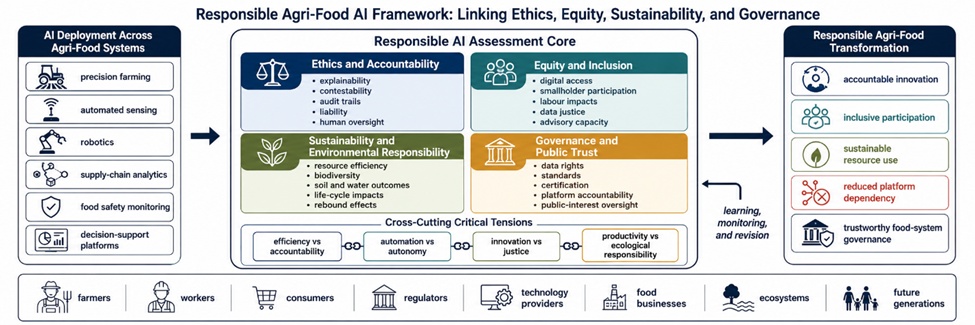
Figure 1. Responsible Agri-Food AI Framework: Linking Ethics, Equity, Sustainability, and Governance
Responsible AI in agriculture and food systems refers to the design, deployment, evaluation, and governance of AI systems in ways that are accountable to farmers, workers, communities, consumers, regulators, ecosystems, and future food-security needs. Unlike generic AI applications, agri-food AI interacts with land, water, biodiversity, livestock, labour, markets, and public trust. A systemic account of responsible agricultural AI is necessary because risks and externalities can arise across data pipelines, environmental feedbacks, food-security dependencies, and institutional arrangements [5]. This makes responsible AI an agri-food challenge rather than merely a software engineering challenge.
A responsible AI approach must also clarify which values guide design and evaluation. Fairness, transparency, accountability, sustainability, privacy, and robustness are not abstract ideals when applied to digital agriculture; they shape whether farmers can contest recommendations, whether data are protected, and whether systems perform reliably across diverse farm contexts. Ethical and responsible use of AI in digital agriculture therefore requires explicit attention to these values during development, deployment, and oversight [6]. The weakness of many technology-led approaches is that they treat these values as add-ons after the technical system has already been defined.
Smart farming further illustrates why responsible AI must be understood as socio-technical. Data-driven farm tools affect privacy, autonomy, data ownership, and power relations because they mediate decisions between farmers, technology vendors, agribusinesses, and advisory systems. Ethical analysis of smart farming shows that responsible innovation is needed precisely because these systems reorganise decision-making authority and the conditions under which farmers act [7]. The responsible AI question is therefore not only whether an algorithm performs well, but whether the surrounding innovation process respects agency, accountability, and legitimate participation.
A critical agri-food perspective also exposes the limits of fragmented ethics responses. Addressing one issue, such as data privacy, will not resolve related problems of platform dependency, exclusion, accountability, or environmental trade-offs. Socio-ethical challenges in smart farming require a comprehensive responsible research and innovation approach because technical design, business models, institutional norms, and user practices interact throughout deployment [8]. Responsible AI should therefore integrate ethics, equity, sustainability, and governance as mutually reinforcing conditions rather than treating them as separate compliance categories.
Ethics and accountability in intelligent agriculture begin with the recognition that AI and agricultural big data can redistribute power. Data-rich actors may gain influence over farm management, input purchasing, credit assessment, risk prediction, market access, and supply-chain participation. This redistribution is ethically significant because farmers may depend on systems they do not control, understand, or have meaningful power to contest. Agricultural big data analytics therefore raises an ethics of power, not merely a question of efficient information processing [9].
Organisational practice complicates accountability further because AI systems are often deployed by agribusiness firms, technology providers, or platform intermediaries rather than by farmers alone. In such settings, abstract principles such as transparency and fairness can become difficult to operationalise when commercial incentives, proprietary algorithms, and data asymmetries shape system design. The case of AI and big-data ethics in a large agricultural multinational shows that responsible deployment depends on organisational responsibilities, business practices, and institutional incentives, not only on general ethical declarations [10]. This is why responsible AI cannot be reduced to publishing principles without mechanisms for implementation and scrutiny.
Autonomous and semi-autonomous agricultural robots sharpen ethical questions because they act physically in fields, barns, orchards, and supply-chain environments. Their impacts include safety, liability, labour displacement, animal welfare, human oversight, and the conditions under which automated action should be trusted. Robotics in agriculture therefore raises policy and ethics issues that exceed the promise of efficiency and precision [11]. The critical issue is whether accountability can be assigned when outcomes emerge from interactions among sensors, machines, algorithms, human supervisors, and organisational deployment contexts.
Explainability is one mechanism for accountability, but it is not sufficient on its own. Interpretable agricultural AI can help users understand which variables drive predictions and recommendations, yet explanation must be meaningful to farmers, advisors, auditors, and regulators rather than only to model developers [12]. Autonomous robots in agri-food systems also require a dedicated ethical research agenda because responsibility, agency, and social consequences differ across production, processing, and distribution contexts [13]. Table 1 summarises key ethics and accountability challenges associated with AI deployment in agriculture and food systems.
Table 1. Ethics and Accountability Challenges in Responsible Agri-Food AI: Risks, Affected Actors, Governance Questions, and Accountability Mechanisms
Ethics and accountability challenge | Core risk in agri-food AI | Affected actors | Governance question | Accountability mechanism |
Algorithmic opacity | Farmers and advisors may receive predictions or recommendations without understanding the basis of the decision | Farmers, advisors, technology vendors, auditors | Who must be able to understand and challenge AI outputs before they shape farm or supply-chain decisions? | Farmer-centred explainability, model documentation, decision logs, and contestability procedures |
Data ownership and control | Farm data may be captured, aggregated, or monetised by actors with greater bargaining power | Farmers, cooperatives, agribusiness firms, platform providers | Who owns, accesses, profits from, and can withdraw farm and supply-chain data? | Transparent data contracts, data-use limits, collective bargaining arrangements, and rights to portability |
Distributed responsibility | Harmful outcomes may emerge from interactions among sensors, platforms, algorithms, machinery, and human operators | Farmers, workers, insurers, regulators, machinery providers | Who is responsible when AI-supported decisions cause economic, environmental, safety, or welfare harms? | Shared liability rules, audit trails, certification, incident reporting, and role-specific duties |
Surveillance and autonomy | Continuous monitoring may reduce farmer discretion or create pressure to conform to platform-defined practices | Farmers, workers, lenders, insurers, supply-chain buyers | When does decision support become coercive surveillance or indirect control? | Limits on secondary data use, consent standards, human oversight, and independent review |
Robotics and physical agency | Autonomous machines can create safety, labour, animal welfare, and operational risks in real environments | Farm workers, livestock managers, communities, robot manufacturers | What level of human supervision is required for autonomous action in fields, barns, and food facilities? | Safety standards, emergency override, operator training, welfare assessment, and liability allocation |
Bias and uneven performance | Models may work better for data-rich crops, regions, farms, or production systems than for underrepresented contexts | Smallholders, low-resource regions, minor crops, marginalised producers | How should developers test whether AI systems perform fairly across diverse agricultural contexts? | Dataset audits, contextual validation, participatory testing, and performance reporting by farm type |
Commercial accountability | Proprietary systems may limit scrutiny while shaping decisions that affect livelihoods and markets | Farmers, firms, regulators, consumers | How can private innovation be scrutinised when algorithms and data infrastructures are commercially protected? | Independent auditing, procurement rules, explainability requirements, and enforceable governance standards |
Equity in responsible agri-food AI begins with the recognition that digital agriculture does not enter socially neutral landscapes. Automated technologies can reshape labour relations, rural livelihoods, skill demands, and community participation, especially when adoption advantages larger or better-capitalised farms. The digital divide is therefore not only about internet access but also about who can afford, maintain, interpret, and negotiate with automated systems. Evidence on automated pastures and rural communities shows that agricultural technologies can reorganise work and participation in ways that raise direct equity concerns [14].
Unequal access is also global, because data-driven farming depends on connectivity, sensors, computational capacity, advisory infrastructures, finance, and institutional support. Producers and regions with stronger data infrastructures may accumulate additional advantages, while low-resource contexts are asked to compete in systems increasingly shaped by data availability and algorithmic optimisation. The global divide in data-driven farming demonstrates that responsible AI must consider structural inequality rather than treating adoption barriers as individual reluctance or lack of awareness [15]. Without this shift, AI may deepen the very food-system vulnerabilities it claims to address.
Inclusion is especially complex for smallholders and producers positioned within global value chains. Digital traceability, transparency, and platform-based monitoring may create new market opportunities, but they may also impose compliance burdens, surveillance risks, and data extraction pressures on producers with limited negotiating power. Work on digital technologies and smallholder inclusion shows that transparency can support participation while also creating new forms of exclusion when value-chain actors define the terms of visibility [16]. Responsible AI must therefore ask whether digital inclusion expands agency or merely incorporates marginal actors into systems controlled elsewhere.
Digital access also depends on knowledge systems, advisory capacity, and interpretive authority. AI recommendations are not automatically useful if farmers lack trusted intermediaries, contextual explanation, or the ability to adapt outputs to local agronomic and cultural conditions. The implications of digitalisation for agricultural knowledge show that responsible AI must strengthen, rather than displace, plural forms of expertise among farmers, advisors, researchers, and rural institutions [17]. Equity-sensitive AI should therefore be evaluated by who can understand, question, modify, and benefit from its recommendations.
The sustainability promise of agri-food AI is substantial but not self-validating. AI can support transitions to more sustainable food systems through improved modelling, resource allocation, monitoring, scenario analysis, and decision support. However, AI contributes to sustainability only when its design is aligned with system-level transformation rather than narrow optimisation of existing production models. Research on AI in transitions to sustainable food systems supports this distinction by positioning AI as a design tool whose value depends on the sustainability goals it is configured to serve [18].
Digital agriculture can also help design sustainable agricultural systems by improving the timing, targeting, and contextual adaptation of management decisions. Precision data can support better use of water, fertiliser, pesticides, energy, and land when integrated with agronomic knowledge and environmental objectives. Yet this contribution depends on whether digital tools are evaluated against ecological outcomes, not only yield or profitability. The case for digital agriculture in sustainable system design shows that responsible AI must link technical decision support to broader agronomic and environmental performance [19].
Precision agriculture illustrates both opportunity and caution. Technologies that optimise input use can contribute to greenhouse-gas mitigation, productivity, and farm economics, but such benefits vary across crops, regions, farm sizes, and implementation practices. A critical sustainability assessment must therefore ask whether gains are real, durable, and equitably distributed, rather than assuming that precision always means environmental improvement. Evidence on precision agriculture technologies and greenhouse-gas mitigation supports the claim that environmental benefits should be assessed alongside productivity and economic outcomes [20].
AI-for-sustainability claims require particular scrutiny because sustainability can be reduced to measurable efficiency while ignoring rebound effects, hardware dependence, energy use, e-waste, and the optimisation of ecologically harmful systems. Reviews of AI for agricultural sustainability show that AI applications may support environmental objectives, but implementation constraints and contextual limits remain central to responsible evaluation [21]. Responsible AI should therefore assess life-cycle impacts, infrastructure demands, and whether optimisation targets align with climate, biodiversity, soil, water, and food-system resilience goals. Table 2 compares the equity and sustainability implications of responsible AI across agriculture and food-system contexts.
Table 2. Equity and Sustainability Implications of Responsible AI in Agriculture and Food Systems: Inclusion Risks, Environmental Trade-Offs, and Corrective Design Principles
Agri-food AI context | Equity and inclusion risk | Sustainability opportunity | Environmental trade-off | Corrective responsible-AI design principle |
Precision input management | Small farms may lack capital, connectivity, or advisory support to adopt precision tools | Reduced fertiliser, pesticide, water, and energy waste | Rebound effects may increase total production intensity if efficiency gains lower costs | Pair precision tools with access programmes, local advisory services, and environmental outcome monitoring |
AI-enabled supply-chain traceability | Smallholders may face new compliance burdens and unequal data visibility | Better monitoring of quality, waste, origin, and safety | Digital traceability infrastructures may increase hardware and data-processing demands | Design traceability around fair participation, proportional reporting, and shared value for producers |
Automated machinery and robotics | Labour displacement and skill polarisation may affect rural workers and communities | More targeted field operations and reduced exposure to hazardous tasks | Manufacturing, maintenance, and disposal of robotics may increase material footprints | Require labour-transition planning, repairability, safety oversight, and life-cycle assessment |
Predictive climate and pest analytics | Data-poor regions and minor crops may receive weaker model performance | Earlier warnings can improve adaptation and reduce crop losses | Overreliance on predictive systems may narrow adaptive knowledge and local experimentation | Validate models across regions, include local knowledge, and report uncertainty transparently |
Platform-based farm management | Platform dependency may concentrate benefits among data-rich firms and large producers | Integrated decision support can coordinate resource management | Proprietary optimisation may privilege productivity over biodiversity or soil-health goals | Mandate data portability, contestability, and sustainability metrics beyond yield |
AI-supported food processing and quality control | Smaller food businesses may lack access to advanced inspection and analytics systems | Reduced waste, improved quality control, and better safety monitoring | High computational demand may shift environmental impacts upstream to energy systems | Support shared infrastructure, transparent standards, and energy-aware deployment |
Environmental monitoring and reporting | Producers may be surveilled without fair control over data interpretation | Improved measurement of emissions, soil health, water use, and biodiversity | Monitoring can become compliance extraction if not linked to support and incentives | Use participatory indicators, independent verification, and farmer access to monitoring data |
Governance challenges begin with farm data because AI systems depend on data that are commercially valuable, contextually sensitive, and often legally ambiguous. Farmers may hesitate to share data when they are uncertain about ownership, access rights, secondary use, or future bargaining consequences. Research on farmers and their data shows that reluctance to share data is shaped by legal and institutional uncertainty surrounding smart farming [22]. Responsible AI governance must therefore clarify rights, obligations, and remedies before data extraction becomes normalised.
Trust cannot be built through data collection alone. Voluntary codes can provide useful starting points for data-sharing norms, but their effectiveness depends on clarity, enforceability, legitimacy, and whether farmers believe that commitments will be honoured. Reflections on the EU code of conduct for agricultural data sharing show that trust depends on governance arrangements as much as on technical interoperability [23]. This suggests that responsible AI requires enforceable expectations, transparent data practices, and credible accountability institutions.
Governance must also address distributive politics because automation changes who gains, who loses, and who has authority to decide. AI-enabled robotics and automated agrifood futures may reconfigure labour, ownership, and control over production systems, particularly when innovation is led by actors with strong capital and platform advantages. Work on robotics, labour, and distributive politics shows that automation is not simply a productivity question but a governance question about whose futures are being automated [24]. Public policy cannot leave such decisions solely to private market dynamics.
Platformisation makes these governance questions more urgent. Agricultural platforms can concentrate data, decision support, input services, machinery ecosystems, and market access within a small number of powerful firms. Evidence on oligopolistic platformisation in agriculture indicates that Big Tech and agribusiness platforms may consolidate control over data and services in ways that increase farmer dependency [25]. Responsible AI governance must therefore address competition, interoperability, procurement, auditing, data portability, and public-interest oversight across food-system infrastructures.
The reviewed literature shows that responsible AI in agriculture and food systems is not a single technical requirement but an unresolved socio-technical settlement. Engagement with digital farming is uneven, and this unevenness weakens responsible innovation when some actors are invited to shape technological futures while others are positioned only as users, data sources, or compliance subjects. A responsible innovation lens reveals that participation and power are not peripheral to digital farming; they are central to whether AI becomes legitimate and accountable [26]. This insight links ethics and equity because accountability cannot be meaningful when affected actors lack the capacity to influence design and governance.
A second synthesis concerns the political character of digital agriculture. Efficiency narratives often present AI as an objective route to better decisions, but the reviewed work shows that digital technologies are shaped by ownership, labour relations, security concerns, agroecological values, and institutional priorities. The politics of digital agricultural technologies demonstrates that automation and datafication are not neutral processes, because they determine who controls information, whose knowledge counts, and what kinds of agriculture are made easier to imagine [27]. This creates a recurring contradiction between automation as empowerment and automation as dependency.
A third synthesis concerns the limits of adoption-centred research. Much work on digital agriculture focuses on barriers to uptake, but responsible AI requires deeper questions about social consequences, institutional design, and alternative innovation pathways. Social-science research on digital agriculture, smart farming, and Agriculture 4.0 calls for future agendas that move beyond productivity and adoption toward socio-technical analysis [28]. This gap matters because systems can be widely adopted and still be ethically weak, inequitable, environmentally narrow, or poorly governed.
A fourth synthesis concerns the supply side of digital transformation. Technology suppliers, agribusiness firms, platform providers, machinery manufacturers, and investors shape which AI systems are built, what problems they prioritise, and what forms of dependency they create. Reviews of the drivers of the digital agricultural revolution show that supply-side actors and business models strongly influence innovation trajectories and governance challenges [29]. Table 3 presents the critical synthesis of responsible AI challenges across ethics, equity, sustainability, and governance dimensions.
Table 3. Critical Synthesis of Responsible AI in Agri-Food Systems: Ethics, Equity, Sustainability, Governance Challenges, and Future Research Priorities
Responsible AI dimension | Core critical tension | Why technical performance is insufficient | Governance implication | Future research priority |
Ethics | Efficiency versus accountability | Accurate models may still be opaque, coercive, biased, or difficult to contest | Require explainability, contestability, role-specific responsibility, and audit trails | Empirical studies of accountability mechanisms in real farm and supply-chain settings |
Equity | Inclusion versus extraction | Wider digital participation can still produce unequal data capture and unequal benefits | Ensure fair access, data rights, advisory support, and participatory design | Research on smallholder, gendered, regional, and low-resource digital AI experiences |
Sustainability | Optimisation versus transformation | Efficient input use may optimise unsustainable systems rather than transform them | Evaluate AI against climate, biodiversity, soil, water, energy, and waste outcomes | Life-cycle assessment of AI hardware, data infrastructures, and rebound effects |
Governance | Voluntary principles versus enforceable oversight | Ethical guidelines cannot manage liability, platform power, or cross-border food-system risks alone | Build multi-level governance involving public institutions, farmers, firms, civil society, and consumers | Comparative research on standards, certification, procurement, auditing, and regulation |
Data justice | Innovation versus control | Data-driven services may create dependency if producers cannot control data use or value capture | Support data portability, collective data governance, and rights to challenge secondary use | Farmer- and movement-led models of agricultural data governance |
Labour and autonomy | Automation versus human agency | Autonomous systems may reduce drudgery while displacing skills, jobs, and local judgment | Require human oversight, labour-transition planning, and worker participation | Studies of labour impacts, skill transformation, and farmer-centred autonomy |
Market power | Platform growth versus public food-system governance | High-performing platforms may still consolidate control over infrastructure and market participation | Address interoperability, competition, procurement, and public-interest safeguards | Analysis of platform ecosystems, supplier power, and alternative cooperative models |
Future research should place data justice at the centre of responsible agri-food AI. This means studying how farmers, food movements, cooperatives, and rural communities can shape data governance rather than being treated only as data providers. Agricultural data governance from the ground up shows that agri-food movements offer important perspectives on data justice, collective control, and public-interest governance [30]. Research should therefore examine practical mechanisms for consent, data portability, benefit sharing, collective bargaining, and contestation.
Future work must also move from data collection toward control, especially in smallholder and low-resource contexts. Responsible AI research should investigate whether digital agriculture expands producer agency or merely increases the volume of data extracted from farmers with limited power over its use. Research on smallholder digitalisation and the politics of inclusion shows that governance must address control, capacity, and participation rather than treating inclusion as access to platforms alone [31]. This agenda requires careful attention to gender, region, infrastructure, advisory systems, finance, local knowledge, and institutional trust. Figure 2 translates the review’s critical synthesis into a multi-level governance architecture for responsible agri-food AI, linking data justice, participatory design, environmental accountability, auditing, and public-interest oversight across the AI life cycle.
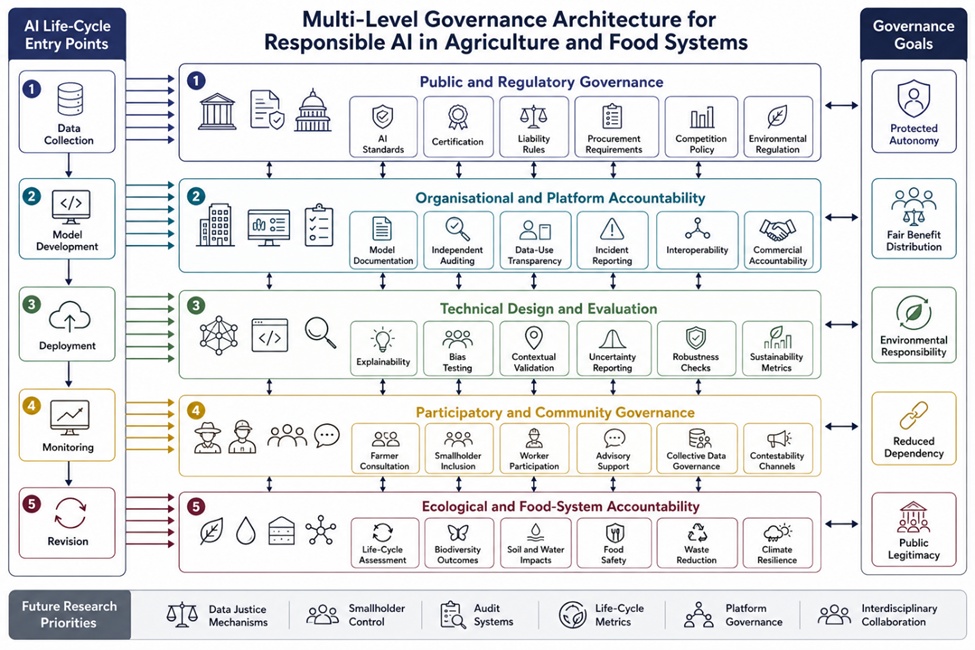
Figure 2. Multi-Level Governance Architecture for Responsible AI in Agriculture and Food Systems
Finally, responsible AI research in agriculture needs integrated governance models that connect technical design with ethics, equity, sustainability, and public accountability. Future research should compare auditing systems, certification models, procurement rules, explainability standards, participatory design methods, environmental life-cycle metrics, and liability frameworks across agri-food settings. Recent work on AI governance in agriculture identifies the need for sector-specific governance frameworks and future research directions that reflect the distinctive risks of agricultural AI [32]. The next generation of scholarship should therefore bring computer science, agricultural science, food policy, ethics, sustainability science, rural studies, and governance research into sustained collaboration.
This critical review has argued that responsible AI in agriculture and food systems must be understood through the connected dimensions of ethics, equity, sustainability, and governance. AI systems in agri-food contexts do not merely improve prediction or automate decisions; they reshape autonomy, labour, data relations, environmental choices, market power, and public trust. For this reason, technical accuracy and efficiency are necessary but insufficient measures of responsible performance.
The review also shows that responsible AI cannot be added after deployment as a narrow compliance exercise. Accountable design, inclusive access, sustainability-aware evaluation, and multi-level governance must be embedded throughout the innovation process. This requires attention to who defines problems, who controls data, who benefits from automation, who bears risk, and who has the authority to challenge AI-enabled decisions.
AI can support more resilient, sustainable, and trustworthy food systems, but only when responsibility is treated as a core condition of agri-food transformation. The future of responsible AI in agriculture depends on institutions, design practices, and governance arrangements that protect autonomy, distribute benefits fairly, and account for environmental consequences. Responsible AI is therefore not a barrier to innovation; it is the basis for innovation that can be trusted, shared, and sustained.
None
None
None
None
Open Access The author(s) retain copyright. This article is licensed under the Creative Commons Attribution-NonCommercial-ShareAlike 4.0 International License. It may be shared and adapted for non-commercial purposes with appropriate attribution, an indication of changes, and distribution of adaptations under the same license. Third-party material may be subject to separate terms identified in its credit line. View the license at https://creativecommons.org/licenses/by-nc-sa/4.0/.
 Agro Intelligence Research Press