Food supply chains face growing pressure to reduce waste, protect product quality, and improve sustainability performance. Yet many supply chain decisions remain reactive, even though food products are perishable, demand is volatile, and quality deterioration often begins before problems become visible. This article proposes that food systems require a more integrated predictive orientation rather than isolated technological improvements. The central problem is that demand forecasting, waste analytics, cold-chain monitoring, and sustainability assessment are often developed as separate capabilities. When these tools remain disconnected, prediction does not necessarily translate into coordinated action or measurable environmental improvement. The absence of an integrated model limits the ability of food supply chains to anticipate waste, preserve quality, and learn from sustainability outcomes. The objective of this article is to propose a conceptual model of Predictive Food Systems. The model connects demand forecasting, waste reduction and inventory intelligence, cold-chain intelligence, and sustainability performance within a closed-loop architecture. It argues that predictive value emerges when data from each component continuously inform decisions across the whole system. The article is based on a conceptual synthesis of 26 peer-reviewed journal articles published between 2017 and 2025. These studies cover food logistics, artificial intelligence, demand forecasting, dynamic inventory management, cold-chain monitoring, food waste accounting, and sustainability assessment. The article does not report new empirical data but uses existing evidence to construct an original systems-oriented framework. The proposed model specifies how demand prediction can reduce overproduction, how inventory intelligence can redirect or discount perishable stock, how cold-chain intelligence can preserve shelf-life, and how sustainability metrics can feed back into predictive systems. Three tables organise the model’s forecasting approaches, cold-chain technologies, and integrated components. The article concludes that predictive food systems can become a practical pathway for reducing waste, improving quality, and advancing sustainability performance.
Food systems display a persistent paradox: they generate significant waste while many populations continue to face food insecurity and unstable access to nutritious food. Food waste accounting research shows that waste occurs across multiple supply chain stages, not only at the consumer end, and therefore requires systemic rather than isolated intervention [1]. Environmental assessments further demonstrate that reducing food loss and waste can lower pressures on carbon emissions, water use, land use, and material throughput, making waste prevention a central sustainability concern rather than a narrow operational problem [2].
Despite this urgency, food supply chains often remain organised around reactive decision routines. Forecasting errors, poor visibility, fragmented data, and delayed quality information create mismatches between supply and demand, especially for perishable products. Studies of demand forecasting in food catering and retail settings show that predictive models can reduce waste when they are connected to ordering, production, and inventory decisions rather than treated as standalone analytical exercises [3, 4].
The shift toward digital food supply chains has created new opportunities for anticipatory decision-making. Data-driven agriculture supply chain research highlights the growing relevance of sensors, digital platforms, analytics, and performance dashboards for improving supply chain coordination [5]. Transparency-oriented technologies, including traceability systems and data infrastructures, also make it possible to observe product movement, quality conditions, and operational decisions more systematically than traditional supply chain records allowed [6-8].
A predictive food system can be defined as a food supply chain configuration that uses data, artificial intelligence, Internet of Things technologies, and performance feedback to anticipate demand, quality deterioration, waste risks, and sustainability consequences before they fully materialise. This definition builds on supply chain research showing that IoT-enabled data streams can support real-time visibility, predictive coordination, and more responsive operational planning [9]. In food systems, however, the goal is not only efficiency but also the preservation of quality, the reduction of avoidable waste, and the improvement of environmental outcomes.
The decision context of food systems makes prediction both valuable and difficult. Perishable products have short useful lives, demand is influenced by weather, promotions, consumer behaviour, local events, and substitution effects, and the consequences of forecast error can appear quickly as spoilage, stockouts, or unnecessary replenishment. Research on shelf-life-sensitive forecasting shows that conventional accuracy measures may be insufficient when products lose value over time, because a mathematically accurate forecast can still produce waste if it ignores remaining shelf-life [10].
Predictive food systems therefore require integration across domains that are usually treated separately. Demand forecasting models may predict sales, cold-chain systems may detect temperature abuse, and waste accounting tools may quantify environmental burdens, but these capabilities often operate in different organisational silos. The need for integration is reinforced by studies on digitalisation in food supply chains, which show that waste prevention depends not only on technology availability but also on collaboration, data sharing, and coordinated decision practices [11].
Demand forecasting is the first predictive layer in the proposed model because many downstream waste and quality problems originate from mismatches between expected and actual consumption. Machine learning models have been applied to food catering demand, fresh fish sales, and broader supply chain forecasting problems, showing that predictive accuracy can support lower overproduction and better inventory decisions when models are connected to operational routines [3, 4, 7]. In this sense, forecasting is not merely a statistical task but a decision mechanism that influences procurement, production, replenishment, and waste exposure.
Food demand forecasting is complicated by consumption variability. Promotions, seasonality, weather conditions, holidays, social trends, and local events can create sharp deviations from historical patterns, especially for short-shelf-life foods. Deep clustering and machine learning approaches have been used to represent heterogeneous demand patterns in food and beverage contexts, indicating that predictive systems must capture both recurring temporal structures and irregular demand shifts [12].
Forecast error has direct consequences for waste and inventory performance. Overforecasting can lead to excess stock, markdown pressure, spoilage, and disposal, while underforecasting can generate stockouts and emergency replenishment that may increase logistics inefficiency. Research on bakery and catering contexts indicates that demand forecasting should be evaluated not only by prediction error but also by its downstream effects on food waste, product availability, and environmental outcomes [3, 13].
A conceptual model of Predictive Food Systems therefore treats demand forecasting as the entry point into a wider decision architecture. Forecasts should inform ordering quantities, production schedules, replenishment timing, markdown policies, and surplus redistribution decisions, while also receiving feedback from observed waste and inventory outcomes. Table 1 summarises the demand forecasting approaches and their relationship to food waste and inventory management.
Table 1. Demand Forecasting Approaches in Predictive Food Systems: Model Types, Data Inputs, and Impact on Waste and Inventory
Forecasting approach | Typical data inputs | Predictive role in food systems | Link to waste reduction | Link to inventory management |
Classical time-series forecasting | Historical sales, seasonality, calendar effects, trend patterns | Establishes baseline demand expectations for recurring consumption cycles | Reduces routine overproduction when demand is relatively stable | Supports replenishment planning and production scheduling |
Machine learning forecasting | Sales history, promotions, weather, product attributes, store-level variables, event data | Captures nonlinear relationships and demand volatility in perishable food contexts | Helps identify demand deviations that may otherwise create surplus stock | Enables more adaptive ordering and stock allocation |
Censored-demand forecasting | Sales records, stockout indicators, lost-sales estimates, availability information | Corrects demand estimates when observed sales are limited by stock availability | Prevents underestimation that can distort future replenishment decisions | Improves stock decisions for products with incomplete sales observations |
Deep learning and clustering models | High-dimensional sales data, product groups, temporal patterns, customer segments | Detects complex and heterogeneous consumption patterns across products and locations | Supports product-specific waste prevention strategies where demand behaviour differs | Enables differentiated replenishment rules across clusters of similar products |
Shelf-life-aware forecasting | Demand history, remaining shelf-life, expiry dates, product age, spoilage risk | Aligns predicted demand with the time-sensitive usability of products | Reduces disposal by connecting forecasts to expiry-sensitive planning | Supports first-expiry-first-out decisions, markdown timing, and stock rotation |
Sustainability-linked forecasting | Demand forecasts, waste records, emissions factors, water and land-use indicators | Connects operational forecasts to sustainability performance targets | Prioritises forecast improvements where environmental benefits are greatest | Guides inventory decisions according to both service levels and sustainability outcomes |
Waste reduction in predictive food systems depends on converting forecasts into inventory actions before products lose commercial or nutritional value. Dynamic shelf-life management research shows that retailers can reduce fresh food waste when discounting decisions are linked to product age, expected demand, and remaining selling time [14]. This means that waste reduction is not simply the result of better prediction but of connecting prediction to pricing, replenishment, and stock rotation decisions.
Inventory intelligence extends demand forecasting by identifying which products should be ordered, held, discounted, redistributed, or removed from the sales channel. Data-driven dynamic pricing models show that perishable food waste can be reduced when markdowns are adjusted according to demand, freshness, and expected disposal risk [15]. In a predictive food system, markdown optimisation becomes a sustainability intervention because it shifts products toward consumption before they become waste.
Surplus redistribution is another inventory intelligence mechanism, especially when demand signals indicate that stock is unlikely to be sold through normal channels. Food loss and waste research emphasises that prevention should be prioritised over disposal and that operational interventions must occur before surplus becomes unavoidable [16, 17]. Predictive inventory systems can therefore support earlier donation, redistribution, processing, or repurposing decisions when products remain safe and usable.
The practical challenge is that waste reduction requires coordination across departments and organisations. Forecasting teams, store managers, logistics providers, suppliers, and sustainability officers may all hold different pieces of the required information, while digitalisation studies show that food waste prevention depends on collaboration as much as technology [11]. Predictive inventory intelligence must therefore be designed as an organisational capability that aligns ordering, pricing, quality control, and sustainability reporting.
Cold-chain intelligence is the second major preservation layer in the proposed model because demand accuracy alone cannot prevent waste if temperature-sensitive products deteriorate during storage and transport. Reviews of cold-chain monitoring show that time-temperature management is central to maintaining food quality and safety across distribution systems [18]. In predictive food systems, cold-chain data become part of the decision architecture rather than a separate compliance record.
Real-time sensing technologies allow supply chain actors to monitor temperature, humidity, location, and handling conditions throughout the movement of food products. Cold-chain monitoring research identifies wireless sensors, RFID, data loggers, and IoT platforms as important tools for detecting deviations that may reduce shelf-life or compromise quality [19]. When these technologies are connected to predictive models, they can estimate risk before visible spoilage occurs.
Cold-chain intelligence also involves predictive maintenance and exception management. Time-temperature abuse studies show that food products may experience quality and safety risks when cold-chain conditions fluctuate during transport, storage, loading, unloading, or retail display [20]. Predictive systems can use equipment performance, route conditions, door-opening events, and temperature histories to identify where intervention is needed before product deterioration accelerates.
The conceptual significance of cold-chain intelligence is that it connects physical product condition to demand and inventory decisions. Intelligent models for multi-temperature food distribution centres show that quality assurance can be improved when monitoring data support operational decisions about storage, routing, and product handling [21]. Table 2 classifies cold-chain intelligence technologies and their effects on food quality preservation and waste reduction.
Table 2. Cold-Chain Intelligence Technologies: Monitoring, Predictive Maintenance, and Quality-Preserving Interventions
Cold-chain intelligence technology | Core data captured | Predictive function | Quality-preserving intervention | Waste reduction pathway |
Time-temperature monitoring | Temperature history, exposure duration, route and storage conditions | Detects accumulated thermal stress and estimates quality risk | Reprioritises affected products for faster sale, processing, or inspection | Prevents hidden deterioration from becoming late-stage disposal |
Humidity and environmental sensing | Humidity, condensation risk, air circulation, packaging environment | Identifies conditions that accelerate texture, microbial, or freshness decline | Adjusts storage conditions and handling procedures | Extends usable shelf-life and reduces preventable spoilage |
IoT-enabled cold-chain visibility | Sensor streams, location data, timestamps, handling events | Provides real-time visibility across transport, warehousing, and retail nodes | Triggers alerts when products move outside acceptable conditions | Enables earlier corrective action before waste becomes unavoidable |
Predictive maintenance for refrigeration | Compressor performance, energy use, fault signals, service history | Anticipates equipment failure or declining cooling efficiency | Schedules maintenance before breakdown or temperature abuse occurs | Reduces batch-level losses caused by refrigeration failure |
Remaining shelf-life modelling | Product age, temperature history, microbial growth assumptions, quality indicators | Estimates product-specific remaining commercial or safe life | Supports routing, markdown, redistribution, and stock rotation decisions | Matches products to the fastest suitable consumption channel |
Multi-temperature distribution intelligence | Product category, storage zone, vehicle configuration, route constraints | Optimises handling for products requiring different temperature regimes | Assigns products to appropriate storage and transport conditions | Prevents cross-category quality losses in mixed distribution systems |
Sustainability performance in predictive food systems must be defined beyond narrow operational efficiency. Food waste has environmental consequences through embedded carbon, water, land, energy, packaging, transport, and labour inputs, and food waste accounting research shows that these burdens differ by product group and supply chain stage [22]. A predictive model should therefore evaluate not only how much waste is reduced but also which waste reductions matter most environmentally.
Environmental assessment studies demonstrate that halving food loss and waste can reduce multiple forms of environmental pressure, but the benefits depend on where in the supply chain the reduction occurs and which products are affected [2]. Waste involving resource-intensive foods may have greater sustainability significance than equivalent mass reductions in lower-impact products. Predictive food systems should therefore connect operational waste metrics with carbon, water, land-use, and material footprint indicators.
A sustainability feedback loop allows the system to learn which predictive actions generate the greatest environmental gains. Food waste accounting methodologies highlight the importance of consistent measurement boundaries, product categories, and lifecycle assumptions when translating waste reduction into sustainability performance [23]. Without such feedback, predictive systems may optimise sales or service levels while failing to prioritise the most meaningful sustainability improvements.
The final sustainability challenge is that waste prevention can sometimes shift burdens rather than eliminate them. Critical assessments of food loss and waste reduction warn that environmental benefits depend on substitution effects, rebound effects, and the actual use of recovered or redistributed food [24]. A predictive food system must therefore treat sustainability performance as a measured outcome that feeds back into model refinement, not as an assumed consequence of waste reduction.
The proposed Predictive Food Systems model links four components in a closed feedback loop: demand forecasting, waste reduction and inventory intelligence, cold-chain intelligence, and sustainability performance. Demand forecasting anticipates consumption variability, inventory intelligence translates forecasts into ordering and redistribution decisions, cold-chain intelligence preserves product quality, and sustainability metrics evaluate whether the system reduces environmental burdens [2, 3, 14, 18]. The model therefore treats prediction as a coordinated system of decisions rather than a collection of isolated tools.
The first data flow runs from demand signals to inventory action. Sales histories, promotions, weather, events, and product-level demand patterns are processed through forecasting models, which then inform production, replenishment, markdown, and redistribution decisions [4, 12]. This flow reduces the likelihood that products enter the supply chain without a realistic pathway to consumption.
The second data flow runs from cold-chain conditions to quality-sensitive decision-making. Temperature, humidity, equipment performance, storage duration, and transport events are used to estimate remaining shelf-life and quality risk, allowing products to be routed, discounted, inspected, or redistributed according to their condition [19, 21]. This makes quality preservation an active predictive process rather than a retrospective safety or compliance check.
Figure 1 illustrates the proposed Predictive Food Systems model as a closed-loop architecture linking demand forecasting, waste reduction, cold-chain intelligence, and sustainability performance.
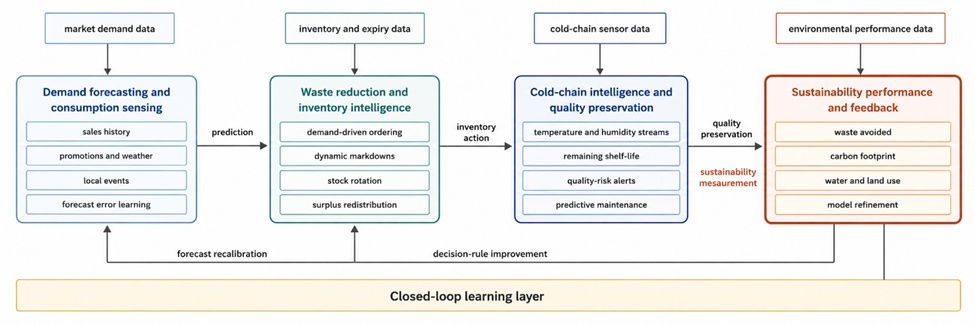
Figure 1. Proposed Predictive Food Systems Model: Closed-Loop Integration of Demand Forecasting, Waste Reduction, Cold-Chain Intelligence, and Sustainability Performance
The third data flow runs from operational outcomes to sustainability feedback. Waste quantities, product categories, disposal routes, avoided waste, emissions factors, water-use estimates, and land-use indicators are evaluated to determine whether predictive decisions improve sustainability performance [1, 23]. Table 3 presents the proposed Predictive Food Systems conceptual model integrating the four components.
Table 3. Proposed Predictive Food Systems Conceptual Model: Components, Data Flows, Feedback Loops, and Sustainability Outcomes
Model component | Key data inputs | Core predictive decision | Operational output | Feedback loop | Sustainability outcome |
Demand forecasting and consumption sensing | Sales history, promotions, weather, local events, customer behaviour, stockout records | Predict expected demand and identify volatility | Demand-informed production, ordering, and replenishment | Forecast errors and unsold stock feed back into model calibration | Reduced overproduction and fewer avoidable surplus products |
Waste reduction and inventory intelligence | Inventory age, expiry dates, sales velocity, markdown response, donation capacity, redistribution options | Decide whether to hold, discount, redistribute, process, or reduce future orders | Dynamic markdowns, stock rotation, demand-driven replenishment, surplus diversion | Waste records and inventory outcomes refine decision rules | Lower disposal volumes and improved use of edible food |
Cold-chain intelligence and quality preservation | Temperature, humidity, route history, storage conditions, equipment performance, remaining shelf-life indicators | Predict quality deterioration and cold-chain risk | Faster routing, condition-sensitive allocation, maintenance alerts, quality inspection | Quality deviations and shelf-life outcomes update deterioration models | Longer usable shelf-life, fewer quality-related losses, improved safety assurance |
Sustainability performance measurement | Waste mass, product type, disposal pathway, emissions factors, water footprint, land-use intensity | Evaluate environmental effects of predictive decisions | Sustainability dashboards, performance reports, priority intervention areas | Sustainability results guide model objectives and intervention priorities | Reduced carbon, water, land, and material impacts from food waste |
System orchestration layer | Integrated data platform, AI models, IoT streams, traceability records, organisational rules | Coordinate decisions across forecasting, inventory, cold chain, and sustainability domains | Closed-loop predictive governance across the food supply chain | Cross-component learning improves future prediction and coordination | System-level transition from reactive waste management to predictive sustainability performance |
For practice, the proposed model implies that food firms should invest in integrated data infrastructure rather than isolated forecasting or monitoring tools. Hierarchical data architectures for sustainable food supply chain management show that information must be structured across operational, tactical, and strategic levels to support planning and sustainability decisions [8]. Predictive food systems therefore require interoperable data platforms that connect sales, inventory, logistics, quality, and sustainability records.
Managers should also pilot predictive food systems with supply chain partners that are willing to share data and coordinate interventions. Blockchain and transparency research shows that digital food supply chains can improve visibility, but technology must be embedded in governance arrangements that define data ownership, accountability, and decision rights [25]. Predictive systems will be most effective where suppliers, logistics providers, retailers, and sustainability teams share both the benefits and responsibilities of waste reduction.
Figure 2 shows how predictive decisions move from data capture to operational intervention and sustainability learning across the food supply chain.
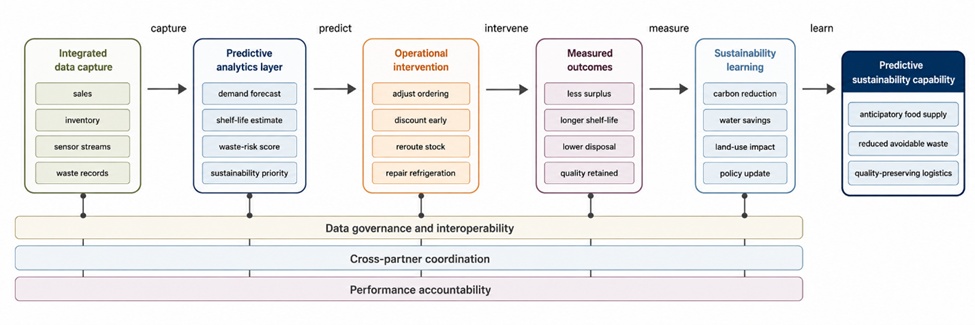
Figure 2. Predictive Decision Pathway for Food Supply Chains: From Data Capture to Waste Prevention, Quality Preservation, and Sustainability Learning
Future research should validate the proposed conceptual model through case studies, simulation models, longitudinal field research, and comparative analysis across product categories. Agricultural supply chain analytics research indicates that big data and geographic information systems can support planning, but more work is needed to understand how predictive capabilities perform across different commodities, regions, and organisational settings [26]. Researchers should also develop metrics for predictive system performance that combine forecast accuracy, waste reduction, quality preservation, cost, and sustainability outcomes.
This article proposed a conceptual model of Predictive Food Systems that links demand forecasting, waste reduction, cold-chain intelligence, and sustainability performance. Its central contribution is to show that predictive technologies become more valuable when they are integrated into a closed-loop system that connects anticipation, intervention, measurement, and learning. The model provides a roadmap for turning fragmented predictive capabilities into a coherent food system that anticipates, adapts, and sustains.
The article has argued that better demand prediction can reduce overproduction, inventory intelligence can prevent edible food from becoming waste, cold-chain intelligence can preserve quality, and sustainability metrics can guide continuous improvement. These elements should not be treated as separate technological domains. They should be understood as mutually reinforcing components of a predictive architecture for food supply chain transformation.
Building predictive food systems will require collaboration among researchers, retailers, producers, logistics providers, technology firms, and sustainability practitioners. The next step is to test the model in real supply chain contexts and refine it through practical evidence. Such work can help food systems move from reactive waste management toward proactive sustainability performance.
None
None
None
None
Open Access The author(s) retain copyright. This article is licensed under the Creative Commons Attribution-NonCommercial-ShareAlike 4.0 International License. It may be shared and adapted for non-commercial purposes with appropriate attribution, an indication of changes, and distribution of adaptations under the same license. Third-party material may be subject to separate terms identified in its credit line. View the license at https://creativecommons.org/licenses/by-nc-sa/4.0/.
 Agro Intelligence Research Press