Food security early warning systems increasingly draw on artificial intelligence, remote sensing, predictive analytics, climate information, crop monitoring, market indicators, and vulnerability data to identify emerging risks before they become severe crises. These systems are expected to provide timely signals about threats to food availability, access, utilisation, and stability across diverse ecological, economic, and social settings. Yet many early warning approaches remain fragmented. Climate risk, market instability, crop stress, and human vulnerability are often analysed in separate technical workflows, which can weaken interpretation, delay action, or produce alerts that are insufficiently linked to response capacity. This article develops a conceptual architecture for AI-enabled food security early warning systems. The architecture treats early warning as a layered process that connects data ingestion, risk-domain analytics, signal integration, uncertainty interpretation, alert generation, decision support, response targeting, and feedback governance. The proposed architecture explains how multi-source data and predictive models can be translated into interpretable and actionable food security warnings. It also emphasises that AI-enabled early warning can fail when data are incomplete, model outputs are opaque, vulnerable populations are underrepresented, or alerts are disconnected from institutions capable of acting.
Food security early warning systems have become central to anticipating crises shaped by climate variability, drought, production shocks, market disruption, conflict, and livelihood vulnerability. Operational early warning practice already shows that food security risk cannot be inferred from one signal alone; it requires the combination of climate monitoring, vegetation indicators, crop assessments, expert judgement, and response partnerships. The experience of drought-focused food security early warning demonstrates the importance of linking scientific monitoring with institutional decision processes rather than treating warning as a purely technical output [1].
Artificial intelligence and machine learning have expanded the analytical possibilities of early warning by enabling pattern detection across heterogeneous data streams, including climate observations, food security classifications, livelihood indicators, and market-related variables. However, the value of data-driven prediction depends on whether the forecast is tied to a meaningful decision problem, such as identifying where and when food insecurity may deteriorate enough to require anticipatory action. Crisis-prediction research shows that analytical models can improve food insecurity anticipation when they are designed around decision-relevant outcomes rather than abstract accuracy targets [2].
A major gap in current early warning practice is that technically available risk signals are often weakly integrated across climate, crop, market, and human vulnerability domains. In settings where primary food security data are incomplete or delayed, machine learning can help infer risk patterns from secondary indicators, but such inference also introduces uncertainty, representational limits, and the danger of overconfidence. Evidence from data-sparse food security estimation shows that AI-enabled systems must be designed to recognise missing information as an architectural constraint rather than a minor technical inconvenience [3].
This article develops a conceptual architecture for AI-enabled food security early warning systems that integrates climate risk, market instability, crop stress, and human vulnerability into response-linked alerts. The architecture does not treat AI as a substitute for institutional judgement; rather, it positions AI as one component within a layered system of data ingestion, risk-domain modelling, signal integration, interpretation, alert generation, response targeting, and feedback. Regional machine-learning prediction of food-security crises illustrates the potential of such systems while also showing that operational usefulness depends on context, transferability, and integration with existing early warning capacity [4].
Food security early warning can be defined as the process of detecting, interpreting, communicating, and acting on signals that indicate emerging threats to food availability, access, utilisation, and stability. It is not only a forecasting task because a warning that cannot be validated, explained, trusted, or acted upon has limited practical value. Validation of food security projections shows why early warning architectures need a feedback layer that compares projected crisis conditions with observed outcomes and uses the results to improve future warning practice [5].
Early warning is an architecture problem because it requires several connected layers to function together. Data must be ingested from multiple sources, risk signals must be modelled within specific domains, cross-domain interactions must be interpreted, and alerts must be routed toward institutions able to respond. Forecasting transitions between food-security states demonstrates why an architecture should track movement from one risk condition to another rather than merely classify a place as currently secure or insecure [6].
AI can support this architecture by detecting nonlinear relationships, combining heterogeneous indicators, identifying emerging anomalies, and prioritising locations where risk is likely to intensify. At the same time, AI can introduce opacity, bias, instability across contexts, and uncertainty that is difficult for decision-makers to interpret. Research on the forecastability of food insecurity highlights that predictive performance varies across settings, horizons, and signal types, which means that uncertainty handling must be designed into the architecture rather than appended after modelling [7].
A conceptual architecture is therefore needed to connect prediction with interpretation and action. In this architecture, the model layer should not be the centre of the system; it should be one layer in a wider chain that includes problem framing, data stewardship, contextual validation, alert communication, response capacity, and learning feedback. Data-driven food insecurity prediction is most useful when it supports a clear decision pathway, while food-security forecastability remains bounded by signal quality, local context, and institutional readiness [2].
Climate risk is a foundational domain in food security early warning because drought, flood, rainfall anomalies, heat stress, soil moisture deficits, extreme weather, and water scarcity can affect crops, livestock, markets, income, and nutrition. In an AI-enabled architecture, climate risk should be treated as a multi-hazard and impact-oriented signal layer rather than as a single meteorological input. Integrated AI approaches to complex climate-risk early warning support this design because they connect climate drivers with exposure, cascading impacts, uncertainty, and decision relevance [8].
The climate-risk layer should ingest meteorological observations, satellite-derived environmental indicators, seasonal forecasts, agroecological context, hydrological information, and historical impact patterns. Remote sensing can strengthen drought-related food security warning by detecting anomalies and potential tipping signals before severe impacts are fully visible on the ground. Applying tipping-point logic to remote-sensing drought indicators shows how climate signals can be transformed into earlier warning information when they are linked to food security consequences [9].
Predictive analytics can also extend warning lead time by combining climate information with expected production outcomes. Preseason yield forecasting for maize and wheat shows that seasonal climate and crop-risk signals can provide early indications of possible crop failure before harvest losses are confirmed. Within the proposed architecture, such outputs should feed both the climate-risk analytics layer and the crop-stress module, because climate anomalies become food security risks partly through their effects on production, livelihoods, and markets [10].
Climate-risk signals require careful interpretation because uncertainty varies by forecast horizon, spatial resolution, data quality, and local exposure. Explainable machine learning can help decision-makers understand which drought-impact drivers are shaping a warning, making it easier to assess whether the alert is credible and actionable in a specific context [11]. Table 1 summarises climate-risk data streams and predictive analytics functions used in AI-enabled food security early warning systems.
Table 1. Climate-Risk Data Streams and Predictive Analytics Functions for AI-Enabled Food Security Early Warning: Weather Signals, Remote Sensing Inputs, Hazard Indicators, Model Outputs, and Alert Implications
Climate-risk data stream | Example inputs | Predictive analytics function | Model output | Alert implication | Architecture safeguard |
Meteorological observations | Rainfall, temperature, evapotranspiration, wind, humidity | Detect abnormal weather conditions and compare them with historical baselines | Rainfall deficit, heat anomaly, dry-spell intensity | Early indication of drought, heat stress, or weather-related livelihood pressure | Local threshold calibration and uncertainty bands |
Seasonal and subseasonal forecasts | Rainfall outlooks, temperature outlooks, probabilistic climate forecasts | Estimate near-future hazard probability and likely exposure windows | Probabilistic hazard forecast | Anticipatory planning before agricultural or market impacts peak | Communication of confidence levels and forecast horizon limits |
Remote sensing indicators | Vegetation indices, land-surface temperature, soil moisture, surface water extent | Identify spatial anomalies and emerging environmental stress | Vegetation stress, soil moisture deficit, flood extent | Spatial prioritisation of areas requiring closer monitoring | Ground validation and comparison with field reports |
Hydrological and water-availability signals | River flow, reservoir levels, groundwater proxies, water-balance indicators | Link water scarcity or excess water to agricultural and livelihood risk | Water stress or flood-risk classification | Warning of irrigation failure, pasture stress, or flood-related disruption | Integration with crop calendars and livelihood profiles |
Agroecological context | Crop calendars, growing zones, livelihood zones, soil properties | Interpret climate anomalies according to production stage and local sensitivity | Context-adjusted climate impact score | Differentiation between meteorological anomaly and food security relevance | Agroecological stratification and expert review |
Historical impact records | Previous drought impacts, crop losses, market responses, humanitarian outcomes | Learn relationships between climate shocks and food security deterioration | Expected impact trajectory | Early identification of places likely to experience worsening food insecurity | Continuous validation against observed outcomes |
Compound climate-risk indicators | Drought plus heat, flood plus market disruption, rainfall shock plus conflict exposure | Detect interacting or cascading risk patterns | Multi-hazard stress index | Escalation from monitoring to warning when risks converge | Cross-domain signal integration and response review |
Market instability is a core food security early warning domain because food insecurity often emerges through access failure rather than aggregate food shortage alone. Price volatility, input-cost shocks, inflation, trade disruption, transport constraints, conflict-related market fragmentation, and supply-chain failures can reduce household purchasing power even when food remains physically available. Text mining and machine learning evidence on determinants of food insecurity supports treating economic and market stress as food-system risk signals that should be monitored alongside climate and production indicators [12].
The market-instability layer should connect production expectations, trade flows, storage conditions, commodity prices, local food prices, exchange-rate pressure, and consumer purchasing power. Forecasting maize prices from regional production patterns shows that production shocks and price movements are analytically linked, which makes it important for the architecture to connect crop-risk outputs with market-risk modules [13]. This connection is especially important where households depend on markets for food access and where local price spikes can rapidly transform production stress into consumption stress.
AI-enabled market analytics can support early warning by detecting abnormal price movements, identifying deviations from seasonal price behaviour, and estimating where food access may deteriorate. Local food-price prediction using hybrid machine-learning methods demonstrates how market monitoring can be adapted to country-specific price systems when data are available and properly calibrated [14]. In the proposed architecture, such models should not generate stand-alone market alerts; they should feed a wider signal-integration layer that also considers crop conditions, livelihoods, and vulnerability.
Market signals must be interpreted cautiously because prices do not automatically reveal who is affected, how severely households are affected, or whether response institutions can act. A price increase may be manageable for one livelihood group but catastrophic for another, depending on income sources, debt, assets, market access, and social protection coverage. For this reason, market analytics should be linked to vulnerability indicators and qualitative interpretation so that food-system stress is not mistaken for household impact without supporting evidence [12].
Crop stress detection is the production-risk layer of the proposed early warning architecture. It converts environmental, agronomic, and remote-sensing signals into information about likely production stress, harvest loss, pasture degradation, or reduced food availability. The GEOGLAM Crop Monitor for Early Warning demonstrates how Earth observation, crop-condition assessment, expert interpretation, and food security decision support can be combined to strengthen agricultural decisions in countries at risk of food insecurity [15].
Remote sensing allows early warning systems to observe vegetation condition, crop phenology, surface water, soil moisture, land-surface temperature, and other signals across wide geographic areas. Yet satellite-based crop monitoring can fail when spatial resolution is inadequate, ground validation is weak, crop calendars are poorly represented, or users are not involved in interpreting outputs. Reviews of remote-sensing crop monitoring emphasise that technical capacity must be paired with reliability checks, field information, and decision relevance if crop-stress signals are to support early warning [16].
Crop-water stress should be treated as a distinct production-risk signal because water deficits can reduce yield potential before visible crop failure occurs. Remote sensing and machine learning methods can identify water stress through thermal signals, vegetation response, evapotranspiration patterns, soil moisture proxies, and crop-specific stress indicators. Evidence on crop water stress assessment supports including water-stress detection as a specialised module within the crop-stress layer rather than merging it into a generic climate anomaly score [17].
Yield-prediction models can translate vegetation, environmental, weather, and agronomic signals into estimates of production risk. Remote sensing and machine-learning approaches to crop-yield prediction show how AI can support food insecurity anticipation by identifying likely production shortfalls before harvest outcomes are fully known [18]. In the proposed architecture, yield forecasts should trigger interpretive review rather than automatic escalation, because production losses become food security crises only when they interact with markets, livelihoods, assets, and response capacity.
Human vulnerability is the bridge between risk detection and food security response. Climate shocks, market stress, and crop losses matter for early warning because they affect people differently according to livelihood exposure, income, assets, land access, displacement, age, gender, nutrition status, health, market dependence, and coping capacity. Machine-learning research on alternatives to calorie-based indicators supports the view that vulnerability assessment should include multidimensional measures rather than relying on a narrow food-consumption metric alone [19].
The vulnerability-assessment layer should identify who is exposed, who is sensitive to shocks, and who lacks the capacity to cope or recover. Household-level analysis in Ethiopia and Nigeria shows that food insecurity determinants can be nonlinear and context-specific, which means that vulnerability models should avoid assuming that the same risk factors operate identically across places and livelihood groups [20]. In architectural terms, vulnerability information should not sit at the end of the system; it should shape how climate, market, and crop signals are interpreted from the beginning.
Nutrition-sensitive vulnerability is especially important because food insecurity can affect dietary quality, child growth, micronutrient intake, and health before aggregate food availability indicators show severe deterioration. Machine-learning approaches to predicting the impact of food insecurity on nutrient consumption and child malnutrition support the inclusion of nutrition vulnerability in response targeting [21]. This means that the alert pathway should distinguish between general livelihood stress and risks requiring nutrition, health, or child-focused intervention. Figure 1 illustrates how climate risk, market instability, crop stress, and human vulnerability converge into food-security deterioration pathways that require response-sensitive interpretation rather than isolated technical alerts.
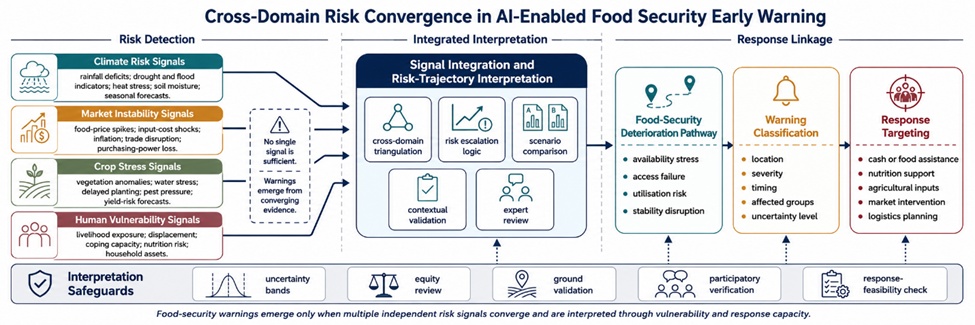
Figure 1. Cross-Domain Risk Convergence in AI-Enabled Food Security Early Warning
Response targeting should connect risk signals with vulnerable groups, feasible interventions, timing requirements, and institutional responsibility. A household may require cash support, food assistance, nutrition services, agricultural inputs, market stabilisation, livelihood protection, or combinations of these depending on the risk pathway identified. Vulnerability models should therefore be interpreted with local knowledge and safeguards against exclusion, especially where household survey coverage, population mobility, or social marginalisation affects who is visible in the data [20]. Table 2 maps market instability, crop stress, and human vulnerability signals to early warning interpretation and response-targeting needs.
Table 2. Market Instability, Crop Stress, and Human Vulnerability Signals in Food Security Early Warning: Data Sources, Risk Indicators, Interpretation Needs, Vulnerable Groups, and Response-Targeting Functions
Risk domain | Data sources | Risk indicators | Interpretation needs | Vulnerable groups likely to be affected | Response-targeting function |
Market instability | Local food prices, commodity prices, transport data, trade flows, inflation indicators, market reports | Price spikes, abnormal seasonal prices, reduced market supply, input-cost shocks | Determine whether price changes reduce access for specific livelihood groups | Net food buyers, urban poor households, displaced populations, wage-dependent households | Cash assistance, market monitoring, price-stabilisation support, transport or supply-chain intervention |
Purchasing-power loss | Wage data, income proxies, employment conditions, remittance patterns, food expenditure shares | Declining real income, rising food expenditure burden, reduced purchasing capacity | Link price movements to household income and coping capacity | Informal workers, landless households, low-income families, female-headed households | Social protection, targeted transfers, livelihood support, food-access assistance |
Crop stress | Vegetation indices, soil moisture, crop calendars, field reports, pest and disease surveillance | Vegetation decline, delayed planting, water stress, pest pressure, expected yield reduction | Distinguish temporary anomaly from production-threatening stress | Smallholder farmers, rain-fed producers, pastoralists, subsistence households | Agricultural advisories, input support, irrigation support, seed distribution, pest-control response |
Production shortfall | Yield forecasts, crop assessments, remote-sensing indicators, harvest reports | Below-normal yield expectation, crop failure probability, harvest delay | Estimate effects on food availability, prices, income, and labour demand | Farming households, agricultural labourers, food-deficit regions | Anticipatory food assistance, livelihood protection, market planning, storage and procurement decisions |
Household vulnerability | Household surveys, livelihood profiles, assets, debt, coping strategies, displacement data | Reduced coping capacity, asset depletion, high dependency ratio, negative coping | Identify who is likely to experience severe food access or utilisation stress | Poor households, displaced people, elderly people, children, people with limited assets | Geographic and demographic targeting, case management, assistance prioritisation |
Nutrition vulnerability | Dietary diversity, child growth data, health records, food consumption, care access | Declining diet quality, malnutrition risk, reduced nutrient intake | Determine whether food insecurity is becoming a nutrition or health emergency | Children, pregnant and lactating women, chronically ill people | Nutrition screening, supplementary feeding, health referral, integrated food and nutrition assistance |
Response capacity | Institutional presence, logistics, funding, local partners, programme coverage | Delayed assistance, limited reach, access constraints, weak referral pathways | Assess whether warning can be acted upon within the required time window | Populations in remote, insecure, or poorly served areas | Response feasibility review, pre-positioning, coordination, escalation to higher-level support |
The proposed conceptual architecture consists of seven connected layers: data ingestion, risk-domain analytics, signal integration, uncertainty and explainability, alert generation, response linkage, and feedback governance. The data-ingestion layer harmonises climate observations, remote sensing, crop monitoring, market data, household vulnerability indicators, nutrition signals, qualitative reports, and institutional response information. Harmonised sub-national food insecurity datasets show why integrated data structures are necessary for comprehensive analysis and predictive modelling across places, time periods, and classification systems [22]. Figure 2 presents the proposed layered architecture through which multi-source data are transformed into risk-domain analytics, integrated warning signals, interpretable alerts, response-linked decisions, and feedback governance.
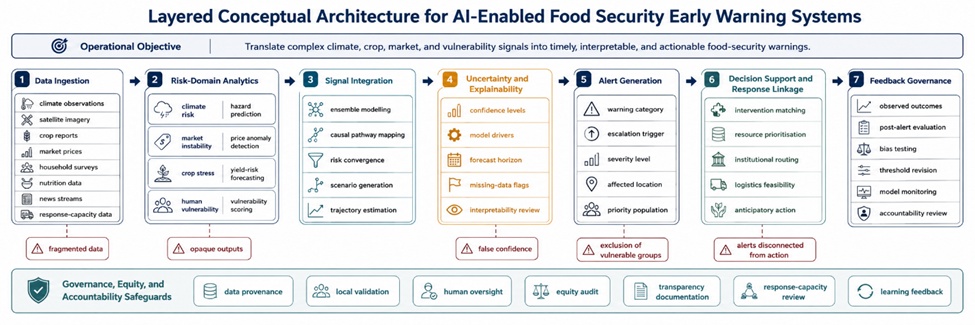
Figure 2. Layered Conceptual Architecture for AI-Enabled Food Security Early Warning Systems
The risk-domain analytics layer contains four interacting modules: climate risk, market instability, crop stress, and human vulnerability. Each module produces domain-specific risk signals, but the architecture requires a signal-integration layer to estimate whether these signals are converging toward food security deterioration. Real-time food-security forecasting supports this design because early warning should generate short-horizon risk trajectories rather than isolated status labels that cannot guide anticipatory action [23].
The architecture also includes an unstructured-signal pathway for information that may appear in news reports, local narratives, humanitarian updates, conflict reporting, or market commentary before it appears in structured datasets. Food-crisis prediction from news streams demonstrates how text analytics can provide complementary signals about emerging disruption, although such signals require source evaluation and bias-aware interpretation [24]. In the architecture, unstructured signals should trigger triangulation with structured data rather than operate as independent proof of crisis.
The uncertainty and explainability layer translates model outputs into interpretable alert information, including confidence levels, major drivers, affected groups, likely time horizon, and recommended review actions. Principles for transparent and usable machine learning in food security support the requirement that model outputs be designed for practitioners who must interpret, communicate, and act on warnings [25]. The response-linkage layer then connects predicted risk with resilience profiles, coping capacity, and feasible interventions, because food security response should be shaped by household and livelihood resilience rather than hazard exposure alone [26]. Table 3 presents the proposed conceptual architecture for AI-enabled food security early warning systems.
Table 3. Proposed Conceptual Architecture for AI-Enabled Food Security Early Warning Systems: Data Ingestion, Risk Analytics, Signal Integration, Alert Generation, Decision Support, Response Linkage, and Feedback Governance
Architecture layer | Core function | Main data streams | AI-enabled function | Decision output | Failure risk | Governance safeguard |
Data ingestion | Assemble and harmonise multi-source risk information | Climate data, satellite imagery, crop reports, market prices, household surveys, nutrition data, news streams | Data fusion, anomaly detection, missing-data estimation, quality screening | Usable multi-domain risk dataset | Fragmented or biased data streams | Data provenance, quality scoring, inclusion checks |
Climate risk analytics | Identify hazards and climate-related stress pathways | Weather observations, forecasts, soil moisture, drought and flood indicators | Hazard prediction, impact modelling, spatial risk estimation | Climate-risk signal and expected exposure | Overgeneralised climate warnings | Local calibration, uncertainty communication |
Market instability monitoring | Detect access risks from food-system and price stress | Food prices, commodity prices, trade, transport, inflation, purchasing power | Price anomaly detection, price forecasting, market-stress classification | Market-access risk signal | Prices misread as household impact | Linkage to livelihood and vulnerability data |
Crop stress detection | Monitor production risk before harvest outcomes are visible | Vegetation indices, crop calendars, water stress, field reports, pest and disease signals | Crop condition classification, yield-risk forecasting, stress detection | Production-risk signal | Weak ground validation or model transferability | Field triangulation and agroecological interpretation |
Human vulnerability assessment | Identify who is most exposed and least able to cope | Household indicators, assets, income, displacement, nutrition, coping strategies | Vulnerability scoring, group-risk classification, targeting support | Vulnerability and priority-population signal | Undercounting or exclusion of marginalised groups | Participatory validation and equity review |
Signal integration | Combine domain-specific signals into food-security risk trajectories | Outputs from climate, market, crop, and vulnerability modules | Ensemble modelling, causal pathway mapping, scenario generation | Integrated food-security risk trajectory | False confidence from aggregated scores | Human review, scenario comparison, explanation of drivers |
Alert generation | Convert risk trajectories into warning categories and escalation triggers | Integrated risk scores, thresholds, expert review, response criteria | Alert prioritisation, threshold learning, severity classification | Warning level, location, timing, likely affected groups | False alarms or missed alerts | Threshold auditing and post-alert evaluation |
Decision support | Translate alerts into response options | Alert outputs, response capacity, programme coverage, logistics, funding | Intervention matching, prioritisation, resource allocation support | Recommended response pathway | Alerts disconnected from feasible action | Institutional coordination and response-capacity review |
Feedback governance | Learn from outcomes and improve future warnings | Observed food security outcomes, response records, user feedback, model performance | Model monitoring, bias testing, retraining, error analysis | Updated thresholds, revised models, improved protocols | Repeated errors without accountability | Independent review, transparency, documented learning loops |
Implementation risks begin when AI-enabled early warning systems are treated as predictive products rather than institutional decision architectures. Fragmented data systems, missing ground-truth information, model opacity, local validation gaps, and weak response capacity can all reduce the practical utility of technically sophisticated forecasts. Evidence from assessing machine learning for food sufficiency prediction in Malawi shows why implementation should compare AI outputs with simpler baselines and evaluate whether predictions are actionable under real policy and operational constraints [27].
Future research should test integrated architectures across different food-security contexts, including settings with diverse livelihoods, conflict exposure, market structures, agroecological zones, and institutional capacities. The potential and limitations of machine learning for acute food-insecurity forecasting show that data fragmentation, model transferability, changing crisis dynamics, and operational constraints remain central challenges for AI-enabled early warning [28]. Research should therefore move beyond model comparison alone and examine explainable warning design, local validation protocols, anticipatory action triggers, vulnerability-sensitive modelling, and post-response learning.
A final implementation risk is that early warning systems may underrepresent the people most at risk. If measurement systems undercount acute hunger, miss mobile or marginalised populations, or misclassify crisis severity, an AI-enabled architecture may reproduce those errors at scale. Evidence that official food insecurity estimates can undercount acute hunger supports the need for feedback governance, participatory validation, and explicit equity safeguards within early warning architecture [29]. The purpose of AI-enabled warning should be not only to predict risk earlier, but also to make vulnerable populations more visible to timely and accountable response.
This article has developed a conceptual architecture for AI-enabled food security early warning systems that integrates climate risk, market instability, crop stress, and human vulnerability. The architecture positions early warning as a layered process that begins with multi-source data ingestion and moves through risk-domain analytics, signal integration, uncertainty interpretation, alert generation, decision support, response linkage, and feedback governance. Its central contribution is to show how technically diverse signals can be organised into a response-oriented system rather than treated as separate analytical products.
The architecture also emphasises that early warning should not be evaluated only by predictive accuracy or data availability. A warning is useful when it is interpretable, timely, vulnerability-sensitive, and linked to institutions capable of acting. AI can strengthen early warning by identifying patterns across complex data streams, but it can also fail when models are opaque, alerts are poorly targeted, data exclude vulnerable populations, or response pathways are weak.
AI-enabled food security early warning systems should therefore be designed as socially accountable decision architectures. Their value lies not in replacing expert judgement, local knowledge, or humanitarian responsibility, but in strengthening the connection between risk detection and timely action. Future systems will be most valuable when they are technically robust, locally validated, transparent to decision-makers, and capable of supporting earlier protection for people facing food security crises.
None
None
None
None
Open Access The author(s) retain copyright. This article is licensed under the Creative Commons Attribution-NonCommercial-ShareAlike 4.0 International License. It may be shared and adapted for non-commercial purposes with appropriate attribution, an indication of changes, and distribution of adaptations under the same license. Third-party material may be subject to separate terms identified in its credit line. View the license at https://creativecommons.org/licenses/by-nc-sa/4.0/.
 Agro Intelligence Research Press