Artificial intelligence is increasingly promoted as a tool for improving agricultural productivity, food-system coordination, sustainability monitoring, risk prediction, quality control, and decision support. Across agri-food systems, AI is expected to support more timely decisions, more efficient resource use, and more adaptive responses to climatic, market, and production uncertainty. These expectations have encouraged investment in digital tools, analytics platforms, automated monitoring systems, and predictive applications. Yet the availability of AI tools does not mean that agri-food systems are prepared to use them effectively or responsibly. Readiness depends on the quality of data infrastructure, the strength of institutions, the capabilities of farmers and other users, and the maturity of governance arrangements. When these conditions are weak, AI implementation can deepen inequality, create dependence on opaque platforms, reduce trust, or generate risks that are difficult to identify and manage. This article develops an agri-food AI readiness framework that explains the conditions required for responsible and effective AI implementation. The framework conceptualises readiness as a socio-technical condition produced through the interaction of data infrastructure and digital capacity, institutional capacity and policy support, farmer capability and adoption readiness, and governance maturity and risk management. It emphasises that AI readiness is not a single technical threshold but a combined maturity condition across interconnected system dimensions. The framework contributes a structured way to assess whether agri-food systems are prepared to adopt, adapt, govern, and benefit from AI. It identifies how weaknesses in one dimension can reduce the effectiveness of the others, even where advanced technologies are available. By linking implementation capacity with governance responsibility, the framework supports more inclusive, trustworthy, and context-sensitive pathways for agri-food AI.
Artificial intelligence is becoming increasingly prominent in agriculture and food systems through precision agriculture, predictive analytics, automation, remote sensing, supply-chain intelligence, climate-risk monitoring, food-quality assessment, and decision support. However, the growth of digital agriculture has also shown that technological change is shaped by social organisation, knowledge systems, business models, advisory relationships, and institutional contexts. Agri-food AI readiness should therefore be framed as a socio-technical readiness condition rather than as a purely technical state [1].
AI adoption is often presented as a diffusion challenge in which new tools move from developers to users, but this framing can understate the diversity of agri-food systems. Farms, regions, supply chains, and institutions differ in their access to digital data, analytics capability, connectivity, financial resources, advisory support, and governance arrangements. Smart farming depends on integrated data flows, analytics capability, and decision infrastructures that can connect digital information to practical agricultural decisions [2].
A further limitation of application-centred AI debates is that they often highlight model performance without sufficiently examining the conditions that make models usable in agricultural environments. AI applications in agriculture require high-quality data, domain-specific modelling, appropriate validation, and implementation pipelines that connect outputs to farm management, environmental monitoring, or supply-chain decisions [3]. Without these conditions, technically sophisticated systems may remain fragile, inaccessible, or poorly aligned with the realities of agri-food work.
This article develops an agri-food AI readiness framework centred on four interdependent dimensions: data infrastructure and digital capacity, institutional capacity and policy support, farmer capability and adoption readiness, and governance maturity and risk management. The framework argues that readiness emerges when these dimensions align to support reliable, inclusive, accountable, and context-sensitive AI implementation. Responsible innovation and social legitimacy are therefore treated as core readiness requirements rather than optional additions to technological deployment [4].
AI readiness refers to the capacity of an agri-food system to adopt, adapt, govern, and benefit from AI in ways that are technically reliable, institutionally supported, socially inclusive, and responsibly governed. It is not limited to whether an AI tool exists, whether a farm has access to software, or whether a platform can process agricultural data. Readiness also includes the ability to anticipate systemic risks, externalities, and implementation failures before AI systems become embedded in production, markets, advisory services, or food-system coordination [5].
Readiness differs from adoption because adoption describes whether a technology is used, while readiness concerns whether the conditions for meaningful and responsible use exist. A farm may adopt a digital service without having the data quality, interpretive support, bargaining power, or governance protection needed to benefit from it. In this sense, readiness includes the capacity to convert data and AI outputs into usable decision-support services that fit agricultural decision cycles and operational constraints [6].
Agri-food AI readiness is also shaped by trust, explainability, responsibility, and perceived fairness. Farmers and other agri-food actors may hesitate to use AI systems when outputs are difficult to interpret, data practices are unclear, or responsibility for errors is ambiguous. Farmer-facing AI adoption readiness therefore depends on trust-building conditions that allow users to understand, evaluate, and contest AI-supported recommendations [7].
At system level, readiness must be assessed across farms, supply chains, institutions, markets, advisory networks, and regulatory environments. AI used for crop monitoring, animal health, input optimisation, market forecasting, or sustainability reporting can influence decisions beyond the immediate user. For this reason, agri-food AI readiness should include the capacity to identify cross-system effects and manage risks that emerge when digital tools reshape decision authority, data access, and accountability [5].
Data infrastructure is the foundation of agri-food AI readiness because AI systems depend on reliable, timely, representative, and usable data. Relevant data may come from sensors, satellites, farm records, machinery, weather systems, soil monitoring, market information, logistics systems, certification records, and food-system databases. Data infrastructure readiness requires interoperable agricultural data, models, and knowledge products that can be reused across decision contexts rather than remaining isolated in disconnected systems [8].
Digital capacity is not only a matter of storing data but also of enabling meaningful data circulation between farmers, advisers, researchers, service providers, businesses, and public institutions. AI readiness improves when data systems support feedback loops that allow local knowledge, farmer observations, and field-level realities to inform digital models and recommendations. Two-way data flows and participatory feedback mechanisms are therefore central to data readiness in agri-food systems [9].
Data readiness is weakened when data quality is inconsistent, platforms are fragmented, connectivity is uneven, and ownership rights are unclear. Farmers may be reluctant to share data when legal protections, benefit-sharing arrangements, and platform responsibilities are not transparent. Data infrastructure therefore becomes a governance-sensitive readiness dimension, because unclear data rights and weak trust arrangements can limit the flow and usefulness of agricultural data [10].
The readiness framework treats data infrastructure and digital capacity as a combined dimension because data systems must be technically functional and institutionally usable. Connectivity, interoperability, cybersecurity, standardisation, metadata quality, and platform access must be aligned with the practical needs of farms and agri-food organisations. Table 1 summarises the data infrastructure and digital capacity requirements for agri-food AI readiness [8].
Table 1. Data Infrastructure and Digital Capacity Requirements for Agri-Food AI Readiness: Data Foundations, Interoperability Needs, Connectivity Conditions, Platform Capabilities, and Readiness Risks
Data infrastructure requirement | Readiness function | Implementation condition | Weak-readiness risk |
Reliable data foundations | Provides usable inputs for AI models, decision-support tools, monitoring systems, and predictive analytics | Agricultural data are accurate, timely, representative, documented, and relevant to local production and food-system contexts | AI outputs become unreliable, biased, incomplete, or poorly adapted to field realities |
Interoperable data systems | Allows data from farms, sensors, satellites, machinery, advisory services, markets, and supply chains to work across platforms | Common standards, metadata practices, data-sharing protocols, and model-compatible formats are in place | Data remain fragmented across incompatible systems, limiting scaling and cross-system learning |
Connectivity and digital access | Enables continuous or timely data exchange between farms, institutions, service providers, and platforms | Rural connectivity, affordable devices, cloud or edge infrastructure, and technical support are available | Less-connected farms and regions are excluded from AI-enabled services and decision systems |
Participatory data flows | Connects digital systems with farmer observations, local knowledge, field validation, and advisory feedback | Platforms enable two-way communication, feedback loops, farmer correction, and contextual interpretation | AI systems extract data without improving farmer agency, trust, or decision quality |
Data governance readiness | Builds confidence that data can be shared, protected, accessed, and used fairly | Data rights, consent rules, privacy protections, cybersecurity safeguards, and benefit-sharing arrangements are clear | Data misuse, platform dependency, legal uncertainty, and distrust reduce participation |
Platform and analytics capacity | Translates data into operational insights for production, sustainability, risk management, and supply-chain coordination | Analytics platforms are usable, explainable, secure, maintainable, and connected to decision processes | Tools remain technically available but operationally disconnected from agri-food decision-making |
Institutional capacity is a central readiness condition because AI implementation depends on more than the availability of private tools or farm-level willingness to experiment. Public agencies, research organisations, extension providers, producer groups, technology firms, and regulators all shape whether AI can be implemented coherently across agri-food systems. Institutional readiness requires clear roles and coordination between public and private actors in technology diffusion, especially where digital tools affect advisory services, production decisions, and innovation pathways [11].
Policy support must also strengthen the knowledge and advice systems that help farmers and agri-food organisations interpret AI outputs. Digital advisory systems can connect data, agronomic knowledge, local experience, and service delivery, but they require organisational capacity, professional skills, and trusted channels of communication. Advisory and extension systems therefore need digital capability if they are to support AI implementation rather than simply promote tool adoption [12].
Weak institutional capacity can produce fragmented pilots, duplicated platforms, unclear accountability, and uneven scaling. When supply-side actors dominate digital transformation without sufficient public coordination, agri-food AI can become shaped by platform interests, proprietary standards, and unequal access to digital services. Policy support must therefore address private-sector influence, platform power, and inclusive market conditions as part of AI readiness [13].
Institutional readiness also requires policy environments that encourage responsible innovation rather than only faster technology adoption. Financing mechanisms, procurement rules, data standards, extension strategies, and regulatory guidance should be aligned so that AI implementation is technically feasible, socially legitimate, and accountable. Public and private institutions need coordinated responsibilities because fragmented diffusion systems can leave farmers and smaller agri-food actors without the support required to benefit from AI [11].
Farmer capability is a core dimension of agri-food AI readiness because AI systems ultimately influence practical decisions about production, labour, inputs, risk, marketing, and environmental management. Capability includes digital literacy, technical confidence, affordability, advisory support, and the ability to evaluate whether a tool fits the farm context. Farmer readiness also depends on incentive structures, perceived value, and the practical capacity to adopt precision technologies in ways that improve decision-making rather than add complexity [14].
Adoption readiness should not be reduced to a farmer’s willingness to use technology. Farmers may be open to innovation while still lacking trusted information, training, reliable connectivity, financial resources, or confidence in the relevance of AI-generated recommendations. Perceived usefulness, ease of use, and access to trusted information sources shape whether farmers view digital tools as credible and worth integrating into their work [15].
Usability is especially important because many AI-enabled services enter farms through apps, dashboards, connected machinery, and advisory platforms. Tools that do not fit everyday routines, labour constraints, or farm management practices may be ignored even if their underlying analytics are technically strong. The uptake of farm-level digital applications is therefore shaped by usability, digital skill, and everyday management fit [16].
Farmer capability also varies across farm sizes, production systems, regions, gendered contexts, and resource levels. A readiness framework must therefore recognise that adoption pathways are context-specific and that capability building should be locally responsive rather than based on a single universal user model. Precision agriculture adoption research shows that readiness strategies need to account for local production conditions, perceived benefits, constraints, and decision environments [17].
Governance maturity refers to the capacity to manage the risks, responsibilities, rights, and accountabilities associated with agri-food AI. AI systems can influence how data are collected, who controls analytics, whose knowledge is valued, and which actors gain bargaining power in digital food systems. Governance maturity must therefore address power asymmetries embedded in agricultural data analytics, particularly where data flows create dependency on platforms or external service providers [18].
Agri-food AI governance also requires attention to privacy, bias, transparency, liability, cybersecurity, auditability, and the social effects of automated or semi-automated decisions. These concerns are not abstract ethical issues; they affect whether farmers trust AI systems, whether institutions can justify their use, and whether affected actors can challenge harmful outcomes. AI ethics concerns must be translated into implementation rules and accountability practices that fit agricultural and food-system contexts [19].
Responsible AI governance should establish mechanisms for privacy protection, fairness, transparency, robustness, accountability, and sustainability. These mechanisms can include data-sharing agreements, audit procedures, procurement standards, explainability requirements, human oversight, grievance processes, and risk assessment protocols. Governance maturity is strongest when these mechanisms are embedded before AI systems are scaled rather than added after harms or failures appear [20].
Immature governance can allow AI deployment to outpace accountability, especially when systems influence credit access, insurance, input recommendations, environmental reporting, market coordination, or supply-chain compliance. In such settings, errors or biases may affect livelihoods, resource allocation, and institutional trust. Governance maturity is therefore necessary for legitimacy because unmanaged power asymmetries in agricultural data systems can turn AI readiness into a source of exclusion rather than shared capability [18].
The proposed Agri-Food AI Readiness Framework defines readiness as the combined maturity of four interdependent dimensions: data infrastructure and digital capacity, institutional capacity and policy support, farmer capability and adoption readiness, and governance maturity and risk management. The framework begins from the premise that no dimension is sufficient on its own. Governance maturity includes data ownership, access, power, and societal effects because these issues determine whether AI systems can be trusted and responsibly integrated into agri-food decision-making [21].
Figure 1 presents the proposed Agri-Food AI Readiness Framework, showing how data infrastructure, institutional capacity, farmer capability, and governance maturity jointly determine whether agri-food systems are prepared for responsible AI implementation.
Figure 1. Integrated Agri-Food AI Readiness Framework Across Data, Institutions, Farmers, and Governance
The first relationship in the framework links data infrastructure with farmer capability. Data systems that are technically advanced but opaque, extractive, or disconnected from farmers’ needs may reduce participation and weaken adoption readiness. Readiness therefore depends on transparent data practices and fair benefit-sharing between farmers and digital platform actors [22].
The second relationship links institutional capacity with governance maturity. Institutions create the policies, advisory systems, standards, and coordination mechanisms through which AI is introduced, while governance systems define responsibilities, rights, oversight, and risk controls. Framework maturity should therefore move from fragmented technology deployment toward comprehensive responsible innovation that connects technical design with social, ethical, and institutional accountability [23].
The third relationship links all four dimensions through an implementation pathway that moves from basic readiness to adaptive readiness and then to responsible maturity. Basic readiness exists when minimum data, connectivity, advisory, and policy conditions are present; adaptive readiness exists when institutions and farmers can interpret, modify, and govern AI tools in context; responsible maturity exists when AI systems are accountable, inclusive, auditable, and aligned with public value. Table 2 presents the proposed Agri-Food AI Readiness Framework integrating data infrastructure, institutional capacity, farmer capability, and governance maturity [24].
Table 2. Proposed Agri-Food AI Readiness Framework: Readiness Dimensions, Maturity Indicators, Implementation Conditions, Governance Responsibilities, and Risk Management Logic
Readiness dimension | Core maturity indicators | Implementation conditions | Governance responsibilities | Weak-readiness risks |
Data infrastructure and digital capacity | Reliable data streams; interoperable systems; secure platforms; usable analytics; connectivity across farms and agri-food organisations | Investment in data standards, rural connectivity, cybersecurity, metadata quality, platform usability, and feedback mechanisms | Define data rights, consent procedures, access rules, privacy safeguards, and benefit-sharing arrangements | Poor data quality, fragmented platforms, biased outputs, exclusion of less-connected actors, and low trust in AI systems |
Institutional capacity and policy support | Coordinated public and private roles; digitally capable extension; policy clarity; financing; standards; innovation support | Alignment between research, extension, regulation, procurement, farmer organisations, and technology providers | Set responsible innovation priorities, coordinate actors, prevent duplication, and ensure inclusion of smaller or marginalised actors | Fragmented pilots, weak scaling, duplicated infrastructure, platform dominance, and unclear accountability |
Farmer capability and adoption readiness | Digital literacy; technical confidence; affordability; advisory access; interpretive capacity; ability to contest recommendations | Context-relevant tools, training, trusted advisory support, participatory design, and farmer control over meaningful decisions | Protect farmer agency, support inclusive capability building, and ensure tools fit diverse production and resource contexts | Unequal adoption, dependency on opaque systems, low usability, exclusion of smaller farms, and reduced farmer autonomy |
Governance maturity and risk management | Transparent rules; accountability mechanisms; auditability; risk assessment; liability clarity; responsible procurement | Privacy protection, explainability, human oversight, grievance channels, algorithmic auditing, and regulatory coordination | Monitor risks, assign responsibility, enforce standards, communicate uncertainty, and protect public value | Data misuse, unmanaged bias, cybersecurity harms, liability gaps, loss of legitimacy, and irresponsible scaling |
Cross-dimensional alignment | Coherence among data, institutions, farmers, and governance systems; readiness assessment before scaling | Phased implementation, continuous evaluation, participatory governance, and adaptive learning | Ensure that AI deployment is technically robust, socially inclusive, and accountable across the agri-food system | Advanced tools fail because one or more readiness dimensions remain weak |
For policymakers, food businesses, agricultural technology firms, extension organisations, farmer groups, regulators, and development agencies, the framework suggests that AI implementation should begin with readiness assessment rather than tool procurement alone. Practical implementation should balance productivity, farmer needs, environmental outcomes, and wider social consequences. Readiness tools should therefore evaluate not only technical capacity but also people, production contexts, governance arrangements, and sustainability implications [25].
Figure 2 translates the readiness framework into a staged assessment pathway, illustrating how agri-food systems can move from basic readiness through adaptive readiness toward responsible maturity.
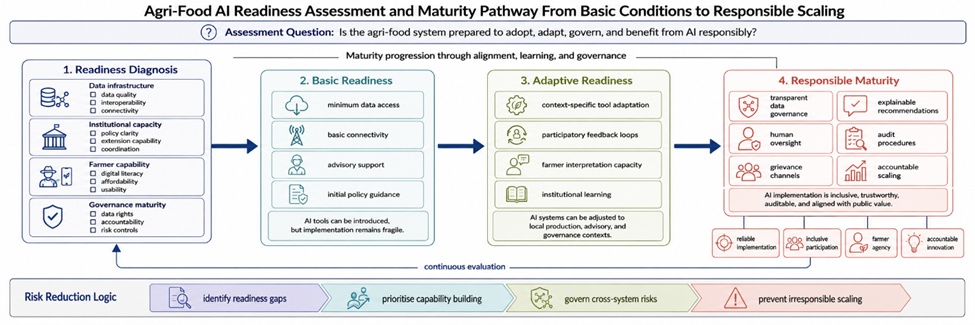
Figure 2. Agri-Food AI Readiness Assessment and Maturity Pathway From Basic Conditions to Responsible Scaling
The framework also implies that future research should examine how AI readiness is shaped by competing visions of agri-food transformation. Policy and platform strategies may prioritise different futures, such as efficiency, sustainability, market integration, automation, resilience, or farmer empowerment. Research should therefore investigate which beneficiaries, values, and food-system pathways are embedded in digital infrastructure design and policy support [26].
Future research should empirically test the proposed readiness dimensions across different regions, production systems, farm scales, and governance settings. Comparative studies could develop indicators for data maturity, institutional coordination, farmer capability, and governance accountability, while implementation research could examine how readiness affects AI outcomes in real agri-food settings. Transdisciplinary risk assessment is especially important for identifying vulnerabilities and socially robust implementation pathways before AI systems are widely scaled [27].
This article has developed an agri-food AI readiness framework linking data infrastructure, institutional capacity, farmer capability, and governance maturity. The central argument is that responsible AI implementation depends not only on advanced models, platforms, or automated tools, but on the systems that support, govern, and contextualise their use. Readiness gaps can weaken implementation, intensify inequality, reduce trust, enable data misuse, and leave risks unmanaged. A framework approach helps policymakers, institutions, technology developers, and farmer organisations assess whether agri-food systems are prepared for AI in ways that are effective, inclusive, trustworthy, and responsibly governed.
None
None
None
None
Open Access The author(s) retain copyright. This article is licensed under the Creative Commons Attribution-NonCommercial-ShareAlike 4.0 International License. It may be shared and adapted for non-commercial purposes with appropriate attribution, an indication of changes, and distribution of adaptations under the same license. Third-party material may be subject to separate terms identified in its credit line. View the license at https://creativecommons.org/licenses/by-nc-sa/4.0/.
 Agro Intelligence Research Press