Ensuring food quality, safety, and authenticity has become a central challenge for contemporary food systems because risks now emerge across production, processing, distribution, retail, and consumption. Artificial intelligence is increasingly used to interpret complex food data, including spectral signals, images, sensor outputs, molecular profiles, traceability records, and supply-chain alerts. These developments suggest that AI can support a shift from reactive food inspection toward predictive and preventive food integrity assurance. Despite this promise, AI applications in food quality, safety, and authenticity often remain separated across disciplinary and technological domains. Sensing studies focus on detection accuracy, prediction studies focus on model performance, traceability studies focus on chain-of-custody infrastructure, and explainable AI studies focus on interpretability. This fragmentation limits the field’s ability to understand how these components could function together as an integrated assurance system. This integrative review synthesises 31 peer-reviewed articles published between 2017 and 2025 across food science, analytical chemistry, sensing technology, food informatics, and artificial intelligence. The review examines four interconnected domains: sensing technologies and data sources, prediction models for quality and safety, traceability and authenticity verification, and explainable decision systems. Its purpose is not to report new empirical data, but to integrate diverse research streams into a coherent conceptual understanding of AI-enabled food integrity assurance. The review shows that AI has already demonstrated value in optical sensing, spectroscopy, imaging, authenticity testing, shelf-life prediction, risk assessment, fraud detection, and traceability analysis. However, most applications are still designed as isolated models rather than as connected decision systems. Three tables classify sensing technologies, categorise prediction models, and present an integrative framework linking detection, prediction, provenance, and explainable decisions. The central conclusion is that the technical components of AI-enabled food integrity assurance already exist, but they remain insufficiently integrated. Future research should move beyond stand-alone classification or prediction models and toward interoperable, explainable, and operationally validated systems. Such systems should connect sensing, prediction, traceability, and human decision-making across food supply chains.
Food quality, safety, and authenticity are increasingly interdependent problems because modern food products move through long, data-rich, and globally distributed supply chains. Reviews of AI in food safety show that hazards, fraud events, spoilage, and quality deviations cannot be treated as isolated technical problems because they share common data infrastructures and decision requirements [1]. Machine learning has therefore become relevant not only for detecting contamination or predicting defects, but also for interpreting weak signals across quality, safety, and integrity systems [2]. This review begins from the premise that food integrity is best understood as a connected AI problem rather than as a collection of separate analytical tasks.
The growth of AI in food science reflects the increasing availability of sensor data, laboratory measurements, supply-chain records, and historical safety alerts. Recent reviews argue that AI can improve food safety through pattern recognition, risk prioritisation, anomaly detection, and decision support when conventional rule-based monitoring is too slow or incomplete [3]. Bibliometric evidence also indicates that research on AI in food safety has expanded rapidly, with growing attention to digital detection, quality monitoring, and intelligent assessment [4]. Yet the literature still often separates food quality, safety, and authenticity even when the same modelling challenges recur across all three domains.
An integrative perspective is necessary because food quality deterioration, safety hazards, and authenticity violations frequently produce overlapping signals. For example, spoilage, adulteration, and origin mislabelling may all be detected through spectroscopy, imaging, chemical profiling, or data-fusion models, but the interpretation of these signals depends on context and decision purpose [5]. Food engineering reviews of AI applications emphasise that model outputs must be connected to practical quality-control and safety-assessment workflows, not only evaluated as statistical predictions [6]. This makes integration a conceptual and operational challenge, not simply a technical modelling task.
The aim of this review is to synthesise evidence across sensing, prediction, traceability, and explainable decision systems in order to develop a holistic view of AI-enabled food integrity assurance. Work on shelf-life prediction shows how AI can support anticipatory decisions about product deterioration, while traceability studies show how digital records can support provenance and accountability across supply chains [7, 8]. At the same time, emerging explainable AI research demonstrates that food decisions require transparency about which signals, features, or records drive rejection, alert, or verification outcomes [9, 10]. The review therefore asks how existing AI applications can be connected into a coherent system for detecting, predicting, tracing, and explaining food integrity risks.
Food quality can be understood as a multidimensional AI problem because freshness, sensory attributes, nutritional properties, texture, colour, and processing defects are often represented through complex, high-dimensional data. Machine learning-based modelling in food processing demonstrates that quality attributes are rarely captured by a single measurement and often require the integration of images, spectral signals, process conditions, and product histories [11]. Computer vision studies of fruit quality further show that visible defects, ripeness, shape, and colour can be transformed into structured predictive features for automated assessment [12]. In this sense, food quality is not only a laboratory measurement problem, but also a data representation and decision-classification problem.
Food safety is also highly amenable to AI because hazards emerge through non-linear interactions among products, environments, processing conditions, microbial behaviour, and supply-chain practices. Machine learning reviews show that safety monitoring and prediction can use historical incident data, environmental measurements, spectral profiles, and operational records to identify risks that may not be visible through routine inspection alone [2]. AI-based food safety risk assessment is particularly important where microbial hazards, chemical contamination, and climate-related risks change dynamically over time [13, 14]. The AI challenge is therefore to transform heterogeneous and uncertain safety data into timely and actionable decisions.
Food authenticity differs from quality and safety because the central question is not always whether a product is defective or hazardous, but whether it is what it claims to be. Studies of rice authentication, red pepper origin discrimination, wine origin verification, and elemental analysis show that authenticity assessment depends on subtle chemical, isotopic, spectral, and compositional signatures [15-18]. These signatures often require chemometric or machine learning models because the relevant differences are distributed across many variables rather than visible in one simple marker. Authenticity is therefore an AI problem of identity verification, provenance inference, and fraud detection.
Figure 1 illustrates how fragmented AI applications in food quality, safety, and authenticity can be reorganised into an integrated food integrity problem space.
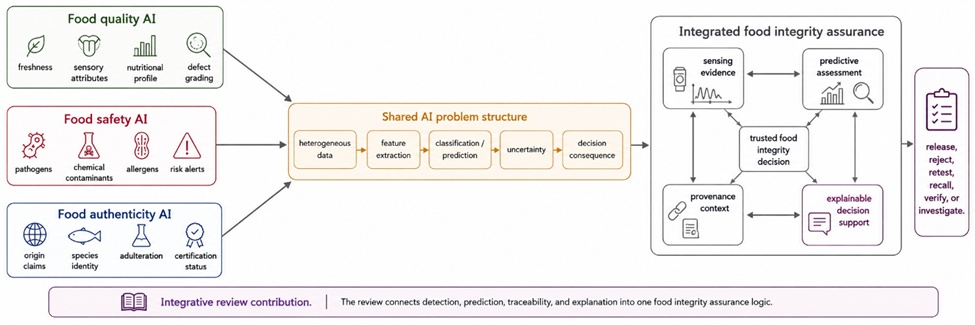
Figure 1. From Fragmented AI Applications to an Integrated Food Integrity Problem Space Across Quality, Safety, and Authenticity
The three domains share common modelling needs because each requires data capture, feature extraction, classification or prediction, uncertainty management, and decision communication. AI-powered food safety innovations from farm to fork emphasise that risks and decisions increasingly span production, processing, distribution, and consumption rather than remaining within one laboratory or facility [19]. Opportunities for AI and machine learning in the food industry similarly depend on linking detection technologies with operational processes, regulatory needs, and management decisions [20]. Food quality, safety, and authenticity should therefore be treated as an integrated problem space in which different data streams support a shared objective: reliable food integrity assurance.
Sensing technologies form the empirical foundation of AI-enabled food integrity because they convert physical, chemical, biological, and supply-chain phenomena into analysable data. Optical spectroscopy, hyperspectral imaging, multispectral imaging, electronic sensing, biosensors, mass spectrometry, elemental analysis, isotopic analysis, and molecular methods each generate distinct forms of information about food composition, deterioration, contamination, or origin [5, 21]. Studies using multispectral and spectroscopic technologies for ready-to-eat pineapple quality demonstrate that sensor outputs can be transformed into machine learning features for quality assessment [21]. The value of sensing therefore lies not only in detection, but in the creation of structured data that AI systems can interpret.
Spectral and imaging approaches are especially important because they allow rapid, non-destructive, and high-dimensional assessment of food products. NIR spectroscopy and multispectral imaging have been used to detect turmeric adulteration, while NMR spectroscopy combined with deep learning has been applied to geographical discrimination of red pepper powders [22, 23]. These examples show how AI can learn patterns that are difficult for human inspectors to identify directly, particularly when authenticity or adulteration signals are dispersed across many wavelengths or spectral regions. However, such models are sensitive to sample diversity, calibration quality, instrument variation, and preprocessing decisions.
Chemical and molecular sensing technologies provide another layer of food integrity evidence because they can capture elemental, isotopic, molecular, or metabolomic fingerprints. High-resolution mass spectrometry fingerprinting has been applied to food authentication in products such as wine, oil, and dairy, while isotope and elemental analyses have been used for origin verification in French red wines [18, 24]. These methods are powerful because they support claims about provenance, composition, and authenticity, but they also generate complex data that require robust chemometric or machine learning interpretation. AI compatibility is therefore shaped by both the richness of the analytical signal and the reliability of reference databases.
The sensing landscape is diverse, but the main challenge is to align sensor outputs with food integrity decisions rather than treating sensing as an isolated technical endpoint. Food fraud detection research using explainable AI shows that model transparency becomes more important when sensing-derived predictions influence rejection, verification, or enforcement decisions [9]. Table 1 classifies the sensing technologies and their data characteristics for food quality, safety, and authenticity assessment. This classification highlights that different sensing modalities vary not only by detection principle, but also by data structure, AI readiness, and suitability for integration into operational food integrity systems.
Table 1. Sensing Technologies and Data Sources for Food Quality, Safety, and Authenticity: Detection Principles, Outputs, and AI Compatibility
Sensing technology or data source | Main detection principle | Typical food integrity application | Data characteristics | AI compatibility and modelling implications |
Hyperspectral imaging | Captures spatial and spectral responses across many wavelengths | Freshness assessment, surface contamination screening, ripeness evaluation, defect detection | High-dimensional image cubes with spatial and wavelength structure | Strongly compatible with CNNs, dimensionality reduction, feature selection, and spectral-spatial fusion, but requires calibration and robust preprocessing |
Multispectral imaging | Captures selected spectral bands with spatial information | Quality grading, spoilage detection, adulteration screening, rapid inspection | Lower-dimensional spectral images compared with hyperspectral data | Suitable for industrial deployment because it reduces data burden, but model performance depends on optimal band selection and product variability |
Near-infrared spectroscopy | Measures molecular absorption related to composition and structure | Moisture, protein, adulteration, freshness, geographical discrimination | Continuous spectral vectors with overlapping bands and noise sensitivity | Compatible with chemometrics, support vector machines, random forests, and deep learning, but requires transferability across instruments and batches |
Nuclear magnetic resonance spectroscopy | Profiles molecular environments and compositional fingerprints | Geographical origin discrimination, authenticity verification, compositional profiling | Rich spectral fingerprints with complex peak patterns | Useful for deep learning and chemometric classification, especially where authenticity signals are distributed across molecular profiles |
High-resolution mass spectrometry | Detects molecular mass patterns and chemical fingerprints | Authentication of wine, oil, dairy, and high-value foods | High-dimensional molecular feature tables with peak intensity variation | Highly suitable for machine learning-based fingerprinting, but dependent on curated reference datasets and rigorous feature alignment |
Isotopic and elemental analysis | Measures isotope ratios and elemental composition | Origin verification, fraud detection, provenance claims | Structured compositional profiles with geographic and environmental signatures | Well suited to supervised classification and chemometric models, but requires geographically representative reference databases |
Electronic nose and electronic tongue | Detects volatile or taste-related sensor response patterns | Spoilage detection, sensory quality estimation, freshness monitoring | Multisensor response arrays with drift and environmental sensitivity | Compatible with pattern-recognition models, but requires drift correction, calibration maintenance, and context-specific validation |
Biosensors | Detects biological or biochemical interactions | Pathogen, toxin, allergen, and contaminant screening | Signal intensity, binding response, or time-series measurements | AI can improve classification, thresholding, and signal interpretation, but real-world reliability depends on specificity and matrix effects |
DNA barcoding and molecular assays | Identifies species or genetic markers | Species substitution, adulteration, authenticity verification | Sequence or marker-based categorical and molecular data | AI can support classification and database matching, but depends on validated reference libraries and standardised protocols |
Smartphone-based detection | Uses portable imaging, optical, or sensor attachments | Field screening, decentralised quality checks, rapid alerts | Variable-quality images or sensor signals collected in non-laboratory settings | Promising for scalable AI deployment, but requires robustness to lighting, user behaviour, device variation, and connectivity limits |
Traceability records | Documents custody, movement, processing, and certification events | Provenance verification, recall management, authenticity claims | Structured and semi-structured event records across supply chains | AI compatibility depends on interoperability, data standards, and linkage with sensing or laboratory evidence |
Safety alert databases | Aggregates historical incidents, recalls, and regulatory notifications | Risk prediction, hazard trend detection, prioritisation | Textual, categorical, temporal, and relational data | Suitable for natural language processing, risk modelling, and anomaly detection, but affected by reporting bias and inconsistent classification |
Prediction models in food quality and safety transform sensing outputs, process records, environmental conditions, and historical outcomes into estimates of deterioration, contamination risk, authenticity status, or operational priority. Shelf-life prediction is a particularly important domain because product quality changes over time through interactions among microbial growth, storage conditions, packaging, and intrinsic product characteristics [7]. AI models can capture these non-linear patterns more flexibly than traditional kinetic models when large and diverse datasets are available. However, the value of prediction depends on whether the model supports a practical decision, such as release, rejection, rerouting, discounting, recall, or additional testing.
Machine learning and deep learning models have been applied across several food quality and safety problems, including spoilage forecasting, contaminant detection, microbial risk assessment, and quality grading. Reviews of machine learning in food processing show that random forests, support vector machines, artificial neural networks, convolutional neural networks, recurrent neural networks, and ensemble models are commonly used depending on the structure of the data [11]. In image-based and spectral applications, CNNs are useful because they can extract spatial or spectral-spatial features, while recurrent and temporal architectures are more appropriate when deterioration or risk evolves over time [7, 12]. Ensemble models remain valuable where structured process variables, historical records, and laboratory measurements are combined.
The prediction literature also shows that performance metrics must be interpreted in relation to food integrity decisions rather than treated as abstract statistical achievements. Studies using European Union Rapid Alert System for Food and Feed data demonstrate that food safety risk prediction may involve imbalanced classes, heterogeneous hazard categories, and decision consequences that differ across product types [25]. Similarly, HACCP-oriented machine learning applications in animal-source foods show that prediction must be aligned with monitoring points, corrective actions, and verification procedures rather than simply reporting accuracy [26]. Therefore, model performance should be assessed through sensitivity, specificity, calibration, false-alarm burden, interpretability, and operational usefulness.
The central limitation of current prediction work is the gap between laboratory validation and industrial deployment. AI models often perform well on controlled datasets, but their robustness may decline under changing suppliers, seasons, instruments, storage conditions, processing lines, or regulatory contexts [2]. Table 2 categorises the AI prediction models and their performance in food quality and safety applications. This categorisation emphasises that model architecture, input data, application domain, and evaluation metrics must be considered together when judging whether a prediction model is suitable for food integrity assurance.
Table 2. AI Prediction Models for Food Quality and Safety: Model Architectures, Application Domains, and Reported Performance Metrics
Model category | Common input data | Main application domains | Typical reported metrics | Strengths for food integrity assurance | Key limitations for deployment |
Support vector machines | Spectral vectors, chemical profiles, image-derived features | Adulteration detection, quality classification, origin discrimination | Accuracy, sensitivity, specificity, classification rate | Effective with moderate-sized datasets and high-dimensional features | Sensitive to kernel choice, preprocessing, and external validation conditions |
Random forests | Structured variables, spectral features, process records, alert data | Risk classification, quality grading, safety prioritisation | Accuracy, area under the curve, variable importance, error rate | Robust to mixed data types and useful for feature importance analysis | May be less transparent than rule-based systems and may not extrapolate well |
Gradient boosting models | Process data, historical incidents, compositional features, supply-chain records | Risk prediction, rejection probability, fraud detection | Area under the curve, precision, recall, calibration metrics | Strong performance on tabular and heterogeneous datasets | Requires careful tuning and monitoring for bias or overfitting |
Artificial neural networks | Spectral, chemical, sensor, and process data | Shelf-life prediction, spoilage forecasting, quality estimation | Mean squared error, root mean squared error, accuracy | Captures non-linear relationships among multiple variables | Requires larger datasets and can be difficult to interpret |
Convolutional neural networks | Images, hyperspectral cubes, multispectral images, visual quality data | Defect detection, ripeness grading, contamination screening, authenticity classification | Accuracy, F1-score, segmentation metrics, confusion matrices | Learns spatial and spectral-spatial patterns automatically | Needs diverse image datasets and may be affected by lighting, device, and product variability |
Recurrent neural networks and temporal models | Time-series storage data, environmental records, microbial growth curves | Shelf-life estimation, spoilage dynamics, dynamic risk forecasting | Prediction error, time-to-event accuracy, forecast horizon performance | Suitable for modelling quality and safety changes over time | Deployment requires continuous data capture and temporal validation |
Deep learning fusion models | Multisensor data, spectral images, chemical profiles, traceability variables | Integrated quality, safety, and authenticity assessment | Accuracy, area under the curve, multimodal fusion performance | Can combine complementary signals across sensing modalities | High data demand and limited explainability unless designed with interpretability tools |
Chemometric machine learning models | Spectroscopy, mass spectrometry, isotopic and elemental profiles | Authenticity verification, origin classification, adulteration detection | Classification accuracy, discrimination rate, validation error | Strong fit for analytical chemistry workflows | Requires representative reference samples and standardised laboratory protocols |
Natural language processing models | Safety alerts, inspection reports, incident narratives, regulatory notifications | Hazard surveillance, risk trend detection, alert prioritisation | Classification accuracy, recall, topic coherence, information extraction quality | Converts unstructured safety information into decision-relevant signals | Affected by inconsistent terminology and reporting bias |
Explainable prediction models | Tabular, spectral, image, and traceability datasets with explanation layers | Batch rejection, contamination alerts, fraud explanation, operator decision support | SHAP values, LIME explanations, attention maps, explanation consistency | Supports transparency, auditability, and trust | Explanation quality is still uneven and rarely validated with food operators |
Traceability extends food integrity assurance from product testing to supply-chain accountability because it records where a product came from, how it moved, who handled it, and which claims accompanied it. Blockchain research in agriculture and food supply chains shows that distributed ledgers can support transparency, tamper resistance, and chain-of-custody documentation [8]. However, blockchain alone does not verify whether the recorded information is true; it preserves the integrity of records once entered. This means traceability systems require integration with sensing, auditing, laboratory analysis, and AI-based anomaly detection.
Blockchain-based traceability has been proposed as a response to fragmented supply-chain records, but reviews warn that it is not a universal solution for food integrity problems. Galvez, Mejuto, and Simal-Gandara argue that blockchain can improve traceability analysis, yet its future value depends on data quality, governance, interoperability, and the ability to link digital records with physical evidence [27]. Pearson and colleagues similarly question whether distributed ledger technologies are a panacea, emphasising that traceability depends on organisational adoption as much as technical architecture [28]. The integrative implication is that traceability must be connected to AI interpretation, not treated as a stand-alone database.
Authenticity verification requires a different but complementary evidence base because provenance and identity claims often need chemical, isotopic, spectral, or molecular confirmation. Rice authentication research demonstrates that analytical techniques combined with multivariate analysis can distinguish varieties, origins, and adulteration patterns in complex food matrices [15]. Red chili powder, turmeric, wine, and red pepper studies further show that machine learning can classify products according to geographical origin or adulteration status using spectral, elemental, isotopic, or molecular fingerprints [16, 18, 22, 23]. These methods provide the physical evidence needed to support or challenge traceability records.
The major integration challenge is interoperability between traceability records and authenticity evidence. Reviews of food traceability identify persistent problems in data capture, standardisation, performance evaluation, and end-to-end visibility across processing and distribution stages [29]. Blockchain reviews similarly conclude that future food systems require alignment among digital platforms, data standards, certification schemes, and analytics workflows [30]. AI can support this alignment by fusing heterogeneous data sources, detecting inconsistencies between claimed and measured attributes, and prioritising cases where traceability records and analytical evidence diverge [31].
Explainable decision systems are essential because food integrity decisions affect commercial value, public health, regulatory compliance, and consumer trust. In food fraud detection, explainable AI has been used to clarify which input variables or patterns drive classification outcomes, moving beyond black-box predictions toward interpretable evidence [9]. This matters because a model that identifies a fraudulent or unsafe product must support defensible reasoning about why the decision was made. Without explanation, AI outputs may be difficult to use in audits, enforcement, supplier negotiations, or quality-management systems.
Explainability is also important in sensor-rich contexts where predictions are generated from complex signals that human operators cannot easily interpret. The milk adulteration study using an XAI-empowered Internet of Things multisensor system illustrates how explanations can connect sensor readings to adulteration decisions in real time [10]. Such systems can help operators understand whether a warning is driven by one dominant signal, a combination of abnormal responses, or a pattern learned across multiple sensors. This is especially valuable in operational environments where false alarms and unexplained batch rejections can reduce trust in automated systems.
Several technical approaches are relevant to explainable food decision systems, including feature importance, SHAP, LIME, attention maps, surrogate models, and rule extraction. Food safety risk-prediction studies using alert or monitoring data can benefit from explanation methods because hazard classifications and risk scores often depend on multiple interacting variables [25]. In image and spectral applications, attention maps or feature attribution can help identify the visual, spatial, or wavelength regions that contribute to decisions about quality, origin, or adulteration [12, 21]. The interpretive challenge is to ensure that explanations are not merely mathematically available, but meaningful to food scientists, inspectors, quality managers, and regulators.
The maturity of explainable AI in food integrity remains uneven because explanation is still often added after model development rather than designed into the decision workflow. Reviews of AI in food safety and quantitative food analysis show that much of the literature still prioritises predictive performance over transparency, uncertainty communication, and user-centred validation [3, 5]. Explainability should therefore be treated as a system requirement rather than as a cosmetic reporting layer. In an integrated food integrity system, every alert, rejection, provenance challenge, or safety prioritisation should be accompanied by an explanation that is understandable, auditable, and linked to the relevant evidence.
The reviewed literature suggests that AI-enabled food integrity assurance should be understood as a connected system rather than as a set of isolated analytical models. Sensing technologies generate signals about product condition, composition, contamination, and origin, while prediction models transform these signals into risk, quality, or authenticity assessments [5, 11]. Traceability systems add contextual information about supply-chain movement, custody, certification, and exposure, and explainable decision systems translate model outputs into reasons that humans can evaluate [8, 9]. The integrative challenge is to connect these layers so that detection, prediction, provenance, and decision-making reinforce one another.
A coherent food integrity assurance system would begin with multimodal sensing and continue through predictive modelling, contextual verification, and transparent decision support. AI-powered farm-to-fork food safety frameworks already point toward this direction by emphasising the need to connect upstream data, processing conditions, monitoring systems, and downstream decisions [19]. Shelf-life prediction research provides one example of how temporal quality data can support proactive management, while traceability research shows how provenance data can support accountability during recalls, fraud investigations, and certification disputes [7, 29]. These literatures are complementary, but they are rarely operationalised as one integrated architecture.
The missing link is not the absence of technology, but the absence of system design. AI, big data, and blockchain have all been discussed as contributors to food safety, yet their integration requires shared data standards, validated interfaces, governance rules, and human decision workflows [31]. Table 3 presents an integrative synthesis linking sensing, prediction, traceability, and explainable decisions into a coherent food integrity assurance framework. The table clarifies how each layer contributes to food integrity and where the main integration gaps remain.
Table 3. Integrative Synthesis of AI-Enabled Food Integrity Assurance: Connecting Sensing, Prediction, Traceability, and Explainable Decision Systems
System layer | Main function in food integrity assurance | Representative data sources | AI contribution | Decision output | Current fragmentation problem | Integration priority |
Sensing and measurement | Detects product condition, composition, contamination, or authenticity signals | Spectroscopy, imaging, biosensors, molecular assays, electronic noses, chemical fingerprints | Converts complex raw signals into features, classifications, or anomaly indicators | Quality grade, contamination signal, adulteration flag, origin profile | Sensing studies often stop at classification accuracy without linking to traceability or operational decisions | Design sensor outputs for downstream prediction, explanation, and supply-chain use |
Predictive modelling | Estimates future quality, safety risk, spoilage, shelf life, or hazard likelihood | Historical quality data, storage conditions, microbial data, alert databases, process records | Learns non-linear relationships and generates forecasts or risk scores | Shelf-life estimate, spoilage forecast, risk tier, monitoring priority | Models are often validated on limited datasets and rarely tested across industrial settings | Validate models across seasons, suppliers, facilities, and decision contexts |
Traceability infrastructure | Records product movement, custody, processing, and certification claims | Blockchain records, enterprise systems, batch histories, certification documents, logistics data | Detects inconsistencies, supports provenance inference, and links claims with evidence | Chain-of-custody record, provenance verification, recall pathway | Traceability platforms often preserve records without verifying physical truth | Connect digital records with laboratory, sensor, and authenticity evidence |
Authenticity verification | Tests whether product identity, origin, species, or certification claims are credible | Isotopic profiles, elemental analysis, mass spectrometry, DNA barcoding, NIR spectroscopy | Classifies origin, detects substitution, identifies fraud patterns, supports data fusion | Verified origin, fraud alert, adulteration classification | Analytical evidence is often separated from supply-chain documentation | Fuse authenticity fingerprints with traceability claims and supplier histories |
Explainable decision support | Makes AI outputs understandable, auditable, and actionable | Model features, SHAP values, LIME explanations, attention maps, operator records | Identifies drivers of risk, rejection, or authenticity classification | Reasoned alert, batch decision, audit note, corrective-action recommendation | Explanations are often technical and not validated with food-system users | Develop user-centred explanations for quality managers, inspectors, regulators, and suppliers |
Human and regulatory oversight | Ensures accountability, corrective action, and responsible deployment | HACCP plans, inspection records, regulations, quality manuals, operator feedback | Prioritises cases, supports documentation, and learns from feedback | Release, reject, recall, retest, investigate, certify | Human workflows are frequently absent from AI model design | Embed AI into accountable human-in-the-loop decision processes |
Continuous learning and governance | Updates models as products, suppliers, hazards, and environments change | Monitoring results, feedback, false alarms, new fraud patterns, climate and safety data | Supports model recalibration, drift detection, and adaptive risk assessment | Updated risk models, revised thresholds, improved alerts | Many systems lack lifecycle monitoring after initial validation | Establish governance for data quality, model updates, drift monitoring, and auditability |
An integrative framework also changes how success should be evaluated. Instead of asking whether one model achieves high accuracy on one dataset, food integrity research should ask whether the system improves detection timeliness, reduces false negatives, supports traceable decisions, strengthens accountability, and remains reliable under real supply-chain variability [1, 6]. This requires evaluation metrics that include predictive validity, operational feasibility, explanation usefulness, data interoperability, and human trust. The future of AI in food integrity therefore depends on moving from model-centred research to system-centred assurance.
Figure 2 presents the proposed end-to-end AI-enabled food integrity assurance architecture connecting sensing, prediction, traceability, explainability, and human oversight.
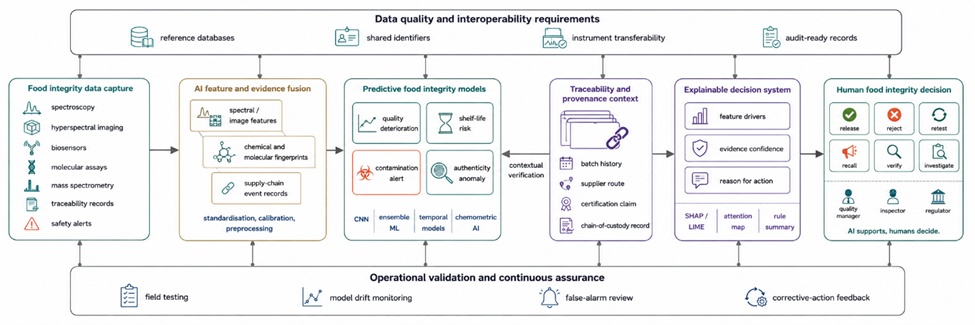
Figure 2. End-to-End Architecture for AI-Enabled Food Integrity Assurance Linking Sensing, Prediction, Traceability, Explainability, and Human Oversight
The first major gap is limited multimodal integration across sensing, prediction, traceability, and decision systems. Many studies demonstrate strong performance for one technology, such as spectroscopy, imaging, blockchain, or machine learning classification, but fewer studies show how these components interact in a complete food integrity workflow [8, 21, 24]. Multimodal AI should be developed to combine sensor outputs, laboratory evidence, supply-chain records, and historical safety data into unified decision models. Such integration would allow systems to detect not only whether a product is abnormal, but also where the abnormality may have emerged and how it should be handled.
The second gap is the shortage of real-world validation across industrially variable environments. Reviews of AI for food safety and machine learning for monitoring show that many models are evaluated on curated datasets, controlled samples, or limited case studies, which may not reflect product diversity, seasonal variation, instrument drift, or operational pressure [2, 3]. Future research should prioritise external validation across facilities, regions, product categories, and supply-chain stages. Field testing should also measure decision outcomes such as reduced inspection burden, faster recalls, improved fraud detection, fewer rejected safe batches, and better allocation of testing resources.
The third gap is under-developed explainability and human-AI interaction design. Explainable AI studies in food fraud and milk adulteration show the promise of transparent decision support, but the broader food integrity literature still rarely evaluates whether explanations are understandable or useful to operators, inspectors, suppliers, and regulators [9, 10]. Future research should develop explanation formats tailored to specific decision contexts, such as batch release, hazard escalation, authenticity dispute, or supplier audit. Explanations should communicate not only the model’s decision drivers, but also uncertainty, evidence quality, and recommended next actions.
The fourth gap concerns data standardisation, governance, and interoperability across the food system. Traceability reviews show that fragmented records, inconsistent identifiers, and uneven data quality remain major barriers to end-to-end food assurance [27, 29, 30]. AI systems will only be as reliable as the data infrastructures that support them, especially when integrating blockchain records, safety alerts, sensing data, and authenticity tests [31]. Future work should therefore prioritise shared data models, validated reference databases, secure data exchange, lifecycle model governance, and cross-disciplinary standards for AI-enabled food integrity.
This integrative review has shown that AI is already reshaping the assessment of food quality, safety, and authenticity through advances in sensing, prediction, traceability, and explainable decision support. The literature demonstrates strong technical capabilities across these domains, including rapid detection, high-dimensional data interpretation, shelf-life forecasting, risk classification, provenance verification, and transparent model explanation. The contribution of this review lies in showing that these capabilities should be understood as parts of a connected food integrity assurance system.
The future of AI in food integrity does not depend only on developing more accurate isolated models. It depends on building systems that connect physical evidence, predictive analytics, supply-chain context, authenticity verification, and human decision-making. Such systems must be explainable, interoperable, auditable, and validated under real operational conditions.
Interdisciplinary collaboration will be essential for this transition. Food scientists, analytical chemists, AI researchers, supply-chain specialists, regulators, and industry practitioners must work together to design AI systems that are not only technically powerful but also trustworthy and usable. The next generation of intelligent food assurance should therefore move from fragmented innovation toward integrated, transparent, and accountable food integrity systems.
None
None
None
None
Open Access The author(s) retain copyright. This article is licensed under the Creative Commons Attribution-NonCommercial-ShareAlike 4.0 International License. It may be shared and adapted for non-commercial purposes with appropriate attribution, an indication of changes, and distribution of adaptations under the same license. Third-party material may be subject to separate terms identified in its credit line. View the license at https://creativecommons.org/licenses/by-nc-sa/4.0/.
 Agro Intelligence Research Press